questions and answers about immortality

gift of lifegift of life #2

questions and answers about immortality

In this session, I will ask four questions about immortality, and look to the Bible to answer those questions.

First, who does the Bible claim is the only being who currently has immortality? In the last session in this study, we looked at 1 Timothy 6:16, which says that God “alone has immortality, (and) dwells in unapproachable light, whom no one has ever seen or can see.” (ESV). It seems to me if Paul believed that all the sentient beings in the universe are immortal, he would not have said that. If all angels, demons and human beings are created with an immortal essence, then God cannot be exclusively immortal. We are forced to either accept what Paul said, or reject it and accept that traditionalist doctrine. The Bible teaches God’s exclusive immortality.

Second question: who revealed the hope of immortality to the world? Was it Greek philosophers or Jesus? Basic to the doctrine of innate immortality is the assumption that Plato and other Greek philosophers discovered innate immortality, and that by the time the New Testament was written, all its authors had accepted it as fact. But what does the Bible actual tell us about who revealed the truth about immortality? To answer that question, we can come again to the Bible. It says in 2 Timothy 1:10 that God’s purpose and grace “now has been manifested through the appearing of our Saviour Christ Jesus, who abolished death and brought life and immortality to light through the gospel.” It was not the Greek philosophers, but Jesus, who revealed the truth about human immortality in the gospel. If he revealed the truth, it was in response to non-truth that had been taught by the pagans. The gospel of resurrection life to those who believe in Christ set the record straight.

Third question: is Immortality an innate attribute of all, or a gift to be given to the saved? Here again, the Bible gives us an answer, and that answer contradicts the human tradition of innate immortality. Romans 2:7 says “to those who by patience in well-doing seek for glory and honour and immortality, (God) will give eternal life.” It does not say that everybody already has it. It does not say that we were born with it. It says that we must seek it, and that God will give it. If you have to seek something, you don’t already have it. If it is a gift that God will give, then it is not now an innate possession.

Fourth question: when do believers become immortal? Is it at death, or at the resurrection? These scriptures answer that question: 1 Corinthians 15:52-54 KJV says “In a moment, in the twinkling of an eye, at the last trump: for the trumpet shall sound, and the dead shall be raised incorruptible, and we shall be changed. For this corruptible must put on incorruption, and this mortal must put on immortality. So when this corruptible shall have put on incorruption, and this mortal shall have put on immortality, then shall be brought to pass the saying that is written, Death is swallowed up in victory.” 1 Corinthians 15:42 ESV says “So is it with the resurrection of the dead. What is sown is perishable; what is raised is imperishable.” According to these scriptures, we get the gift that God promised us – not at death – but at our resurrection. The resurrection happens when Jesus returns. The long-standing human tradition that believers go to be with the Lord in heaven as immortal beings when they die is not biblical truth.

If you have any questions about this teaching, you can ask me at jeffersonvann@yahoo.com. Join me for this entire series as we search the scriptures to learn about the gift of life.

(listen to the audio file at Afterlife)
a gift, not a given

gift of lifegift of life #1

Eternal life is a gift, not a given.

If we were to allow the Bible to speak for itself, without reading the long standing human traditions into it, then we would see that in it God promises something to those who believe the gospel. He promises to give us eternal life when Jesus returns.

Some people teach that everybody already has eternal life. They believe that human immortality has no conditions – that it is a given. This is the doctrine of innate immortality. An innate attribute is one we are all born with.

In this series, we are going to examine numerous passages of scripture. With these texts, I will argue that the doctrine of innate immortality is not taught in scripture. Instead, the texts show that we really do need eternal life, but the good news is that it is available as a gift from God, promised only to those who believe in Jesus.

The first question we need to look to scripture to answer is not about the what we humans are made of, and it is not about what our destiny is. The most important question is not about what happens when we die. The first, most important question is about God. What makes God different from us? This is a theology proper question. If we are going to talk about immortality as a gift, we must first determine who is the source of the gift.

The Scriptures we look at in this section of our study are going to lead us to two conclusions about the gift of eternal life: First, God is the only one who now possesses eternal life, and secondly, we human beings once had the opportunity to gain eternal life (in Eden), but by sinning we lost that opportunity.

Now we will look at our first text.

— … God ….[is] “the blessed and only Sovereign, the King of kings, and the Lord of lords, the only One who has immortality, dwelling in unapproachable light, whom none of mankind has seen or can see, to whom be honor and eternal might. Amen.” (1 Timothy 6:15-16 HCSB.

This is one of the most important texts in all the Bible on the subject of who God is. It states categorically that God is the only being in the universe who has immortality. Theologians write page after page of God sovereignty, his power and his holiness, and all of those things are also taught in scripture. But when these same theologians come to this text, they either ignore it, or find some way to make it say something it does not say.

What does this text say about God? Imagine two hypothetical boxes. The first box is for us to put all beings who have immortality, the second box is for all other beings. What 1 Timothy 6:15-16 says is that only God can reside in the first box. The rest of us do not fit, because we are not qualified. Angels are not qualified. Satan is not qualified. The only being who has immortality today is the supreme being: God himself. Immortality is exclusive to God alone.

If you have any questions about this teaching, you can ask me at jeffersonvann@yahoo.com . Join me for this entire series as we search the scriptures to learn about the gift of life.

(listen to the audio file at Afterlife)
WE ARE… an open family

Slide1

Takanini Community Church’s identity statement is one of the best that I have ever read.

We Are: An open family of believers seeking to follow Jesus Christ and live out His teaching while we watch for His return.

When I was thinking about what the Lord wanted me to share as Penny and I resume our roles here, one of the thoughts I had was to go through some texts that serve as the scriptural basis for that statement.

Today’s text serves as a good scriptural basis for the idea of the local church being a family.

clip_image004

The city of Ephesus was one of the major cities of the Roman empire in Paul’s time. He planted a group of churches there, and wanted to make sure that those churches stayed true to their identity as God’s family. Families do not just happen. Successful families take a lot of hard work. So, Paul spent several months there, teaching them from the word. After he left, he sent Timothy there, to continue establishing the church. Timothy had to train and appoint leaders who would also be responsible to equip the churches. Paul’s letter to the Ephesians helped them to understand what it meant to be a family of believers.


clip_image006

Being a family means sharing a relationship. I am not right now referring to a relationship with each other. That – I’ll talk about next. What I mean by relationship is that all the members of a church have the same Father. Verse 18 talks about the fact that believers have access to God the Father.

Lots of families today are broken and blended, so it is not true that all families have an equal relationship with the same father. But we can all understand what Paul meant, because our church family exists because one God has called us all to himself. In the church, there are no stepfathers. The church never has a deadbeat dad. Each of as an individual is in the family of God because of God. He chose us, and adopted each of us into his royal family. We owe our identity not to something we did, or do, but to the choice of our loving Father to adopt us.

Being in a relationship with God can change our attitude about life. It can take away old fears.

“So you have not received a spirit that makes you fearful slaves. Instead, you received God’s Spirit when he adopted you as his own children. Now we call him, “Abba, Father.”Romans 8:15 NLT

Being in a relationship with God can also help us to endure the difficulties of our present lives, because we can see beyond them.

“And we believers also groan, even though we have the Holy Spirit within us as a foretaste of future glory, for we long for our bodies to be released from sin and suffering. We, too, wait with eager hope for the day when God will give us our full rights as his adopted children, including the new bodies he has promised us.” Romans 8:23 NLT

clip_image008

Being a family means being connected to one another. Paul used words that described the connection that Jewish people in his day felt by virtue of their being both citizens of a nation, and members of a family at the same time. He implied that when people become part of the church, their status changes.

· from strangers to fellow citizens

· from aliens to members of the household

Having just undergone a major ordeal in order to return to New Zealand, I can appreciate what a privilege it is to be reconnected.

The Ephesians also got it. Most of them were Gentiles, and had not known any connection with the family of God. They had been considered outcasts. So, when they came to God through Christ, they had to learn about that new relationship. But they also had to learn what it meant to be part of this new family.

· It meant bearing with each other in love (4:2); not insisting on my own way.

· It meant being truthful with each other (4:25); not putting on a show.

· It meant being kind, and forgiving each other (4:32); not making enemies.

· It meant worshiping with each other (5:19); not insisting on my own preferences.

· It meant submitting to each other (5:21); not establishing myself as the authority.

clip_image010Being a family means sharing a common purpose.

One of the tricks to become mature as a family member is to stop thinking that everyone else in the family exists for your personal service and enjoyment. That is not how families work.

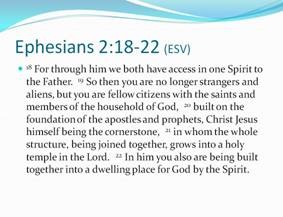
Paul uses the word picture of building to describe how the family of God exists for a purpose. He is also thinking in Hebrew, so he makes a kind of shift in discussion that seems weird. Notice that in verse 19 he was talking about being members of God’s household, but starting in verse 20 the metaphor shifts and he is talking about being built into God’s holy temple.

No, this does not mean that Paul had lost his concentration. In Hebrew, the same word can be used for both a household and a temple. But another reason Paul shifted metaphors is that he was trying to convey a new reality about the church. The church consists of individual stones which are being fit together to become a holy temple. The purpose of the church today is that God is preparing to come back to earth and dwell upon it. We are being prepared today to be the eternal dwelling place of God.

Now, you probably thought that God wanted you to live in heaven forever. No, he wants to live in us forever. It takes a little reorienting of our thinking to grasp the fact that God does not want to bring us to heaven. He wants to bring heaven to us, in the form of himself. This is the holy city that John saw in Revelation 21. It is God coming down to us, not us going up to him.

The purpose for the church today is to prepare for that eternal reality. Christ himself is the cornerstone because when he walked among us he demonstrated what it means for God to be present among us. He set the pattern. The prophets and apostles are the foundation because the prophets predicted the coming of the church and the apostles planted it.

Now, there is another very important word in this text that we cannot afford to overlook. It is the word together.

· the whole structure, being joined together, grows into a holy temple…(21)

· you also are being built together into a dwelling place…(22)


clip_image011God’s plan is not just to live in me, or you, but to live in us. We are the church together. Individually, we are members, but the members have to cooperate and be built together for the temple to function properly.

We, at Takanini call ourselves an open family. Anyone who wants to can join this family. You do not have to come from a certain race or ethnic group. You do not have to have the same social status. You do not have to be like the rest of us. But, as a member of our family you do have to have a relationship with our mutual Father. And, you will be expected to stay connected to the rest of us. And, you will have to want to make yourself fit for our purpose – to welcome and enjoy the presence of God for eternity. If that is your heart, welcome home.

a basis for certainty

IMG_20150220_125138In conversation the other night, someone asked me a question about how we can know what is true and what is not true. I responded by saying that I made up my mind years ago to base my understanding of what is true on what God has revealed in the Bible. There can be no other basis for certainty. I supposes hypothetically someone might be able to study all the books in the world and come to some other standard of certainty. But even if that happened, it would merely be a choice made by someone stepping out in the dark, and holding up a spent torch, saying “I see, I see!” How do I know that someone else sees? I would have to trust.

But if it comes down to a choice to trust, wouldn’t it make more sense to trust God? Why would it not make sense to let God’s word be my guide? I can imagine only three possible reason for not trusting God’s word: lack of faith in God’s existence, or lack of conviction about what he has revealed on the subject in question, or lack of trust that he cares enough to give you a certain answer. There are lots of people in each category. My sneaking suspicion is that each of these excuses feed on each other.

So, I offer this advice for those who are in constant anxiety about this thing or that. First, dare to believe that there is a sovereign God. Then, dare to study his word until you find the truth about what is bothering you. Finally, dare to live on the basis of what you found there. If you have the courage to seek his will in this way, he will reveal it to you. His faithfulness is our basis for certainty.