

John 2:13-22
Joh 2:13 And the Passover that the Jews celebrate was coming, so Jesus travelled to Jerusalem.
Joh 2:14 And He found in the temple the sellers of oxen and sheep and doves, and the moneychangers sitting.
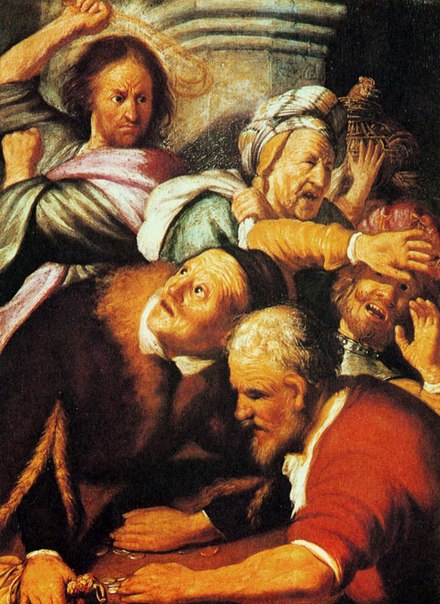
Joh 2:15 And after he made a whip out of cords, he threw them all out of the temple, with the sheep and the oxen; and He poured out the coins of the moneychangers, and flipped their tables;
Joh 2:16 and he said to the dove sellers, “Take these away; stop making my Father’s house a market house.”
Joh 2:17 His disciples remembered that scripture says, “Zeal for your house will consume me.”
Joh 2:18 The Jews responding asked him, “What sign will you show to us, proving that you have the right to do these things?”
Joh 2:19 Jesus responded by telling them, “Destroy this temple, and in three days I will raise it back up.”
Joh 2:20 To that the Jews responded, “It took forty-six years to build this temple, and will You raise it back up in three days?”
Joh 2:21 But he had been referring to the temple which is his body.
Joh 2:22 So, after he had been raised from the dead, his disciples had remembered that He promised this; and they believed both the scripture, and the prediction which Jesus had made. (Joh 2:13-22 JDV)
What does the resurrection really prove? I mean, we Christians make some bold claims about our Jesus, being raised from the dead, and the eternal difference that his resurrection makes. Do we really have any basis for such claims? I want to examine that question this Easter morning, and I have brought along a text of scripture which I think is relevant to the question.
Let me set the stage for the drama we read about in today’s text. The events described in John 2:13-22 take place early in Jesus ministry. It can be a bit confusing, because there was a similar event where Jesus chased out the moneychangers just prior to his crucifixion. But today’s text records Jesus doing this years earlier, when he was still relatively unknown except to his disciples.
Behind the worship in the Jewish temple in Jesus’ day, there had been a long history of a kind of symbiotic relationship between the ministers who worked in the temple and the merchants who kept the system going by providing a means for people to purchase animals for sacrificing — at a tidy profit. The system had worked for a long time, and nobody wanted to change it — except Jesus.
An insult (2:16)

Jesus saw the temple market system as an insult to his heavenly Father. The temple was supposed to be a place where people could go and find the glory of God, not the greed of humanity. It was supposed to be a place where God’s covenant loyalty could be seen clearly in spite of the sinfulness and and coveting of the people that he had chosen to save by his grace. Putting a market in the temple was an insult to the character of the God who had chosen to reside there.
Jesus felt that insult more than anyone else because he was the only begotten Son of the Father. He was offended by the audacity of these people and their blasphemous approach to worship. He could not stand there and just take it in. He had to respond, and his violent response was absolutely appropriate. It was appropriate not because violence is always appropriate. No, it was appropriate because of who God is, who Christ is, and what worship is supposed to be.
An insight (2:17)

It was also appropriate because of the response it triggered in his disciples. It was a visual demonstration of Christ’s devotion to his Father’s house, and his Father’s plan. When the disciples saw their teacher flipping tables and chasing away the businessmen from the place they should not have been, they remembered scripture.
Particularly, they remembered this scripture: “Because for your sake I have been disgraced; Dishonour has covered my face. I have become estranged from my brothers, And I am like a foreigner to my mother’s sons. Because zeal for your house has consumed me, And the disgraceful acts of those who embarrass you have fallen on me. (Ps. 69:7-9 JDV)” These words were originally part of a psalm in which David admitted that he had sinned, and that his sin had embarrassed God. David repented, and his prayer in Psalm 69 was that his act of stupidity would not cause true believers to lose their faith in God. Notice the prayer in Psalm 69:6 “Do not let those who put their hope in You be disgraced because of me, Lord Yahweh of armies; do not let those who seek You be embarrassed because of me, God of Israel (Ps. 69:6 JDV). After repenting, David’s only purpose in life was to restore the reputation of his heavenly Father. Now, Jesus’ disciples see him as the coming Messiah David predicted, who would never sin, and whose only purpose in life is to ultimately restore the reputation of his heavenly Father.
Another insult (2:18)

The self-proclaimed experts in scripture miss that insight entirely. Instead of seeing what Jesus had done as a fulfilment of scripture, they saw it as a challenge to their own authority. How dare this upstart young prophet come in here on our area of expertise and pretend to tell us what to do! They demand a miraculous sign to prove that Jesus is the Son of the Father he claims to be.
Before we criticise these Jews too much, I want us to be fully aware of what is happening here, because I think we are often guilty of the same thing. The difference is that except for the disciples, these Jews did not know who Jesus really was. They demanded a sign because only the Messiah would have had the authority to come into the temple and change the system.
What is our excuse? I am talking about those times in our lives when things are not going right with us, and we are tempted to just stop believing what we know is true about Jesus. We say he is the saviour of the world, but we often find ourselves coming to him in prayer and saying “just one more sign, Lord.”
Remember what Jesus said about his generation?
“An evil and adulterous generation is asking for a sign, but no sign will be given to it except the sign of the prophet Jonah. Because just as Jonah was three days and three nights in the belly of the sea monster, so will the Son of Man be three days and three nights in the heart of the ground. The men of Nineveh will rise up at the judgement with this generation and condemn it, because they repented when Jonah preached, and see, something much more than Jonah is here. The queen of the South will rise up at the judgement with this generation and condemn it, because she came from the ends of the land to hear the wisdom of Solomon, and see, something much more than Solomon is here” (Matt. 12:39-42 JDV).
I know how hard it is when you keep praying for something and you do not get your answer. But I also know that it is an insult to God to effectively say to Jesus “You died on the cross for me, but I will refuse to believe you until you fix my present problem.” It is better to pray,”Lord, since you died on the cross for me, I know you love me, and I will trust you to bring me through this problem too.”
Another insight (2:22)

Jesus knew that the temple officials did not have that kind of trust in him. So he challenged them to “destroy this temple” — something he knew they had no intention to do. He said he could raise it back up in three days. They knew he could do no such thing. It was only years later that the disciples, reflecting on Jesus being raised back to life after three days dead –they finally got it. I can imagine them sitting around talking about the amazing revelations they had seen, and somebody said “Oh, and remember when he challenged the temple officials? He said destroy this temple. He was talking about his body then!
Today we celebrate Easter — the season when we remember that Jesus died on the cross, and then was miraculously raised to eternal life.
Destroy this!
What does the resurrection really prove? I am asking again that question I started with. We make some bold claims about our Jesus, being raised from the dead, and the eternal difference that his resurrection makes. Do we really have any basis for such claims? Yes, we do. We have the scriptures. They testified for thousands of years that Jesus would appear, that he would die, and that he would be raised again. When people saw what Jesus did, they recognised him as the fulfilment of those scriptures.
But those scriptures go on to say that the one who was raised from the dead would return to this earth as its rightful king. We have every reason to believe and expect that this same Jesus whom the disciples saw ascend to heaven will return in the same way. After reflecting on the resurrection of Christ, the world is left with only two choices. We can either saw “Now we get it, come Lord Jesus” or we can stubbornly say “prove it again.” May God give us the wisdom to make the right choice.

 Just as he did in chapter two, Paul sets the foundation for Titus’ ministry assignment in the gospel message itself. Nothing that Paul instructs Titus to do is arbitrary. Everything is based on what God had already done for us in Christ. Notice the elements of the gospel message here. In theological terms, incarnation, justification, regeneration and sanctification are all works of grace and they are the foundation of the church’s ministry.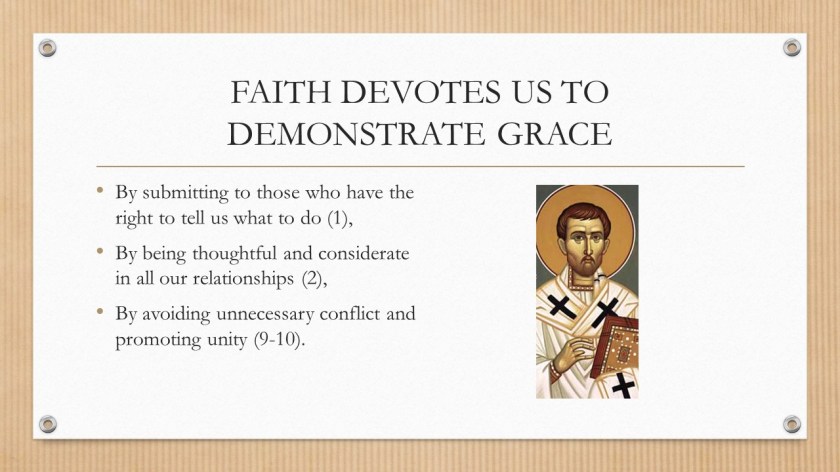

 jeffersonvann