OUR HOPE IS COMING

OUR HOPE IS COMING

1 Peter 1:3-13 (CSB)

3 Blessed be the God and Father of our Lord Jesus Christ. Because of his great mercy, he has given us new birth into a living hope through the resurrection of Jesus Christ from the dead 4 and into an inheritance that is imperishable, undefiled, and unfading, kept in heaven for you. 5 You are being guarded by God’s power through faith for a salvation that is ready to be revealed in the last time. 6 You rejoice in this,[a] even though now for a short time, if necessary, you suffer grief in various trials 7 so that the proven character of your faith—more valuable than gold which, though perishable, is refined by fire—may result in praise, glory, and honor at the revelation of Jesus Christ. 8 Though you have not seen him, you love him; though not seeing him now, you believe in him, and you rejoice with inexpressible and glorious joy, 9 because you are receiving the goal of your faith, the salvation of your souls. 10 Concerning this salvation, the prophets, who prophesied about the grace that would come to you, searched and carefully investigated. 11 They inquired into what time or what circumstances the Spirit of Christ within them was indicating when he testified in advance to the sufferings of Christ and the glories that would follow. 12 It was revealed to them that they were not serving themselves but you. These things have now been announced to you through those who preached the gospel to you by the Holy Spirit sent from heaven—angels long to catch a glimpse of these things.13 Therefore, with your minds ready for action, be sober-minded and set your hope completely on the grace to be brought to you at the revelation of Jesus Christ.

Most of the Christmas stories that we tell ourselves every year come from the first two chapters of Matthew’s Gospel and the first two chapters of Luke’s Gospel.

Matthew records the story of the angel’s appearance to Joseph, the young couple’s travel to Bethlehem, Jesus’ birth, the visit of the wise men, the escape to Egypt, and Herod’s massacre of the children.

Luke tells us about the angel Gabriel’s announcement to Zechariah about the coming birth of John the Baptist. Then he records Gabriel’s announcement to Mary that she would give birth as well. Luke then tells us what happened when pregnant Mary visited pregnant Elizabeth. Then he records the birth of John, and Zechariah’s prophecy about him.

It isn’t until chapter two that Luke gets back to the story of Jesus. He explains why Mary and Joseph were in Bethlehem when Jesus was born. He is also the only one who mentions the manger, and the only one who tells us about the angel’s announcement to the shepherds, and their visiting the baby Jesus in the manger.

Toward the end of Luke 2, there are two stories that take place when the infant Jesus is being dedicated. Two old people are featured in these stories. Simeon and Anna recognize who Jesus is when his parents bring him into the temple to be dedicated. These old saints were hoping for something. They were looking for something that Luke called “Israel’s consolation.” They recognized this infant Jesus as the key figure in God’s plan to save their people.

Over 60 years later, Peter pens the words of today’s text. He has lived the events described in the four Gospels. He wants to encourage the people who have put their hope in Jesus Christ for salvation. If I were to summarize what Peter says in chapter 1 of his epistle it would be this: “Our hope is coming.”

our hope is coming because of what Christ has done for us.

Peter mentions “the sufferings of Christ” in verse 11. By now, everybody knows the story of the trial and crucifixion of our Savior, but nobody knows it better than Peter. He was there, sleeping in Gethsemane. He was there, denying his master. He didn’t understand it at the time, but now, he understands why Jesus had to suffer what he did when he did.

Peter preached about Christ’s suffering in the early days after Pentecost. It was a major part of his gospel message. He taught that Christ’s suffering was not a mistake. It was part of God’s plan and had been announced by his prophets.

Christ’s suffering on the cross was necessary. Without the cross, humanity would have no hope. But because of what Jesus did on the cross, Peter can speak of the “glories that would follow (11).

Peter also mentions “the resurrection of Jesus Christ from the dead” in verse 3. Christ had to do more than just suffer on the cross because the wages of sin is not suffering. The wages of sin is death. But if Jesus were to merely die for us, how would we know that his death has paid the price for our sins? That is why the resurrection of Jesus was essential to God’s plan. His resurrection is also essential to our hope. Because he lives, we too will live.

Paul called Jesus the first fruits of those who are asleep. That imagery is a harvest imagery. The first fruits is the first of the crop. When the first fruits come in, people start celebrating, because there is now hope for a full crop. Because Jesus was raised from the dead, there is hope for us.

Paul even told us when we would be raised. He said “For as in Adam all die, so also in Christ all will be made alive. But each in his own order: Christ the first fruits, after that those who are Christ’s at His coming” (1 Corinthians 15:22-23 NASB).

our hope is coming because of what our faith is doing in us

Peter not only tells us what Christ has done to give us hope, but he goes on to explain what is going on right now in our lives to keep that hope alive until Jesus returns.

He says in verse 5 that we “are being guarded by God’s power through faith.” The word “guarded” suggests the picture of military protection while the battle ensues. The faith that God has given us keeps us in the interval between Christ’s first advent and his second advent.

That is why Peter can speak of his readers rejoicing during this time. He says in verse 6 “You rejoice in this, even though now for a short time, if necessary, you suffer grief in various trials.” Also, in verse 8, he says “Though not seeing him now, you believe in him, and you rejoice.” Joy is one of the manifestations of the Spirit’s presence – what Paul called the fruit of the Spirit. The joy that God has given us to express keeps our hope alive in this interval between Christ’s first advent and his second advent.

In verse 7, Peter talks about how our faith is being refined by fire in this present age. Faith is described as a precious metal, more valuable than gold. The tough times we go through test our faith, refining it so that it is even more pure.

In verse 9, Peter tells his readers that they are receiving the goal of their faith, the salvation of their souls. In verse 3, he calls this salvation a new birth. So, technically, he’s saying that we can be born-again, and not saved yet. You see, the salvation he is talking about is the permanent deliverance. We have not experienced that yet. That is why we need Jesus to return.

our hope is coming because Jesus Christ is going to return for another mission.

Just like Simeon and Anna, we who have trusted in Christ for our salvation are waiting for his advent. They waited for his first advent; we await his second advent.

They waited for him to come as a sacrifice, because he had a mission, and that mission was to die for our sins on the cross.

Check. That mission was accomplished.

Now, Peter says, Jesus has to return because he has another mission. There is “an inheritance that is imperishable, undefiled, and unfading, kept in heaven for” us (4). We do not have that inheritance yet. In fact, our lives today are the exact opposite. We are living in perishable bodies, defiled by ongoing sin, and our lives are fading away.

Jesus said that our “reward is great in heaven” (Luke 6:23). He did not mean that our reward is heaven when we die. Later on, in the book of Revelation, John records Jesus saying “Behold, I am coming quickly, and My reward is with Me” (Revelation 22:12). So our reward – what Peter calls our inheritance – is with Jesus in heaven right now, but we won’t get it until he returns.

Peter acknowledges this in verse 5 when he describes our coming inheritance as “a salvation that is ready to be revealed in the last time.” In essence, he is saying we “ain’t seen nothing yet.” Our salvation is secure, but it has not yet been revealed, because our savior has to come back for that.

Peter goes on to say in verses 6-7 that our present sufferings are turning our faith into something wonderful. We start out with the dross of condemnation, shame and dishonor, and the fire of our suffering is producing “praise, glory, and honor.” This result may not always be evident in our lives today, but it will be evident “at the revelation of Jesus Christ” – when he returns.

The Old Testament prophets usually talked about both advents as if they were going to happen at the same time. They didn’t know that there would be over two thousand years between what Peter calls in verse 11 “the sufferings of Christ and the glories that would follow.” His sufferings took place during his first advent, his glories began at his ascension and will continue into his second advent.

So, what is Peter saying to us today? In verse 13, he tells his readers to set their “hope completely on the grace to be brought to [them] at the revelation of Jesus Christ.” That is his message for us as well. Our hope is coming.

During the Advent season, it is good to be Advent Christians. We can be grateful for all that God has done for us, and all he is now doing in us. But we can also be assured that the best is yet to come.

books-by-jefferson-vann-ad-1


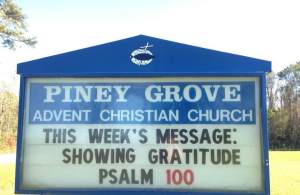
SHOWING GRATITUDE

SHOWING GRATITUDE

Psalm 100 (CSB)

Enter his gates with thanksgiving and his courts with praise. Give thanks to him and bless his name” (4)

When my family lived in the Philippines, we discovered that they do not have a national day of Thanksgiving, like we have in America. Instead, each church had its own Thanksgiving Day. It usually corresponded to the date when that particular church was established.

As Americans, we tried to keep our national Thanksgiving as well. One time we had a big spread with all the fixings, only to discover later that we had done it on the wrong week.

But we appreciated God and we enjoyed celebrating him and his connection to all of us. It just seems natural for us to show our gratitude. Showing gratitude is what this psalm is all about.

who should show gratitude?

The psalm is not too particular about who should celebrate their gratitude to God. In fact, note the expression “the whole earth” in verse 1.

Neither does the psalm limit the celebrants to the very old or the young. Verse 5 says that “all generations” should show their gratitude to him.

There is no age limit, no ethnic, geographic or cultural boundary to showing gratitude to the God of the Bible.

how should we show our gratitude?

We should show our gratitude to God by serving him. Verse 2 encourages us to “serve the LORD.” Do you know that is an honor to serve a great leader? People send in resumes and take proficiency exams in order to get an opportunity to be the president’s butler, or the queen’s maid. They don’t do that because they are slaves, but because it is their opportunity to express their gratitude. In the same way, our service to God demonstrates the level of our appreciation for him.

We should also express our gratitude to God with our worship. Verse 4 talks about entering God’s gates and his courts. It is talking about the gates and courts of the temple in Jerusalem. People had all kinds of reasons for entering into the gates of Jerusalem. But when they entered the gates of the temple, they were supposed to do it as worshipers. Our English word worship is a contraction for worth-ship. A worshiper is someone who is in the act of expressing how much God is worth to him or her.

The Jews had gotten too formal and materialistic about their worship. It had come to the point where people rated a person as a worshiper by the monetary value of the gift they brought with them. But this psalmist suggested that there are two things every worshiper needs to bring with him when he comes into the temple. note what comes after the word “with” in verse 4. The worship had to enter “with thanksgiving” and “with praise.”

We also need to check our emotional state when we dare enter God’s presence to worship him in public. What comes after the word “with” in verse 2? We are to serve “with gladness.” The way some people act in church, you would think that it said “with grimness.” They seem to regard the worship service as a chore. No sir. We will earn our living in ways that cause our brow to sweat and our back to ache and our feet to blister. But when we come into the presence of our God, we need to do it with gladness.

We have lots to be glad about. God has blessed us with a place, and a time, and a community like no other in history. We are overflowing with potential. And at the same time, our God has prevented so many disasters, diseases, pestilences and wars that we could have experienced. One of the advantages of learning history is that it gives a person perspective. For us, as believers in Christ, we have every reason to worship the Lord with gladness.

Also in verse 2, we are to show our gratitude “with joyful songs.” It does not say dirges, or mournful songs. There is a time and a place for singing the blues, but it is not this time and this place. God wants to hear our joyful songs. He is listening for the sweet sound of joy coming from his children’s throats. It brings a smile to his face.

And look at verse 1 again. It says we are to shout triumphantly. This is the first psalm I memorized as a kid. From my Rainbow edition of the King James Bible, I memorized “Make a joyful noise.” Saying those words, I think of Joshua and the Israelites attack on Jericho. They marched with their musical instruments, but they didn’t blow those horns until the last day of the march. Then they blew those horns, but not just that. Joshua told them to “Shout! For the LORD has given you the city” (Joshua 6:16).

Brothers and sisters, a triumphal shout is a sign of faith. It says my God is stronger than those city walls. It says God is the God of my coming triumph. The walls didn’t come down when the people marched. They didn’t even come down when the trumpets blew. The walls came down when the people shouted triumphantly!

So, I have exhausted all the ways we can show our gratitude from this text. No, I lied, there’s one more. Look again at verse 4. It says we can show our gratitude by blessing his name.

God has a name that is above all names. We cannot add to his greatness by anything we do. But we can bless his name. He allows us the privilege of demonstrating the greatness of his character by affirming it.

There is a world all around is which is gaining an ever-increasing gratitude for the planet itself, but has never learned to express its gratitude for the planet’s creator. When we bless God’s name, we complete the circuit. The world is not going to learn how to do that unless we demonstrate it.

Which brings me to my third point.

why should we show our gratitude?

Verse 3 challenges us to show our gratitude by acknowledging that the Lord is God. He is God and we are not. I, for one, am grateful that I am not God. I do not qualify. I don’t have the skill-set it takes to control this planet. I cannot even set my alarm clock.

Also, according to verse 3, “he made us, and we are his.” We are living in an age dominated by mechanical computers, but we are still not able to reproduce the computing capacity of the human brain. God is our creator, and we should show gratitude for that.

Also, in verse 3, the psalmist calls us God’s sheep, which implies that he is our shepherd. A shepherd guides and provides for the sheep. Without the shepherd, sheep tend to wander off and die by accident, predators, or starvation. Even stupid sheep learn this. They learn to respond the voice of their shepherd, obeying out of gratitude.

Now, look at verse 5. Here are three more reasons that we should show our gratitude to God. He is good. All the time. We don’t always know how God is manifesting his goodness based on what we are experiencing. But we know that he causes all things to work together for good to those who love him, to those who are called according to His purpose (Romans 8:28). If we cannot spot his goodness short-term, we know enough to expect it to manifest long-term.

God is also faithful, and that is another reason to show our appreciation for him. He is faithful to his promises, and for keeping his covenant. The word translated “faithful love” in verse 5 is a technical term for covenant faithfulness.

And finally, look at that word “forever” in verse 5. That is the word “le’olam” in Hebrew. It indicates permanence. I am grateful that God is not temporary like I am. I have a “use-by-date” but my God does not. My grandchildren’s grandchildren will be reading this same Bible and serving this same God long after I have expired. My only hope for permanence is his promise of a resurrection.

LORD, we want to show our gratitude because you are our good, faithful, permanent creator, guide and provider God.

________________

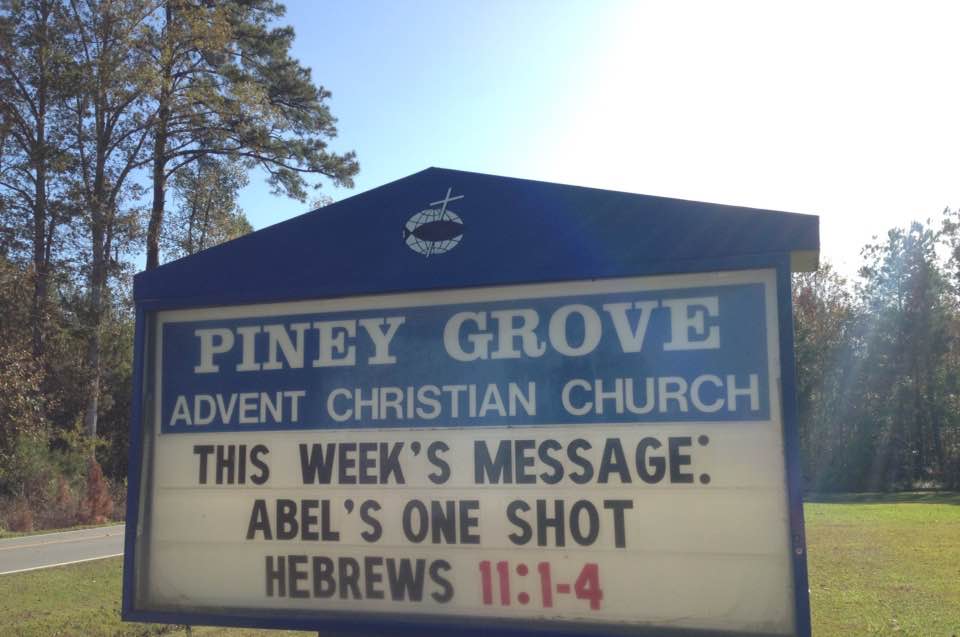
ABEL’S ONE SHOT

ABEL'S ONE SHOTABEL’S ONE SHOT

“By faith Abel offered to God a better sacrifice than Cain did. By faith he was approved as a righteous man, because God approved his gifts, and even though he is dead, he still speaks through his faith” (Hebrews 11:4 CSB).

The author of Hebrews encourages his fellow Jewish Christians not to draw back into unbelief, but to live their lives by faith. Note the final words of chapter 10:

“So don’t throw away your confidence, which has a great reward. For you need endurance, so that after you have done God’s will, you may receive what was promised. For yet in a very little while,
the Coming One will come and not delay. But my righteous one will live by faith; and if he draws back, I have no pleasure in him. But we are not those who draw back and are destroyed, but those who have faith and are saved” (Hebrews 10:35-39).

It is in that context that he wrote that amazing chapter that we will be studying in this series. It highlights several heroes of the faith, who serve as illustrations of what a life of faith looks like.

Abel is the first in the list, and he is one hero who we know very little about. Besides these four verses, he is mentioned in Genesis:

“The man was intimate with his wife Eve, and she conceived and gave birth to Cain. She said, “I have had a male child with the Lord’s help.” She also gave birth to his brother Abel. Now Abel became a shepherd of flocks, but Cain worked the ground. In the course of time Cain presented some of the land’s produce as an offering to the Lord. And Abel also presented an offering—some of the firstborn of his flock and their fat portions. The Lord had regard for Abel and his offering, but he did not have regard for Cain and his offering. Cain was furious, and he looked despondent. Then the Lord said to Cain, “Why are you furious? And why do you look despondent? If you do what is right, won’t you be accepted? But if you do not do what is right, sin is crouching at the door. Its desire is for you, but you must rule over it.” Cain said to his brother Abel, “Let’s go out to the field.” And while they were in the field, Cain attacked his brother Abel and killed him” (Genesis 4:1-8 CSB).

What is it that made Abel a hero, and Cain a villain? Is it just the fact that he died? Is that what makes a person righteous before God? If so, we are all set, because we are all going to die. But the author of Hebrews highlighted Abel not because he died, but because he manifested faith before he died. Abel’s story is also significant because it highlights only one act of faith. Abel had only one shot at being in the heroes list of Hebrews 11, and he did not throw away his shot.

Abel is a hero of faith because he believed in the unseen God who created him.

Abel’s one shot at faith in God gave him hope (1)

“Now faith is the reality of what is hoped for, the proof of what is not seen”

Both brothers responded to a religious need to show their appreciation for God. Both gave from what they had to give. But God accepted Abel’s sacrifice and did not accept Cain’s sacrifice.
Why? We do not know, and that is the point. There is something going on in the heart of Abel that is not going on in the heart of his brother. It may have had something to do with the animal sacrifice that God performed in Eden in order to clothe his parents. We don’t know.

What we do know is that Abel’s hope was real, and Cain’s was not. But the only reality – the only evidence was Abel’s faith. It was Abel’s faith in God which led him to expect God’s approval.

My friend, if you have hope for the future today, then the reason for your hope cannot be explained by what you have experienced in the past. If you have hope for a permanent future, you did not manufacture that hope. It came from God, when he gave you faith.

“For by grace you have been saved through faith; and that not of yourselves, it is the gift of God” (Ephesians 2:8 NASB).

When God gives gifts, he gives them in bundles. The gift of salvation comes bundled with faith, hope and love. You get all of them at the same time.

That is why Abel was happy and hopeful about his sacrifice, but Cain was despondent and furious about his. He had no hope. It was in that hopeless, faithless, loveless condition that Cain decided that if he was never going to have a happy life, he was going to make sure that Abel didn’t have a long life.

Abel’s one shot at faith in God gave him understanding (3)

“By faith we understand that the universe was created by the word of God, so that what is seen was made from things that are not visible.”

The world without God looks at itself and thinks “this is all we have, and it is all that is real.” Abel looked at his world and believed in its creator, even though he had never seen him. Abel dared to have a relationship with God sight unseen. That is faith. Faith filled in the blanks in Abel’s understanding.

Now, we live in a world just like Abel’s world. We can choose to only trust the things we see, or we can do like Abel did and let our faith fill in the blanks of our understanding.

Abel’s one shot at faith in God gave meaning to his life (4a)

“By faith Abel offered to God a better sacrifice than Cain did. By faith he was approved as a righteous man, because God approved his gifts…”

What was better about Abel’s sacrifice? Well, we know that without the shedding of blood, there is no forgiveness, but Abel didn’t know that. It was Abel’s faith that pushed him to give up the lives of his animals, but not just any animals — “some of the firstborn of his flock and their fat portions.” He gave his best. He wanted to show his appreciation and respect to God. His relationship with God was what gave meaning to his life.

People who are in the royal family live different lives than others because of who they are related to. People related to celebrities live different lives because of who they are related to. We believers in Christ have been adopted into God’s family, and it is that relationship that gives meaning to our lives as well.

Abel’s one shot at faith in God outlasted his life (4b)

“and even though he is dead, he still speaks through his faith.”

In our Bible studies in Ecclesiastes, we discovered that the name of Abel (Hebrew hevel) became a word describing anything that is temporary. Because Abel’s life was cut short, his name became synonymous with things that do not last.

Solomon discovered that the pursuit of knowledge is not as satisfying as he thought it would be, because it does not last. He tried partying his life away; that didn’t last. He tried building a bunch of things; that didn’t last. So Solomon concluded that everything was hevel. He finally concluded that the best thing to do is to fear God and obey him, because only a relationship with God will last. Our only future is him.

But Abel knew that. He did not live long, and he is dead today. He has not yet received the inheritance that God promised him. But Abel’s short life was worth it, and even though he is dead today, he still speaks by the example of his life of faith.

If Abel were to join us today, he would tell us that even if we are given only one shot at living a life of faith, we should not throw away our shot. We should take that one shot and make the best of it.

We have the opportunity to live lives of faith like Abel. We are not guaranteed long lives. Abel’s life wasn’t long. But God has prepared a city for us. He has another life in store for us. It is better to live a short life focused on God than to live a long life of hopelessness and selfishness.

In Wednesday’s Maranatha Devotional, Millie Griswold asked “Has your name been added to the litany of faithful people in Hebrews 11?” You may just get one shot a life of faith, like Abel did. Don’t throw away your shot.