
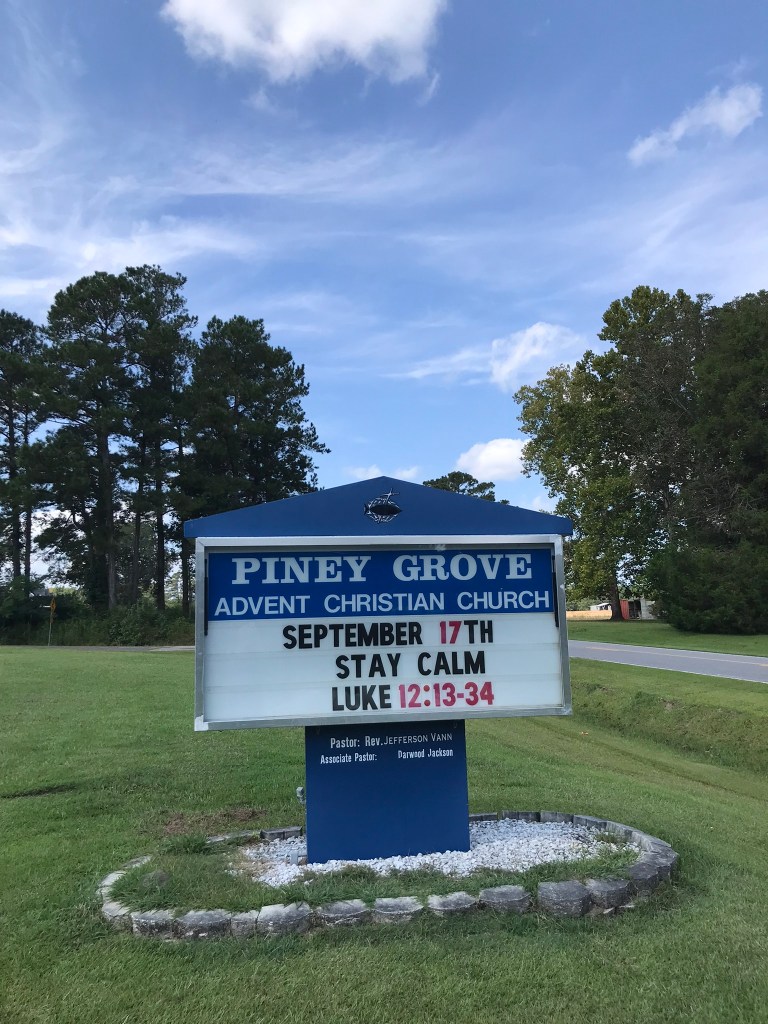
STAY CALM
Luke 12:13-34 NET
In the Anxiety Handbook, we read that the “symptoms of anxiety can be divided into four slightly overlapping categories of symptoms: the physiological (what your body is experiencing), the cognitive (your thoughts), the emotional (your feelings), and the behavioral (what your body is doing externally).”[1]

The physiological symptoms include diarrhea, vomiting, and other gastric problems, frequent urination, flushing of the skin, light-headedness, headache, muscle tension, rapid heart rate, palpitation, recurrent localized pain, shortness of breath, sleeping problems, sweating, involuntary twitching of muscles and tingling sensations.
The cognitive symptoms include confusion, poor memory, decreased problem-causing skills, difficulty concentrating or paying attention, distorted perception, morbid thoughts, obsessions, and oversensitivity.
The emotional symptoms include anger, rage, lashing out, fear and even terror, fear of losing control, feeling as if one is not in one’s body, feelings of apprehension, loss of one’s sense of reality, and panic: an extreme need to escape the situation.
The behavioral symptoms include erratic behavior, failing to complete tasks by avoiding challenges or avoiding the tasks altogether, fidgeting, hand wringing, finger tapping, irritability, perfectionism, pressured and rapid speech, restlessness, pacing, nervous shaking or moving of the limbs, trembling, withdrawal from people and lack of participation.
Some of these symptoms may apply to you. I know some of them apply to me sometimes. Anxiety comes to us all at times. The problem is when anxiety stays. That is when it becomes a disorder. In today’s text, Jesus encounters someone with anxiety, and he uses that as an opportunity to teach his disciples how to avoid it. So, in addition to his encouragement for us to stay real in the first part of this chapter, he teaches us to stay calm in this part.
Stay calm because life is not about taking care of ourselves (13-21).
13 Then someone from the crowd said to him, “Teacher, tell my brother to divide the inheritance with me.” 14 But Jesus said to him, “Man, who made me a judge or arbitrator between you two?” 15 Then he said to them, “Watch out and guard yourself from all types of greed, because one’s life does not consist in the abundance of his possessions.” 16 He then told them a parable: “The land of a certain rich man produced an abundant crop, 17 so he thought to himself, ‘What should I do, for I have nowhere to store my crops?’ 18 Then he said, ‘I will do this: I will tear down my barns and build bigger ones, and there I will store all my grain and my goods. 19 And I will say to myself, “You have plenty of goods stored up for many years; relax, eat, drink, celebrate!”‘ 20 But God said to him, ‘You fool! This very night your life will be demanded back from you, but who will get what you have prepared for yourself?’ 21 So it is with the one who stores up riches for himself, but is not rich toward God.”
Last week, we saw the setting of this discourse. It is very similar to that of the sermon on the mount. Jesus is teaching his apostles, and there is a very large crowd looking on, and listening in. This section begins with a rude interruption. Someone from the crowd blurts out a request for Jesus to arbitrate a dispute over his inheritance. I think we can add rudeness and lack of consideration as symptoms of anxiety. This man interrupted the Lord’s sermon to his apostles with a personal request. It had nothing to do with what Jesus was preaching about. Jesus said as much in reply to his request. He essentially said to the rude interrupter that the man’s inheritance was none of his business.
So, Jesus turns back to the twelve, but he uses that interruption as a segway to a new topic. He warns the apostles to watch out for greed because life is not about taking care of yourself by getting as much as you can. By saying this, Jesus links two problems: greed and anxiety. Being greedy gives you something to worry about. Wanting more makes you anxious when you don’t get what you want. That was this man’s problem.
Jesus proceeds to tell another parable. Remember that parables are designed to illustrate something that is usually taught elsewhere. Avoiding the two related evils of greed and worry are identified by Jesus as the subject matter of this parable. He said in verse 15 for us to guard ourselves against greed, and he will go on to tell us not to worry in verses 22 and 29, and not to be afraid in verse 32.
The parable is about a farmer who has anxiety because he is greedy. As a farmer, he is a tremendous success. He had such an abundant crop that his current barns would not be able to hold his whole harvest. Now, if this man had not been greedy, he might have seen this as an opportunity to be a good Samaritan to all his poor neighbors. In so doing, he would have been obeying the second great commandment of the Law. But he was greedy. All he could think about was keeping all his harvest. So, he decides to tear down his barns and build bigger ones – to take care of himself at the expense of the needy all around him.
The rude interrupter was like that. He was anxious to get what was coming to him, and so worried about it that he interrupted the preaching of the gospel to feed his greed.
In the parable, the LORD calls this rich anxious man a fool. He had been a success as a farmer but a failure as a person. His greed for more stuff caused him to waste his life on stuff he could not keep. He would die, and all that stuff he had accumulated would go to someone else. You could call such a man stupid. He worried about the things of this life but never gave a thought to preparing for the next. That is what happens to someone who stores up riches for himself but is not rich toward God.
Stay calm because the ravens are teaching us something (22-26).
22 Then Jesus said to his disciples, “Therefore I tell you, do not worry about your life, what you will eat, or about your body, what you will wear. 23 For there is more to life than food and more to the body than clothing. 24 Consider the ravens: They do not sow or reap, they have no storeroom or barn, yet God feeds them. How much more valuable are you than the birds! 25 And which of you by worrying can add an hour to his life? 26 So if you cannot do such a very little thing as this, why do you worry about the rest?
Jesus gives us three examples of those who are not overcome by greed and who are not eaten up by anxiety. The first is the ravens. These are birds of prey. They live in the same world that the rich fool lives in. But they don’t sow or reap, and unlike the rich farmer, they don’t have any barns. They find what they need because God feeds them.
Jesus asks a question in this section that is very revealing. He asks which of us by worrying can add an hour to our lives. We know that worrying does the exact opposite. Anxiety takes away from our lives. It doesn’t add to it.
Imagine if the ravens got together and decided that they needed to figure out how to plant berry bushes and build worm farms. If they spent their time worrying about doing what they could not do, they would not have time to hunt for what God has already provided for them. The best thing for the ravens to do is to be ravens.
Now, God knows what you and I need too. He wants to feed us, just like he feeds the ravens, but he is insulted if we keep trying to do his job for him.
Stay calm because the flowers are teaching us something (27-31).
27 Consider how the flowers grow; they do not work or spin. Yet I tell you, not even Solomon in all his glory was clothed like one of these!
28 And if this is how God clothes the wild grass, which is here today and tomorrow is tossed into the fire to heat the oven, how much more will he clothe you, you people of little faith! 29 So do not be overly concerned about what you will eat and what you will drink, and do not worry about such things. 30 For all the nations of the world pursue these things, and your Father knows that you need them. 31 Instead, pursue his kingdom, and these things will be given to you as well.
The flowers and the wild grass are two tremendous gifts from our creator. They adorn this world we live in. They give it a glorious color. I remember on our thru hike in 2018 I was talking to a young lady who was hiking with us for a time. We were looking out over a meadow of some of the lushest green grass we had ever seen. I said to her “That’s what God can do with only one crayon out of the box.”
In the culture in which Jesus and the apostles lived, the grass was also an abundant source of free fuel. It could be harvested, dried, and burned in the ovens to cook food. Imagine that – something to do with grass that doesn’t require spending thousands of dollars on a lawn mower!
Jesus tells us not to worry about the things that all the nations of the world pursue. In fact, the words “do not be overly concerned about” in verse 29 is the same word translated as “pursue” in verse 31. We are to spend our time pursuing God’s kingdom. The kingdom of God is either his rule in our lives today or his rule of the restored universe when Christ comes again. Either way, we are to be concerned about God’s will and his plan, not the mundane things like food and clothing. The contrast is that the nations of the world without God pursue mundane things. In fact, the word pursue is a stronger word in verse 30. The nations of the world eagerly seek the things of the world. When they don’t get enough to satisfy their greed, they become anxious.
Stay calm because the sheep are teaching us something (32-34).
32 “Do not be afraid, little flock, for your Father is well pleased to give you the kingdom. 33 Sell your possessions and give to the poor. Provide yourselves purses that do not wear out — a treasure in heaven that never decreases, where no thief approaches and no moth destroys. 34 For where your treasure is, there your heart will be also.
The little flock of verse 32 is not a flock of ravens. It is a flock of sheep. Jesus uses the shepherd and sheep metaphor a few times in the Gospels to describe his relationship with believers. For that reason, one of the words describing a church leader is pastor, another term for shepherd. Jesus is the chief shepherd, and we pastors are undershepherds.
I have seen actual sheep following their shepherds on four continents. I’ve seen it here in America, in Europe, in Oceania, and in Africa. Not once have I ever seen a sheep carrying something on its back. Sheep don’t have to collect things and carry them with them. No, the shepherd provides all the flock’s needs.
Sheep can teach us something about how to live our lives. Instead of pursuing all the things we might need or want, we would do much better if we focused on just being sheep. That is all a sheep is responsible for, so it leaves it to the shepherd to take care of all its needs.
Now, the sheep, the ravens, the flowers and the grass are all teaching us to calm down and trust God to take care of us. We can get nervous and excited and fearful and anxious about the stuff of this world. Or we can choose to let God take care of those needs. We can choose to focus our lives on being who God says we are. We are his creatures, and we glorify him when we choose to depend on him. Instead of building bigger barns for us, if he gives us more than we need, we will just share it with those who do need it. Instead of putting ourselves into early graves by anxiety, we can live our lives to their fullest – grateful that we have a Father who is fully capable of taking care of his children.
[1] The Anxiety Handbook: The 7-Step Plan to Understand Manage and Overcome Anxiety. Callistoga Press 2013. p. 10.


 jeffersonvann