ALL LIVES

ALL LIVES

Ezekiel 18:1-4 NET.

1 The word of the LORD came to me: 2 “What do you mean by quoting this proverb concerning the land of Israel, ‘The fathers eat sour grapes And the children’s teeth become numb?’ 3 “As surely as I live, declares the sovereign LORD, you will not quote this proverb in Israel anymore! 4 Indeed! All lives are mine — the life of the father as well as the life of the son is mine. The one who sins will die.”

It is very easy for us to go from day to day just looking at the world from our perspective. We are born into this world looking at it from our perspective. As we grow older, hopefully, we mature. Part of maturing is learning to look at things from other people’s perspectives. We learn to be considerate of others. That means we think of how our actions affect them: how they see us. Developing ways of seeing our world from other people’s perspectives is helpful and healthy. Sometimes we cannot see things clearly when focusing on how things affect us.

The Prophets in the Old Testament allow us to do the same thing on a higher level. They are written in order to give us God’s perspective. They help us to see things from God’s point of view. This is exactly why so many people avoid reading the Prophets. They are bothersome because they reveal how selfish and inconsiderate we can be. They reveal how wrong we are when we live our normal lives not considering that there is a heaven above us where God lives. We are accountable to him but don’t see him, so it is easy to live our lives as if he doesn’t exist.

This is called practical atheism. None of us would dare proclaim that we are atheists, but we often live as if there is no God above us to whom we are accountable. The people to whom the Prophets wrote lived like that. It was the Prophets’ job to slap them on the face and get them to wake up to a reality that they were ignoring: the reality of God’s existence and their accountability to him.

The Prophets were God’s mouthpiece. They received words from God and communicated those words to the people. Sometimes those words were words of comfort and consolation. When the people were hurting, God wanted them to know that he was aware of their plight and cared for them. He wanted them to know that help was on the way. The Prophets had the happy role of sharing the good news from God.

But the Prophets had another role as well. When the people were disobedient—when they were sinning and not living by God’s standards—the Prophets had the task of calling them to account. They had to share the bad news as well as the good news. They had to speak for God when God was angry at his people. They had to warn the people of the danger of God’s wrath.

Since the people were constantly straying away from God’s will and breaking their covenant with him, nobody wanted to see the Prophet. If the Prophet was walking down the street, the people would turn and walk the other way. They did not want to be reminded of their sin and unfaithfulness. They were comfortable thinking and living by their own standards and did not like to be held accountable for how different those standards were compared to how God thought and lived.

This is the world in which the Prophet Ezekiel lived. He was one of the people himself. He was just as guilty of looking at life from his perspective. So, before God could speak through him to his people, God often had to correct Ezekiel for his failures. That is what is going on in today’s text.

God’s question (2).

Ezekiel had been fond of quoting a proverb. It was not something Ezekiel made up. You can find the same proverb referred to in Jeremiah 31:29. It was a saying that people were familiar with. It said that the fathers ate sour grapes, and that caused their children to get numb teeth. What the fathers did changed the lives of their children.

As sayings go, it was not necessarily wrong. It could remind someone that their choices could affect their children’s lives. It could be a way of stopping yourself from doing something that might have negative consequences for those who come after you.

But that is not why people quoted that proverb in Ezekiel’s time. In Ezekiel’s time, people quoted that proverb as an excuse for not living up to God’s standards. They would live unrighteous, unfaithful lives and quote that proverb to blame bad choices made by their parents or ancestors for their sins.

It’s not my fault, they would say. I’m just living the life I inherited. If God has a problem, it’s not with me. He should deal with my ancestors. They got the ball rolling, so what I’m doing is all their fault.

So, God asks a question to Ezekiel. He asks the Prophet what he means by quoting the proverb. A proverb is like a tool. When used correctly, it can help people make course corrections in their lives. But this proverb was not being used correctly. It was being used to excuse bad behavior. 

God’s command (3).

God commanded Ezekiel to stop quoting that proverb. It was not being used correctly. It was not being used as a tool to foster wise living and a healthy lifestyle. So, the proverb has to go. From now on, such talk would be flagged to be deleted from anyone’s social media post. A warning would be given to anyone who used it. Such words would now be off-limits. They would be marked as inappropriate.

God is all for freedom of speech but bans us from unhealthy and dangerous speech. If what I am saying harms someone else, then the Lord commands me to shut up and stop saying it. If I am speaking as a representative of God and I am saying something he does not want me to say, then I am taking his name in vain. The Lord will not hold me guiltless if I do that.

The best way to deal with inappropriate activity is to STOP IT! If I’m hurting someone else, I need to STOP IT! If I’m misrepresenting God’s truth by telling lies, I need to STOP IT! If I’m looking where I should not be looking, seeking something I should not be seeking, God’s word to me is to repent of that sin and stop doing that.

God’s Justice (4).

But God is not just telling Ezekiel to stop quoting the proverb. He wants the Prophet to know why he needs to change his behavior. God does not just give commands. He also has a reason for every command he gives. He has a logical purpose for everything he commands and everything he prohibits. His purpose is not just “because I said so.”

God told Ezekiel the reason that he should no longer quote this proverb. He said it was because all lives are his. Literally, he said all throats are his. In Hebrew, if you wanted to talk about having power over someone’s life, with the ability to kill them or let them live, you would say that his throat is yours. That is what God said to Ezekiel. He said, “Notice, all throats, they are mine.

God is saying that not one person on the face of this planet is ever going to be condemned on the basis of who their Daddy is. For God, justice is something very personal. God has encoded that principle in his Law itself. Deuteronomy 24:16 says, “Fathers must not be put to death for what their children do, nor children for what their fathers do; each must be put to death for his own sin.” The principle is individual accountability.

All the pagan religions had taught the opposite principle. They taught that bad things happen because of someone else’s choice. You suffer because of a curse put on your family because of someone else’s sin or someone else’s greed. But the God of the Bible said that he does justice differently. He is not going to punish anyone for someone else’s crime.

Our God will dispense justice on Judgment Day, and not one stripe will come to anyone who does not personally deserve it. Therefore, not one of us can use our ancestry to excuse sin. Saying, “My Daddy made me like this,” is just as wrong as saying, “The devil made me do it.” When God punishes the lost for their sins, the principle is “The one who sins will die.” That is justice.

There will be people who stand before the throne of judgment and weep over their fate, but not one will ever be able to truthfully say that it isn’t their fault. Many will gnash their teeth in anger against God, but they won’t be able to blame the judge because each of them will see the law that they have transgressed. People will be redeemed because of Christ’s blood shed for them. But not one of those unredeemed will die because of someone else’s sin. All the unredeemed will die because each will personally deserve to die. That is how God does justice.

God’s mercy (21-23).

The good news God shares through Ezekiel comes later in the chapter. In verses 21-23, we read, “But if the wicked person turns from all the sin he has committed and observes all my statutes and does what is just and right, he will surely live; he will not die. None of the sins he has committed will be held against him; because of the righteousness he has done, he will live. Do I actually delight in the death of the wicked, declares the Sovereign LORD? Do I not prefer that he turn from his wicked conduct and live?”

That is the gospel. It says that anyone can be rescued from the consequences of his sin by repenting from that sin. God extends his hand to anyone who wants to be taken out of the hell that everyone deserves. That is grace. Grace is God giving us what we don’t deserve. Mercy is God not giving us what we deserve. Both God’s grace and God’s mercy are found in Christ. He is the Savior – the Rescuer.

Now, understand me. There is such a thing as inherited sin and inherited judgment. There is an instance where people die because of someone else’s sin. Inherited sin and judgment are what happened to the human race in Eden. God warned Adam and Eve that if they disobeyed his prohibition against eating from the forbidden tree, the race as a whole would be condemned to mortality. Because of their mortality, all humans would eventually die. God warned our ancestors that if they transgressed the commandment, both they and all their descendants would become mortal and eventually die.

We all know what happened. They transgressed, and God made good on his threat. The Apostle Paul said, “sin entered the world through one man and death through sin, and so death spread to all people” (Romans 5:12). That is inherited judgment. All those graves outside in the cemetery are filled because of that inherited judgment. Not one of those people died because of their sins. They died because of their ancestor’s sin.

So, the God of the Bible tells us that there will come a day of Judgment. On that day, everyone will stand before God and answer to their creator for their sins. All it takes is one sin—one transgression against one law—to condemn a person to permanent destruction. The only thing that will ever keep anyone from that fate is God’s mercy.

That is why we all need Jesus Christ. His death on the cross is the only way out of the fate that we all deserve. So, Paul also says, “Just as condemnation for all people came through one transgression, so too through the one righteous act came righteousness leading to life for all people” (Romans 5:18). The one transgression took place in Eden and condemned us all to mortality and eventual death. The one righteous act took place on Calvary, resulting in “eternal life through Jesus Christ our Lord” (Romans 5:21).

Grace is God giving us what we don’t deserve, while mercy is God not giving us what we do deserve. Both God’s grace and God’s mercy are found in Christ. He is the Savior—the Rescuer. He is the one who gave his life on the cross so that you and I can live forever.

God told Ezekiel to stop blaming others and take personal responsibility. He encouraged all his people to come to him in confession and repentance; they would find him ready to forgive and heal them. He says the same thing to you and me today. He tells us not to use any excuses for living in sin. He pleads with us to come to Christ, who offers us forgiveness and restoration.

God knows that we are sinners and that we sinned because we wanted to sin. He wants us to stop blaming others and seek his deliverance and grace. His door is open. All we have to do is walk through it. His grace and mercy are available for a limited time only. The price has already been paid. Our lives are his. All lives belong to him. He will either save them or destroy them. He wants to save us!

STAY ALERT

STAY ALERT

Matthew 24:42-44 NET.

42 “Therefore stay alert, because you do not know on what day your Lord will come. 43 But understand this: If the owner of the house had known at what time of night the thief was coming, he would have been alert and would not have let his house be broken into. 44 Therefore you also must be ready, because the Son of Man will come at an hour when you do not expect him.

Just these three verses remain, and we will have covered Matthew 24. Three years ago, I spoke on verses 45-51, so I won’t cover that ground again. But these three verses are significant because they focus on Jesus’s commands. Jesus wasn’t very interested in answering the questions that the disciples had. He didn’t want to entertain them or encourage their curiosity. His purpose was to prepare them for a lifetime of ministry as representatives of his coming kingdom.

That is why Jesus gave them orders. The most important thing about the coming kingdom is not when it is coming. The most important thing about the coming kingdom is that when it comes, it will come upon the world suddenly, like a flood. Most of the world will not be ready. So, Jesus focuses on giving us commands that will help us welcome the coming kingdom.

The commands are for us to stay alert and be ready (42a, 44).

The command to stay alert uses the Greek word γρηγορέω. That is the word that Jesus used two chapters later when he was in the garden of Gethsemane just before his arrest. He told his disciples that he was deeply grieved, even to the point of death. He commanded them to stay with him as he prayed and stay awake. When he told them to stay awake, he used the word γρηγορέω.

But the disciples could not stay awake for even one hour. Jesus told them to “keep watching and praying,” and the word he used for “watching” was γρηγορέω.

He told them to keep watching so they would not succumb to temptation. Even a Christian who has every intention of following Christ can fall into temptation. Even the disciples of Christ who had committed to following and serving him could not stay awake for even one hour during the most critical and crucial test of their lives. That highlights the importance of staying awake and alert during this age.

The Apostle Paul embraced the same theme as he ministered to Gentile believers. He told the Corinthians to Stay alert (γρηγορέω), stand firm in the faith, show courage, be strong (1 Corinthians 16:13). He told the Colossians to be devoted to prayer, keeping alert (γρηγορέω) in it with thanksgiving (Colossians 4:2). He told the Thessalonians that we must not sleep as the rest but must stay alert (γρηγορέω) and sober (1 Thessalonians 5:6).

One thing that Paul and Jesus had in common is that both commanded that people stay alert in prayer. This is an area of most of our lives where we are in constant danger of becoming spiritually crippled. The devil knows that if he can cripple our prayer life, then he will render us practically useless for Christ and his kingdom. He attacks us relentlessly to keep us from staying awake in prayer.

You all know that I just came back from vacation. I was gone for three weeks in July. During those three weeks, the weeds attacked my garden with ferocity. I am still pulling gigantic weeds from my garden. All it took was a few days of distraction and neglect and now I have a tremendous job on my hands.

That is what happens when we take time off from our task of diligent prayer. Jesus taught about that in his parable of the sower. In that parable, some of the seeds fell among thorns. Jesus said that these are the ones who hear the word, but as they go on their way, they are choked by the worries, riches, and pleasures of life, and their fruit does not mature (Luke 8:14).

Seeds are designed to germinate, grow, and produce trees, fruits, and vegetables. But weeds can interfere with that process. To be fruitful, the seeds have to mature. But some seeds are kept from that purpose by weeds. They are choked out before they have a chance to be fruitful. Jesus identified the weeds in his parable. They are three things: worries, riches, and pleasures of life.

Worry is a weed. It distracts us from taking in the word of God and being fruitful in our Christian lives. Don’t expect a crop to appear if the weed of worry is allowed to stay in your garden. Jesus commanded us not to worry about tomorrow. He said today has enough trouble of its own (Matthew 6:34). Jesus commanded us not to worry about what we will eat, drink, or wear. We worry about these things, and worry distracts us from having meaningful prayer lives, hindering our spiritual growth.

The solution to this problem is a strong prayer life that focuses on trusting our heavenly Father for daily bread. Instead of allowing our fear of tomorrow to choke out our spiritual lives, we must come to God regularly and declare our trust in his provision. We can cast all our cares on him because he cares for us.

Greed is also a weed. The lust for riches distracts us from the rest we can currently have in God, our provider. When God rescued the Israelites from their slavery in Egypt, he commanded them to remember the Sabbath day and keep it sacred. They had been slaves. Work was all they knew how to do. But God rescued them from their slavery in Egypt. They now had the privilege to focus on something besides work. But he knew they would be tempted to replace their former slavery with a new slavery. They could replace Pharaoh with Ego. They could work themselves to death trying to get ahead. So, God told them to stop what they were doing once a week and rest in the finished work of their salvation.

In the New Testament, Jesus met two men who had been workaholics. We don’t know the name of one of these men. We usually call him the rich young ruler. Jesus told him that he could have eternal life. All he had to do was sell everything he owned, give it away, and come and follow him. But that man went away disappointed. He was not willing to give away everything. His greed was keeping him from eternal life. The other workaholic was Zacchaeus. He could see that what Jesus had to offer was better than what he could seek on his own. He had been a greedy cheater, but when he met Jesus, he stopped being greedy. Zacchaeus is proof that you don’t have to be poor to be a Christian, but you have to surrender your greed. If you don’t pull the greed weed, then the word of God will never take root in your life.

Selfishness is also a weed. A focus on the pleasures of this life can keep us from experiencing eternal life. When we pray to God, we have to make sure that self gets off the throne. If self stays on the throne, God leaves the palace. That is why it’s hard for a selfish person to pray. Oh, you can pray a selfish prayer. But it doesn’t accomplish anything. It ends up sounding like the prayer of the self-righteous Pharisee: ‘God, I thank you that I am not like other people: extortionists, unrighteous people, adulterers — or even like this tax collector. I fast twice a week; I give a tenth of everything I get.’ (Luke 18:11-12). God knows what we are really like. He doesn’t need us to rehearse our accomplishments to him in our prayers. Prayer needs to focus on who God is. It is his kingdom we are to seek.

Staying alert in our prayer lives means not allowing the weeds of worry, greed, or selfishness to distract us from his kingdom.

Jesus’ second command in today’s text is to be ready. We must be prepared for the second coming. The word for ready is ἕτοιμος, which Jesus had previously used in his parable of the wedding banquet. A king had planned a wedding banquet for his son, and when everything was ἕτοιμος, he summoned those who had been invited.

The real question for us is not what date Jesus will come, but will we be prepared for him when he comes? That is what we are commanded to do. I just finished a book about King Charles III of England. It focused on his transition from Prince to King. What struck me as I read it were all the things that he had experienced all his life that make up who he is and how he will rule as king.

You and I are destined to be part of Jesus’ coming reign. We are not just waiting for Jesus’ kingdom to come; we are part of that kingdom now. If we are not declaring the Lordship of Christ by how we live today, we should not expect to do that after he comes. The command to be ready entails transforming our lives today.

Why did Jesus command us to stay alert and be ready?

The reason is that we do not know the time (42b).

We do not know what day our Lord will come. We know that he is coming, but we cannot put the date on the calendar. If we do put a date on the calendar, we will probably be wrong. Numerous people have ventured a guess, but their guesses have all proven to be wrong. We have not been commanded to guess at the date. We have been commanded to be ready on this date.

Since we don’t know the time, we need to be ready at any time. We must be prepared on Sunday, August 18th, at 11:45 a.m. If he comes right now and we are not prepared, we are guilty of directly disobeying his command. No one wants to be caught disobeying a direct command of the king. It doesn’t bode well for people if they are invited but are not ready when the banquet is set.

His coming is compared to a break-in (43).

Jesus said he was coming like a thief. A thief does not call you and say, “I’m coming.” No, a thief wants to take you by surprise so he can steal your stuff. If you are ready for him, the thief will skip your house and find a home where the owner is unprepared.

Since we don’t know the time, we must live like now is the time. We have to ask ourselves every day whether we are ready for our Master to return to his slaves.

Jesus doesn’t say this to make us afraid of his coming. He says it to remind us of who we are. He knows that the longer he delays his return, the more we will be distracted by the world, the flesh, and the devil. Jesus is not the thief. He is the good shepherd who cares for his sheep. He loves the sheep and lays down his life for them. All who have come before him are thieves and robbers. The sheep did not listen to them. They are tuned in to the sound of the good shepherd’s voice.

The thieves come only to steal, kill, and destroy, but the good shepherd comes so that the sheep may have life and may have it abundantly. The second coming of Christ is not a terrible event we are to fear. It is a glorious event that we anticipate with joy and confidence. We cannot be who God wants us to be for eternity unless Jesus returns.

As it is now, we are aliens and strangers on the very planet that God plans for us to inherit. We are like sheep being led to the slaughter for his and his kingdom’s sake. Following Jesus means taking up our crosses and following him to death. But we choose to surrender our hopes, worries, greed, and selfishness in this life. We have bet everything on his promise of a coming resurrection. If there will be no resurrection, then we are the most to be pitied.

But since there is a resurrection, everything we do to join his coming kingdom and every sacrifice we make to stay prepared for that day is worth it. Like Paul, we strive to lay hold of that for which Christ Jesus also laid hold of us.

Let the world be caught off guard. But we will not be caught off guard. Let the world keep being distracted by the worries, riches, and pleasures of this life. We will stay alert. We will remain focused on our coming king. We will be ready for him when he comes. We want to hear “well done”! We want to be there for our Master and enter his joy.

Books by Jefferson Vann:

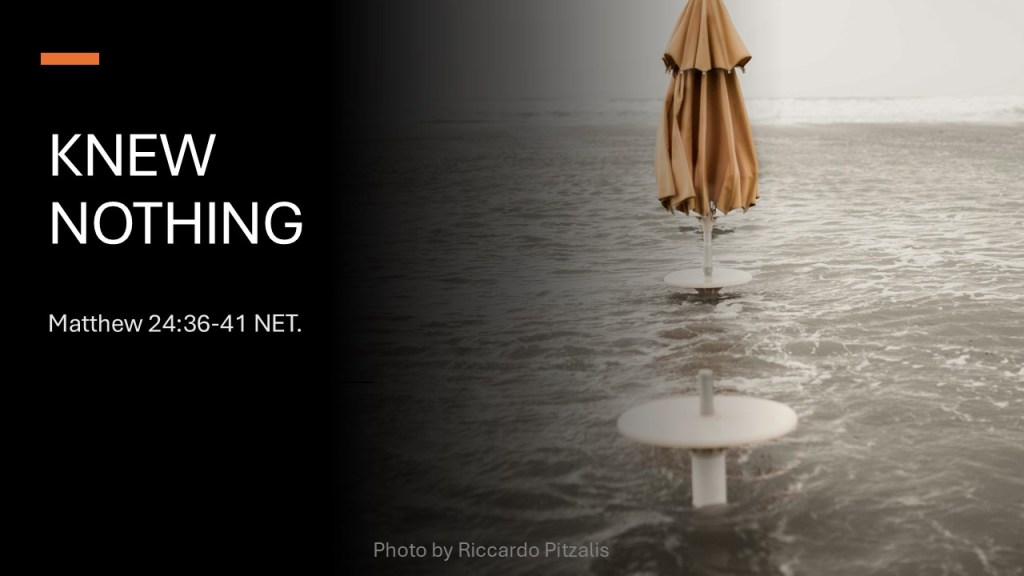
KNEW NOTHING

KNEW NOTHING

Matthew 24:36-41 NET.

36 “But as for that day and hour no one knows it — not even the angels in heaven — except the Father alone. 37 For just like the days of Noah were, so the coming of the Son of Man will be. 38 For in those days before the flood, people were eating and drinking, marrying and giving in marriage, until the day Noah entered the ark. 39 And they knew nothing until the flood came and took them all away. It will be the same at the coming of the Son of Man. 40 Then there will be two men in the field; one will be taken and one left. 41 There will be two women grinding grain with a mill; one will be taken and one left.

The Gospel of Matthew is about Jesus as the king and his coming Kingdom. The gospel can be divided into seven parts. The first part of Matthew explains who Jesus is and why he qualifies as the king. The final part explains why Jesus had to die on the cross. The second part, which begins in chapter 4, verse 12, describes how we can represent the coming Kingdom. That is the part that contains the sermon on the mount. The third part of Matthew explains how to spread the future Kingdom. The 4th part describes how to stay committed to the coming king. The 5th part explains how to live by the standards of the coming Kingdom. The 6th part, which contains today’s passage, tells us what we need to know about when the Kingdom will come.

Each part of Matthew’s gospel focuses on a particular sermon Jesus gave. The sermon in section 6 is in chapters 24 and 25 of the Gospel. We have been examining chapter 24 for several months now. By this time, you ought to remember the process we go through whenever we approach one of the texts in this chapter. The first thing we must establish is which question Jesus answers in this Passage. Is he talking about the destruction of Jerusalem? Or is he talking about the second coming? Or is he talking about the end of the age? Those were the three questions a disciple asked him while they left the temple into the Mount of Olives.

It is easy to find the answer to that question in today’s passage. Verse 39 says it will be the same at the coming of the Son of Man, so it is clear that Jesus is talking about his second coming here.

The principle: no one will know the timing of the second coming (36).

Many books about Bible prophecy appear to have some special knowledge about the second coming. But today’s passage teaches that that special knowledge does not exist. It says that as for that day and hour, no one knows it, not even the angels in heaven, except the Father alone.

Now, let’s get practical here. Lots of us know that Jesus is coming back. Lots of us are convinced that Jesus is coming back sooner rather than later. This world’s condition is an indicator that Jesus is coming back soon. I don’t think the fact that Jesus is coming again is what is in question here. Instead, the issue is the timing of the second coming. The principle that Jesus gives us in today’s text is that the timing of his second coming is something that no one will know. Even if you had an Angel from heaven and you grilled him about this secret he could not reveal it because he doesn’t know it. The father alone knows when the son is going to come back.

That is a good thing. All the instructions that Jesus gave us about how to live our lives as Christians representing his Kingdom assume that we are living those lives in ignorance of when he is going to come back. A life of faith demands a certain amount of unawareness. A life of faith requires that we live prepared for Christ’s second coming, not knowing exactly when it will happen. If we knew precisely when the Lord was coming back, we would be tempted to ease off on living according to his commands. The blessing on Christ’s servants is given to us because we keep working for him even though we don’t know precisely when he will return and reward us. We are blessed because we are found serving him when he returns.

The question that the disciple gave Jesus that day is, what is the sign of your coming? Jesus answered that question by telling his disciples that no one knows when he is coming. There will be no preparatory sign. When Jesus talks about his coming, he describes it as an event that will happen suddenly, and no one will be prepared for it. Possibly, the disciples wanted to know when Jesus was coming back so they could quickly prepare for it when the time came. But Jesus point is that there is no preparing for Christ second coming until it comes. There will be no pre-warning. Not even Christians will know when Christ will return. That is precisely why we need to be ready at all times on all occasions. Our master wants us to get prepared and stay prepared.

Jesus doesn’t want us to set our calendars based on our prophetic understanding and then rest until the time approaches. He wants us to live in expectation and anticipation of his return at all times. He wants us to be instant in and out of season. He wants us to represent his Kingdom at all times, not just at the end times. The New Testament frames our understanding of God’s timing in this way: we live in the last days. We don’t know how long these last days will last. But we must always be ready for the coming of the Son of Man at any time.

The precedent: it will be like the days of Noah were (37-39a).

Jesus said that his coming was going to be just like the days of Noah were. The book of Genesis describes Noah and the great flood. It tells that Noah was given the revelation that the flood would come. From then on, Noah had two jobs. He had the job of building the ark that would rescue humanity from the coming flood. He also had the job of preaching about the coming day of judgment to everyone who would listen.

So, Noah built. He built an ark. He built that ark so that it could contain all the animals that God wanted to rescue. He also built rooms in that arc for his family members. He probably also built rooms in that ark for people he desperately wanted to save. But he preached and preached. Nobody came down the aisle. Nobody wanted to be saved. God had warned of a coming day of judgment. God had set aside his messenger to proclaim that day of judgment. Noah built, and Noah preached. The ark grew more extensive, but the congregation remained the same. It was just the preacher, his wife, his three sons, and their wives. Eight people, week after week. Eight people, month after month. God planned to rescue humanity, but an entire generation ignored his plan.

They probably called Noah a lunatic, and he certainly seemed like one. He kept building and preaching, and the number in the pews remained the same.

Jesus said that his second coming would be like that, too. I’m so grateful that he didn’t mean that only eight people would be saved. He suggested that even though the gospel will be preached, people will stay eating and drinking, marrying, and giving in marriage until the day comes, and they will miss their opportunity. Jesus is not promising that we will become famous preachers who reach many people for Christ. He’s not telling us to expect that. Instead, he tells us not to be surprised if we preach and preach and nobody cares about what we say. He’s telling us not to be surprised if the world thinks we’re crazy and sets us aside as insignificant. He’s telling us not to be surprised if the world ignores us and ignores our message.

Therefore, we should celebrate it whenever someone gives their life to Christ. A miracle has happened. A lost soul has been swept into God’s Kingdom against all odds. A generation that has learned to ignore God has produced another believer. What a miracle that is. If God has touched your life and assured you of the truth of his word, and you have put your faith in Jesus Christ according to that word, you are blessed beyond comprehension. You have been snatched not just from the flood but from the fire.

But Jesus tells us to be faithful like Noah was, even if we experience the same kind of rejection that Noah did. He does not guarantee that we will be successful. He warns us that we might not make a difference, but he calls on us to be faithful like Noah was.

Jesus said that that generation knew nothing until the flood came and took them all away. They could have known something. They could have put their faith in God’s word through his prophet Noah. But they chose to ignore him and so they knew nothing. We can know some things about the second coming of Christ. Just like Noah’s generation could have known much about what God was doing if they had listened to Noah. The tragedy is that there was something to know, but the generation chose to know nothing, so they knew nothing. We are living in such a generation today. They pride themselves on being agnostic. The word agnostic means ignorant. It means not knowing. There are people in this generation today who wear the title agnostic as if it is a badge of honor. It is not. It is a sign of shame. When God has given us his word in 66 books filled with infallible inherent knowledge, to claim to be an agnostic about God is ridiculous. Yet this generation continues to know less and less about the things that matter.

If you had been part of that generation during the days of Noah, you would have noticed the sky growing darker and the rains coming down. You might even have noticed that that boat that crazy Noah had built is now beginning to float. You might have wondered whether Noah was crazy or not. But even if your head raised your voice to the sky and cried out to the God of Noah, your prayers would not be answered. God gave that generation 100 years to listen to him. They never found the time to do that. Once the judgment began, there was no time to change their mind. The flood had come, and they had been left behind.

The purpose: we need to be ready (39b-41).

Jesus tells us that it will be the same at the coming of the Son of Man. Those who had never dared to enter the church will suddenly be interested in the Bible and the church. But it will be too late for them. There’ll be no time for church and Sunday school. There’ll be no time for preparation. The coming of the Son of Man will be a time of separation.

There will be two men in the field. One will be taken and one left. There’ll be two women grinding grain. One will be taken, and the other left. Scholars disagree over precisely what Jesus is describing here. He could be talking about the rapture. When Jesus appears in the sky and believers are caught up to be with him in the air. But he could also be talking about judgment. The people who are taken could be taken in judgment. Either way, Jesus is saying here that there will be a separation when he comes. The sheep will be separated from the goats. The wise will be separated from the foolish. The faithful will be separated from the unfaithful.

An immediate judgment will divide this world into the haves and the have-nots. Once again, there will be no time to change your status before God when Jesus returns. There will be people praying at that time, but they will be praying for the mountains to fall upon them to hide them from God’s wrath. They will be weeping in mourning over their eternal fate. They will be gnashing their teeth in anger at the God who is putting them on trial and punishing them for their sins.

But just as it was in Noah’s time, so it will be on the day when our Lord Jesus returns to this earth. The day of preparation will be over. The day of separation will come. The day of preparation is now. Tomorrow may be too late. Tonight may be too late. Now is the day of salvation. Now is the time to get ready for the coming king.

COMPLETE VICTORY

COMPLETE VICTORY

Romans 8:31-39 NET.

31 What then shall we say about these things? If God is for us, who can be against us? 32 Indeed, he who did not spare his own Son, but gave him up for us all — how will he not also, along with him, freely give us all things? 33 Who will bring any charge against God’s elect? It is God who justifies. 34 Who is the one who will condemn? Christ is the one who died (and more than that, he was raised), who is at the right hand of God, and who also is interceding for us. 35 Who will separate us from the love of Christ? Will trouble, or distress, or persecution, or famine, or nakedness, or danger, or sword? 36 As it is written, “For your sake we encounter death all day long; we were considered as sheep to be slaughtered.” 37 No, in all these things we have complete victory through him who loved us! 38 For I am convinced that neither death, nor life, nor angels, nor heavenly rulers, nor things that are present, nor things to come, nor powers, 39 nor height, nor depth, nor anything else in creation will be able to separate us from the love of God in Christ Jesus our Lord.

We are in the Summer Olympic season. Athletes from all over the globe have convened in Paris to compete against others and to show their strength. Some will emerge triumphant and earn the right to stand on the podium and hear their country’s national anthem played in honor of their achievement. They will carry home Olympic medals of bronze, silver, and gold. Others will not taste victory this year, but perhaps they will have another opportunity four years from now. Even if they do not, it will be worth it just to be chosen to compete. Not everyone can be a winner in the Olympic games.

We have been looking at the gospel as described by the Apostle Paul in his letter to the Romans. In chapter 8, Paul explains the Christian life as a major competition. We fight against trouble, distress, persecution, famine, nakedness, danger, and sword. Our competitors are death, life, angels, heavenly rulers, things that are present, things to come, powers, height, depth, and anything in creation.

But there is one major difference between Christian’s battle and that of the Olympic athlete. When the Olympic athletes get into the arena and begin to warm up for the competition, they know that anything can happen. They can emerge as winners and bring pride to their country, or they can lose and bring shame. They have absolutely no guarantee of a positive outcome. Every one of their competitors is well-trained and physically fit, so they might possibly get defeated.

Not so, the faithful Christian. The principle that Paul teaches in Romans 8 is that even though we as Christians face extreme challenges in this life, we are assured complete victory in Christ. No one in Christ is ultimately a loser. In verse 37, Paul says, “In all these things we have complete victory through him who loved us!” It is not a partial victory. If your faith is genuine, your faith is enough.

Today, we are going to examine the principle that Paul teaches in this chapter by asking six questions.

What shall we say? (v. 31).

Paul asks, “What then shall we say about these things?” What things? Paul had said in verse 28 “And we know that all things work together for good for those who love God, who are called according to his purpose.” He did not say that all things are good. He said that all things work together for our good. If you look back on your life, you will probably be able to testify to some pretty terrible things that have happened to you and your family. But if you examine how you faced those calamities, you will probably also recognize that your ordeals made you a better person. You gained strength for having to deal with the crisis. You learned to work with other believers because you faced more than you could handle alone.

But Paul is saying something else here. He is pointing out that amid the severe challenges we face as believers, strength comes to us that cannot be explained by our spiritual growth or the help we get from other believers.

Tim Keller summarizes this principle well: “For the believer, there can never be any condemnation by, nor separation from, their heavenly Father. Why? Because of the work of his Son on the cross and the work of his Spirit in our hearts.”[1] Our experience as believers facing life’s challenges is the outworking of God’s plan for our lives. Three things will never change according to that plan. We have a relationship with God the Father that will never change. What Jesus has done for us on the cross will never change. The power we access because of the Holy Spirit’s presence within us will never change.

Who can be against us? (v. 31).

These three constants in our lives are why we can ask who would dare be against us. God is for us, and he is supreme. There is no challenge we can face that can undo the will of God. We are like the team captain on the playground who gets to choose the first player on his team. Who does that captain choose? He chooses the most significant player. He wants the most vital, most intimidating team member. He knows that the game will always come out in his favor if he chooses the right team member.

So, Paul asks, “If God is for us, who can be against us?” If God is on our team, it does not matter who is on the opposing team. Pharaoh can bring his entire army with all their chariots. It does not matter. There can even be a Red Sea between us and the victory. It does not matter. If the sea is in the way, God can part the sea.

If God is on our side, our numbers don’t matter. Gideon can turn hundreds of soldiers away. “Sorry, your services are not required for this battle because God is fighting for us.” Elijah can stand alone against all the prophets of Baal because he is not alone. God is on his side and can defeat Elijah’s enemies with or without Elijah.

How will He not give us all? (v. 32).

Paul says, “Indeed, he who did not spare his own Son, but gave him up for us all — how will he not also, along with him, freely give us all things?” If you need a contribution, you do not look for it from a stingy person. A stingy person is likely to shut his door in your face. So, if you need help, you go to a generous person—someone who has shown kindness to you in the past.

What Paul is getting at in verse 32 is that God has already shown his generous disposition toward us by giving his own Son on the cross for our sins. There is no more excellent gift in all the universe than that. So, now that we need help living the Christian life and having victory over life’s challenges, should we expect God to shut his door in our faces? Absolutely not. If he gave us Jesus, will he not provide us with everything else we need? Oh, yes, he will. Our God is not stingy. If ever we have not it is because we ask not.

Who will bring a charge? (v. 33).

In a court of law, the prosecution brings charges against the defendant. The defense seeks to get the defendant acquitted of all charges. They never bring charges against the defendant because that is not their role. Paul says in verse 33, “Who will bring any charge against God’s elect? It is God who justifies.” The world, the flesh, and the devil are your enemies. They work for the prosecution. They are going to find all kinds of charges and accusations against you. But God is on the other side. He saw it when you applied the blood of Christ to your sins. He declared you justified from that point on. There is, therefore, now no condemnation.

Who will condemn us? (v. 34).

Paul says, “Who is the one who will condemn? Christ is the one who died (and more than that, he was raised), who is at the right hand of God, and who also is interceding for us.” Not only did Jesus pour out his life’s blood on the cross for you, but he is also now pouring out prayers of intercession for you. He didn’t go to heaven and forget you. He is still fighting for you at the Father’s right hand.

So, no matter what we face, we have a defense team in heaven that does not seek to condemn us but to support us during the challenges we face.

Joni Eareckson Tada is no stranger to difficulty. A tragic accident as a young adult disabled her during her entire life and ministry. Her attitude about facing trials is this: “We are the Lord’s, and He will not forsake us. We are assured that God will be with us through whatever difficulty we face.”[2]

Who will separate us? (35).

Paul asks, “Who will separate us from the love of Christ? Will trouble, or distress, or persecution, or famine, or nakedness, or danger, or sword?” No, none of these things are designed to separate us from our defense team.

Ray Ortlund says, “Certainty in the love of God is how the gospel makes heroes out of ordinary sinners. Life is mean. It is hard to bear. But real life does not mean that God no longer cares. In it all, we move forward not as victims but as victors because everything happening to us, while not necessarily good in itself, is working for our good and is guided by God’s love. The love of God is the key to the narrative of our lives. Your life is a love story! So stop thinking of yourself as a victim. You are more than a victor. Your real life just happens to be the vehicle God is using to bring you to splendor. Your sufferings do not define you; the love of God defines you.”[3]

Jacob met up with God and got into a fight with him. He realized who he was wrestling with and he said, “I’m not letting you go until you bless me.” This was a sign of spiritual maturity for Jacob. He could have turned away from God and tried to live his way. But he understood that if his life were going to be blessed, it would have to come from God, not himself. So, he hung on to God. All the while, God was hanging on to him. That’s how the Christian life works. Physically, Jacob came away from that fight with a limp – an injury. But spiritually, he came away blessed and strengthened.

The Apostle Paul struggled with God and came away blind for a time. But he was blessed with spiritual insight that still astounds his readers today. The principle he teaches in today’s text is simple:  God will finish what he started. You will struggle in this life, but that does not mean you can be defeated. If you are a believer, a gold medal is waiting for you to claim. Complete victory is yours. Nothing can separate us from that victory.


[1] Keller, Timothy. Romans 8-16 for You. The Good Book Company, 2015. P. 7.

[2] Klicka, Christopher J., and Joni Eareckson Tada. Power Perfected in Weakness: The Journal of Christopher J. Klicka. Shepherd Press, 2010. P. 23.

[3] Ortlund, Raymond C. Supernatural Living for Natural People: Studies in Romans 8. Christian Focus, 2001. P. 168.