
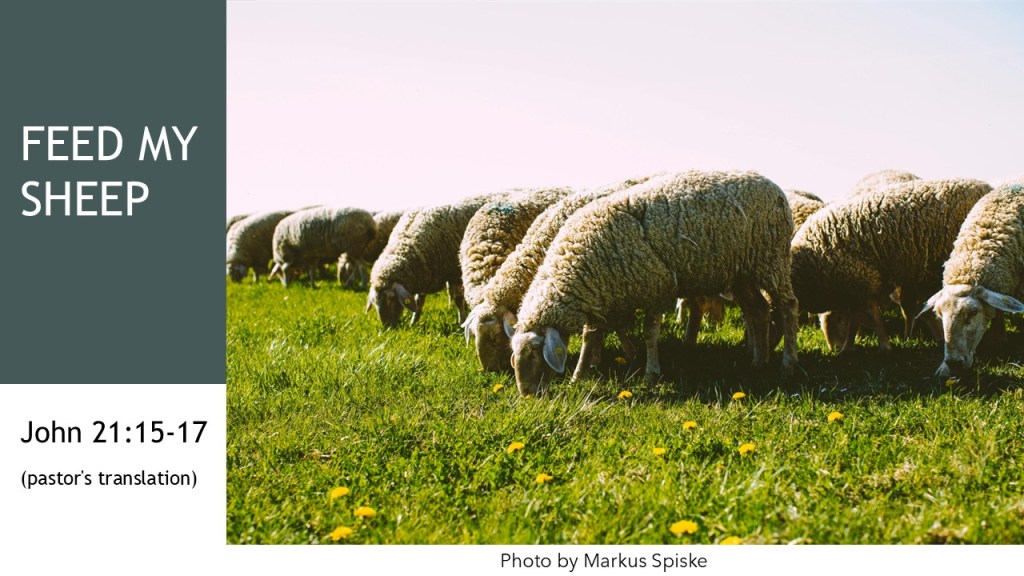
FEED MY SHEEP   

FEED MY SHEEP   

John 21:15-17 (pastor’s translation)

15  When they had eaten breakfast, Jesus asked Simon Peter, “Simon, son of John, do you care about me more than these?” “Yes, Lord,” he said to him, “you are aware that I have regard for you.” “Feed my lambs,” he told him. 16 He asked him a second time, “Simon, son of John, do you care about me?” “Yes, Lord,” he said, “you are aware that I have regard for you.” “Shepherd my sheep,” he told him. 17 He asked him the third time, “Simon, son of John, do you have regard for me?” Peter was so grieved that he asked him the third time, “Do you have regard for me?” He said, “Lord, you are aware of everything; you are aware that I have regard for you.” “Feed my sheep,” Jesus said.

The incident that John described in today’s passage fell between our Lord’s resurrection and his ascension to heaven. Peter had decided to go fishing and had a disappointing night because they had caught nothing. But Jesus intervened and told them to throw the net on the right side of the boat. They caught so many fish that they could not haul in the net. Some of the other disciples came and assisted them in recovering the net. When they went onto the shore, Jesus instructed them to bring some of the fish they had caught. He had already started a charcoal fire. The conversation Jesus had with Jesus took place at this fireside.

This passage is about Peter’s grief.

The fact that they were at a campfire and Jesus asked essentially the same question three times got Peter’s memory going. He remembered another fireside – on the night of Jesus’ crucifixion. On that night the people had built a fire to keep warm, and Peter had approached the fire, hoping that nobody would recognize him. Sure enough, three different people had asked him if he knew this criminal – Jesus. Three times, Peter had denied knowing Jesus and being his disciple.

Our text says that Peter was so grieved that Jesus had asked him the same question three times. He was grieved that when challenged, he had chosen to deny Christ rather than admit that he had been his disciple. Peter had boasted that he would follow Jesus even if he had to die doing it. But when the time for testing came, Peter chickened out. The rooster crowed, and Peter had broken down in shame and grief. He was grieving not only because his master was being condemned. He was also grieving because he (Peter) had not lived up to his promise. He proved to be not as committed as he said he was.

Each of us who tries to live the Christian life will find ourselves in such situations. We will see that our actions do not match our testimony. As much as we love Jesus and declare our allegiance to him, we will discover times when we fail to live the life we want to live. We will be seriously disappointed with ourselves.

I’m glad that this passage is in the Bible. It tells us something about our loving Savior. It tells us that when we have failed him in the most public and shameful ways, Jesus will still be waiting at the seashore, ready to talk about it over breakfast. If we did not have this passage, we might be tempted to think that Jesus would reject us as soon as we fail to admit our loyalty to him. But this passage tells us that the one who taught us to forgive seventy times seven is going to be there for us with love and forgiveness.

This passage is about Peter’s love.

Y’all know that I do not normally use my translation when preaching. I usually use a modern translation that is available to anyone. However, I chose to use my translation because the modern translations and the ancient ones all have problems translating the passage. The difficulty is found in the fact that the passage was originally written in Greek with two different words, both of which are usually translated with the same word in English. The Greek words are ἀγαπάω and φιλέω. John is using these two words because even though both can be translated with our English word love, each has a different connotation. Each denotes a different aspect of love.

In order to show the differences between the two words being used, in my translation, I translate both words differently. I chose not to use the word love in my translation because it would not be clear which word was being used in Greek. When ἀγαπάω is used, I translate the word “care about.” When you care about someone, the focus is on what you can do for them. When φιλέω is used, I translate it as “have regard for.” When you have regard for someone, the focus is on appreciation for who they are and what they have done for you.

So, here again is my translation of the conversation:

“Jesus asked Simon Peter, “Simon, son of John, do you care about (ἀγαπάω) me more than these?” “Yes, Lord,” he said to him, “you are aware that I have regard for (φιλέω) you.” “Feed my lambs,” he told him. 16 He asked him a second time, “Simon, son of John, do you care about (ἀγαπάω) me?” “Yes, Lord,” he said, “you are aware that I have regard for (φιλέω) you.” “Shepherd my sheep,” he told him. 17 He asked him the third time, “Simon, son of John, do you have regard for (φιλέω) me?” Peter was so grieved that he asked him the third time, “Do you have regard for (φιλέω) me?” He said, “Lord, you are aware of everything; you are aware that I have regard for (φιλέω) you.”

Peter had grieved because he knew that he had dissapointed Jesus when he denied him at his crucifixion. His grief was natural because he cared about Jesus. He did not want to disappoint him again. But Jesus was teaching Peter that he didn’t want Peter to focus on his concern for Jesus. He wanted Peter to concentrate on his admiration and appreciation of Jesus because that is what he needed to be successful in his future ministry. In other words, his future ministry had to be based on the greatness of his master, not the strength of his concern for his master.

This passage is about Peter’s mission.

That is why Jesus kept telling Peter to feed and shepherd his sheep. Peter had to get his mind focused on his mission because that was to be the means by which he proved his regard for his master. The story began with Jesus asking Peter, “Do you care about me more than these?”  Who were the “these”? They were the fish. Peter had decided to go fishing. Jesus first met Peter when he was out fishing. Jesus called Peter and three other fishermen to follow him, and he would make them fishers of people.

The new mission required a new metaphor. The old metaphor was good enough when the disciples’ primary ministry was evangelism. Jesus made them fishers of people because their primary responsibility was to catch people in the net—to win them to Christ. They would still be doing that, but Jesus was adding a new ministry when he told them to feed and shepherd his flock.

The new mission was to assist and lead the congregations to maturity in Christ. This would be proof of their high regard for their master. Jesus had given them a new commandment: to love one another. Now, he was giving them a new mission to nurture and protect all the sheep in the fold.

The Lord has been dealing with me on the issue of feeding the flock as well. For this coming year, he wants me to focus on getting this congregation into the word of God on a regular basis. I am introducing a new calendar for the coming year. Each day of the calendar has a reference to two chapters from the Bible. We will be beginning in Genesis and reading through the Bible, finishing with Revelation in the middle of 2026. Each month, you will get a new calendar with the month’s readings. Each Sunday, I will take my Scripture passage from that Sunday’s texts. I want us to commit to reading or listening to those two chapters every day if possible. The Sunday School lessons will also be taken from that week’s readings.

There is more to spiritual growth and maturity than just reading the Bible regularly. But one of the reasons Christians stay spiritually immature is that they do not get into the word and let it nourish them. As a congregation, we are responsible to feed the sheep in this community. I want us to get more biblically literate because it is one of the means of becoming more spiritually mature. As we are preparing to begin a new year, let us take the opportunity to establish some new patterns. One of the most critical new patterns that anyone can set is to have a regular plan for reading and studying the Bible. As you read, if you encounter a word or phrase you do not understand, write it down to discuss on Sunday. You can also email or text me with a question.

The owner of the flock wants us all to be well-fed and strong. Let’s commit to becoming a congregation that knows the Word and lives by it. God bless y’all.

A quote from Piney Grove Pulpit #3:

““Make yourself an ark of gopher wood” (Genesis 6:14).

Noah’s response was that he “built an ark to deliver his family.” He built it by faith. Nobody had built such a thing before. There was no precedent. There hadn’t been any need before. God himself had to give Noah the blueprint for the thing. Building the ark was something that was going to be very hard to do, and it was going to take a lot of effort and resources to do it.

But … and this is very important… it could be done. God sometimes calls you and me to do the impossible, but most of the time he just calls us to do the impractical, to test our resolve and commitment to him. God didn’t call Noah to build a spaceship. A boat was what was needed, and Noah could do that. Noah’s faith helped him to respond appropriately to his fear and build that boat.”


WITH POWER AND GLORY 

WITH POWER AND GLORY 

Luke 21:27 NET.

“Then they will see the Son of Man arriving in a cloud with power and great glory.”

The prophets predict Christ’s advents.

Numerous prophets predicted many aspects of the birth and life of Jesus Christ.

  • His virgin birth was predicted in Genesis 3 and Isaiah 7.
  • He would descend from Abraham according to Genesis 12.
  • He would descend from Isaac according to Genesis 17.
  • He would descend from Jacob according to Numbers 24.
  • He would belong to the tribe of Judah (Genesis 49).
  • The timing of his coming was during the Roman Empire, according to Daniel 9.
  • The killing of the children in Bethlehem was predicted in Jeremiah 31.
  • His family’s escape to Egypt was predicted in Hosea 11.
  • God would declare him to be his Son according to Psalm 2.
  • God made him a priest of the order of Melchizedek, according to Psalm 110.
  • He would begin his ministry in Galilee, according to Isaiah 9.
  • He would be a prophet in Israel, according to Deuteronomy 18.
  • He would have a ministry of healing and deliverance, according to Isaiah 61.
  • His nation would reject him, according to Isaiah 53.
  • He would enter Jerusalem triumphantly riding on a colt (Zechariah 9).
  • He would be betrayed by a familiar friend (Psalm 41).
  • He would be sold for 30 pieces of silver (Zechariah 11).
  • He would be accused by false witnesses (Psalm 35).
  • He would remain silent at his trial (Isaiah 53).
  • He would be beaten and spat upon (Isaiah 50).
  • His suffering would not be for his sins, but for ours (Isaiah 53).
  • They would pierce his hands and feet and side (Zechariah 12).
  • Soldiers would gamble for his clothing (psalm 22).
  • He would be buried with the rich (Isaiah 53).
  • He would rise from the dead (Psalms 16 and 49).
  • He would ascend to God’s right hand ((Psalm 68).

Some of the prophecies describe both Christ’s first coming and his second coming.

  • “For a child has been born to us, a son has been given to us. He shoulders responsibility and is called a Wonderful Counselor, Mighty God, Everlasting Father, and Prince of Peace. His dominion will be vast, and he will bring immeasurable prosperity. He will rule on David’s throne and over David’s kingdom, establishing it and strengthening it by promoting justice and fairness, from this time forward and forevermore” (Isaiah 9:6-7).
  • “As for you, Bethlehem Ephrathah, seemingly insignificant among the clans of Judah — from you, a king will emerge who will rule over Israel on my behalf, one whose origins are in the distant past” (Micah 5:2).

The New Testament picks up where the Old Testament left off. Jesus himself predicted his return numerous times. We examined many of those predictions when we looked at the eschatological discourse over several weeks this year. Today’s text is part of that eschatological discourse. It is in the context of Jesus answering the specific question of his second coming. The disciples had asked what would be the sign of his coming (Matthew 24:3). Jesus said that there would be many signs in the sun and moon and stars and that the world would be in distress, anxious over the roaring of the sea and the surging waves.

People will faint from fear and from expectation of what is coming because the powers of the sky will be shaken. There will be many signs, but these will not be preliminary signs. There will be signs that it is too late. That is why the world will panic.

The angels announce Christ’s advents.

The angels appeared to the shepherds in the fields and to Joseph, Zechariah, and Mary in the birth narratives of the Gospels. They also announced his second advent. They said, “This same Jesus who has been taken up from you into heaven will come back in the same way you saw him go into heaven” (Acts 1:11).

Jesus said that when he returned, “he will send his angels with a loud trumpet blast, and they will gather his elect from the four winds, from one end of the sky to the other” Matthew 24:31. He also said that “When the Son of Man comes in his glory and all the angels with him, then he will sit on his glorious throne” (Matthew 25:31).

Whenever God does something significant, he brings his angels along. It is right for us to celebrate the miraculous birth of Christ. We should also herald the second coming because it, too, is a long-awaited event. Heaven itself looks forward to the day when the rightful heir takes back his kingdom from the one who stole it.

The stars announce Christ’s advents.

The wise men found a star in the sky and knew that it meant a new

king had been born. They followed the sign in the sky to Jesus. Signs in the sky will also announce the second coming. Jesus said that there would be many signs in the sun and moon and stars and that the world would be in distress, anxious over the roaring of the sea and the surging waves. People will be fainting from fear and from the expectation of what is coming in the world because the powers of the sky will be shaken.

Some think that it is human destiny to expand into the stars. They wonder if there is life on other planets and in other solar systems. Some think that our lives are controlled by the stars associated with the month of our births. They think that they can get wisdom by reading their horoscope every day.

The truth is there is a message that the stars have to tell us. It is an ancient message about the Son of God coming to earth. The star announced his first coming, and the stars will signify his second coming. But God’s wisdom is for those who look past the sign and pay attention to what it signifies. The wise men rejoiced when they saw the star because they knew that it meant a king had been born. They let the sign lead them to Jesus. That is what we should be doing as well.

The shepherds announce Christ’s advents.

We recently looked at the story of the shepherds again. When they learned from the angels that Jesus had been born, they left in a hurry to find him. After they met Jesus, they did not run back to their day jobs. They had to go into the villages and tell people about Jesus. We would do well to follow their example.

In fact, those of us who are shepherds of God’s flock today have it as our primary task to take care of his sheep. One of the major responsibilities we have is proclaiming the gospel to everyone. The next major prophetic event that will happen is the return of our Lord, and we must make sure that everyone is ready for that event.

The apostle Paul described himself as set apart for the gospel of God. Paul was capable of many things—things he could do—but he must do only one thing: get the good news out.

Jesus said that when he returns to this planet, its inhabitants will see him arriving in a cloud with power and great glory.” That will be the moment when the unbelieving world will be forced to admit that they have rejected the only truth that ultimately matters. They will see him. They will know for real that he exists. They will come face to face with the king of the universe and recognize that no matter what nation they live in, he is their king. But they will know that they have rejected their king. There will be weeping and gnashing of teeth. They will know that God had a wonderful plan for their lives, but they rejected that plan. They told God that they would not have his Son rule over them.

When he comes, it will be in a cloud. The angels’ prophecy will be fulfilled. Just as Jesus disappeared into the clouds when he ascended, he will return in the same way that he left. And everyone will see him – even those who pierced his hands, feet, and side at his crucifixion. Many live their entire lives today, actively ignoring Jesus Christ. On that day, no one will have the privilege of ignoring him. They will be calling for the mountains to fall on them to hide them from his presence. But there will be no hiding from him ever again. Adam and Eve tried to hide from God in the Garden of Eden. But when he came, they could not hide. When our Lord comes again, everyone will stand before him. He will decide their fate and reveal their destiny. Some will experience the destiny of permanent death in the lake of fire – the second death. Others will be welcomed into eternal life in his forever kingdom.

He came at first as a humble child lying in a borrowed manger. When he comes again, it will be with power and great glory. Those who welcome him into their lives today will share in that power and glory. No matter what lowly standards we live by today, every believer has a glorious inheritance bought and payed for by the blood of Christ. The Bible says that Jesus had to suffer many things before he returned to glory. We will also suffer many things in this life. But we will share in the glory of his return. On that day, and forever afterward, we will forget all our suffering because of the joy of the new life we will have. Our king will come and take his glorious throne. That day will be a glorious day for him and us.

As we celebrate the first Advent of Christ, we can also focus on the second Advent. His coming into power and great glory is a gift we can all anticipate. It won’t be under the tree this Christmas, but hopefully, it will come soon. Hopefully, we will all be ready.

GLORY TO ISRAEL 

GLORY TO ISRAEL 

Luke 2:32 NET.

“a light, for revelation to the Gentiles, and for glory to your people Israel.”

When Mary and Joseph took the baby Jesus to the temple in Jerusalem to dedicate him, they encountered two prophets: a man named Simeon and a woman named Anna. Today we are going to focus on the prophetic statement that Simeon made that day. Simeon is described in this chapter as “righteous and devout.” Those two words say a lot. They speak of Simeon’s outward character and his inward loyalty to God. He was a man who did the right thing toward others and also stayed faithful to God and cultivated a close relationship with God. We would all do well to focus on those two things.

This chapter also says that Simeon had an expectation – a hope. It says that he was “looking for the restoration of Israel.” It did not elaborate on that statement, so we don’t know in what sense Simeon expected Israel to be restored. We know from history (including the history in the Gospels themselves) that Israel was a nation in captivity. Rome ruled an empire that expanded to include the known world at that time. All of Israel was engulfed in that empire. Caesar ruled over the whole empire and all the rulers of the various regions had their rulers who were subservient to Rome. When Joseph and Mary traveled from Nazareth to Bethlehem, they moved from one region to the next. Nazareth was part of the Roman Provence of Galilee. Bethlehem and Jerusalem were parts of the Roman Provence of Judea. Israel wanted to be free from Rome’s power. They had gained their freedom from Greece for a time under the Maccabees. But that freedom was short-lived. Perhaps Simeon was praying for and hoping for his nation to be restored to independence.

But since Simeon was a devout prophet of God, he hoped for more than that. His aspirations for his homeland were more than political. He wanted a spiritual restoration for Israel. Like the Old Testament prophets, Simeon longed for a day when his nation would truly be the people of God and foremost in proclaiming and living the word of God. Simeon was not just a player in the drama of the temple. He was tuned in to the power that the temple represented: the presence of God among human beings. This chapter says that the Holy Spirit was upon him. That was the best that any believer could expect before Pentecost. The Holy Spirit of God used him to declare the word of God to the people of God.

The Holy Spirit had also given a particular message to Simeon about his own life and ministry. He had told Simeon that he would not die until he saw with his own eyes the Anointed Messiah of Israel: the Christ. Simeon had a calling to a particular ministry. That calling would continue until he fulfilled it. He would know when his ministry was complete by the sign that one day when he entered the temple, the Messiah would be there. Perhaps Simeon imagined a triumphant Messiah coming into the temple to take over and lead his people to glory. We don’t know.

We only know that Simeon was watching for the moment when he would see his savior face to face. That moment arrived, and Simeon did not miss it. Joseph and Mary came into the temple with a little bundle of joy. Jesus was 40 days old. Because Jesus was the firstborn male of Joseph and Mary’s family, he was to be formally presented to the Lord and redeemed according to this law. The ritual celebrated God’s deliverance of all the firstborn males from the destroying angel in Egypt. When the destroying angel saw the blood of the lamb on the doorposts of the Hebrew slaves, he did not enter those houses and take the lives of the firstborn males within them. The ritual celebrated that deliverance.

What Mary and Joseph did that day was to redeem the Redeemer ritually. They paid the price for their son, who would one day pay the price for everyone’s sons and daughters. The angels in heaven were watching.

Simeon was watching too. The moment he saw that child, Simeon knew that his life’s work had been completed. This chapter says that “Simeon, directed by the Spirit, came into the temple courts, and when the parents brought in the child Jesus to do for him what was customary according to the law, Simeon took him in his arms and blessed God, saying, “Now, according to your word, Sovereign Lord, permit your servant to depart in peace. For my eyes have seen your salvation that you have prepared in the presence of all peoples.” It is in that context that we read the verse that is today’s text.

Simeon said that Jesus is a light shining from heaven to earth.

When all creation was in darkness, seen only by the creator, he said four words (actually two words in Hebrew): “Let there be light.” From that time on, God has been the one to bring light to the darkness.

One of the plagues in Egypt was a plague of darkness. Exodus 10 says, “The LORD said to Moses, “Extend your hand toward heaven so that there may be darkness over the land of Egypt, a darkness so thick it can be felt.” So Moses extended his hand toward heaven, and there was absolute darkness throughout the land of Egypt for three days. No one could see another person, and no one could rise from his place for three days. But the Israelites had light in the places where they lived.”

The theme of God bringing light to his people amid the darkness of unbelief runs throughout the Old Testament. When the Israelites traveled by night in the wilderness, God provided a fiery light to direct them all night long. Psalm 78:14 says, “He led them with a cloud by day, and with the light of a fire all night long.” Psalm 97:11 says. “The godly bask in the light.” Psalm 112:4 says, “In the darkness, a light shines for the godly, for each one who is merciful, compassionate, and just.”

Isaiah prophesied that the Messiah would come and appear first in a particular region. He said, “The gloom will be dispelled for those who were anxious. In earlier times, he humiliated the land of Zebulun and the land of Naphtali, but now he brings honor to the way of the sea, the region beyond the Jordan, and Galilee of the nations. The people walking in darkness see a bright light; the light shines on those who live in a land of deep darkness” (Isaiah 9:1-2).

Did you catch that? Isaiah predicted the exact region where the Messiah would begin his earthly ministry. It would be in the land where the tribes of Zebulun and Naphtali were apportioned property. It would be the land that the Gentiles called Galilee. 700 years later, who shows up in the tiny village of Nazareth in Galilee? A carpenter’s son named Jesus. Simeon said that Jesus would be a light shining from heaven to earth. It would first start shining in Galilee.

Simeon also said that Jesus revealed God’s will to the Gentiles.

The prophet Simeon predicted that Jesus would have a ministry among the Gentiles. That, itself, was not unheard of. Many of Israel’s great heroes had a profound influence on the Gentiles and Gentile rulers. But Simeon predicted that God would reveal himself to the Gentiles through Jesus. You and I are in this place right now, declaring our love for God because Jesus did just that. He was the door for the sheep allowing sheep from other pastures into the fold. As Gentiles, we did not have a way to the Father. But Jesus came and proclaimed that he is the Way, the Truth, and the Life and that everyone and anyone can come to the Father through him.

Jesus revealed God’s love to the Gentiles. He said, “For this is the way God loved the world: He gave his one and only Son so that everyone who believes in him will not perish but have eternal life. For God did not send his Son into the world to condemn the world, but that the world should be saved through him” (John 3:16-17). The Old Testament revealed that God loved Israel and rescued it from Egypt. Jesus revealed to the Gentiles that God loved us too. He loved us and provided for our rescue by sending his Son – not just to Israel, but to the planet, and anyone – Jew or Gentile – who believes in Jesus will not have to perish in hell but can be rescued and have eternal life.

Jesus revealed God’s truth to the Gentiles. He spoke that truth to anyone who had ears to hear – whether those ears were Jewish or Gentile – it didn’t matter. He commissioned his apostles to launch their mission work starting from Jerusalem, but to expand into all of Judea, then into Samaria, and to keep going until they reach the farthest parts of the earth (Acts 1:8). The gospel message was to go to all the nations. The word “nations” in Matthew 28 is the same word in today’s text that is translated as “Gentiles.” You and I are in Christ because Jesus’ message and ministry were designed to reach us. It was not a cosmic accident. Jesus was never meant to be the exclusive property of one ethnic group. He is King of all kings and Lord of all lords. We are to send the proclamation over vale and hill that whosoever will may come to Jesus.

But Simeon also said that Jesus brought eternal glory to Israel.

In light of what we know about the universal nature of Christ’s gospel message and the universal scope of his deliverance, what did Simeon mean when he said that Jesus was for glory to Israel?

Paul addresses this question in his epistle to the Romans. He makes it quite clear that everyone is a sinner and needs salvation, and everyone can get saved only by repenting of their sins and putting their faith in Christ. So, salvation is not a particular gift to Jews. It is for everyone. So, Paul asks what advantage does the Jew have. Being a Jew himself, Paul could answer his question. He said that the Jews were entrusted with the oracles of God (Romans 3:2). Before it was our Old Testament, it was their Hebrew Bible. It’s possible to become a Christian without the Old Testament, but those 39 books explain much of what appears in the latter 27 books.

Jesus himself said that “salvation is from the Jews” (John 4:22). The gospel message was first proclaimed in that cultural context, which makes the Jew more likely to understand its basic principles, provided those ideas are believed. Of course, many Jews rejected the gospel, and they are not going to be saved. God does not have two kingdoms. He is not going to save anyone just because of their ethnic heritage. He responds to one thing: faith in his Son.

So, why did Simeon say that Jesus would bring glory to Israel? Remember, when we defined the word glory, we noted that its opposite is shame. Jesus brought glory to Israel because theirs was the nation and culture into which God sent his Son. If he was to be born a man, he had to be born into a nation and live with a particular culture. Israel has the distinction of being the nation to which God sent his prophets. God sent salvation to the Jewish patriarchs. He sent his precious promises through the Old Testament authors by his Holy Spirit. “When the appropriate time had come, God sent out his Son, born of a woman, born under the (Jewish) law, to redeem those who were under the law, so that we may be adopted as sons with full rights” (Galatians 4:4-5).

God took this shameful culture, steeped in sin, and sent us his only begotten Son through them. His human ancestry was Jewish. God’s eternal kingdom is laid upon the foundations of the New Testament apostles (who were all Jewish) and the Old Testament prophets (who were all Jewish). Even though many things were shameful and wrong about Israel, God, in his grace, chose to glorify that nation by sending us our Redeemer from that nation. They had been longing for a Messiah who would come and ransom captive Israel. He came, and because God is not a respecter of persons, he offered redemption not just for Israel but for all nations.

So, Simeon was right on both counts. The baby boy that he blessed that day would grow up to be a revelation from God to the Gentiles and bring glory to Israel. All across this planet today, people from all nations and ethnic backgrounds are worshipping him and praying in his name. But there is a land which we call the holy land. It is a unique land because God sent us a savior and he walked and lived and preached and died and rose again in that land.

LORD GOD, thank you for your Son, Jesus Christ. Thank you for that nation through whom you have given us this great gift. Thank you that anyone can receive this gift, regardless of our ancestry. He is our gift from your grace. Amen.

Jeff’s Books available through Amazon!

GLORY TO GOD 

GLORY TO GOD 

Luke 2:14 NET.

“Glory to God in the highest, and on earth peace among people with whom he is pleased!”

We are back in the fields with the shepherds today. We are focusing on the words that the army of angels said after the angel had given his message to the shepherds. Are you aware that you know a little Latin? Yes, you do. In fact you just sang in Latin when we were singing “Angels We Have Heard on High.” “Gloria in Excelsis Deo” is one way of translating “Glory to God in the highest” in Latin.

The English word glory sometimes means the impressive appearance of someone or something. When we see something amazing, we might call it glorious. Luke used this word when he said that the glory of the Lord shone around the shepherds.

But there is another meaning of the word. It sometimes refers to the fame, renown, praise, and honor that someone is due. The opposite of glory is shame. What the angles appear to be saying is that the greatest glory belongs to the greatest God—the God who created all things and rules all things.

You will notice that I used the word “saying” there instead of “singing.” The Christmas cards and carols are wrong. The Bible does not tell us that these angels were singing. It says that they were praising God and saying something.

It probably felt like they were singing. They were, after all, angels. Their voices probably resonated throughout the countryside. When these shepherds went into the towns and villages to share the good news that these angels told them, the villagers probably asked them what all that racket was about. I imagine those angel voices shook the mountains. When the shepherds went to tell the good news on the mountains, over the hills and everywhere, they were explaining the miraculous supernatural event that they experienced firsthand. When they told the villagers about the baby boy in the manger, they could explain that he was the one that all this noise was about.

Well, once again, I have to say that it was not exactly a silent night. It was a typically quiet night up until the army of angels showed up and started praising God and talking about his glory. Then, it became a noisy night. The angels were noisy, and they passed the noise on to the shepherds. The shepherds went to see Jesus, and then they gossipped the gospel throughout the countryside. I imagine the silence was broken that night and people would be talking about that noisy night for years afterward.

On that night God’s glory shone around the shepherds. On that night, God’s glory was celebrated by the angels, then by the shepherds, and then by all the believers who heard the message that the king had been born. I want to talk about that glory today.

God’s glory is a message.

The message is about God, who lives in the highest place. We call that place heaven. It is the realm in which God resides and the realm over which he presides. No human being had ever seen that glory. Some of the people of God had come close to seeing it. But God does not share his visible glory with the likes of us. We can only imagine what it is like to be in the visible presence of Almighty God. Some have even dared to describe what it might be like, but all the descriptions we have ever heard or read about do not approach any proximity of accuracy.

Those angels celebrated this marvelous glory of Almighty God that night. The angel Gabriel – when he was sent to share the good news with Zechariah – told him, “I am Gabriel, who stands in the presence of God, and I was sent to speak to you and to bring you this good news” (Luke 1:19). Imagine standing in the presence of God. I don’t feel worthy even to lie prostrate in the presence of God. But this mighty angel stands in the presence of his creator without shame. He is one of God’s sacred angels. He is in another category – he is not a fallen creature, like all of us human beings are.

We miserable mortal creatures have decided that we are going to launch ourselves into space to see what is up there – to reach what is out there. We can go farther than we had ever imagined, but we have never reached the highest place. We never will reach the highest place. The Bible says that no one has ascended into heaven except the one who descended from heaven — that is Jesus himself (John 3:13). I hear a lot of people talking about dying and going to heaven. It is just not so. Religion has fostered that fallacy for generations, but the Bible denies it. Our goal in life is not to get to heaven but to be ready when heaven’s king comes back to earth.

One of the reasons that the angels were celebrating that night is that God was putting into action his plan to rescue humanity, and he had chosen this angelic army to begin the process of spreading that message. God’s glory is a message. It is a message that says that the God who lives in the highest place has decided to reach down to the lowest place. It is appropriate then, that these angelic messengers pass the baton on to these lowly shepherds. It is as if God is telling us that when he decides to act to redeem his fallen creatures, he is going to make that salvation available to everyone, great and small.

When we look at humanity as a whole, we see all kinds of differences. We see racial differences. I believe that black lives matter just as much as white lives. But we can talk about black lives because people who are African Americans grow up in a different world than those who are not. I am fortunate to have some black friends, but I can never be just like them because there is a difference that cannot be explained just by referencing the color of our skin. I was born into and live in a different world.

There are also socio-economic differences among human beings. We have a lower economic class, a middle class, and an upper class. Back in the biblical days, they also had a slave class. I thank God that we no longer have a slave class in America, but we do have many who are destined to live their whole lives as subservient to others. We have a long way to go before we can imagine a world in which there are no socio-economic differences.

There are also gender differences. God created us, male and female. Those differences are obvious. Some in our society today want to blur those distinctions. Some want to recreate the world and make it have several genders. Some want to medically alter themselves so that they can pretend to be a different gender than the one they were born as. Some want to turn gender distinctions into an opportunity to tyrannize others. It gets very complicated. But the fact that we were born with a gender difference is obvious.

There are also religious differences. There are different religions, denominations, and forms of atheism and agnosticism. There are fanatical cults and lukewarm pretenders. We cannot unify everyone under one religion because religions involve belief, and none of us believe the same things as anyone else.

When we look at all these differences, we discover that very few things are true of every human being. We are a divided species. But there is one thing that unites us because it is true of all of us: We are all part of a fallen species, a sinful species, a reprobate species. The message of glory is that our God is going to change that.

God’s glory is a mission.

The good news that the angels declared that night is the announcement that God in the highest place was beginning his mission to reach down and save all of us who live in the lowest place. So, the angels compared heaven (the highest) with earth. The earth is the mission field. It is characterized by sin, corruption, violence, and warfare. But God has made it his mission to bring peace on earth. He plans to bring peace back to the earth. He is not going to eradicate all our differences. But he does plan to deal with the sin problem because it is sin in us that turns all our differences into means of exploiting and hurting one another.

So, the Christmas cards get this one right. Christmas is a message of God’s mission to bring peace on earth. God is putting his plan into operation on this night, which will eventually result in a world restored to the original peace of the pre-fall paradise.

But some even manage to get this aspect of the mission wrong. They think that God has already brought peace to earth and we celebrate that on Christmas. They think that just by being born on this planet, Jesus has already undone the effects of sin and shame brought about by the fall. So, they misread what the angels declared that night.

The angels promised peace on earth “among people with whom he is pleased.” The peace that God brings only comes to some of the people on this planet. He is coming with a mission to eradicate sin. Only those who repent of their sins and put their faith in the Savior will experience redemption. They will know peace with God at first and will eventually experience universal peace from God when Christ restores all things.

That explains why Jesus said something that appears to contradict what the angels promised. He said, “Do not think that I have come to bring peace to the earth. I have not come to bring peace, but a sword” (Matthew 10:34). Jesus’ mission was not to bring peace to all of us but to bring peace to some of us. Those of us who put our faith in him will experience division, persecution, violence, and martyrdom at the hands of those who do believe. The mission to bring peace to Earth will happen in stages. The peace is always conditional. Those who accept peace with God will be at war with those who reject his peace.

This explains why our Christmas traditions are filled with stories of violence and rejection as well as stories of blessing and joy. Herod rejected God’s mission of peace and went to war, trying to eliminate the newborn king. The wise men were warned not to disclose the whereabouts of the holy family to Herod but to return to their country. The other newborns in Bethlehem and the surrounding towns are violently put to death. The sacred family are forced to become political refugees and flee to Egypt and live there as immigrants.

There is one more aspect implied in the angels’ doxology that I want to point out today.

God’s glory is a man.

Before the angelic army chanted their “Gloria in Excelsis Deo,” a single angel told the shepherds not to be afraid because he was here to proclaim the good news that brings great joy. The good news was that a baby boy had just been born. What made that good news glorious was that it announced the birth of the world’s only savior. He was born in Bethlehem, the city of David, and he is Christ the Lord. God’s glory is a man.  

What does the Bible say about that man? Our Declaration of Principles sums up the Bible’s description of Jesus. It says that Jesus Christ is “our Lord, the only begotten Son of God, conceived of the Holy Spirit, born of the Virgin Mary; who came into our world to seek and to save that which was lost; who died for our sins; who was raised bodily from the dead for our justification; who ascended in heaven as our High Priest and Mediator, and who will come again in the end of this age, to judge the living and the dead, and to reign forever and ever.”

The Bible also expresses who Jesus is by different titles that he holds.  Moses called him the Rock. Job called him his Redeemer.  Isaiah called him the Prince of Peace and Immanuel (God with Us). Jeremiah called him the Branch. God called him his Beloved Son. The angel called him the Christ – the Messiah – Anointed One. Jesus called himself the Vine, the Bread of Life, the Way, the Truth and the Life, and the “I Am,” Matthew called him the Son of Man.  John called him the Word, the Alpha and Omega, the Good Shepherd, the Lion of Judah, the Bridegroom, the King of Kings, the Bright and Morning Star, and the Lamb of God. Paul called him the Chief Cornerstone. The Author of Hebrews called him the Mediator.

Each of Jesus’ titles reflects a relationship that he has with us as his followers and something about his mission. God has a glorious message and a glorious mission and they all center around this glorious man. He stands at the center of time and calls everyone to himself. Christmas comes every year, but Jesus only came as our savior once. The next time he comes, it will be to fulfill the rest of the Bible’s promises about him. He is coming in his glory because God’s full mission to bring his glory and peace to earth has not been accomplished. As we celebrate the first advent of our Lord this year, let’s keep in mind that however spectacular that event was, his second advent will be even more glorious. Let’s get ready for that.

Jeff’s books available at Amazon.com

THE GLORY SHONE

THE GLORY SHONE

Luke 2:9 NET.

“An angel of the Lord appeared to them, and the glory of the Lord shone around them, and they were absolutely terrified.”

Two years ago, we examined the shepherd’s story, but this year, we are going to begin our Christmas series by zooming in on one incident in that story. The very first thing the shepherds saw that night was an angel. At first, it was just one angel. The text says that the glory of the Lord shone around them. It wasn’t just an angel with the glory of the Lord around him. When the angel appeared, the glory of the Lord shone around all of the shepherds.

the story begins in terror

If it was really a silent night when the angel showed up, it was because the shepherds were scared and speechless. We Christians sometimes talk about angels as if they are warm and fuzzy creatures who make everybody smile, but the picture we get in the Bible is that angels are supernatural warriors who are a force to be reckoned with. In fact, all it takes is one angel to slaughter an entire army.

The Apostle Paul wrote to the Corinthians that they should not be immoral as some of the Israelites were in the wilderness. He spoke about the time when 23,000 immoral Israelites died in a single day. Paul told the Corinthians not to “put Christ to the test, as some of them did, and were destroyed by snakes.” He told them not to “complain, as some of them did and were killed by the destroying angel” (1 Corinthians 10:8-10). All it took was one angel to destroy thousands. All it took was one angel to kill all the firstborns in Egypt not protected by the blood of the lamb.

So, when the shepherds saw the angel on that first Christmas night, they didn’t feel like singing. They did not feel warm and fuzzy. They could only feel what anyone would feel when faced with an uncontrollable danger. Lions and tigers and bears, Oh my! An angel. Oh my, Oh my!

So, first contact had all the makings of a terrorist attack. Nobody would ever imagine that two thousand years later, we would be celebrating the event with Christmas cards, gifts, and chocolates! When the prophets saw angelic beings in visions, they had so little experience with their form that they often described them by saying that they looked like fierce beasts with a head of a “this” and legs like a “that.” Part of their terror was the fact that they looked so unusual.

But, then, sometimes, they looked just like a man. The angels sent to destroy Sodom looked like ordinary men – so much so that the corrupt inhabitants of Sodom wanted to abuse them. Lot realized that they were not the simple men they looked like. Joshua encountered the Angel of the Lord and dared to ask him whose side he was on – was he for the Israelites or their enemies? The angel told him that he was the commander of the Lord’s army. At that, Joshua “bowed down with his face to the ground and asked, “What does my master want to say to his servant?”

In the Book of Daniel, an angel appeared as just the palm and fingers of a human hand writing something on a wall. King Belshazzar saw it, and the color drained from his face. The joints of his hips gave way, and his knees began knocking together. He was terrified and visibly shaken (Daniel 5). All it took was this meager demonstration of God’s power to take down the pride of the most powerful man in the empire.

Now, these men out in the fields that night were not powerful kings. They were just ordinary men. In fact, they were the lowest of the low. They were humble shepherds. As shepherds, they were probably pretty tough. They kept watch over their flocks. They were perhaps prepared if a wolf or lion came after their sheep. But they saw that angel, and they were absolutely terrified. It was not just their sheep who seemed in danger. They saw an angel. They were probably convinced that it would be the last thing they saw.

Add to that, the glory of the Lord shone all around them. It was night-time. None of these me had ever seen a flashlight, much less the glory of the Lord. It was a brilliant light, brighter than anything in their experience, and it shone all around them. Their first feeling was not the blessed assurance of their salvation. It was a desperate feeling of doom and impending destruction.

But the story ends in joy.

The angel immediately tells them not to be afraid because he is not coming to destroy them. Angels are agents sent from heaven. An angel is a messenger. The message can be bad news or good news. On this occasion, the message is good news. He said, “Do not be afraid! Listen carefully, for I proclaim to you good news that brings great joy to all the people: Today, your Savior is born in the city of David. He is Christ the Lord. This will be a sign for you: You will find a baby wrapped in strips of cloth and lying in a manger” (Luke 2:10-12).

A woman travails in labor – sometimes for hours while her anxious friends and family await the news in anticipation and trepidation. Then the news comes in just three words: “It’s a girl” or “It’s a boy.” The last message these shepherds expected to hear that night was, “It’s a boy.” But that was the angel’s message.

The wise men from another country got the message when they observed his star. That sent them on a mission to find this newborn king and honor him with gifts. Despite the Christmas mythology, they didn’t show up that night. They came later after Mary, Joseph, and Jesus had moved into a house in Bethlehem.

But that night, when the angel told the shepherds that it was a boy, they hurried to find this newborn. When the wise men saw the star, they were overjoyed. When the shepherds saw the baby, they rejoiced and spread the news. They “related what they had been told about this child and all who heard it were astonished at what the shepherds said” (Luke 2:17-18). Then, the shepherds returned, glorifying and praising God for all they had heard and seen; everything was just as they had been told (Luke 2:20).

The whole universe had been waiting for this good news. Paul told the Galatians that “when the appropriate time had come, God sent out his Son, born of a woman, born under the law, to redeem those who were under the law, so that we may be adopted as sons with full rights” (Galatians 4:4-5). Because he was born, we can be reborn. Because he lives, we have the option of living again and forever.

Today’s text suggests the question, how will you meet Jesus?

The glory of God that shone around the shepherds that night terrified them until they heard the good news. It was the Shekinah glory—the glory of God’s presence among his people. That was a one-time event, not to be repeated. But the Bible does speak of a time in the future when Jesus himself will appear in glory.

“When the Son of Man comes in his glory and all the angels with him, then he will sit on his glorious throne” (Matthew 25:31). When Jesus was born, he did not look glorious. He looked like an ordinary child. The shepherds had to be told that Jesus was the savior, or they would not have gone to look for him. His birth was normal, aside from the fact that his mother was a virgin.

The angel announced his birth with glory. A whole sky full of angels joined him to celebrate that good news. Then, the shepherds went to see Jesus. Many others went to see Jesus while he walked this earth. The apostles said, “We saw his glory — the glory of the one and only, full of grace and truth, who came from the Father” (John 1:14). But they saw his glory in a vision—on the Mount of Transfiguration. Jesus came in the flesh but not in his glory.

We are still waiting for when the Son comes in his glory. My question for you – brother or sister – is how will you meet Jesus.”  Will you meet him as your savior, master, and king? Will his coming terrify you or be a cause of great joy? The answer to that question will depend on your relationship with him now. When he comes, he will separate the faithful followers from the faithless pretenders. The sheep will be put on his right side, the goats on his left. The sheep will know the joy of a permanent life in his kingdom. The goats will depart from him, destined for a fire which is called the second death. It is a death from which there will be no resurrection. It is what Paul called the penalty of permanent destruction (2 Thessalonians 2:9). All of us will meet the same Jesus. For some, it will be a time of weeping and gnashing of teeth. For some, it will be a blessed reunion with our loved ones to be with the Lord forever. I cannot answer for you. I can only ask the question for you. I can answer the question for me because I have put my faith and hope in Jesus Christ, so my destiny is sure.

Is your destiny sure? If so, good. But I have one more question.

how will your neighbor meet Jesus?

Yes, that neighbor who you see on a regular basis as he comes and goes. When the shepherds got the good news, the first thing they wanted to do was go and see Jesus for themselves. Then, they did not rush back to their regular jobs and regular lives. They had to share the good news. It was too good to keep to themselves. They had the joy of meeting Jesus; then, they had the pleasure of sharing Jesus. But it was not just for their benefit. The villages around Bethlehem were filled with people who needed to know that God had not forgotten them. They needed to understand that a savior had been born.

Your neighbor needs to know that Jesus is not just a religious myth or an excuse to get together with family and pass out presents. Your neighbor needs to know the gospel. The Bible says, “Look! He is returning with the clouds, and every eye will see him, even those who pierced him, and all the tribes on the earth will mourn because of him” (Revelation 1:7). Why will the tribes of the earth mourn? They will mourn because they will meet Jesus as their judge, not as their savior. He must be one or the other. He will either be their savior and welcome them to permanent life, or he will be their judge and punish them with permanent destruction.

On that first Christmas night, the shepherds were given a great privilege. They saw the baby in a manger that all heaven had rejoiced over, and that experience caused them to rejoice as well. But with that great privilege came a great responsibility. The shepherds had to get the good news out. So, as you celebrate the birth of your savior this year, use this holiday period to reach out to your friends and neighbors and make sure they are ready to meet Jesus. Because, when he comes again, it will not be as a baby in a manger. He’s coming in his glory as king of kings and Lord of Lords.