WAITING 

WAITING  

Exodus 2:23-25 NET.

23 During that long period of time the king of Egypt died, and the Israelites groaned because of the slave labor. They cried out, and their desperate cry because of their slave labor went up to God. 24 God heard their groaning, God remembered his covenant with Abraham, with Isaac, and with Jacob, 25 God saw the Israelites, and God understood … .

Last week, we left the Patriarch Jacob staring at a bloody tunic, confident that he would die of grief because of the loss of his son, Joseph. He was wrong on both counts. He did not die of grief, and his son had not died in Gothan. Instead, Joseph was taken to Egypt, where he lived a tough life, ending up in prison. But God gave Joseph a special gift – the ability to interpret dreams. That gift eventually led to Joseph being released from prison and appointed second-in-command over all of Egypt. Joseph saved Egypt from a terrible famine, and his family joined him to live outr their lives in prosperity in that land.

The Book of Genesis ends with the death of Jacob and Joseph – both old and prosperous. Exodus begins with the good news that the Israelites “were fruitful, increased greatly, multiplied, and became extremely strong, so that the land was filled with them” (1:7). Then the other shoe dropped. The next verse says, “Then a new king, who did not know about Joseph, came to power over Egypt.” The new Pharaoh – and his nation with him – began to view the Israelites not as a blessing but as a threat. Likewise, the Israelites in that generation saw Egypt not as a blessing from God for their survival but as a curse to oppress and destroy them. The union of nations that had been their salvation had now become division and polarization.

while we wait, the world changes around us.

It did not happen overnight. It was not a drastic cataclysmic event that caused the two nations to turn against one another. While the people were living their lives and doing what they thought they should do, the world changed around them. There was no doubt a long period of prosperity for the Israelites in Egypt that led to their fulfilling the mandates of the Adamic and Noaic covenants – being fruitful and multiplying in the land of Egypt. However, it was this prosperity and multiplication that was seen as a threat to the new regime in Egypt. Thus, he ordered their oppression and hard labor and eventually demanded that they kill all their newborn males.

Chapter two tells of Moses’ birth, his rescue from the Nile by Pharaoh’s daughter, and his being reared as a prince in Egypt. It also records his taking vengeance on a brutal guard and killing him. This led to Moses having to flee Egypt and settle down in Midian as a shepherd. Meanwhile, the nation of Israel waits for its deliverance. That “long period” continues when it seems like nothing is happening.

When a cataclysmic event happens, we sometimes refer to it as an act of God. We think that God did it, or at least allowed it, to get our attention. But the Bible teaches that it is not just the times of upheaval and disaster in which God is active. He is just as real and just as active in the long periods of waiting. We can learn from these chapters in Exodus what we should be doing during our long times of waiting.

while we wait, we can cry out to God.

“During that long period of time, the king of Egypt died, and the Israelites groaned because of the slave labor. They cried out, and their desperate cry because of their slave labor went up to God.” Before they began experiencing oppression and slavery, the Israelites were not known for their relationship with God. They were just another nation living in a land of many such groups brought together by Pharaoh’s mighty empire. But the tide turned, and the Egyptian culture turned against them and isolated them as a nation of slaves that must be controlled. Suddenly, the Israelites started praying. Their prayers were not ritual prayers that parents teach their kids to pray at mealtime or bedtime. Their prayers were the groans and cries of a people being mistreated and oppressed.

It is a fact that hard times tend to cause people to reach out, try to find answers and seek change. For many, that desire for change leads to a more intense religious life. It is an attempt to take hold of a power higher than the power that is causing the trouble that they are facing.

Our Lord asked a question after he taught the parable of the persistent widow. He asked, “Won’t God give justice to his chosen ones, who cry out to him day and night? Will he delay long to help them? (Luke 18:7). In the parable, the widow was being treated unfairly, and she had no recourse but to cry out for help. She was commended for her persistence in doing just that. The Israelites in Egypt were in the same position. They were being mistreated. They were branded as enemies because the people in power feared them. They were made second-class citizens because of other people’s prejudice and ignorance.

The history of our world records many times when this has happened. Nazi Germany and the Holocaust is still fresh in our minds as a clear example of this phenomenon. But let’s open our eyes a little further. We might notice some similar situations closer to home: our own nation’s shameful treatment of Native Americans or Africans that we enslaved and deprived of their God-given rights.

Anything that we can do to make up for such shameful behavior is warranted. But what I am getting at is that such suffering can have a positive outcome. It is wrong, and it should never happen. Nobody is right to do it. But it can produce in the human heart a desire to be set free and a resulting cry to God for that deliverance. This is what was happening in the lives of those children of Jacob in Egypt. Their time of suffering was producing in them a connection with God that they had not felt during the time of prosperity and freedom.

All the elements of their oppression were already there among them before they started experiencing the oppression. They were living in a foreign land. They were under the control of a foreign king. That foreign king dictated their role in their society. But they were “getting along Ok” for a very long time until the oppression started. They should have been praying to their God during this time. They should have been seeking God and establishing a strong religious culture during this time. But it did not happen until the difficulties began.

while we wait, God is there.

Notice what today’s text says God was doing while his children were crying out to him. Verses 24-25 use four different verbs to describe what God was doing during this time. The temptation during long periods of waiting is to accuse God of doing nothing. We pray and pray and seek his face, but it seems like God is passive. Moses wants us to know that when the Israelites were crying out to God, he was anything but passive.

God heard their groaning. Moses used the Hebrew verb שָׁמַע. He used this word to describe how Adam and Eve heard God moving around in the Garden of Eden. It was the root of the name Ishmael, who was to be so named because God had heard Hagar’s painful groans. Moses used it to describe the way Joseph’s brothers felt when they remembered Joseph’s cries for mercy while he was down in the pit, but they refused to listen to him. Even if they ignored his cries, they most certainly heard them.

As we pray, we often wonder if anybody is listening. But the Bible tells us that God always hears. Even if the time may not be right for him to act, he still listens to our prayers. He can’t not hear them.

God remembered his covenant with Abraham, with Isaac, and with Jacob. This is the Hebrew verb זָכַר. The names Zachariah and Zechariah are based on that root. They mean Yahveh has remembered. This verb shows that God not only hears our prayers, but they actively remind him of his promises to us. God had made promises to Abraham and to each of the successive patriarchs who took up the mantle as representatives of his covenant. When the children of Israel cried out to God, he heard the voices of Abraham and the other Patriarchs.

As we age, our memory becomes… what was I saying? But our God is not like that. He remembers everything. Our prayers are important because they are linked to his promises. When we pray to God, everything he has promised us comes back to him. When the Israelites were praying because of their slavery and oppression, chances are they only prayed for immediate relief from that slavery. But God had promised so much more. The prayers of the Israelites set the stage for both the exodus and the conquest of Canaan. They prayed for some things, but God gave them more than what they asked for. The reason is that the prayers reminded God of all his promises.

Often, when we pray as believers today, we limit what we ask for to only the immediate emergencies that we are presently facing. When we do that, we are short-changing ourselves. We have a God who is capable of giving us so much more than we can ask for or even imagine having. That reminds me of the old story of the couple who booked passage on a luxury liner. They saw such glorious and delicious-looking food on the ship, but they hid away in their cabin and ate a few meager snacks that they had brought with them. They were not aware that the price they paid for their passage included all the fancy feasts on the ship. We often pray like that. We are so hesitant to ask God for anything.

However, Jesus tells us to ask, and it will be given to us. Seek, and we will find; knock, and the door will be opened to us. Why did he give us such an open-ended promise? Because our heavenly Father loves us and has an unlimited supply of resources to meet our needs. He wants to display his elaborate love to his children.

We often fail to ask for anything because we think we are unworthy. We are right. But the basis for prayer is not our worth but God’s grace. He blessed us with salvation when we came to him in repentance and admitted that we did not deserve it. He still responds to those who come to him with their need and trust in his love to meet those needs.

Verse 25 says that God saw the Israelites. This is the Hebrew word רָאָה, which we recently discussed in reference to the miracle at Moriah. The word means to see something, but it can also mean to see to something—to provide for what is needed. God not only saw the plight of the children of Israel, but he already had a solution for their problem. He had another land for them to live in. He had a way for them to be released from their slavery in Egypt. He had a way to provide for their needs as they traveled through the wilderness to Canaan. He had a way to defeat all the adversaries they would face on the way to Canaan.

I am reminded of a story about a computer company that had a problem. They had not been able to locate the source of the problem, much less devise a solution. So, they called in an expert. The expert examined the machine – pulled out a piece of chalk, and marked an X on the spot where the problem was. The company’s accountants were thrilled to have a solution to their problem, but they were pretty surprised when the expert sent them a bill for $50,000. They wrote the expert demanding that he present them with an itemized bill. Later, he wrote them back with a bill consisting of two entries:

  • One chalk mark: $1.
  • Knowing where to put the X: $49,999.

When the Bible says that God sees us, it means more than just that he recognizes our problems. It also means that he already knows the best solution for those problems. He not only sees us, but he can also provide us with what we need.

God saw their need and all the obstacles they would face in leaving Egypt and entering Canaan. I can imagine one of his angels standing and holding a clipboard. It had a long list of those obstacles. There was a box by each obstacle. The angel read through it:

□ Destroying angel  

□ Red Sea

□ Need for water

□ Need for food

□ Rebellion

□ Enemy kings

□ Wall of Jericho

But the angel knows that for each need that arises, God has a solution. He sees it all ahead of time, and he can deal with every incident and fix any problem.

He knows where to put the X. The final verb in verse 25 is “God understood.” That’s the Hebrew verb יָדַע, to know. Praying gives us access to the expert who has figured us out and knows what we need.

While we wait, we get stronger.

The power that the Israelites would experience in Egypt was not brought about simply because they prayed. They were able to overcome all the obstacles they would face because they first waited on the Lord to deliver them. Isaiah 40:31 says, “But those who wait for the LORD’s help find renewed strength; they rise up as if they had eagles’ wings, they run without growing weary, they walk without getting tired.”

The secret to Israel’s success in praying for deliverance is that they prayed to God and then waited for God to deliver them. They did not pray a short prayer to God and then go to the next provider on the list when nothing seemed to be happening. They waited a long time.

God did not need a long time to answer their prayers. He could have delivered them from Pharaoh’s grasp in a single day. But there is strength that comes from waiting on the Lord. God knows what we will face tomorrow, and he knows how much strength we will need to face it.  So, when we encounter a need and pray for God to meet that need, every day we wait is an opportunity to display our faith in a God who answers prayers. As we patiently wait for his solutions to our problems, we glorify him and declare our loyalty to him.

Every problem we face is actually several problems. First, there is the problem itself. Then, there is our reluctance to seek God’s face to solve the problem immediately. Then, there is our lack of trusting God to take care of the problem once we have prayed to him about it. Then, there is our anxiety over the problem when we feel we have no one to turn to. The story of the exodus should be a reminder for us that we serve a problem-solving God. Each generation of us is given an opportunity to put our faith in him and to display our trust in him.

Oh, Lord, may those of us in this generation prove faithful to you by entrusting our problems to you and waiting on you for their solutions.

Here is a quote from Devotions from Exodus:

“Nuisance

The frog was also a deity in the Egyptian pantheon. Heqet was a goddess who represented fertility. To have the territory overrun by these creatures was more than an annoyance. It was another reminder to Pharaoh that his worldview was erroneous. It was an embarrassment. And even though his magicians were able to duplicate the same thing on a smaller scale (because they were illusionists) he was perturbed, so he appealed to Moses to have Yahveh stop the plague. He was starting to take Yahveh seriously. Moses even gives Pharaoh the honor of choosing the day for the pestilence to stop. But when the break came, Pharaoh still stubbornly refused to comply with Yahveh’s demand.

I wonder if we are any better than Pharaoh was. We regularly experience nuisances in our lives, and they sometimes are so bad that we appeal to Yahveh to rescue us. But do we ever stop to ask if Yahveh wants to change us? Maybe an annoying event might be his way of getting our attention. Perhaps we should not be so quick to return to business as usual when the nuisance is over.

LORD, forgive us for ignoring you when you remind us of our need to change. Help us to see the possible significance of the annoying interruptions in our lives. Keep us sensitive to your guidance” (p. 40);

The book is 296 pages long and was released on May 17, 2024.

BLOODY TUNIC

BLOODY TUNIC

Genesis 37:31-35 NET.

31 So they took Joseph’s tunic, killed a young goat, and dipped the tunic in the blood. 32 Then they brought the special tunic to their father and said, “We found this. Determine now whether it is your son’s tunic or not.” 33 He recognized it and exclaimed, “It is my son’s tunic! A wild animal has eaten him! Joseph has surely been torn to pieces!” 34 Then Jacob tore his clothes, put on sackcloth, and mourned for his son many days. 35 All his sons and daughters stood by him to console him, but he refused to be consoled. “No,” he said, “I will go to the grave mourning my son.” So Joseph’s father wept for him.

Penny and I had the opportunity to drive up to Virginia this past week. We got to walk in the snow and visit some people we hadn’t seen in a while. But the excuse we used for traveling was that it was Tuesday, the birthday of one of our grandchildren. Tuesday morning came, and I witnessed a wonderful sight. I had woken up and was doing my devotions at the kitchen table. Suddenly, the quietness was broken by two very small children running downstairs together. They were playing together and just enjoying each other’s company. The older sister started singing to the birthday girl. It was the happy birthday song – the same song we sing each Sunday morning when we are celebrating with one of our members. At the end of the song, the older sister tacked on, “Happy birthday, Jesus bless you.” and my heart melted.

One of the joys of being a parent is when you have the chance to see and hear your children or grandchildren enjoying each other’s company. That was a joy that Jacob had lost. He was a profoundly unhappy man, and the things that happened, as recorded in today’s text, added even more sorrow to him. I’m not going to go over all the events of the story because I’m sure you all have read today’s chapters. Instead, I am going to focus my message on one object that is introduced in the story. The bloody tunic that Jacob’s sons showed their father.

the tunic was a symbol of love

It did not start out as evidence in a crime scene. It started as a precious gift given by a proud father to his favorite son. Jacob loved Joseph because he was the firstborn of Rachel – who was always his favorite. This chapter says that “Israel loved Joseph more than all his sons because he was a son born to him late in life, and he made a special tunic for him. When Joseph’s brothers saw that their father loved him more than any of them, they hated Joseph and were not able to speak to him kindly” (vv. 3-4).

So, you see that the Patriarchs continue to produce broken, dysfunctional families. What made matters worse was that Joseph had some interesting dreams—dreams that indicated that, at some point, all his family would bow down to him. That just made the ten brothers greener and more angry at him. Meanwhile, his father just “kept in mind” what he had said. Like Mary, the mother of Jesus, Jacob pondered these things in his heart. He loved Joseph so much that he would not dare rebuke him.

The tunic was a special gift. It signified a special standing among Jacob’s children. It was like an inheritance given beforehand. It symbolized a special relationship and set Joseph apart as a special blessing who would be blessed. It was how Jacob expressed his love for his favorite son.

the tunic was a symbol of envy

I mentioned that the older brothers were envious of young Joseph. Because that special garment set him apart from them, some of their hatred was focused on that blessing. They considered it a curse. The brothers were so envious that they saw an opportunity for sweet revenge when Joseph came to Dothan. They saw him coming, and before he even reached them, they had already plotted to kill him. They said, “Come now, let’s kill him, throw him into one of the cisterns, and then say that a wild animal ate him. Then we’ll see how his dreams turn out!”

Two of the older brothers displayed a bit of constraint. Reuben, the oldest, suggested that they just throw him into a deep hole. Judah suggested that they sell him to some foreign traders who happened by. As soon as Joseph reached them, the brothers stripped him of that precious tunic and tossed him into the hole. When the foreign traders arrived, they fished him out and sold him to them for twenty silver coins. They got their revenge and some money to sweeten the deal.

the tunic was a symbol of treachery

It was a symbol of sibling rivalry to the extreme – like Cain, who waited until his brother was alone with him in the field and clobbered him to death. They cared so little for their own brother that when the opportunity presented itself – they took it. The wonderful colored tunic that had been a sign of their father’s love would now be evidence of Joseph’s supposed death by a wild animal. All it took was some goat’s blood.

No doubt these sons of Jacob had been told many times of their own father’s betrayal of his brother, Esau. He found Esau hungry and offered him a bargain – some stew for his birthright. Then he and Rachel cooked up a scheme where they would deceive his father, Isaac, by pretending to be Esau and getting his blessing as firstborn.

So, these sons of Jacob cooked up a plot of their own. They would present this tunic to their father as evidence that his favorite son was dead. How ironic that Jacob himself had used a goatskin to pass himself off as Esau. Now it would be goat’s blood that covered his precious garment.

the tunic was a symbol of deception

When the ten sons returned to their father, they came with a lie, and backed up their lie with a deception. They didn’t say it. The best lies are those you don’t say but force others to believe. They just “brought the special tunic to their father and said, “We found this. Determine now whether it is your son’s tunic or not.” Of course, Jacob had no problems identifying this sign of his love, now covered with evidence that he had met a sudden, violent death.

It was not just a lie; it was a false lie. Joseph had not died at all – though he probably often felt it would have been better if he did. At the time this incident is happening, Joseph is on the way to Egypt to be sold as a slave. He was on his way to his destiny. But his brothers had convinced Jacob that he was ended. They had their revenge against the dreamer and got rid of those pesky dreams – they thought.

the tunic was a symbol of mourning

When I was eleven years old, I had an older brother. His name was Gary.  He was 16. I remember a joyous day when Gary brought home his special prize. It was a green Honda 100 motorcycle. Gary loved that vehicle. He went everywhere with it. It was a symbol of his pride in being able to ride it and his joy that it was his very own.

But in June of that year, a terrible thing happened. I can still remember my mother getting a phone call. I don’t know who called her, but what I recall was that Mom was calm and collected on the phone. But as soon as she hung up, she called out to my Dad: “Come on, Buck, Gary’s been in a wreck.” The two of them left the house quickly, and my two sisters and I began praying and crying.

Gary died that day. Some well-meaning people took his broken and mangled motorcycle and brought it to all the nearby schools. They used it as evidence to teach young people to be extra cautious on motorcycles or don’t ride them at all. They also had his cracked helmet, with a blood smear still prominent on it. Sometime later, they brought that wrecked motorcycle back to our place and dumped it in a pile. From then on, every time we saw that pile, we grieved again.

The Bible does not say what Jacob did with that bloody tunic. It just says that “Jacob tore his clothes, put on sackcloth, and mourned for his son many days. All his sons and daughters stood by him to console him, but he refused to be consoled. “No,” he said, “I will go to the grave mourning my son.” So Joseph’s father wept for him.”

Actually, the Hebrew says something even more specific. Jacob said that he would go down (יָרַד) to Sheol (שְׁאוֹל) to his son mourning. Sheol is the state of being dead. Jacob planned to mourn himself to death and join his son in the state of death. The Bible tells us some very specific things about Sheol.

Sheol is always described as a place that is down there – a place you descend (יָרַד) to. When the biblical authors compare it to something, they always compare it to a pit or destruction. When Eric Lewis examined the 65 references to Sheol in the Old Testament, he concluded that the term specified “not the place of interment, nor a presumed locality of departed spirits, but the condition of death, the death-state.”[1]

Sheol is also described as a place of silence. When David was in threat of death, he cried out to God to deliver him because he said, “In death, there is no remembrance of you; in Sheol who will give you praise?” (Psalm 6:5). To David, there is no afterlife. There was merely silence and stillness – a waiting on God to perhaps rescue by resurrection. To the Old Testament saints, a residence in Sheol would not be considered a goal to attain. It was an inevitable consequence of their mortality – to be avoided at all costs.

Sheol is also described as a dark place where people sleep. It is a silent, dark state or condition in which everyone exists at death and can only live again by a resurrection from the LORD. It is always contrasted with heaven and never equated with it. It is not the hope of the saints; rescue from it is the hope of the saints. That is the Old Testament consensus. When Jacob said he was going to Sheol he was not anticipating a happy reunion there.

When Jacob saw that bloody tunic, he was convinced that all hope was lost. When we experience tragedy, we can start feeling that way, too. But we can learn from this story. Tragedy does not mean that everything is lost. As long as we have a God in heaven with a plan for our lives, we can trust him to carry out that plan. Jesus told us that in the world, we will have trouble. But he also told us that he has overcome the world. We can find our hope in him. He gives a hope of a life after death. It starts with a resurrection unto eternal life. That is a destiny we can cling to no matter what we face today.


[1] Eric Lewis, Christ, The First Fruits (Boston: Warren Press, 1949), 48

Here is a quote from Devotions from Exodus:

“Nuisance

The frog was also a deity in the Egyptian pantheon. Heqet was a goddess who represented fertility. To have the territory overrun by these creatures was more than an annoyance. It was another reminder to Pharaoh that his worldview was erroneous. It was an embarrassment. And even though his magicians were able to duplicate the same thing on a smaller scale (because they were illusionists) he was perturbed, so he appealed to Moses to have Yahveh stop the plague. He was starting to take Yahveh seriously. Moses even gives Pharaoh the honor of choosing the day for the pestilence to stop. But when the break came, Pharaoh still stubbornly refused to comply with Yahveh’s demand.

I wonder if we are any better than Pharaoh was. We regularly experience nuisances in our lives, and they sometimes are so bad that we appeal to Yahveh to rescue us. But do we ever stop to ask if Yahveh wants to change us? Maybe an annoying event might be his way of getting our attention. Perhaps we should not be so quick to return to business as usual when the nuisance is over.

LORD, forgive us for ignoring you when you remind us of our need to change. Help us to see the possible significance of the annoying interruptions in our lives. Keep us sensitive to your guidance” (p. 40);

The book is 296 pages long and was released on May 17, 2024.
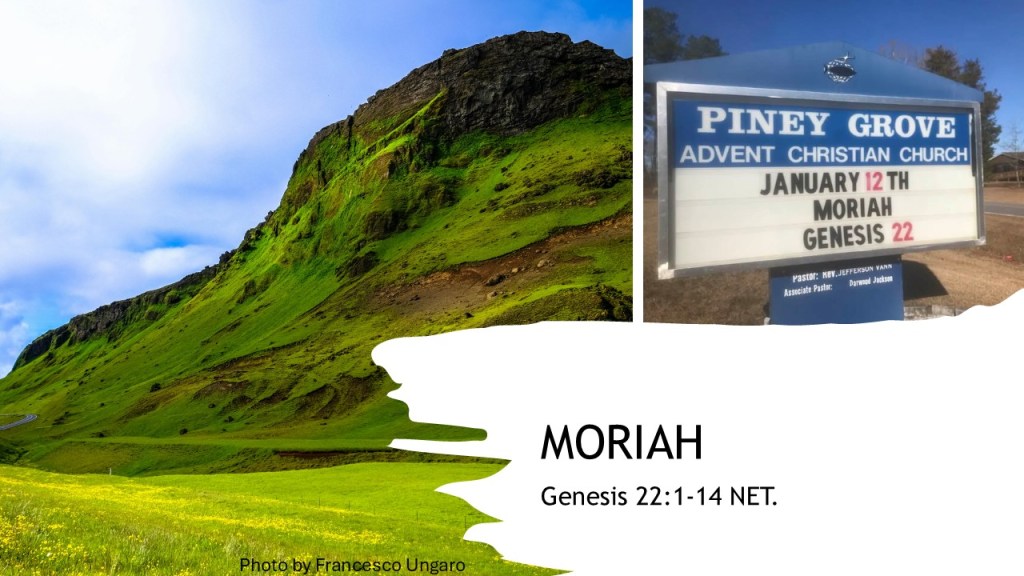
MORIAH 

MORIAH 

Genesis 22:1-14 NET.

1 Some time after these things God tested Abraham. He said to him, “Abraham!” “Here I am!” Abraham replied. 2 God said, “Take your son — your only son, whom you love, Isaac — and go to the land of Moriah! Offer him up there as a burnt offering on one of the mountains which I will indicate to you.” 3 Early in the morning Abraham got up and saddled his donkey. He took two of his young servants with him, along with his son Isaac. When he had cut the wood for the burnt offering, he started out for the place God had spoken to him about. 4 On the third day Abraham caught sight of the place in the distance. 5 So he said to his servants, “You two stay here with the donkey while the boy and I go up there. We will worship and then return to you.” 6 Abraham took the wood for the burnt offering and put it on his son Isaac. Then he took the fire and the knife in his hand, and the two of them walked on together. 7 Isaac said to his father Abraham, “My father?” “What is it, my son?” he replied. “Here is the fire and the wood,” Isaac said, “but where is the lamb for the burnt offering?” 8 “God will provide for himself the lamb for the burnt offering, my son,” Abraham replied. The two of them continued on together. 9 When they came to the place God had told him about, Abraham built the altar there and arranged the wood on it. Next he tied up his son Isaac and placed him on the altar on top of the wood.

10 Then Abraham reached out his hand, took the knife, and prepared to slaughter his son. 11 But the LORD’s angel called to him from heaven, “Abraham! Abraham!” “Here I am!” he answered. 12 “Do not harm the boy!” the angel said. “Do not do anything to him, for now I know that you fear God because you did not withhold your son, your only son, from me.” 13 Abraham looked up and saw behind him a ram caught in the bushes by its horns. So he went over and got the ram and offered it up as a burnt offering instead of his son. 14 And Abraham called the name of that place “The LORD provides.” It is said to this day, “In the mountain of the LORD provision will be made.”

The book of Genesis tells many stories about the history of this planet. It tells the story of creation itself. It tells the story of the original rebellion of our ancestors in the Garden of Eden and their subsequent banishment from that paradise. It tells the story of how the ancient world became so corrupt and sinful that God reluctantly decided to destroy it in a flood. It tells the story of great people, too: people larger than life who shaped the reality of our existence today. Two of those people are featured in today’s text: Abraham, the father of the faithful, and Isaac, the promised son. Isaac was still a young man when the events of today’s text happened. His father was not young. Abraham was 115 years old.

I want us to look carefully at the characters that predominate in the drama our text reports. We don’t know the whole story unless we are willing to investigate what happened from the perspective of all those involved. That is one of the reasons that the Bible often tells the same story more than once. The stories of Israel’s kings are scattered throughout the six books we now call 1 & 2 Samuel, 1 & 2 Kings, and 1 & 2 Chronicles. In the New Testament, we have the life of Christ told us by four different authors: Matthew, Mark, Luke and John. Each tells the story of Christ’s earthly life from their perspective, highlighting the things that made the most impact on them. They do not contradict each other, but neither do they see it necessary to parrot the others.

We don’t have different variations of the story in today’s text, but we do realize that things are happening that affect each central character differently. I want us to look at these events from the perspective – first of Isaac, then of Abraham, then of God himself and the message he has for us.

the story from Isaac’s perspective

The meaning of Isaac’s name (יִצְחָק in Hebrew) is laughter. He got his name by means of an incident in his parent’s life before he was born. The LORD told Abraham that he was going to bless Sarah by giving her a son. She had always wanted a child, but she had been barren, and she was 90 years old when God made this promise. She had already given up on the hope of ever giving birth to a son of her own. Both Abraham and Sarah immediately laughed when they heard the promise. That’s how Isaac got his name.

Sarah had long passed menopause, so she agreed to a plan to have a son by means of a surrogate mother – her handmaid, Hagar. They named this son Ishmael. יִשְׁמָעֵאל means God hears. The couple believed that their son Ishmael was how God had heard and answered their prayer. We are often convinced that when we come up with a plan and it seems to work, it must be God’s will. But Ishmael was not God’s plan. God’s plan was the miracle child – Isaac.

Isaac lived a privileged life. If he wasn’t a spoiled brat, then he had every reason to be. Isaac was heir to the covenant God had made with his father. In today’s story, he goes along with his father on a trip to the mountains. Isaac didn’t know all the details, but he knew his father wanted him along, and that was OK because he loved his father.

When they got to Mount Moriah, Abraham dismissed his servants and just he and Isaac climbed the mountain. He had told the servants that he and Isaac were going up onto the mountain to worship and that they would return when they were finished. But when they got to the summit, Isaac noticed that something was missing. He had lugged a pile of wood on his back all the way up the mountain, but he saw no lamb for the sacrifice. That itself was not a significant problem. Isaac probably figured that Abraham had already arranged for a lamb to be brought to the summit.

Maybe Isaac thought that the father was forgetting things in his old age. So, on the way up, he asked Abraham where the lamb was. Abraham just said that God will provide for himself. The verb Abraham used for “provide” is related to the proper noun “Moriah.” So, Isaac figured his father knew, so that settled it. Until they actually got to the summit. An altar was built, but there was no sacrificial lamb in sight.

Isaac was probably in shock when his father placed him on the altar and strapped him down with some ropes. This passage does not tell us that Isaac said anything. I cannot imagine him remaining silent, but perhaps he did. If Isaac did stay quiet during this ordeal, it could only be a sign for us of another promised Son who would remain silent while he was being sacrificed.

But Isaac’s story has a happy ending because God intervenes and prevents his death. A substitute is found, and Abraham’s statement is proven true. God did provide.

the story from Abraham’s perspective

Moriah is not Abraham’s first rodeo. He and God have a history. He has been tested time and time again. Sometimes, he passes the test. Sometimes, he tries to do things his way and winds up complicating things. But all the time, Abraham has been learning how to live by faith in God.

Abraham had come to a point in his life when living by faith has paid off with the fruit of faith. He had become wealthy and respected, and at long last, he was given the blessing of Isaac, who would succeed him as patriarch of his clan and would inherit the special blessings of the covenant. So, Abraham was not expecting another test at this point in his life. But the test came that day that God gave him a new command: God said, “Take your son — your only son, whom you love, Isaac — and go to the land of Moriah! Offer him up there as a burnt offering on one of the mountains which I will indicate to you.”

God said, “Go,” and Abraham went, but you can bet his mind was going in a thousand different directions as he traveled. He went over the promises that God had given him—many of those promises are specifically related to Isaac and his future. But Abraham wondered how God’s promises about Isaac could be fulfilled if Isaac died. Could the covenant be passed on through Ishmael instead? No, that can’t be it. God had explicitly named Isaac as the one who would pass on the blessing.

Abraham continued to think. A long walk is an excellent opportunity to consider, and the walk to Moriah takes three days. At some point, Abraham hit upon the idea that God must plan to raise Isaac from the dead in order to fulfill his promises about him. The book of Hebrews says, “By faith Abraham when he was tested, offered up Isaac. He had received the promises, yet he was ready to offer up his only son. God had told him, “Through Isaac, descendants will carry on your name,” and he reasoned that God could even raise him from the dead” (11:17-19). So, Abraham thought that must be how God was going to do this.

It took a lot of faith for Abraham to come to that conclusion. After all, we have the benefit of knowing all about the miracle of resurrection. We know about Elijah raising the widow’s son in Sidon (1 Kings 17). We know that Elisha did the same thing in Shunem (2 Kings 4). We know about how Jesus raised Lazarus (John 11), the widow’s son at Nain (Luke 7), and Jairus’ daughter (Matthew 9). We read about many other resurrections in the New Testament. But Abraham did not have a single story to point to. He reasoned that the God who gave us life can give it back to us after we are dead. He reasoned that the God who promises things to his people can make a way to fulfill those promises, and even death is not an obstacle to his doing that.

So, here is this old saint of God, raising his knife. He’s getting ready to put an end to the nearest and dearest thing in the world to him. But he trusts God. He does not know why God is demanding that he do such a thing. It does not fit in his theology. It goes against everything he has ever learned about God in his 115 years of getting to know him. But, if God says that his son must die on this mountain, then he is going to do it.

But in the last second, before Abraham’s knife finds itself going down in the direction of his beloved, he hears an angel’s voice. God has provided, and he has found a way to do it without Isaac’s death. From now on, when people ask Abraham about Moriah, he will tell them this story. It is the story of how God provided a substitute for the life of his son on the mountain called Moriah—a mountain with a name that means the place where he provides.

the story from God’s perspective

But the story is not over because there is another main character in these events whom we have not investigated. God himself had a reason for the things that took place on that mountain on that day. In fact, he had several reasons. He was teaching his friend that staying faithful to God will sometimes mean doing things that cannot be explained. The mission will not always be easy. The plan of God for our lives will often lead us to bitter conflict within ourselves as we wrestle with paradoxes and puzzles. But God calls us to be faithful anyway. He loves us, and wants us to trust in that love even when we feel very much unloved. He wants us to know that he is our friend, even when all the evidence suggests that he is an enemy.

Something else was going through the mind of God on that day. It was something that even Abraham did not know and would not know. The events at Moriah were a divine dress rehearsal for other events that would take place 19 centuries later. It was here, on this same mountain range, in a city called Jerusalem, that another promised son would be sacrificed. Only when this event happens will there be no last-minute deliverance by the angel’s voice. The angels will remain silent when the world’s only innocent man dies on the cross.

God knew what Abraham did not know. He knew that this would be how the human race found redemption from the slavery of sin. He knew that to demonstrate his passionate love for us, God would have to sacrifice his only Son whom he loves to a lonely and violent death – on this same mountain.

So, for us today, Abraham’s ordeal means even more than the story of an old man’s willingness to do something unthinkable because he trusts God. It is the Old Testament prediction of our loving God’s supreme sacrifice so that he could call back all believers to life again. He had no reason to do that except for his elaborate and compassionate love for his lost children.

If you ever start to feel that God must not love you because things are not working out the way you want, think of Moriah. If you ever feel that God is unfair to test you, think of Moriah. If you ever question your value in God’s sight, think of Golgotha. He loves you so much and has invested so much in you that the least you could do in return is spend your life serving him and eternity worshiping him.


Suggested Reading:

Jarman, David Fenton. Faith’s Trial; or, Abraham’s Example Practically Applied. 3rd ed, 1858. pp. 38-45.

Wade, Kenneth R. Journey to Moriah: The Untold Story of How Abraham Became the Friend of God. Pacific Press Pub. Association, 2004. pp. 132-139.

Here is a quote from the 43rd “day” of 148 Days with The Coming King:

“43 Matthew 8:14-17

And when Jesus entered Peter’s house, he saw his mother-in-law lying sick with a fever. He touched her hand, and the fever left her, and she got up and began to serve him. That evening they brought to him many who were oppressed by demons, and he expelled the breaths with a command and healed all who were sick. This was to fulfil what was predicted by the prophet Isaiah: “He took our illnesses and bore our diseases.”

• Isaiah had predicted that Jesus would take our illnesses and pains upon himself. He did that ultimately on the cross, but he first began doing that by his healing and deliverance ministry. Hurting people were not a distraction for him. He came to heal and deliver us all. Our hurt matters to him.

• He would empower his disciples to heal and deliver as they preached his gospel as well [Matthew 10:1, 8]. They were not always able to heal, but they tried [Matthew 17:16]. Those blessed with citizenship in the kingdom from the sky are invested in helping the hurt. It is what we do.

• Coming King, help us to help the hurting in your name. Where there is illness, give us your healing touch. Where there is a demonic invasion, give us your delivering word.”

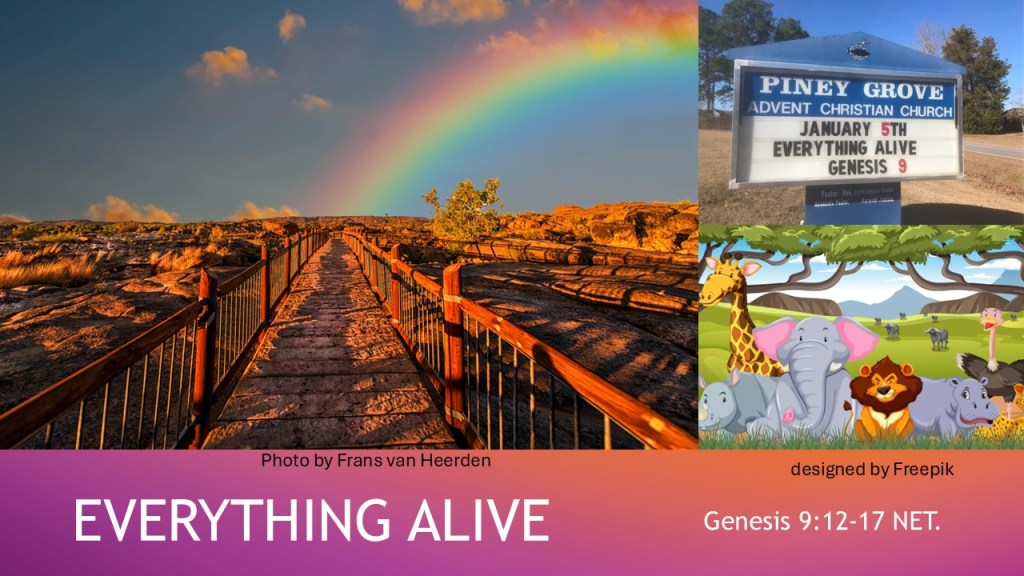
EVERYTHING ALIVE 

EVERYTHING ALIVE 

Genesis 9:12-17 NET.

12 And God said, “This is the guarantee of the covenant I am making with you and every living creature with you, a covenant for all subsequent generations: 13 I will place my rainbow in the clouds, and it will become a guarantee of the covenant between me and the earth. 14 Whenever I bring clouds over the earth and the rainbow appears in the clouds, 15 then I will remember my covenant with you and with all living creatures of all kinds. Never again will the waters become a flood and destroy all living things. 16 When the rainbow is in the clouds, I will notice it and remember the perpetual covenant between God and all living creatures of all kinds that are on the earth.” 17 So God said to Noah, “This is the guarantee of the covenant that I am confirming between me and all living things that are on the earth.”

We are now on our 5th day of the new year, which means that we are five days into our commitment to read two chapters a day in God’s holy word. I’m hoping that we all can keep to that commitment because I know that God wants to bless us with his wisdom and a closer relationship with him. The early chapters of Genesis teach us that God is holy and he wants to have a close relationship with his people. But he will not tolerate rebellion. Adam and Eve rebelled in the garden and so God banished them from it. That meant that our ancestors no longer had access to the Tree of Life. They were mortal, and our race began to die, starting with Abel, who his brother killed.

The rebellion continued among our ancestors and finally grew to such a degree that God could not tolerate it. Thus, God sent the flood to cover the planet in water and destroy all its inhabitants. But God is also merciful, and he chose one family of humans to rescue by his grace, along with the animals he chose to preserve for life after the flood. Genesis 9 describes the new covenant that God made with Noah, all humanity, and everything alive on this planet when the flood was over.

The version we are reading today uses the phrase “every living creature” to describe everything alive on the planet—humans and animals. That term is found in verses 12, 15, and 16. Verse 17 uses a synonym, “all living things.” Both terms refer to everything alive. The covenant God made was more comprehensive than we usually think. It was not made merely with Noah. It was a covenant with all the humans and animals on earth.

We should also note that the term for living creatures in verses 12, 15, and 16 reveals something that many religions (including many Christian denominations) refuse to accept. The average Hindu, Muslim, Catholic, and many others believe that the one thing that separates human beings from animals is that humans have souls, but animals do not.

One reason many Christians accept this doctrine is that many versions of Genesis 2:7 read something like the King James, which says, “And the LORD God formed man of the dust of the ground, and breathed into his nostrils the breath of life, and man became a living soul.” This reading led many to accept the concept that humans are endowed with an immortal soul and animals do not have souls.

Some modern translations correct the KJV. The NET reads, “The LORD God formed the man from the soil of the ground and breathed into his nostrils the breath of life, and the man became a living being.” The reason they had to correct this is that the exact phrase that the KJV translated, “living soul,” is found elsewhere in the Bible to refer to animals. The phrase is found in today’s text three times. Every time, it refers explicitly to everything alive. The point is not that every animal has a soul. The point is that the word translated soul (Hebrew נֶפֶשׁ) means something that breathes. The verb נָפַשׁ means to breathe. A נֶפֶשׁ is a throat which breathes.

This is a very unpopular belief, but it is proven true by the Bible. The Bible nowhere says that human beings are immortal – not even a part of them. Having a soul does not make us immortal. In fact, it proves the opposite. We breathe every breath until we breathe our last breath. We are temporary creatures, just like every other living creature. Our hope in Christ is not that we will survive death but that he will return and make us alive again. We don’t have immortality naturally by being human. We hope for immortality supernaturally by means of resurrection.

Now, I’m saying all this not just because of a doctrine I espouse but because it is essential context to understand the passage we are looking at this morning. The covenant that God made, as expressed in Genesis 9, is often called the Noahic covenant. But in fact, God made the covenant not just with Noah and not even with all humanity. He made this covenant with everything alive on the planet.

This passage gives the reason for the covenant

Notice the phrase “never again” in today’s text. In verse 11, God says, “Never again will all living things be wiped out by the waters of a flood; never again will a flood destroy the earth.” In verse 15, he says, “Never again will the waters become a flood and destroy all living things.” The reason for the covenant between God and everything alive is that the act of Judgment had a profound effect on the divine judge. He regretted that he had to destroy all those lives. Even though God, by his grace, rescued one family and enough animals to repopulate the planet, he still regretted having to kill everyone else.

God is the creator of all life, and he does not approve of reckless disregard for that life. There is a doctrine called the sanctity of human life, and I agree with it. I believe abortion is wrong because it is the taking of the life of an innocent human being who has done nothing wrong to deserve the death penalty. You can choose to rename abortion and call it reproductive rights or reproductive healthcare if you want to. But it does not change what is really happening. A human life is being destroyed. It’s not a suicide; it’s a homicide. The sanctity of human life is being disregarded.

But this passage is saying something even more comprehensive. It is saying that all life is sacred, not just all human life. God regretted the fact that he had to destroy every living creature in the flood. He determined not to do that ever again. It is wrong to kill a human being and show reckless disregard for that life. It is equally wrong to kill another creature for no reason and show reckless disregard for that life. The Noahic covenant was put into effect so that human beings would show the proper respect for all God’s creatures.

This passage gives the details of that covenant.

One of the details of the Noahic covenant was a repetition of a mandate that was part of the Adamic covenant. Verse 1 says, “Then God blessed Noah and his sons and said to them, “Be fruitful and multiply and fill the earth.” God still wants human beings to have children and expand their dominion over the planet.

A new mandate that is part of the Noahic covenant involves a change in the relationship between humans and animals. Human beings are allowed to take the lives of animals for the purpose of sustaining their own lives. Humans are allowed to eat animals but must not do so when the animals are still alive. Verses 3-4 say, “You may eat any moving thing that lives. As I gave you the green plants, I now give you everything.  But you must not eat meat with its life (that is, its blood) in it.” The word “life” in that verse is the same translated creature in 12, 15, and 16. It’s that word “soul” again. It means something breathing. Humans are not allowed to eat an animal still breathing, with its blood still coursing through its veins.

There is also a new mandate stipulated in the Noahic covenant suggested in verse 6: “Whoever sheds human blood, by other humans must his blood be shed; for in God’s image God has made humankind.” This mandate establishes human law against homicide and human government to enforce that law.

From the Noahic covenant, we know that our God holds us accountable for preserving all life—especially human life. He wants us to be agents of renewal, undoing the devastation of the flood and making this planet thrive.

This passage also gives the guarantee of the covenant.

It is a sign. The sign still exists today. Unfortunately, many are abusing this sign and using it as a symbol of pride in something they should be ashamed of. For many, the rainbow now means that human beings are free to have conjugal relations with anything they want – be it someone of the same gender or even a different species. That’s not what the sign means. The rainbow in the sky is God’s guarantee that he will never again destroy everything alive on earth by means of a universal flood. He has done that, and he will not do it again. If people commit crimes, there will be governments with authority to punish them. If people sin against God, there will be the final judgment and the lake of fire to punish that. But the rainbow is God’s promise to us that “Never again will all living things be wiped out by the waters of a flood; never again will a flood destroy the earth.” He is going to allow us to live how we want to live, and he will not intervene by retaliating against all humanity as he did in the days of Noah.

The rainbow is God’s commitment to life. It is his statement and sign of his love for us, even if we do not deserve it. We should certainly be aware that God is capable of immediate reprisal against any rebellion. We should not take the rainbow to mean that God is not capable of punishing sin. Instead, we should realize that God is giving us space and time to turn back to him—to seek him during this age of grace.

Holy Communion

In Matthew 26:28 Jesus said, “for this is my blood, the blood of the covenant, that is poured out for many for the forgiveness of sins.”

The signs of the new covenant that Jesus established with his followers were the bread and cup of the communion ritual. The sign of the rainbow meant that God chose not to punish the sins of humanity with immediate retribution. The signs of the new covenant show God’s grace even more drastically. The bread and cup symbolized what Jesus did for us on the cross. He did more than delay God’s retaliation against sin. He brought about God’s forgiveness of sins. When the blood of Jesus flowed from his body while he was nailed to that cross, the flowing blood took our sins with it. We now stand as recipients of a new covenant with God. When we stand before Christ as judge, all of the world’s sins will be laid before him. But our sins will be marked “paid in full” because of the substitutionary death of Christ.

The rainbow is God’s commitment to life. So are the symbols we use today to celebrate Holy Communion. They are signs of sinners forgiven and given eternal life in the age to come. Hallelujah!

A quote from The Piney Grove Pulpit #5:

“God also said “(he) will put a new spirit within (them)” (Ezekiel 36:26b). The spirit is the breath that is inside a breathing body. The Hebrews used this breath as a metaphor for the internal life. As such, good breath inside a person suggested health, vitality and a good attitude. An evil breath (not to be confused with bad breath) meant that the body was unhealthy, dying and full of hate and bitterness.

So, when God said that he was going to put a new spirit in his people, he was talking about restoring their relationship with him through forgiveness, and that would result in health and wholeness.”

{The book has 72 pages and was published on September 15th, 2024}.