Exodus 11:1 Yahveh had told Moses, “Yet one plague more I will bring upon Pharaoh and upon Egypt. Afterward he will send you away from here. When he sends you away, he will expel you, and it will be complete.
Exodus 11:2 Now tell this in the hearing of the people, so that they ask, every man from his neighbor and every woman from her neighbor, for silver and gold jewelry.”
Exodus 11:3 And Yahveh gave the people favor in the sight of the Egyptians. In addition to this, the man Moses was influential in the land of Egypt, in the sight of Pharaoh’s slaves and in the sight of the people.
Exodus 11:4 So Moses said, “Thus says Yahveh: Around midnight I will go out in the midst of Egypt,
Exodus 11:5 and every firstborn in the land of Egypt will die, from the firstborn of Pharaoh who sits on his throne, even to the firstborn of the slave girl who is behind the hand mill, and all the firstborn of the cattle.
Exodus 11:6 There will be a great outcry throughout all the land of Egypt, such as there has never been, nor ever will be again.
Exodus 11:7 But not a dog will stick out its tongue against any of the people of Israel, either man or beast, so that you may know that Yahveh makes a distinction between Egypt and Israel.
Exodus 11:8 And all these your slaves will come down to me and bow down to me, and this is what they will say, ‘Go out, you and all the people who follow you.’ And after that I will go out.” And he went out from Pharaoh with a burning nose.
Exodus 11:9 And Yahveh had said to Moses, “Pharaoh will not listen to you, so that my miracles may be multiplied in the land of Egypt.”
Exodus 11:10 Moses and Aaron did all these miracles before Pharaoh, and Yahveh made Pharaoh’s heart strong, and he did not send the people of Israel away from his land.
Exodus 11 quotes:
“Now our fanciful flight of imagination connects us with the culture of today that says, image supercedes substance. Consider what part perception plays in the name of politics and market place advertising. Much is based on illusion, being deceived by a false perception or belief, rather than fact and reality. But now we read Exodus 11:4 and see that Moses is convinced of power, not based on illusion, but on God.”
Younger, Tom. Tom’s Thought Provokers : Gems from a Pastor’s Heart. 1stBooks, 2004. p. 246.
“Exodus 11:5, “from the firstborn of Pharaoh who sits on his throne to the firstborn of the female slave who is behind the handmill,” suggests that Egyptians were also slaves in this house of bondage.”
Dykstra, Laurel. Set Them Free : The Other Side of Exodus. Orbis Books, 2002. p. 191.
“Exodus 11 is a transitional chapter in several ways. Moses’ final conversation with Pharaoh continues from Exodus 10. Having been warned by Pharaoh never to appear before him again, Moses delivers the warning of the tenth plague, the death of the firstborn (vv. 4-8). Verses 1-3, however, contain God’s instructions for asking for silver and gold articles from the Egyptians. The chapter as a whole marks the ending of the first nine plagues (chs. 7-10), provides the announcement of the final plague to Pharaoh, and introduces the beginning of the exit from Egypt (chs. 11-15).”
Bruckner, James K. Exodus. Hendrickson Publishers ; Paternoster, 2008. p. 104.
Exodus 10:1 Then Yahveh told Moses, “Go see Pharaoh, because I have hardened his heart and the heart of his slaves, in order that I may show these, my signs, among them,
Exodus 10:2 and in order that you may tell in the hearing of your son and of your grandson how I have humiliated the Egyptians and what signs I have done among them, so that you may know that I am Yahveh.”
Exodus 10:3 So Moses and Aaron saw Pharaoh and said to him, “This is what Yahveh, the God of the Hebrews, says, ‘How long will you refuse to humble yourself before me? Send my people away, so that they may serve me.
Exodus 10:4 Because if you refuse to send my people away, notice, tomorrow I will bring locusts into your territory,
Exodus 10:5 and they will cover the face of the land, so that no one can see the land. And they will eat whatever is left to you that escaped the hail, and they will eat every tree of yours that is growing in the orchard,
Exodus 10:6 and they will fill your houses and the houses of all your slaves and of all the Egyptians, something neither your fathers nor your grandfathers have seen, from the day they came to the land to this day. ‘Then he turned around and went out from Pharaoh.
Exodus 10:7 Then Pharaoh’s slaves said to him, “How long will this man be a snare to us? Send the husbands away, that they may serve Yahveh their God. Do you not yet understand that Egypt is destroyed?”
Exodus 10:8 So Moses and Aaron were brought back to Pharaoh. And he said to them, “Go, serve Yahveh your God. But which ones are to go?”
Exodus 10:9 Moses said, “We will go with our young and our old. We will go with our sons and daughters and with our flocks and herds, because we must hold a feast to Yahveh.”
Exodus 10:10 But he said to them, “Let it be so” Yahveh be with you, when I send you and your little ones away! See, you have evil in mind.
Exodus 10:11 Not so! Go now, the men among you, and serve Yahveh, because that is what you are asking.” And they were driven out from Pharaoh’s presence.
Exodus 10:12 Then Yahveh told Moses, “Stretch out your hand over the land of Egypt for the locusts, so that they may come upon the land of Egypt and eat every plant in the land, all that the hail has left.”
Exodus 10:13 So Moses stretched out his staff over the land of Egypt, and Yahveh brought an east wind upon the land all that day and all that night. When it was morning, the east wind had brought the locusts.
Exodus 10:14 The locusts came up over all the land of Egypt and rested on the whole territory of Egypt; it had never been so very heavy with locusts before, nor will it ever be again.
Exodus 10:15 They covered the face of the whole land, so that the land was darkened, and they ate all the plants in the land and all the fruit from the trees that the hail had left. Not a green thing remained, neither tree nor plant of the field, through all the land of Egypt.
Exodus 10:16 Then Pharaoh quickly called Moses and Aaron and said, “I have failed Yahveh your God, and against you.
Exodus 10:17 So now, forgive my sin, please, this time, and plead with Yahveh your God to remove this sure death from me.”
Exodus 10:18 So he went out from Pharaoh and pleaded with Yahveh.
Exodus 10:19 And Yahveh turned a very strong sea wind, which removed the locusts and drove them into the Red Sea. Not a single locust was left in all the territory of Egypt.
Exodus 10:20 But Yahveh made Pharaoh’s heart strong, and he did not send the sons of Israel away.
Exodus 10:21 Then Yahveh told Moses, “Stretch out your hand toward the sky, and there will be darkness over the land of Egypt and let that darkness cause people to feel around with their hands.”
Exodus 10:22 So Moses stretched out his hand toward the sky, and there was deep darkness in all the land of Egypt three days.
Exodus 10:23 No man saw his brother, nor did any man leave from under his roof for three days, but all the people of Israel had light where they lived.
Exodus 10:24 Then Pharaoh called Moses and said, “Go, serve Yahveh; your little ones also may go with you; only let your flocks and your herds remain behind.”
Exodus 10:25 But Moses said, “You must also give us sacrifices and ascending[1] offerings, so that we may present them to Yahveh our God.
Exodus 10:26 Our livestock also must go with us; not a hoof will be left behind, because we must take of them to serve Yahveh our God, and we will not know with what we must serve Yahveh until we arrive there.”
Exodus 10:27 But Yahveh made Pharaoh’s heart strong, and he would not let them go.
Exodus 10:28 Then Pharaoh said to him, “Go away from me; keep yourself from ever seeing my face again, because on the day you see my face you will die.”
Exodus 10:29 Moses said, “You said that right! I will never again see your face.”
“Clouds of locusts swept over the land blocking out the sun. They picked the trees clean, as well as herbs and crops of the field. Exodus 10:14 tells how the effects of the plague were so devastating that nothing like it had ever been witnessed in history. This was the eighth plague and would have been seen as a defeat of Oswiris (known to the Greeks as Osiris), who was supposed to be the protector of crops. His burial was often reenacted annually in ancient Egypt, and his “resurrection” was evidenced by corn sprouting from the site which the Egyptians believed was his grave.””
Long, James D. The Riddle of the Exodus. Lightcatcher Books, 2002. p. 86.
“10:1-2 / “Go to Pharaoh, for I have hardened his heart and the hearts of his officials.” The first two verses of Exodus 10 give reasons (“so that”) for the Lord’s actions. The explanations are brief, but they are critical to understanding who the Lord is. The focus is on the Israelites and their progeny: so that I may perform these miraculous signs of mine among them that you may tell your children and grandchildren.”
Bruckner, James K. Exodus. Hendrickson Publishers ; Paternoster, 2008. p. 96.
“Moses insisted, “Our livestock too must go with us; not a hoof is to be left behind” (Exodus 10:26). All we have and are is needed to serve our God. Sacrificing to Jehovah involves everything. A Christian commitment is not merely spiritual, it is a lifestyle touching the warp and woof of everyday life. Our person and our possessions are involved.”
Briscoe, Jill. Here Am I, Lord– Send Somebody Else : How God Uses Ordinary People to Do Extraordinary Things. W Pub. Group, 2004. p. 67.
Exodus 9:1 Then Yahveh said to Moses, “Go to Pharaoh and say to him, ‘Thus says Yahveh, the God of the Hebrews, “Send my people away, so that they may serve me.
Exodus 9:2 Because if you refuse to send them away and still hold strongly to them,
Exodus 9:3 notice, the hand of Yahveh will fall with a very brutal plague upon your livestock that are in the field, the horses, the donkeys, the camels, the herds, and the flocks.
Exodus 9:4 But Yahveh will make a distinction between the livestock of Israel and the livestock of Egypt, so that nothing of all that belongs to the sons of Israel will die.”‘”
Exodus 9:5 And Yahveh set a time, and this is what he said, “Tomorrow Yahveh will do this thing in the land.”
Exodus 9:6 And the next day Yahveh did this thing. All over the place, the livestock of the Egyptians died, but not one of the livestock of the sons of Israel died.
Exodus 9:7 And Pharaoh sent, and notice, not one of the livestock of Israel was dead. But the heart of Pharaoh was hardened, and he did not send the people away.
Exodus 9:8 And Yahveh said to Moses and Aaron, “Take handfuls of soot from a kiln, and let Moses throw them in the sky[1] in the sight of Pharaoh.
Exodus 9:9 It will become fine dust over all the land of Egypt and become boils breaking out in sores on man and animal throughout all the land of Egypt.”
Exodus 9:10 So they took soot from the kiln and stood before Pharaoh. And Moses threw it into the sky, and it became boils breaking out in sores on man and animal.
Exodus 9:11 And the magicians could not stand before Moses because of the boils, for the boils came upon the magicians and upon all the Egyptians.
Exodus 9:12 But Yahveh made the heart of Pharaoh strong, and he did not listen to them, as Yahveh had spoken to Moses.
Exodus 9:13 Then Yahveh told Moses, “Get up early in the morning and present yourself before Pharaoh and say to him, ‘Thus says Yahveh, the God of the Hebrews, “Send my people away, so that they may serve me.
Exodus 9:14 Because this time I will send all my plagues on you yourself, and on your slaves and your people, so that you may know that none like me exists in all the land.
Exodus 9:15 Because by now I could have put out my hand and struck you and your people with pestilence, and you would have been made to disappear[2] from the land.
Exodus 9:16 But for this purpose I have raised you up, to show you my power, so that my name may be proclaimed in all the land.
Exodus 9:17 You are still exalting yourself against my people and will not send them away.
Exodus 9:18 Notice, about this time tomorrow I will cause very heavy hail to fall, such as never has been in Egypt from the day it was founded until now.
Exodus 9:19 So now send word, get your livestock and all the people whom you have in the field into safe shelter, because every man and beast that is in the field and is not gathered home will die when the hail falls on them.” ‘”
Exodus 9:20 Then whoever feared the word of Yahveh among the slaves of Pharaoh hurried his slaves and his livestock into the houses,
Exodus 9:21 but whoever did not pay attention to the word of Yahveh left his slaves and his livestock in the field.
Exodus 9:22 Then Yahveh said to Moses, “Stretch out your hand toward the sky, so that there may be hail in all the land of Egypt, on man and animal and every plant of the field, in the land of Egypt.”
Exodus 9:23 Then Moses stretched out his staff toward the sky, and Yahveh sent thunder and hail, and fire ran down to the land. And Yahveh rained hail upon the land of Egypt.
Exodus 9:24 There was hail and lightning flashing continually in the midst of the hail, very heavy hail, such as had never been in all the land of Egypt since it became a nation.
Exodus 9:25 The hail destroyed everything that was in the field in all the land of Egypt, both man and animal. And the hail struck down every plant of the field and stripped every tree of the field.
Exodus 9:26 Only in the land of Goshen, where the people of Israel were, was there no hail.
Exodus 9:27 Then Pharaoh sent and called Moses and Aaron and said to them, “This time I have failed; Yahveh is in the right, and I and my people are in the wrong.
Exodus 9:28 Plead with Yahveh, because there has been enough of God’s thunder and hail. I will send you away, and you will stay no longer.”
Exodus 9:29 Moses told him, “When I have gone out of the city, I will reach out my hands to Yahveh. The thunder will cease, and there will be no more hail, so that you may know that the land is Yahveh’s.
Exodus 9:30 But I know that you and your slaves do not yet fear the face of Yahveh God.”
Exodus 9:31 (The flax and the barley were struck down, because the barley was fresh and the flax was in bud.
Exodus 9:32 But the wheat and the spelt were not struck down, because they are late in coming up.)
Exodus 9:33 So Moses went outside the city, away from Pharaoh and reached out his hands to Yahveh, and the thunder and the hail ceased, and the rain no longer poured upon the land.
Exodus 9:34 But when Pharaoh saw that the rain and the hail and the thunder had ceased, he failed to keep his promise yet again and hardened his heart, he and his slaves.
Exodus 9:35 So the heart of Pharaoh was made strong, and he did not send the sons of Israel away, just as Yahveh had predicted. through Moses.
[2] כָּחַד = make to disappear. Exodus 9:15; 23:23.
Exodus 9 quotes:
“So Yahweh declares the intention to strengthen or stiffen Pharaoh’s resolve. I imagine Pharaoh hearing this voice saying, “No, don’t be soft; it would be stupid to let them go’; but it is Pharaoh who decides whether to listen to this voice. Thus, when Moses and Aaron perform their signs, Exodus more often speaks of Pharaoh’s resolve being strong or firm and of Pharaoh’s strengthening or stiffening his own resolve than of God’s strengthening or stiffening it. The three ways of speaking are all significant. Saying, “Pharaoh’s resolve was strong or firm” simply reports the phenomenon. Saying, “Pharaoh strengthened or stiffened his resolve” makes clear that Pharaoh’s will is involved; this is not a decision imposed on him from outside. Saying, “God strengthened or stiffened Pharaoh’s resolve” makes clear that God is also at work. Referring to God’s intention first affirms that God’s sovereignty is involved, but in describing how things actually work out, Exodus refers first to Pharaohs resolve being strong or firm (Exodus 7:13, 14, 22) and to Pharaoh’ stiffening his own resolve (Exodus 8:15, 32) before speaking of God’s strengthening Pharaohs resolve (Exodus 9:12). That order again makes clear how significant is Pharaoh’s human involvement. He is not just a puppet in God’s hands.”
Goldingay, John. Exodus and Leviticus for Everyone. First edition, Westminster John Knox Press, 2010. p. 37.
“Exodus 9 presents the fifth, sixth, and seventh plagues. The livestock pestilence (fifth) and the plague of boils (sixth) conclude the second cycle of three (flies-livestock-boils) and the text presents them in abbreviated form. Pharaoh responds very briefly to the fifth plague and not at all to the sixth. The Lord simply informs Moses of the pestilence on the livestock (vv. 1-5) and the pestilence of boils (vv. 8-9); they broke out (vv. 6, 10-11); and the text reports Pharaoh’s hard heart (vv. 7, 12). The chapter describes the storm of thunder, hail, and lightning, the seventh plague, in fuller form because it begins the third and final cycle (hail-locustsdarkness). This last cycle intensifies the struggle for control between Yahweh and Pharaoh for the service (worship) of the children of Israel. In this chapter we also see the transition from Pharaoh’s hardening of his (own) heart, to the Lord as the one who hardened Pharaoh’s heart as the exit from Egypt approaches (vv. 7, 12).”
Bruckner, James K. Exodus. Hendrickson Publishers ; Paternoster, 2008. p. 86.
“The struggle with Pharaoh was not arbitrary; its purpose was both revelatory and redemptive.”
Dalglish, Edward R. The Great Deliverance : Studies in the Book of Exodus. Broadman Press, 1977. p. 45.
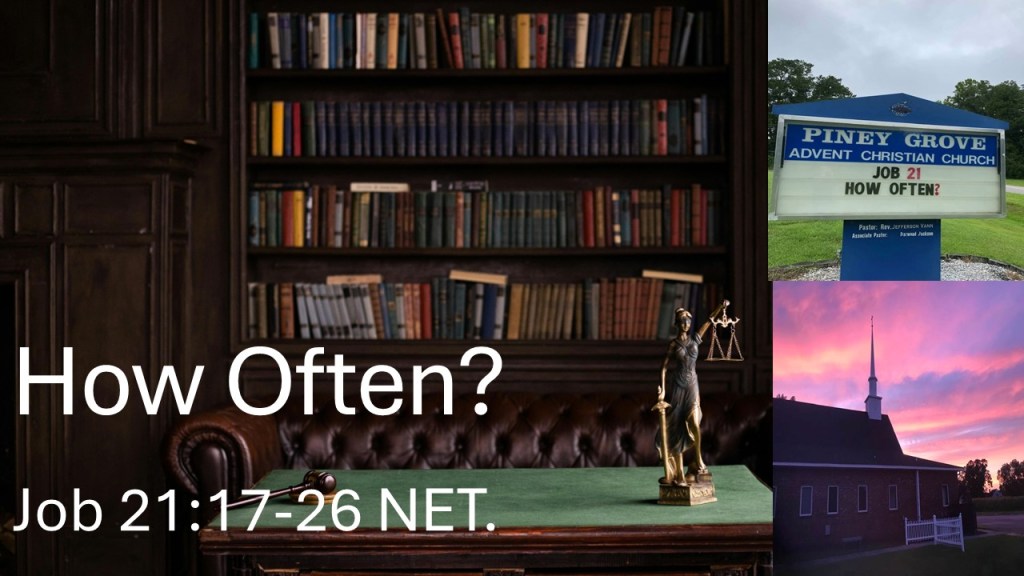
17 “How often is the lamp of the wicked extinguished? How often does their misfortune come upon them? How often does God apportion pain to them in his anger? 18 How often are they like straw before the wind, and like chaff swept away by a whirlwind? 19 You may say, ‘God stores up a man’s punishment for his children!’ Instead let him repay the man himself so that he may know it! 20 Let his own eyes see his destruction; let him drink of the anger of the Almighty. 21 For what is his interest in his home after his death, when the number of his months has been broken off? 22 Can anyone teach God knowledge, since he judges those that are on high? 23 “One man dies in his full vigor, completely secure and prosperous, 24 his body well nourished, and the marrow of his bones moist. 25 And another man dies in bitterness of soul, never having tasted anything good. 26 Together they lie down in the dust, and worms cover over them both.
Since we’re reading two chapters of the Bible each day, we’ll find ourselves in the book of Job for three Sundays. It’s going to take a little longer for us to get through Job because there are 42 chapters. But once we’re finished with Job, we’ll move on to the Psalms, and we won’t be done with them until November.
Last week, I explained how the Book of Job plays an important role in our biblical understanding. It is part of wisdom literature but acts as a counterbalance to many other books in that genre, which focus on what I call conventional wisdom. As we go through Job, we’ll see that all of his miserable comforter friends are experts in conventional wisdom. However, each of them views the concept of conventional wisdom from a different perspective.
Today’s text is part of Job’s reply to Zophar’s argument. Zophar argues that Job is guilty of a secret sin but that God knows about the sin and has brought this calamity on him as punishment.
Zophar’s argument.
Before we examine Job’s words in today’s text, let’s review the context. Zophar’s second speech is in chapter 20, and I want to highlight some of what he said there.
Zophar acknowledges that wicked people exist and sometimes prosper, but he argues they won’t prosper for long before their sins catch up with them. Zophar states that “the elation of the wicked is brief, the joy of the godless lasts but a moment” (20:5). This view is ancient and common in many religions worldwide. It reflects the principle of karma – what goes around comes around. A person’s evil actions are the cause, and they lead to suffering as the effect. In many of these religions, this effect appears in the person’s next reincarnation. It can also be seen in the troubles a person faces, which might otherwise be blamed on bad luck.
Zophar did not believe in reincarnation, but he did believe that Job had committed a secret sin, and all the calamity and pain he experienced were the result of God’s effecting a balance in his life. He was telling Job that even though he had experienced elation and joy for a while, it was now time to pay for his sins, and this suffering was all his fault.
Zophar tells Job that his ill-gotten gain was sweet when he devoured it, but it turned into snake venom in his stomach, so he had to vomit it out. “Nothing is left for him to eat; that is why his prosperity does not last. In the fullness of his sufficiency, distress overtakes him. The full force of misery will come upon him. While he is filling his belly, God sends his burning anger against him, and rains down his blows upon him” (21-23). He implied that lasting blessing only goes to the righteous. In a sense, that is true. But Zophar infers from that principle that the righteous would never experience the kind of calamity that Job did. The book of Job teaches against that inference.
Zophar is essentially acting as a prosecuting attorney, presenting Job’s suffering as evidence that he had committed a crime. The suffering proves that Job’s claim of innocence is a lie. All the while, we have been presented with evidence to the contrary in chapters 1-2. We know that Job is not suffering because of his own sin. He is not being punished because God is angry at him. He is being tested because God is proud of him, and the devil hates him.
Job’s question.
When we get to Job’s reply in today’s text, we discover Job acting as his defense attorney. He needs to present evidence that contradicts Zophar’s accusation that his suffering is evidence of his guilt. The prosecution has made its case and presented its evidence. It is now up to the defense to poke holes in that evidence – to create reasonable doubt in the jury by showing that there is some evidence not accounted for in the prosecution’s theory.
Job does that by asking questions of Zophar. One of his questions is found in verse 7: “Why do the wicked go on living, grow old, even increase in power?” That question suggests that if Zophar were correct in his assumption, there should be plenty of examples of evil rich men who wind up like Job. But Job says that is not the case. Plenty of rich evil people keep getting richer and never experience the significant reversal Zophar says is bound to happen. Those prominent religions that teach karma recognize this fact as well. That is why they invented reincarnation, to teach that the reversal occurs in the next life.
Another question Job asks Zophar is found in verse 29: “Have you never questioned those who travel the roads?” Job asked Zophar if he had actually surveyed to see if evil people finally get theirs. The evidence actually shows something different. Plenty of people actually get away with their crimes because they are rich. That was true in Job’s day, and it is just as true today. Justice is supposed to be blind, but she has a bit of a hole in her mask.
But I want us to focus for a bit on the other question that Job asked Zophar. He actually repeats the question four times in today’s text. Look again at verses 17-18:
17 “How often is the lamp of the wicked extinguished? How often does their misfortune come upon them? How often does God apportion pain to them in his anger? 18 How often are they like straw before the wind, and like chaff swept away by a whirlwind?
Zophar has accused Job of sinning and presented as his evidence the principle that God judges sin by punishing the sinner in this life. The sin that goes around in a rich man’s life eventually comes around and punishes him in that same life. Job’s question is, “How often does that actually happen?”
Now, Job is not asking, “Can such a thing ever happen?” He knows that God is sovereign. Our Bibles tell us that God can punish sinners like Pharaoh and Saul, Haman, Nebuchadnezzar, and Herod. But we all know that these are actually exceptions to the rule. They are not evidence of any principle of Karma that is taking place in the world.
If we actually do survey the stories on the road, we find that most of the time, evil rich people keep getting more and more evil and richer and richer. Prosperity is not proof that you have done the right thing.
Job does present evidence of a kind of leveling that happens at the end of life. He says that when rich, healthy people die, they lie down in the dust, and the worms cover them. When poor, sick people die, they lie down in the dust, and the worms cover them.
Job is arguing that Zophar has not made his case. There is no evidence that people are always held accountable for their sins during this life or that they experience judgment for their sins at death.
The gospel answer.
The book of Job leaves us there, but Job’s question still stands, challenging everyone who believes that people experience God’s judgment and that we can judge if someone is righteous just by their outward appearance.
We have to fast-forward to the New Testament for a gospel answer to Job’s question: “How often are people judged for their sins in this life?” The ultimate answer is never. Some criminals are caught and punished, and some sinners are found out. But God’s judgment is not taking place now, and it will not take place at death.
The texts we read this morning in our responsive reading[1] describe another time and day. They talk about Jesus the Judge, sitting on a large white throne, with both the great and the small standing before Him, being judged based on what was written in the books. The graves are emptied, and the sea releases its dead. The Lord has returned and called all our names. We have risen from our tombs because Judgment Day has arrived.
Everyone has their day in court. There are no exceptions. The wealthy cannot buy their way out of this trial. The powerful cannot use their influence to escape it. Each of us will give an account of himself to God. There are only two verdicts: life or condemnation. Those who are chosen for life will be set free from death forever because their names are written in the Lamb’s book of life. Those who are condemned will face the second death in the lake of fire, never to live again.
Job’s question was, “How often are people judged for their sins in this life?” The ultimate answer is never. That is because judgment for personal sins awaits that judgment day. What goes around does come around, but it’s going to take a long time. So, if we see people who are suffering today, we would do well not to turn our backs on them. God is not judging them; that comes later. It may be that we see someone suffering because God wants us to help relieve their suffering. Like the Good Samaritan, we may have encountered the sufferer so that we can be a neighbor to them and show love to them.
Or perhaps, when we see someone who is suffering, God has placed that person in our path so that we can pray for them. God has brought that poor sufferer to our doorstep so that He can perform a miracle in that person’s life. All He asks from us is that we pray.
Or, it could be that when we encounter someone who is suffering, God has placed that person in our path so we can introduce them to Christ. The hardship they are experiencing might be God’s way of grabbing their attention so they seek the salvation they need. If we turn away or cross to the other side to avoid the difficult situation, we might miss the opportunity to share Christ.
All of these responses to suffering are good and healthy. But the sad fact is that many of us, even if we are Bible-believing Christians, tend to react to suffering the way Zophar did. We don’t show love, pray, or share Christ. Instead, we judge those who are suffering. We assume that if something bad is happening to these people, they must have done something to deserve it.
Our Lord instructed us not to judge. He understands that when we act like Zophar, we are condemning ourselves. We are depriving ourselves of the joy that comes from helping the helpless, witnessing God’s work through our prayers, or lifting the lowly by leading them to Christ. That joy arises from seeking opportunities to love others in Jesus’ name.
Judgment Day is coming, and when the day arrives, we will all be there. But today isn’t judgment day. It’s not a time for us to judge others or ignore their pain. Today is our opportunity to show love, heal the wounded, and save those who are lost.
Exodus 8:1 Then Yahveh said to Moses, “Go to Pharaoh and say to him, ‘This is what Yahveh says, “Send away my people, so that they may serve me.
Exodus 8:2 But if you are refusing to send them away, notice, I will plague all your territory with frogs.
Exodus 8:3 The Nile will swarm with frogs that will come up into your house and into your bedroom and on your bed and into the houses of your slaves and your people, and into your ovens and your kneading bowls.
Exodus 8:4 The frogs will come up on you and on your people and on all your slaves.”‘
Exodus 8:5 And Yahveh said to Moses, “Tell Aaron, ‘Extend your hand with your staff over the rivers, over the canals and over the pools, and make frogs come up on the land of Egypt!'”
Exodus 8:6 So Aaron extended his hand over the waters of Egypt, and the frogs came up and covered the land of Egypt.
Exodus 8:7 But the magicians did the same by their secret arts and made frogs come up on the land of Egypt.
Exodus 8:8 Then Pharaoh called Moses and Aaron and said, “Plead with Yahveh to take away the frogs from me and from my people, and I will let the people go to sacrifice to Yahveh.”
Exodus 8:9 Moses said to Pharaoh, “Honor yourself by commanding me when I am to plead for you and for your slaves and for your people, that the frogs be cut off from you and your houses and be left only in the Nile.”
Exodus 8:10 And he said, “Tomorrow.” Moses said, “It will be as you say, so that you may know that there is no one like Yahveh our God.
Exodus 8:11 The frogs will go away from you and your houses and your slaves and your people. They will be left only in the Nile.”
Exodus 8:12 So Moses and Aaron went out from Pharaoh, and Moses cried to Yahveh about the frogs, as he had agreed with Pharaoh.
Exodus 8:13 And Yahveh acted consistent with the word of Moses. The frogs died out in the houses, the courtyards, and the fields.
Exodus 8:14 And they gathered them together in piles, and the land stank.
Exodus 8:15 But when Pharaoh saw that there was a break, he hardened his heart and would not listen to them, as Yahveh had predicted.
Exodus 8:16 Then Yahveh told Moses, “Say to Aaron, ‘Extend your staff and strike the dust of the land, so that it may become gnats in all the land of Egypt.'”
Exodus 8:17 And they did so. Aaron extended his hand with his staff and struck the dust of the land, and there were gnats on man and beast. All the dust of the land became gnats in all the land of Egypt.
Exodus 8:18 The magicians tried by their secret arts to produce gnats, but they could not. So, there were gnats on man and beast.
Exodus 8:19 Then the magicians said to Pharaoh, “This is the finger of a god.” But Pharaoh’s heart was made strong, and he would not listen to them, as Yahveh had predicted.
Exodus 8:20 Then Yahveh said to Moses, “Get up early in the morning and present yourself to Pharaoh, as he goes out to the water, and say to him, ‘Thus says Yahveh, “Send my people away, that they may serve me.
Exodus 8:21 Because, if you will not send my people away, notice, I will send swarms of flies on you and your slaves and your people, and into your houses. And the houses of the Egyptians will be filled with swarms of flies, and the ground on which they stand also.
Exodus 8:22 But on that day I will set apart the land of Goshen, where my people dwell, so that no swarms of flies will be there, so that you may know that I am Yahveh in the midst of the land.
Exodus 8:23 This is how I will distinguish between my people and your people. Tomorrow this sign will happen.”‘”
Exodus 8:24 And Yahveh did so. Large swarms of flies came into the house of Pharaoh and into his slaves’ houses. Throughout all the land of Egypt the land was devastated by the swarms of flies.
Exodus 8:25 Then Pharaoh called Moses and Aaron and said, “Go, sacrifice to your God within the land.”
Exodus 8:26 But Moses said, “It would not be right to do so, for the offerings we would sacrifice to Yahveh our God are a repugnance to the Egyptians. If they notice us sacrificing offerings repulsive to the Egyptians before their eyes, would they not stone us?
Exodus 8:27 We must go three days’ journey into the open country and sacrifice to Yahveh our God as he tells us.”
Exodus 8:28 So Pharaoh said, “I will let you go to sacrifice to Yahveh your God in the open country; only you must not go very far away. Plead for me.”
Exodus 8:29 Then Moses said, “Notice, I am going out from you and I will plead with Yahveh that the swarms of flies may depart from Pharaoh, from his slaves, and from his people, tomorrow. Only let not Pharaoh be mocking again by not sending the people away to sacrifice to Yahveh.”
Exodus 8:30 So Moses went out from Pharaoh and prayed to Yahveh.
Exodus 8:31 And Yahveh did as Moses asked, and removed the swarms of flies from Pharaoh, from his slaves, and from his people; not one remained.
Exodus 8:32 But Pharaoh hardened his heart this time also and did not send the people away.
Exodus 8 quotes:
“The constant demand during the plagues was basically the same: “Let my people go, so that they may worship [serve] me.””
White, John H. Slavery to Servanthood. Great Commission Publications, 1987. p. 108.
““Let my people go, that they may worship me,” God demanded through His mouthpiece (Exodus 8:1). As Jesus said, “No one can serve two masters” (Matthew 6:24). We have been told that we should serve God only (see Matthew 4:10). The problem with many people today is that they think they can serve God in Egypt. They think going to church or saying prayers, reading the Bible, or just believing in God is serving Him and is quite enough religion. But the service God required was in Canaan, in a different dimension altogether. He is not interested in us practicing religion, but rather in us finding reality.”
Briscoe, Jill. Here Am I, Lord– Send Somebody Else : How God Uses Ordinary People to Do Extraordinary Things. W Pub. Group, 2004. p. 61.
“The second loathsome disaster came out of the sacred river, compounding the insult to the Egyptian frog goddess, Heqt, the wife of Khnum, the guardian of the sources of the Nile. The indignity proved that neither of them had control over their supposed domains. Frogs filled the land, the beds, the cooking pots. No square inch of ground was spared. And again the foolish magicians only increased the plague by duplicating it.”
Bubeck, Craig, and James Dyet. Studies in Exodus : Farewell to Bondage. Scripture Press Publications, 1999. p. 26.