
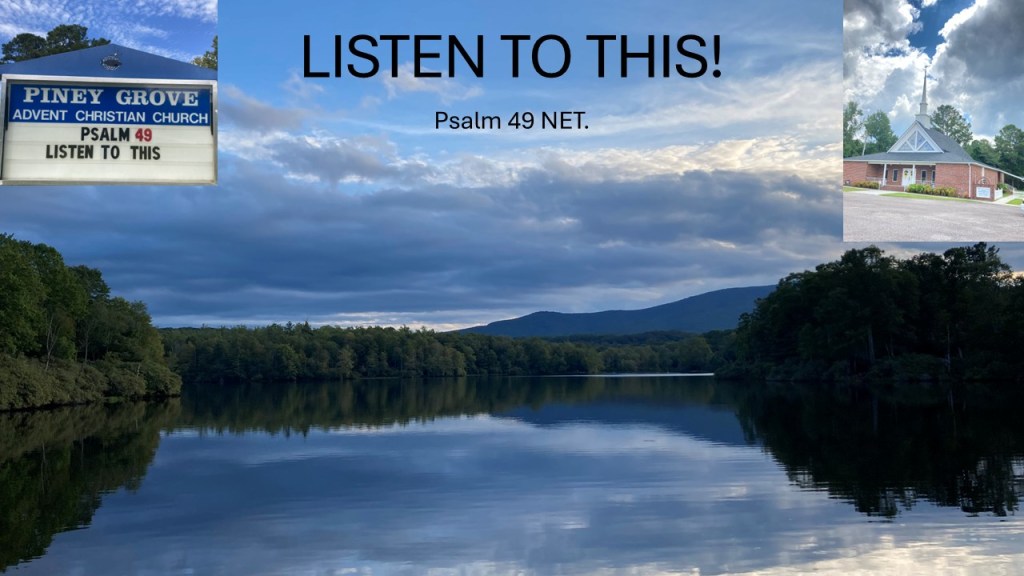
LISTEN TO THIS!
Psalm 49 NET.
For the music director, a psalm by the Korahites. 1 Listen to this, all you nations! Pay attention, all you inhabitants of the world! 2 Pay attention, all you people, both rich and poor! 3 I will declare a wise saying; I will share my profound thoughts. 4 I will learn a song that imparts wisdom; I will then sing my insightful song to the accompaniment of a harp. 5 Why should I be afraid in times of trouble, when the sinful deeds of deceptive men threaten to overwhelm me? 6 They trust in their wealth and boast in their great riches. 7 Certainly a man cannot rescue his brother; he cannot pay God an adequate ransom price 8 (the ransom price for a human life is too high, and people go to their final destiny), 9 so that he might continue to live forever and not experience death. 10 Surely one sees that even wise people die; fools and spiritually insensitive people all pass away and leave their wealth to others. 11 Their grave becomes their permanent residence, their eternal dwelling place. They name their lands after themselves, 12 but, despite their wealth, people do not last; they are like animals that perish. 13 This is the destiny of fools, and of those who approve of their philosophy. ( Selah) 14 They will travel to Sheol like sheep, with death as their shepherd. The godly will rule over them when the day of vindication dawns; Sheol will consume their bodies and they will no longer live in impressive houses. 15 But God will rescue my life from the power of Sheol; certainly he will pull me to safety. ( Selah) 16 Do not be afraid when a man becomes rich and his wealth multiplies! 17 For he will take nothing with him when he dies; his wealth will not follow him down into the grave. 18 He pronounces this blessing on himself while he is alive: “May men praise you, for you have done well!” 19 But he will join his ancestors; they will never again see the light of day. 20 Wealthy people do not understand; they are like animals that perish.
We are continuing our reading of the Psalter (the book of Psalms) in the Old Testament. Although it contains poetry, the Psalter is more than mere poetry. It is the source of many of the predictions about the coming Messiah that are revealed in the New Testament. For example:
- This book teaches that Jesus was called to a permanent priesthood that would replace the Aaronic priesthood.
- This book teaches us that Jesus was passionate about his Father’s house, the temple at Jerusalem.
- This book teaches that the world’s leaders would rise against King Jesus. He would have many enemies and be hated for no reason. It predicts that a close companion would betray Jesus.
- This book teaches that Jesus would die an agonizing death on the cross, that the soldiers would gamble for his clothing. He would cry out to God, asking why he had forsaken him.
- This book teaches some of the most essential New Testament truths about theology: the revelation of God in nature, the need for a Savior, justification by God’s grace, and the supremacy of Christ.
We don’t know the tune for today’s song, but we do know its authors. It was composed, not by David, but by the sons of Korah. You might remember the name Korah from our reading of the book of Exodus. If you do, you might be asking yourself why we have psalms from this group. Korah was a rebel Levite who tried to overthrow Moses. The ground swallowed him and all his followers as punishment. But Moses had allowed any of the sons of Korah who would dissociate themselves from their father’s sin to be saved. Three of them did. We even know their names: Assir, Elkanah, and Abiasaph. Abiasaph was an ancestor of Samuel. But mostly we know about the sons of Korah from the psalms that they wrote. So far, we have read eight of them: one in 1 Chronicles 6, and seven in Psalms. Four more will appear in the Psalms as we keep reading.
I’m glad we have psalms written by this group because they remind us that God can redeem anyone. It doesn’t matter who your parents were or who your ancestors were. God can use you. He can take the mistakes of your history and turn them into a message of hope and mercy for today.
But what did the sons of Korah write about in today’s psalm? What was the focus?
This is a song for everyone.
The psalm challenges us to listen. One of the most memorable passages in the Old Testament begins with the same word: the Shema. Deuteronomy 6:4 says: Hear, O Israel: The Lord our God, the Lord is one.” It’s called the Shema because the Hebrew word for hear or listen is Shema. The sons of Korah use the same word to begin this psalm. It starts with the phrase שִׁמְעוּ־זֹאת, which could be translated “Y’all listen to this.” So, the message that the sons of Korah teach in this psalm is not directed merely toward the nation of Israel. It is for all the nations, all the inhabitants of the world.
When I get an email from someone who has a message for me, I can reply to that email, and my reply will go to the original sender of that email. But if the sender includes a bunch of people in the same email that he sent to me, I have the option to send my reply not just to him but to everyone who got the original message. If I want to do that, instead of hitting the reply button, I can hit the reply-all button. That’s what the sons of Korah are doing here. They have looked around all over the world, and they have learned a valuable lesson about life. They want to share that message with everyone it applies to. So, when they say “Listen to this”, their song is not going out to an individual “you.” It’s not even going out to a collective nation of y’all. They’re saying, “All y’all listen to this.”
This is a song for everyone: the great and the small, the wise and the simple, the rich and the poor. The sons of Korah say, “Put this on your playlist.”
The rich need to listen.
Some people in this world never have to worry about which bills get paid this month and which stay on the stack. They get a bill, and they pay it. They don’t have to consult their accounts to see if they have enough because they always have enough. The sons of Korah have met these people. They know about wealthy people. They probably were not rich people, but they knew about them.
One thing they had learned about rich people was that they tend to be overconfident. Since they never met a problem that they could not fix by throwing money at it, they tended to trust in their wealth and boast in their great riches. They never met a wall they could not scale because there was always money to build another ladder. But the sons of Korah discovered that there was a limit to even what a millionaire’s money could buy.
They can’t buy a better coffee than Chock full o’nuts. No, that’s not it. Even a millionaire gets stopped in his tracks when he comes face to face with the enemy, death. If his brother gets sick, then all his money cannot rescue his brother from the danger of death. If he gets ill or injured, and death comes a’calling, he’s not going to prevent that inevitable appointment.
Even if you are lucky enough never to lose your fortune, one day it’s going to go to someone else. You can’t keep it where you are going. You’ve never seen a hearse pulling a U-Haul, and you never will.
So, the song of the sons of Korah is a song to the rich. It tells them that their money cannot buy them the one thing that they need more than anything they now have. They can contribute some of their money to God and his ministry, but that does not make them like God. Money cannot buy immortality.
They might have all the money in the world, but when they lie in that hospital bed, they will discover that it cannot reverse the curse. Sin’s penalty is death, and no amount of money paid will commute that sentence. They are like sheep being led by death as their shepherd. They can’t turn around. They can’t run in the opposite direction. They are headed to Sheol – the state of death.
The rest need to listen.
The rest of us need to listen to this song, too. What is true of the rich is also true of the not-so-rich. We also have a date with the undertaker, and we will keep that appointment.
When my father died, my mother purchased a headstone for him and included another with her name on it. For years, she would go to the cemetery and stare at a tombstone with her name on it. It was creepy, but it was also a reminder of the reality that she was going to Sheol, too. She kept her appointment. We laid her to rest in 2019. A few years ago, when I was studying this chapter, I noticed that one of my study Bibles said that the unrighteous go to Sheol when they die, but the righteous go to God. That’s just not true. The hope that the sons of Korah had was not that they would automatically float up into God’s presence when they die. Verse 15 says that their hope was for God to rescue them from Sheol, to pull them to safety.
David shared the same hope, stating in Psalm 17 that he planned to see God face to face when he woke up from the sleep of death. His hope was not going to God at death, but being raised to life by God. That is the biblical hope. When his friend Lazarus had died, Jesus didn’t tell his disciples that Lazarus was in God’s presence. He said, “Our friend Lazarus has fallen asleep. But I am going there to awaken him.” He says the same thing to us today about those friends and family who are out in the cemetery.
In our responsive reading this morning, we read what Jesus promised in John chapter 6. Jesus promises something four times in that chapter, and it is not that he will welcome our loved ones to heaven when they die. The promise is that he will raise them on the last day—the day of his second coming.
The sons of Korah were not looking for a transition at death; they were looking for a rescue at the resurrection. They said, “God will rescue my life from the power of Sheol; certainly he will pull me to safety.” Like Job, they were looking for their redeemer to come and restore their lives so that in their flesh they could see God (Job 19:25). Like Isaiah, they encouraged the righteous with the promise that their dead will come back to life, their corpses will rise (Isaiah 26:19). Like Daniel, they encouraged believers to look forward to the day when those who sleep in the dust will rise to eternal life (Daniel 12:2). Their goal in life was not to die. Their objective was to live again. Like Paul, they aimed to experience the power of Christ’s resurrection and to attain to the resurrection from the dead (Philippians 3:11).
This is the gospel, and it applies equally to the rich and the poor because nobody is rich enough to avoid death. But the gospel good news is that we have a redeemer. We have hope after death because God does not intend for death to have the last word. Death is the last enemy, and all of God’s enemies will be destroyed. The question for you and me today is not how much money we have, because money can’t buy everything. It may not be able to purchase much happiness, but it certainly cannot buy eternal life.
Today’s psalm talks about rich fools who work their whole lives for something that they will all eventually lose. But the rest of us can live like that, too. You don’t have to be wealthy to focus your life on making money. Poor people can throw away their lives, too. The lasting message of this psalm is sometimes missed. Jesus once pronounced a woe upon the rich because they had received their comfort already (Luke 6:24). He told a parable about a pearl of great value. When the merchant found it, he went out and sold everything he had and bought it (Matthew 13:46). The Christian life is a life of sacrifice because the goal of eternal life is worth the sacrifice. Everything else pales in comparison to that great salvation.
The sad thing is that most people will not try it. They would rather waste their lives on temporary things that they cannot keep. It takes faith to go against that current. It takes faith to tell Jesus, “Take my life and let it be consecrated, Lord, to thee.”

 jeffersonvann