
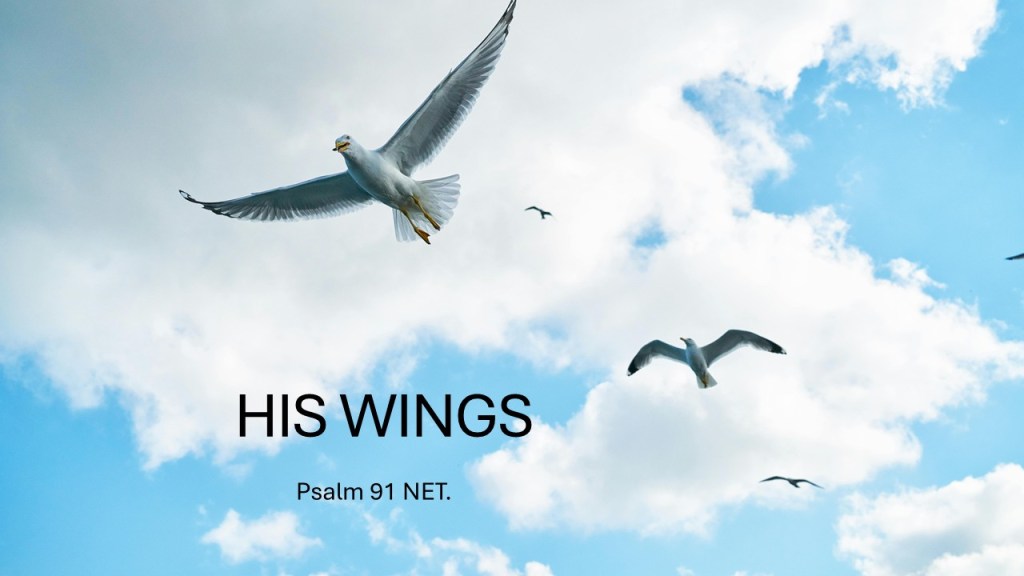
HIS WINGS
Psalm 91 NET.
1 As for you, the one who lives in the shelter of the sovereign One, and resides in the protective shadow of the mighty king — 2 I say this about the LORD, my shelter and my stronghold, my God in whom I trust —
3 he will certainly rescue you from the snare of the hunter and from the destructive plague. 4 He will shelter you with his wings; you will find safety under his wings. His faithfulness is like a shield or a protective wall. 5 You need not fear the terrors of the night, the arrow that flies by day, 6 the plague that comes in the darkness, or the disease that comes at noon. 7 Though a thousand may fall beside you, and a multitude on your right side, it will not reach you. 8 Certainly you will see it with your very own eyes — you will see the wicked paid back. 9 For you have taken refuge in the LORD, my shelter, the sovereign One. 10 No harm will overtake you; no illness will come near your home. 11 For he will order his angels to protect you in all you do. 12 They will lift you up in their hands, so you will not slip and fall on a stone. 13 You will subdue a lion and a snake; you will trample underfoot a young lion and a serpent. 14 The LORD says, “Because he is devoted to me, I will deliver him; I will protect him because he is loyal to me. 15 When he calls out to me, I will answer him. I will be with him when he is in trouble; I will rescue him and bring him honor. 16 I will satisfy him with long life, and will let him see my salvation.
There is no superscription in today’s Psalm, which means we don’t know who wrote it or why it was written. Based on the content of the Psalm itself, we can assume that the priests may have used it to encourage and comfort believers facing challenges in their lives. I chose to title today’s sermon “HIS WINGS” from the statement in verse four, which says, “He will shelter you with his wings; you will find safety under his wings.” The imagery is that of a mother bird covering her young with her wings to protect them and keep them from harm. I like that picture because it shows that we are vulnerable to the enemy’s attacks, but that God has invested Himself in protecting us.
This Psalm is Hebrew poetry, so we should expect repetition as we read it. What we see throughout this Psalm is that the same principle, stated in metaphor: “He will shelter you with his wings,” is restated five times in different words.
God will rescue.
In verse three, the believer is assured that God will certainly rescue him “from the snare of the hunter and from the destructive plague.” This does not mean that the believer will never face problems. Instead, it suggests that the enemy (Satan himself) will attack the believer in at least two ways: by setting traps and spreading plagues. Satan aims to hurt us and make us victims of epidemics and pandemics. The priest assures the believer not that he will never encounter a trap, but that God will rescue him or her from it. Similarly, the priest does not promise that the believer will never catch a disease, but that God will actively deliver him or her from it.
God’s promise for believers in this Psalm is found in verse fifteen: “When he calls out to me, I will answer him. I will be with him when he is in trouble; I will rescue him.” This is a promise from God, but also some advice and a challenge for us. The rescue is not supposed to be automatic. It involves something on our part. He will rescue, but first, we must call out to him.
We have already encountered this idea numerous times in the Psalms:
- “To the LORD I cried out, and he answered me from his holy hill.” (3:4).
- “When I call out, answer me, O God who vindicates me!” (4:1).
- “The LORD responds when I cry out to him.” (4:3).
- “I call to you for you will answer me” (17:6).
- “I called to the LORD, who is worthy of praise, and I was delivered from my enemies.” (18:3).
- “In my distress I called to the LORD; I cried out to my God. From his heavenly temple he heard my voice; he listened to my cry for help.” (18:6).
The word appears twenty-eight more times in the Psalms we’ve already read. The main idea is that God is present and eager to rescue us from danger, but he waits for us to take prayer seriously. By praying earnestly to God, we show him we mean it. This is what God wants. He wants to be there for us. His wings are ready to cover us, but he will stay distant if he never hears a peep from us.
God will shelter.
This is another way the psalmist describes how God covers us with His wings. He is our shelter and stronghold (verses two and nine). He will protect us (verse four). The Hebrew word used here is also used for building a fence.
Psalm 5:11 says, “But may all who take shelter in you be happy! May they continually shout for joy! Shelter them so that those who are loyal to you may rejoice!” It suggests a preventative measure in which God builds a shelter around the believer so that he can find happiness and joy.
I was once told that if I wanted to see happy children, I should look at a house where the parents have built a fence around their play area. The idea is that kids feel free to play and enjoy life because they are protected from anything that might endanger them. I did not like that idea at first because, to me, a fence suggested that the kids were in bondage, like slaves. But I soon realized that children are okay with fences as long as they know the fences are there to keep them safe.
God will protect.
God’s wings symbolize His faithfulness, which “is like a shield or a protective wall” (verse four). The LORD promises, “Because he is devoted to me, I will deliver him; I will protect him because he is loyal to me” (verse fourteen). The imagery behind this word is that of a tower, elevating someone high enough to prevent harm from touching them. A shelter acts as a fence, keeping danger away. A tower places the believer securely on high.
- “Indeed, you are my shelter, a strong tower that protects me from the enemy” (61:3).
- “The name of the LORD is like a strong tower; the righteous person runs to it and is set safely on high” (Proverbs 18:10).
The tower of God’s protection is Himself. He doesn’t just cover us with His wings; He lifts us into the lofty heights of His own presence.
God will honor.
God promises believers not only that He will rescue us but also that He will honor us (verse 15). This needs some explanation because the root idea is to make someone heavy. Most of us don’t need God to make us heavier; we can handle that ourselves. All it will take is a few more trips to the diner on Sunday afternoons!
No, the idea of honor in this text is to earn the respect of others—to maintain a good reputation and personal dignity. God does not want to protect us from harm just for the sake of protection; he wants to bless us.
God will satisfy.
The Psalm concludes with the LORD promising to satisfy the believer with a long life. He doesn’t just answer our prayers for protection when we are in danger; he wants to bless us with a satisfied life and enrich our lives. The Lord Jesus said that he came that we might have life and have it abundantly (John 10:10).
Now, here is where we, who are the recipients of God’s promises, often prevent the abundance that he offers. We become satisfied in the wrong way. We settle. God wants to satisfy us, but we are okay with just having a small bit. We get by with a nibble when God wants us to feast.
One of the stories in the Gospels tells of ten lepers who came to Jesus for healing. One of them, when he saw he was healed, turned back, praising God with a loud voice. He fell with his face to the ground at Jesus’ feet and thanked him. He was a Samaritan.
Jesus asked, “Were not ten cleansed? Where are the other nine?”
He said to the man, : Get up and go your way. Your faith has made you well” (Luke 17:11-19).
Ten lepers came to Jesus for healing. All ten were cleansed of their leprosy, but only one was made well. All ten were healed, but only one was satisfied. His gratitude enabled him to receive another blessing beyond the answer to his prayer.
That is a lesson for all of us. We need to learn how to follow through on our prayers for healing. In our Sunday evening Bible studies, we are discovering that in the Book of Acts, every miracle of God’s power for the early church was more than just a blessing; it was an opportunity to share the gospel with those who saw the miracle.
Similarly, God wants to answer our prayers for healing, but he doesn’t want it to end there. He desires every miracle to become a way of worshiping him and to inspire our testimonies of his goodness. When that Samaritan leper returned and thanked Jesus, he received the chance not only to regain a normal life but also to experience an abundant one. That is the difference that satisfaction makes.
Today’s Psalm also hints at prophecy. The author speaks of the believer seeing God’s salvation. Of course, this can refer to deliverance from trouble or salvation from sin. But I think in this context, the Psalmist is talking about ultimate salvation. In several places in the Psalms, the NET translators render this word as “saving intervention” (42:5, 11; 43:5).
The outcome of God’s blessing on believers is witnessing His great salvation through our resurrection at Christ’s return. We don’t have to choose between an abundant life now and eternal life at the second coming; we can have both. The wings of our rescuing and protecting God will keep us safe from harm now and carry us into our final destiny when Christ returns.


 jeffersonvann