Numbers 33

Numbers 33

Numbers 33:1 These are the phases of the people of Israel, when they went out of the land of Egypt by their companies, being guided by Moses and Aaron.

Numbers 33:2 Moses wrote down their starting places, phase by phase, by command of Yahveh, and these are their phases according to their starting places.

Numbers 33:3 They advanced from Rameses in the first month, on the fifteenth day of the first month. On the day after the Passover, the people of Israel went out triumphantly in the sight of all the Egyptians,

Numbers 33:4 while the Egyptians were burying all their firstborn, whom Yahveh had struck down among them. Yahveh also executed judgments against their gods.

Numbers 33:5 So the people of Israel advanced from Rameses and camped at Succoth.

Numbers 33:6 And they advanced from Succoth and camped at Etham, which is on the edge of the open country.

Numbers 33:7 And they advanced from Etham and turned back to Pi-hahiroth, which is east of Baal-zephon, and they camped at the face of Migdol.

Numbers 33:8 And they advanced from where Hahiroth could be seen and passed through the midst of the sea into the open country, and they went a three days’ journey in the open country of Etham and camped at Marah.

Numbers 33:9 And they advanced from Marah and came to Elim; at Elim, there were twelve springs of water and seventy palm trees, and they camped there.

Numbers 33:10 And they advanced from Elim and camped by the Red Sea.

Numbers 33:11 And they advanced from the Red Sea and camped in the open country of Sin.

Numbers 33:12 And they advanced from the open country of Sin and camped at Dophkah.

Numbers 33:13 And they advanced from Dophkah and camped at Alush.

Numbers 33:14 And they advanced from Alush and camped at Rephidim, where there was no water for the people to drink.

Numbers 33:15 And they advanced from Rephidim and camped in the open country of Sinai.

Numbers 33:16 And they advanced from the open country of Sinai and camped at Kibroth-hattaavah.

Numbers 33:17 And they advanced from Kibroth-hattaavah and camped at Hazeroth.

Numbers 33:18 And they advanced from Hazeroth and camped at Rithmah.

Numbers 33:19 And they advanced from Rithmah and camped at Rimmon-perez.

Numbers 33:20 And they advanced from Rimmon-perez and camped at Libnah.

Numbers 33:21 And they advanced from Libnah and camped at Rissah.

Numbers 33:22 And they advanced from Rissah and camped at Kehelathah.

Numbers 33:23 And they advanced from Kehelathah and camped at Mount Shepher.

Numbers 33:24 And they advanced from Mount Shepher and camped at Haradah.

Numbers 33:25 And they advanced from Haradah and camped at Makheloth.

Numbers 33:26 And they advanced from Makheloth and camped at Tahath.

Numbers 33:27 And they advanced from Tahath and camped at Terah.

Numbers 33:28 And they advanced from Terah and camped at Mithkah.

Numbers 33:29 And they advanced from Mithkah and camped at Hashmonah.

Numbers 33:30 And they advanced from Hashmonah and camped at Moseroth.

Numbers 33:31 And they advanced from Moseroth and camped at Bene-jaakan.

Numbers 33:32 And they advanced from Bene-jaakan and camped at Hor-haggidgad.

Numbers 33:33 And they advanced from Hor-haggidgad and camped at Jotbathah.

Numbers 33:34 And they advanced from Jotbathah and camped at Abronah.

Numbers 33:35 And they advanced from Abronah and camped at Ezion-geber.

Numbers 33:36 And they advanced from Ezion-geber and camped in the open country of Zin (that is, Kadesh).

Numbers 33:37 And they advanced from Kadesh and camped at Mount Hor, on the edge of the land of Edom.

Numbers 33:38 And Aaron the priest went up Mount Hor at the command of Yahveh and died there, in the fortieth year after the people of Israel had come out of the land of Egypt, on the first day of the fifth month.

Numbers 33:39 And Aaron was 123 years old when he died on Mount Hor.

Numbers 33:40 And the Canaanite, the king of Arad, who lived in the Negev in the land of Canaan, heard of the coming of the people of Israel.

Numbers 33:41 And they advanced from Mount Hor and camped at Zalmonah.

Numbers 33:42 And they advanced from Zalmonah and camped at Punon.

Numbers 33:43 And they advanced from Punon and camped at Oboth.

Numbers 33:44 And they advanced from Oboth and camped at Iye-abarim, in the territory of Moab.

Numbers 33:45 And they advanced from Iyim and camped at Dibon-gad.

Numbers 33:46 And they advanced rom Dibon-gad and camped at Almon-diblathaim.

Numbers 33:47 And they advanced from Almon-diblathaim and camped in the mountains of Abarim, at the face of Nebo.

Numbers 33:48 And they advanced from the mountains of Abarim and camped in the plains of Moab by the Jordan at Jericho;

Numbers 33:49 they camped by the Jordan from Beth-jeshimoth as far as Abel-shittim in the plains of Moab.

Numbers 33:50 And Yahveh spoke to Moses in the plains of Moab by the Jordan at Jericho, and this is what he said,

Numbers 33:51 “Speak to the people of Israel and say to them, When you pass over the Jordan into the land of Canaan,

Numbers 33:52 then you will drive out all the inhabitants of the land from in the sight of you and destroy all their sculptured images and destroy all their metal images and exterminate[1] all their high places.

Numbers 33:53 And you will take possession of the land and settle in it because I have given the land to you to possess it.

Numbers 33:54 You will inherit the land by lot according to your clans. To a large tribe, you will give a large inheritance, and to a small tribe, you will give a small inheritance. Wherever the lot falls for anyone, that will be his. According to the tribes of your fathers, you will inherit.

Numbers 33:55 But if you do not drive out the inhabitants of the land from in the sight of you, then those of them whom you let remain will be as barbs in your eyes and thorns in your sides, and they will trouble you in the land where you stay.

Numbers 33:56 And I will do to you as I thought to do to them.”


[1] שָׁמַד = exterminate.

Numbers 33 quotes:

The present chapter is mainly devoted to an account of the various stages and stations, the encampments and removals, of the children of Israel on their march through the wilderness, embracing the time from their depart ure from Egypt to their entrance into Canaan . Thus was intrinsically a very memorable part of their history, and divine wisdom saw fit thatMoses should write and transmit to posterity a journal of their extraordinary travels. In executing this order he recapitulates the principal stopping-places on their long journey , amounting to forty-two in number, occasionally reciting the important events that occurred here and there at different points in their progress.”

Bush, George. Notes Critical and Practical on the Book of Numbers. New York: [publisher not identified], 1858. p. 457.

“These journeys were not so long; but what principally characterized them was their crookedness, their zigzag course. They might have reached Canaan in a brief time had they fully believed and obeyed the Lord ; but unbelief and disobedience made their journeys through the wilderness long and tedious.
In three short months they could easily have reached Canaan from Egypt, with all their flocks and herds and all that they possessed ; but they were forty long years in their journeys thitherward. Nor did they dwell very long in one place. The pillar of cloud and of fire was ever directing them to a change in the place of their encampment. Perhaps they made only an average stay of about a year in one place ; and this was all the rest they were permitted to have. How truly do these facts illustrate the Christian’s character and course! How many after their conversion never seem to push on or to march right forward into Canaan!”

DUNN, Lewis R. The Gospel in the Book of Numbers. Hunt & Eaton: New York, 1889. p. 246.

“The word which is rendered journey appears to denote primarily the breaking up of the encampments, which lasted for very different periods, and which, during the protracted wanderings in the wilderness, may have been of the average duration of a twelvemonth. The list of the encampments is expressly said to have been written by Moses, and it served as a permanent memorial, on the one hand, of the sin and rebellion of the nation, and, on the other hand, of the faithfulness and longsuffering of God in leading and sustaining His people throughout their sojourn in the wilderness.”

Ellicott, C. J. The Fourth Book of Moses, Called Numbers. London: Cassell & Co, 1850. p. 203.

Numbers 33 links:

a specific walk
against their gods
discovered
exterminate!
history recommenced
leaving room for the enemy
looking back as we walk
Perish the thought


Maranatha Daily Devotional – Friday, May 7, 2021
Maranatha Daily Devotional – Tuesday, May 9, 2023

The NUMBERS shelf in Jeff’s library

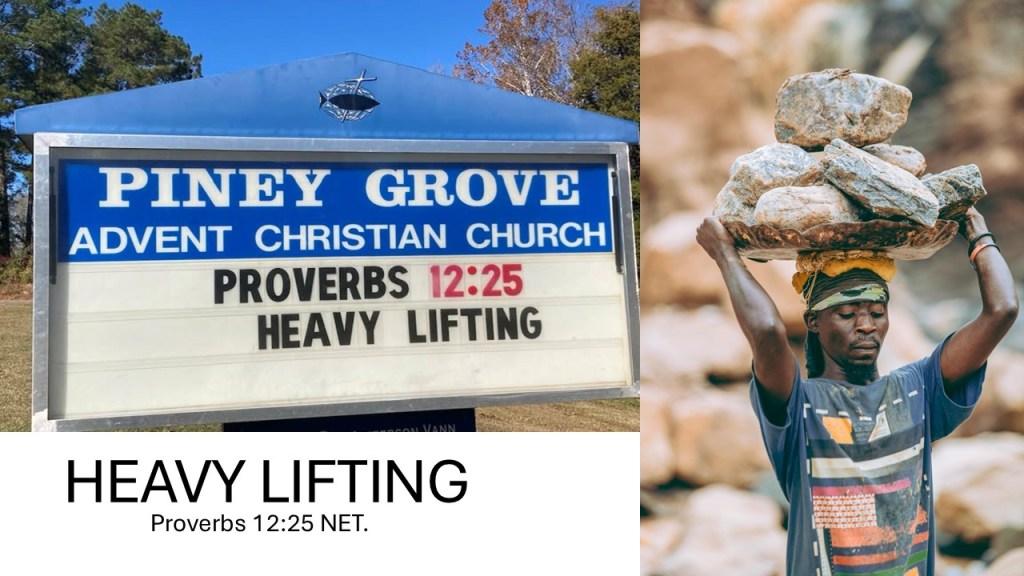
HEAVY LIFTING

HEAVY LIFTING

Proverbs 12:25   Anxiety in a person’s heart weighs him down, but an encouraging word brings him joy.

Tuesday, we began reading through the book of Proverbs, two chapters a day. Some time ago, we spent several months studying the Proverbs in our Sunday evening Bible Studies. For that reason, I don’t think we must cover everything the book has to say in the two Sundays we have for sermons on Proverbs. Instead, I will summarize some of the main ideas in Proverbs while considering the teachings of just two verses that I believe are especially relevant for life today.

Proverbs is a collection of wise sayings compiled by Solomon, the son of David. This compilation occurred approximately a thousand years before the birth of Christ.  There is only one hero of the Proverbs. This is the wise person. Wise people learn wisdom from their parents and live the right sort of lives so that they avoid the pitfalls of being unwise.

There is only one kind of wise person, but there are very many different kinds of unwise person. The unwise people are the villains of the book of Proverbs. They appear throughout the book and take different names. Each name identifies the way in which this particular kind of unwise person deviates from the wisdom the book teaches.

So, here is a roster of the villains in Proverbs:

The Stupid Villains

The book of Proverbs refers to these people as fools. They are fools because they choose to ignore God’s wisdom. They disregard the instructions of wise people, whether from their parents or other leaders. They “despise wisdom and instruction” (1:7). They hate knowledge (1:22). They live carelessly, even when making decisions that can potentially destroy them.

I saw a cartoon once that illustrates the power of stupidity. It was a Hägar the Horrible cartoon. There is a character in this cartoon called Lucky Eddie. Lucky Eddy has a bow and arrow. He has pulled back the bow, getting ready to send the arrow to its target. But there is something wrong. Eddie has the arrow pointed not away from him, but directly at his own face. A passerby sees this and tries to intervene. He wants to tell Eddie that the arrow is aimed in the wrong direction and it could kill him. But Hägar stops the man from intervening. He explains, “No, that’s the only way he’ll learn.”

The point of the Proverbs is that these fools are making choices that will inevitably lead to their own destruction. Wise people must intervene because the fools are making unwise choices, which will lead to disaster.  The fools are convinced that they are right, but they are not only wrong; they are often mistaken with a loud voice.

The Psalms tell us that fools convince themselves that there is no God (Psalm 14:1; 53:1). They begin with a practical atheism that renders them incapable of approaching wisdom. The Proverbs teach us to stay away from such fools and not to listen to their babbling.

The Scoffing Villains

The second type of villain introduced in Proverbs is the mockers. They are arrogant and disrespectful, and distrustful. If we try to correct the scoffing villains, they will insult us (9:7). When I was growing up, we used to say about such people that they were too big for their britches. The Proverbs warns such people that “The eye that mocks at a father and despises obeying a mother — the ravens of the valley will peck it out and the young vultures will eat it” (30:17).

The Slothful Villains

The third type of villain in Proverbs is not foolish because they are ignorant or arrogant. They are just too lazy to learn the correct way to live. These are the sluggards.  They are not motivated to do anything, so they will not amount to anything. They should learn the lesson from the ant and be industrious. But the way they are going is going to lead them to poverty and destitution.

The Scheming Villains

The final type in my little roster today is the scheming villain. They may seem to be our friends, inviting us to share in their table. But there is always an angle to their kindness. They are trying to get rich by taking advantage of others. If they give a party, we should politely decline their invitation.

But the book of Proverbs is not always trying to get us to avoid the villains. Often, the goal is to teach us how to be the heroes of our own lives. The goal is not simply to avoid foolishness, but to act wisely. Wisdom is about learning to do the right thing and making wise decisions. Today’s verse is an example of that.

It talks about anxiety, but the Hebrew word used is not the same word that is usually translated as fear.

Fear is a gift, but anxiety is a curse.

There are, of course, some abnormal fears. We call them phobias. But normal fear is actually a gift. It is a heightened sense of danger that can trigger in us the adrenaline we need to either fight off the threat or flee from it. Normal fear is a gift from God, and it is not something we should try to eradicate from our lives.

But the anxiety that today’s verse talks about is something else entirely. It is a sense of dread that lodges itself inside the human heart. This anxiety sits in the heart and weighs it down. It removes the everyday happiness that makes living a joy and working a blessing.  It creates its own gravity, sending every thought downward into depression and disillusionment.

The heart in the Bible is a symbol of the central thoughts and desires of the human being. When the heart becomes weighed down, its owner feels as though there is no longer any reason to live. Many commit suicide because they stop having any hope of things getting better. They see only despair and disappointment in their future.

This feeling can happen at any stage in a person’s life. This horrible gravity can weigh down both young people and older individuals. It can inflict its damage on a person anywhere along the spectrum of intelligence. It can attack a man or a woman, a boy or a girl. The rich are not immune to its power. People experiencing poverty cannot avoid its influence.

Many live with the pressure of anxiety.

In 2021, they did a survey that discovered that anxiety was the most common mental disorder and affected an estimated 359 million people in the world. Between 1990 and 2019, the number of people being affected by anxiety increased by over 55%. They discovered that people at a higher socio-economic level are more likely to suffer from anxiety. Poverty can cause depression, but wealth is no defense against it. They also discovered that anxiety disorders are becoming more and more prevalent among adolescents and young adults. Age can lead to depression, but youth is not a defense against it.

But the heaviness that today’s verse talks about is not just the result of a mental disorder. The Proverbs seems to be discussing a problem that any one of us can experience. Anxiety can lodge itself inside our hearts, putting pressure on us and keeping us from seeing any way out or any hope for recovery.

That is the problem. However, the Holy Spirit never introduces us to a problem without revealing an answer to it. In fact, every situation presents an opportunity for us to make a wise decision that alleviates the problem. The solution to the problem of a heavy heart I an encouraging word.

Our encouragement can help.

This is where the heavy lifting (from today’s title) comes into play. Our friends, our family members, and our fellow church members are in danger of falling prey to the heavy heart syndrome. They can become victims. That means that we have the opportunity to become the heroes of their stories.

The book of Job is a lesson in how not to deal with personal anxiety. Job suffered loss, disaster, and despair. His wife was no help. She just told him to curse God and die. His friends were no help. They just lectured him about his hidden sins that supposedly led to his troubles. Job’s story is a lesson for all of us in how not to lift the heavy burden of anxiety from a hurting heart.

But today’s verse tells us how it can be done. It says that an encouraging word brings joy to the anxious person. That is what we have the opportunity to do. We can replace the heavy heart with a joyful heart.

There are probably as many ways to encourage someone as there are ways to become discouraged. Here are some ways to encourage a person with a heavy heart.

We can encourage them with our testimony. If we have ever experienced the kind of anxiety that the victim is experiencing, we can tell our story, showing them that rescue from that predicament is possible. One reason that anxiety can be so damaging is that it convinces its victims that they are the only ones who have ever felt this badly. But by sharing our testimonies, we let the victims know that we were once there too, and by God’s grace, we were able to overcome it.

We can also encourage them with our prayers. Even if we have never experienced the kind of pressure that our anxious friends are facing, we can show them that we care by interceding for them in prayer. I, myself, have been there. I have been going through a rough time, and when my friends prayed for me, I saw no immediate result of the prayer. But as soon as they prayed, I felt the result in my heart. The heaviness I had felt began to lift slightly. Prayer does change things, even when the prayer does not seem to be answered. The act of praying itself can be a source of encouragement.

We can encourage them with the promises from the Bible. The devil wants to destroy people with anxiety. He wants them to feel like they are all alone in their problems, and God is somewhere distant. But the promises of God can lift that burden. Psalm 23 shows how the psalmist encouraged himself by meditating on God’s promise to guide him as a shepherd.

We can encourage them by reminding them who God is. They need to know that there is a power greater than the problem they are currently facing. They need to be reminded that God is Almighty. There is nothing too complicated for him. They also need to be reminded that God is loving and compassionate, slow to anger and abounding in mercy and faithfulness.

But what if we still cannot find the words to say? My advice is – wait it out. Stay with our hurting friends and give them the gift of our time. At some point, the God of all comfort will provide us with words to say to lift the heavy loads of anxiety from the hearts of our friends. While we wait for the words to say, we can be silently praying for those encouraging words. Jesus commands us to ask, and he promises to give what we ask for. Surely, he wants us to minister to those of a heavy heart.

Encouraging those who are feeling anxiety is just one of the many ministries that every believer can be involved in. You do not need a seminary degree. You do not need an impressive church title. You don’t have to be on the church board. You don’t have to possess a special spiritual gift. Today’s text tells us that all we need is an encouraging word. It seems like a tiny thing. But most of us can share our own experience when we were weighed down with anxiety, and somebody came along and just said the right thing to lighten our load. Let’s be that somebody for somebody else.

Numbers 32

Numbers 32

Numbers 32:1 At that time, the people of Reuben and the people of Gad had a very significant number of livestock. When they saw the land of Jazer and the land of Gilead and noticed the place was a place for livestock.

Numbers 32:2 So the people of Gad and the people of Reuben came and said to Moses and Eleazar the priest and the leaders of the congregation,

Numbers 32:3 “Ataroth, Dibon, Jazer, Nimrah, Heshbon, Elealeh, Sebam, Nebo, and Beon,

Numbers 32:4 the land that Yahveh struck down at the face of the congregation of Israel, is a land for livestock, and your servants have livestock.”

Numbers 32:5 And they said, “If we have found favor in your sight, let this land be given to your servants for a possession. Do not take us across the Jordan.”

Numbers 32:6 But Moses said to the people of Gad and the people of Reuben, “Will your brothers go to the war while you sit here?

Numbers 32:7 Why will you discourage the heart of the people of Israel from going over into the land that Yahveh has given them?

Numbers 32:8 Your fathers did this when I sent them from Kadesh-Barnea to see the land.

Numbers 32:9 Because when they went up to the Valley of Eshcol and saw the land, they discouraged the heart of the people of Israel from going into the land that Yahveh had given them.

Numbers 32:10 And Yahveh’s nose was ignited on that day, and he swore, and this is what he said,

Numbers 32:11 ‘Surely none of the men who came up out of Egypt, from twenty years old and upward, will see the land that I swore to give to Abraham, to Isaac, and Jacob, because they have not wholly followed me,

Numbers 32:12 none except Caleb the son of Jephunneh the Kenizzite and Joshua the son of Nun, because they have wholly followed Yahveh.’

Numbers 32:13 And Yahveh’s nose was ignited against Israel, and he made them wander in the open country forty years until all the generation that had done evil at the face of Yahveh was finished.

Numbers 32:14 And notice, you have risen in your fathers’ place, a brood of sinful men, to increase still more the fierce anger of Yahveh against Israel!

Numbers 32:15 Because if you turn away from following him, he will again abandon them in the open country, and you will destroy all these people.”

Numbers 32:16 Then they came near to him and said, “We will build sheepfolds here for our livestock, and cities for our little ones,

Numbers 32:17 but we will take up arms, ready to go at the face of the people of Israel, until we have brought them to their place. And our little ones will live in the fortified cities because of the inhabitants of the land.

Numbers 32:18 We will return to our homes once each of the people of Israel has gained his inheritance.

Numbers 32:19 Because we will not inherit with them on the other side of the Jordan and beyond, because our inheritance has come to us on this side of the Jordan to the east.”

Numbers 32:20 So Moses said to them, “If you will do this if you will take up arms to go at the face of Yahveh for the war,

Numbers 32:21 and every armed man of you will pass over the Jordan at the face of Yahveh until he has driven out his enemies from at the face of him

Numbers 32:22 and the land is subdued at the face of Yahveh; then after that, you will return and be free of obligation to Yahveh and Israel, and this land will be your possession at the face of Yahveh.

Numbers 32:23 But if you will not do so, notice, you have failed Yahveh, and be sure your failure will find you out.

Numbers 32:24 Build cities for your little ones and folds for your sheep, and do what you have promised.”

Numbers 32:25 And the people of Gad and the people of Reuben said to Moses, “Your servants will do as my lord commands.

Numbers 32:26 Our little ones, our wives, our livestock, and all our animals will remain there in the cities of Gilead,

Numbers 32:27 but your servants will pass over, every man who is armed for war, at the face of Yahveh to battle, as my lord orders.”

Numbers 32:28 So Moses gave command concerning them to Eleazar the priest, Joshua the son of Nun, and the heads of the fathers’ houses of the tribes of the people of Israel.

Numbers 32:29 And Moses said to them, “If the people of Gad and the people of Reuben, every man who is armed to battle at the face of Yahveh, will pass with you over the Jordan and the land will be subdued your face, then you will give them the land of Gilead for a possession.

Numbers 32:30 However, if they do not pass over with you armed, they will have possessions among you in the land of Canaan.”

Numbers 32:31 And the people of Gad and the people of Reuben answered, “What Yahveh has said to your servants, we will do.

Numbers 32:32 We will pass over armed at the face of Yahveh into the land of Canaan, and the possession of our inheritance will remain with us beyond the Jordan.”

Numbers 32:33 And Moses gave to them, to the people of Gad and the people of Reuben and the half-tribe of Manasseh the son of Joseph, the kingdom of Sihon king of the Amorites and the kingdom of Og king of Bashan, the land and its cities with their territories, the cities of the land throughout the country.

Numbers 32:34 And the people of Gad built Dibon, Ataroth, Aroer,

Numbers 32:35 Atroth-shophan, Jazer, Jogbehah,

Numbers 32:36 Beth-nimrah and Beth-haran, fortified cities, and folds for sheep.

Numbers 32:37 And the people of Reuben built Heshbon, Elealeh, Kiriathaim,

Numbers 32:38 Nebo, and Baal-meon (their names were changed), and Sibmah. And they gave other names to the cities that they built.

Numbers 32:39 And the sons of Machir the son of Manasseh went to Gilead and captured it, and dispossessed the Amorites who were in it.

Numbers 32:40 And Moses gave Gilead to Machir the son of Manasseh, and he settled in it.

Numbers 32:41 And Jair the son of Manasseh went and captured their villages, and called them Havvoth-jair.

Numbers 32:42 And Nobah went and captured Kenath and its villages, and called it Nobah, after his name.

Numbers 32 quotes:

“The heads of these tribes, therefore, came to Moses and Eleazar, preferring a petition that this region , so well adapted to their favorite pursuit, might be conferred upon them instead of their being required to pass over the river and receive their allotment with their brethren within the bounds of Canaan . Their motives in making this proposition, though they appeared at first somewhat questionable to Moses, yet were subsequently so explained as to remove, in great measure, his anxiety, and to redound to the credit of their fealty and fidelity”

Bush, George. Notes Critical and Practical on the Book of Numbers. New York: [publisher not identified], 1858. p. 452.

“The land on the east side of the Jordan, which was now conquered, was a fertile and beautiful country. Jazer was remarkable for its rich and abundant pastures, and so was the land of Gilead. Even now amid its desolations it shows clearly how rich and fertile it was. It lay north and south of the brook Jabbok, and is often spoken of in the word of God. It was this beautiful region which was shown to Moses before he closed his eyes upon earthly scenes and awoke among the blessed. It was this land which was promised to Jephthah if he would become the leader of its people. And here Abner set up Ishbosheth as king after the death of Saul. It was here that, when rebellion raged against the house of David, Absalom and Israel fought the battle which resulted in his complete discomfiture and in the triumph of Israel. It was the birthplace of Elijah the Tishbite. The bride of the Lamb is represented as having her locks as a flock of goats from Gilead. It was also famous for its balm. Hence the question of the prophet Jeremiah : ” Is there no balm in Gilead? is there no physician there? why then is not the health of the daughter of my people recovered?”

DUNN, Lewis R. The Gospel in the Book of Numbers. Hunt & Eaton: New York, 1889. p. 241.

“It is possible that the speakers, judging from the ease and rapidity with which the eastern side of the Jordan which the eastern side of the Jordan thought that their brethren were well able to subdue the western side without their aid.”

Ellicott, C. J. The Fourth Book of Moses, Called Numbers. London: Cassell & Co, 1850. p. 198.

Numbers 32 links:

a considerate walk
changing the names
our brothers’ brothers


Maranatha Daily Devotional – Tuesday, May 7, 2019


The NUMBERS shelf in Jeff’s library

Numbers 31

Numbers 31

Numbers 31:1 Yahveh spoke to Moses, and this is what he said,

Numbers 31:2 “Avenge the people of Israel on the Midianites. Afterward, you will be gathered to your people.”

Numbers 31:3 So Moses spoke to the people, and this is what he said “Arm men from among you for the war, that they may go against Midian to execute Yahveh’s vengeance on Midian.

Numbers 31:4 You will send a thousand from each of the tribes of Israel to the war.”

Numbers 31:5 So there were provided, out of the thousands of Israel, a thousand from each tribe, twelve thousand armed for war.

Numbers 31:6 And Moses sent them to the war, a thousand from each tribe, together with Phinehas the son of Eleazar, the priest, with the vessels of the sanctuary and the signal trumpets in his hand.

Numbers 31:7 They warred against Midian, as Yahveh commanded Moses, and killed every male.

Numbers 31:8 They killed the kings of Midian with the rest of their slain, Evi, Rekem, Zur, Hur, and Reba, the five kings of Midian. And they also killed Balaam, the son of Beor, with the sword.

Numbers 31:9 And the people of Israel took captive the women of Midian and their little ones, and they took as plunder all their animals, their flocks, and all their goods.

Numbers 31:10 All their cities in the places where they lived, and all their encampments, they burned with fire,

Numbers 31:11 and took all the spoil and all the plunder, both of human and animal.

Numbers 31:12 Then they brought the captives and the plunder and the spoil to Moses, and Eleazar the priest, and to the congregation of the people of Israel, at the camp on the plains of Moab by the Jordan at Jericho.

Numbers 31:13 Moses, Eleazar, the priest, and all the leaders of the congregation went to meet them outside the camp.

Numbers 31:14 And Moses was angry with the officers of the army, the commanders of thousands and the commanders of hundreds, who had come from service in the war.

Numbers 31:15 Moses said to them, “Have you let all the women live?

Numbers 31:16 Notice that these, due to Balaam’s advice, caused the people of Israel to act treacherously against Yahveh in the incident of Peor, and this caused the plague to come to the congregation of Yahveh.

Numbers 31:17 Now, therefore, kill every male among the little ones and kill every woman who has known man by lying with him.

Numbers 31:18 But all the young girls who have not known man by lying with him keep alive for yourselves.

Numbers 31:19 Encamp outside the camp for seven days. Whoever of you has killed any throat and whoever has touched any slain, purify yourselves and your captives on the third day and the seventh day.

Numbers 31:20 You will purify every garment, every article of skin, all work of goats’ hair, and every article of wood.”

Numbers 31:21 Then Eleazar the priest said to the men in the army who had gone to battle: “This is the prescription of the instruction that Yahveh has commanded Moses:

Numbers 31:22 only the gold, the silver, the bronze, the iron, the tin, and the lead,

Numbers 31:23 everything that can stand the fire, you will pass through the fire, and it will be pure. Nevertheless, it will also be purified with the water for impurity. And whatever cannot stand the fire, you will pass through the water.

Numbers 31:24 You must wash your clothes on the seventh day, and you will be pure. And afterward, you may come into the camp.”

Numbers 31:25 Yahveh said to Moses,

Numbers 31:26 “Take the count of the plunder that was taken, both of human and of animal, you and Eleazar the priest and the heads of the fathers’ houses of the congregation,

Numbers 31:27 and divide the plunder into two parts between the warriors who went out to battle and all the congregation.

Numbers 31:28 And levy for Yahveh a tribute from the men of war who went out to battle, one out of five hundred, of the humans and the oxen and the donkeys and the flocks.

Numbers 31:29 Take it from their half and give it to Eleazar, the priest, as a contribution to Yahveh.

Numbers 31:30 And from the people of Israel’s half you will take one drawn out of every fifty, of the humans, of the oxen, of the donkeys, and of the flocks, of all the animals, and give them to the Levites who keep guard over the tabernacle of Yahveh.”

Numbers 31:31 And Moses and Eleazar the priest did as Yahveh commanded Moses.

Numbers 31:32 Now the plunder remaining of the spoil that the army took was 675,000 sheep,

Numbers 31:33 72,000 animals,

Numbers 31:34 61,000 donkeys,

Numbers 31:35 and 32,000 throats in all, women who had not known man by lying with him.

Numbers 31:36 And the half, the portion of those who had gone out in the army, numbered 337,500 sheep,

Numbers 31:37 and Yahveh’s tribute of sheep was 675.

Numbers 31:38 The animals were 36,000, of which Yahveh’s tribute was 72.

Numbers 31:39 The donkeys were 30,500, of which Yahveh’s tribute was 61.

Numbers 31:40 The throats were 16,000, of which Yahveh’s tribute was 32 throats.

Numbers 31:41 And Moses gave the tribute, which was the contribution for Yahveh, to Eleazar, the priest, as Yahveh commanded Moses.

Numbers 31:42 From the people of Israel’s half, which Moses separated from that of the men who had served in the army —

Numbers 31:43 the congregation’s half was 337,500 sheep,

Numbers 31:44 36,000 animals,

Numbers 31:45 and 30,500 donkeys,

Numbers 31:46 and 16,000 throats —

Numbers 31:47 From the people of Israel’s half, Moses took one of every 50, both humans and animals and gave them to the Levites who kept guard over the tabernacle of Yahveh, as Yahveh commanded Moses.

Numbers 31:48 Then the officers who were over the thousands of the army, the commanders of thousands and the commanders of hundreds, came near to Moses

Numbers 31:49 and said to Moses, “Your servants have counted the men of war who are under our command, and there is not a man missing from us.

Numbers 31:50 And we have brought Yahveh’s offering, what each man found, articles of gold, armlets and bracelets, signet rings, earrings, and beads, to provide reconciliation for our throats to the face of Yahveh.”

Numbers 31:51 And Moses and Eleazar, the priest, received from them the gold, all crafted articles.

Numbers 31:52 And all the gold of the contribution that they presented to Yahveh, from the commanders of thousands and the commanders of hundreds, was 16,750 shekels.

Numbers 31:53 (The men in the army had each taken plunder for himself.)

Numbers 31:54 And Moses and Eleazar,, the priest, received the gold from the commanders of thousands and of hundreds, and brought it into the conference tent, as a memorial for the people of Israel to the face of Yahveh.

Numbers 31 quotes:

“The people of Israel were not hereby commanded to enter upon this work with vindictive feelings, but as the instruments of a just retribution upon a guilty race who had incurred the divine displeasure by “ the wiles wherewith they had beguiled Israel in the matter of Peor,” ch. 25:18 .”

Bush, George. Notes Critical and Practical on the Book of Numbers. New York: [publisher not identified], 1858. p. 443.

“The justice of God is absolute and equal. He had punished his own people severely for sinning against him, through the temptations of the women of Midian. Now he punishes their tempters and deceivers. His hand smites sins unrepented of, both among his own people and among his enemies. It is probable, if they had surrendered to his people the men and the women who had been guilty of the idolatry and adultery, most probably at the suggestion of Balaam, that they would have been satisfied, and the Lord’s anger might have been turned away from them. But this they failed to do, as Benjamin did in the after years, and so there was nothing left for them but to slay and destroy them.”

DUNN, Lewis R. The Gospel in the Book of Numbers. Hunt & Eaton: New York, 1889. p. 234.

“The time had now come for the fulfilment of the command which had already been given (see chap. xxv. 16-18). after which Moses was to be gathered unto his people, as it had been revealed to him (chap. xxvii. 13).”

Ellicott, C. J. The Fourth Book of Moses, Called Numbers. London: Cassell & Co, 1850. p. 190.

Numbers 31 links:

“To be gathered to his people”
a nation that turned away
a victorious walk
Dead souls, dying souls
end of a conspiracy
Excursus- “To Be Gathered”
let my soul live
staying on his good side


The NUMBERS shelf in Jeff’s library

Numbers 30

Numbers 30

Numbers 30:1 Moses spoke to the leaders of the tribes of the people of Israel, and this is what he said “This is what Yahveh has commanded.

Numbers 30:2 If a man pledges a solemn pledge to Yahveh, or swears an oath to bind his throat by a pledge, he will not break his word. He will do according to all that proceeds out of his mouth.

Numbers 30:3 “If a woman pledges a solemn pledge to Yahveh and binds herself by a pledge, while within her father’s house in her youth,

Numbers 30:4 and her father hears of her solemn pledge — of her pledge by which she has bound her throat and says nothing to her, then all her solemn pledges will stand, and every pledge by which she has bound her soul will stand.

Numbers 30:5 But if her father opposes her on the day that he hears of it, no solemn pledge of hers, no pledge by which she has bound her throat will stand. And Yahveh will forgive her because her father opposed her.

Numbers 30:6 “If she marries a husband, while under her solemn pledges or any thoughtless utterance of her lips by which she has bound her throat,

Numbers 30:7 and her husband hears of it and says nothing to her on the day that he hears, then her solemn pledges will stand, and her pledges by which she has bound her throat will stand.

Numbers 30:8 But if, on the day that her husband comes to hear of it, he opposes her, then he makes void the solemn pledge that was on her, and the thoughtless utterance of her lips by which she bound her throat. And Yahveh will forgive her.

Numbers 30:9 (But any solemn pledge of a widow or of a divorced woman, anything by which she has bound her throat, will stand against her.)

Numbers 30:10 And if she solemnly pledged in her husband’s house or bound her throat by a pledge with an oath,

Numbers 30:11 and her husband heard of it and said nothing to her and did not oppose her, then all her solemn pledges will stand, and every pledge by which she bound her throat will stand.

Numbers 30:12 But if her husband makes them null and void on the day that he hears them, then whatever proceeds out of her lips concerning her solemn pledges or concerning the pledge of her throat will not stand. Her husband has made them void, and Yahveh will forgive her.

Numbers 30:13 Any solemn pledge and any binding oath to discipline her throat, her husband may establish, or her husband may make void.

Numbers 30:14 But if her husband says nothing to her from day to day, then he establishes all her solemn pledges or all her pledges that are upon her. He has established them because he said nothing to her on the day that he heard of them.

Numbers 30:15 But if he makes them null and void after he has heard of them, then he will bear her violation.”

Numbers 30:16 These are the prescriptions that Yahveh commanded Moses regarding a man and his wife and a father and his daughter while she was in her youth within her father’s house.

Numbers 30 quotes:

“It is easily conceivable that under the influence of the fervent zeal inspired by the festivals enjoined in the preceding chapter, there would be prompted many of those voluntary gifts and services which are alluded to ch. 29:30.”

Bush, George. Notes Critical and Practical on the Book of Numbers. New York: [publisher not identified], 1858. p. 438.

“To vow means to give, dedicate, or consecrate to God by solemn promise. Such vows are frequently made. There are two kinds of vow spoken of in verse 2 ; namely, the neder, which denotes, primarily, a positive vow, or a vow of performance, and the issar, which denotes a negative vow, or a vow of abstinence. In all ages, among all people, and in all religions, such vows have been uttered, at times with solemnity, and in other instances thoughtlessly and recklessly. Religious vows are more common
than others ; and yet men and women will vow on very small occasions and for very small purposes.
Very many are often entirely indifferent as to the performance of their vows.”

DUNN, Lewis R. The Gospel in the Book of Numbers. Hunt & Eaton: New York, 1889. p. 230.

“It is natural to suppose that at the expiration of the protracted wanderingsin the wilderness the pious Israelites would be desirous of testifying their gratitude by dedicating themselves, or some portion of their substance beyond that which the law demanded, to the service of the Lord.”

Ellicott, C. J. The Fourth Book of Moses, Called Numbers. London: Cassell & Co, 1850. p. 183.

Numbers 30 links:

a responsible walk
I promise


The NUMBERS shelf in Jeff’s library