
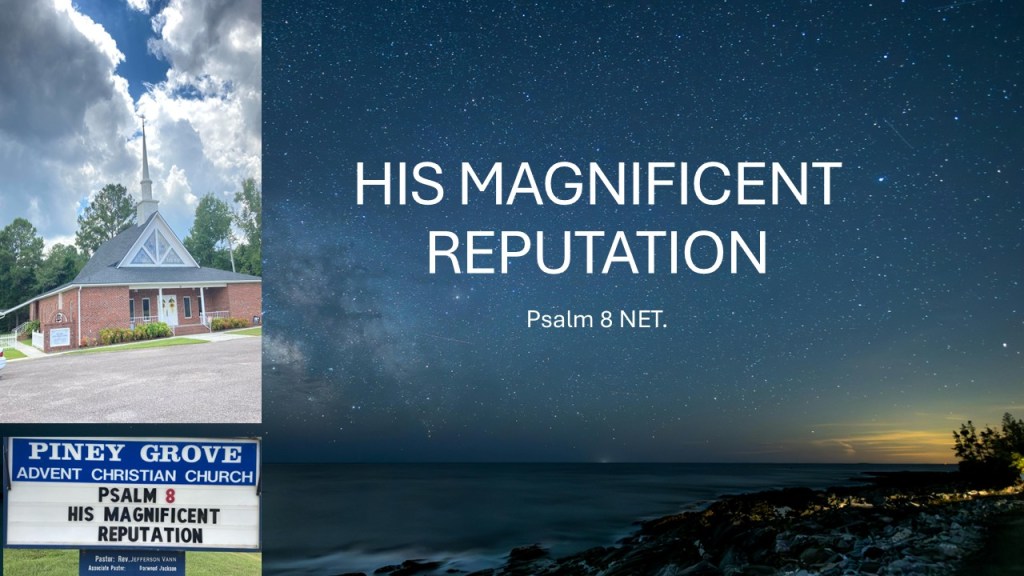
HIS MHIS MAGNIFICENT REPUTATION
Psalm 8 NET.
For the music director, according to the gittith style; a psalm of David. 1 O LORD, our Lord, how magnificent is your reputation throughout the earth! You reveal your majesty in the heavens above! 2 From the mouths of children and nursing babies you have ordained praise on account of your adversaries, so that you might put an end to the vindictive enemy. 3 When I look up at the heavens, which your fingers made, and see the moon and the stars, which you set in place, 4 Of what importance is the human race, that you should notice them? Of what importance is mankind, that you should pay attention to them, 5 and make them a little less than the heavenly beings? You grant mankind honor and majesty; 6 you appoint them to rule over your creation; you have placed everything under their authority, 7 including all the sheep and cattle, as well as the wild animals, 8 the birds in the sky, the fish in the sea and everything that moves through the currents of the seas. 9 O LORD, our Lord, how magnificent is your reputation throughout the earth!
We are now in the 19th book of our English Bibles, the Psalms – the songbook of the Bible. It is poetry, but our translations rarely rhyme or have a metrical rhythm. The originals are not about that either. Hebrew poetry focuses more on pairing two or more expressions of the same idea than on rhyming sounds.
We recognize poetry in the 1784 anonymous nursery rhyme: “The rose is red, the violet’s blue, The honey’s sweet, and so are you.” Over time, the poem has changed a bit, but it still says what people wanted to say. The original used rhyme and paired similar syllables in 4-3-3-4 meter. Our modern version is a 4-4-4-4 meter.
Many Hebrew words of the same type rhyme, so rhyming is not a characteristic of Hebrew poetry. Instead, they pair statements of the same idea. For example, here is what that poem would look like if written in Hebrew poetry:
Roses are red, like a brilliant sunset
Violets are blue, the color of berries
Honey is sweet, as sweet as syrup
And you are sweet and precious to me.
The emphasis is shown by the repetition of an idea, using different words. In today’s text, verses 3-4 are good examples:
3 When I look up at the heavens, which your fingers made,
and see the moon and the stars, which you set in place,
4 Of what importance is the human race, that you should notice them?
Of what importance is mankind that you should pay attention to them?
That gives us insight into the structure of what we are reading. But what is the purpose of the Psalms? As poetry, the Psalms focus not on historical facts but on the feelings connected to them. In the Torah, God speaks to humanity. In the Psalms, humans talk back to him. They share their feelings. They use these words to encourage others to trust God and continue obeying him. Songs can sometimes inform us, but their main purpose is to go beyond instruction. They are meant to make us feel something – to evoke emotion. They are expressions of emotion.
Reading the Psalms can be difficult because they include feelings we might prefer not to acknowledge. These songs often involve a lot of complaining. They were written by people who experienced suffering and brought their laments to God. Consequently, they give us a view of a God who is large enough not to be bothered by our honest frustrations. He loves us and wants to hear from us, even if what we say falls short of praise.
The Psalms are also meant to bring us back to God when we’re distracted by our problems. When we struggle to make ends meet, it’s comforting to remember that we have a Shepherd watching over us, leading us to still waters, and guiding us with his rod and staff. When we feel confused and everything around us seems dark, we are encouraged to think of the LORD as our light and salvation.
Many of the Psalms were written by David, and this seems to be one of them. The inscription informs us that David wrote this song, dedicated it to the music director, and composed it in the Gittith style. Some parts of the psalm make sense when we consider that David was the author. The writer clearly understands musical styles. David was a skilled musician. The writer also reflects on the importance of human authority. David was a king. The writer has gone out at night, gazed at the open sky, and thought about the moon and stars. As a young boy, David was a shepherd and likely spent many nights watching over the flock.
As we explore the details of this ancient poem, it helps to visualize not just the facts David conveys, but the feelings they evoke in him. These feelings are what David wants us to experience.
The Shepherd King looks up.
David is sitting on his throne, but in his mind, he is back in the fields, watching his flock by night. Once the stray sheep are brought into the fold, there isn’t much to do. You spend most of your time just standing around. It gives you time to think. You probably get to know the night sky very well. David is not an evolutionist. He looks up into the night sky and does not see a bunch of random orbs that accidentally came together to make up that sky. He sees the heavens that the LORD God has made. He sees the moon and stars that the LORD God has set in place. The night sky is a testimony to the divine artist who created it as a testimony to his existence, greatness, and power. No human being could do that. The sky (as it says in another psalm) declares the glory of God. It displays his handiwork.
In the Psalms, the sky is where God sits, laughing at the proud claims of mere mortals. Birds are up there, along with the sun, moon, and stars, but even above all these wonders is the glory of God. His throne is there, and from it, he looks down on humanity. He spoke, and the sky came into existence. Now, he looks down from there to see if anyone understands and seeks him. The sky joins the divine chorus of all creation in praising its creator, even when human voices are silent. From the sky, the LORD speaks, and it rains water onto the ground. From the sky, God provided manna for his people to eat. All the gods of the nations are just dumb idols, but the LORD made the sky.
The sky symbolizes God’s character and work. Just as the sky is high above the earth, God’s mercy is great toward those who fear him. His mercy, truth, and glory are as boundless as the space between the ground and the stars. He also possesses infinite power. He is in the sky and does whatever he chooses. The sky represents the highest realm we can reach, and the psalmist says that even if he were to go there, he would find the same God as here. There is no escaping his presence.
King David authored this psalm. He once faced a giant and did not fear him because he knew someone greater and more powerful than Goliath. David had reached the pinnacle of the metaphorical ladder — he was king. No one was more powerful or more prominent. Still, King David looked up. Later kings would look down on their insignificant subjects and declare themselves gods. But David knew better. One of the healthiest lessons leaders can learn is that there is a God on the throne in heaven, and they are not him.
What is the Shepherd King feeling as he gazes up at the sky? He feels humbled by God’s greatness and understands his responsibility to Him. But that feeling of responsibility is more than humbling.
The Shepherd King looks around.
David was once in charge of a flock of sheep. Now he oversees an entire nation. He is amazed that small humans like himself have been given the authority to rule over anything in God’s creation. He mentions sheep first, which I find important. Then he talks about cattle, wild animals, the birds in the sky, and the fish and other creatures in the sea.
David sees himself as a model of exemplary leadership because he leads others by following God. He believes dominion is possible because that is what God designed all humans to do. He created us (as David mentions in verse 5) a little less than the heavenly beings, but he gave us charge over all the earthly beings. David is in awe that God even pays attention to us. He is amazed that God would delegate such power into our small hands.
Here we are, the human race. We have the potential for greatness, but we can also fail miserably. We can build, but we can also destroy. We can clean the air and water, but we can also pollute them. We can heal diseases, but we can also infect others and cause pandemics. We can blow up a mountain and mine its jewels. Yet, we can also use that same dynamite to blow up our neighbors. We can get it right, but we can also get it oh, so wrong.
God’s reputation is magnificent. But the strange part is that he has not chosen to protect that reputation by restricting us. Instead, he has entrusted us with the task of controlling this world. God’s power is impressive, but the fact that he has delegated some of that power to us is unbelievable. Compared to him, we are all children and nursing infants.
The Shepherd King looks beyond.
After David considers all that he and other humans are responsible for, he becomes prophetic. We only get hints from the Holy Spirit in this psalm, but the hints are there. Those children and nursing babies are praising God for something. When the crowds shouted Hosanna, welcoming Jesus into Jerusalem, the religious leaders were furious at them. But Jesus said that they were fulfilling the prediction in Psalm 8:2. David was a great king, but he also knew that one of his descendants would be an even greater king— the Messiah himself. He would come to Earth to redeem the lost and restore humanity, and God had prepared praise for himself because of this coming king (Matthew 21:16).
Another hint that David is becoming messianic in this Psalm is his use of the word translated as “mankind” in verse 4. The Hebrew phrase is בֶן־אָדָם – son of man. We know that Jesus often used that phrase as his own title. What’s happening in this psalm is that David is saying that God gives humans authority, but we all fall short of ruling with God’s perfection. However, there will come a human being in David’s future who will embody all that humanity is meant to be. He will reign with God’s glory and perfectly reflect God’s magnificent reputation.
The New Testament passages we read in today’s responsive reading[1] highlight that theme and expand on it. The author of Hebrews tells us that we don’t yet see everything under Jesus’ control, but that day is coming. Paul says that Jesus will reign until all of his enemies are defeated – with death itself being the final enemy. He also mentioned that Christ currently serves as the head of the church. As we submit to him, we are simply acknowledging him as the rightful King of Kings and Lord of Lords. Eventually, every knee will bow to him, so it is right and fitting for us to bow our knees to him now. David did not live to see his descendant begin his reign, but he will be raised to life to witness the moment when that reign becomes universal.
If we want to live out the message of Psalm 8 today, we should keep looking up at the sky and recognize God’s greatness and that everything belongs to Him. Then, we should look around to see how we can bring God’s order to the chaos caused by sinful humanity. But, most importantly, we should look beyond what we can do and long for the day when the rightful King of the universe will restore things to God’s original design. When Jesus returns, He will bring the world back to a state where we all reflect God’s magnificent reputation.
[1] Hebrews 2:5-9; 1 Corinthians 15:25-27; Ephesians 1:22.


 jeffersonvann