Joshua 15

Photo by Pixabay on Pexels.com

Joshua 15 

Joshua 15:1 Now the allotment for the tribe of the descendants of Judah by their clans was in the southernmost region, south to the Wilderness of Zin and over to the border of Edom.

Joshua 15:2 Their southern border began at the tip of the Dead Sea on the south bay

Joshua 15:3 and went south of the Scorpions’ Ascent, proceeded to Zin, ascended to the south of Kadesh-Barnea, passed Hezron, ascended to Addar, and turned to Karka.

Joshua 15:4 It proceeded to Azmon and the Brook of Egypt and so the border ended at the Mediterranean Sea. This is your southern border.

Joshua 15:5 Now, the eastern border was along the Dead Sea to the mouth of the Jordan. The border on the north side was from the bay of the sea at the mouth of the Jordan.

Joshua 15:6 It ascended to Beth-hoglah, proceeded north of Beth-Arabah, and ascended to the Stone of Bohan, son of Reuben.

Joshua 15:7 Then the border went up to Debir from the Valley of Achor, turning north to the Gilgal opposite the Ascent of Adummim, which is south of the ravine. The border proceeded to the Waters of Shemesh and ended at Rogel.

Joshua 15:8 From there the border went up Ben Hinnom Valley to the southern Jebusite slope (that is, Jerusalem) and ascended to the top of the hill that faces Hinnom Valley on the west, at the northern end of Rephaim Valley.

Joshua 15:9 From the top of the hill, the border curved to the spring of the Waters of Nephtoah, went to the cities of Mount Ephron, and then curved to Baalah (that is, Kiriath-jearim).

Joshua 15:10 The border turned westward from Baalah to Mount Seir, went to the northern slope of Mount Jearim (that is, Chesalon), went down to Beth-shemesh, and proceeded to Timnah.

Joshua 15:11 Then the border reached the slope north of Ekron, curved to Shikkeron, proceeded to Mount Baalah, went to Jabneel, and ended at the Mediterranean Sea.

Joshua 15:12 Now the western border was the coastline of the Mediterranean Sea. This was the boundary of the descendants of Judah around their clans.

Joshua 15:13 He gave Caleb, son of Jephunneh the following portion among the descendants of Judah based on Yahveh’s instruction to Joshua: Kiriath-arba (that is, Hebron; Arba was the father of Anak).

Joshua 15:14 Caleb drove out from there the three sons of Anak: Sheshai, Ahiman, and Talmai, descendants of Anak.

Joshua 15:15 From there, he marched against the inhabitants of Debir, which used to be called Kiriath-Sepher,

Joshua 15:16 and Caleb said, “Whoever attacks and captures Kiriath-Sepher, I will give my daughter Achsah to him as a wife.”

Joshua 15:17 So Othniel, son of Caleb’s brother, Kenaz, captured it, and Caleb gave his daughter Achsah to him as a wife.

Joshua 15:18 When she arrived, she persuaded Othniel to ask her father for a field. As she got off her donkey, Caleb asked her, “What can I do for you?”

Joshua 15:19 She replied, “Give me a blessing. Since you have given me land in the Negev, give me the springs also.” So he gave her the upper and lower springs.

Joshua 15:20 This was the inheritance of the tribe of the descendants of Judah by their clans.

Joshua 15:21 These were the outermost cities of the tribe of the descendants of Judah toward the border of Edom in the Negev: Kabzeel, Eder, Jagur,

Joshua 15:22 Kinah, Dimonah, Adadah,

Joshua 15:23 Kedesh, Hazor, Ithnan,

Joshua 15:24 Ziph, Telem, Bealoth,

Joshua 15:25 Hazor-hadattah, Kerioth-hezron (that is, Hazor),

Joshua 15:26 Amam, Shema, Moladah,

Joshua 15:27 Hazar-gaddah, Heshmon, Beth-pelet,

Joshua 15:28 Hazar-shual, Beer-sheba, Biziothiah,

Joshua 15:29 Baalah, Iim, Ezem,

Joshua 15:30 Eltolad, Chesil, Hormah,

Joshua 15:31 Ziklag, Madmannah, Sansannah,

Joshua 15:32 Lebaoth, Shilhim, Ain, and Rimmon– twenty-nine cities in all, with their settlements.

Joshua 15:33 In the Judean foothills: Eshtaol, Zorah, Ashnah,

Joshua 15:34 Zanoah, En-gannim, Tappuah, Enam,

Joshua 15:35 Jarmuth, Adullam, Socoh, Azekah,

Joshua 15:36 Shaaraim, Adithaim, Gederah, and Gederothaim– fourteen cities, with their settlements;

Joshua 15:37 Zenan, Hadashah, Migdal-gad,

Joshua 15:38 Dilan, Mizpeh, Jokthe-el,

Joshua 15:39 Lachish, Bozkath, Eglon,

Joshua 15:40 Cabbon, Lahmam, Chitlish,

Joshua 15:41 Gederoth, Beth-dagon, Naamah, and Makkedah– sixteen cities, with their settlements;

Joshua 15:42 Libnah, Ether, Ashan,

Joshua 15:43 Iphtah, Ashnah, Nezib,

Joshua 15:44 Keilah, Achzib, and Mareshah– nine cities, with their settlements;

Joshua 15:45 Ekron, with its surrounding villages and settlements;

Joshua 15:46 From Ekron to the sea, all the cities near Ashdod, with their settlements;

Joshua 15:47 Ashdod, with its surrounding towns and settlements; Gaza, with its surrounding villages and settlements, to the Brook of Egypt and the coastline of the Mediterranean Sea.

Joshua 15:48 In the hill country: Shamir, Jattir, Socoh,

Joshua 15:49 Dannah, Kiriath-sannah (that is, Debir),

Joshua 15:50 Anab, Eshtemoh, Anim,

Joshua 15:51 Goshen, Holon, and Giloh – eleven cities, with their settlements;

Joshua 15:52 Arab, Dumah, Eshan,

Joshua 15:53 Janim, Beth-tappuah, Aphekah,

Joshua 15:54 Humtah, Kiriath-arba (that is, Hebron), and Zior– nine cities, with their settlements;

Joshua 15:55 Maon, Carmel, Ziph, Juttah,

Joshua 15:56 Jezreel, Jokdeam, Zanoah,

Joshua 15:57 Kain, Gibeah, and Timnah– ten cities, with their settlements;

Joshua 15:58 Halhul, Beth-zur, Gedor,

Joshua 15:59 Maarath, Beth-anoth, and Eltekon– six cities, with their settlements;

Joshua 15:60 Kiriath-baal (that is, Kiriath-jearim) and Rabbah– two cities with their settlements.

Joshua 15:61 In the wilderness: Beth-arabah, Middin, Secacah,

Joshua 15:62 Nibshan, the City of Salt, and En-gedi – six cities, with their settlements.

Joshua 15:63 But the descendants of Judah could not drive out the Jebusites who lived in Jerusalem. So, the Jebusites still live in Jerusalem among the descendants of Judah today.

Joshua 15 quotes:

“Allotment of the land of Judah includes a detailed description of its boundaries. The boundary list begins in the south and then moves to the east, north, and west. On the east the boundary is the Salt, or Dead Sea to the mouth of the Jordan, and on the west it is the coastline of the Great Sea, or Mediterranean. Descriptions of the southern and northern boundaries indicate a thorough knowledge of ancient geography. The area is small in comparison with ancient empires, but it is a precious heritage for people who have been landless to this point in their history.”

Harris J. Gordon et al. Joshua Judges Ruth. Hendrickson Publishers ; Paternoster Press 2000. p. 88.

“This chapter gives the limits of the territory assigned to the tribe of Judah (verses 1-12), reports Caleb’s conquest of the cities of Hebron and Debir in the territory of Judah (verses 13-19), and names the cities within Judah’s territory (verses 20-63). Judah’s territory lay in the southern part of the land; only Simeon was farther south, but its precise boundaries were never well defined.”

Bratcher Robert G and Barclay Moon Newman. A Handbook on the Book of Joshua. United Bible Societies 1992. p. 201.

Joshua 15 links:

Achsah’s blessing
hell and the holy city
Judah could not
Maranatha Daily Devotional – Tuesday, June 25, 2019
Maranatha Daily Devotional – Tuesday, June 27, 2023
mission and limits


The JOSHUA shelf in Jeff’s library

Joshua 14

Photo by Johannes Plenio on Pexels.com

Joshua 14 

Joshua 14:1 The Israelites took possession of these portions that the priest Eleazar, Joshua son of Nun, and the family heads of the Israelite tribes gave them in the land of Canaan.

Joshua 14:2 Their inheritance was by lot as Yahveh commanded through Moses for the nine and a half tribes,

Joshua 14:3 because Moses had given the inheritance to the two and a half tribes beyond the Jordan. But he gave no inheritance among them to the Levites.

Joshua 14:4 The descendants of Joseph became two tribes, Manasseh and Ephraim. No portion of the land was given to the Levites except cities to live in and pasturelands for their cattle and livestock.

Joshua 14:5 So the Israelites did as Yahveh commanded Moses, and they divided the land.

Joshua 14:6 The descendants of Judah approached Joshua at Gilgal, and Caleb, son of Jephunneh the Kenizzite, said to him, “You know what Yahveh promised Moses the man of God at Kadesh-Barnea about you and me.

Joshua 14:7 I was forty years old when Moses Yahveh’s slave sent me from Kadesh-Barnea to scout the land, and I brought back an honest report.

Joshua 14:8 My brothers who went with me caused the people to lose heart, but I followed Yahveh, my God, wholly.

Joshua 14:9 On that day, Moses swore to me: ‘The land where you have set foot will be a permanent inheritance for you and your descendants because you have followed Yahveh my God completely.’

Joshua 14:10 “As you see, Yahveh has kept me alive these forty-five years as he promised, since Yahveh spoke this word to Moses while Israel was journeying in the wilderness. Here I am today, eighty-five years old.

Joshua 14:11 I am still as strong today as I was the day Moses sent me out. My strength for battle and daily tasks is now as it was then.

Joshua 14:12 Now give me this hill country Yahveh promised me on that day because you heard then that the Anakim are there, as well as large fortified cities. Maybe Yahveh will be with me, and I will drive them out as Yahveh promised.”

Joshua 14:13 Then Joshua blessed Caleb, son of Jephunneh, and gave him Hebron as an inheritance.

Joshua 14:14 Therefore, Hebron still belongs to Caleb, son of Jephunneh the Kenizzite, as an inheritance today because he followed Yahveh, the God of Israel, completely.

Joshua 14:15 Hebron’s name had been Kiriath-arba; Arba was the most extraordinary man among the Anakim. After this, the land had rest from war.

Joshua 14 quotes:

“Joshua 14 introduces the dividing of land west of the Jordan with a summary statement on areas inherited in the land of Canaan (14:1). The phrase “land of Canaan” refers to land west of the Jordan, where the Canaanites live. The narrator repeats the instructions in a concluding summary (19:51). Eleazar, the priest, Joshua, son of Nun, and clan heads (lit. heads of father’s houses) will determine the allotments by casting lots. As the Lord commanded through Moses (14:2, 5), they distribute a tribe’s inheritance by lot, taking into account the names of the ancestors and size of tribe (Num. 26:52-56). The narrator’s introduction stresses that the priest, military leader, and local heads follow instructions from the Lord that came through Moses. The role of heads of clans indicates that tribal inheritances reflect a democratic, representative process. Clans represent the basic social organization of the tribes, the strong and the weak together. Later, a closing summary of the west-bank division of land adds that the ceremony took place in Shiloh at the entrance to the Tent of Meeting (19:51).”

Harris J. Gordon et al. Joshua Judges Ruth. Hendrickson Publishers ; Paternoster Press 2000. p. 82.

“These introductory verses inform the reader how the twelve tribes, descended from the twelve sons of Jacob, are accounted for: Levi was not given any territory (verses 3b,4b; see also 13.14,33), which would reduce the number of tribes with land to eleven. But the descendants of Joseph were divided into two tribes, named for his two sons Manasseh and Ephraim, which made the total number of landed tribes twelve.”

Bratcher Robert G and Barclay Moon Newman. A Handbook on the Book of Joshua. United Bible Societies 1992. p. 191.

Joshua 14 links:

honoring his promise
Maranatha Daily Devotional – October 15, 2015
missions and possibilities

The JOSHUA shelf in Jeff’s library

Joshua 13

Photo by Kellie Churchman on Pexels.com

Joshua 13 

Joshua 13:1 Joshua had become old and advanced in age, and Yahveh said to him, “You have become old and advanced in age, but a lot of land remains to be possessed.

Joshua 13:2 This is the land that remains: All the districts of the Philistines and the Geshurites:

Joshua 13:3 from the Shihor east of Egypt to the border of Ekron on the north (considered to be Canaanite territory) –  the five Philistine rulers of Gaza, Ashdod, Ashkelon, Gath, and Ekron, as well as the Avvites

Joshua 13:4 in the south; all the land of the Canaanites, from Arah of the Sidonians to Aphek and as far as the border of the Amorites;

Joshua 13:5 the land of the Gebalites; and all Lebanon east from Baal-gad below Mount Hermon to the entrance of Hamath –

Joshua 13:6 all the inhabitants of the hill country from Lebanon to Misrephoth-maim, all the Sidonians. I will drive them out in front of the Israelites, only distribute the land as an inheritance for Israel, as I have commanded you.

Joshua 13:7 Therefore, divide this land as an inheritance to the nine tribes and half the tribe of Manasseh.”

Joshua 13:8 With the other half of the tribe of Manasseh, the Reubenites, and Gadites had received the inheritance Moses gave them beyond the Jordan to the east, just like Moses Yahveh’s slave had given them:

Joshua 13:9 From Aroer on the rim of the Arnon Valley, along with the city in the middle of the valley, all the Medeba plateau as far as Dibon,

Joshua 13:10 and all the cities of King Sihon of the Amorites, who reigned in Heshbon, to the border of the Ammonites;

Joshua 13:11 also Gilead and the territory of the Geshurites and Maacathites, all Mount Hermon, and all Bashan to Salecah –

Joshua 13:12 the whole kingdom of Og in Bashan, who reigned in Ashtaroth and Edrei; he was one of the remaining Rephaim. Moses struck them down and pushed them out,

Joshua 13:13 but the Israelites did not push out the Geshurites and Maacathites. So, Geshur and Maacath still live in Israel today.

Joshua 13:14 He did not, however, give any inheritance to the tribe of Levi. This was their inheritance, just like he had promised: the offerings made by fire to Yahveh, the God of Israel.

Joshua 13:15 To the tribe of Reuben’s descendants by their clans, Moses gave

Joshua 13:16 this as their territory: From Aroer on the rim of the Arnon Valley, along with the city in the middle of the valley, the whole plateau as far as Medeba,

Joshua 13:17 with Heshbon and all its cities on the plateau– Dibon, Bamoth-baal, Beth-baal-meon,

Joshua 13:18 Jahaz, Kedemoth, Mephaath,

Joshua 13:19 Kiriathaim, Sibmah, Zereth-shahar on the hill in the valley,

Joshua 13:20 Beth-peor, the slopes of Pisgah, and Beth-jeshimoth –

Joshua 13:21 all the cities of the plateau, and all the kingdom of King Sihon of the Amorites, who reigned in Heshbon. Moses had killed him and the chiefs of Midian –  Evi, Rekem, Zur, Hur, and Reba – the princes of Sihon who lived in the land.

Joshua 13:22 Along with those the Israelites put to death, they also killed the diviner, Balaam, son of Beor, with the sword.

Joshua 13:23 The border of the Reubenites was the Jordan and its plain. These were the inheritances of the Reubenites by their clans, with the cities and their settlements.

Joshua 13:24 To the tribe of the Gadites by their clans, Moses gave

Joshua 13:25 this as their territory: Jazer and all the cities of Gilead, and half the land of the Ammonites to Aroer, near Rabbah;

Joshua 13:26 from Heshbon to Ramath-mizpeh and Betonim, and from Mahanaim to the border of Debir;

Joshua 13:27 in the valley: Beth-haram, Beth-nimrah, Succoth, and Zaphon– the rest of the kingdom of King Sihon of Heshbon. Their land also included the Jordan and its territory as far as the edge of the Sea of Chinnereth on the east side of the Jordan.

Joshua 13:28 This was the inheritance of the Gadites by their clans, with the cities and their settlements.

Joshua 13:29 And to half the tribe of Manasseh (that is, to half the tribe of Manasseh’s descendants by their clans) Moses gave

Joshua 13:30 this as their territory: From Mahanaim through all Bashan – all the kingdom of King Og of Bashan, including all of Jair’s Villages that are in Bashan – sixty cities.

Joshua 13:31 But half of Gilead and Og’s royal cities in Bashan – Ashtaroth and Edrei – are for the descendants of Machir, son of Manasseh (that is, half the descendants of Machir by their clans).

Joshua 13:32 These were the portions Moses gave them on the plains of Moab beyond the Jordan east of Jericho.

Joshua 13:33 But Moses did not give a portion to the tribe of Levi. Yahveh, the God of Israel, was their inheritance, just like he had promised them.

Joshua 13 quotes:

“This introduction tells readers that the tribes can no longer expect Joshua to lead them into warfare. Instead, completion of the struggle now depends on the tribes. The followers must become courageous leaders. This is God’s bad news that goes with the good news of giving an inheritance. An inheritance brings with it a set of challenges. As it was in the time of Joshua, today some people inherit resources but are overwhelmed by challenges accompanying them. Others alertly confront the challenges and enjoy the blessings of God’s inheritance by overcoming temptations that come with the inheritance. This is the challenge that comes with the blessings of God’s promises.”

Harris J. Gordon et al. Joshua Judges Ruth. Hendrickson Publishers ; Paternoster Press 2000. p. 77.

“The section heading, The Land Still to Be Taken, may be translated “The LORD commands Joshua to take the rest of the land.” Or, on the basis of verse 7, ‘The LORD commands Joshua to take the rest of the land and divide it among the other tribes of Israel.”

Bratcher Robert G and Barclay Moon Newman. A Handbook on the Book of Joshua. United Bible Societies 1992. p. 178.

Joshua 13 links:

Maranatha Daily Devotional – Monday, June 24, 2019
Maranatha Daily Devotional – Monday, June 26, 2023
missions and possibilities
sweet benefits
time’s up for Balaam
unfinished victory


The JOSHUA shelf in Jeff’s library

Joshua 12

Photo by Quang Nguyen Vinh on Pexels.com

Joshua 12 

Joshua 12:1 The Israelites struck down these kings of the land and took possession of their land beyond the Jordan to the east and from the Arnon River to Mount Hermon, including all the Arabah eastward:

Joshua 12:2 King Sihon of the Amorites lived in Heshbon. He ruled from Aroer on the rim of the Arnon River, along the middle of the valley, and half of Gilead up to the Jabbok River (the border of the Ammonites),

Joshua 12:3 the Arabah east of the Sea of Chinnereth to the Sea of Arabah (that is, the Dead Sea), eastward through Beth-jeshimoth and southward below the slopes of Pisgah.

Joshua 12:4 King Og of Bashan, of the remnant of the Rephaim, lived in Ashtaroth and Edrei.

Joshua 12:5 He ruled over Mount Hermon, Salecah, all Bashan up to the Geshurite and Maacathite border, and half of Gilead to the border of King Sihon of Heshbon.

Joshua 12:6 Moses Yahveh’s slave and the Israelites struck them down. And Moses Yahveh’s slave gave their land as an inheritance to the Reubenites, Gadites, and half the tribe of Manasseh.

Joshua 12:7 Joshua and the Israelites struck down these kings of the land beyond the Jordan to the west, from Baal-gad in the Valley of Lebanon to Mount Halak, which ascends toward Seir (Joshua gave their land as an inheritance to the tribes of Israel according to their allotments:

Joshua 12:8 the hill country, the Judean foothills, the Arabah, the slopes, the wilderness, and the Negev – the lands of the Hethites, Amorites, Canaanites, Perizzites, Hivites, and Jebusites):

Joshua 12:9 the king of Jericho one the king of Ai, which is next to Bethel, one

Joshua 12:10 the king of Jerusalem one the king of Hebron one

Joshua 12:11 the king of Jarmuth one the king of Lachish one

Joshua 12:12 the king of Eglon one the king of Gezer one

Joshua 12:13 the king of Debir one the king of Geder one

Joshua 12:14 the king of Hormah one the king of Arad one

Joshua 12:15 the king of Libnah, one the king of Adullam one

Joshua 12:16 the king of Makkedah one the king of Bethel one

Joshua 12:17 the king of Tappuah one the king of Hepher one

Joshua 12:18 the king of Aphek one the king of Lasharon one

Joshua 12:19 the king of Madon one the king of Hazor one

Joshua 12:20 the king of Shimron-meron one the king of Achshaph one

Joshua 12:21 the king of Taanach one the king of Megiddo one

Joshua 12:22 the king of Kedesh one the king of Jokneam in Carmel one

Joshua 12:23 the king of Dor in Naphath-dor one the king of Goiim in Gilgal one

Joshua 12:24 the king of Tirzah one. The total number of all kings: thirty-one.

Joshua 12 quotes:

“An introduction describes the conquered area west of the Jordan before listing defeated kings (12:7-8). Thirtyone kings (12:24) conquered west of the Jordan are listed by the name of their city, not by a personal name. A list of six (not seven) ethnic groups on the western side of the Jordan appears in verse 8 (see the list also in 9:1). The narrative here does not divide the area into ethnic enclaves. The passage contrasts the work of Joshua as conqueror of the western area and thirty-one kings with that of Moses, the conqueror of two. The impressive list elevates Joshua’s role in defeating enemy rulers. Both passages state that Moses (12:6) and Joshua (12:7) gave Israel the land as a possession or inheritance. Surprisingly, the introduction to each section stresses that the tribes conquered the enemy kings and omits any reference to the Lord’s part in the victories (12:1, 7). The entire passage points out the importance of leadership and praises the fighting of the people as keys to defeating enemy leaders.”

Harris J. Gordon et al. Joshua Judges Ruth. Hendrickson Publishers ; Paternoster Press 2000. p. 74.

“This section recalls the victories won by the Israelites under the leadership of Moses in the land east of the Jordan. The two kings, Sihon of Heshbon and Og of Bashan, were defeated and their land was given to the two and one-half tribes that settled in the east.”

Bratcher Robert G and Barclay Moon Newman. A Handbook on the Book of Joshua. United Bible Societies 1992. p. 169.

Joshua 12 links:

31 kings
missions and conflict #2
taking the land
what land belongs

The JOSHUA shelf in Jeff’s library

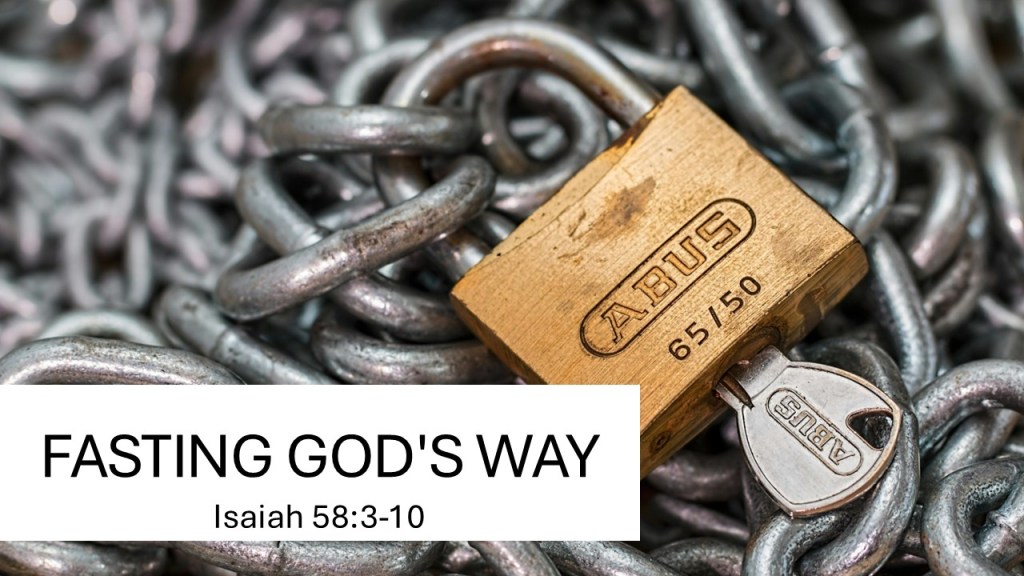
FASTING GOD’S WAY

FASTING GOD’S WAY           

Isaiah 58:3-10 NET.

3 They lament, ‘Why don’t you notice when we fast? Why don’t you pay attention when we humble ourselves?’ Look, at the same time you fast, you satisfy your selfish desires, you oppress your workers. 4 Look, your fasting is accompanied by arguments, brawls, and fistfights. Do not fast as you do today, trying to make your voice heard in heaven. 5 Is this really the kind of fasting I want? Do I want a day when people merely humble themselves, bowing their heads like a reed and stretching out on sackcloth and ashes? Is this really what you call a fast, a day that is pleasing to the LORD? 6 No, this is the kind of fast I want. I want you to remove the sinful chains, to tear away the ropes of the burdensome yoke, to set free the oppressed, and to break every burdensome yoke. 7 I want you to share your food with the hungry and to provide shelter for homeless, oppressed people. When you see someone naked, clothe him! Don’t turn your back on your own flesh and blood! 8 Then your light will shine like the sunrise; your restoration will quickly arrive; your godly behavior will go before you, and the LORD’s splendor will be your rear guard. 9 Then you will call out, and the LORD will respond; you will cry out, and he will reply, ‘Here I am.’ You must remove the burdensome yoke from among you and stop pointing fingers and speaking sinfully.

10 You must actively help the hungry and feed the oppressed. Then your light will dispel the darkness, and your darkness will be transformed into noonday.

Some health gurus suggest that intermittent fasting can help us lose weight or manage specific health problems. That is not the fasting Isaiah addresses in today’s text. He is dealing with ritual fasting, when a group of people fast to get back on God’s good side. Recently, our Sunday School class watched a video featuring a former Muslim. He described salvation in Islam as doing enough good works to outweigh all your sins. He said that one of the good works a Muslim can do to impress God is to fast.

The LORD told Isaiah to confront his people with their rebellious deeds. They were seeking God, but they were not changing their ways. They were doing many of the things they thought were right, but it was to cover up for all the things they were doing wrong. Let’s take a look at today’s text to see what the problem was.

What was wrong?

The ritual was fasting, and the people fasted regularly. They complained to Isaiah that God was not holding up his part of the bargain. But God told Isaiah to tell them that their fast was not acceptable. They were doing it, but they were doing it wrong. A fast is supposed to bring a person closer to God by allowing them to focus on God rather than their daily work schedule. It was not just about food. It was also about the tremendous amount of time each day needed for the processing, preparation, and consumption of food. By setting aside time that would otherwise be spent on food, people could focus on their relationship with God.

Food is a natural desire. But if we allow that desire to take first place in our lives, it can overrule our spiritual desires and make us selfish. During their fast, the Israelites showed an inclination toward selfish desires. Instead of satisfying their need for closeness to God, they focused on themselves. Their hunger became an excuse to mistreat others, especially employers. If a couple had servants working for them, they would hate fast days because those would be the days when their bosses would be unbearable. They would use their hunger as an excuse to exploit their workers.

Another thing that happened during fast days was that personal relationships took a hit. Because people were hungry, they allowed it to affect how they felt about each other. Little annoyances became huge problems. Everyone was wound tight, so the slightest thing could make them angry. Anger, without self-control, can lead to arguments and fights. That is what fasting was doing to the people Isaiah was preaching to.

It was also turning them into a nation of hypocrites. They would focus so much on appearing humble, yet inside, they would denounce each other in pride. It was all about the show.

Why was it wrong?

God never intended the ritual of fasting to become a means of destroying his people. He wanted their fasting time to be a time of spiritual healing and growth. He wanted it to be a time when the people could come together and reflect his love for one another. He wanted them to look forward to this time when they could rest from their labor and focus on the word of God rather than on their own stomachs.

God had never intended the ritual of fasting to become a show of false humility. It was designed to reinforce their actual dependence on God and on each other. But it had become a competition. They were trying to outdo each other by appearing more humble than anyone else. The winners looked more humble than the losers. The fact was that they were all losers. You cannot get a blue ribbon in a humility contest. As soon as you accept the prize, you reveal that the show is all you were doing.

Brian Beyer says this about today’s passage:

  • “The people complained because God was not honoring their fasting (58:3). They abstained from food and humbled themselves (at least they thought so), yet God seemed unimpressed. Isaiah explained the reason for God’s failure to honor the people’s fasting (58:3-4). No heart change occurred. The people continued exploiting their workers and quarreling, their edginess no doubt intensified by their hunger and their frustration at God’s lack of response. Such a situation would never receive God’s blessing. Isaiah contrasted the people’s current situation with the scenario God desired (58:5-7). Sincerity and humility are needed to accompany their fasting. But sincerity and humility were best evidenced by action, not by words. The Lord wanted to see them cease injustice and oppression, share food with the hungry, and take care of others’ needs. Fasting that produced a change of heart in God’s people would bring God’s approval (58:8-12). The Lord’s presence would surround them, and he would quickly answer their prayers. Their spiritual darkness would give way to the light of God’s ways, and the Lord would refresh their souls. They would rebuild ancient cities that had long lain in ruins. God’s presence would bring them the ability and resolve to accomplish everything he set before them.”[1]

How could it be made right?

God tells the people through the prophet that if they want to rescue the fasting ritual, they will need to break some chains. Where were the sinful chains? The lower class was wearing them. The servants, the poor, and the homeless in the community were being mistreated. The foreigners who owned no land were at the mercy of the landowners. During fasting times, the mistreatment worsened. The lower class expected to be abused by their “betters” during fasting days.

God tells the people to change how they observe fasting days. He tells them to take some of the food they have stored because they cannot eat it and give it to the hungry. Build shelters for the homeless and exploited poor. Give clothing to those who need it. Help fellow Israelites who are down on their luck.

He says that if they rescued the ritual of fasting in that way, the darkness will turn to light. Then the Lord will be free to respond to their prayers and make himself known among them.

Communion meditation:

“…we must help the weak, and remember the words of the Lord Jesus that he himself said, ‘It is more blessed to give than to receive.’” (Acts 20:35).

The communion service is a time we set apart to remember what Jesus Christ did for us. He gave his life for us. His death paid the ransom for our sins, so that we do not have to experience the second death.

The Apostle Paul told the Ephesian elders to remember something else. He told them to remember that Jesus said it is more blessed to give than to receive. He wanted the church community to model the Lord’s generosity.

We don’t have public fasts in our community today, but we do have a ritual we observe every week. It’s called going to church. If we are not careful, going to church can become a time when our selfishness dominates us, and our anger and lack of self-control can ruin our testimony. God wants us to turn that around, too.

Imagine what would happen if our fellowship became a time to help those in need. Imagine if we broke a few chains and rescued the needy during our meetings. Imagine a time focused on spiritual growth rather than the deeds of the flesh. That is what our Lord wants. This week, whenever we remember the blessing of communion, let’s also remember to be a blessing to the others we see every day.


[1] Beyer, Bryan. Encountering the Book of Isaiah: A Historical and Theological Survey. Baker Academic, 2007. pp. 224-225.