
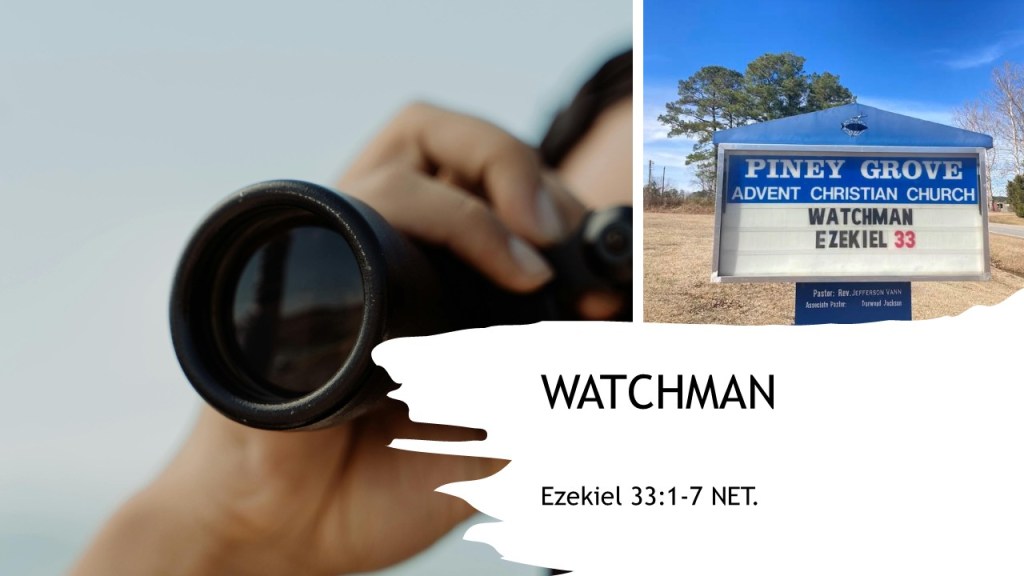
WATCHMAN
Ezekiel 33:1-7 NET.
1 The word of the LORD came to me: 2 “Son of man, speak to your people, and say to them, ‘Suppose I bring a sword against the land, and the people of the land take one man from their borders and make him their watchman. 3 He sees the sword coming against the land, blows the trumpet, and warns the people, 4 but there is one who hears the sound of the trumpet yet does not heed the warning. Then the sword comes and sweeps him away. He will be responsible for his own death. 5 He heard the sound of the trumpet but did not heed the warning, so he is responsible for himself. If he had heeded the warning, he would have saved his life. 6 But suppose the watchman sees the sword coming and does not blow the trumpet to warn the people. Then the sword comes and takes one of their lives. He is swept away for his iniquity, but I will hold the watchman accountable for that person’s death.’ 7 “As for you, son of man, I have made you a watchman for the house of Israel. Whenever you hear a word from my mouth, you must warn them on my behalf.
Some refer to them as lookouts. Ships at sea position these lookouts on high points to watch for other vessels and hazards. On road construction sites, work crews use them to monitor approaching vehicles and warn the other workers. The Forest Service places them in towers to detect smoke from forest fires and dispatch firefighters swiftly.
The purpose of a watchman was to warn of danger.
We have read about watchmen at work in 2 Samuel and 2 Kings, as well as in the Psalms and Isaiah. It was a familiar sight in cities of the Ancient Near East. Their purpose was to protect the city by alerting its citizens of coming invaders. If they saw the signs of an invading army, they would blow their trumpet, and the citizens and the army would be warned so that they could defend themselves against the attack.
The presence of these watchers was common in Ezekiel’s time. The Lord reminded Ezekiel of their presence to explain to him his purpose as a prophet.
Ezekiel was responsible for being a watchman.
He was to be a watchman, but not exactly like those with trumpets. He was to be a lookout for spiritual enemies. Instead of guarding the city’s walls, he was to guard the hearts of its people. The Lord told him that if he sees the enemy coming into their hearts and he doesn’t sound the alarm to warn them, he would be responsible for their captivity. They will die in their sins, but the Lord will hold them responsible for their deaths.
Two wars were going on simultaneously. There was a physical war that threatened invading armies who would bring disaster and captivity to the people of God. But another war was also raging in the hearts and minds of those same people. Ezekiel was the watchman responsible for protecting the people from that invasion.
The Lord said that if he declares that certain wicked people will surely die but doesn’t tell them to change their ways, they will die in their sins, and he will be held accountable for their deaths. That made Ezekiel passionate about his work. He fervently warned his listeners that their lives were in danger because they had rebelled against God and needed to repent before disaster overtook them.
The people listened, but they failed to respond.
Ezekiel attracted a following. People gathered to hear that unconventional prophet deliver his sermons. They observed him to critique his style and scrutinize his word choice. To them, it was entertainment, much like watching a TV show. They never considered that God might be guiding his words. Nor did they realize that God had sent him to guard them against the invisible army invading their hearts and causing their downfall.
There were also false prophets in Ezekiel’s generation. If people got tired of Ezekiel’s harsh words, they could change the channel. On the other channel, they could find a prophet who would tell them what they wanted to hear. Oh, and they were such eloquent liars. They were so erudite. They had such a way with words. Their sermons were so polished that you were left feeling so blessed. Their message was always the same: God loves you and has a wonderful plan for your life. He is a good shepherd, and he always takes care of his sheep. You are safe in his arms, no matter what you do.
Meanwhile, Ezekiel has the tough job of warning the people of coming disaster, both from the invading foreign armies and from the invisible invasion that had already begun. It didn’t matter that the people showed up to listen to him if they never heeded his call to repent.
We have to respond to God’s warnings.
The message applies to us today as clearly as it applied to the people in Ezekiel’s time. When God warns us of the consequences of our sins, we must listen, but we must do more than listen. We have to repent of our sins and change our ways. If we fail to do that, God is forced to condemn us for that neglect.
In the church age, we have watchers, just as in Ezekiel’s time. We have people whose spiritual gift is to be on the lookout for where we, as the church, are failing to live up to the standards of the covenant. Four places in the New Testament discuss the spiritual gifts. Romans chapter 12, I Corinthians chapter 12, Ephesians 4, and 1 Peter 4. Neither list is exhaustive, but one gift is discussed in all three chapters: the gift of prophecy.
The purpose of the gift of prophecy is the same as it was during Ezekiel’s time. It is not primarily for foretelling the future. Its primary purpose is to declare God’s mind and what he wants us to do, or not do. It is the watchman’s gift. Every church has them. They are not always popular for the same reason that Old Testament prophets were often executed. Nobody likes to be reminded of their sins.
It is an embarrassing thing to have to listen to someone tell you that you are doing something wrong. But God has built into each Christian community a ministry of doing just that. He knows that we need them. He knows that unless the watchers are at their post, the enemy will invade and destroy.
We have some examples of the Lord himself serving as a watchman in two chapters of Revelation. The letters sent to the seven churches in Asia Minor are prophecies to those churches.
In his letter to Ephesus, the Lord praised their orthodoxy and endurance despite the city’s reputation as a pagan city. However, He warned they had abandoned their first love, not the truth. They were theologically correct but flawed in action, neglecting the very works they taught. Jesus cautioned that if they didn’t return to their initial love and deeds, they risked being replaced. Love does more than say “I love you.” Love proves itself by works. Faith that does not work is dead faith.
In his letter to Smyrna, Jesus told them to remain faithful to the end and promised them the crown of life. Their testing was like an Olympic game where winners undergo rigorous trials and emerge victorious wearing a crown, which is the same as the one Jesus promised the church at Ephesus: life itself. Wearing the crown of life means being raised from the dead at Christ’s return. Ultimately, that is the only victory that matters.
The believers at Smyrna could also take solace in the fact that Jesus promised their time of testing would be limited. What those ten days of testing entailed, we can only speculate. We do know that at least some would pass the test. Some would live to see the time of testing completed and gain victory over the apostate Jewish community by surviving their attacks.
In his letter to the church at Pergamum, Jesus identifies two distinct false teachings. First, he speaks of “the teaching of Balaam, who taught Balak to put a stumbling block before the sons of Israel, so that they might eat food sacrificed to idols and practice sexual immorality.” Most of us remember this prophet for speaking to animals. Jesus reminds his readers of another incident in Balaam’s life, when he tricked the Israelites into sinning. Pergamum apparently had prophets who were leading the church astray.
Then there was “the teaching of the Nicolaitans.” Jesus commended the Ephesians for hating the Nicolaitans’ works, but did not explain what those works were. Both the Ephesians and the believers in Pergamum knew exactly what the Nicolaitans were teaching. While the Ephesian Christians had resisted their influence, the church at Pergamum had not. They had been compromised by – not one, but two heresies.
In his letter to Thyatira, Jesus spoke against a false prophetess. He called her Jezebel and demanded that she repent of her false prophecies. He told the church to hold fast to what they have.
He found Sardis sleeping and told the church to wake up, or else he would come upon them like a thief.
He commended Philadelphia for its faithfulness.
He warned Laodicea for being lukewarm: neither cold nor hot. They had what they needed, so they felt no need to be radical in their faith. Jesus is depicted as knocking at their door, symbolizing a relationship they could pursue. Taking this for granted led to tepid faith, and remaining lukewarm would be disastrous.
In each of these cases, God had a message for his church, and Jesus was the watchman he sent to deliver it. In most of these cases, that message was a warning. We ignore God’s warnings at our own peril. Our God loves us, so he cannot stand by and let us put ourselves in danger. He will send a word of warning. But it is our responsibility to heed that warning.


 jeffersonvann