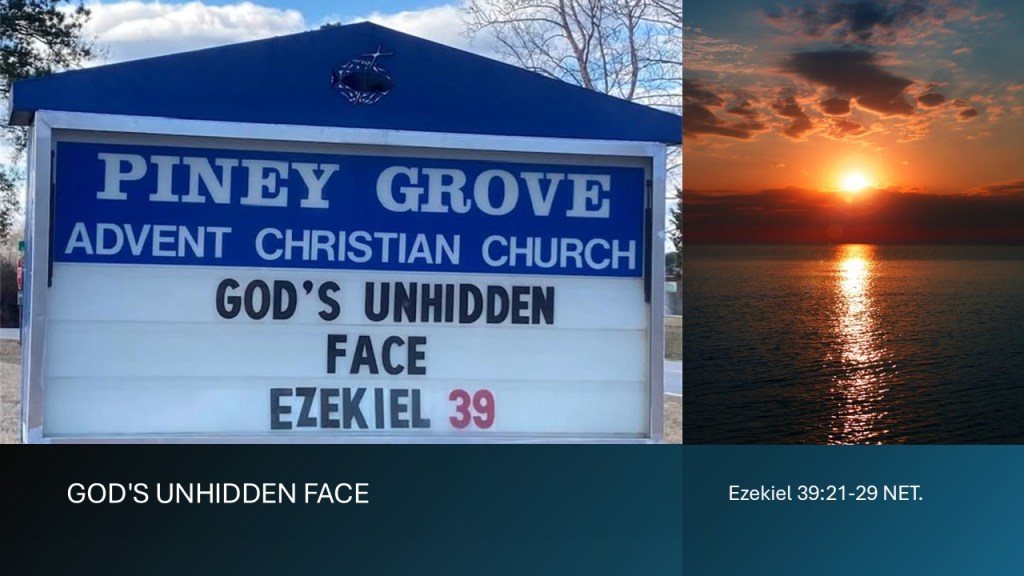
GOD’S UNHIDDEN FACE
Ezekiel 39:21-29 NET.
21 “I will display my majesty among the nations. All the nations will witness the judgment I have executed, and the power I have exhibited among them. 22 Then the house of Israel will know that I am the LORD their God, from that day forward. 23 The nations will know that the house of Israel went into exile due to their iniquity, for they were unfaithful to me. So I hid my face from them and handed them over to their enemies; all of them died by the sword. 24 According to their uncleanness and rebellion, I have dealt with them, and I hid my face from them. 25 “Therefore, this is what the sovereign LORD says: Now I will restore the fortunes of Jacob, and I will have mercy on the entire house of Israel. I will be zealous for my holy name. 26 They will bear their shame for all their unfaithful acts against me, when they live securely on their land with no one to make them afraid. 27 When I have brought them back from the peoples and gathered them from the countries of their enemies, I will magnify myself among them in the sight of many nations. 28 Then they will know that I am the LORD their God, because I sent them into exile among the nations, and then gathered them into their own land. I will not leave any of them in exile any longer. 29 I will no longer hide my face from them, when I pour out my Spirit on the house of Israel, declares the sovereign LORD.”
Ezekiel prophesied during the age of empires. The superpowers swallowed up small nations like Israel and Judah. Those empires reshaped the Earth’s geography by enslaving weaker nations and forcing them to become part of them. God’s people were enslaved and controlled by pagan nations because, during the age of empires, what was right was determined not by morality but by power. Might was right.
It was important for Ezekiel and the other prophets of this age to emerge and speak for God. If it were not for the prophets, the average Jew might conclude that the reason all this was happening was that their God was not strong enough to prevent it. After all, one of the names of their God was Yahveh of Armies (יְהוָה צְבָאוֹת). That name signified that the armies of the nations moved at the Lord’s command. Even though pagan kings and commanders gave the commands, God was behind the movements of the armies and their victories.
But during the age of empires, those armies did things that the average Israelite could not explain. They attacked Israel and were victorious over it. They destroyed Jerusalem and demolished its temple. They killed its warriors. They deported the citizens of Israel and Judah to foreign lands, where they lived in slave-like conditions under the power of unholy tyrants.
During this time, the Jewish people were tempted to believe that the God of the Bible was not as all-powerful as the Bible said he was. They were tempted to see themselves as second-class citizens and to view their God as a smaller, weaker, less important deity. They had the old stories of God’s supernatural power, delivering his people from bondage in Egypt, leading their kings in the conquest of the land, or in battle against their enemies. But those stories began to seem like fables and nursery rhymes.
One of the purposes of the prophets during this time was to correct a misconception about God. They had to keep explaining that this age of empires, with all its horrors, was not outside God’s control. “Though the wrong seems oft so strong, God is the ruler yet.” The people had convinced themselves that God had hidden his face from them, and that was why these greater gods and greater nations had taken over their lives. The tyrant’s might had proven itself right. But the prophets kept reminding their people that the exile came about because the Israelites themselves had broken their covenant with God. There was a moral reason for the age of empires. The military was not the prime mover of this history. God’s relationship with his people was the prime mover of these events.
The nations watched as God hid his face from Israel (23-24).
In verses 23-24, the Lord declares that the nations will realize that Israel was taken into captivity because of its disobedience and rebellion against Him. As a result, He turned His face away from them and handed them over to their enemies. They perished in battle, and He punished them for their impurity and sins, withdrawing His presence from them. He hid His face from them so they could not see Him at work. Yet he was still at work. He had not surrendered His sovereignty to these foreign kings or to their foreign gods.
These foreign emperors and kings were unaware, but Ezekiel predicts that they will come to know. Even during their exile, when they are captives of the empire’s rulers, God’s power will manifest among them in those lands. Prophets such as Ezekiel and Daniel would be taken to these foreign lands, where they would live out their lives and serve their ministries. The pagan kings, including Nebuchadnezzar and Cyrus, would encounter God and His word through the testimony of His people. They would realize that the God of Israel is all that the other Old Testament authors described about Him.
These kings would come to respect the God of Israel and understand that their control over these people was temporary and had nothing to do with their greatness. It was God himself who gave them over to these pagan rulers. He was punishing his people for their rebellion. Israel had a God, and their God had hidden his face from them for a limited time.
.
The nations would watch as God brought them back (27-28).
But Ezekiel prophesied that, in his mercy, God would reverse the punishment. He had exiled them, and he would bring them back. What is more, the very lands that had captured and enslaved them would watch helplessly as God brought them back to their land. God was behind the exile, hidden face and all. God would be behind the restoration. He had a purpose for the punishment, and he has a purpose for the restoration.
God assures his people, “When I bring you back from the lands of your enemies and gather you from various nations, I will show how great I am among you while many nations watch. Those nations will realize that I am the LORD your God, because I was the one who sent you into exile across the nations and then brought you back to your own land. I promise I will not leave any of you in exile anymore.”
As the age of empires continued, this small land of Israel became a visual sign for all those tyrants and their minions. They came to realize that, of all the nations they had destroyed, this nation had been restored. They came to respect this land and suspect that God had yet to do some great thing among them. It was so centrally located that war after war was waged in this land, yet those who had returned from exile remained. That horrible exile had cured their idolatry.
The prophets were unanimous in proclaiming that God was not finished with this land. Something important was going to happen there, and among these restored people. The nations around them would recognize it when it happened. But what was the reason for the return from exile?
?
The nations would watch as God poured out his Spirit on them (29).
God says that he will no longer hide his face from his people when he pours out his Spirit on the house of Israel. This prophecy was not unique to Ezekiel. In fact, God had said the same to one of the pre-exilic prophets.
God told the prophet Joel that his people would experience a terrifying time, comparable only to a locust plague that devastated a farmer’s crop. But then God said he would make up for the loss caused by the locust plague. He said he would make up for the years of loss caused by the invading locust armies. He said his people would have plenty to eat, and their hunger would be fully satisfied; they would praise the name of the LORD their God, who has acted wondrously on their behalf. His people would never again be put to shame. They will be convinced that He is in the midst of Israel. He is the LORD their God; there is no other. His people will never again be put to shame.
Then Joel made an interesting and unexpected prediction. He said that after this restoration, God will pour out His Spirit on all kinds of people. Their sons and daughters will prophesy. Their elders will have revelatory dreams; their young men will see prophetic visions. Even on male and female slaves, He will pour out His Spirit in those days.
When the Holy Spirit came down at Pentecost, it was in the Jewish city of Jerusalem, and God’s presence and power filled the lives of Jewish people who had come to know their Messiah. Peter’s message at that time was, “Let all the house of Israel know beyond a doubt that God has made this Jesus whom you crucified both Lord and Christ.” The mass repentance that day was a Jewish repentance. The Gift of the Holy Spirit that day was a gift to the nation of Israel. But those Jews were residents in many different regions and nations and spoke different languages. The purpose of the infilling of the Holy Spirit among those Jews was that God intended to use them to bless the nations all around them. The Book of Acts tells us that this enormous church, begun by the supernatural event of Pentecost, was sent by God to those nations. God filled the church with his Holy Spirit. Then God scattered them all over the face of the Earth in a massive missionary campaign.
The horrible exile and the merciful restoration were only the first two stages in God’s plan. The third stage is what Ezekiel and Joel predicted. It would begin with a miraculous empowerment and result in new people.
The book of Revelation gives us a picture of the result of this new age we are now living in. First, there are 144,000 Jews from all the tribes of Israel. No, they are not JW’s. They are identified by tribe. But these are believers in the Messiah. They have a gospel message to preach to another group. It was an enormous crowd that no one could count, made up of people from every nation, tribe, people, and language, standing before the throne and before the Lamb, dressed in long white robes and holding palm branches. They were shouting in a loud voice, “Salvation belongs to our God, to the one seated on the throne, and to the Lamb!”
Now, Ezekiel’s message was to a poor, downtrodden, defeated nation whose God seemed to have hidden his face from them. Yet his message was good news. He told them that God would not hide his face from them forever. He had a plan for them. His plan included everything they had been hoping and praying for. The tyrants and their empires would come and go, but God would restore Israel to the land. As Joel prophesied, God would make up for what the locust plague had destroyed.
But there was more good news to follow. This beaten, bedraggled nation would be the launching point for God’s great, holy, and righteous empire, which would eventually cover the globe and produce a redeemed new universe. Daniel saw all the world’s empires toppled by a stone cut from a mountain. God is going to bowl a strike and reset the universe.
If you are a Christian today, you are part of that new universe. You may feel as those Israelites did in Ezekiel’s day. You may feel like a helpless pawn to the powerful and dark forces of a world out of control. But if you are a Christian today, you are not that helpless pawn. You are part of what God is doing. Let the Holy Spirit reign in your life, because no one else’s reign will last.
Communion meditation
But the gracious gift is not like the transgression. For if the many died through the transgression of the one man, how much more did the grace of God and the gift by the grace of the one man Jesus Christ multiply to the many! (Romans 5:15 NET).
As we remember again what our Lord did for us on Calvary’s cross, we would do well to consider what the Apostle Paul says in this text. He compares two things: a transgression and a gift of grace. The transgression is the rebellion in Eden. Adam was justly condemned for transgressing the prohibition in the garden. But as a result of his sin, death has come to all of us, even though we were not there and were not given the same choice.
But Paul says the gracious gift is not like the transgression. Some things make the comparison possible. Jesus made a choice just as Adam did. The consequences of Jesus’ choice will be experienced by everyone in Christ, just as everyone in Adam is experiencing the consequences of Adam’s choice.
But the differences are these. Jesus offers the gift of his own sacrifice to everyone who chooses to come to him. He paid the price, but we can choose to accept his death on the cross and apply it personally to our own sin debt. The other difference is the result. Adam’s sin brought a reign of death. Christ’s gift of grace will reign through righteousness to eternal life.


 jeffersonvann