
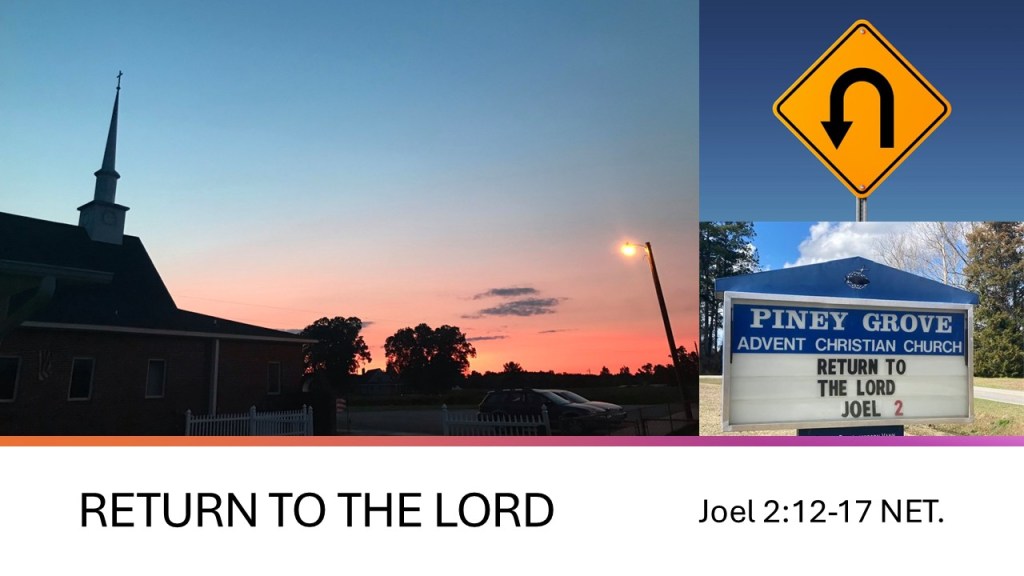
RETURN TO THE LORD
Joel 2:12-17 NET.
12 “Yet even now,” the LORD says, “return to me with all your heart — with fasting, weeping, and mourning. Tear your hearts, not just your garments!” 13 Return to the LORD your God, for he is merciful and compassionate, slow to anger and boundless in loyal love — often relenting from calamitous punishment. 14 Who knows? Perhaps he will be compassionate and grant a reprieve, and leave blessing in his wake — a meal offering and a drink offering for you to offer to the LORD your God! 15 Blow the trumpet in Zion. Announce a holy fast; proclaim a sacred assembly! 16 Gather the people; sanctify an assembly! Gather the elders; gather the children and the nursing infants. Let the bridegroom come out from his bedroom and the bride from her private quarters. 17 Let the priests, those who serve the LORD, weep from the vestibule all the way back to the altar. Let them say, “Have pity, O LORD, on your people; please do not turn over your inheritance to be mocked, to become a proverb among the nations. Why should it be said among the peoples, “Where is their God?”
The prophet Joel addressed the southern kingdom of Judah, and he never mentions the northern kingdom of Israel. Because he names no kings and refers to no contemporary prophets, the exact date of his ministry is difficult to determine. Our prophetic chronology places the book around 850 B.C., but the text itself offers no firm historical markers, leaving the date approximate rather than precise.
Joel was a pre‑exilic prophet who ministered before the fall of both the northern kingdom of Israel (721 B.C.) and the southern kingdom of Judah (586 B.C.). Other pre‑exilic prophets include Jonah, Hosea, Amos, Isaiah, and Micah. Among them, Joel stands as the earliest.
Joel describes a devastating locust plague that had ravaged Judah. History records a similar catastrophe in 1915 across what is now Israel and Syria. The first swarms arrived in March, forming clouds so dense they blotted out the sun. The female locusts immediately began laying eggs—about a hundred each. Observers reported 65,000 to 75,000 eggs in a single square yard. Within weeks, the eggs hatched, and the young—unable to fly—moved like armies of oversized ants, hopping forward 400 to 600 feet a day and stripping every trace of vegetation in their path. After two more molts, they became adults capable of flight, and the destruction only intensified.
Immediately after the locust plague, a severe drought struck the land, deepening the devastation. The heat was relentless. The soil cracked, the rivers shrank, and the remaining vegetation withered. What little survived the locusts was now consumed by fires sweeping across the parched fields. Judah was left staring at a landscape stripped bare—an ecological collapse that touched every part of life: crops, livestock, economy, and hope.
But Joel’s message is unmistakable: this disaster was not the final judgment. It was an alarm, a divine warning shot. The locusts and the drought were God’s way of shaking Judah awake, forcing the nation to see its spiritual condition. Their covenant unfaithfulness had consequences, and the devastation around them was meant to drive them to repentance.
Joel insists that if Judah ignored this warning, something far worse was approaching. The locusts were only a symbol, a preview of a greater judgment on the horizon. He calls that coming catastrophe the day of the Lord—a day marked not by insects or drought, but by the arrival of an invading army, overwhelming and unstoppable, bringing destruction far beyond anything the locusts had done.
The plague was terrible. The drought was worse. But the day of the Lord would eclipse them both. Joel’s purpose was to make Judah understand that God was not merely punishing; He was calling—summoning His people to return to Him before the final blow fell.
Joel warned Judah to repent—to return to the Lord before an even greater calamity struck. The passage before us makes several foundational statements about repentance, and these statements speak directly to the questions every one of us carries about what it means to come back to God. Repentance is not a relic of the Old Testament or a theme confined to ancient prophets. It is the steady, unbroken call of Scripture from beginning to end.
The Law calls Israel to turn back to the Lord with all their heart. The prophets plead with the nation to return before judgment falls. John the Baptist begins his ministry with the command to repent. Jesus opens His public preaching with the same call. The apostles proclaim repentance as the doorway into life. And the book of Revelation ends with Christ still calling His people to turn from sin and return to Him.
Joel’s message fits squarely within this biblical pattern. His warnings are not merely historical; they reveal how God deals with His people in every generation. When disaster strikes, when life collapses, when the consequences of sin become impossible to ignore, God is not simply punishing—He is calling. He is summoning His people back to Himself.
HOW do we return to the LORD? (12).
Many of us carry a history with the word “repentance”. We remember revival meetings where the preacher urged us to walk the aisle, be baptized, or join the church. For many, repentance became something we did—a moment in the past, an event we point back to. But Scripture treats repentance as far more than a single decision or a trip down an aisle. It is a turning of the heart toward God, not merely a response to a preacher’s invitation. And Joel’s message forces us to rethink repentance, not as a box we checked years ago, but as a present, ongoing call from God Himself.
The people of Judah had their own traditions surrounding repentance. One of the most visible was the act of tearing their garments—a public display of grief meant to show their hatred of sin and their sorrow over its consequences. It was a cultural symbol everyone recognized. Joel understood this practice well; he knew it was the standard way people demonstrated repentance in his day. But he also knew its danger: it allowed people to perform repentance without actually repenting. A torn garment could hide an untouched heart.
The word Joel delivered from the Lord was direct and unmistakable: “Return to Me with all your heart—with fasting, weeping, and mourning. Tear your hearts, not just your garments!” God was not asking for a performance. He was calling for a genuine turning of the inner life. The outward signs—fasting, tears, expressions of grief—were meant to flow from a heart that was truly broken over sin. Judah had mastered the ritual of tearing garments; God wanted the reality of a torn heart.
Fasting is not something most of us practice regularly. We usually stop eating only when something so painful or shocking happens that food becomes irrelevant. When a loved one is in critical condition or tragedy strikes without warning, appetite disappears. We don’t choose to fast—we cannot imagine eating because our hearts are too heavy to care. That is the kind of fasting Joel has in mind: not a scheduled religious exercise, but the natural response of a heart overwhelmed by the weight of sin.
And Joel doesn’t stop with fasting. He adds weeping and mourning—the outward expressions of inward grief. In Scripture, these are not theatrical displays. They are the visible overflow of a heart that finally sees sin for what it is: a rupture in our relationship with God, a wound to His holiness, a betrayal of His goodness. When the heart breaks, the eyes follow. When the heart grieves, the body responds. Joel is describing repentance that is so real, so deep, so honest that it affects the whole person.
This is why God says, “Tear your hearts, not just your garments.” Judah knew how to perform repentance. They knew how to tear their clothes, bow their heads, and look sorrowful. But God was not moved by their rituals. He wanted the reality behind the ritual—the broken heart, the humbled spirit, the genuine turning back to Him.
True repentance is not measured by how loudly we cry or how dramatically we respond. It is measured by whether the heart has truly turned. The outward signs—fasting, weeping, mourning—are meaningful only when they flow from an inner transformation. Joel’s message is that repentance is not a performance; it is a surrender.
WHY should we return to the LORD? (13-14, 17b).
Joel calls Judah to return with fasting, weeping, and mourning—not because God delights in misery, but because true repentance is born from a heart that finally feels the weight of sin. But Joel does something crucial here: he anchors the call to repent in the character of God. The reason God demands a torn heart is not that He is harsh, but because He is gracious.
Joel 2:13 gives one of the most beautiful descriptions of God in the Old Testament: “For He is gracious and compassionate, slow to anger, and abounding in steadfast love.” That is the foundation of repentance. We return to God because of who He is.
- He is gracious — God gives what we do not deserve. Repentance is not met with rejection but with open arms.
- He is compassionate — God feels for His people. He is not indifferent to their suffering or their sin.
- He is slow to anger — God is patient. He does not rush to judgment. He gives space to return.
- He abounds in steadfast love — His covenant love is not fragile or fickle. It is abundant, overflowing, and constant.
- He refrains from sending calamity — God’s desire is not to destroy but to restore. Judgment is His strange work; mercy is His delight.
This is why God calls for the heart. A torn garment can be faked. A torn heart cannot. And when the heart turns, it turns toward a God who is eager to forgive, ready to restore, and overflowing with mercy.
Joel wants Judah to understand that repentance is not driven solely by fear. The character of God draws it. The warning is real, but the invitation is rooted in grace. The God who judges is the same God who longs to show compassion.
Joel ends this call to repentance with a scene that is both solemn and urgent. The priests—those appointed to stand between God and the people—are commanded to take their place “between the porch and the altar” and cry out, “Spare Your people, O Lord.” This is not a casual prayer. It is the desperate plea of spiritual leaders who understand that unless God shows mercy, the nation is finished.
The location matters. “Between the porch and the altar” was the space where sacrifices were offered and where the presence of God was approached. It was the meeting point between human guilt and divine grace. By placing the priests there, Joel is showing that repentance is not merely emotional sorrow—it is a return to God on His terms, through the means He provides.
The prayer itself is simple but profound:
- “Spare Your people” — an admission that judgment is deserved, and mercy is the only hope.
- “Do not make Your heritage a reproach” — an appeal to God’s covenant promises and His reputation among the nations.
- “Why should the nations say, ‘Where is their God?’” — a reminder that God’s mercy toward His people displays His glory to the world.
Joel wants Judah to see that repentance is not only personal and not only communal—it is intercessory. The leaders must plead on behalf of the people. The people must humble themselves before God. And the entire nation must throw itself on the mercy of the God who is gracious, compassionate, slow to anger, and abounding in steadfast love.
This priestly cry becomes the turning point of the book. When the people return to God with torn hearts, and when the priests intercede on their behalf, God responds—not with judgment, but with restoration.
WHO should return to the LORD? (15-17a).
Joel makes it clear that repentance is never a private matter. When God calls His people to return, He calls all of them. That is why, in Joel 2:15–17, the prophet commands the nation to gather for a sacred assembly. No one is excused. No one is too young, too old, too busy, or too important to respond.
- The elders must come, because they are responsible for leading the people back to God.
- The priests must come, because they stand between God and the nation, pleading for mercy.
- The children must come, because even the youngest are part of the covenant community.
- Nursing infants must come, because the crisis is so severe that even daily routines must be interrupted.
- Newlyweds must come, because not even the joy of marriage outweighs the urgency of returning to the Lord.
Joel’s point is unmistakable: when God calls for repentance, He calls for a whole‑community response. Sin affects everyone, so repentance must involve everyone. The nation cannot be healed if only a handful return. The priests cannot repent for the people, and the people cannot repent without their leaders. The entire community must gather, humble themselves, and cry out for mercy.
And at the center of this gathering stands the priestly prayer: “Spare Your people, O Lord.” It is a cry that acknowledges guilt, pleads for compassion, and appeals to God’s covenant love. Joel wants Judah to see that repentance is not merely an individual act of sorrow—it is a collective turning back to the God who is gracious, compassionate, slow to anger, and abounding in steadfast love.
We in 21st‑century America live in an individualist culture, so we rarely grasp the power of an entire community turning back to the Lord. That’s unfortunate, because I believe God desires to pour out blessings, righteousness, and justice on whole communities—not just on isolated individuals. But He is not going to transform a town because a handful of people on the margins seek Him while everyone else carries on unchanged. What we need is a community‑wide return to God.
I’m not talking about one congregation, not even Piney Grove by itself. I believe God wants to revive this whole community and breathe life into every church that calls on His name. Imagine what could happen if believers across our town humbled themselves, prayed together, and returned to the Lord. That is the kind of movement God has honored throughout Scripture. And that is the kind of movement we should be asking Him for today.
Let’s lift our eyes beyond our own pews and pray for a revival that reaches every home, every church, and every corner of our community. Let’s see what God will do when His people come together and return to Him with one heart.


 jeffersonvann