
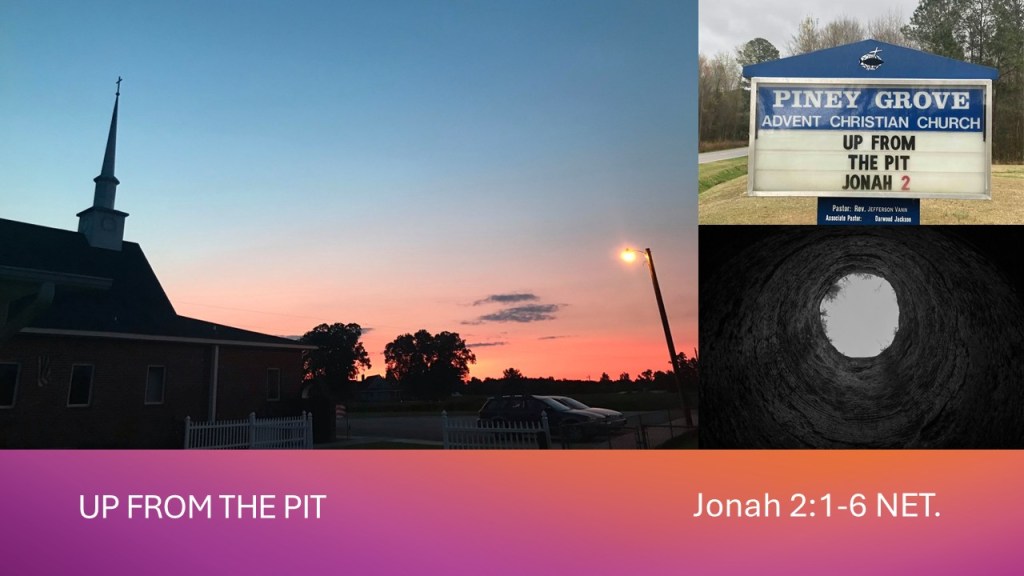
UP FROM THE PIT
Jonah 2:1-6 NET.
1 Jonah prayed to the LORD his God from the stomach of the fish 2 and said, “I called out to the LORD from my distress, and he answered me; from the belly of Sheol I cried out for help, and you heard my prayer. 3 You threw me into the deep waters, into the middle of the sea; the ocean current engulfed me; all the mighty waves you sent swept over me. 4 I thought I had been banished from your sight, that I would never again see your holy temple! 5 Water engulfed me up to my neck; the deep ocean surrounded me; seaweed was wrapped around my head. 6 I went down to the very bottoms of the mountains; the gates of the netherworld barred me in forever; but you brought me up from the Pit, O LORD, my God.
I usually rely on the NET translation when I preach because it is clear, careful, and often very helpful. At times, though, I switch to another version if it captures the Hebrew or Greek more accurately. But today I stayed with the NET precisely because, in this case, its weaker rendering becomes a teaching moment. I’m referring to the phrase “the gates of the netherworld” in verse 6. Jonah did not speak in vague mythological language, nor was he imagining some shadowy underworld out of ancient folklore. The Hebrew phrase points much more directly to the realm of death itself—the place no one escapes, the place whose “bars” and “gates” symbolize finality and hopelessness.
Jonah is describing what it felt like to be swallowed by death. He believed he had crossed the threshold from which no human being returns. And yet, from within that prison, he cried out—and the Lord heard him. The point is not that Jonah understood everything perfectly, but that God’s mercy reached him even where he thought no mercy could reach. The “gates” that should have held him forever could not hold him because the Lord willed otherwise.
Keeping the NET’s awkward phrase in front of us helps us slow down and ask what Jonah actually meant. It reminds us that God’s saving power is not limited by our circumstances, our despair, or even our mistaken assumptions. When we feel trapped behind our own “gates,” Jonah’s prayer teaches us that the Lord can still bring us up from the pit.
The NET’s own notes acknowledge the literal Hebrew—“As for the earth, its bars…”—yet the translation still opts for the much looser and theologically loaded phrase “the gates of the netherworld.” That choice imports an idea Jonah never expressed. There is no “netherworld” in this passage, no mythic underworld, no realm of demons or torment. Jonah is not giving us cosmology; he is giving us biography—the raw memory of a man who believed he was about to die.
The phrase הָאָרֶץ בְּרִחֶיהָ paints a concrete picture: the earth with its bars, the physical world closing over him like a prison. In Jonah’s mind, the ocean floor was not a symbolic underworld but the literal boundary between life and death. The “bars” are the finality of drowning—the sense that the world has shut behind him and there is no way back.
Jonah prays this from inside the fish, but his language reaches back to the moments before the fish swallowed him. Verse 2 already tells us he cried out from “the belly of Sheol.” In the Old Testament, Sheol is not the netherworld; it is simply the state of being dead—the grave, the silence, the end of consciousness. Jonah is saying, “I was as good as dead. I had crossed the threshold. I was already in death’s grip.”
Jonah’s point is simple and profound: he was dying, and God saved him. The “bars” of the earth were closing, the grave was claiming him, and yet God intervened. The miracle is not that Jonah visited some mystical realm—it is that God preserved a man who had already begun to descend into death.
Christians often end up confused about what happens after death because our English Bibles sometimes adjust the Hebrew and Greek in ways that unintentionally reinforce ideas the biblical writers never taught. When translators choose words like “netherworld”, they introduce the notion of a conscious realm people enter immediately after death—a concept far more at home in Greek mythology than in the Old Testament. The result is that many readers assume the Bible teaches an automatic, conscious afterlife somewhere else, when in fact the Hebrew text is describing something much simpler and far more sobering: death itself.
Several English translations use terms like “netherworld,” “underworld,” or “realm of the dead,” language that suggests ongoing awareness after death. These words carry cultural baggage and make readers imagine souls continuing life elsewhere. But Hebrew Scripture uses Sheol to describe the state of being dead—silent, unconscious, cut off from the living. It is not a destination but the condition of no longer being alive. Such mythic terms mislead readers into believing in a conscious afterlife before resurrection. In Jonah 2, the language is physical: he is drowning, the “bars of the earth” closing over him. “Sheol” means he was as good as dead.
The biblical writers are not concerned with where people “go” when they die. They are concerned with the fact that death ends life, and only God can restore it.
When Christians focus on “going somewhere” after death, they often miss the heart of the good news. The gospel is not about escaping to another realm. It is about God’s promise to undo death itself. Jesus does not offer relocation; He offers resurrection. The hope held out in Scripture is not that we will continue living elsewhere, but that God will give life back to those who have died.
This is why the New Testament proclaims resurrection so loudly and so often. It is the answer to the problem the Bible actually describes: not the fear of going to the wrong place, but the reality that we die—and need Jesus to raise us.
We all face the same reality when life ends, and Scripture names it in several ways: the grave, Sheol, the Pit, and death. These are not different realms but different expressions for the same end of earthly life. Biblical writers use them interchangeably to describe the universal fate of all people. When Jonah speaks of Sheol and the Pit, he is not picturing an underworld but describing how near he was to dying as the sea closed in around him. In his mind, he had already crossed into death, and his prayer rose from that desperate awareness.
And yet, God brought him back.
Because all these terms point to the same reality, they also point to the same hope. If death is the problem, then resurrection is the solution. The Bible does not promise that we will go somewhere else when we die; it promises that God will raise the dead. That is why the New Testament anchors Christian hope not in escape from death but in victory over it.
Death is a Pit
Jonah was not exaggerating. He was seconds from death, the world closing in like a prison as the sea swallowed him and the earth’s “bars” shut behind him. He was entering the finality Scripture calls the Pit—where life ends, and hope disappears. At that moment, God intervened and lifted him out. His rescue was a reversal of death, not a metaphor. The Pit is not an underworld but another name for Sheol, the grave, death itself. Jonah describes breath leaving his body and darkness overtaking him. His prayer is the cry of a man already slipping beneath life’s final boundary.
Job captures this hopelessness with painful clarity: “If I hope for Sheol as my house, if I make my bed in darkness, if I say to the pit, ‘You are my father,’ and to the worm, ‘My mother,’ or ‘My sister,’ where then is my hope? Who will see my hope? Will it go down to the bars of Sheol? Shall we descend together into the dust?” (Job 17:13–16)
Job’s questions assume the answer: there is no hope in Sheol—no future, no life, no expectation. Hope cannot follow a person into the dust. Jonah felt that same nearness to death as darkness closed in and the sea’s “bars” shut behind him. Yet where hope should have ended, God intervened and lifted him from the Pit. His prayer becomes a testimony of deliverance. Scripture’s images—darkness, worms, bars—describe the finality of death, not a conscious realm. This matches God’s word to Adam: made from dust, he would return to dust. Death ends life; consciousness ceases; dust returns to dust.
This is why the Bible uses “Sheol,” “the grave,” “the Pit,” and “death” interchangeably. They all describe the same reality: the end of life, the silence that follows, the condition from which only God can raise a person.
When Jonah speaks of the Pit and the bars of the earth, he is not imagining a mythological underworld. He is describing the moment when death was closing in on him. The darkness, the pressure, the descent, the sense of no escape—these are the very images Scripture uses to describe the grave. Jonah believed he was already crossing that threshold.
And yet, God brought him back.
There will be a rescue from the Pit.
Job admits no one escapes the Pit; once a person enters death, no strength or righteousness can bring him back. Yet he refuses despair. He knows he will return to dust, but he also knows his Redeemer lives and will one day stand on that dust and raise him. His own eyes will see God—resurrection hope. David echoes this in Psalm 30: death silences praise, so he pleads for life. Psalm 49 adds that no one can ransom another to “live on forever.” Wise and foolish alike perish. Death ends consciousness and activity; the Pit is simply the end of life.
Many people still resist this. They insist that people continue living somewhere else after their bodies die. But the sons of Korah say the opposite: we perish. We do not relocate; we cease.
Paul’s confirmation: we are perishable until resurrection
Paul brings Old Testament teaching to its climax: we are perishable and remain so until Jesus raises us from the dead. Only then do we become imperishable. He writes, “the dead will be raised imperishable” (1 Corinthians 15:52). He does not say the dead are already imperishable or alive elsewhere. He speaks of a future resurrection in which the dead are made imperishable. The Bible’s hope is not surviving death but God undoing death itself.
Jonah was lifted from the Pit.
Jonah fits seamlessly into the pattern established by Job, David, and the sons of Korah. He was seconds from dying, swallowed by the sea, sinking past the point of rescue. He felt himself descending into the Pit, the same Pit Job said no one can escape. The “bars of the earth” were closing behind him, sealing him in. His life was slipping away; he was returning to the dust from which all humanity comes. And yet, at the very brink—when death had already begun its work—God reached into that hopeless place and lifted him. Jonah’s deliverance is not merely dramatic; it is a small-scale demonstration of the very thing Scripture promises God will one day do for all His people.
Jonah’s rescue is a living parable of resurrection: God will bring life out of death, hope out of hopelessness, deliverance up from the Pit.


An EXPANDED VERSION of this sermon is available on the Afterlife site!

 jeffersonvann