2 Samuel 20:1 Now a wicked man, a Benjaminite named Sheba son of Bichri, happened to be there. He blew the ram’s horn and shouted: We have no portion in David, no inheritance in Jesse’s son. Each man to his tent, Israel!
2 Samuel 20:2 So all the men of Israel deserted David and followed Sheba son of Bichri, but the men of Judah from the Jordan all the way to Jerusalem remained loyal to their king.
2 Samuel 20:3 When David came to his palace in Jerusalem, he took the ten concubines he had left to take care of the palace and placed them under guard. He provided for them, but he was not intimate with them. They were confined until the day of their death, living as widows.
2 Samuel 20:4 The king said to Amasa, “Summon the men of Judah to me within three days and be here yourself.”
2 Samuel 20:5 Amasa went to summon Judah, but he took longer than the time allotted him.
2 Samuel 20:6 So David said to Abishai, “Sheba son of Bichri will do more harm to us than Absalom. Take your lord’s soldiers and pursue him, or he will find fortified cities and elude us.”
2 Samuel 20:7 So Joab’s men, the Cherethites, the Pelethites, and all the warriors marched out under Abishai’s command; they left Jerusalem to pursue Sheba son of Bichri.
2 Samuel 20:8 They were at the great stone in Gibeon when Amasa joined them. Joab was wearing his uniform and over it was a belt around his waist with a sword in its sheath. As he approached, the sword fell out.
2 Samuel 20:9 Joab asked Amasa, “Are you well, my brother?” Then with his right hand Joab grabbed Amasa by the beard to kiss him.
2 Samuel 20:10 Amasa was not on guard against the sword in Joab’s hand, and Joab struck him in the stomach with it and spilled his intestines out on the ground. Joab did not stab him again, and Amasa died. Joab and his brother Abishai pursued Sheba son of Bichri.
2 Samuel 20:11 One of Joab’s boys had stood over Amasa saying, “Whoever favors Joab and whoever is for David, follow Joab!”
2 Samuel 20:12 Now Amasa had been writhing in his blood in the middle of the highway, and the man had seen that all the people stopped. So he moved Amasa from the highway to the field and threw a garment over him because he realized that all those who encountered Amasa were stopping.
2 Samuel 20:13 When he was removed from the highway, all the men passed by and followed Joab to pursue Sheba son of Bichri.
2 Samuel 20:14 Sheba passed through all the tribes of Israel to Abel of Beth-maacah. All the Berites came together and followed him.
2 Samuel 20:15 Joab’s people came and besieged Sheba in Abel of Beth-maacah. They built a siege ramp against the outer wall of the city. While all the people with Joab were putting an end to the wall to make it collapse,
2 Samuel 20:16 a wise woman called out from the city, “Listen! Listen! Please tell Joab to come here and let me speak with him.”
2 Samuel 20:17 When he had come near her, the woman asked, “Are you Joab?” “I am,” he replied. “Listen to the words of your servant,” she said to him. He answered, “I’m listening.”
2 Samuel 20:18 She said, “In the past they used to say, ‘Seek counsel in Abel,’ and that’s how they settled disputes.
2 Samuel 20:19 I am one of the peaceful and faithful in Israel, but you’re trying to destroy a city that is like a mother in Israel. Why would you devour Yahveh’s inheritance?”
2 Samuel 20:20 Joab protested: “Never! I would never devour or put an end to it!
2 Samuel 20:21 That is not the case. There is a man named Sheba son of Bichri, from the hill country of Ephraim, who has rebelled against King David. Deliver this one man, and I will withdraw from the city.” The woman replied to Joab, “Watch! His head will be thrown over the wall to you.”
2 Samuel 20:22 The woman went to all the people with her wise counsel, and they cut off the head of Sheba son of Bichri and threw it to Joab. So he blew the ram’s horn, and they dispersed from the city, each to his own tent. Joab returned to the king in Jerusalem.
2 Samuel 20:23 Joab commanded the whole army of Israel; Benaiah son of Jehoiada was over the Cherethites and Pelethites;
2 Samuel 20:24 Adoram was over forced labor; Jehoshaphat son of Ahilud was court historian;
2 Samuel 20:25 Sheva was court secretary; Zadok and Abiathar were priests;
2 Samuel 20:26 and in addition, Ira the Jairite was David’s priest.
2 Samuel 19:1 It was reported to Joab, “The king is weeping. He’s mourning over Absalom.”
2 Samuel 19:2 That day’s victory was turned into mourning for all the people because on that day the people heard, “The king is grieving over his son.”
2 Samuel 19:3 So they returned to the city quietly that day like people come in when they are humiliated after fleeing in battle.
2 Samuel 19:4 But the king covered his face and cried loudly, “My son Absalom! Absalom, my son, my son!”
2 Samuel 19:5 Then Joab went into the house to the king and said, “Today you have shamed all your soldiers– those who saved your throat as well as the throats of your sons, the throats of your wives, and the throats of your concubines–
2 Samuel 19:6 by loving your enemies and hating those who love you! Today you have made it clear that the commanders and soldiers mean nothing to you. In fact, today I know that if Absalom were alive and all of us were dead, it would be fine with you!
2 Samuel 19:7 “Now get up! Go out and speak to the heart of your soldiers, for I swear by Yahveh that if you don’t go out, not a man will remain with you tonight. This will be worse for you than all the trouble that has come to you from your youth until now!”
2 Samuel 19:8a So the king got up and sat in the city gate, and all the people were told: “Look, the king is sitting in the city gate.”
2 Samuel 19:8b Then they all came into the king’s presence. Meanwhile, each Israelite had fled to his tent.
2 Samuel 19:9 People throughout all the tribes of Israel were arguing among themselves, saying, “The king rescued us from the grasp of our enemies, and he saved us from the grasp of the Philistines, but now he has fled from the land because of Absalom.
2 Samuel 19:10 But Absalom, the man we anointed over us, has died in battle. So why do you say nothing about restoring the king?”
2 Samuel 19:11 King David sent word to the priests Zadok and Abiathar: “Say to the elders of Judah, ‘Why should you be the last to restore the king to his palace? The talk of all Israel has reached the king at his house.
2 Samuel 19:12 You are my brothers, my flesh and blood. So why should you be the last to restore the king? ‘
2 Samuel 19:13 And tell Amasa, ‘Aren’t you my flesh and blood? May God punish me and do so severely if you don’t become commander of my army from now on instead of Joab! ‘”
2 Samuel 19:14 So he won over all the men of Judah, and they unanimously sent word to the king: “Come back, you and all your servants.”
2 Samuel 19:15 Then the king returned. When he arrived at the Jordan, Judah came to Gilgal to meet the king and escort him across the Jordan.
2 Samuel 19:16 Shimei son of Gera, the Benjaminite from Bahurim, hurried down with the men of Judah to meet King David.
2 Samuel 19:17 There were a thousand men from Benjamin with him. Ziba, a boy from the house of Saul, with his fifteen sons and twenty servants also rushed down to the Jordan ahead of the king.
2 Samuel 19:18 They forded the Jordan to bring the king’s household across and do whatever the king desired. When Shimei son of Gera crossed the Jordan, he fell facedown before the king
2 Samuel 19:19 and said to him, “My lord, don’t hold me guilty, and don’t remember your servant’s wrongdoing on the day my lord the king left Jerusalem. May the king not take it to heart.
2 Samuel 19:20 For your servant knows that I have sinned. But look! Today I am the first one of the entire house of Joseph to come down to meet my lord the king.”
2 Samuel 19:21 Abishai son of Zeruiah asked, “Shouldn’t Shimei be put to death for this, because he cursed Yahveh’s anointed?”
2 Samuel 19:22 David answered, “Sons of Zeruiah, do we agree on anything? Have you become my adversary today? Should any man be killed in Israel today? Am I not aware that today I’m king over Israel?”
2 Samuel 19:23 So the king said to Shimei, “You will not die.” Then the king gave him his oath.
2 Samuel 19:24 Mephibosheth, Saul’s grandson, also went down to meet the king. He had not taken care of his feet, trimmed his mustache, or washed his clothes from the day the king left until the day he returned safely.
2 Samuel 19:25 When he came from Jerusalem to meet the king, the king asked him, “Mephibosheth, why didn’t you come with me?”
2 Samuel 19:26 “My lord the king,” he replied, “my servant Ziba betrayed me. Actually your servant said: ‘I’ll saddle the donkey for myself so that I may ride it and go with the king’– for your servant is lame.
2 Samuel 19:27 Ziba slandered your servant to my lord the king. But my lord the king is like the angel of God, so do whatever you think best.
2 Samuel 19:28 For my grandfather’s entire family deserves death from my lord the king, but you set your servant among those who eat at your table. So what further right do I have to keep on making appeals to the king?”
2 Samuel 19:29 The king said to him, “Why keep on speaking about these matters of yours? I hereby declare: you and Ziba are to divide the land.”
2 Samuel 19:30 Mephibosheth said to the king, “Instead, since my lord the king has come to his palace safely, let Ziba take it all!”
2 Samuel 19:31 Barzillai the Gileadite had come down from Rogelim and accompanied the king to the Jordan River to see him off at the Jordan.
2 Samuel 19:32 Barzillai was a very old man– eighty years old– and since he was a very wealthy man, he had provided for the needs of the king while he stayed in Mahanaim.
2 Samuel 19:33 The king said to Barzillai, “Cross over with me, and I’ll provide for you at my side in Jerusalem.”
2 Samuel 19:34 Barzillai replied to the king, “How many years of my life are left that I should go up to Jerusalem with the king?
2 Samuel 19:35 I’m now eighty years old. Can I discern what is pleasant and what is not? Can your servant taste what he eats or drinks? Can I still hear the voice of male and female singers? Why should your servant be an added burden to my lord the king?
2 Samuel 19:36 Since your servant is only going with the king a little way across the Jordan, why should the king repay me with such a reward?
2 Samuel 19:37 Please let your servant return so that I may die in my own city near the tomb of my father and mother. But here is your servant Chimham: let him cross over with my lord the king. Do for him what seems good to you.”
2 Samuel 19:38 The king replied, “Chimham will cross over with me, and I will do for him what seems good to you, and whatever you desire from me I will do for you.”
2 Samuel 19:39 So all the people crossed the Jordan, and then the king crossed. The king kissed Barzillai and blessed him, and Barzillai returned to his home.
2 Samuel 19:40 The king went on to Gilgal, and Chimham went with him. All the people of Judah and half of Israel’s escorted the king.
2 Samuel 19:41 Suddenly, all the men of Israel came to the king. They asked him, “Why did our brothers, the men of Judah, take you away secretly and transport the king and his household across the Jordan, along with all of David’s men?”
2 Samuel 19:42 All the men of Judah responded to the men of Israel, “Because the king is our relative. Why does this make you angry? Have we ever eaten anything of the king’s or been honored at all?”
2 Samuel 19:43 The men of Israel answered the men of Judah: “We have ten shares in the king, so we have a greater claim to David than you. Why then do you despise us? Weren’t we the first to speak of restoring our king?” But the words of the men of Judah were harsher than those of the men of Israel.
2 Samuel 18:1 David reviewed his people and appointed commanders of thousands and of hundreds over them.
2 Samuel 18:2 He then sent out the troops, a third under Joab, a third under Joab’s brother Abishai son of Zeruiah, and a third under Ittai of Gath. The king said to the troops, “I must also march out with you.”
2 Samuel 18:3 “You must not go!” the people pleaded. “If we have to flee, they will not take us to heart. Even if half of us die, they will not take us to heart because you are worth ten thousand of us. Therefore, it is better if you support us from the city.”
2 Samuel 18:4 “I will do whatever you think is best,” the king replied to them. So he stood beside the city gate while all the people marched out by hundreds and thousands.
2 Samuel 18:5 The king commanded Joab, Abishai, and Ittai, “Treat the boy Absalom gently for my sake.” All the people heard the king’s orders to all the commanders about Absalom.
2 Samuel 18:6 Then David’s forces marched into the field to engage Israel in battle, which took place in the forest of Ephraim.
2 Samuel 18:7 Israel’s army was defeated by David’s soldiers, and the slaughter there was vast that day– twenty thousand dead.
2 Samuel 18:8 The battle spread over the entire area, and that day the forest claimed more people than the sword.
2 Samuel 18:9 Absalom was riding on his mule when he happened to meet David’s soldiers. When the mule went under the tangled branches of a large oak tree, Absalom’s head was caught fast in the tree. The mule under him kept going, so he was suspended between the sky[1] and the ground.
2 Samuel 18:10 One of the men saw him and informed Joab. He said, “I just saw Absalom hanging in an oak tree!”
2 Samuel 18:11 “You just saw him!” Joab exclaimed. “Why didn’t you strike him to the ground right there? I would have given you ten silver pieces and a belt!”
2 Samuel 18:12 The man replied to Joab, “Even if I had the weight of a thousand pieces of silver in my hand, I would not raise my hand against the king’s son. For we heard the king command you, Abishai, and Ittai, ‘Protect the boy Absalom for me.’
2 Samuel 18:13 If I had risked my own throat– and nothing is hidden from the king– you would have abandoned me.”
2 Samuel 18:14 Joab said, “I’m not going to waste time with you!” He then took three spears in his hand and thrust them into Absalom’s heart. While Absalom was still alive in heart of the oak tree,
2 Samuel 18:15 ten boys who were Joab’s armor-bearers surrounded Absalom, struck him, and killed him.
2 Samuel 18:16 Joab blew the ram’s horn, and the people broke off their pursuit of Israel because Joab restrained them.
2 Samuel 18:17 They took Absalom, threw him into a large pit in the forest, and raised up a huge mound of stones over him. And all Israel fled, each to his tent.
2 Samuel 18:18 When he was alive, Absalom had taken a pillar and raised it up for himself in the King’s Valley, since he thought, “I have no son to preserve the memory of my name.” So he named the pillar after himself. It is still called Absalom’s Monument today.
2 Samuel 18:19 Ahimaaz son of Zadok said, “Please let me run and tell the king the good news that Yahveh has vindicated him by freeing him from his enemies.”
2 Samuel 18:20 Joab replied to him, “You are not the man to take good news today. You may do it another day, but today you aren’t taking good news, because the king’s son is dead.”
2 Samuel 18:21 Joab then said to a Cushite, “Go tell the king what you have seen.” The Cushite bowed to Joab and took off running.
2 Samuel 18:22 However, Ahimaaz son of Zadok persisted and said to Joab, “No matter what, please let me also run behind the Cushite!” Joab replied, “My son, why do you want to run since you won’t get a reward?”
2 Samuel 18:23 “No matter what, I want to run!” “Then run!” Joab said to him. So Ahimaaz ran by way of the plain and outran the Cushite.
2 Samuel 18:24 David was sitting between the city gates when the watchman went up to the roof of the city gate and over to the wall. The watchman looked out and saw a man running alone.
2 Samuel 18:25 He called out and told the king. The king said, “If he’s alone, he bears good news.” As the first runner came closer,
2 Samuel 18:26 the watchman saw another man running. He called out to the gatekeeper, “Look! Another man is running alone!” “This one is also bringing good news,” said the king.
2 Samuel 18:27 The watchman said, “The way the first man runs looks to me like the way Ahimaaz son of Zadok runs.” “This is a good man; he comes with good news,” the king commented.
2 Samuel 18:28 Ahimaaz called out to the king, “All is well,” and paid homage to the king with his face to the ground. He continued, “Blessed be Yahveh your God! He delivered up the men who rebelled against my lord the king.”
2 Samuel 18:29 The king asked, “Is the boy Absalom all right?” Ahimaaz replied, “When Joab sent the king’s servant and your servant, I saw a big disturbance, but I don’t know what it was.”
2 Samuel 18:30 The king said, “Move aside and stand here.” So he stood to one side.
2 Samuel 18:31 Just then the Cushite came and said, “May my lord the king hear the good news: Yahveh has vindicated you today by freeing you from all who rise against you!”
2 Samuel 18:32 The king asked the Cushite, “Is the boy Absalom all right?” The Cushite replied, “I wish that the enemies of my lord the king, along with all who rise up against you with evil intent, would become like that young man.”
2 Samuel 18:33 The king was deeply moved and went up to the chamber above the city gate and wept. As he walked, he cried, “My son Absalom! My son, my son Absalom! If only I had died instead of you, Absalom, my son, my son!”
+2 Samuel 17:1 Ahithophel said to Absalom, “Let me choose twelve thousand men, and I will set out in pursuit of David tonight.
2 Samuel 17:2 I will attack him while he is weary and discouraged, throw him into a panic, and all the people with him will scatter. I will strike down only the king
2 Samuel 17:3 and bring all the people back to you. When everyone returns except the man you’re looking for, all the people will be at peace.”
2 Samuel 17:4 This proposal seemed right to Absalom and all the elders of Israel.
2 Samuel 17:5 Then Absalom said, “Summon Hushai the Archite also. Let’s hear what he has to say as well.”
2 Samuel 17:6 So Hushai came to Absalom, and Absalom told him: “Ahithophel offered this proposal. Should we carry out his proposal? If not, what do you say?”
2 Samuel 17:7 Hushai replied to Absalom, “The advice Ahithophel has given this time is not good.”
2 Samuel 17:8 Hushai continued, “You know your father and his men. They are warriors and have bitter throats like a wild bear robbed of her cubs. Your father is an experienced soldier who won’t spend the night with the people.
2 Samuel 17:9 He’s probably already hiding in one of the caves or some other place. If some of our people fall first, someone is sure to hear and say, ‘There’s been a slaughter among the people who follow Absalom.’
2 Samuel 17:10 Then, even a brave man with the heart of a lion will lose heart because all Israel knows that your father and the valiant men with him are warriors.
2 Samuel 17:11 Instead, I advise that all Israel from Dan to Beer-sheba– as numerous as the sand by the sea– be gathered to you and that you personally go into battle.
2 Samuel 17:12 Then we will attack David wherever we find him, and we will descend on him like dew on the ground. Not even one will be left– neither he nor any of the men with him.
2 Samuel 17:13 If he gathers to some city, all Israel will bring ropes to that city, and we will drag its stones into the valley until not even a pebble can be found there.”
2 Samuel 17:14 Since Yahveh had decreed that Ahithophel’s good advice be undermined in order to bring about Absalom’s ruin, Absalom and all the men of Israel said, “The advice of Hushai the Archite is better than Ahithophel’s advice.”
2 Samuel 17:15 Hushai then told the priests Zadok and Abiathar, “This is what Ahithophel advised Absalom and the elders of Israel, and this is what I advised.
2 Samuel 17:16 Now send someone quickly and tell David, ‘Don’t spend the night at the wilderness ford, but be sure to cross over the Jordan, or the king and all the people with him will be devoured.'”
2 Samuel 17:17 Jonathan and Ahimaaz were staying at En-rogel, where a servant girl would come and pass along information to them. They in turn would go and inform King David, because they dared not be seen entering the city.
2 Samuel 17:18 However, a boy did see them and informed Absalom. So the two left quickly and came to the house of a man in Bahurim. He had a well in his courtyard, and they climbed down into it.
2 Samuel 17:19 Then his wife took the cover, placed it over the mouth of the well, and scattered grain on it so nobody would know anything.
2 Samuel 17:20 Absalom’s servants came to the woman at the house and asked, “Where are Ahimaaz and Jonathan?” “They passed by toward the water,” the woman replied to them. The men searched but did not find them, so they returned to Jerusalem.
2 Samuel 17:21 After they had gone, Ahimaaz and Jonathan climbed out of the well and went and informed King David. They told him, “Get up and immediately ford the river, for Ahithophel has given this advice against you.”
2 Samuel 17:22 So David and all the people with him got up and crossed the Jordan. By daybreak, there was no one who had not crossed the Jordan.
2 Samuel 17:23 When Ahithophel realized that his advice had not been followed, he saddled his donkey and set out for his house in his hometown. He set his house in order and hanged himself. So he died and was buried in his father’s tomb.
2 Samuel 17:24 David had arrived at Mahanaim by the time Absalom crossed the Jordan with all the men of Israel.
2 Samuel 17:25 Now Absalom had appointed Amasa over the army in Joab’s place. Amasa was the son of a man named Ithra the Israelite; Ithra had married Abigail daughter of Nahash. Abigail was a sister to Zeruiah, Joab’s mother.
2 Samuel 17:26 And Israel and Absalom camped in the land of Gilead.
2 Samuel 17:27 When David came to Mahanaim, Shobi son of Nahash from Rabbah of the Ammonites, Machir son of Ammiel from Lo-debar, and Barzillai the Gileadite from Rogelim
2 Samuel 17:28 brought beds, basins, and pottery items. They also brought wheat, barley, flour, roasted grain, beans, lentils,
2 Samuel 17:29 honey, curds, sheep, goats, and cheese from the herd for David and the people with him to eat. They had reasoned, “The people must be hungry, exhausted, and thirsty in the wilderness.”
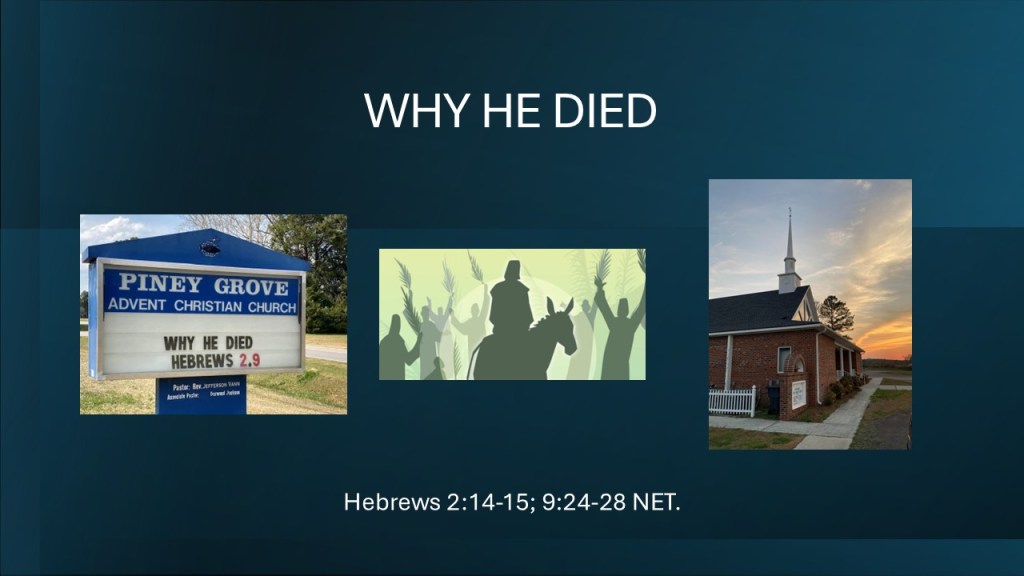
14 Therefore, since the children share in flesh and blood, he likewise shared in their humanity, so that through death he could destroy the one who holds the power of death (that is, the devil), 15 and set free those who were held in slavery all their lives by their fear of death.
24 For Christ has not entered the holy places made with hands, which are copies of the true, but into heaven itself, now to appear in the presence of God for us; 25 not that He should offer Himself often, as the high priest enters the Most Holy Place every year with blood of another — 26 He then would have had to suffer often since the foundation of the world. Still, now, once at the end of the ages, He has appeared to put away sin by the sacrifice of Himself. 27 And as it is appointed for men to die once, but after this the judgment, 28 so Christ was offered once to bear the sins of many. To those who eagerly wait for Him, He will appear a second time, apart from sin, for salvation.
The joy of Palm Sunday
In Matthew 21:1–11, Jesus gives two of His disciples a simple but unusual job: find a donkey and her young colt and bring them to Him. They do exactly what He says. Soon, Jesus is riding into Jerusalem on the young donkey.
What happens next is amazing. People start taking off their coats—things that were very valuable back then—and laying them on the road like a carpet for a king. Others cut branches and wave them in the air to celebrate. When Jesus rides by, the whole crowd shouts with excitement: “Hosanna to the Son of David!” This isn’t quiet clapping. It’s the loud cheer of people who believe their long‑promised King has finally arrived.
Matthew stops to remind us that this moment was predicted long ago in Zechariah 9:9, where God told His people to rejoice because their King would come to them humbly, riding on a donkey. The joy of the crowd isn’t random. It’s exactly the kind of joy the prophet said would happen hundreds of years earlier.
In Mark 11:1–11, the story happens almost the same way—there’s the donkey, the coats on the road, and the branches waving in the air. But Mark focuses on what the people were hoping for. They shout, “Hosanna! Blessed is he who comes in the name of the Lord!” Then they add something that shows what they’re expecting: “Blessed is the coming kingdom of our father David!”
They aren’t just cheering for a man who can do miracles. They believe Jesus is the King who will bring back the great kingdom David once ruled. Their excitement is huge. They think Jesus isn’t only going to help others—He is going to change their own lives in a big way.
In Luke 19:28–44, the feelings in the story are even stronger. As Jesus rides the young donkey, His disciples start praising God loudly because of all the amazing miracles they have seen Him do. They shout, “Blessed is the king who comes in the name of the Lord!” They are excited and proud to follow Him.
But then Luke tells us something surprising. While the crowds are cheering, Jesus begins to cry. He knows something the people don’t. Even though everyone is happy right now, the city of Jerusalem will not accept the peace He brings. Their joy is real, but it doesn’t go very deep, and it won’t last.
This reminds us of something important. Even when we celebrate Palm Sunday and worship Jesus as our King, many people in the world still ignore Him or push Him away. Jesus feels that sadness, even in the middle of all the cheering.
In John 12:12–19, the celebration becomes the biggest and most excited of all the Gospel stories. John is the only one who mentions palm branches, which were symbols of victory and national pride. Huge crowds rush out to meet Jesus, shouting, “Hosanna! Blessed is the King of Israel!”
John also tells us why everyone is so thrilled. Just before this, Jesus had raised Lazarus from the dead. News of that miracle spread everywhere, and people couldn’t stop talking about it. So when Jesus arrived, they weren’t just welcoming a great teacher. They were welcoming the One who had shown power over death itself.
Their joy is the joy of people who feel like they are seeing the beginning of a brand‑new world—one filled with hope, life, and the promise that everything is about to change.
The irony of Palm Sunday
Right after the exciting Triumphal Entry, Jesus enters the temple and finds people cheating others and making dishonest money. He turns over the tables of the moneychangers to stop the corruption. This makes the religious leaders very angry. They challenge Him in front of everyone and ask, “Who gave you the right to do this?” Then they try to trap Him with tricky questions about paying taxes, the resurrection, and which commandment is the greatest. They aren’t looking for real answers. They want to catch Him saying something wrong. This is the first big rejection: they refuse to accept Jesus as the Messiah or even as a true teacher.
After Jesus tells several parables exposing the leaders’ hypocrisy, they become even angrier. They decide that Jesus must die. The chief priests and elders meet in secret and make a plan. They agree to arrest Him quietly so the crowds won’t find out. They look for the perfect moment when no one is watching. This is the strongest rejection of all: they choose, on purpose, to work together to kill Him.
One of Jesus’ own disciples becomes part of the leaders’ plan. Judas agrees to betray Jesus in exchange for a bag of coins. After that, he starts watching for the right time to hand Jesus over. This is a very personal kind of rejection—a painful betrayal from someone in Jesus’ closest group of friends.
When Jesus is arrested, His disciples become scared and run away. Even though they had promised to stay with Him no matter what, their fear is stronger in that moment. This is a painful kind of rejection: the people who loved Him most leave Him alone when He needs them.
Jesus is taken to the high priest’s house for a trial in the middle of the night, even though this was against Jewish law. People are brought in to lie about Him, but their stories don’t match. Some accuse Jesus of saying He would destroy the temple. When Jesus says clearly that He is the Messiah, the Son of Man, the council becomes furious. They say He is guilty of blasphemy. Then they spit on Him, hit Him, and make fun of Him. This is a terrible kind of rejection: the religious court wrongly condemns the true Judge of Israel.
While Jesus is being mocked inside, Peter is outside in the courtyard. Three different times, people ask him if he knows Jesus, and each time Peter says he doesn’t. When the rooster crows, Peter suddenly remembers Jesus’ warning. He realizes what he has done and begins to cry bitterly. This is an emotional kind of rejection: fear makes even Jesus’ bravest disciple deny knowing Him.
Jesus is taken to Pilate, the Roman governor. The religious leaders accuse Him of claiming to be a king. Pilate looks into the charges and says he can’t find anything Jesus has done wrong. But the crowd, pushed by the leaders, begins shouting for Jesus to be crucified. Pilate doesn’t want trouble, so he gives in to the pressure and hands Jesus over to be killed. This is a kind of public, government rejection: Rome chooses to punish an innocent man to keep the peace.
The same city that cheered for Jesus with palm branches now chooses someone else instead of Him. Pilate offers to let Jesus go free, but the crowd shouts for Barabbas, a man who had committed serious crimes. Then the crowd begins to yell, “Crucify Him!” This is a public rejection: the people choose a criminal over their true King.
Everyone around Him rejects Jesus. The Roman soldiers make fun of Him and pretend He is a fake king. People walking by the cross shout insults at Him. The religious leaders laugh at Him and challenge Him to save Himself. Even one of the criminals being crucified next to Him joins in the mocking. This is complete rejection: leaders, crowds, soldiers, and criminals all turn against Him.
Between Palm Sunday and Good Friday, Jesus is rejected again and again. The religious leaders turn against Him. One of His own disciples betrays Him. His friends run away. False witnesses lie about Him. Peter denies knowing Him. The Jewish council hands Him over to the Romans. Rome sentences Him even though He is innocent. And the same crowds that once cheered for Him now shout for His death.
Why did Jesus have to die?
After seeing the huge, joyful crowd on Palm Sunday, it’s hard to understand how everything went so wrong so fast. One day, the people are cheering for Jesus, and only a few days later, He is rejected and killed. It doesn’t seem to make sense. So we naturally ask, Why was Jesus rejected? And why did He have to die?
But we don’t have to stay confused. God never gives us a question without giving us an answer in His Word. When we look at today’s passage, we find many reasons that explain why Jesus was rejected and why His death was necessary.
Today’s passage in the Book of Hebrews gives us three big reasons why Jesus had to die on the cross. To make them easy to remember, we can use three words that all start with the same letter: slavery, sacrifice, and salvation.
These three words help us understand that the cross was not an accident. It wasn’t a mistake or a surprise. It was part of God’s perfect plan. God chose to send His one and only Son to die on a cruel cross so that His people could be set free, forgiven, and saved forever.
The first reason Jesus had to die is connected to the word slavery. The writer of Hebrews explains that God’s children are human—they have flesh and blood—so Jesus became human too. He did this so that through His own death, He could break the power of the devil, the one who uses death to scare people. By dying, Jesus set people free from being slaves to the fear of death their whole lives.
In other words, Jesus died to break our chains. He died so we wouldn’t have to live scared of death anymore.
One of the big problems Jesus came to fix by dying on the cross was the slavery problem. This problem began with Satan. In the Garden of Eden, Satan appeared to Adam and Eve as a serpent. He tempted them to disobey God’s command and eat the fruit God had forbidden. When they listened to him, sin entered the world, and people became trapped—like slaves—under the power of sin and death.
Jesus came to break that slavery. He came to undo what Satan started and to set people free from the fear and power of death.
Satan knew exactly why God told Adam and Eve not to eat the forbidden fruit. God wanted to protect them from the power of sin and from the pain of death. God had warned them that if they disobeyed, they would become mortal—their bodies would grow old, break down, and eventually die.
Satan understood this. He knew that if he could get them to disobey, they would fall under the power of sin and death. And that is exactly what happened. By tempting them, Satan helped bring death into the human story, and people became trapped in fear and brokenness.
We don’t have to look far to see that this is exactly what happened. The world around us shows the results of that first terrible choice in the Garden. We know we are mortal—we are flesh‑and‑blood people who live only for a short time. Our lives are fragile, and every breath reminds us that one day our bodies will stop working.
Because of this, many people live with a quiet fear of dying. That fear follows us through life like a shadow. The writer of Hebrews calls this slavery—being trapped by the fear of death and unable to escape it on our own.
Jesus came to break that slavery. He came to set us free.
The worst part of this slavery is that we can’t fix it ourselves. There is nothing we can do to stop being mortal. Doctors can help us for a while, but eventually, even they reach a point where they can’t repair our bodies anymore. Science tries to make our lives longer, but even then, it can only stretch out the time, not remove death. Sometimes people live longer in their bodies while their minds fade away.
No matter what we try, slavery continues. We cannot free ourselves from death or the fear that comes with it.
The writer of Hebrews says that the devil holds the power of death. He has this power because our first ancestors gave it to him. When Adam and Eve listened to Satan’s temptation and chose to disobey God, they handed themselves—and all of us—over to the power of sin and death.
By following Satan’s lie instead of God’s truth, they placed themselves under his control. In that moment, we became like slaves, trapped by sin.
Since we are slaves to sin and death, we cannot free ourselves. No matter how hard we try, we cannot pay the price needed to break our chains. For us to be set free, one of us would have to pay the price for all of us. But none of us qualifies, because we are all sinners and all mortal.
So God sent Jesus.
Jesus is God’s only begotten Son, but He came into the world and became one of us. He took on our humanity—our flesh and blood—so that He could die a sinless death in our place. His perfect life and His willing death became the ransom that frees us from our slavery to sin and death.
Jesus did what none of us could ever do. He paid the price to set us free.
Because we were slaves to sin and death, we also had a sacrifice problem. We knew we were sinners, and we knew that sin needed a perfect, spotless sacrifice to make things right with God. But none of us could make that sacrifice. Even the best people in the world are still touched by the failure that began in the Garden of Eden.
No human being is completely pure. No one is without sin. So none of us could offer the perfect sacrifice God required. We needed someone who was truly without sin—someone who could stand in our place.
Under the old covenant, God told the Israelites to offer sacrifices as part of their worship. These sacrifices were important, but they did not solve the problem of sin forever. They were more like a temporary fix—something to hold things together until a better, final sacrifice would come.
People could bring an animal to the altar, but that didn’t always mean their hearts were truly changed. Someone could offer a sacrifice without real repentance or without turning away from their sin. So even though the sacrifices were part of God’s plan, they could not remove sin completely or change the human heart.
They pointed forward to a greater sacrifice that was still to come.
The writer of Hebrews explains this in chapter 9, verses 24–26. He says that Jesus did something no other priest or sacrifice could ever do. Instead of bringing an animal into an earthly temple, Jesus brought His own life as the perfect sacrifice into the heavenly sanctuary—God’s true presence.
All the sacrifices in the Old Testament were pointing forward to this one moment. They were like signs showing that a greater sacrifice was coming. And when Jesus came, He offered Himself once for all. Hebrews says He appeared “at the end of the ages” to put away sin by giving His own life.
In other words, Jesus didn’t need to be sacrificed again and again. His one sacrifice was enough to deal with sin forever.
The last problem we face is our need for salvation. We needed someone to rescue us from slavery to death. We needed a perfect, sinless sacrifice to take our place. But we also needed someone who could save us forever.
The writer of Hebrews explains this in chapter 9, verses 27–28. He says that every person is appointed to die once, and after that comes judgment. That means we will all stand before God one day. But here is the good news: Jesus has already been offered once to carry the sins of many people. He died once, and that sacrifice was enough.
And Hebrews says something even better. Jesus will come again—not to deal with sin, because He already did that—but to bring salvation to everyone who is waiting for Him with hope.
In other words, Jesus’ first coming took away our sin. His second coming will restore his universe.
For our salvation to be complete, we needed two things. First, we needed our sins to be paid for, and Jesus did that when He died on the cross. His death provided the atonement we could never earn on our own.
But even after our sins are forgiven, we still face another problem: we still die. Our bodies still grow old, break down, and eventually stop working. That’s because our first death comes from Adam’s sin, not our own. The Bible says, “In Adam, all die.” Jesus’ death on the cross paid for our sins, but it did not remove the physical death that comes from being part of Adam’s family.
So even forgiven people still experience the first death. That’s why we need something more—something only Jesus can give.
For our salvation to be complete, we needed more than a perfect sacrifice. Jesus’ death on the cross paid for our sins, and that was essential. But even after our sins are forgiven, we still face physical death. That first death comes from Adam’s sin, and Jesus’ sacrifice did not remove that part of our human condition.
So we needed something else.
We needed a Savior who would come back and rescue us from our graves. We needed someone who had already defeated death to come and pull us out of it. Until that happens, our salvation is not finished. We can say we are saved because we trust Jesus to complete the work He began.
That’s why the Bible talks about salvation in three tenses:
We have been saved — Jesus paid for our sins on the cross.
We are being saved — Jesus is changing us and keeping us in faith.
We will be saved — Jesus will return and raise us from the dead.
All three are true because of what Jesus did on the cross and what He will do when He comes again.
So now we come back to the cries of the crowds on that first Palm Sunday. They shouted “Hosanna!” Many people today think of that word as a kind of praise, but at first it wasn’t praise at all. It was a prayer. The word comes from the Hebrew phrase hôshîʿah-nnaʾ, which means “Save us, please!” or “Please rescue us!” Over time, the meaning of the word changed. It became a way of celebrating the salvation God had already given. That’s why we often use it as a joyful word of praise today. But it is still right—and very fitting—for us to use the word in its original meaning too. We still need God to save us. We still need Jesus to finish the salvation He began. So when we cry out “Hosanna,” we are both praising God for what He has done and praying for Him to complete His work when Christ returns. “Hosanna” is both a shout of joy and a cry for help. It is the perfect word for people who trust Jesus to save them completely.
We still live in a world that is trapped in the slavery of fearing death. So we pray, “Save us, Christ, we pray!” We still need forgiveness for our sins and rescue from the damage they cause. So again we cry, “Save us, Christ, we pray!”
And we still wait for the day when our salvation will be complete—when the One who conquered death will return and pull us out of our graves. Our hearts long for that day, so we say once more, “Save us, Christ, we pray!”
This is the true meaning of Hosanna. It is the cry of people who trust Jesus to finish what He started. It is the prayer of those who believe He will come again to save us fully and forever.






 jeffersonvann