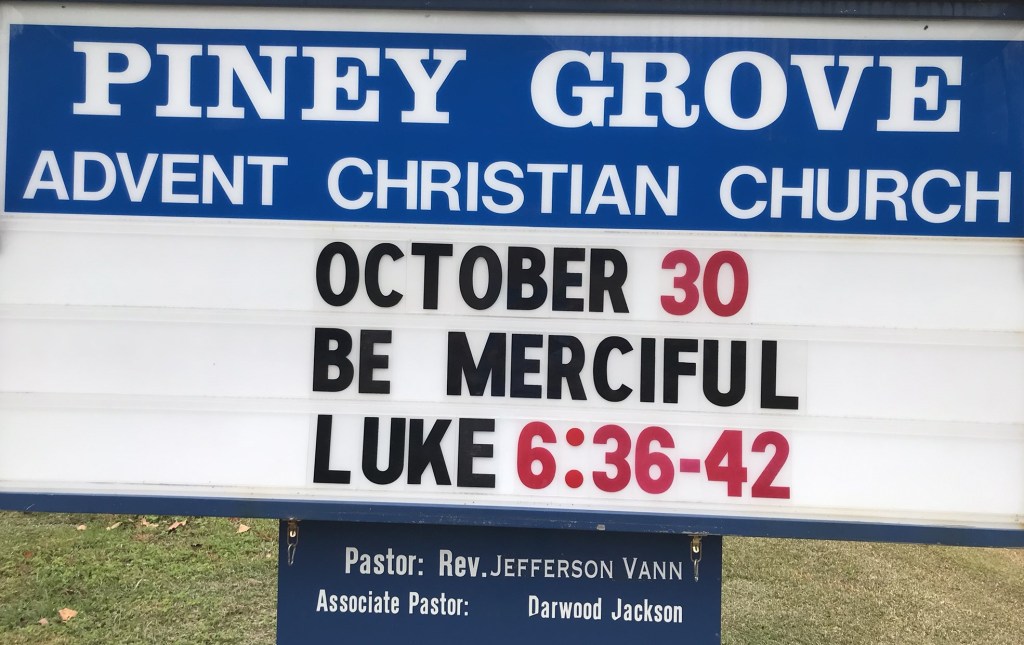
BE MERCIFUL

BE MERCIFUL

Luke 6:36-42 NET

36 Be merciful, just as your Father is merciful. 37 “Do not judge, and you will not be judged; do not condemn, and you will not be condemned; forgive, and you will be forgiven. 38 Give, and it will be given to you: A good measure, pressed down, shaken together, running over, will be poured into your lap. For the measure you use will be the measure you receive.” 39 He also told them a parable: “Someone who is blind cannot lead another who is blind, can he? Won’t they both fall into a pit? 40 A disciple is not greater than his teacher, but everyone when fully trained will be like his teacher. 41 Why do you see the speck in your brother’s eye, but fail to see the beam of wood in your own? 42 How can you say to your brother, ‘Brother, let me remove the speck from your eye,’ while you yourself don’t see the beam in your own? You hypocrite! First remove the beam from your own eye, and then you can see clearly to remove the speck from your brother’s eye.

When the LORD tells me to do something, I don’t normally stop and ask him why. I figure he has his reasons. But since we have been studying the commands of Christ for several months now, I think it might be appropriate for us to stop before we go any further and try to figure out why he wants us to do these things. Why should Christians obey the commands of Christ?

We could probably find several correct answers to that question this morning. But the reason that seems to be totally obvious to me after we have gone through all these commands so far is that we lead other people to God by imitating his character. We see that in the first verse of today’s text: Jesus commands his apostles to be merciful, even as God their Father is merciful. Jesus said a similar thing in one of his beatitudes. He said “Blessed are the merciful, for they will be shown mercy” (Matthew 5:7). Matthew used a different word for merciful in Greek, but it looks like he was talking about the same thing.

We need to learn to be consistent in our obedience to Christ’s commands. We don’t do this to get saved. Obedience cannot save you, even obedience to Christ’s commands. We are saved by faith in God’s grace, through the obedience and righteousness of Christ demonstrated by his death on the cross. That is the only means of our salvation. But once we come to Christ in faith, declaring him to be our king, and committing ourselves to become active in his coming kingdom, we have a choice. We can choose to act consistently with that faith and obey our new king, or we can choose to shipwreck our faith by disobeying him.

I believe anyone with true faith in Christ is going to want to live out that faith by obeying his commands. I also believe that this is God’s plan for saving others. Jesus told his apostles that they were the light of the world. He implied that if they obeyed his commands, it would light the way for others to come to him and be saved. You and I are recipients of the same promise, and that is why we also must consistently obey his commands.

I chose the Luke passage for today’s study because it goes into more detail about what it means to be merciful. That is the primary command that Jesus is drawing our attention to. A merciful person is someone who does not retaliate when he is wronged. A merciful person is someone who chooses to overlook an insult and chooses to not get even when he is injured.

Note the context of today’s passage: “If you love those who love you, what credit is that to you? For even sinners love those who love them. And if you do good to those who do good to you, what credit is that to you? Even sinners do the same. And if you lend to those from whom you hope to be repaid, what credit is that to you? Even sinners lend to sinners, so that they may be repaid in full. But love your enemies, and do good, and lend, expecting nothing back. Then your reward will be great, and you will be sons of the Most High, because he is kind to ungrateful and evil people” (Luke 6:32-35).

God is kind to ungrateful and evil people. If we want to imitate him, we are going to have to be kind to ungrateful and evil people too. We have to learn to act mercifully. In fact, Jesus makes it clear in verse 36 that this is not something that we will be able to do automatically because we are Christians. The word for “be” in verse 36 is γίνομαι — a word that actually means “become.” If you and I want to imitate God and lead other people to Christ, we are going to have to work at becoming merciful. Today’s text can show us how.

A merciful person sees beyond another person’s failures (37).

Jesus says “Do not judge, and you will not be judged; do not condemn, and you will not be condemned; forgive, and you will be forgiven.” These are three examples of the choice to be merciful when you are confronted by evil.

First, we have to choose not to judge. Now, again it is important to understand this statement in its context. Jesus is not telling us to withhold our value assessment of another person’s theology or lifestyle. He actually criticized the hypocrites because they failed to judge for themselves what is right (Luke 12:57). The apostle Paul told the Corinthian believers that they were wrong to go to court with one another before unbelieving judges. He argued that the church itself should be able to settle its own disputes. In fact, he said that in the future we will judge angels. His point is that the church is exactly the place for finding out what is right and wrong.

So, if Jesus is not talking about that kind of judgment — the settling of disputes within the congregation — what is he talking about? I say again, God is kind to ungrateful and evil people. If we want to imitate him, we are going to have to be kind to ungrateful and evil people too. We have to learn to act mercifully. Mercy is a means of evangelism. Mercy is a way of turning an enemy into a friend — more than a friend — a brother or sister.

The first step is to see that unbeliever not as an enemy, but as a potential fellow believer. It is what you choose to see. If you look only in the flesh, you will only see a sinner. But if you choose to look beyond that person’s failures, you can see a sinner saved by grace.

Jesus says, do not judge. To judge means to criticize. The problem with light is that it exposes the ugly things that you could not see when you were in darkness. But once the light shines in the living room you see the dust, the dirty carpet, the stain on the sofa, the crack in the window, the ants crawling on the floor, etc.

Our tendency — even as believers — is going to be that we will see the bad things that people do, and the evil motives behind those actions. If we are not careful, we will become the wrong kind of a perfectionist. The right kind of perfectionist is the kind who carefully removes the logs from his eyes before he ever mentions the sawdust speck in the eye of his neighbor. But the wrong kind of perfectionist is the kind who is always criticizing, always finding fault. That kind of person will not win others to Christ. Every wrong thing he experiences will be another obstacle keeping him from making friends and influencing people with the gospel.

After criticizing, the next step is condemning. This is a step further because criticism may be just a private value judgment. But condemnation is a public sentence. Jesus commands us not to condemn. By condemning someone — even if what they do is evil — we separate ourselves from that person. We isolate them from ourselves, which means that they no longer have access to the light of the gospel. We effectively say that since they did X and it resulted in Y then they no longer deserve the grace of God or the mercy of God.

After criticizing and condemning, the third step in the wrong direction is failing to forgive. Jesus tells us to forgive. He does not say that we should forgive only if a person asks for forgiveness. He does not say forgive only once, but seventy times seven. Try to obey Jesus at this point and you will lose count. That’s the point. If we are really interested in leading someone to Christ, we are going to be merciful toward them. We are not merciful because they deserve it. We are merciful because they need it.

Failing to forgive means holding a grudge. Grudges keep us from the very people God wants us to bring to Christ. It is very easy to effectively isolate yourself from all the people God wants you to evangelize. Criticism, condemnation, and failure to forgive are all human nature revealing itself. You have that human nature, and your first inclination when someone does or says something wrong is for you to act according to it. But you also have God’s nature since you are a born-again child of your heavenly Father. He is merciful, so you should also be merciful. Instead of criticizing, overlook the offense. Instead of condemning, love the offender. Instead of isolating yourself from him, forgive him and get closer.

A merciful person invests himself in the needy (38).

Jesus says “Give, and it will be given to you: A good measure, pressed down, shaken together, running over, will be poured into your lap. For the measure you use will be the measure you receive.” He has not changed the subject. He is still talking about how we can become merciful like our heavenly Father is merciful. Have you ever noticed that he gives to all kinds of people? He does not seem to be too choosy about who he gives his rain. It falls on the just and the unjust.

When Jesus talks about giving here, he means all the ways you can enrich another person’s life. It is not just about money. But money is a good illustration. We all have certain things we like to give to, and we have a list of other things we choose not to invest in. If you are not sure what I’m talking about, I invite you to take a look at your monthly bank statements. They reveal just where your money went. You can also find out the things that are really important to you. Dr. J. Ronald Schoolcraft preached a sermon about this entitled “The Gospel According to Stubs.” He implied that if you really want to know what is important in your life, check your check stubs.

Now, there are all kinds of needy people in the world. Some people don’t get enough food. Some need more adequate health care. Others are victims of drugs and other addictive substances. Jesus’ encouragement is for believers to reach out to people with these needs and help them, and we will find that when we have a need, there will be someone doing the same for us.

But we have to keep in mind the context of this statement. There is a category of needy people that you probably did not think of when I made the above statement. These may have enough food. They may have a good health insurance policy. They may even not suffer from drug or alcohol addiction. But they need something even more basic. They need a relationship with Jesus Christ. They need to get their names on the roll of God’s coming kingdom. They need faith in God. They need to be born again.

These — more than anyone else — need God’s mercy. Jesus tells us to invest in these people. Some of them do need more food. Thank God for ministries like the food bank and the world hunger fund. They are simple investments that show others we care about them. They just might make the difference between someone listening to the gospel or rejecting it. Any way that we can invest in the needs of others might just be a way to link them with someone who can share the gospel with them.

A merciful person learns to rescue others by first repenting of his own sins (39-42).

Jesus said “Someone who is blind cannot lead another who is blind, can he? Won’t they both fall into a pit? A disciple is not greater than his teacher, but everyone when fully trained will be like his teacher. Why do you see the speck in your brother’s eye, but fail to see the beam of wood in your own? How can you say to your brother, ‘Brother, let me remove the speck from your eye,’ while you yourself don’t see the beam in your own? You hypocrite! First remove the beam from your own eye, and then you can see clearly to remove the speck from your brother’s eye”

The first thing we need to do is learn how to live mercifully toward others. If we insist on being the wrong kind of a perfectionist, we are going to be useless in bringing other people to Christ. We will criticize and condemn and fail to forgive every time we are wronged. We will turn against all our neighbors. Even if we see them ambushed and beaten on Jericho road we will not stop to help them. We will criticize them because of the color of their skin. We will condemn them for their lack of common sense. We will let all their old failures keep us from being merciful toward them.

God has a means of rescuing our enemies from their sins. He offers them forgiveness through Christ, and eternal life on the last day by means of the resurrection unto eternal life. But Jesus has chosen you and me to be his representatives. We are the ones he has chosen as his witnesses, declaring his good news of deliverance and freedom from the bondage of sin and warning about the sure destiny of destruction in hell for those who reject the good news.

But what if we choose not to be merciful? What if we are perfectionists toward others and not ourselves. What if we get so fixated on those specks of sawdust that we spend all our time criticizing them, condemning them, and holding grudges against them? I’ll tell you what will happen. They will turn their backs on us and our message. They will say “if this is what it means to be a Christian, I don’t want anything to do with it.”

But what if we take Jesus seriously on this issue of being merciful? What if we take special care to remove all those logs that are keeping us from looking and acting like our heavenly Father? What if we get our act together so that when someone does do something bad to us, they are ashamed of their actions. What if we give to people just because we want them to be blessed. God is not going to forget that kind of investment.

Something else is going to happen too. If we who claim to be disciples of Christ start living like him — being merciful like him — loving those who mistreat us like he did… The world around us is going to notice. Some of those same people we count as our enemies today are going to be drawn to Jesus by our acts of mercy. They will want to be our disciples because they see something in us they want to see in themselves.

NOTES:

merciful: “being concerned about another’s unfortunate state or misery, merciful, compassionate” (Bauer, Walter. A Greek-English Lexicon of the New Testament and Other Early Christian Literature, ed. Frederick W. Danker, 3rd ed. Chicago: University of Chicago Press, 2000. [BDAG]).

“Merciful action requires human initiative without any reservations; it realizes the demand for unlimited love” (Strecker, Georg. The Sermon on the Mount. T. & T. Clark 1988. p. 39).

“Out of the beatitudes for the poor, the hungry, the weeping, and the persecuted, and out of the cries of woe against the wealthy, the satisfied, the happy, and those who seek the praise of people, arises the appeal to be guided by God’s mercy. It is striking that the command to love one’s enemies is placed at the very beginning, in a lengthy statement that also calls for renunciation of resistance and retaliation, and for giving and lending without requiring repayment, and climaxes with the admonition, “Be merciful, even as your Father is merciful” (Luke 6:36). The sayings regarding not judging, forgiveness, and ready generosity follow immediately” (Schnackenburg, Rudolf. All Things Are Possible to Believers: Reflections on the Lord’s Prayer and the Sermon on the Mount. 1st ed. Westminster John Knox Press 1995. p. 27).

“Do not judge and your house will not be destroyed when the judgment turns on you. Do not condemn so that the final storm of condemnation will not sweep your house away. Forgive and the waves will be forgiving. Give and you will receive back a good measure, shaken together and poured into your lap. You cannot possibly measure and saw and hammer your house when there is a log in your eye. So does it make sense to be distracted by the sawdust in your brother’s or sister’s eye? Before you can get on with your work—much less help your brother or sister with his or her speck—take the log out of your own eye” (Card, Michael. Luke: The Gospel of Amazement. Downers Grove, Ill: IVP Books, 2011. p. 93-94).

“For this reason the Golden Rule is “golden” only when interpreted in the light of its Christian context, not in a secularized abstraction. In Luke it occurs as a kind of summary in the middle of the section on loving enemies and forgoing retaliation (Luke 6:3). This context gives the rule a loftiness it cannot have in isolation. Doing as you would be done by now means far more than calculating one’s self-interest, because its meaning is illustrated by love of enemies and non-retaliation. The rule is then immediately contrasted with reactive reciprocity in the follow- ing verses, for example, Luke 6:34: “If you lend to those from whom you hope to receive, what credit is that to you? Even sinners lend to sinners, to receive as much again.” The ultimate clue for interpreting and applying the Golden Rule is provided by the section’s concluding verse: “Be merciful, just as your Father is merciful” (Luke 6:36). (Hare Douglas R. A. Matthew. John Knox Press 1993. p 80).

Romans 2:1, 19

Romans 14:3, 10

James 4:11

1 Corinthians 4:3-5

1 Corinthians 11:1

1 Corinthians 13

James 2:13

James 3:1

Matthew 5:19

Matthew 15:14

John 7:24

Proverbs 19:27

20221030 BE MERCIFUL.mp3

DON’T WORRY

Photo by Jahoo Clouseau on Pexels.com

DON’T WORRY

Matthew 6:25-34 NET

25 “Therefore I tell you, do not worry about your life, what you will eat or drink, or about your body, what you will wear. Isn’t there more to life than food and more to the body than clothing? 26 Look at the birds in the sky: They do not sow, or reap, or gather into barns, yet your heavenly Father feeds them. Aren’t you more valuable than they are? 27 And which of you by worrying can add even one hour to his life? 28 Why do you worry about clothing? Think about how the flowers of the field grow; they do not work or spin. 29 Yet I tell you that not even Solomon in all his glory was clothed like one of these! 30 And if this is how God clothes the wild grass, which is here today and tomorrow is tossed into the fire to heat the oven, won’t he clothe you even more, you people of little faith? 31 So then, don’t worry saying, ‘What will we eat?’ or ‘What will we drink?’ or ‘What will we wear?’ 32 For the unconverted pursue these things, and your heavenly Father knows that you need them. 33 But above all pursue his kingdom and righteousness, and all these things will be given to you as well. 34 So then, do not worry about tomorrow, for tomorrow will worry about itself. Today has enough trouble of its own.

Our English word “sidetrack” comes from the railroad industry in the 19th century. To move a rail car onto a sidetrack was to divert it from its connection with the other cars. It didn’t take long for that term to be used for anything that distracts a person from what he really should be doing.

The Pharisees were sidetracked. Even though they did all the things that Jesus commanded his disciples to do — give, pray, fast — they did it for human praise. God’s kingdom was not their purpose. They were too busy accumulating treasure on the present earth to invest in a future in God’s coming new earth.

In today’s text, Jesus reveals another thing that can sidetrack a person: worry.

We shouldn’t worry, because we are more important than what we worry about (25-27).

Jesus says we should not worry about our life, what we will eat or drink, or about our body, what we will wear. We know that bodies wear clothing, but we don’t usually say that our “life” is eating or drinking something. It’s a bad translation. The Greek word translated as “life” there is the word ψυχή. In the Bible, the word often means “neck” or “throat.” That is the more appropriate word to use here. We use our throats in the process of eating and drinking.

Incidentally, I think the reason the translators didn’t do this is that the Greek word ψυχή is often translated as “soul.” Lots of people think of a soul as an immaterial part of a human being — like a ghost inside the body. They can’t imagine an immaterial soul eating and drinking. So, the translators avoid the problem by substituting the generic word “life” instead.

Jesus used the word ψυχή because the throat is a good metaphor for the appetite. Hunger is a serious problem that we have to attend to regularly, several times a day. Jesus had talked about fasting in this same sermon. Voluntary fasting was a way to set aside time to focus on God. But what Jesus is talking about here is involuntary fasting: not eating because there is nothing to eat. Jesus instructs his apostles not to worry about where their next meal is coming from.

Everybody has to provide for themselves, and that includes planning regular meals for themselves and their families. Jesus is not telling us that we should just ignore this need. He is telling us that we should not spend all our time worrying about it. Worry sidetracks us from doing the things that our king has commanded us to do.

But Jesus goes on to tell his apostles why they don’t have to be sidetracked by worry. He tells them that their throats are more important than the food and drink they put down their throats. Their bodies are more important than the clothes they wear on their bodies. In other words, God loves them for who they are themselves — not for what they have.

To illustrate this, Jesus directs them to look up into the sky. Remember the last time you looked into the sky and saw a flock of birds flying in formation? What an awesome thing that is! It makes you wonder who programmed those things. Jesus told his apostles that those birds don’t plant berry bushes or build worm farms. But they are fed. Who feeds them? Note these words: “your heavenly Father.”

We shouldn’t worry, because we are more important than what we worry about. We shouldn’t worry because we have a Father in heaven who is watching over us, making sure that our regular needs are met. We pray to him for daily bread, so we don’t have to worry about where the next loaf is going to come from.

The next thing Jesus says is that worrying does not accomplish anything positive. He asks his apostles if any of them can add any time to their life span by worrying. He didn’t need to look around to see if either of them raised their hand. It’s a rhetorical question. They all know that worrying may take hours off their lives, but it never adds an hour to them.

We shouldn’t worry, because our heavenly Father knows what we need (28-32)

To illustrate what Jesus said about clothing, he directs their attention to the flowers of the field. They don’t plant cotton fields and build factories either. But even Solomon in his best royal robe couldn’t be decked out any better than the flowers. His point was the same: you are more important than the clothes you wear. You have a heavenly Father who will clothe you.

We have a Father who is looking out for us. That does not mean we have a Santa Claus in heaven and we can send our Christmas list to him. We don’t need a lot of toys. But there are some things that we do need. God has already demonstrated that he can be trusted to provide the bare necessities of life.

Look at that wild grass! Acres and acres of nothing but green. That shows you what God can do with only one crayon from the box. But Grass is temporary. It is here today and tomorrow is tossed into the fire to heat the oven. But if our heavenly Father goes to all the trouble to provide for that temporary grass, imagine what he will do to take care of your needs. You have the potential to live eternally.

Jesus says that “this is the will of my Father — for everyone who looks on the Son and believes in him to have eternal life, and I will raise him up at the last day” (John 6:40). That means that if you are a believer, eternal life is your destiny. You are more than the grass which is clothed in green today and burns up tomorrow. You are destined to be clothed with immortality.

In light of that fact, it doesn’t make sense to worry about what we are wearing. If you have clothes, that should be enough. You shouldn’t waste time worrying about whether your clothes are new enough or fashionable enough. Jesus said that the “unconverted” pursue these things.

We shouldn’t worry, because we have a kingdom to pursue (33-34)

We, believers, have better things to do than focus on the externals. We have a kingdom to proclaim, a righteous life to live and a just society to build. Let the unbelievers worry themselves into an early grave. We have the gospel to preach.

After warning us not to get distracted by worry, Jesus redirects us to the right track. He says that we should pursue God’s kingdom and righteousness.” We pursue the kingdom by learning and obeying the commands of the king. Note that Jesus did not say that we are to simply wait for the kingdom. He says that we should pursue it. You have to chase something if you haven’t caught it yet. There is a sense in which we are already citizens of the coming kingdom. Our names are on the list. We have a permanent inheritance.

But if we want to secure our permanent inheritance, we need to live like sons of the Father from whom we will inherit. We are currently living in one of the kingdoms of this earth. The kingdom that is coming down from the sky is not here yet. We pursue that kingdom by living according to its rules. That is what the sermon on the mount is all about. If you want to live by someone else’s rules, it disqualifies you from the coming kingdom. That is why Jesus told his apostles to not follow the hypocrites. He said unless their righteousness goes beyond that of the experts in the law and the Pharisees, they will never enter the kingdom.

To make it clear that Jesus was talking about how we live our lives today, Jesus’ command here is that we should pursue God’s kingdom and righteousness. Now, there are two aspects to the meaning of the Greek word for righteousness that Jesus used here. The word δικαιοσύνη means the righteousness of justification internally, and justice externally. We are justified by faith in Jesus Christ and the results of that justification are the forgiveness of sins and positional sanctification. We are then called to represent God’s kingdom on earth today by seeking justice and fairness for others. Pursuing God’s righteousness means chasing both these things.

Worry becomes a problem when our worries keep us from seeking God’s kingdom and righteousness. But the solution to the problem of worry is not going to come by focusing on what we are worrying about. Jesus didn’t tell his apostles to get together in small groups and go through therapy sessions about their anxieties over eating, drinking, and their wardrobes. No, he told them that their worries were sidetracking them from their purpose. Their purpose was to pursue the coming kingdom, in their personal lives, and in society. He told them that if they would keep on track and not get distracted, then God would provide for their needs.

His final instruction on this subject was to remind them that they would face problems every day. But the solution to these dilemmas is simple. They should take life one day at a time, and not worry about tomorrow. If we focus on seeking God’s kingdom and righteousness today, we can avoid getting sidetracked by worrying about what might happen tomorrow.

_______

NOTES:

“If we trust God rather than Mammon, we won’t worry about the necessities of this life. Worry about such things is sin, for it is an expression of doubt that God will do what he has clearly promised to do. Yet we frequently worry because of the weakness of our flesh. Here Jesus tells us how to deal with our worries. First he tells us not to worry about life, food, drink, or clothing, and then he tells us why we need not worry.

His first argument compares the greater to the lesser. If God has given you life, which is far greater than any material possessions, will he not provide you with the lesser gifts of food, drink, clothing, and shelter? Would it make any sense at all for God to give us life and then be unconcerned about sustaining that life? The obvious answer is No.

Then he compares the lesser to the greater. If God provides for the needs of the birds of the air, who don’t even sow or reap or store up food in barns, will he not provide for your needs? You have the advantage over the birds of being able to sow and reap and store up the fruits of the field in barns. You also have the advantage of being far more valuable in God’s sight. … Can you imagine that he will be less concerned about you than about the birds? Or look at the wildflowers. The lilies of the field do not labor or spin; yet God dresses them in finery that even Solomon in all his splendor could not rival. We can “labor and spin.” We have that advantage over the lilies. So why should we worry about having the necessary clothing? The grass of the field was used as fuel for cooking in areas where firewood was scarce. It was here today and gone tomorrow, and yet God also made the grassy fields a thing of beauty. Can we imagine that God has less concern for us? Impossible!

With these observations and reassurances in mind, Jesus gives us a word of advice that might well serve as our motto for Christian living day after day: “But seek first his kingdom and his righteousness, and all these things will be given to you as well” (verse 33). He is telling us to make his kingdom and his righteousness the number one priority in our lives.”

Albrecht, G J, and Michael J. Albrecht. Matthew. Milwaukee, Wis: Northwestern Pub. House, 1996. pp. 99-100.

“The delightful irony about slavery to God is that the master entrusts to his slaves the very wealth from whose bondage he delivered them (6:24, 33b; cf. 25:14-30); that persons preoccupied with God are able to enjoy earthly wealth; that those who ‘store up treasures in heaven’ can find pleasure in things others are hoarding on earth. God’s slaves — the Father’s children — now perceive wealth for what it really is, the handiwork and gift of God. They view life’s necessities with new eyes (6:22): besides being nourishing, meals are found to be tasty, one reason being food’s exquisite colors; a woolen coat is appreciated for both its warmth and its beauty; which helps to explain believers’ contentment with food and clothing (1 Tim. 6:8). Now, perhaps for the first time since childhood, they ‘behold the birds’ and ‘consider the flowers,’ and stand in wonder before the Creator’s endless wisdom and artistry.”

Chamblin, J K. Matthew: A Mentor Commentary. Fearn, Tain: Christian Focus Pub, 2010. p. 450.

“When Jesus says, ‘Do not worry about your life, what you will eat or drink, or about your body, what you will wear, he is not referring to people who are destitute but rather to people who are relatively well-off. People should not make food and drink, one’s body or one’s clothes into idols or fetishes. Rather, Jesus says, ‘Set your hearts on his kingdom first, and on his righteousness, and all these other things will be given to you.’ In Matthew’s gospel, seeking God’s kingdom and seeking justice (righteousness) are not two distinct quests. There is no authentic search for the kingdom except in a quest whose immediate goal is God’s justice: justice here on earth that makes a real difference in people’s lives, especially those who are poor.”

Fogarty, Philip. Matthew. Dublin: Columba Press, 2010. p. 38.

“In normal circumstances, our cushioned Western lifestyle leaves little scope for the sort of “worry” about basic provisions which this passage envisages. It is perhaps at times of economic catastrophe or of drastically changed personal circumstances that its message applies most directly, and that it becomes clear how far our essential priorities enable us to trust rather than to worry.”

France, R.T. The Gospel According to Matthew. Grand Rapids (MI: Eerdmans, 2007. p. 267.

“We hear Jesus say the only thing that casts out anxiety is trust. Like nonbelievers, we’ll find ourselves agonizing about our circumstances. But when that happens, we should review the choice that belief first presented to us: do you want God’s kingdom, or do you want to build one for yourself? We should then renew our decision to accept God’s kingdom [vv.31-33]. This spells out in detail the advice with which Matthew tells us both John the Baptist and Jesus began their ministries: “Repent, for the kingdom of heaven is at hand” (see 3:2; 4:17). Turning away from self-absorbed anxiety, and turning to the kingdom, is what we must do day after day after day [v.34]. All we need will be put in our laps along with the kingdom [v.33b]. Good News!”

McCarren, Paul J. A Simple Guide to Matthew. Lanham: Rowman & Littlefield Publishers, 2012. p. 30.

“There is a subtle transition from greed in 6:19-24 to anxiety in 6:25-34 (Gundry 1994: 115). These verses begin with a general prohibition against worrying about life. Two (or perhaps three; see the additional note on 6:25) staples of everyday life are singled out to explain what is meant by “life’—-what one eats and what one wears (6:25). God’s provision of food is then stressed in 6:26-27, and of clothing in 6:28-30, before the general prohibition against worry is restated in 6:31 and again in 6:34 (cf. Luke 12:22-31). Rhetorical questions underline the incompatibility of anxiety with faith (Matt. 6:25, 26, 30) and stress its impotence (6:27).”

Turner, David L. Matthew. Grand Rapids, MI: Baker Academic, 2008. p. 198.

“Living totally without worry sounds, to many people, as impossible as living totally without breathing. Some people are so hooked on worry that if they haven’t got anything to worry about they worry that they’ve forgotten something. Here, at the heart of the Sermon on the Mount, is an invitation that surprisingly few people even try to take up. Why not learn how to share the happiness of Jesus himself?”

Wright, N T. Matthew for Everyone: Chapters 1-15. London: SPCK, 2004. p. 67.

“Some worries we bring on ourselves directly. According to one estimate, the average American family has $8,000 in credit card debt, and almost half of all families spend more than they make in a year.’ We have more things to spend money on and more ways to spend it than ever before. Our greed traps us in a cycle of worry and fear.

This is not what God wants for his children! God does not want us to be slaves to worry or to be trapped by our selfish desires. The life Jesus described in the Sermon on the Mount is a life characterized by trust and dependence rather than anxiety and greed. To live lives free from anxiety and greed, we must discover what is truly important. We must focus our lives on God’s way, rather than on gaining material things. As we trust God and focus on God’s way, God calls us to change our treasure, our outlook on life, and the kingdom we seek.”

Younger, Carol D. The Gospel of Matthew: Hope in the Resurrected Christ: Adult Bible Study Guide. Dallas, Tex: BaptistWay Press, 2008. p. 84.

20221023 DON’T WORRY.mp3

WHEN YOU FAST

WHEN YOU FAST

WHEN YOU FAST

Matthew 6:16-18 NET

16 “When you fast, do not look sullen like the hypocrites, for they make their faces unattractive so that people will see them fasting. I tell you the truth, they have their reward. 17 When you fast, put oil on your head and wash your face, 18 so that it will not be obvious to others when you are fasting, but only to your Father who is in secret. And your Father, who sees in secret, will reward you.

Last month, when Penny and I began our focus on the commands of Christ in Matthew 6, I explained what Jesus meant by his instruction to “be careful not to display your righteousness merely to be seen by people” (6:1). These displays of righteousness were habits that the religious experts of Christ’s day practiced. They considered these three habits marks of healthy relationships. We have already looked at two of those habits.

The first habit was introduced in 6:2 with the words “whenever you do charitable giving.” Giving to the needy was considered a mark of spiritual maturity, and it helped maintain a healthy relationship with others. If God blessed a person, that person was expected to pass on the blessing to those who needed it.

The second habit was introduced in 6:5 with the words “whenever you pray.” Praying to God was a mark of spiritual maturity and it helped maintain a healthy relationship with God.

Today, I want to talk about the third habit of highly successful religious professionals. That was the habit of fasting.

Fasting is a means of displaying righteousness (6:16).

Jesus says “when you fast.” He did not say “if you fast.” Jesus endorsed every one of these signs of spiritual maturity. He expected that his apostles would be doing a lot of giving, a lot of praying, and a lot of fasting. Like giving and praying, fasting is a legitimate way of showing that you have a commitment to God and you discipline yourself because of that commitment.

The Old Testament prescribed fasting on Yom Kippur – the day of atonement.

“This is to be a perpetual statute for you. In the seventh month, on the tenth day of the month, you must humble yourselves and do no work of any kind, both the native citizen and the foreigner who resides in your midst, for on this day atonement is to be made for you to cleanse you from all your sins; you must be clean before the LORD. It is to be a Sabbath of complete rest for you, and you must humble yourselves. It is a perpetual statute” (Leviticus 16:29-31).

The actual commands were for the Israelites to humble themselves, to remain ritually clean, and to cease all work on that day. Regularly fasting that one day of the year became a way to set that day apart so that God’s people could celebrate what he was doing for them by atoning for their sins.

This is not the fasting that Jesus was talking about in Matthew 6. The fasting on the day of atonement was a national fast. Jesus was talking about a personal voluntary fast.

Jesus himself voluntarily fasted, and we read about that earlier in Matthew’s Gospel, chapter 4. There, Jesus fasted for 40 days and nights, endured temptation from the devil, and overcame that temptation. He emerged ready to do the ministry that God had called him to do.

We learn something about the voluntary fast from that incident. We learn that fasting can be a way to prepare yourself spiritually for something that the LORD is calling you to do.

When you face a decision that you have to make, and you want to make sure that you are making your choice based on God’s will, not just your own inclination, fasting can help you do that.

If you are facing a challenge, and you want strength from the Lord to help you overcome that challenge or endure a time of difficulty, fasting can help you do that. Sometimes people fast over some personal problem or social tragedy or injustice. You might feel that just praying about your concern is not enough – you want to do more. So, the Lord might be inviting you for an extended time of prayer and fasting. If a sin you are being tempted to commit, a loved one’s illness, COVID-19, racial injustice, or the war in Ukraine is on your mind a lot, maybe you should consider praying and fasting about it.

Fasting can be abused (16).

We need to keep in mind that Jesus brought up all three of these habits of displaying righteousness because all three of them had been hijacked by the hypocrites. Jesus told his apostles not to “look sullen like the hypocrites, for they make their faces unattractive so that people will see them fasting.”

Just as giving and praying could be ruined by doing it with the wrong motive, the same thing is true of fasting. If you fast just so people can see you fast, that is the only result you’re going to get from your fast.

The question of fasting comes up one other time in Matthew’s Gospel. That is when the disciples of John the Baptist came to Jesus to ask him why he and his disciples were not publicly fasting the way they were. They asked: “Why do we and the Pharisees fast often, but your disciples don’t fast?” (Matthew 9:14).

Jesus responded: “The wedding guests cannot mourn while the bridegroom is with them, can they? But the days are coming when the bridegroom will be taken from them, and then they will fast” (Matthew 9:15).

You see, Jesus was a publicly recognizable figure. Since his apostles were his entourage, everything they did had to fit the mission of their master. Jesus said it was like they were the wedding guests, and he was the bridegroom. While the wedding ceremony is going on, you don’t fast.

But Jesus also implied that something was going to happen to change the situation, and when that something happened, the apostles would have times of voluntary fasting, just like John’s disciples. The bridegroom was taken away.

Fasting can be done right (17-18).

Jesus told his apostles “When you fast, put oil on your head and wash your face, so that it will not be obvious to others when you are fasting, but only to your Father who is in secret. And your Father, who sees in secret, will reward you.” When fasting is done right, nobody knows about the fast except the faster and the Father. It’s not to display your devotion before others. It’s to spend time with the one you are devoted to.

Now, it’s not always going to be possible for everyone not to know. If you are married, your spouse will know. Your children might need to know why you are not coming to the table. But the best rule is to keep the information as limited as possible.

There is also a danger that we can presume too much because we are fasting. We can get really discouraged if we have expectations that fasting is going to change us into super-saints, and fix all our problems.

Isaiah faced this with his people. They asked God “Why don’t you notice when we fast? Why don’t you pay attention when we humble ourselves?” (Isaiah 58:3). But Isaiah reminded them that they were not just fasting. They were also arguing, brawling, fist fighting, mistreating each other, failing to take care of the homeless, ignoring the oppressed, and failing to give to the needy. God is not going to be impressed if I’m doing that. It doesn’t matter how many meals I skip.

God wants to know that you love him – enough to spend quality time alone with him in prayer. God wants to know that you love your neighbor – enough to give to those in need. God also wants to know that you love yourself – enough to every now and then stop paying attention to your ordinary needs and focus on the things that can only come from God.

God spoke through the prophet Isaiah and told his people: “Is this really the kind of fasting I want? Do I want a day when people merely humble themselves, bowing their heads like a reed and stretching out on sackcloth and ashes? Is this really what you call a fast, a day that is pleasing to the LORD? No, this is the kind of fast I want. I want you to remove the sinful chains, to tear away the ropes of the burdensome yoke, to set free the oppressed, and to break every burdensome yoke. I want you to share your food with the hungry and to provide shelter for homeless, oppressed people. When you see someone naked, clothe him! Don’t turn your back on your own flesh and blood! Then your light will shine like the sunrise; your restoration will quickly arrive; your godly behavior will go before you, and the LORD’s splendor will be your rear guard. Then you will call out, and the LORD will respond; you will cry out, and he will reply, ‘Here I am.’ (Isaiah 58:5-9).

If you live like the devil, fasting is worthless. But if you live like God wants you to, when you fast, He’s going to show up. When God shows up, miracles happen.

— NOTES —

the Law and fasting

“The third “act of righteousness” of which Jesus speaks is fasting. The Law of Moses seems to have required at the most only one day of fasting per year. (Leviticus 16:29 in the NIV speaks of denying oneself on the Day of Atonement, which is assumed to be a reference to fasting.) The Pharisees, on the other hand, fasted twice a week and boasted about it. They loved to demonstrate how grievously they were suffering when they fasted, and their performances impressed many people. But they did not impress God at all” (Albrecht, 94).

“The Law of Moses seems to have required fasting at the most only once a year on the Day of Atonement (Yom Kippur). Voluntary fasting on other days might be practiced as a expression of grief or of sorrow over sin” (Albrecht, 135).

New Testament and fasting

“New Testament believers are not required to fast at all. If, however, you want to fast, Jesus says, if you feel that fasting will help you to keep your sinful flesh under control and to concentrate your attention on spiritual matters, by all means fast. But don’t even mention it to anybody” (Albrecht, 94-95).

“Early documents give evidence that the church practiced fasting as a regular discipline quite as assiduously as the members of the Jewish community” (Beare, 230).

motives for fasting

“The communal fasts such as are prescribed for the Day of Atonement (in the Priestly Code, Lev.16: 29-31, etc.) are not envisaged, but only private fasts such as might be undertaken by individuals as an expression of grief, or of penitence, or of preparation for. communion with God (Neh.1:4; Dan.9:3; 10:2f., etc.). Here it is indicated that individuals might undertake a fast as a work of merit, hoping that God will reward them for their piety. The ‘hypocrites’ no doubt entertained such hopes, but they’ also wanted to win the admiration of their neighbors. They, therefore, show obvious outward signs of their fasting; they look gloomy, and even ‘cause their faces to disappear’ (that is the literal meaning of ἀφανίζουσιν yap τὰ πρόσωπα αὐτῶν), perhaps by smearing them with ashes? Whatever they hope from God, their primary desire is to win a reputation for exceptional piety. This is all the reward they will ever get; they are paid off in full by the gain in social prestige” (Beare, 179).

“Matthew says that, in addition to almsgiving and praying (see 6:2-6), Jesus spoke about fasting as another way of reminding ourselves how our relationship with God works. As with every other action, we’re tempted to make the act of fasting about ourselves — “You’re fasting? You’re so conscientious!” [v.l6]. Instead, says Jesus, let fasting help you allow God into your life; let it remind you who knows your need for nourishment better than you [vv. 17-18]” (McCarren, 28).

“As with almsgiving and prayer (w. 1-6), Christians who fast are not to call attention to their pious practice. The verb aphanizo, “neglect their appearance,” literally means “disfigure” or “render unrecognizable.” It may refer to covering one’s head with a cloth (Jer 14:4) or with ashes (1 Macc 3:47), or neglecting to wash (v. 17). The point is that adulation is its own reward, and no further benefit will accrue to one who is ostentatious in fasting” (Reid, 45).

Isaiah 58

Isaiah 58: The Lord Desires Genuine Devotion

1 “Shout loudly! Don’t be quiet! Yell as loud as a trumpet! Confront my people with their rebellious deeds; confront Jacob’s family with their sin!

2 They seek me day after day; they want to know my requirements, like a nation that does what is right and does not reject the law of their God. They ask me for just decrees; they want to be near God.

3 They lament, ‘Why don’t you notice when we fast? Why don’t you pay attention when we humble ourselves?’ Look, at the same time you fast, you satisfy your selfish desires, you oppress your workers.

4 Look, your fasting is accompanied by arguments, brawls, and fistfights. Do not fast as you do today, trying to make your voice heard in heaven.

5 Is this really the kind of fasting I want? Do I want a day when people merely humble themselves, bowing their heads like a reed and stretching out on sackcloth and ashes? Is this really what you call a fast, a day that is pleasing to the LORD?

6 No, this is the kind of fast I want. I want you to remove the sinful chains, to tear away the ropes of the burdensome yoke, to set free the oppressed, and to break every burdensome yoke.

7 I want you to share your food with the hungry and to provide shelter for homeless, oppressed people. When you see someone naked, clothe him! Don’t turn your back on your own flesh and blood!

8 Then your light will shine like the sunrise; your restoration will quickly arrive; your godly behavior will go before you, and the LORD’s splendor will be your rear guard.

9 Then you will call out, and the LORD will respond; you will cry out, and he will reply, ‘Here I am.’ You must remove the burdensome yoke from among you and stop pointing fingers and speaking sinfully.

10 You must actively help the hungry and feed the oppressed. Then your light will dispel the darkness, and your darkness will be transformed into noonday.

11 The LORD will continually lead you; he will feed you even in parched regions. He will give you renewed strength, and you will be like a well-watered garden, like a spring that continually produces water.

12 Your perpetual ruins will be rebuilt; you will reestablish the ancient foundations. You will be called, ‘The one who repairs broken walls, the one who makes the streets inhabitable again.’

13 You must observe the Sabbath rather than doing anything you please on my holy day. You must look forward to the Sabbath and treat the LORD’s holy day with respect. You must treat it with respect by refraining from your normal activities, and by refraining from your selfish pursuits and from making business deals.

14 Then you will find joy in your relationship to the LORD, and I will give you great prosperity, and cause crops to grow on the land I gave to your ancestor Jacob.” Know for certain that the LORD has spoken.

“See Isa 58, in which the prophet declares that God does not delight in sackcloth and ashes but in the fast which looses the bonds of wickedness, frees the oppressed, brings bread to the hungry, shelters the poor, and covers the naked. What counts is not external show but humility; a person’s attention should be directed towards others in order to help them, not in order to learn what good things others think about him” (Davies, 617).

Matthew 4:1-11

The Temptation of Jesus

1 Then Jesus was led by the Spirit into the wilderness to be tempted by the devil.

2 After he fasted forty days and forty nights he was famished.

3 The tempter came and said to him, “If you are the Son of God, command these stones to become bread.”

4 But he answered, “It is written, ‘Man does not live by bread alone, but by every word that comes from the mouth of God.'”

5 Then the devil took him to the holy city, had him stand on the highest point of the temple,

6 and said to him, “If you are the Son of God, throw yourself down. For it is written, ‘He will command his angels concerning you’ and ‘with their hands they will lift you up, so that you will not strike your foot against a stone.'”

7 Jesus said to him, “Once again it is written: ‘You are not to put the LORD your God to the test.'”

8 Again, the devil took him to a very high mountain and showed him all the kingdoms of the world and their grandeur.

9 And he said to him, “I will give you all these things if you throw yourself to the ground and worship me.”

10 Then Jesus said to him, “Go away, Satan! For it is written: ‘You are to worship the LORD your God and serve only him.'”

11 Then the devil left him, and angels came and began ministering to his needs.

Matthew 9:14-15

14 Then John’s disciples came to Jesus and asked, “Why do we and the Pharisees fast often, but your disciples don’t fast?”

15 Jesus said to them, “The wedding guests cannot mourn while the bridegroom is with them, can they? But the days are coming when the bridegroom will be taken from them, and then they will fast.

“Matthew … could be telling the early Church why they should practice fasting” (Anderson, 33).

“There is some discrepancy between 5.4 and 9.15. In this last Jesus declares that the wedding guests (=his disciples) cannot mourn (diff. Mark, who has ‘fast’) as long as the bridegroom (= Jesus) is with them. So the text of Matthew both addresses the disciples as those who mourn (5.4) and at the same time excuses them for not mourning while Jesus is with them. The seeming contradiction, however, is only one aspect of the tension created by the fact that the kingdom of God is both present and coming in the gospel tradition (see on 4.17). And while in 5.4 the weight comes down on the future coming of the kingdom, in 9.15 the presence of the kingdom is being proclaimed” (Davies, 448).

_____________

Albrecht, G J, and Michael J. Albrecht. Matthew. Milwaukee, Wis: Northwestern Pub. House, 1996

Anderson, William A. Gospel of Matthew. Place of publication not identified: Liguori Pubns, 1999.

Beare, Francis W. The Gospel According to Matthew: Translation, Introduction, and Commentary. San Francisco: Harper & Row, 1982

Davies, W D, and Dale C. Allison. A Critical and Exegetical Commentary on the Gospel According to Saint Matthew. Volume I. Edinburgh: T. & T. Clark, 1988.

Fogarty, Philip. Matthew. Dublin: Columba Press, 2010.

McCarren, Paul J. A Simple Guide to Matthew. Lanham: Rowman & Littlefield Publishers, 2012.

Reid, Barbara E. The Gospel According to Matthew. Collegeville, Minn: Liturgical Press, 2005.

20221002 WHEN YOU FAST.mp3

PRAYER AND FORGIVENESS

Photo by Ric Rodrigues on Pexels.com

PRAYER AND FORGIVENESS

Matthew 6:11-15 NET

11 Give us today our daily bread, 12 and forgive us our debts, as we ourselves have forgiven our debtors. 13 And do not lead us into temptation, but deliver us from the evil one. 14 “For if you forgive others their sins, your heavenly Father will also forgive you. 15 But if you do not forgive others, your Father will not forgive you your sins.

When our Lord taught his disciples to pray, he packed his instructions with information about forgiveness. He knows that for us, the two ideas are inseparable. Maybe that is why people nowadays have such a hard time maintaining a consistent prayer life. Maybe it is not that we don’t know how to pray. Maybe our problem is that lack of forgiveness is keeping us from praying.

Today I want to look at this text to see if we can get a better grip on the relationship between prayer and forgiveness.

Forgiveness is something every Christian regularly needs (11-12a)

The Lord told his apostles to ask for two things on a regular daily basis: food to sustain them physically and forgiveness to revive them spiritually. Now, this is odd, because most of us are used to thinking about forgiveness as something that we got when we first came to Christ. In fact, our testimony is that we were sinners, and we repented, and God forgave us of all our sins. All our sins were nailed on the cross with Jesus. God has separated us from those sins as far as the east is from the west.

So, why does Jesus tell his apostles to come to their heavenly Father and ask for forgiveness every day? That is not a mistake. Jesus knows that each of us is going to fail in our attempt to walk the straight and narrow. We are going to need forgiveness therapy on a regular basis.

The cross has made it possible for us to enter the narrow way and guarantees us an inheritance of eternal life when Jesus returns. But God does not want to leave us to figure out the Christian walk all by ourselves. He wants to stand by us as we take our baby steps. He wants to be there for us every time we fall. He’s not going to make us fall, but he’s going to be there to pick us up every time we do fall. That is why he commands us to pray for forgiveness regularly.

N.T. Wright says that this verse “assumes that we will need to ask for forgiveness not on one or two rare occasions but very regularly. This is a sobering thought, but it is matched by the comforting news that forgiveness is freely available as often as we need it” (60).

David Turner says that the word ἐπιούσιος in 6:11 refers to “immediate day-to-day necessities rather than long-term luxuries” (188).

Jesus also knows that we will be tempted to try to live the Christian life without the Father’s help. We think that Jesus went to the cross for our salvation, but that he has left Christian living up to us. That is wrong thinking and trying to live the Christian life without regular forgiveness therapy leads to disaster.

Part of our problem is that we do not like to be reminded of our failures. It is much easier to ignore the things that we have done that need forgiveness. We don’t want to dwell on our mistakes. So, we tell ourselves that it is all covered in the blood and just try to forget it. But if we fail to deal with today’s mistakes, we are going to repeat those mistakes tomorrow. Jesus does not want us to get caught up in a cycle of failure. He has opened a window in heaven for us, so that we have access to the Father’s forgiveness, as often as we need it.

We need that regular forgiveness because every time we stumble, we are not just hurting ourselves, or other people. The most important relationship we all have is with our creator. He is our heavenly Father. The relationship we have with him is the most important relationship we will ever have. Reconciliation with him is not something we can do just once.

When I go to the grocery store and buy bread, I usually buy enough for the whole week. But I cannot wait a whole week to reconcile with God. I can survive a week between meetings of congregational worship. But I cannot put off my time at the throne room. That has to be regular.

Prayer can also keep us from failing others (13).

Prayer therapy is not only necessary to heal our damaged relationship with God. It is also necessary to prevent us from falling as we go about the day’s walk. Prayer can strengthen us. Some of that strength will be given to us so that we can have a more appropriate relationship with others.

I think this is what Jesus had in mind when he instructed his apostles to pray for God to protect them from temptation. We have been studying the book of James in our Sunday evening Bible study times. Last Sunday we read that “each one is tempted when he is lured and enticed by his own desires. Then when desire conceives, it gives birth to sin, and when sin is full grown, it gives birth to death” (James 1:14-15). James taught that temptation happens when desires inside us are allowed to lure us away from healthy actions and produce unhealthy actions. We need guidance from God so that we can stay away from temptation.

Warren Wiersbe says that “In this petition, we are asking God to guide us so that we will not get out of His will and get involved in a situation of temptation”(44).

If we don’t regularly go to God in prayer for that guidance, we will not only make mistakes that hurt others, we will keep making those same mistakes over and over again. A prayer is a tool for us to repair the damage that we have done, and to prevent us from making things worse and worse.

Turner says that “When disciples pray for protection from temptation to sin, they pray for God to break the cycle that so often plagues them (cf. Josh. 7:20-21; James 1:13-15). Temptation leads to sin, and sin leads to the necessity of praying for forgiveness. Prayer for protection from temptation and deliverance from the evil one’s strategies breaks the cycle (cf. Matt. 4:1-11)” (189).

There is also a third relationship that we have to keep in mind. Jesus instructed his apostles to pray for deliverance from the evil one. The devil wants to ruin our lives. He wants us to keep failing God and each other. He is going to bring trials and temptations and stumbling blocks into our lives because he wants to prevent us from having victory.

Folks, we need to take the devil seriously. He takes us seriously. He spends a lot of time trying to discourage us and thwart our efforts. He is stronger than we are. But he is not stronger than our heavenly Father is. We need to pray for protection from and deliverance from the devil every day.

Senior says that “Both words, “test” (πειρασμός) and “evil” or “evil one” (πονηρός), have a strong eschatological flavor referring to the ultimate test of the final days and the assault of the demonic, but can also be attached to those incursions of threat and evil in the present age, which are, in a sense, anticipations of the final test” (86).

Forgiving others keeps the prayer channel open (12b, 14-15).

Jesus also commanded his apostles to specifically use their prayer time to declare forgiveness for everyone who has wronged them. In fact, he told them that this kind of forgiveness therapy is absolutely essential if the other kind of forgiveness therapy is going to work.

Remember, our problem is that we fail God and other people all the time. We have to regularly come to God for forgiveness. But Jesus said that there is something that can stop the flow of that healing. If we refuse to forgive others for the wrongs they have committed against us, then when we come to the throne room, we will get a busy signal.

The reason this happens is that one of our primary responsibilities as Christians is to represent God and his kingdom. The minute we stop forgiving those who have wronged us, we stop representing God. It is a sin to fail to forgive. It is a major sin.

It is like a person who was arrested for speeding and who argued that he should be let go because he was not speeding in this county because he was in the neighboring county robbing a bank at the time. They’re not going to let him go. They’re going to send him to that other county to stand trial.

But the good news is, it works the other way, too. When we come to the throne room of God and he forgives us, it makes it easier for us to forgive those who fail us. That is how forgiveness therapy is supposed to work. The purity and healthiness that we feel when we know we have been forgiven by God can empower us to extend that same forgiveness.

But what happens when we refuse to forgive? Jesus told a parable about a slave that had been forgiven a huge debt – ten thousand talents, but then he found someone who owed him a much smaller sum – a hundred silver coins, and he threw him into prison. When the master found out about it, he sent that slave to prison to be tortured. Jesus told his listeners “So also my heavenly Father will do to you if each of you does not forgive your brother from your heart” (Matthew 18:35).

Leigh Ann Powers writes, “Sometimes people have a false understanding of forgiveness. Forgiveness does not mean being a doormat for others’ mistreatment. Forgiveness means relinquishing the right to our own vengeance and leaving justice with God. Forgiveness is a refusal to hold others’ sins against them and coming to that place where we desire God’s will for them — whatever that may be. When we, as God’s people, experience God’s forgiveness, God empowers us through his Spirit to extend forgiveness to others” (Younger,79).

As Turner puts it, “a forgiven person is a forgiving person” (189).

Jesus is telling us something very important here. Forgiveness therapy is available for us. We can come regularly to the throne room of heaven and confess our failures to God, and he will forgive us – clean slate forgiveness. There are some things that we can do that will stop forgiveness therapy from working. We can stop living like our heavenly Father. We can keep a grudge against those who wrong us. We can plot to get even. We can choose to ignore or ostracize those who offend us.

Living a life like that is its own prison. Forget about bringing others to Christ. Forget about having a victorious walk. When you are stuck in a lack of forgiveness, you become a liability to the kingdom. Don’t stay there. Go back to the throne room and confess the sin of failing to forgive. Forgive completely, not because they ask for it, not even because they deserve it, but because you cannot function without it. You have to forgive. Give it over to God. Set yourself free to live a Christian life.

Notice the sequence of Jesus’ commands here. He first tells us to pray for forgiveness of our debts. Within that prayer is a promise that we will reciprocate by forgiving others for what they owe us. If we first come to God praying about our problems with others, we are failing to obey Jesus.

For example, suppose I go to the Lord in prayer tomorrow morning, and say ‘Lord, Joe is a problem for me, I want you to fix him.’ But the Lord responds to my prayer and says, ‘I was just talking to Joe last night. He said ‘Lord, Jeff is a problem for me, I want you to fix him.’ Who should I fix first?

According to today’s text, I should not go to the Lord with my problems until I have already received forgiveness for being someone else’s problem. Then I am free to forgive those who are a problem for me. Every time I go to the throne room, I should leave reconciled with God and my neighbor. Prayer is the place to get free from debt, and it is also the place to set other people free.

_______

Senior, Donald. Abingdon New Testament Commentaries: Matthew. Nashville: Abingdon Press, 2011.

Turner, David L. Matthew. Grand Rapids, MI: Baker Academic, 2008.

Wiersbe, Warren W. Meet Your King. Wheaton, Ill: Victor Books, 1980.

Wright, N T. Matthew for Everyone: Chapters 1-15. London: SPCK, 2004.

Younger, Carol D. The Gospel of Matthew: Hope in the Resurrected Christ: Adult Bible Study Guide. Dallas, Tex: BaptistWay Press, 2008.

20220925 PRAYER AND FORGIVENESS – jeffersonvann.mp3

LOVE YOUR ENEMIES

Photo by Francesco Ungaro on Pexels.com

LOVE YOUR ENEMIES

Luke 6:27-36 NET

27 “But I say to you who are listening: Love your enemies, do good to those who hate you,
28 bless those who curse you, pray for those who mistreat you.
29 To the person who strikes you on the cheek, offer the other as well, and from the person who takes away your coat, do not withhold your tunic either.
30 Give to everyone who asks you, and do not ask for your possessions back from the person who takes them away.
31 Treat others in the same way that you would want them to treat you.
32 “If you love those who love you, what credit is that to you? For even sinners love those who love them.
33 And if you do good to those who do good to you, what credit is that to you? Even sinners do the same.
34 And if you lend to those from whom you hope to be repaid, what credit is that to you? Even sinners lend to sinners, so that they may be repaid in full.
35 But love your enemies, and do good, and lend, expecting nothing back. Then your reward will be great, and you will be sons of the Most High, because he is kind to ungrateful and evil people.
36 Be merciful, just as your Father is merciful.

Before we get to examining today’s text I want to remind you of the picture we need to see in our minds in order to understand why Jesus preached the sermon from which this text is extracted. He had just been praying on a mountain, and then he gathered his disciples to himself and appointed twelve who were going to be his apostles. The sermon was directed to the twelve as representatives of his mission to reach all the people with the message of his coming kingdom. The sermon was not a new law for the world to follow. It was missionary training for the apostles. The purpose of the message was not to get the apostles saved. The purpose was to equip them to get other people saved.

Jesus commands his apostles to GO BEYOND their enemies’ expectations (27-28).

The NET Study Bible notes for these verses say “Love your enemies is the first of four short exhortations that call for an unusual response to those who are persecuting disciples.” That means that instead of one command, there are actually four — or at least four different ways of obeying this command. Those exhortations are:

LOVE your enemies,

Barclay says of this command, “We cannot love our enemies as we love our nearest and dearest. To do so would be unnatural, impossible, and even wrong. But we can see to it that, no matter what a man does to us, even if he insults, ill-treats, and injures us, we will seek nothing but his highest good. One thing emerges from this. The love we bear for our dear ones is something we cannot help. We speak of falling in love; it is something that happens to us. But this love towards our enemies is not only something of the heart; it is something of the will. It is something which by the grace of Christ we will ourselves to do” (76).

McDonald says that this choice to love is our secret weapon. He says “This will be one of (the apostles’) most effective weapons in evangelizing the world. When Jesus speaks of love, He is not referring to human emotion. This is supernatural love. Only those who are born again can know it or display it. It is utterly impossible for anyone who does not have the indwelling Holy Spirit. A murderer may love his own children, but that is not love as Jesus intended. One is human affection; the other is divine love. The first requires only physical life; the second requires divine life. The first is largely a matter of emotions; the second is largely a matter of the will. Anyone can love his friends, but it takes supernatural power to love his enemies. And that is the love (Greek—agape) of the New Testament. It means to do good to those who hate you, to bless those who curse you, to pray for those who are nasty to you, and ever and always to turn the other cheek. … This love is unbeatable. The world can usually conquer the man who fights back. It is used to jungle warfare and to the principle of retaliation. But it does not know how to deal with someone who repays every wrong with kindness. It is utterly confused and disorganized by such other-worldly behavior” (43).

DO GOOD to those who hate you,

Jesus later told his followers “You will be betrayed even by parents, brothers, relatives, and friends, and they will have some of you put to death. You will be hated by everyone because of my name” (Luke 21:16-17). So this amounts to a command to love everyone.

BLESS those who curse you,

Gooding suggests that sonship is “the key to Christ’s moral teaching” (121). Jesus is suggesting that the apostles will be cursed by many who they will try to reach. Instead of cursing back in retaliation, they should bless the people who curse them.

PRAY FOR those who mistreat you.

Our Lord Jesus himself prayed for those who nailed him to the cross.

Our enemies expect us to hate them, but we should love them instead.
Our enemies expect us to do harm to them, but we should do good to them instead.
Our enemies expect us to curse them, but we should bless them instead.
Our enemies expect us to mistreat them, but we should pray for them instead.

Craddock says that “Following the statement of principle are numerous examples of forms of mistreatment: hating, cursing, abusing, striking, stealing, begging (pressuring one’s sense of compassion). Two observations are in order. First, the teachings assume that the listeners are victims, not victimizers. Jesus offered no instruction on what to do after striking, stealing, hating, cursing, and abusing others” (89). There are some things that are going to happen when these apostles set off on their evangelistic campaigns. They should expect mistreatment and abuse.

Jesus warns his apostles that obeying him will make them vulnerable to VIOLENT REJECTION (29a).

Someone who strikes me on the side of my face is saying “No, and I mean no.” They are sick to death of me trying to witness to them. They have had enough of my preaching. My temptation will be to say, Okay, I’ll just go on to the next person. But what would happen if I resisted that temptation? What would happen in the heart of that person if I said, “Okay, beat on the other side of my face if you want to, but I have good news to tell, and I’m going to tell it”?

That is persistence. But if someone is drowning, it takes a brave person to jump into the deep water to try to save him. He might pull me down with him. But it’s life or death for that drowning victim. Love jumps in.

Jesus warns his apostles that obeying him will make them vulnerable to UNFAIR LOSS (29b).

You might lose your overcoat. Are you prepared to risk your suitcoat as well? There will be some unfair things that will happen to you if you dare to bear witness to others. Safety is for those who will never enjoy the harvest.

Jesus warns his apostles that obeying him will test their GENEROSITY (30).

We all like to manage our debts — to always know we will have enough. So, we choose carefully those to whom we will lend. But Jesus is calling on us to risk loss for the sake of his name. He’s not asking us to risk for our own benefit. He doesn’t want us to throw our money away. He isn’t telling us to invest in the lottery in the hopes of striking it rich. He’s telling us to invest in lost people as a witness to the generosity that is in us because of who our heavenly Father is.

Jesus commands his apostles to treat their enemies according to their POTENTIAL (31).

He says to “Treat others in the same way that you would want them to treat you.” The apostles were once have-nots, now they have life in Christ. All their enemies are potential brothers and sisters because they have the potential to come to Christ as well. It is impossible to truly love an enemy, but it is possible to love someone into becoming your friend. That is what love does. “God demonstrates his own love for us, in that while we were still sinners, Christ died for us” (Romans 5:8). God chose to love us — his enemies — and then we became his friends.

Jesus warns his apostles not to NARROW THE SCOPE of their love (32-34).

He said “If you love those who love you, what credit is that to you? For even sinners love those who love them. And if you do good to those who do good to you, what credit is that to you? Even sinners do the same. And if you lend to those from whom you hope to be repaid, what credit is that to you? Even sinners lend to sinners, so that they may be repaid in full.” Sinners choose to narrow the scope of their love. They decide they will love those who are related to them, those who treat them right, those who are of the same race as them, or those who root for the same team as them.

But Jesus warned his apostles that if they wanted to reach people for the kingdom, they could not afford to narrow the scope of their love. They had to stretch out their love so that it reached people outside of their comfort zones.

Jesus explains two benefits of obeying this command: HARVEST and GODLINESS (35-36).

One of these benefits is HARVEST. Jesus calls it a great reward. I used to think Jesus was talking about our reward at his coming. But the context (remember) is that Jesus is coaching the apostles to bring people to him. In that context, the great reward will be lots of people won to Christ.

Harvest takes hard work. Penny and have been enjoying a good harvest in our garden this year. But we have paid for that harvest by investing time and effort in pulling weeds, working the soil, fertilizing, watering, and processing what grows. Loving our enemies is the hard work of kingdom living. The reward of that hard work is a great harvest of new believers. Some of those enemies are going to become friends and brothers and sisters.

The second benefit that Jesus mentioned is that Loving our enemies makes us more like our heavenly Father. Godliness does not come from saying that we love them. It comes from showing that we love them. It is a supernatural act. It is Christ demonstrating his love through us.

So, the challenge today — if we choose to accept it — is to do something we cannot do for people we cannot stand so that God can accomplish the impossible. In Matthew’s version of this text, Jesus puts it this way: “be perfect, as your heavenly Father is perfect” (Matthew 5:48). That is not just hard, it is impossible. But Jesus never gave us a challenge that he did not equip us with the power to accomplish. Let’s go love our enemies, y’all.


Barclay, William. The Gospel of Luke. Edinburgh: Saint Andrew, 1997.

Craddock, Fred B. Luke, 2009.

Gooding, David W. According to Luke: A New Exposition of the Third Gospel, 1988.

MacDonald, William. The Gospel of Luke. Dubuque, IA: Emmaus Correspondence School, 2011.

LOVE YOUR ENEMIES.mp3