A JUDGE IS COMING

A JUDGE IS COMING

church sign

Isaiah 11:1-5 NET

1 A shoot will grow out of Jesse’s root stock, a bud will sprout from his roots.
2 The LORD’s spirit will rest on him — a spirit that gives extraordinary wisdom, a spirit that provides the ability to execute plans, a spirit that produces absolute loyalty to the LORD.
3 He will take delight in obeying the LORD. He will not judge by mere appearances, or make decisions on the basis of hearsay.
4 He will treat the poor fairly, and make right decisions for the downtrodden of the earth. He will strike the earth with the rod of his mouth, and order the wicked to be executed.
5 Justice will be like a belt around his waist, integrity will be like a belt around his hips.

During this advent season, we have been looking at some of the things predicted about the coming Messiah. Last year we focused on some of the things we usually associate with Christmas. But this year we are looking at some predictions about Jesus that we normally don’t talk about at Christmas. In today’s text, Isaiah described the coming Messiah as a shoot that will grow out of Jesse’s root stock, a bud that will sprout from his roots.

The prophet Ezekiel used similar imagery to describe the coming Messiah. He predicted that God would put an end to the kingdom of Judah, but that he would pull a sprig from Judah, and replant it on a very high mountain. That shoot would grow into a huge cedar and birds of every kind would be protected under it (Ezekiel 17:23). This coming king from the line of Judah would rule over not just Judah, but birds of every kind.

We now know who that king is, and what Ezekiel meant by the birds of every kind. When we celebrate the newborn king, the wise men from the east join in the celebration. They realize that the Messiah is not just a Jewish king. He is everyone’s king.

Now, Isaiah’s message about this coming Messiah emphasizes not the ability to rule over all people, but his ability to judge all people fairly.

What comes to your mind when you hear the word justice? Maybe you picture the image of a woman with a blindfold on, carrying a scale. That is actually a good image because it portrays some of the aspects of justice that we have come to expect. It is a woman, so we would expect justice to have compassion for the weak and helpless. She has a blindfold on because she is not influenced by prejudice or greed or the color of a defendant’s skin. She carries a scale because she is interested in doing the right thing exactly.

Jesus has the wisdom to judge everyone fairly (2)

During his earthly life, Jesus demonstrated all those abilities we would expect in the perfect judge. He came from humble circumstances, so he has compassion for the needy. He treated people with decency no matter who they were. He was able to deal with others without prejudice or chauvinism. When others wanted to stone the adulterous woman, he saw beyond the sin and treated it with the proper balance. When his own disciples wanted him to call down fire, he rebuked them.

Jesus demonstrated what the Bible calls wisdom. Isaiah predicted that “The LORD’s spirit will rest on him — a spirit that gives extraordinary wisdom.” That is what we need in a judge. We need someone who can look past the things that we get hung up on, and find the root of the problem. We need someone who cares about everyone the same — who does not play favorites.

God has appointed a day in which he will judge the world and its inhabitants and has given us a wise judge who will do the judging.

Jesus has the compassion to bring justice to those who have been mistreated (4a)

I love that time in Jesus’ ministry when he looked over the crowds coming to him and the Bible says that he had compassion on them because they were harassed and helpless. He knows things like that. He not only knows our strengths, he knows our weaknesses. If I am being mistreated, I want a judge who understands that.

Isaiah predicted that the Messiah “will treat the poor fairly, and make right decisions for the downtrodden of the earth.” Jesus came preaching the gospel — and he made it a point to reach the poor and downtrodden with that gospel message. The kingdom is open to everyone, but Jesus knew that the ones whom life had treated unfairly would be looking for a chance at making things right. His gospel proclaimed that.

Jesus defined his mission when he quoted “The Spirit of the Lord is upon me because he has anointed me to proclaim good news to the poor. He has sent me to proclaim release to the captives and the regaining of sight to the blind, to set free those who are oppressed, to proclaim the year of the Lord’s favor” (Isaiah 61:1-2 quoted in Luke 4:18-19).

Jesus has the authority of a judge to execute the wicked (4b)

Isaiah says that the Messiah “will strike the earth with the rod of his mouth, and order the wicked to be executed.” That’s his call. Religion says that God made us so that we cannot be unmade. But God says differently. He will not only condemn the wicked, he will execute them. There is a reason that the book of Revelation talks about a lake of fire, and calls it the second death.

So the Old Testament tells us that our Messiah will judge the world. But when Jesus came to this earth for his first advent, he did not come as judge. John said that “God did not send his Son into the world to condemn the world, but that the world should be saved through him” (John 3:17). Paul told the Athenians that God “has set a day on which he is going to judge the world in righteousness, by a man whom he designated, having provided proof to everyone by raising him from the dead” (Acts 17:31). That is one of four normative texts in the New Testament that explain about the coming day of judgment.

The other three texts are 2 Corinthians 5:10; Romans 2:16 and 2 Timothy 4:1.

2 Corinthians 5:10 NET For we must all appear before the judgment seat of Christ, so that each one may be paid back according to what he has done while in the body, whether good or evil.

Romans 2:16 NET on the day when God will judge the secrets of human hearts, according to my gospel through Christ Jesus.

2 Timothy 4:1 NET I solemnly charge you before God and Christ Jesus, who is going to judge the living and the dead, and by his appearing and his kingdom:

Let me summarize for you what those four normative New Testament passages teach about the coming day of judgment.

They teach that Christ is the means of judgment.

St. Peter is not going to be standing at the pearly gates letting people in or telling them to go you know where. Jesus is the judge. The one who has set a day has also designated a man to judge, and that man is the one he authorized by means of raising him from the dead. “We must all appear before the judgment seat of Christ.”

They teach that Christ will judge us all.

He’s going to judge the world. We “must all appear before the judgment seat of Christ.” He “will judge the secrets of human hearts.” And all means “the living and the dead” so there will have to be a resurrection.

Revelation describes that courtroom. It mentions a large white throne. It says “Then I saw a large white throne and the one who was seated on it; the earth and the heaven fled from his presence, and no place was found for them. And I saw the dead, the great and the small {That’s everybody, folks}, standing before the throne. Then books were opened, and another book was opened — the book of life. So the dead were judged by what was written in the books, according to their deeds. The sea gave up the dead that were in it, and Death and Hades gave up the dead that were in them, and each one was judged according to his deeds. Then Death and Hades were thrown into the lake of fire. This is the second death — the lake of fire. If anyone’s name was not found written in the book of life, that person was thrown into the lake of fire” (Revelation 20:11-15 NET).

They teach that Christ will judge on the Judgment Day.

The timing is important. There is a popular teaching among the religious that people are judged when they die. That is not the case. God has set a day, and that day corresponds to Christ’s appearing and his kingdom. So, until Christ returns, the judgment will not take place. If you have unsaved loved ones, they are not suffering in hell. They are doing the same thing your saved loved ones are doing. They are waiting for the judge. Just like in a modern courtroom, the judgment doesn’t start until the judge arrives.

Revelation talks about that judgment day. It says “the time has come for the dead to be judged, and the time has come to give to your servants, the prophets, their reward, as well as to the saints and to those who revere your name, both small and great, and the time has come to destroy those who destroy the earth” (Revelation 11:18 NET). God has set a day for both judging the lost and rewarding the saved, and that day corresponds to the day of Christ’s appearing. No one suffers the lake of fire until that day. No one goes to their reward until that day.

Isaiah predicted that the coming Messiah would be a judge. He would not be wearing a blindfold, because he will know all things, and be able to judge with wisdom. Instead, he will be wearing justice as a belt around his waist, and integrity as a belt around his hips. He will judge fairly. But really, the only thing we need to know about judgment day is whether our name is listed in his book of life. He has a list, and he does not need to check it twice. It is not a list of nice boys and girls. It is a list of those redeemed by the blood of the Lamb. Only the righteous will be rewarded and righteousness comes only through faith in Jesus Christ. Our judge will be the one who went to the cross for us. We will be in good hands.

video

A SNAKE KILLER IS COMING

the sign for today’s message

A SNAKE KILLER IS COMING

Genesis 3:14-15 NET

14 The LORD God said to the serpent, “Because you have done this, cursed are you above all the wild beasts and all the living creatures of the field! On your belly you will crawl and dust you will eat all the days of your life.
15 And I will put hostility between you and the woman and between your offspring and her offspring; her offspring will attack your head, and you will attack her offspring’s heel.”

Last year during the Advent season, we took some time and focused on the themes of advent that apply to Christ’s first coming and to his next coming.

In 1 Peter 1, the apostle encouraged his readers to set their hope completely on the revelation of Jesus Christ. Christ was revealed to us first as a baby in a manger, but soon he will be revealed again. Christmastime has always been a time to rekindle our hope in Christ.

In Isaiah 9, the prophet predicted that Christ’s coming would bring peace. He did bring peace, but that peace did not happen through warfare. It came in the form of a peaceful child, sleeping in a manger. The peace he offered was peace with God. Christmastime offers us a chance to step back from the troubles and anxiety of life and enjoy a few silent nights.

In John 16, our Savior promised to come again, and it would bring Joy to us — a joy that no one can take away. Christmastime helps us to focus on our joy in Christ by bringing joy into the lives of others — especially the children.

In Revelation 1, the apostle sees Jesus as the coming king. Christmastime is a season to reflect on what it means for Jesus to be the newborn king then, the king who reigns in our hearts now, and the king of kings to whom every knee will soon bow.

In John 12, Jesus tells us that he has come as the light of the world so that everyone who believes in him would not remain in darkness. Christmastime, with its lights and stars, is a time to reflect on how Jesus has lit up our lives and promises to light up the universe when he comes again.

So, again this year, I want to focus on some things that were predicted about Jesus and were partly fulfilled at his first advent. There are some things that Jesus did that only gave us a small taste of what he is going to do when he comes again.

The first prediction about Jesus in the Bible is embedded in today’s text. It is kind of weird that it is there because what the text describes is actually God’s curse on the serpent in Eden. But if we look a little closer, we will discover that God is saying something on a different level.

On the surface level, God describes his punishment of the serpent for his role in the fall.

The creatures that we now know as snakes were an entirely different species before this event. When we were looking at this text in our Sunday evening Bible study a few weeks ago, sister Nancy got us all laughing when she questioned why Eve was so captivated by the serpent. She reckons that it would be more understandable if the creature had been more cuddly, like a Koala bear.

Well, we don’t know much about what the serpent looked like before this event. We do know that it had been described as “more shrewd than any of the wild animals that the LORD God had made” (3:1). It didn’t crawl. It didn’t slither. It didn’t hiss. It didn’t rattle. When people looked at it, they saw something wise, something beautiful — something glorious.

For some reason, this beautiful, glorious creature could also communicate with human beings. Milton suggests that it was Satan who gave this creature the ability to talk so that he could demonstrate how powerful the forbidden fruit was. I don’t know. Maybe the serpent already had the ability to talk. Maybe it was endowed with that gift as part of its status as the highest of all animal life. Maybe all the lions and tigers and Koala bears admired him because of this ability. Maybe the serpent was the hero of the animal kingdom.

But because of his role in the temptation of humanity, the hero has now been turned into a zero. God says to him “Because you have done this, cursed are you above all the wild beasts and all the living creatures of the field!” He was immediately transformed from the highest to the lowest.

He went from having conferences with the noble humans to the lowest of creatures, eating the dust all the days of his life. He went from being the friend of humans to being their enemy — and that status would not change. His offspring would remain the creeping, slithering, hissing, rattling lowlifes. And all of Eve’s offspring would remain hostile to his offspring. When the serpents saw humans, they would aim their fangs at their ankles. When the humans saw the snakes, they would aim their feet and rocks and shotguns and other tools at their heads.

Looking beyond the surface level, what God is describing is his condemnation of Satan.

The prophet Ezekiel tells us what that serpent had looked like when it was in Eden.

“You were in Eden, the garden of God. Every precious stone was your covering, the ruby, topaz, and emerald, the chrysolite, onyx, and jasper, the sapphire, turquoise, and beryl; your settings and mounts were made of gold. On the day you were created they were prepared. I placed you there with an anointed guardian cherub; you were on the holy mountain of God; you walked about amidst fiery stones. You were blameless in your behavior from the day you were created, until sin was discovered in you. In the abundance of your trade you were filled with violence, and you sinned; so I defiled you and banished you from the mountain of God — the guardian cherub expelled you from the midst of the stones of fire. Your heart was proud because of your beauty; you corrupted your wisdom on account of your splendor. I threw you down to the ground; I placed you before kings, that they might see you. By the multitude of your iniquities, through the sinfulness of your trade, you desecrated your sanctuaries. So I drew fire out from within you; it consumed you, and I turned you to ashes on the earth before the eyes of all who saw you. All who know you among the peoples are shocked at you; you have become terrified and will be no more” (Ezekiel 28:13-19 NET).

Ezekiel is describing more than the serpent though. He is also describing that spirit being who possessed the serpent. The book of Revelation makes that clear.

“So that huge dragon — the ancient serpent, the one called the devil and Satan, who deceives the whole world — was thrown down to the earth, and his angels along with him” (Revelation 12:9 net).

“He seized the dragon — the ancient serpent, who is the devil and Satan” (Revelation 20:2 NET).

Paul told the Roman Christians to persevere in their faith and that the God of peace would soon crush Satan under their feet (Romans 16:20). Paul recognized that the curse upon the serpent was real — but that it also pointed to another curse. The serpent would be cursed by becoming a lowly enemy of human beings. The fallen angel who possessed him would be cursed by becoming a victim of a particular offspring of Eve: the Messiah.

Satan has always known that his fate is to be destroyed by the coming Christ. One day when Jesus was teaching in Capernaum, he entered into a synagogue and found a man possessed by a demon there. The demon knew that Jesus was the Holy One of God. He asked him, “Have you come to destroy us?” (Mark 1:24; Luke 4:34).

John tells us that the Son of God was revealed for this purpose “to destroy the works of the devil” (1 John 3:8). That is why that demon was afraid that Jesus had come to destroy him. He knew about the snake killer.

Jesus’ destiny is to destroy the devil and all those who follow him.

The book of Revelation depicts Jesus as sitting on the throne and promising to make all things new (Revelation 21:5). But in order to make all things new, he is going to have to put an end to the devil and all the evil he has caused.

He promised “To the one who is thirsty I will give water free of charge from the spring of the water of life. The one who conquers will inherit these things, and I will be his God and he will be my son” (Revelation 21:6-7).

But what about the ones who are not thirsty for the water of life? What about those who do not overcome? What will be their fate?

“But to the cowards, unbelievers, detestable persons, murderers, the sexually immoral, and those who practice magic spells, idol worshipers, and all those who lie, their place will be in the lake that burns with fire and sulfur. That is the second death” (Revelation 21:8).

The snake killer is going to kill the snake and all his offspring. Their destiny is permanent destruction (2 Thessalonians 1:9). Malachi says “For indeed the day is coming, burning like a furnace, and all the arrogant evildoers will be chaff. The coming day will burn them up,” says the LORD who rules over all. “It will not leave even a root or branch” (Malachi 4:1 NET).

But we are not there yet. When Christ died on the cross for us, his last words were “it is finished.” What was finished? The atonement was finished. He took our sins on his body and he died for us. That work is finished. Your sins are no longer an obstacle. You have been reconciled to God by the blood of the Lamb.

But there is a part of Christ’s ministry for us that is still unfinished. He is more than the Lamb of God who takes away the sin of the world. He is more than the prince of peace, sleeping in a manger. He is more than the light of the world, exposing sin and showing us the way back to the Father.

We have seen him as a beacon of hope, but we have not yet seen the blessed hope — the glorious appearing of our great God and Savior, Jesus Christ! When he comes, he will have his snake stomping boots on. A snake killer is coming.

Jesus was an offspring of Eve, and just like Eve, he was tempted. He “has been tempted in every way just as we are, yet without sin” (Hebrews 4:15). He was victorious over the serpent. But his victory is still partial.

As Christians, we celebrate that partial victory. But as Advent Christians, we also look forward to the complete victory. When he comes again, our Lord is going to take back all the territory that Satan has stolen. He is going to give life to us — a life that is unlike this temporary life. It will be a permanent life.

But there will be no room in the new universe for that snake and his offspring. His destiny is destruction. Many are following him to their own destruction. But there is still time. We can snatch a few more out of the fire before he comes.

LORD, we thank you that we can look forward to a future with no snake, no Satan, no sin, and no death. Show us how to snatch people out of the fire of Gehenna. Help us to deliver people out of the snake’s kingdom before the snake killer comes.

video
click for my e-books

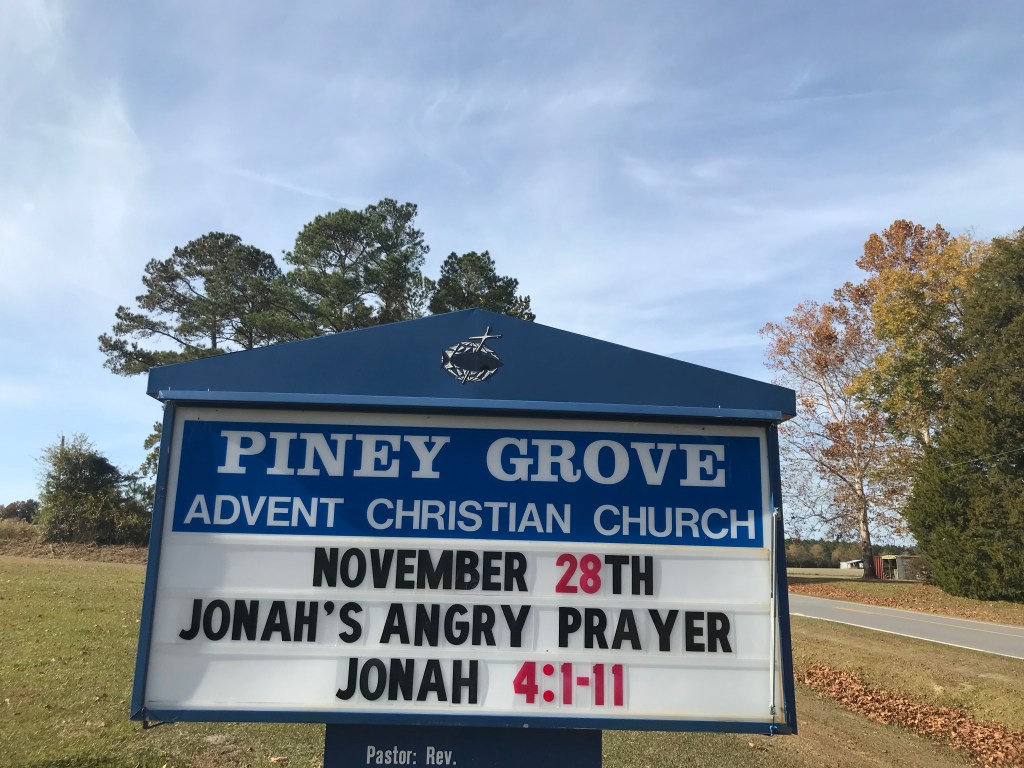
JONAH’S ANGRY PRAYER

JONAH’S ANGRY PRAYER

Jonah 4:1-11 NET

1 This displeased Jonah terribly and he became very angry. 2 He prayed to the LORD and said, “Oh, LORD, this is just what I thought would happen when I was in my own country. This is what I tried to prevent by attempting to escape to Tarshish! — because I knew that you are gracious and compassionate, slow to anger and abounding in mercy, and one who relents concerning threatened judgment. 3 So now, LORD, kill me instead, because I would rather die than live!” 4 The LORD said, “Are you really so very angry?” 5 Jonah left the city and sat down east of it. He made a shelter for himself there and sat down under it in the shade to see what would happen to the city. 6 The LORD God appointed a little plant and caused it to grow up over Jonah to be a shade over his head to rescue him from his misery. Now Jonah was very delighted about the little plant. 7 So God sent a worm at dawn the next day, and it attacked the little plant so that it dried up. 8 When the sun began to shine, God sent a hot east wind. So the sun beat down on Jonah’s head, and he grew faint. So he despaired of life, and said, “I would rather die than live!” 9 God said to Jonah, “Are you really so very angry about the little plant?” And he said, “I am as angry as I could possibly be!” 10 The LORD said, “You were upset about this little plant, something for which you have not worked nor did you do anything to make it grow. It grew up overnight and died the next day. 11 Should I not be even more concerned about Nineveh, this enormous city? There are more than one hundred twenty thousand people in it who do not know right from wrong, as well as many animals!”

We have been taking a look at the Old Testament book of Jonah this month. In most of the Old Testament, the Prophets of God are the ones his people should be patterning themselves after. But Jonah is the odd person out in that regard. All through the book, we learn that Jonah is charged to obey God’s plan, but he tries to follow Jonah’s plan. God’s plan was to go to Nineveh and preach. Jonah’s plan was to go as far away from Nineveh as he could possibly go. Thus, the storm, the frightened sailors, the toss overboard, almost dying in the belly of Sheol, and a rescue – and some time to evaluate things in the stomach of a fish.

When Jonah finally agreed to obey God’s plan to go to Nineveh — he adapted his plan. He got burped up on the beach. He went to Nineveh and he preached there. But his purpose was still not God’s purpose. God’s plan was to save the Ninevites. Jonah’s plan was to condemn them, and to have a front-row seat at their execution. Once again, God intervenes. The Ninevites repented. They humble themselves – they fast – they pray. God relents. They did what God wanted them to do, and God responds in his grace. But that was not part of Jonah’s plan, and he was angry about it.

Jonah’s prayer expresses his anger at God’s grace (1-3).

The fact that God relented from destroying the Ninevites “displeased Jonah terribly and he became very angry.” If someone has God’s heart, then seeing someone repent and turn to God should not make him angry. If someone wants to see other people saved, then that someone should not get angry when God steps down and gives them the grace to repent and be saved.

Jonah 2 showed us Jonah’s grateful prayer for God’s grace in rescuing him from the danger of dying in the ocean. But in Jonah 4, this same God manifests his same grace to rescue the Ninevites and this same prophet gets angry. Notice why Jonah is angry. He tells God “this is just what I thought would happen when I was in my own country. This is what I tried to prevent by attempting to escape to Tarshish! – because I knew that you are gracious and compassionate, slow to anger and abounding in mercy, and one who relents concerning threatened judgment.

Jonah’s problem was not his theology. He knew that when the LORD was having Moses go back up Mount Sinai for the second copy of the ten commandments, he revealed himself as “the LORD, the compassionate and gracious God, slow to anger, and abounding in loyal love and faithfulness, keeping loyal love for thousands, forgiving iniquity and transgression and sin” (Exodus 34:6-7 NET). So, Jonah knew that it was God’s nature when he finds iniquity, transgression or sin to come to those people with his grace, to be slow to anger toward them and to treat them mercifully.

But God’s grace was not in Jonah’s plan that day. He did not want God to manifest his grace. Brother John Roller describes God’s grace as his “generosity in giving us good things that we don’t deserve to have.” God was showing his grace to the Ninevites by giving them a word of warning through Jonah. But Jonah did not want to be a representative of God’s grace to the Ninevites. He wanted to be a representative of God’s judgment.

When Jonah discovered that God intended to rescue the Ninevites, he got so angry that he asked God to kill him instead. Now, I have never been that angry, but I can understand that kind of anger. When anger takes hold of a person, it leads him to say things and do things that go overboard. Jonah was experienced with that. But it wasn’t just God’s grace that Jonah was reacting to.

Jonah’s ordeal while waiting reveals his anger at God’s sovereignty (4-9).

Previously, in the book of Jonah we saw God use a ship, a storm and a fish to teach Jonah a lesson. In this chapter, God uses the sun, a plant, and a worm. The section begins and ends with the same question. God asks Jonah if he is really so very angry about his sparing the Ninevites. Then Jonah goes outside the city, and he sits and stews. He is watching the city. He knows God has spared it, and it makes him mad. While Jonah is watching, the sun comes out, and it starts to make him uncomfortable. But God had placed a plant near where Jonah was watching, and God by his sovereign power caused that plant to grow so that it shaded Jonah from the sun. God had appointed that little plant and “caused it to grow up over Jonah to be a shade over his head to rescue him from his misery.” Jonah was very delighted about the little plant.

But the next day, this same sovereign God sent a worm to attack the plant. The plant died that day, and Jonah got so hot that he also wanted to die.

Now, it just so happened that while I was writing this sermon, I got to this point and it became very hard for me to see what I was doing. The sun was coming through the window in the pastor’s study. I did not get angry. All I had to do was stand up, go to the window, and drop the blinds.

That incident reminded me that Jonah was still trying to do his ministry according to Jonah’s plan. God had not told Jonah to leave the city. Jonah just wanted to get away and stew. God did provide the plant for Jonah by his sovereignty, but God also provided the worm.

Jonah had no real reason to be angry at God because of the worm. Jonah did not plant that plant. God did. God did not owe Jonah another comfortable day.

You and I have to come to grips with God’s sovereignty. He does things according to his plan, and he does not have to get our approval to do it.

This applies to our prayer list as well. We have a list of people who we ask God to heal and save every day. But God in his sovereignty does not heal and save these people every day. He has reasons for what he does, and reasons for what he doesn’t do. At the end of the day, we need to evaluate what happened and what did not happen on the basis of God’s sovereignty. We need to be able to say what Job did when he lost everything: “The LORD gives, and the LORD takes away. May the name of the LORD be blessed!” (Job 1:21 NET).

Now, if we or someone we love is suffering, we should follow the example of Jesus and pray for our Father to remove that cup. But we should also be willing to say “not my will but yours be done” (Luke 22:42 NET).

That was Jonah’s problem. He knew God was gracious and merciful, but he wanted God to be gracious and merciful according to Jonah’s plan, not God’s. It doesn’t work that way.

God showed Jonah that he had no right to be angry at him (10-11).

The plant was a real plant, but it was also a parable. God used Jonah’s ordeal of the plant and the worm to show Jonah that every good thing and every bad thing that happened to Jonah was all in God’s plan. Jonah didn’t plant that plant, and Jonah didn’t kill that plant. The LORD gave and the LORD took away. Jonah’s proper response should have been “May the name of the LORD be blessed!”

God told Mary that he had some good news and some bad news. The good news is she is going to give birth to the Son of God, and he is going to save his people from their sins. The bad news is that there was going to be a sword of suffering. She felt that sword as she watched her son crucified. But through it all, she was right there, trusting God to work out his plan.

God told Peter that he had some good news and some bad news. He said to Peter that the good news is he was going to use him as the foundation of his church. The bad news is that when he gets older, they’re going to tie him up and bring him where he doesn’t want to go. Peter would remember that when they were preparing him for his own crucifixion. But through it all, he was right there, trusting God to work out his plan.

God told Paul that he had some good news and some bad news. Paul would become a great missionary, and speak to kings and governors, proclaiming the gospel to the Gentiles as well as the Jews. But he would also suffer much for the sake of Christ’s name.

When we spent some time in Hebrews 11, we saw that pattern in the lives of the heroes of faith. They were great men and women, not because everything went well for them, but because they had learned to trust God as he worked out his plan.

Abraham trusted God that he would make good on his promise of a land. The only land he ever actually owned there was a burial plot.

Joseph trusted God that he would make him a great ruler. He held on to that trust while languishing as Potiphar’s slave and then in prison. He held on to God’s sovereignty.

All these great heroes were tested, and passed the test. Jonah was failing the test. His anger at how things were going was causing him to lose sight of God’s heart for the nations. He should have been cheering when he was grumbling. He needed to get his eyes off the dead plant and focus on an entire city that had been given new life.

LORD God, give us your heart. Help us to see things from your perspective. And when things happen that we did not expect and cannot understand, help us to trust in your sovereignty.

video

JONAH AND THE PAGAN NINEVITES

JONAH AND THE PAGAN NINEVITES

Jonah 3:1-10 NET

1 The LORD said to Jonah a second time, 2 “Go immediately to Nineveh, that large city, and proclaim to it the message that I tell you.”3 So Jonah went immediately to Nineveh, as the LORD had said. (Now Nineveh was an enormous city – it required three days to walk through it!) 4 When Jonah began to enter the city one day’s walk, he announced, “At the end of forty days, Nineveh will be overthrown!”5 The people of Nineveh believed in God, and they declared a fast and put on sackcloth, from the greatest to the least of them. 6 When the news reached the king of Nineveh, he got up from his throne, took off his royal robe, put on sackcloth, and sat on ashes. 7 He issued a proclamation and said, “In Nineveh, by the decree of the king and his nobles: No human or animal, cattle or sheep, is to taste anything; they must not eat and they must not drink water. 8 Every person and animal must put on sackcloth and must cry earnestly to God, and everyone must turn from their evil way of living and from the violence that they do. 9 Who knows? Perhaps God might be willing to change his mind and relent and turn from his fierce anger so that we might not die.” 10 When God saw their actions – they turned from their evil way of living! – God relented concerning the judgment he had threatened them with and he did not destroy them.

I am enjoying our look into this ancient book about Jonah and what he experienced. Jonah appeals to me on several levels. As a former missionary, I like the way God seeks out the lost and uses his people to encourage them to repent. I also like the way God uses all the details in Jonah’s life to accomplish his will – often in spite of Jonah’s reluctance. God uses a ship, sailors, a storm – even a fish.

I can relate to this because so much of my life has involved drastic changes of location and even vocation – yet God has used all of those events and circumstances to accomplish His will in my life and the lives of my family members.

Jonah’s details are all over the map. That’s literally true. Geographically, he probably started out in Zebulun territory, which if I am reading my map correctly – means that he would have to travel about 500 miles by land to get there. So, Jonah decided to take a boat. You can’t get there by boat. The Mediterranean Sea is in the other direction.

All we really know about Tarshish is that it is a long way away from where Jonah was told to go. So, even when Jonah got burped up on the beach, he still had a long hike to get to Nineveh. I like to think about things when I’m hiking. Jonah probably thought about his experiences as he hiked to Nineveh.

Jonah had learned some of the lessons that God was teaching him (1-3a).

He probably thought about his initial decision to try to run away from God’s commission and call. Yeah, that was a bad idea. He wasn’t going to make that mistake again. He did not dawdle. He went immediately to Nineveh, as the LORD had said.

But he couldn’t get in a jet plane, so his going immediately to Nineveh would take him several weeks. So, he had time to think about other lessons the LORD was teaching him. He had probably thought about his arrogance in assuming that God was going to take care of him on that trip to Tarshish. He had fallen asleep in the storm that threatened to wreck the ship he was on. Maybe he thought that because he was an Israelite that he was safe. But he was in blatant disobedience to God’s call. There’s no safety net there.

And what about those pagan sailors. He thought they were just heathens – that they would never amount to anything. But those heathens turned out to be more spiritually sensitive than he was. In fact, when they were confronted with God’s power, they turned to God. Jonah knew all about God’s power and was trying to turn away from him.

So, Jonah winds up in the sea, sinking down to the belly of Sheol, and he cries out to God. Just when he is about to breathe in a lung full of seawater, God rescues him – with a fish. You can’t make this stuff up. God shows Jonah that he will go to extravagant ends to rescue those who cry out to him.

When Jonah finally gets to the end of the trail, he is ready to preach.

Jonah warned the Ninevites of God’s coming judgment (3b-4).

He had one message. He told them that at the end of forty days, Nineveh will be overthrown. He didn’t beg them to repent. He didn’t lay out a master plan for their renewal. He didn’t tell them that God loved them and had a wonderful plan for their lives. No, he just told them that the end was coming.

I wonder sometimes if our gospel preaching sounds like that. We try to talk about God’s love and God’s grace, but I think all the lost people around us hear is “y’all are sinners and you’re gonna burn.”

Oh, Jonah knew all about the Ninevites. He knew that the city was the capital city of the great Assyrian empire – and these people do not play nice. The prophet Nahum said this about Nineveh:

“Woe to the city guilty of bloodshed! She is full of lies; she is filled with plunder; she has hoarded her spoil! (Nahum 3:1 NET).

The whole superpower of Assyria was known for its brutality, violence and terror. Nineveh deserved to be destroyed.

In football, we have a two-minute warning. It means the game is essentially over because there is very little chance of any team doing anything to change the score in those last two minutes. Mostly it is just to make sure both teams know that the game is ending.

Jonah probably thought of his own ministry like that. we know from his angry prayer in the next chapter that Jonah wanted to be the last prophet to speak to Nineveh. He wanted to be the one to say “last two minutes” to the losers at Nineveh.

He wasn’t prepared for what actually happened.

Jonah was not prepared for his warning to actually be effective (5-9).

From the lowest to the highest, the people believed in God this time. They declared a fast and put on sackcloth. My uncle once asked me if sackcloth was like burlap. It wasn’t. Sackcloth was worse than burlap. It’s made of hair. It’s uncomfortable and itchy. Add to that the bizarre act of sitting in a dirty pile of ashes. That’s not a fashion statement, but it is a statement. It says we’re all in trouble and we need to get someone’s attention.

That grass-roots social demonstration got the attention of the king and his nobles. The king took off his royal robe and put on his hair coat as well. He found an ash pile to sit in. He made it official by issuing a proclamation. In addition to a forced fast, the king commanded that everyone “must put on sackcloth and must cry earnestly to God, and everyone must turn from their evil way of living and from the violence that they do.” “Who knows?” He said. “Perhaps God might be willing to change his mind and relent and turn from his fierce anger so that we might not die.” There was no guarantee, but Jonah’s preaching had gotten their attention.

Jonah was not prepared for his warning to actually work. I wonder sometimes, what would we do if all those people we keep inviting to church actually showed up one day.

Jonah needed to learn that God does not want to punish sinners – he wants them to repent (10).

“When God saw their actions – they turned from their evil way of living! — God relented concerning the judgment he had threatened them with and he did not destroy them.”

God did not want to destroy Nineveh. He wanted to rescue them. He wanted to avoid the punishment Jonah warned them about.

God does not want to destroy Delco either. We owe it to our neighbors to let them know that God will punish those who rebel against him. But we also need to tell them that it doesn’t have to be that way.

“God did not send his Son into the world to condemn the world, but that the world should be saved through him” (John 3:17 NET).

The purpose of God is not revenge, it’s rescue. If people refuse to repent, they will be destroyed. Make no mistake about that. But for thousands of years, our commission has been to declare the good news to the nations. The good news is that we can avoid Gehenna.

There is a lake of fire in the future of this universe. But the lake of fire is a destiny that can be avoided. God does not want to send anybody to hell.

“The Lord is not slow concerning his promise, as some regard slowness, but is being patient toward you, because he does not wish for any to perish but for all to come to repentance” (2 Peter 3:9 NET).

God was patient with the Ninevites, and he sent his prophet when their time had almost run out. His patience paid off because they repented.

Jonah learned that God does not want to punish sinners — he wants them to repent. We need to keep that in mind as we go about our daily work of telling people about God. We have to tell them about God’s coming wrath, but we should never forget to tell them that God’s wrath is not inevitable.

It is not necessary. Jesus has already taken God’s wrath upon himself at his crucifixion. Nobody needs to die for their personal sins because Jesus has already taken that punishment upon himself and nailed it to the cross. We have to die the first death because of Adam’s sin. But God has made a way for us to escape the second death that we have earned with our own sins. Jesus is that Way.

Repentance and faith changed the fate of the Ninevites. Repentance and faith can change anyone’s fate. We all begin as sinners — lost and condemned. But the gospel tells us that we can rewrite our destiny. By repenting of our sins and putting our faith in God’s rescue through Christ, we can change not only our relationship with God now but our permanent destiny in the future.

The prophet Jonah was surprised when his preaching worked. He shouldn’t have been. God sends us to the nations not because he wants to condemn them, but because he has a way to save them. His heart is not to destroy the lost, but to save the lost.

video

JONAH AND THE PAGAN SAILORS

JONAH AND THE PAGAN SAILORS

Jonah 1:1-16 NET

1 The LORD said to Jonah son of Amittai,

2 “Go immediately to Nineveh, that large capital city, and announce judgment against its people because their wickedness has come to my attention.”

3 Instead, Jonah immediately headed off to Tarshish to escape from the commission of the LORD. He traveled to Joppa and found a merchant ship heading to Tarshish. So he paid the fare and went aboard it to go with them to Tarshish far away from the LORD.

4 But the LORD hurled a powerful wind on the sea. Such a violent tempest arose on the sea that the ship threatened to break up!

5 The sailors were so afraid that each cried out to his own god and they flung the ship’s cargo overboard to make the ship lighter. Jonah, meanwhile, had gone down into the hold below deck, had lain down, and was sound asleep.

6 The ship’s captain approached him and said, “What are you doing asleep? Get up! Cry out to your god! Perhaps your god might take notice of us so that we might not die!”

7 The sailors said to one another, “Come on, let’s cast lots to find out whose fault it is that this disaster has overtaken us.” So they cast lots, and Jonah was singled out.

8 They said to him, “Tell us, whose fault is it that this disaster has overtaken us? What’s your occupation? Where do you come from? What’s your country? And who are your people?”

9 He said to them, “I am a Hebrew! And I worship the LORD, the God of heaven, who made the sea and the dry land.”

10 Hearing this, the men became even more afraid and said to him, “What have you done?” (The men said this because they knew that he was trying to escape from the LORD, because he had previously told them.)

11 Because the storm was growing worse and worse, they said to him, “What should we do to you to make the sea calm down for us?”

12 He said to them, “Pick me up and throw me into the sea to make the sea quiet down, because I know it’s my fault you are in this severe storm.”

13 Instead, they tried to row back to land, but they were not able to do so because the storm kept growing worse and worse.

14 So they cried out to the LORD, “Oh, please, LORD, don’t let us die on account of this man! Don’t hold us guilty of shedding innocent blood. After all, you, LORD, have done just as you pleased.”

15 So they picked Jonah up and threw him into the sea, and the sea stopped raging.

16 The men feared the LORD greatly, and earnestly vowed to offer lavish sacrifices to the Lord.

The story of Jonah is amazing. But it is one of those stories that is very easy for us to look at just as a story, and fail to see its relevance for our individual lives. One of the things I want to do in this series on Jonah is to show how Jonah’s story demonstrates what God wants to do in our lives – even if we never get swallowed by a fish.

The beginning of the story is a good place to start in discovering this.

God has a plan to save sinners, and he has commissioned us to be a part of that plan (1-2).

The LORD told Jonah to go immediately to Nineveh because that city was the capital city in an empire known for its wickedness. He had a plan to save the sinners in that great city, and Jonah was part of his plan. He commissioned Jonah to go and preach. He has commissioned us to go and preach to all the nations.

Penny and I have had the privilege to share the gospel in several nations. None of those opportunities happened by accident. There were some specific nations in Europe, Africa, Asia and Oceania that God wanted us to preach and teach his word in. He made it happen. I didn’t want to go to Germany with the Army, but God wanted me there. Once I got there, I discovered that I liked it, and that God could use me to share the gospel there just like he did when I was pastoring in Tennessee.

When the LORD made a way for me to go to seminary, he had already shown us the next nation which would be our target: The Philippines. God had a plan to reach a large number of Filipinos through our ministry there – mostly by training pastors and church workers. Even today, there are hundreds of amazing Christian workers in that nation who Penny and I helped to disciple. It wasn’t an accident. God loves that nation, and he had a plan to reach them, and commissioned us to be part of that plan.

I could go on and talk about all the other nations, but my biography is not the point. My point is that God has a plan to save sinners, and he has included us in that plan. He doesn’t need us to share his word. Somebody other than Jonah could have gone to Nineveh. But God commissioned Jonah to do it.

Sometimes, we ridiculously think that we can ignore God’s commission (3).

Jonah thought he could escape from the commission of the LORD. He traveled to Joppa and found a merchant ship heading to Tarshish. So he paid the fare and went aboard it to go with them to Tarshish because he thought that distance would be far enough away from the LORD for him to ignore his commission. It wasn’t. No place is.

Our God is omnipresent. We could get in a spaceship and go to the far reaches of the Galaxy, and we will not have traveled one inch away from God. He is everywhere. If he gives us a commission, there is no place we can go to escape from it. Guess what? He has given us a commission. He told us to go to every place on the planet and share his good news.

We cannot escape his commission by going somewhere, neither can we escape it by ignoring it. Jonah thought that if he just focused on going away, that he could ignore God’s command for him to go to the particular place of Nineveh.

God always has a way of bringing the commission to us (4-10).

His way in this situation was to make a storm. The storm got everyone’s attention. In fact, everyone was able to realize how crucial it was to act to save their lives – except Jonah. He was the last one to wake up. When the people learned that the storm was Jonah’s fault, it provided Jonah a perfect opportunity to testify. He told them that he was a Hebrew, and that he was trying to escape the LORD. Jonah wound up doing preaching about God and his coming wrath – only the wrath was now targeting Jonah himself. God had used the storm to get Jonah to do for these sailors what he was reluctant to do for the Ninevites.

He always has a way of bringing the commission to us. If we wont obey him out of a heart of compassion for sinners, He will make circumstances warrant that we obey for some other reason. When Peter was reluctant to reach out to the Gentiles, the Lord sent him a vision. Then Cornelius – who had also seen a vision – sent some servants to Peter. So, even Peter – who would continue to have problems recognizing that Gentiles are equal with Jews in God’s sight – was convinced that God does not show favoritism.

This was one of Jonah’s problems too. He did not like the Ninevites. He was convinced that they were not worth saving. But our God has compassion on us all in spite of the fact that none of us is worth saving. He sent the storm that day because he had a plan to save some pagan Ninevites. He also sent the storm because there were some pagan sailors who also needed to be saved.

God will reach sinners, but we need to learn to stop resisting his call (11-16).

Jonah had to learn to stop resisting his call, and his having to be thrown into the sea did the trick. God wanted to reach the pagan Ninevites, so Jonah had to get off that ship because God had another means of transportation for him.

Meanwhile, notice what is happening among those pagan sailors. They are crying out to the LORD not to let them die on account of Jonah. Now, notice what happens next. They pick Jonah up and throw him into the sea. The sea stops raging. Did those pagan sailors go back to business as usual? No, the text says that the men feared the LORD greatly, and earnestly vowed to offer lavish sacrifices to the Lord. God had a plan to reach sinners, and he did. He reached these pagan sailors in spite of the fact that Jonah was not among them because he wanted them saved. God reached them anyway because that is the kind of God he is.

Now, if God can reach these sailors through the witness of a reluctant prophet, imagine what he could do through the witness of a community of believers who actually want to reach the lost for him. We discover later on in this book that even though Jonah gets the message and goes and preaches to the Ninevites and the whole city repents – Jonah still didn’t want to do it. One of the major messages of the book of Jonah is that God wants his people to have his heart for the lost.

God told Ezekiel “I will seek the lost and bring back the strays” (Ezekiel 34:16).

“Jesus entered Jericho and was passing through it. Now a man named Zacchaeus was there; he was a chief tax collector and was rich. He was trying to get a look at Jesus, but being a short man he could not see over the crowd. So he ran on ahead and climbed up into a sycamore tree to see him, because Jesus was going to pass that way. And when Jesus came to that place, he looked up and said to him, “Zacchaeus, come down quickly, because I must stay at your house today.” So he came down quickly and welcomed Jesus joyfully. And when the people saw it, they all complained, “He has gone in to be the guest of a man who is a sinner.” But Zacchaeus stopped and said to the Lord, “Look, Lord, half of my possessions I now give to the poor, and if I have cheated anyone of anything, I am paying back four times as much!”Then Jesus said to him, “Today salvation has come to this household because he too is a son of Abraham! For the Son of Man came to seek and to save the lost”” (Luke 19:1-10 NET).

Now, this week, you and I might encounter a Zacchaeus. Everybody around us thinks that he is unredeemable. Everybody else wants to overlook him. Don’t do it. Don’t be like Jonah. He didn’t want to go to preach to those pagan Ninevites. He never imagined preaching to those pagan sailors. He was God’s prophet, but he didn’t have God’s heart.

God has commissioned us to go to the nations with the gospel. There are some of those nations that we wouldn’t want to go to even on vacation. But God’s heart is to reach the lost there.

video