tough times prove our maturity

slide1

I am not a huge fan of topical sermons. I think there is a danger of coming to the Bible with my mind already made up on a topic, and reading into the texts of scripture just what I want to hear. It is for that reason that I prefer messages like those of Dr. Flanagan of late.  He is approaching the entire Gospel of Luke, and trying to get at what Luke had in mind in the entire book, and relating each section to the book’s purpose as a whole. That is a safer practice, because it puts what God has to say above what I want to hear.

Nevertheless, I admit that there is a place in the church for topical preaching.  Sometimes I need to come to the scriptures with my questions, and seek God’s answers. That is what I have been trying to do with this series on tough times.  We have been going through some tough times as individuals, and as a church. I want to get God’s perspective on these tough times.

When I looked at Jesus’ parable of the planter and soils in Matthew 13, I asked whether going through tough times implies that I am not a Christian. I discovered that my identity depends on who planted me, not on how difficult the soil is. In fact, Jesus tells us in that parable that God intentionally puts some of his seed in rough soil.  So, I should not be surprised to undergo challenges. The existence of those challenges serves to prove my identity as a Christian, not to disprove it.

When I looked at 1 Peter 1, I asked why God puts me through tough times – what is his ultimate plan for me, and why do I have to go through tough times to experience his ultimate plan.  Peter changes the metaphor, and says that God is a refiner. He puts his gold through the fire so that it comes out refined – purer.  Peter taught that Christians have a future we will inherit which is imperishable, undefiled, and unfading.

So, today I want to explore another text which treats the subject of tough times.

James 1: 2-8 NET

2    My brothers and sisters, consider it nothing but joy when you fall into all sorts of trials,

3     because you know that the testing of your faith produces endurance.

4     And let endurance have its perfect effect, so that you will be perfect and complete, not deficient in anything.

5     But if anyone is deficient in wisdom, he should ask God, who gives to all generously and without reprimand, and it will be given to him.

6     But he must ask in faith without doubting, for the one who doubts is like a wave of the sea, blown and tossed around by the wind.

7     For that person must not suppose that he will receive anything from the Lord,

8     since he is a double-minded individual, unstable in all his ways.

Some of you have probably wondered why I took so long to get to this passage.  For many, it is the go-to passage on the subject, and for at least three good reasons.

  1. The audience is similar. James is writing to churches.
  2. The context is similar. The churches are facing hard times – I mean really hard times – as in some are being persecuted and killed.
  3. Some gospel songs and choruses are based on this text, so it is easier to remember.

So, what is James telling Christians in this passage that relates directly to my questions about tough times in my context today? Here is what I find.

First, TOUGH TIMES ARE ALLOWED IN ORDER TO MATURE US.

slide3

James says that tough times come into our lives “so that (we) will be perfect and complete, not deficient in anything.” (4).  In other words, just being a disciple of Christ is not enough. God wants disciples to be discipled. He uses other Christians to do that, but he also uses tough times as part of the process.

James tells us not to be surprised when “all sorts of trials” come to us.  God is producing the character quality of endurance by allowing those tough times to affect us.  He is testing our faith.  He is not testing to see if we have faith. He is proving the existence of our faith by means of the trials.

True Faith + Tough Times = Endurance

True Faith + Tough Times = Maturity

Secondly, TOUGH TIMES ARE ALLOWED IN ORDER TO PROMOTE PRAYER FOR WISDOM.
slide4

James gives a prescription for those believers who want to know what to do when things get tough. He says “if anyone is deficient in wisdom, he should ask God.” (5).  Notice that James does not say our first prayer should be “Lord, take this problem away from me.!” No, our first prayer should be “Lord, what are you teaching me through this trial?”

We human beings can endure all kinds of hardship as long as we are aware of the purpose for the pain. When we lose sight of the purpose, even the slightest hardship can be our undoing.

Thirdly, TOUGH TIMES ARE ALLOWED IN ORDER TO PRODUCE STRENGTH.

slide5

James gives these battle hardened soldiers in the churches he is writing to some good strategic advice. When they pray, “(they) must ask in faith without doubting.” (6).  I know a lot of preachers have taught this text as if it is saying that if you ask God to deliver you from your hardship, you have to really believe or God is going to let you keep experiencing the hardship until you do.  I do not think that is what James is saying at all.

Let’s look at the text again:

5           But if anyone is deficient in wisdom, he should ask God, who gives to all generously and without reprimand, and it will be given to him.

6              But he must ask in faith without doubting, for the one who doubts is like a wave of the sea, blown and tossed around by the wind.

7              For that person must not suppose that he will receive anything from the Lord,

8              since he is a double-minded individual, unstable in all his ways.

What are we encouraged to ask for in this text?  Wisdom (5).

What, then, should we expect to receive (7) if our prayers are answered? Wisdom!

A prayer for wisdom is a request for insight that will help me endure the tough times I am going through.  If I pray for this wisdom, I should expect the Lord to give me wisdom enough to endure the tough times.

What happens when a double-minded person goes through tough times? Either they only ask for deliverance, or they ask for wisdom, doubting that God would ever give them this wisdom. They are unstable, immature.

The reason this is so important is that God does not guarantee me or anyone else that he is going to fix things.  What he guarantees is that he will give us wisdom enough to endure the tough times in peace. But this wisdom and peace is not automatic. With each new trial, the potential for wisdom and peace is there, but we have to keep asking for it.

Paul said something similar:

“Do not be anxious about anything. Instead, in every situation, through prayer and petition with thanksgiving, tell your requests to God. And the peace of God that surpasses all understanding will guard your hearts and minds in Christ Jesus” (Philippians 4:6-7 NET).

Again, notice that the outcome is not “God promises to fix all my problems.”  The real outcome is that even though we go through tough times our hearts and minds will be guarded from anxiety and given peace!

slide1

LORD, mature us. Show us how to respond to all the tough times we face with a determination to know your wisdom as we face them.  We are not praying for easy lives. We are praying for you to make us into strong people.
 

Tough times prove our faith

slide1

1 Peter 1:3-9 (NET)

 3 Blessed be the God and Father of our Lord Jesus Christ! By his great mercy he gave us new birth into a living hope through the resurrection of Jesus Christ from the dead, 4 that is, into an inheritance imperishable, undefiled, and unfading. It is reserved in heaven for you,5 who by God’s power are protected through faith for a salvation ready to be revealed in the last time. 6 This brings you great joy, although you may have to suffer for a short time in various trials. 7 Such trials show the proven character of your faith, which is much more valuable than gold — gold that is tested by fire, even though it is passing away — and will bring praise and glory and honour when Jesus Christ is revealed. 8 You have not seen him, but you love him. You do not see him now but you believe in him, and so you rejoice with an indescribable and glorious joy, 9 because you are attaining the goal of your faith — the salvation of your souls.

2016 is over and done with, and I for one am happy to see it go. It has been Jefferson’s “terrible, horrible, no good, very bad” year.  One of the reasons I decided to preach this series of sermons is I just needed to remind myself why believers go through tough times. I know that the Bible gives some good answers to that question, but when you go through tough times, it is not easy to remember them.

So, last time, when we looked at Jesus’ story about the planter and the soils, we saw that it is not unusual for believers to experience tough times, because our ability to overcome them and remain fruitful is evidence of our identity as real Christians.

In today’s text, Peter says something very much the same.  In fact, it seems like Peter is reflecting on what Christ said in the parable.  It may very well be the case. There are quite a few similarities.  But Peter steps back from the planter/harvest allegory and uses more familiar church language when he talks about being given new birth and a salvation that will be revealed when Christ returns.

There is a lot of truth packed into these few verses, but what I want to investigate further is what Peter says about tough times.  He puts what he says about tough times (or, what he calls various trials) in the larger context of what God has decided to do in the lives of Christians, and how that will end up bringing him eternal praise, glory and honour.

slide2

TOUGH TIMES COME TO CHALLENGE OUR FAITH, BUT CANNOT CHANGE OUR FUTURE

 3 Blessed be the God and Father of our Lord Jesus Christ! By his great mercy he gave us new birth into a living hope through the resurrection of Jesus Christ from the dead, 4 that is, into an inheritance imperishable, undefiled, and unfading. It is reserved in heaven for you,5 who by God’s power are protected through faith for a salvation ready to be revealed in the last time.

What Peter wants believers to know is that the God who planted them is going to harvest them. The God who gave them new birth is going to make sure that those born-again people are raised to eternal life when Jesus comes. So, yes, tough times are going to come. But those tough times cannot change the believer’s destiny. How do we know that? The evidence Peter puts forth for that claim is the resurrection of Jesus Christ.  In fact, it was the resurrection of Christ from the dead that made being born-again possible.

Paul talked about Jesus being the first-fruits of the harvest.  The Jewish feast that celebrated first-fruits was a faith-celebration of the whole harvest.  They did not wait until the whole harvest was in before they celebrated. They celebrated in faith once the first-fruits appeared.  Peter looks at a church whose members suffer tough times sometimes, and he tells us to look at Jesus. Jesus has already been raised from the dead to live immortal. That is our future.  Tough times will come, but they cannot change what God did for us in the past, so they cannot change what he is going to do in the future.

3 Blessed be the God and Father of our Lord Jesus Christ! By his great mercy he gave us new birth into a living hope through the resurrection of Jesus Christ from the dead, 4 that is, into an inheritance imperishable, undefiled, and unfading. It is reserved in heaven for you,5 who by God’s power are protected through faith for a salvation ready to be revealed in the last time.

Peter chooses to use the birth metaphor instead of the harvest metaphor because he wants to assure the believers who are going through tough times that God has not abandoned them.  So, it is not like God planted them, and then went off somewhere else to tend another crop. Now, God gave them new birth, and he has an inheritance waiting to give to those new children that he has given birth to.

Notice what Peter says about that inheritance:

slide3

(You may not have noticed, but the three words rhyme in Greek, and they start with the same letter in Greek.) They are …


  • imperishable, [άφθαρτον]


This is a word that Paul uses to describe God’s immortality, and the immortality that believers will be raised with.  When Peter uses it to describe our inheritance, he is assuring believers that nothing is going to change their future.

In fact, Peter kind-of mixes metaphors in verse 23 of this same chapter when he tells believers that they … “have been born anew, not from perishable but from imperishable seed, through the living and enduring word of God.” So, Peter is telling us not that we are immortal already, but that immortality has been planted in us.

  • undefiled, [αμίαντον]


This word is used to describe something that is pure, uncontaminated.  If Peter is using it to refer to seed, it means that believers are made of pure seed which will produce a pure crop. If Peter is alluding to believers’ inheritance and their being given birth to by God, then it takes on the further meaning of the holiness of the parent.  Our future depends on our origin. Our inheritance depends on who gave us birth.

  • unfading [αμάραντον]


This is an interesting word for Peter to use in this context.  It is a word that describes a flower in full-bloom. In fact, there is a species of flowering grain called the amaranth.


What Peter seems to be saying is that if God has given you birth, you do not have to worry about your relationship with him fading away and dying off. That is a good thing to know, especially if you face tough times.

slide4

TOUGH TIMES COME TO TEST OUR FAITH, BUT CANNOT AFFECT WHO WE REALLY ARE

 6 This brings you great joy, although you may have to suffer for a short time in various trials. 7 Such trials show the proven character of your faith, which is much more valuable than gold — gold that is tested by fire, even though it is passing away — and will bring praise and glory and honour when Jesus Christ is revealed.

So, having assured the believers he is writing to that their future is safe in God’s hands, he now goes on to address what it is that tough times are sent for in the present.  He changes the metaphor again. Instead of a plant, or a child, here Peter describes the Christian in terms of a precious metal, like gold.

Most substances when subjected to fire are completely destroyed.  But gold is different. If you put gold in the fire, what is going to happen is that anything that is not gold is going to burn away, and what you will have left is gold. So, Peter is saying that tough times are not there to destroy us. They are there to show what we are really made of, who we really are.

6 This brings you great joy, although you may have to suffer for a short time in various trials. 7 Such trials show the proven character of your faith, which is much more valuable than gold — gold that is tested by fire, even though it is passing away — and will bring praise and glory and honour when Jesus Christ is revealed.

In fact, the result of the tough times is that God is going to be worshipped.  Our going through the tough times happens so that God will be eternally praised because of the faith he gave us to overcome the tough times.

So, you see, if you ask the gold whether it wants to go through the fire, it would probably say no thank you very much.  But if you ask the refiner, he would say, “absolutely.”  Why? Because the refiner wants to produce a brilliant pure gold, and for that, he needs to put it through the fire.

slide5

TOUGH TIMES COME TO STEAL OUR JOY, BUT CANNOT OVERCOME OUR FAITH IN CHRIST

8 You have not seen him, but you love him. You do not see him now but you believe in him, and so you rejoice with an indescribable and glorious joy, 9 because you are attaining the goal of your faith — the salvation of your souls.

So, to sum up Peter’s message so far. He says that tough times are not going to change what happened in the past: God gave those believers a new birth to a permanent inheritance.  He also says that tough times are not going to change what is going to happen in the future.  It is all going to come through the fire and reveal a pure gold that brings glory and praise to the Refiner.

So, the last thing Peter wants to reflect upon is the present.  He sees a church that has put her faith in a Saviour that she presently cannot see.  He sees that church rejoicing in her Saviour with an indescribable and glorious joy.  Then he sees tough times come.  Those tough times are not going to destroy her faith.  She has something that those tough times cannot touch. She has a living and enduring faith in Christ. She is attaining the goal of her faith. She is being saved by Him.

slide6

When we go through tough times, we need to remember that it does not mean that God has abandoned us. It means the opposite. He is there, refining us so that who we are blesses him forever.


tough times prove our identity

tough-times-prove-our-identity-1

Matthew 13:18-23 (JDV)

18 “So listen to the parable of the planter:

19 When anyone hears the message about the coming kingdom and does not understand it, the evil one comes and snatches away what has been planted in his heart. This is what was planted along the path.

20 As for what was planted on rocky ground, this is the one who hears the message and immediately receives it with joy,

21 yet he has no internal root, so stays true for a while, but when troubles or opposition arise on account of the message, he falls away right then.

22 As for what was planted among thorns, this is the one who hears the message, but the worries of the age and the untrustworthiness of riches choke the message, and it becomes unfruitful.

23 As for what was planted on good soil, this is the one who hears the message and understands it. He really bears fruit and produces, in one case a hundred times as much, in another sixty, and in another thirty.”


Our church has experienced a series of unfortunate events in the past few months. Bad things have happened one after another, and it has caused many of us to rethink our situation. Some of us are wondering whether our church is going to survive, as domino after domino keeps toppling. I think it is appropriate for us to look into the Bible, and see what God has to say about when Christians go through tough times.

This passage is a good one to start with. It is the place where Jesus explains his parable of the soils. The parable itself was used by Jesus to show that there will always be different responses to the gospel when it is preached in the world. Jesus highlights four different responses using the allegory of four soils, and how they affect the seed planted in them.

The first soil he mentions is “the path” which doesn’t really receive the seed at all. The birds come and eat the seed before it has a chance to germinate and start growing. There is no life there. The truth comes and goes without any affect.

The last soil Jesus speaks of is the good soil which produces an abundant crop. This is the ideal.

I don’t want to focus on either one of these today.

In other sermons, I have talked about the four different kinds of response to the gospel, but that is not the direction I want to take today. Instead, I want to talk about the way Jesus describes tough times in this story.


tough-times-prove-our-identity-2

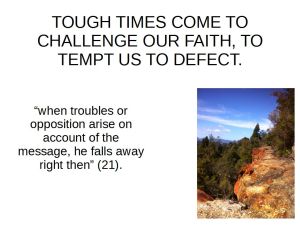
TOUGH TIMES COME TO CHALLENGE OUR FAITH, TO TEMPT US TO DEFECT.

“when troubles or opposition arise on account of the message, he falls away right then” (21).

This is when the tough times come into our lives for the express purpose of destroying our faith, and getting us to deny either God’s existence, or his relevance for our lives.

But I want you to notice the picture that Jesus has painted for us to look at. It is a picture of a crop that spouts up immediately. It is on rocky ground, so there is no internal root, but it looks just like the crop which had spouted on the good soil. When Jesus explains what the picture means, he says that it is people who receive the message of the kingdom immediately and joyfully.

I have seen so many people who appeared to have quickly and dramatically come to faith in Christ, but then just as quickly and dramatically lose all connection with the gospel and the church. That is what Jesus is talking about.

There are two causes for this phenomenon: an internal cause and an external cause. The external cause that Jesus refers to is when someone or something challenges the message of the gospel in your life. That is “when troubles or opposition arise on account of the message.” So, when the enemy of our faith notices that we are taking God’s word seriously, he will send direct challenges to the veracity of that word. But the parable does not say that Satan is directly responsible every time trouble comes into a person’s life. Trouble comes because trouble comes. Opposition arises because the message of the gospel is counter culture. Opposition is a natural thing in this world system. It should not surprise us when it happens.

But Jesus also mentioned the internal cause of defection. The defector “has no internal root, so stays true for a while” … but defects as soon as his beliefs are challenged. In other words, there is no faith there strong enough to overcome the effect of the troubles that Satan or the world sends to destroy it.

I worry sometimes that we tend to idolize people with the wrong kind of faith. Celebrities come along and appear to say something nice about Jesus, and we evangelicals fall all over ourselves to promote them. Then, when Jesus is no longer the flavour of the month for those celebrities any more, we look like idiots.

One thing we can learn from this portion of scripture is that true faith is long-haul faith. Troubles coming into our lives can actually help us to determine if we have that long-haul kind of faith. They can prove our identity as true Christians, because they reveal our roots. If our faith is real, it can withstand the challenges of the opposition.

tough-times-prove-our-identity-4

TOUGH TIMES COME TO CHOKE OUR FAITH, TO DIVERT OUR ATTENTION.

“the worries of the age and the untrustworthiness of riches choke the message, and it becomes unfruitful” (22).

The second way that Jesus describes tough times in this story is by painting a picture of a crop surrounded by thorns, briers, gorse.

This is when the tough times come into our lives for the express purpose of distracting us from the natural process of maturing and bearing fruit as disciples of Jesus Christ.

If the enemy cannot get you to defect, he is going to do all he can to distract you so that you are not productive in your faith.

The devil has two major tools that he uses to divert our attention away from productive Christianity: the worries of the age and the untrustworthiness of riches.

The “worries of the age” can be big things that affect the entire planet, or they can be things that affect us more directly. They can be global warming, or a high fever. They can be war in the middle east or not getting along with your spouse. They can be anxiety over the next political election, or even worrying about money.

The “untrustworthiness of riches” can be anything that is considered valuable that might serve as a substitute for the lordship of Christ and the pre-eminence of his kingdom. We have to seek his kingdom and his righteousness first. If we put anything else first, it becomes for us the “untrustworthiness of riches.” Even if it is a good thing… in fact, especially if it is a good thing.

  • Tolerance of other people’s world-views is a good thing. But if it keeps you from sharing the gospel with them, it has become your chief distraction.
  • Love of your family is a good thing. But if it keeps you from your commitment to your family of faith then it can become your chief distraction.
  • Desire to provide for your family is a good thing. But if it forces you to focus on making money instead of making disciples, then it becomes greed, and your chief distraction.

Those thorn bushes are going to be there. There is no secret weapon that will eliminate them from the patch of land we happen to be planted on. We have to overcome the distraction in order to be fruitful in our Christian lives.

tough-times-prove-our-identity-7

I titled today’s message “TOUGH TIMES PROVE OUR IDENTITY.”

But I do not want to give anyone the impression that I am teaching that having troubles is proof that you are not a Christian. Jesus said this to his followers on another occasion:

“Blessed are you who are poor, …

Blessed are you who are hungry …

Blessed are you who weep…

Blessed are you when people hate you and when they exclude you and revile you and spurn your name as evil…” (Luke 6:20-22 ESV).

That sounds like tough times, and it is actually proof that you are in the sky kingdom, not proof that you aren’t.

If you are a Christian, I want to tell you today that God knows your situation. He is not challenged by your challenges. He has things under control. He does not lack the power to change your circumstances. He may not choose to fix your problems today, and he has every right to make that choice.

But he is the one who planted the seed of the gospel in your life. He knows what you are going through, and he knows that the gospel message inside of you has the power to overcome the obstacles of the day. Those tough times that you are experiencing to not have to lead to defection or distraction. You can still thrive and grow as a Christian. And when you do, the one who planted the gospel in your life will be glorified by your perseverance.

who asked for that?

who asked for that

Who Asked for that?

Isaiah 1:7-15a

7 Your country is deserted, your cities have been burned up with fire; your land: aliens are devouring it in your presence, and it is desolate, as if devastated by foreigners.
8 And the daughter of Zion is left like a hut in a vineyard, like a shelter in a cucumber field, like a city that is besieged.
9 If Yahveh of armies had not left us survivor, we would have been as few as Sodom, we would have become like Gomorrah.
10 Hear the word of Yahveh, rulers of Sodom! Listen, the teaching of our God, people of Gomorrah!
11 What is that heap of your sacrifices to me? says Yahveh. I have had enough burnt offerings of rams and fat, fattened animals and I do not enjoy blood of bulls and ram-lambs and goats.
12 When you come to appear before me, who asked for this from your hand: you trampling my courts?
13 You must not keep bringing useless offerings, incense—which stinks to me; each new moon and Sabbath, each calling of a convocation– I cannot endure iniquity when you assemble.
14 Your new moons and your appointed festivals my soul hates; they have become to me like a burden I am not able to bear.
15 And when you stretch out your hands, I will hide my eyes from you; even though you make many a prayer, I am not listening. (Isa. 1:7-15a JDV)

Isaiah had just revealed to Judah that they were not as healthy as they thought they were. In the next few verses ISAIAH DESCRIBES THE CONDITION OF JUDAH in his time (7-10).

Slide3

a deserted country
burned cities
land devoured and desolate
left like a guard hut after harvest
like a besieged city
almost like Sodom & Gomorrah

This is a challenge from God for us to evaluate our true condition. We must stop deceiving ourselves by claiming normalcy. We need to see beyond the veneer, past the facade.

Secondly, ISAIAH CONDEMNS THE ORGANISED RELIGION OF JUDAH in his time (11-14)

Slide5He calls this religious people rulers of Sodom and people of Gomorrah, and indicates that their religious practices are negatives, rather than positives.

He has had enough offerings
He does not enjoy the blood
He calls it trampling his courts
He calls the offering useless
He says the incense stinks
He says the assemblies are for iniquity
He hates the festivals because they burden him

This is a challenge from God for us to evaluate what wev are doing and why we are doing it. We must stop pretending that if we just do the right thing, that our condition will somehow get better. We need to see beyond what we do.

I once visited a city and did a seminar there. I heard someone describe that city a being full of SEMINARians. In other words, all the church people did was go to seminars. They believed that the key to their success was doing the right thing more often than others. That is not how success is measured in the kingdom.

Thirdly, ISAIAH REVEALS WHAT GOD IS DOING as a result of Judah’s current approach to him through their organised religion (15a).
Slide7

  • He is hiding his eyes
  • He is not listening to their prayersThis is a challenge from God for us to stop doing business as usual. If we think God only responds to our prayers and worship, what happens when we discover that God is no longer listening to our prayers and watching our worship?

    There is nothing wrong with prayer and nothing wrong with worship. But both of these can become worse than useless when coming from the heart of the rebellious and unrepentant. So, Isaiah goes on to reveal the way for Judah to get back on God’s good side. We will explore this next section more in the next sermon in this series. But let me summarise verses 15b-17 here.

    15b Your hands are full of blood.
    16 Wash up! Make yourselves clean! Remove the evil of your actions from before my eyes! Stop doing evil!

    = REPENT

    To repent is to seek God’s cleansing by grace and resolve to stop rebelling against God’s moral law.

    17 Learn to do good! Seek justice! Rescue an oppressed one! Defend an orphan! Plead for a widow!

    = REFORM

    To reform is not to add more rituals to your worship, but to focus on meeting the needs of those around you, and so begin to act like your Father in heaven.

    Without true repentance and reformation, all the religion and prayers and worship in the world is worse than useless.

How is your health?

Slide1

This next series of sermons will focus on some questions we encounter when reading Isaiah chapter 1. The questions are designed to make us a bit uncomfortable, because they expose our reluctance to examine ourselves.
Isaiah 1:1-6

1 A vision from Isaiah son of Amoz, which he saw with reference to Judah and Jerusalem during the reigns of Uzziah, Jotham, Ahaz, and Hezekiah, kings of Judah. 2 Listen, sky, and discern, land, because Yahveh has spoken: I reared children and I brought them up, but they rebelled against me.3 An ox knows its owner and a donkey the trough of its master. Israel does not know; my people do not understand. 4 Wow, sinful nation, a people weighed down with iniquity, offspring of evildoers, children who deal corruptly. They have forsaken Yahveh; they have despised the holy one of Israel. They are estranged and perverted. 5 Why do you want to be beaten again? You continue rebelling. All of your head is sick, and all of your heart is weak.    6 From the sole of the foot and up to your head there is nothing healthy; your bruise and sore and bleeding wound has not been cleansed, and they have not been bound up and not treated with healing oil. (Isa. 1:1-6 JDV)

Slide2

Today’s question is “How is your health?” Are you really as spiritually healthy as you think you are?

Slide3

First Symptom: spiritual dementia (2-3)

2 Listen, sky, and discern, land, for Yahveh has spoken: I reared children and I brought them up, but they rebelled against me.
3 An ox knows its owner and a donkey the trough of its master. Israel does not know; my people do not understand.

Isaiah pictures Judah as having suffered a horrible debilitating disease. He describes the disease as a kind of spiritual dementia, because not only does it cause much physical suffering, it has also caused Judah to forget who she is, where she came from, who she belongs to. Consequentially, she is not aware of the relationship she has with Yahveh, a relationship which would offer her relief, treatment and recovery. The disease goes untreated, and is just getting worse.

Slide4

Second Symptom: psychological aberrations (4)

4 Wow, sinful nation, a people weighed down with iniquity, offspring of evildoers, children who deal corruptly. They have forsaken Yahveh; they have despised the holy one of Israel. They are estranged and perverted.

Yet, if you had asked the average citizen of Judah in Isaiah’s time how his spiritual health is, he would say he is healthy and normal. The first thing to go in them was their since of shame over their own sinfulness. Sin was something that the outsiders did. They saw themselves as a holy island in a sea of corruption. They were the holy nation. But look at how Isaiah described them.

Nowadays, our society is in denial, refusing to categorise anyone as abnormal. In fact, this generation defends anyone who insists he or she be treated just like everyone else, no matter how he or she acts. It is as if the category of psychological deviancy no longer exists. We are like the world that was described in the book of Judges, where everyone does what is right in his own eyes. The result of that kind of aberant behaviour in Judges, and here in Isaiah — is bondage.

Slide5

Third symptom: refusal of treatment (5-6)

5 Why do you want to be beaten again? You continue rebelling. All of your head is sick, and all of your heart is weak.
6 From the sole of the foot and up to your head there is nothing healthy; your bruise and sore and bleeding wound has not been cleansed, and they have not been bound up and not treated with healing oil.

So Isaiah puts his generation onto the scanner, and the results reveal a society that is totally sick, which has refused any treatment. Denying that there is anything wrong, the whole nation — sick in the head, sick in the heart, sick from the foot up to the head — continues to walk around pretending that everything is ok.

Such was the case with the scribes and Pharisees during Jesus’ day.

“When the scribes of the Pharisees saw that he is eating with the sinners and tax collectors, they were saying to his disciples, “Why is he eating and drinking with tax collectors and sinners?” So after hearing this, Jesus says to them, “It is not the ones who have strength who need a doctor, but the ones who are having something wrong with them; I did not come to call upright ones, but sinful ones.” (Mk. 2:16-17 JDV)

Such is the case with the world today as well. We deny that there is something wrong, and we have forgotten that there is a Great Physician who is ready to treat us. We go from bad to worse, refusing to acknowledge that God is ready to undo the damage.

So, here we are, the church of Christ, a hospital for the broken ones, a clinic for those who recognise that there is something wrong with us.

LORD, here we are, checking in to your hospital. Forgive us for denying that we have a health problem, for forgetting that you are the answer to our debilitating disease.