Time Travel

2011-calendar-800 I have always been fascinated by the concept of time travel. Among my favourite movies are those in which the characters travel through time in some way. These include Frequency, Deja Vu, Timeline, and the Back to the Future series. Who among us would not like to go back to our past to correct some oversight, or to let someone know that you care about them who is no longer here to hear it.

Of course, there is usually a twist in the movie plots. Fixing one problem winds up causing several other. In Frequency, the hero saves his father from a fire, and inadvertently causes many others to die. In Back to the Future, Doc Brown regrets that he ever made that infernal time travel machine, and orders Marty to destroy it.

I think my fascination with time travel is actually growing as I get older, even though I am not as much a fan of sci-fi as I have been.  I have almost lived five decades and along the way I have made some decisions which have mapped out my life for me. Some of those decisions I cannot undo. Time travel movies let me toy with the idea of “what if I had…”

Movies like this are also a reminder for me to take advantage of the time that I have. It is a precious resource, and must be used wisely. I hate the thought of spending heaps and gobs of time on things that do not really matter – things that are insignificant.

It isn’t that I am afraid of death. I am angry at death. Death is an end. And, even though I am a Christian, and I believe in a resurrection unto eternal life, I resent the fact that I must keep losing friends and relatives along the way – and that someday my friends and relatives are going to lose me. The Bible calls death an enemy. If they read a poem at my funeral, I want it to be “rage against the dying of the light.” 

Time travel movies are exciting to me because they represent an attack against the status quo of life – a rebellion against the tyranny of time. I would love to go back to the time of that first kiss, that first paycheck, or that chance  that I had and blew it. But I cannot go back. The best that I can do is keep going forward in the right direction.

OK, 2010 is history. I do not like it, but it is there. I begrudgingly take down one calendar and put up another. And while I do that I say a prayer to the LORD that this year I waste less time, and invest my time on more important things.

The Heart of Isaiah (55:1-7)


{to download the audio (mp3), click here}


slide1

Isaiah 55:1-7 ESV

“Come, everyone who thirsts, come to the waters; and he who has no money, come, buy and eat! Come, buy wine and milk without money and without price. 2 Why do you spend your money for that which is not bread, and your labor for that which does not satisfy? Listen diligently to me, and eat what is good, and delight yourselves in rich food. 3 Incline your ear, and come to me; hear, that your soul may live; and I will make with you an everlasting covenant, my steadfast, sure love for David. 4 Behold, I made him a witness to the peoples, a leader and commander for the peoples. 5 Behold, you shall call a nation that you do not know, and a nation that did not know you shall run to you, because of the LORD your God, and of the Holy One of Israel, for he has glorified you. 6 “Seek the LORD while he may be found; call upon him while he is near; 7 let the wicked forsake his way, and the unrighteous man his thoughts; let him return to the LORD, that he may have compassion on him, and to our God, for he will abundantly pardon.

slide2

We have been journeying through the Old Testament prophets for a few months now. We are not reading everything they wrote. We just want to get a glimpse of what drove them – what they were passionate about. That’s why I call this series “The heart of the Prophets.” Another way of saying it is we want to know what made the prophets tick. That expression comes from clockwork – the intricate machinery that is found when you open the back of a clock or watch. It’s the hidden substance that explains the outward style. It’s the reason for the function.

slide3

Isaiah’s lifetime overlapped two of our historical periods. He lived to see Israel fall to Assyria, and knew that Judah’s time was coming as well. The period of time that Isaiah saw was even broader than that. He not only predicted the Babylonian captivity of Judah, but he predicted the return from the captivity as well. Lots of people who have studied the book of Isaiah insist that there is no way that one man could have known all that. It has been popular to divide Isaiah into two or three parts, imagining that it really has more than one author. I don’t think that was the case. I think that God – knowing that his people were going to have to wait a long time for relief from their captivity – provided them with glimpses into their future to help them persevere.

slide4

Isaiah’s audience was varied as well. He spoke against both the northern and southern kingdoms. After Israel fell, he continued to plead with Judah, but knew that they too would be defeated by Babylon. He also spoke out against the nations in power, because he knew God was only allowing them to conquer as his instruments of punishment. Isaiah’s ultimate audience was the world. His prophecies are the most quoted in the New Testament. What made Isaiah tick was the same thing that makes God tick. He was always warning the disobedient to repent, and encouraging God’s people with messages of comfort about coming blessings in the future.

slide5

There is a problem that recurs throughout the prophets and is especially seen here in Isaiah 55. That problem is that God is the answer to all our needs, but we fail to pursue him. Isaiah put it this way: “Seek the LORD while he may be found; call upon him while he is near” (Isaiah 55:6). This is the problem of the limited time offer. If we had an eternity to decide whether or not God’s way may be the right way, then we could afford to waste a few decades on our own selfish pursuits. But we do not have an eternity, or a few decades. What makes God tick and what made Isaiah tick is that there is a clock ticking. When that clock reaches midnight, time is up. When time is up, Cinderella, you will not turn into a pumpkin. You will be permanently destroyed!

slide6

Isaiah appeals to his people and God appeals to his planet. They are both saying the same thing. You have been doing things your own way and it has left you hungry and thirsty. You have spent all of your money but you have still not found the satisfaction you are longing for. What you need to to is forsake your way, and your thoughts. Come to the LORD and he will forgive. Come to the LORD in repentance and he will provide you with food that satisfies and water that quenches your thirst. Jesus spoke once of the bread of God who comes down from heaven and gives life to the world. The people said to him, “Sir, give us this bread always.” Jesus said to them, “I am the bread of life; whoever comes to me shall not hunger, and whoever believes in me shall never thirst.” The only way to Christ is on our knees.

slide7


Isaiah calls on the people to remember what God did for the Shepherd king: David. God made a covenant with David and turned him into three things:


1)David was a witness. His life was a testimony of what God can do through a man who follows him from the heart.

2)David was a leader. People chose to follow him because they saw God at work in his life.

3)David was a commander. His words were important – so much so that people wrote them down and obeyed them.

Do you know someone like that? God is calling you and me to be like that.


slide8

Isaiah calls on the people to imagine themselves as being kings, like David. Notice verse 5 again: “Behold, you shall call a nation that you do not know, and a nation that did not know you shall run to you, because of the LORD your God, and of the Holy One of Israel, for he has glorified you.” Who is the”you” of verse 5? It is the “everyone who thirsts” of verse 1. In other words, each of us has the potential to be a David in God’s kingdom. The only thing God asks of us is that we forsake our own ways and come to him.

I’m sure that in Isaiah’s time the people often said “It sure would be great if we had a king like David again.” Isaiah is telling them that God could do for them what he did for David.


slide9

Evangelist D.L. Moody was once speaking with a British evangelist named Henry Varley. Varley said “The world has yet to see what God can do with and for and through and in and by the man who is fully and wholly consecrated to Him.” Those words burned in Moody’s heart. Moody said “I will try my utmost to be that man.” By God’s grace, Moody became such a man. I want to invite you to join me in seeking to be that kind of person as well. You have been hungering and thirsting your entire life. Give your body what it is truly thirsting for.

LORD, I present my life to you today, and so do all those following me in this prayer. We choose to forsake our ways and our thoughts, and follow you. In Jesus name. Amen.

Good Habits

slide1

1 Corinthians 10:23-33 ESV   “All things are lawful,” but not all things are helpful. “All things are lawful,” but not all things build up. 24 Let no one seek his own good, but the good of his neighbor. 25 Eat whatever is sold in the meat market without raising any question on the ground of conscience. 26 For “the earth is the Lord’s, and the fullness thereof.” 27 If one of the unbelievers invites you to dinner and you are disposed to go, eat whatever is set before you without raising any question on the ground of conscience. 28 But if someone says to you, “This has been offered in sacrifice,” then do not eat it, for the sake of the one who informed you, and for the sake of conscience- 29 I do not mean your conscience, but his. For why should my liberty be determined by someone else’s conscience? 30 If I partake with thankfulness, why am I denounced because of that for which I give thanks? 31 So, whether you eat or drink, or whatever you do, do all to the glory of God. 32 Give no offense to Jews or to Greeks or to the church of God, 33 just as I try to please everyone in everything I do, not seeking my own advantage, but that of many, that they may be saved.”

slide2

Some time ago I began a study on the continuous active imperative commands given by the apostle Paul in his epistles. Those are the commands in which Paul encourages the churches to keep on doing something. One such command is found in 1 Cor. 10:31, where Paul tells the Corinthians to “keep on doing everything” that they do for the purpose of glorifying God.

He is encouraging good habits. In Corinth, some of the people in the churches had been developing bad habits. They were making choices that did not bring glory to God. Instead, the bad habits were reflecting poorly on the churches, and bringing shame to God.

slide3

The most effective way to get rid of a bad habit is to replace it with a good one. Paul dealt with some of the bad habits that the Corinthians had developed by suggesting some good ones to take their place.

The first good habit he suggests is to focus your free time on helping others (23). Some of the Corinthians were always celebrating the freedom that they have in Christ. They would constantly quote the slogan “all things are lawful” because believers are no longer bound by the Old Testament law.

But Paul pointed out to them that their freedom is given so that they can concentrate on others, not themselves. If I am bound by law, I am always seeking ways to obey the law so I can be saved. If I am free, I have the opportunity to focus that freedom on meeting the needs of others.

slide4

The second good habit he suggests is to do things that build others up, or edify them (23). The Corinthians prided themselves on their Spiritual gifts. Paul wanted the Corinthians to use those gifts to build up the church instead of tearing it down. Earlier in his letter, he referred to himself as a skilled master builder who laid the foundation for the churches in Corinth, and that foundation was Christ (3:10-11). He told the Ephesian believers that they “are being built together into a dwelling place for God by the Spirit” (Eph. 2:22).

Now he uses the same idea when he tells the Corinthian Christians to keep building each other up. God wants us to be his temple – to be a place where people can go to meet God and reconcile with him. Each of us is a brick in the edifice. We need each other.
slide5

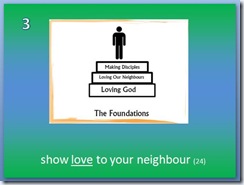
The third good habit he suggests is to show love to your neighbour. He says “Let no one seek his own good, but the good of his neighbour” (24 ). The second greatest commandment in the law is to love your neighbour as yourself. This is getting back to the foundations. A few months ago, I shared from the parable of the Good Samaritan. Like the Samaritan did, we need to intentionally plan to show love to those around us – especially those in need.

We usually have no problem finding time to seek our own good, so Paul encourages us here to intentionally find time to seek the good of those around us. This begins in the prayer closet, but must not be allowed to stay there. Otherwise, we are just like the priest and Levite in the parable.

slide6

The fourth good habit he suggests is to demonstrate thankfulness. He talks about partaking of food with thankfulness in verse 30. Some of the Corinthians were having problems eating certain foods because they were afraid the foods might have been dedicated to a pagan god. Paul encouraged them to eat whatever is set before them without worrying about it. The only time they should abstain is when someone at the table points out that the food has been dedicated to another god.

Paul’s principle is that we are free to eat anything we want, as long as doing so does not lead someone else to participate in idolatry. So, as long as it does not violate habits 1, 2, and 3, Christians are free to visit any item on the buffet. One of the reasons to be thankful is that God does not hold us to any arbitrary dietary taboos.

slide7

The fifth good habit he suggests is to lead people to Christ. Listen to verse 33 in the NLT: “I, too, try to please everyone in everything I do. I don’t just do what is best for me; I do what is best for others so that many may be saved.” Paul had many principles which guided his ministry among the Gentiles. Strategic principles were higher on Paul’s list than personal preferences. One of those strategic principles is that everything should be done with evangelism in mind.

Filipinos love basketball. OBC often used basketball games as a means to win people to Christ. A good question for all of us to ask is “What is it that I love to do, and can I use that to lead people to Christ?

slide8

Today’s text encourages us to “keep on doing everything to the glory of God.” I have to admit that before I even begin to obey this command, I am going to need to step back and evaluate what I am doing with my life. Probably lots of the things I do are habitual – and they are more me centered than God centered. I want to invite you to do the same kind of life evaluation. Get somewhere alone today and write a list of the things you do on a regular basis. Be specific. If you watch TV, list each program. If you go to a coffee shop, list it. Then think about how you can use that to help, edify, or love your neighbor, to demonstrate thankfulness to God, or to lead people to Christ. I’m not encouraging you to stop doing anything. I just want you to join me in asking “is what I am doing bringing glory to God?”

slide9

LORD, we want to ask you to help us to examine ourselves this week. Help us to take a good look at the things we regularly do. Help us to make sure that we are bringing you glory by loving others, building them up, and helping to meet their needs. Help us to do everything with thankfulness because of the freedom that we have in Christ. Help us to order our lives in such a way that leading people to you is just part of normal living for us.

In Jesus’ name. Amen.

gospel in the night sky?


zodiac I have been reading a very old book, The Star Evangel written by George Aldridge in 1904. Aldridge suggested that the constellations contained a message older than the Bible. His premise was that God revealed the gospel message to the early humans who preserved that message through the constellations. That way, the message could be preserved throughout the generations even without a written alphabet.

I have to admit, the idea is intriguing. Aldridge (and others whose research he drew upon) does a masterful job of seeing gospel truths in those old star connections.  He probably over-stretched his point on some of his conclusions, but the general impression I have is that he’s got something there.

To Aldridge, there is a reason that the star charts begin with a virgin (Virgo) who bears a seed and also a branch. The charts end with a lion (Leo) who rules. Aldridge sees Christ in the stars. He also sees significance in the ancient names of the stars.

And why not? If God has gone to all the trouble to give modern humanity his infallible word in scripture, who’s to say he could not have given a glimpse of this revelation to the ancients?

Here is Aldridge’s book in a nutshell:

Christ, the Redeemer The Seed of the Woman
Redemption
Conflict with Satan
Victory over Satan
the virgin
the scales
the scorpion
the bowman
Christ, the Life-Giver Life by Sacrificial Death
Water of Life
Life and Dominion
The Ever-Living Conqueror
the goat
the waterman
the fishes
the ram
Christ, the Rightful King The Advent in Power
Unity in Rule and Redemption
Gathering the Ransomed
The Enemy’s Overthrow
the bull
the twins
the crab
the lion

I appreciate two things that Aldridge stresses. He sees the message in the stars as emphasizing the hope of the ages as a kingdom that is to come. Amen to that.

Also, he calls on his fellow New Zealanders who have visual access to the Southern Cross to get the message, and trust in the One who died on the cross for them – and for the rest of us.

My only caution is that we are far removed from these ancients, so much of what we might see in the constellations would probably be hopeful eisegesis, rather than careful exegesis.

My … other only caution is that shared by Aldridge. He warns against those who have taken the stars and turned them into means of controlling human destiny: the field of astrology. That is a demonic corruption of what God intended the stars to do for us.

In spite of this, it would do us all no harm to contemplate whether there is a message in the night sky. As long as we keep our hope set on Christ.

____________________

If you are interested in looking further into this idea, these links are a good start. Not all of them support the idea, and please don’t assume I agree with everything the links say:

Is the gospel spelled out in the stars?

The Gospel Message—Written in the Stars?

Summary of the meanings of the Constellations from “Gospel in the Stars” by Joseph Seiss

Review of Gospel in the Stars

The Star Gospel

The Gospel Before The Bible

The Gospel In the Stars

_______________

P.S. Thanks, Ernie