BLOODY TUNIC

BLOODY TUNIC

Genesis 37:31-35 NET.

31 So they took Joseph’s tunic, killed a young goat, and dipped the tunic in the blood. 32 Then they brought the special tunic to their father and said, “We found this. Determine now whether it is your son’s tunic or not.” 33 He recognized it and exclaimed, “It is my son’s tunic! A wild animal has eaten him! Joseph has surely been torn to pieces!” 34 Then Jacob tore his clothes, put on sackcloth, and mourned for his son many days. 35 All his sons and daughters stood by him to console him, but he refused to be consoled. “No,” he said, “I will go to the grave mourning my son.” So Joseph’s father wept for him.

Penny and I had the opportunity to drive up to Virginia this past week. We got to walk in the snow and visit some people we hadn’t seen in a while. But the excuse we used for traveling was that it was Tuesday, the birthday of one of our grandchildren. Tuesday morning came, and I witnessed a wonderful sight. I had woken up and was doing my devotions at the kitchen table. Suddenly, the quietness was broken by two very small children running downstairs together. They were playing together and just enjoying each other’s company. The older sister started singing to the birthday girl. It was the happy birthday song – the same song we sing each Sunday morning when we are celebrating with one of our members. At the end of the song, the older sister tacked on, “Happy birthday, Jesus bless you.” and my heart melted.

One of the joys of being a parent is when you have the chance to see and hear your children or grandchildren enjoying each other’s company. That was a joy that Jacob had lost. He was a profoundly unhappy man, and the things that happened, as recorded in today’s text, added even more sorrow to him. I’m not going to go over all the events of the story because I’m sure you all have read today’s chapters. Instead, I am going to focus my message on one object that is introduced in the story. The bloody tunic that Jacob’s sons showed their father.

the tunic was a symbol of love

It did not start out as evidence in a crime scene. It started as a precious gift given by a proud father to his favorite son. Jacob loved Joseph because he was the firstborn of Rachel – who was always his favorite. This chapter says that “Israel loved Joseph more than all his sons because he was a son born to him late in life, and he made a special tunic for him. When Joseph’s brothers saw that their father loved him more than any of them, they hated Joseph and were not able to speak to him kindly” (vv. 3-4).

So, you see that the Patriarchs continue to produce broken, dysfunctional families. What made matters worse was that Joseph had some interesting dreams—dreams that indicated that, at some point, all his family would bow down to him. That just made the ten brothers greener and more angry at him. Meanwhile, his father just “kept in mind” what he had said. Like Mary, the mother of Jesus, Jacob pondered these things in his heart. He loved Joseph so much that he would not dare rebuke him.

The tunic was a special gift. It signified a special standing among Jacob’s children. It was like an inheritance given beforehand. It symbolized a special relationship and set Joseph apart as a special blessing who would be blessed. It was how Jacob expressed his love for his favorite son.

the tunic was a symbol of envy

I mentioned that the older brothers were envious of young Joseph. Because that special garment set him apart from them, some of their hatred was focused on that blessing. They considered it a curse. The brothers were so envious that they saw an opportunity for sweet revenge when Joseph came to Dothan. They saw him coming, and before he even reached them, they had already plotted to kill him. They said, “Come now, let’s kill him, throw him into one of the cisterns, and then say that a wild animal ate him. Then we’ll see how his dreams turn out!”

Two of the older brothers displayed a bit of constraint. Reuben, the oldest, suggested that they just throw him into a deep hole. Judah suggested that they sell him to some foreign traders who happened by. As soon as Joseph reached them, the brothers stripped him of that precious tunic and tossed him into the hole. When the foreign traders arrived, they fished him out and sold him to them for twenty silver coins. They got their revenge and some money to sweeten the deal.

the tunic was a symbol of treachery

It was a symbol of sibling rivalry to the extreme – like Cain, who waited until his brother was alone with him in the field and clobbered him to death. They cared so little for their own brother that when the opportunity presented itself – they took it. The wonderful colored tunic that had been a sign of their father’s love would now be evidence of Joseph’s supposed death by a wild animal. All it took was some goat’s blood.

No doubt these sons of Jacob had been told many times of their own father’s betrayal of his brother, Esau. He found Esau hungry and offered him a bargain – some stew for his birthright. Then he and Rachel cooked up a scheme where they would deceive his father, Isaac, by pretending to be Esau and getting his blessing as firstborn.

So, these sons of Jacob cooked up a plot of their own. They would present this tunic to their father as evidence that his favorite son was dead. How ironic that Jacob himself had used a goatskin to pass himself off as Esau. Now it would be goat’s blood that covered his precious garment.

the tunic was a symbol of deception

When the ten sons returned to their father, they came with a lie, and backed up their lie with a deception. They didn’t say it. The best lies are those you don’t say but force others to believe. They just “brought the special tunic to their father and said, “We found this. Determine now whether it is your son’s tunic or not.” Of course, Jacob had no problems identifying this sign of his love, now covered with evidence that he had met a sudden, violent death.

It was not just a lie; it was a false lie. Joseph had not died at all – though he probably often felt it would have been better if he did. At the time this incident is happening, Joseph is on the way to Egypt to be sold as a slave. He was on his way to his destiny. But his brothers had convinced Jacob that he was ended. They had their revenge against the dreamer and got rid of those pesky dreams – they thought.

the tunic was a symbol of mourning

When I was eleven years old, I had an older brother. His name was Gary.  He was 16. I remember a joyous day when Gary brought home his special prize. It was a green Honda 100 motorcycle. Gary loved that vehicle. He went everywhere with it. It was a symbol of his pride in being able to ride it and his joy that it was his very own.

But in June of that year, a terrible thing happened. I can still remember my mother getting a phone call. I don’t know who called her, but what I recall was that Mom was calm and collected on the phone. But as soon as she hung up, she called out to my Dad: “Come on, Buck, Gary’s been in a wreck.” The two of them left the house quickly, and my two sisters and I began praying and crying.

Gary died that day. Some well-meaning people took his broken and mangled motorcycle and brought it to all the nearby schools. They used it as evidence to teach young people to be extra cautious on motorcycles or don’t ride them at all. They also had his cracked helmet, with a blood smear still prominent on it. Sometime later, they brought that wrecked motorcycle back to our place and dumped it in a pile. From then on, every time we saw that pile, we grieved again.

The Bible does not say what Jacob did with that bloody tunic. It just says that “Jacob tore his clothes, put on sackcloth, and mourned for his son many days. All his sons and daughters stood by him to console him, but he refused to be consoled. “No,” he said, “I will go to the grave mourning my son.” So Joseph’s father wept for him.”

Actually, the Hebrew says something even more specific. Jacob said that he would go down (יָרַד) to Sheol (שְׁאוֹל) to his son mourning. Sheol is the state of being dead. Jacob planned to mourn himself to death and join his son in the state of death. The Bible tells us some very specific things about Sheol.

Sheol is always described as a place that is down there – a place you descend (יָרַד) to. When the biblical authors compare it to something, they always compare it to a pit or destruction. When Eric Lewis examined the 65 references to Sheol in the Old Testament, he concluded that the term specified “not the place of interment, nor a presumed locality of departed spirits, but the condition of death, the death-state.”[1]

Sheol is also described as a place of silence. When David was in threat of death, he cried out to God to deliver him because he said, “In death, there is no remembrance of you; in Sheol who will give you praise?” (Psalm 6:5). To David, there is no afterlife. There was merely silence and stillness – a waiting on God to perhaps rescue by resurrection. To the Old Testament saints, a residence in Sheol would not be considered a goal to attain. It was an inevitable consequence of their mortality – to be avoided at all costs.

Sheol is also described as a dark place where people sleep. It is a silent, dark state or condition in which everyone exists at death and can only live again by a resurrection from the LORD. It is always contrasted with heaven and never equated with it. It is not the hope of the saints; rescue from it is the hope of the saints. That is the Old Testament consensus. When Jacob said he was going to Sheol he was not anticipating a happy reunion there.

When Jacob saw that bloody tunic, he was convinced that all hope was lost. When we experience tragedy, we can start feeling that way, too. But we can learn from this story. Tragedy does not mean that everything is lost. As long as we have a God in heaven with a plan for our lives, we can trust him to carry out that plan. Jesus told us that in the world, we will have trouble. But he also told us that he has overcome the world. We can find our hope in him. He gives a hope of a life after death. It starts with a resurrection unto eternal life. That is a destiny we can cling to no matter what we face today.


[1] Eric Lewis, Christ, The First Fruits (Boston: Warren Press, 1949), 48

Here is a quote from Devotions from Exodus:

“Nuisance

The frog was also a deity in the Egyptian pantheon. Heqet was a goddess who represented fertility. To have the territory overrun by these creatures was more than an annoyance. It was another reminder to Pharaoh that his worldview was erroneous. It was an embarrassment. And even though his magicians were able to duplicate the same thing on a smaller scale (because they were illusionists) he was perturbed, so he appealed to Moses to have Yahveh stop the plague. He was starting to take Yahveh seriously. Moses even gives Pharaoh the honor of choosing the day for the pestilence to stop. But when the break came, Pharaoh still stubbornly refused to comply with Yahveh’s demand.

I wonder if we are any better than Pharaoh was. We regularly experience nuisances in our lives, and they sometimes are so bad that we appeal to Yahveh to rescue us. But do we ever stop to ask if Yahveh wants to change us? Maybe an annoying event might be his way of getting our attention. Perhaps we should not be so quick to return to business as usual when the nuisance is over.

LORD, forgive us for ignoring you when you remind us of our need to change. Help us to see the possible significance of the annoying interruptions in our lives. Keep us sensitive to your guidance” (p. 40);

The book is 296 pages long and was released on May 17, 2024.

WITH POWER AND GLORY 

WITH POWER AND GLORY 

Luke 21:27 NET.

“Then they will see the Son of Man arriving in a cloud with power and great glory.”

The prophets predict Christ’s advents.

Numerous prophets predicted many aspects of the birth and life of Jesus Christ.

  • His virgin birth was predicted in Genesis 3 and Isaiah 7.
  • He would descend from Abraham according to Genesis 12.
  • He would descend from Isaac according to Genesis 17.
  • He would descend from Jacob according to Numbers 24.
  • He would belong to the tribe of Judah (Genesis 49).
  • The timing of his coming was during the Roman Empire, according to Daniel 9.
  • The killing of the children in Bethlehem was predicted in Jeremiah 31.
  • His family’s escape to Egypt was predicted in Hosea 11.
  • God would declare him to be his Son according to Psalm 2.
  • God made him a priest of the order of Melchizedek, according to Psalm 110.
  • He would begin his ministry in Galilee, according to Isaiah 9.
  • He would be a prophet in Israel, according to Deuteronomy 18.
  • He would have a ministry of healing and deliverance, according to Isaiah 61.
  • His nation would reject him, according to Isaiah 53.
  • He would enter Jerusalem triumphantly riding on a colt (Zechariah 9).
  • He would be betrayed by a familiar friend (Psalm 41).
  • He would be sold for 30 pieces of silver (Zechariah 11).
  • He would be accused by false witnesses (Psalm 35).
  • He would remain silent at his trial (Isaiah 53).
  • He would be beaten and spat upon (Isaiah 50).
  • His suffering would not be for his sins, but for ours (Isaiah 53).
  • They would pierce his hands and feet and side (Zechariah 12).
  • Soldiers would gamble for his clothing (psalm 22).
  • He would be buried with the rich (Isaiah 53).
  • He would rise from the dead (Psalms 16 and 49).
  • He would ascend to God’s right hand ((Psalm 68).

Some of the prophecies describe both Christ’s first coming and his second coming.

  • “For a child has been born to us, a son has been given to us. He shoulders responsibility and is called a Wonderful Counselor, Mighty God, Everlasting Father, and Prince of Peace. His dominion will be vast, and he will bring immeasurable prosperity. He will rule on David’s throne and over David’s kingdom, establishing it and strengthening it by promoting justice and fairness, from this time forward and forevermore” (Isaiah 9:6-7).
  • “As for you, Bethlehem Ephrathah, seemingly insignificant among the clans of Judah — from you, a king will emerge who will rule over Israel on my behalf, one whose origins are in the distant past” (Micah 5:2).

The New Testament picks up where the Old Testament left off. Jesus himself predicted his return numerous times. We examined many of those predictions when we looked at the eschatological discourse over several weeks this year. Today’s text is part of that eschatological discourse. It is in the context of Jesus answering the specific question of his second coming. The disciples had asked what would be the sign of his coming (Matthew 24:3). Jesus said that there would be many signs in the sun and moon and stars and that the world would be in distress, anxious over the roaring of the sea and the surging waves.

People will faint from fear and from expectation of what is coming because the powers of the sky will be shaken. There will be many signs, but these will not be preliminary signs. There will be signs that it is too late. That is why the world will panic.

The angels announce Christ’s advents.

The angels appeared to the shepherds in the fields and to Joseph, Zechariah, and Mary in the birth narratives of the Gospels. They also announced his second advent. They said, “This same Jesus who has been taken up from you into heaven will come back in the same way you saw him go into heaven” (Acts 1:11).

Jesus said that when he returned, “he will send his angels with a loud trumpet blast, and they will gather his elect from the four winds, from one end of the sky to the other” Matthew 24:31. He also said that “When the Son of Man comes in his glory and all the angels with him, then he will sit on his glorious throne” (Matthew 25:31).

Whenever God does something significant, he brings his angels along. It is right for us to celebrate the miraculous birth of Christ. We should also herald the second coming because it, too, is a long-awaited event. Heaven itself looks forward to the day when the rightful heir takes back his kingdom from the one who stole it.

The stars announce Christ’s advents.

The wise men found a star in the sky and knew that it meant a new

king had been born. They followed the sign in the sky to Jesus. Signs in the sky will also announce the second coming. Jesus said that there would be many signs in the sun and moon and stars and that the world would be in distress, anxious over the roaring of the sea and the surging waves. People will be fainting from fear and from the expectation of what is coming in the world because the powers of the sky will be shaken.

Some think that it is human destiny to expand into the stars. They wonder if there is life on other planets and in other solar systems. Some think that our lives are controlled by the stars associated with the month of our births. They think that they can get wisdom by reading their horoscope every day.

The truth is there is a message that the stars have to tell us. It is an ancient message about the Son of God coming to earth. The star announced his first coming, and the stars will signify his second coming. But God’s wisdom is for those who look past the sign and pay attention to what it signifies. The wise men rejoiced when they saw the star because they knew that it meant a king had been born. They let the sign lead them to Jesus. That is what we should be doing as well.

The shepherds announce Christ’s advents.

We recently looked at the story of the shepherds again. When they learned from the angels that Jesus had been born, they left in a hurry to find him. After they met Jesus, they did not run back to their day jobs. They had to go into the villages and tell people about Jesus. We would do well to follow their example.

In fact, those of us who are shepherds of God’s flock today have it as our primary task to take care of his sheep. One of the major responsibilities we have is proclaiming the gospel to everyone. The next major prophetic event that will happen is the return of our Lord, and we must make sure that everyone is ready for that event.

The apostle Paul described himself as set apart for the gospel of God. Paul was capable of many things—things he could do—but he must do only one thing: get the good news out.

Jesus said that when he returns to this planet, its inhabitants will see him arriving in a cloud with power and great glory.” That will be the moment when the unbelieving world will be forced to admit that they have rejected the only truth that ultimately matters. They will see him. They will know for real that he exists. They will come face to face with the king of the universe and recognize that no matter what nation they live in, he is their king. But they will know that they have rejected their king. There will be weeping and gnashing of teeth. They will know that God had a wonderful plan for their lives, but they rejected that plan. They told God that they would not have his Son rule over them.

When he comes, it will be in a cloud. The angels’ prophecy will be fulfilled. Just as Jesus disappeared into the clouds when he ascended, he will return in the same way that he left. And everyone will see him – even those who pierced his hands, feet, and side at his crucifixion. Many live their entire lives today, actively ignoring Jesus Christ. On that day, no one will have the privilege of ignoring him. They will be calling for the mountains to fall on them to hide them from his presence. But there will be no hiding from him ever again. Adam and Eve tried to hide from God in the Garden of Eden. But when he came, they could not hide. When our Lord comes again, everyone will stand before him. He will decide their fate and reveal their destiny. Some will experience the destiny of permanent death in the lake of fire – the second death. Others will be welcomed into eternal life in his forever kingdom.

He came at first as a humble child lying in a borrowed manger. When he comes again, it will be with power and great glory. Those who welcome him into their lives today will share in that power and glory. No matter what lowly standards we live by today, every believer has a glorious inheritance bought and payed for by the blood of Christ. The Bible says that Jesus had to suffer many things before he returned to glory. We will also suffer many things in this life. But we will share in the glory of his return. On that day, and forever afterward, we will forget all our suffering because of the joy of the new life we will have. Our king will come and take his glorious throne. That day will be a glorious day for him and us.

As we celebrate the first Advent of Christ, we can also focus on the second Advent. His coming into power and great glory is a gift we can all anticipate. It won’t be under the tree this Christmas, but hopefully, it will come soon. Hopefully, we will all be ready.

GLORY TO ISRAEL 

GLORY TO ISRAEL 

Luke 2:32 NET.

“a light, for revelation to the Gentiles, and for glory to your people Israel.”

When Mary and Joseph took the baby Jesus to the temple in Jerusalem to dedicate him, they encountered two prophets: a man named Simeon and a woman named Anna. Today we are going to focus on the prophetic statement that Simeon made that day. Simeon is described in this chapter as “righteous and devout.” Those two words say a lot. They speak of Simeon’s outward character and his inward loyalty to God. He was a man who did the right thing toward others and also stayed faithful to God and cultivated a close relationship with God. We would all do well to focus on those two things.

This chapter also says that Simeon had an expectation – a hope. It says that he was “looking for the restoration of Israel.” It did not elaborate on that statement, so we don’t know in what sense Simeon expected Israel to be restored. We know from history (including the history in the Gospels themselves) that Israel was a nation in captivity. Rome ruled an empire that expanded to include the known world at that time. All of Israel was engulfed in that empire. Caesar ruled over the whole empire and all the rulers of the various regions had their rulers who were subservient to Rome. When Joseph and Mary traveled from Nazareth to Bethlehem, they moved from one region to the next. Nazareth was part of the Roman Provence of Galilee. Bethlehem and Jerusalem were parts of the Roman Provence of Judea. Israel wanted to be free from Rome’s power. They had gained their freedom from Greece for a time under the Maccabees. But that freedom was short-lived. Perhaps Simeon was praying for and hoping for his nation to be restored to independence.

But since Simeon was a devout prophet of God, he hoped for more than that. His aspirations for his homeland were more than political. He wanted a spiritual restoration for Israel. Like the Old Testament prophets, Simeon longed for a day when his nation would truly be the people of God and foremost in proclaiming and living the word of God. Simeon was not just a player in the drama of the temple. He was tuned in to the power that the temple represented: the presence of God among human beings. This chapter says that the Holy Spirit was upon him. That was the best that any believer could expect before Pentecost. The Holy Spirit of God used him to declare the word of God to the people of God.

The Holy Spirit had also given a particular message to Simeon about his own life and ministry. He had told Simeon that he would not die until he saw with his own eyes the Anointed Messiah of Israel: the Christ. Simeon had a calling to a particular ministry. That calling would continue until he fulfilled it. He would know when his ministry was complete by the sign that one day when he entered the temple, the Messiah would be there. Perhaps Simeon imagined a triumphant Messiah coming into the temple to take over and lead his people to glory. We don’t know.

We only know that Simeon was watching for the moment when he would see his savior face to face. That moment arrived, and Simeon did not miss it. Joseph and Mary came into the temple with a little bundle of joy. Jesus was 40 days old. Because Jesus was the firstborn male of Joseph and Mary’s family, he was to be formally presented to the Lord and redeemed according to this law. The ritual celebrated God’s deliverance of all the firstborn males from the destroying angel in Egypt. When the destroying angel saw the blood of the lamb on the doorposts of the Hebrew slaves, he did not enter those houses and take the lives of the firstborn males within them. The ritual celebrated that deliverance.

What Mary and Joseph did that day was to redeem the Redeemer ritually. They paid the price for their son, who would one day pay the price for everyone’s sons and daughters. The angels in heaven were watching.

Simeon was watching too. The moment he saw that child, Simeon knew that his life’s work had been completed. This chapter says that “Simeon, directed by the Spirit, came into the temple courts, and when the parents brought in the child Jesus to do for him what was customary according to the law, Simeon took him in his arms and blessed God, saying, “Now, according to your word, Sovereign Lord, permit your servant to depart in peace. For my eyes have seen your salvation that you have prepared in the presence of all peoples.” It is in that context that we read the verse that is today’s text.

Simeon said that Jesus is a light shining from heaven to earth.

When all creation was in darkness, seen only by the creator, he said four words (actually two words in Hebrew): “Let there be light.” From that time on, God has been the one to bring light to the darkness.

One of the plagues in Egypt was a plague of darkness. Exodus 10 says, “The LORD said to Moses, “Extend your hand toward heaven so that there may be darkness over the land of Egypt, a darkness so thick it can be felt.” So Moses extended his hand toward heaven, and there was absolute darkness throughout the land of Egypt for three days. No one could see another person, and no one could rise from his place for three days. But the Israelites had light in the places where they lived.”

The theme of God bringing light to his people amid the darkness of unbelief runs throughout the Old Testament. When the Israelites traveled by night in the wilderness, God provided a fiery light to direct them all night long. Psalm 78:14 says, “He led them with a cloud by day, and with the light of a fire all night long.” Psalm 97:11 says. “The godly bask in the light.” Psalm 112:4 says, “In the darkness, a light shines for the godly, for each one who is merciful, compassionate, and just.”

Isaiah prophesied that the Messiah would come and appear first in a particular region. He said, “The gloom will be dispelled for those who were anxious. In earlier times, he humiliated the land of Zebulun and the land of Naphtali, but now he brings honor to the way of the sea, the region beyond the Jordan, and Galilee of the nations. The people walking in darkness see a bright light; the light shines on those who live in a land of deep darkness” (Isaiah 9:1-2).

Did you catch that? Isaiah predicted the exact region where the Messiah would begin his earthly ministry. It would be in the land where the tribes of Zebulun and Naphtali were apportioned property. It would be the land that the Gentiles called Galilee. 700 years later, who shows up in the tiny village of Nazareth in Galilee? A carpenter’s son named Jesus. Simeon said that Jesus would be a light shining from heaven to earth. It would first start shining in Galilee.

Simeon also said that Jesus revealed God’s will to the Gentiles.

The prophet Simeon predicted that Jesus would have a ministry among the Gentiles. That, itself, was not unheard of. Many of Israel’s great heroes had a profound influence on the Gentiles and Gentile rulers. But Simeon predicted that God would reveal himself to the Gentiles through Jesus. You and I are in this place right now, declaring our love for God because Jesus did just that. He was the door for the sheep allowing sheep from other pastures into the fold. As Gentiles, we did not have a way to the Father. But Jesus came and proclaimed that he is the Way, the Truth, and the Life and that everyone and anyone can come to the Father through him.

Jesus revealed God’s love to the Gentiles. He said, “For this is the way God loved the world: He gave his one and only Son so that everyone who believes in him will not perish but have eternal life. For God did not send his Son into the world to condemn the world, but that the world should be saved through him” (John 3:16-17). The Old Testament revealed that God loved Israel and rescued it from Egypt. Jesus revealed to the Gentiles that God loved us too. He loved us and provided for our rescue by sending his Son – not just to Israel, but to the planet, and anyone – Jew or Gentile – who believes in Jesus will not have to perish in hell but can be rescued and have eternal life.

Jesus revealed God’s truth to the Gentiles. He spoke that truth to anyone who had ears to hear – whether those ears were Jewish or Gentile – it didn’t matter. He commissioned his apostles to launch their mission work starting from Jerusalem, but to expand into all of Judea, then into Samaria, and to keep going until they reach the farthest parts of the earth (Acts 1:8). The gospel message was to go to all the nations. The word “nations” in Matthew 28 is the same word in today’s text that is translated as “Gentiles.” You and I are in Christ because Jesus’ message and ministry were designed to reach us. It was not a cosmic accident. Jesus was never meant to be the exclusive property of one ethnic group. He is King of all kings and Lord of all lords. We are to send the proclamation over vale and hill that whosoever will may come to Jesus.

But Simeon also said that Jesus brought eternal glory to Israel.

In light of what we know about the universal nature of Christ’s gospel message and the universal scope of his deliverance, what did Simeon mean when he said that Jesus was for glory to Israel?

Paul addresses this question in his epistle to the Romans. He makes it quite clear that everyone is a sinner and needs salvation, and everyone can get saved only by repenting of their sins and putting their faith in Christ. So, salvation is not a particular gift to Jews. It is for everyone. So, Paul asks what advantage does the Jew have. Being a Jew himself, Paul could answer his question. He said that the Jews were entrusted with the oracles of God (Romans 3:2). Before it was our Old Testament, it was their Hebrew Bible. It’s possible to become a Christian without the Old Testament, but those 39 books explain much of what appears in the latter 27 books.

Jesus himself said that “salvation is from the Jews” (John 4:22). The gospel message was first proclaimed in that cultural context, which makes the Jew more likely to understand its basic principles, provided those ideas are believed. Of course, many Jews rejected the gospel, and they are not going to be saved. God does not have two kingdoms. He is not going to save anyone just because of their ethnic heritage. He responds to one thing: faith in his Son.

So, why did Simeon say that Jesus would bring glory to Israel? Remember, when we defined the word glory, we noted that its opposite is shame. Jesus brought glory to Israel because theirs was the nation and culture into which God sent his Son. If he was to be born a man, he had to be born into a nation and live with a particular culture. Israel has the distinction of being the nation to which God sent his prophets. God sent salvation to the Jewish patriarchs. He sent his precious promises through the Old Testament authors by his Holy Spirit. “When the appropriate time had come, God sent out his Son, born of a woman, born under the (Jewish) law, to redeem those who were under the law, so that we may be adopted as sons with full rights” (Galatians 4:4-5).

God took this shameful culture, steeped in sin, and sent us his only begotten Son through them. His human ancestry was Jewish. God’s eternal kingdom is laid upon the foundations of the New Testament apostles (who were all Jewish) and the Old Testament prophets (who were all Jewish). Even though many things were shameful and wrong about Israel, God, in his grace, chose to glorify that nation by sending us our Redeemer from that nation. They had been longing for a Messiah who would come and ransom captive Israel. He came, and because God is not a respecter of persons, he offered redemption not just for Israel but for all nations.

So, Simeon was right on both counts. The baby boy that he blessed that day would grow up to be a revelation from God to the Gentiles and bring glory to Israel. All across this planet today, people from all nations and ethnic backgrounds are worshipping him and praying in his name. But there is a land which we call the holy land. It is a unique land because God sent us a savior and he walked and lived and preached and died and rose again in that land.

LORD GOD, thank you for your Son, Jesus Christ. Thank you for that nation through whom you have given us this great gift. Thank you that anyone can receive this gift, regardless of our ancestry. He is our gift from your grace. Amen.

Jeff’s Books available through Amazon!

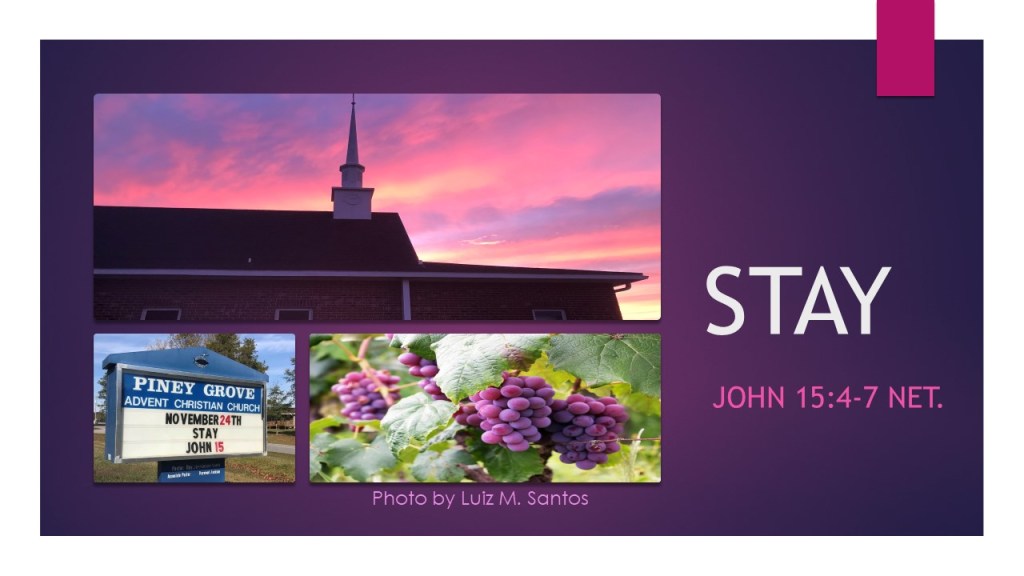
STAY 

STAY 

John 15:4-7 NET.

4 Remain in me, and I will remain in you. Just as the branch cannot bear fruit by itself, unless it remains in the vine, so neither can you unless you remain in me. 5 “I am the vine; you are the branches. The one who remains in me — and I in him — bears much fruit, because apart from me you can accomplish nothing. 6 If anyone does not remain in me, he is thrown out like a branch, and dries up; and such branches are gathered up and thrown into the fire, and are burned up. 7 If you remain in me and my words remain in you, ask whatever you want, and it will be done for you.

Back in February, I was preaching from Matthew 20, where Jesus described the work of the kingdom by comparing it to work in a vineyard. He told a parable about a vineyard owner who hired a bunch of people to work in his vineyard. The vineyard owner paid all the workers the same regardless of how many hours they worked in the harvest. That parable was actually a description of God’s grace. It taught that all of us who sign up for God’s coming kingdom will be blessed with that kingdom when it comes, and the eternal life we get will all be the same, no matter how much kingdom work we do. That’s because salvation is by grace. It is not brought about by our work – even our kingdom work. It is all bought at the same price, and Jesus paid that price on Calvary’s cross.

Today’s message is by the same Jesus, and it also mentions a vineyard. But in John 15, he is not talking about kingdom work. In this parable, Jesus is not the vineyard owner – he’s the vine. And we are not the workers in the vineyard. We are the branches of the vine.

Jesus’ parable of the workers in the vineyard was intended to remind all believers that God initiates our salvation, and he blesses us with the promise of eternal life not because of the quantity of our work for him but because of the quality of his grace toward us. It is helpful for us to know this because even on our best days, we are not going to accomplish anything by ourselves that would warrant any unique standing with God. Salvation by grace tells us that whatever God accomplishes through us or however much we are blessed, it is all because of his grace and his sola gratia – his grace alone.

Today’s parable puts the accent on the other side of the coin. It reminds us that even though we are all saved by grace, and we supply nothing to add to it, God still requires that we persevere in our faith. It is not totally passive – as if a person could be saved without ever knowing it.

Jesus says that his Father is the gardener and He is the vine. He says that the gardener will attend to every branch in him that does not bear fruit and take away all the branches that do not bear fruit. Even the branches that are bearing fruit will undergo pruning so that they can become even more fruitful.

Again, salvation is not described as passive. God himself is involved in the lives of every believer and works out the details of their lives so that they are fruitful. So, even though Jesus is telling us that he expects us to stay committed to him, he is not suggesting that our commitment is the only thing that matters for our salvation.

Before he tells us to stay in him, he tells us that his Father is already working in the background of our lives to produce that commitment. This gives Christians a whole new approach to the problem of suffering. We see every instance of suffering in our lives, not just as the work of the devil. We see the Father’s hand—the gardener’s hand—at work, building commitment and fruitfulness by means of suffering.

That is the background to today’s text. Now, let’s look at what the text tells us.

The text tells us where we should stay (4-5).

Jesus commands us to remain in him and promises that if we do, he will remain in us. He said that he is the vine, and we are the branches. The only thing he requires of his branches is that we do not jump off his vine and jump onto some other vine. It is a ridiculous thing to ask, in a sense. Have you ever noticed any grapes jumping off their vine and jumping on another vine?

Jesus was well aware of how unnatural that sounded. I imagine one or two of the disciples who heard Jesus say these words might have giggled at the notion. But they might also have remembered that low point in Jesus’ ministry when the crowds stopped coming, and even some of those who had been following him earlier decided to stop.

Jesus had been teaching using another illustration. He was teaching in a synagogue at Capernaum and said that unless people eat his flesh and drink his blood, they will not have eternal life and be raised on the last day. After that, “many of his disciples quit following him and did not accompany him any longer” (John 6:66). So, Jesus asked his disciples if they wanted to desert him too. That is when Peter said, “Lord, to whom would we go? You have the words of eternal life. We have come to believe and to know that you are the Holy One of God!” (John 6:68-69).

What was happening? It was a separation of the sheep from the goats. It was a church split that revealed the authentic believers and the inauthentic wannabe Christians. To use the wording of today’s text, some of the branches stopped staying in the vine.

I know that there is a considerable theological debate about whether a person can lose their salvation. This text does not actually speak to that issue. The parable that Jesus uses does not suggest that true believers can jump off the vine. Instead, it indicates that many who claim to be true believers or who want to be true believers will not stay with Jesus. They will depart. They will apostatize. They will not remain in the vine. They will jump off. As ridiculous as that picture is, it does describe what happens when people discover the cost of following Jesus and decide that they are not willing to pay the price.

True believers will never make that choice. But it is not always possible to see who is the true believer and who is the imposter. Judas did everything that the other apostles did. The eleven were shocked to find that he was the betrayer. If the parables in Matthew 25 inform us regarding this issue, they teach us to be diligent to be found faithful and not to assume that we are the elect and, therefore, not in danger of defection. Today’s passage teaches the same thing. Jesus had just told the eleven that they were clean already because of the word that he had spoken to them. But he didn’t follow that up with: “Relax, you are safe.” No, the very following words he said were, “Remain in me, and I will remain in you.” He did not want his disciples to hide behind the doctrine of election; He wanted them to stay committed to him and to remain diligent in doing his work.

I should also point out that this word translated “remain” or “stay” is the Greek verb μένω. It is directly related to the noun Jesus had just used in John 14:2. He said that in his Father’s house there are many dwelling places. That word is μονή. So, when Jesus commands us to stay, he is pointing back to that promise. He’s saying that we not only have a future in God’s presence when he returns, but we can stay in that presence now. We do that by staying faithful to Christ and staying in Christ.

The text answers the question, ‘What if we don’t stay?’ (5, 6).

There are two outcomes that Jesus highlights in today’s text. There is the present-day outcome and the ultimate outcome. The present-day outcome for those who decide to jump off the vine is that they will “accomplish nothing.” Someone who claims to be a Christian but does not stay in Christ will not bear any fruit for Christ. They might stay in church, but they are outside of Christ. As a result, their lives will be unfruitful for Christ’s kingdom.

They might look like they are working toward a harvest, but at the end of the day, they will have no produce to show for their work. In Jesus’ day, the nation of Israel had whole groups of committed workers who were not really in the vine. The Scribes, Pharisees, and Sadducees were such. They had the appearance of being committed to God but Jesus called them out for their hypocrisy. He said they were like whitewashed tombs. Outwardly, they looked clean and tidy, but inside them were dead people’s bones.

Jesus pictured the ultimate outcome of such lives by describing them as branches that fall off the vine, are gathered up and thrown into the fire, and are burned up. What Jesus is describing is Gehenna hell. Jesus had said that we should not fear human beings, but we should fear God because he “is able to destroy both soul and body in hell” (Matthew 10:28). Here, Jesus is saying that those branches that do not stay in him will be gathered all together in one place at one time. The place is hell, and the time is judgment day. When Jesus throws those branches into hell, they will NOT burn forever and ever. They will be destroyed. According to today’s text, they will be burned up.

The prophet Malachi predicted the same thing. He said, “The day is coming, burning like a furnace, and all the arrogant evildoers will be chaff. The coming day will burn them up,” says the LORD who rules over all. “It will not leave even a root or branch” (Malachi 4:1). Imagine that. Malachi even used the same word that Jesus did in today’s text. Rebellious branches will not be given the privilege of eternal life – even in hell. They will be burned up, obliterated, annihilated. That is the ultimate result of not staying in the vine.

The text also answers the question, ‘What if we do stay?’ (4, 5, 7).

Jesus was not aiming at scaring the disciples with the parable. He used the parable of the vine and the branches to encourage them. He told them that choosing to stay in the vine – that is, remain in Christ – will result in the ability to bear fruit. After all, that is what the vine is for, and that is what the branches are for. A branch that does not bear fruit is pruned because it is not accomplishing the task it was created for. If we do stay in Christ, we can expect a fruitful life and fruitful ministry.

In fact, Jesus promises in verse 5 that if we stay in him we will not only bear some fruit, but we will bear much fruit. Apart from him, we can do nothing, but in him, we can do anything. We should all be looking at our lives and expecting Jesus to use us to bear much fruit for his kingdom. We should be praying for more than “Lord, get me safe into the coming kingdom.” We should be praying, Lord, make good on your promise to make my life bear much fruit for you today.

If we get into that mindset where we expect to bear much fruit for the Lord now, we will have no problem fulfilling the other promise that is in today’s text. In verse 7, Jesus says, “If you remain in me and my words remain in you, ask whatever you want, and it will be done for you.” This is an actual promise from Jesus. Some people think that the promise no longer applies because they don’t see any evidence that Jesus is answering their prayers. So, they come up with a doctrine that the gifts and miracles have ceased.

I want to challenge you on this issue because I am not such a person, and I do not believe the Bible teaches that the gifts and miracles have ceased. Instead, if we look at the context of Jesus’ promise here, we will find out why there seem to be so few examples of answered prayer. The context is that of remaining in Christ and having a fruitful life and ministry for him. The two conditions of the promise are these: “if you remain in me” and “if my words remain in you.”

The condition “if you remain in me” speaks of maintaining an authentic relationship with Christ. The condition “if my words remain in you” speaks of learning and living by the commands of Christ and trusting in the promises of Christ. We all have a long way to go before we can claim that we have met those conditions. But, again, Jesus is not asking us to despair. He wants us to aim at fulfilling those conditions because he wants to create an army of faithful Christians who are well-known for answered prayers.

John Wesley commented on this verse, “Prayers themselves are a fruit of faith, and they produce more fruit.” The devil knows that there is one sure way to prevent us from bearing fruit as Christians. He can keep us from being productive if he can convince us to stop praying. Praying is not an additional condition that Jesus adds to the ones Jesus already pointed out. Those are having a relationship with Christ, learning and living by the commands of Christ, and trusting in the promises of Christ. So, when Jesus says, “Ask whatever you want, and it will be done for you,” he is telling us to pray because we are in him, and his word is in us. Prayer is not a third condition. It is a natural outflow of meeting the two conditions.

That means that anytime we get into our prayer closets and are determined to spend some quality time praying, we can pray with confidence. There are only two conditions that Jesus lists for fruitful prayer. Perfection is not one of those conditions. His grace covers our inadequacies and faults. His love overlooks our obvious failures and imperfections. We need only concern ourselves with two questions: do we have a relationship with Christ by faith, and do we know and trust his word? If we can answer “yes” to those two conditions, then we can pray with confidence.

Now, I know what happens when I pray and I don’t see an immediate answer. I begin to doubt my ability to pray productively. That doubt is the devil’s work. Jesus did not add any further conditions to his promise. So, what will happen if I give in to that doubt and stop praying? Remember what the command is. Jesus said, “Remain in me.” We honor him when we keep praying and keep staying. We show our trust in his promises by persevering through the dry times and waiting for him to produce the water from the rock. Our Lord wants people who dare to persevere.

HEAVENLY FATHER, thank you for the gift of Jesus Christ. Thank you for his sacrifice on Calvary’s cross that made it possible for us to be saved by grace. Thank you for the privilege of being in Christ by faith. Oh, Lord, we want to stay in him. Protect us from the temptation to defect from him, to stop trusting in his finished work, or to doubt his sure promises. We thank you that he is the way to your eternal presence. We ask you for the strength we need to stay in him as we wait for the fulfillment of all his promises. In Jesus’ name, Amen.

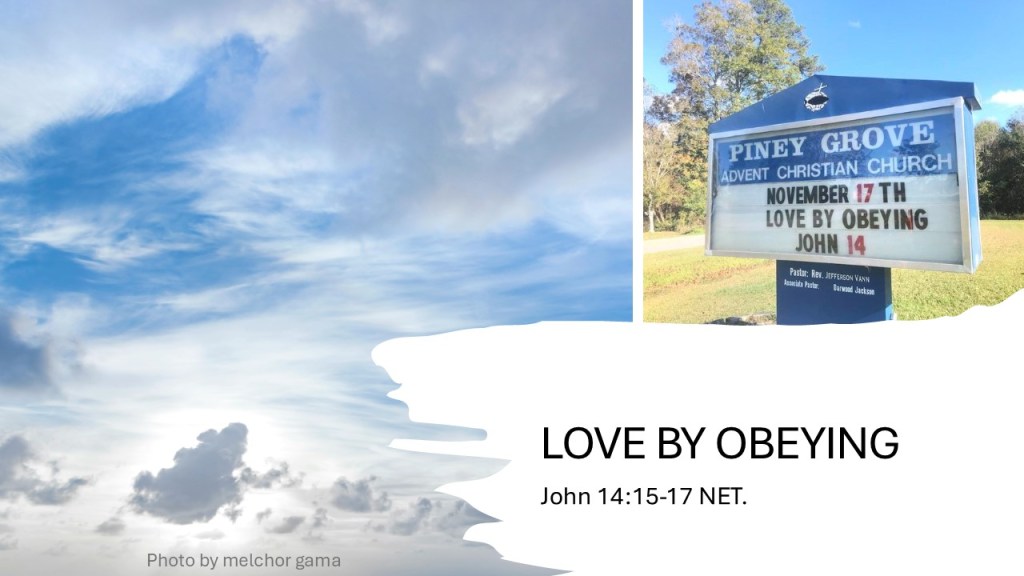
LOVE BY OBEYING  

LOVE BY OBEYING  

John 14:15-17 NET.

15 “If you love me, you will obey my commandments. 16 Then I will ask the Father, and he will give you another Advocate to be with you forever — 17 the Spirit of truth, whom the world cannot accept, because it does not see him or know him. But you know him, because he resides with you and will be in you.

I imagine that if you stopped everyone in this county and asked them if they love Jesus, the vast majority would say yes. We live in a world that apparently loves Jesus – billions of us. But how do you know if a person’s love of Jesus is genuine or not? That is where today’s text can help. It says that people who genuinely love Jesus are going to demonstrate that love. What’s more, it says that the way they will demonstrate their love for Jesus is concrete and easy to recognize. It says that genuine lovers of Jesus obey his commandments.

We have been studying the commands of Jesus here at Piney Grove for three years now. We isolated each command and examined it in its context to discover its full meaning and how it can be applied to our lives today. But that is the easy part. Jesus didn’t say “If you love me, you will learn my commandments. No, the way we truly demonstrate love for our Lord is to obey them. The Greek word is τηρέω, which means to keep. You keep a commandment by doing what it says to do or not doing what it prohibits. A commandment is a special message from God. But we can only keep commandments when we take that message and let it alter our lives. That is what it means to keep it. Once you encounter the commandment, if you had been breaking it, you repent of that rebellion, and you own it. From that time on, you are changed by that act of repentance.

We learned that Jesus gave many commands, and we have had to meet him at the altar regularly and deal with each one. The more we allowed the command to challenge us and change our behavior, the more like Jesus we became. The more like Jesus we became, the more love for Jesus grew inside us. We have discovered a more profound commitment to Jesus and a stronger appreciation for him with each trip to the altar. What Jesus wants is for us to learn the habit of letting him change us each time we encounter a command from him. We learn to love Jesus by obeying him and our love for him grows as we allow him to keep reviving us with his commands in God’s word.

In today’s text, Jesus identifies three ways that we can know if this process is really going on in our lives. We all want to be the real thing, not just people who appear to be obedient Christians. We want to be actually obedient Christians.

First, only obedient Christians truly love Jesus (15).

Jesus said that if we love him, we will obey his commandments. He did not say that if we put our names on a church membership list, he would accept that as a substitute. He didn’t say that if we had family members who were obedient Christians, we could be accepted on the basis of their obedience.

Love is loyalty. Lots of people admire Jesus and approve of his words. But that does not mean they love him. Jesus himself gave the evidence that would indicate if a person truly loves him. True love is a commitment. Since Jesus is a king, the kind of love he requires is the love of a loyal subject. Our generation has problems with that kind of love. They want a Jesus they can like, but not a Jesus whom they have to obey. They want the other Jesus. They want a Jesus who will accept them on their terms. They want to do what they want and get Jesus thrown in as a minor side-project.

The world wants Jesus without all those costly commandments. They want a baby in a manger, but not a prophet pronouncing tragedy coming upon the rebellious. They want a good shepherd as long as the shepherd does not mind them straying off on their own and getting into trouble when they want to. The only problem is that a good shepherd will not allow his flock to stray. He disciplines the unruly. The world doesn’t want a Jesus like that.

But those who genuinely love Jesus invite him to take control of their lives. They realize their need for him and are willing to do anything he asks them to do because they know obeying him is the only way they will ever know true freedom.

The world does not mind the idea of a Jesus who accepts them just as they are. They do mind a Jesus who insists on bringing them back into a relationship with his Father. That would involve change. They don’t want a Jesus who wants to change them.

Only obedient Christians can truly love Jesus because they are the only ones who want to be saved. Salvation is not possible without repentance, and repentance does not happen without change.

Second, only obedient Christians can accept the Advocate (16,17a).

Jesus used the word Advocate for the gift of the Holy Spirit here. The actual Greek word in verse 16 is παράκλητος. This word is variously translated in different versions as Helper, Advocate, Comforter, and Counselor. It speaks of a person who is called alongside another person to assist them.

The best way to understand how Jesus uses that title for the Holy Spirit is to keep in mind that Jesus intended the Holy Spirit to do what Jesus did while he was here on earth. He had a ministry of discipling and he gave us his Holy Spirit to continue that process after he ascended to heaven.

Jesus said that he was going to ask the Father to give us the Holy Spirit. We know from the Book of Acts that he followed up on that promise. The Holy Spirit descended visibly upon the obedient Christians in Jerusalem at Pentecost. Ever since then, the Holy Spirit has been available for all true Christians to help us grow in our faith and to empower us to disciple others. That is an amazing gift, and the fact that people still keep coming to Christ after all these centuries is evidence that He has not lost his power.

Now, Jesus said in verse 17 that the world cannot accept this gift. He is earmarked for only truly obedient Christians. It does not matter how much an unbeliever might want the Holy Spirit; they cannot have Him. The seven sons of Sceva in the book of Acts wished to use the Holy Spirit’s power, so they tried to invoke the names of Jesus and Paul to access that power. The demons replied, “I know about Jesus, and I am acquainted with Paul, but who are you?” (Acts 19:15). A man named Simon approached Peter and tried to purchase the Holy Spirit with money. But Peter said “May your silver perish with you, because you thought you could acquire God’s gift with money! (Acts 8:20). There is only one way to accept the Gifty of the Holy Spirit. It is given to repentant, obedient Christians.

Finally, only obedient Christians can possess the Advocate (17b).

Jesus went on in today’s text to explain just how his apostles were going to receive this Advocate. He said that He already resides with them and will be in them. The Holy Spirit was not absent from the world before Pentecost. But He came to work his power alongside[1] those whom he decided to bless. After Pentecost, the Holy Spirit was still capable of showing God’s power alongside others. But he could also work through obedient Christians because at Pentecost he came inside.[2] them.

Thus, the Holy Spirit has two ongoing missions. He is the Advocate for every believer, assisting them in learning and putting into practice Christ’s commands. He is also the empowerment that enables every believer to proclaim the gospel to the nations.

He is available to you and me. If we need more wisdom to walk according to the commands of our King, the Advocate is there for us. If we need the power to fulfill the great commission, the Holy Spirit is in us. Jesus told the watching faithful that they would receive power when the Holy Spirit came upon them, and they would be his witnesses in Jerusalem, and in all Judea and Samaria, and to the farthest parts of the earth (Acts 1:8). That same Holy Spirit is provided for us, to accomplish the same mission. He is also available to help us obey our King.

LORD, we acknowledge what the Scripture teaches. The Holy Spirit is within us. Empower us through your Holy Spirit to be obedient to our Master and, by so doing, to show that we love him.


[1] Greek παρά.

[2] Greek ἐν.