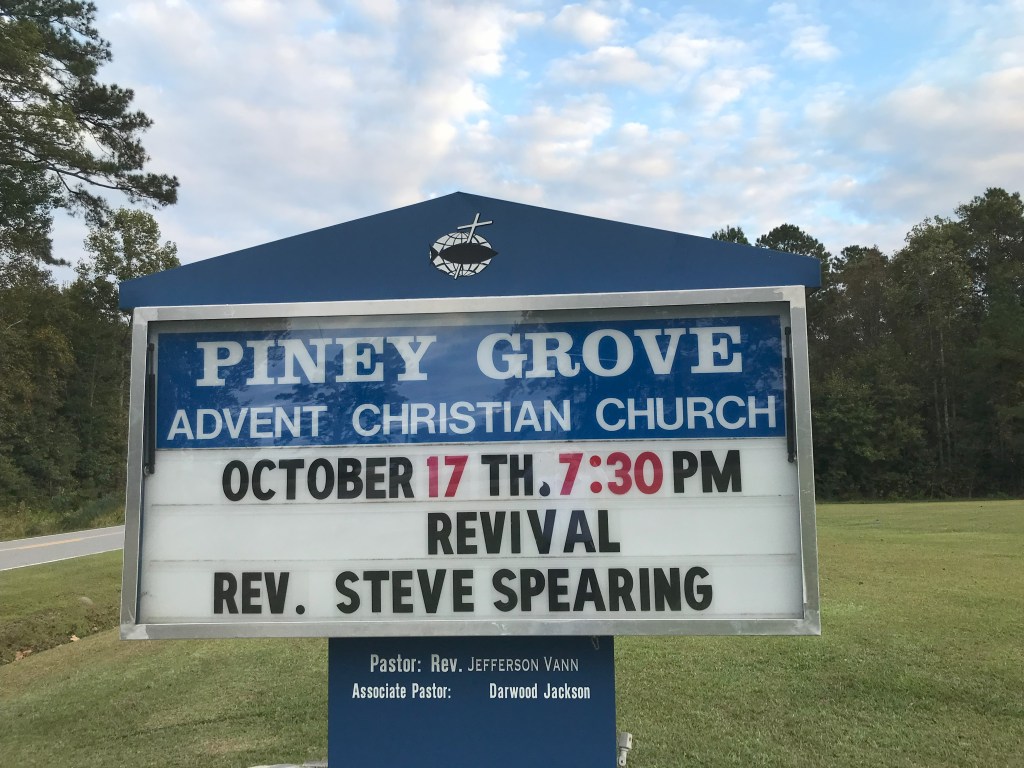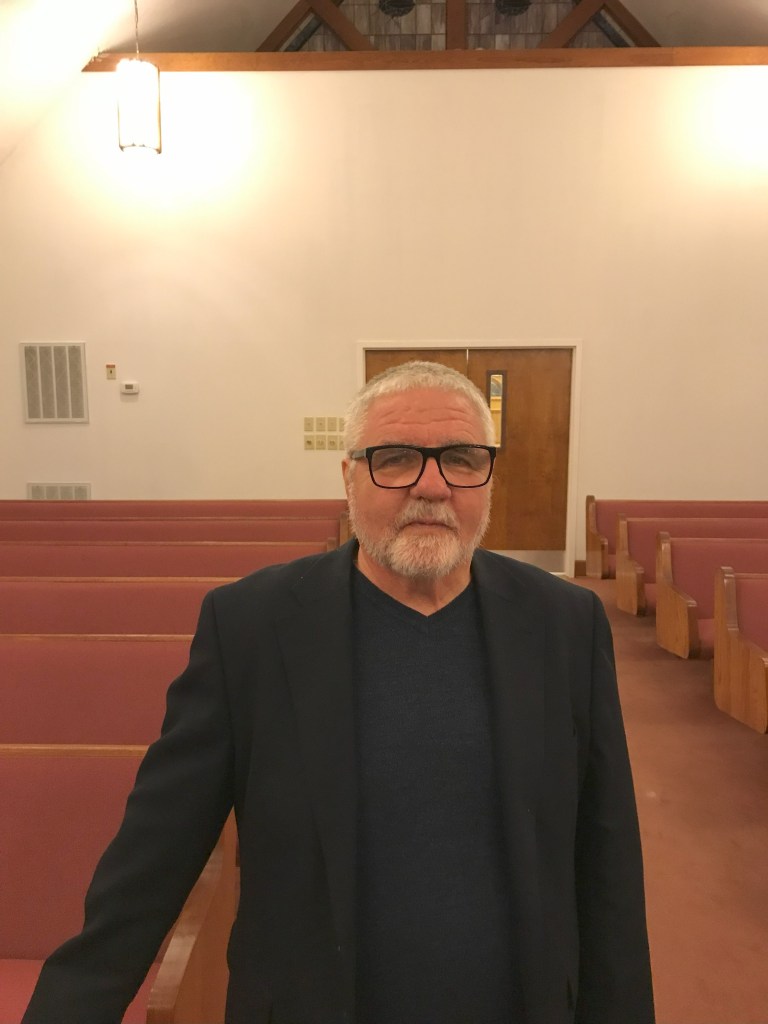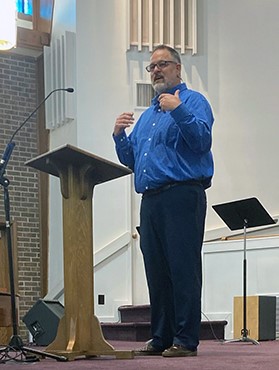
Rev. Tom McMahon was the guest speaker at Piney Grove Advent Christian Church for our Homecoming service, on October 15th, 2023.


STAY READY
Luke 12:35-48 NET.
Penny and I have spent a lot of our time in our decades of ministry teaching others how to teach the Bible. For me, I always begin with four questions. First, “What is the Background of this text that I need to know in order to understand it?” Second, “What special words appear in the text that I need to understand?” Third. “What is the theological focus of the text?” Finally, “How should I apply this text?”
Today’s text is a continuation of the discourse Jesus is having with his apostles as the crowds of Judea look on. That answers one of the background questions. The speaker is Jesus, and his primary target is his apostles. But some of what he says will also be relevant for the larger crowd of disciples and potential apostles who are looking on.
But the background involves more than that question. It also consists of the culture that the speaker shares with the listeners. For example, when I say the words “Dale’s Store” everyone at Piney Grove knows what I am referring to. I don’t have to explain the history and background of Dale’s Store to you, because you all know it.
The people who were listening to Jesus on the day in which he spoke the words of today’s text knew some things in their cultural background that helped them understand what Jesus was talking about. We might be able to understand the gist of what Jesus is talking about by just reading the text as it is. But we will understand it much better and see its relevance if we also know what his audience did.
For that reason, I want to explain a cultural phenomenon that the Jews in the first century called the Shoshabin. The Greeks in the first century called it the paranymph. It had to do with weddings. After the wedding ceremony, the groom and the bride would enjoy a long wedding party that would last for several days. At some point during the party, the groom would tell his special friend – his Shoshabin – to take his bride to his house, so that she could get ready for their honeymoon. The Shoshabin was often a brother or other relative of the groom – someone he intrinsically trusted. Sometimes it was his chief steward – the slave that he trusted to manage his household. The Shoshabin would then organize all the other slaves in the household to stand watch and stay ready for their master to return from the party.
The Shoshabin also had another responsibility. It was not unheard of for some unscrupulous character looking for a wife to break into a house where a bride awaits her new groom and to steal the bride for himself. The Shoshabin was primarily responsible for protecting the bride from this thief.
My point in telling you this set of facts about the first-century culture is that it provides the background we need to hear the words of Jesus as someone living in that time and place would have heard them. It is easier for us to get what Jesus is commanding if we know about the Shoshabin and his role.
With that in mind, let us now listen to Jesus’ words from today’s text.
We should stay ready because we don’t know when the Lord will come (35-40)
35 “Get dressed for service and keep your lamps burning; 36 be like people waiting for their master to come back from the wedding celebration, so that when he comes and knocks they can immediately open the door for him. 37 Blessed are those slaves whom their master finds alert when he returns! I tell you the truth, he will dress himself to serve, have them take their place at the table, and will come and wait on them! 38 Even if he comes in the second or third watch of the night and finds them alert, blessed are those slaves! 39 But understand this: If the owner of the house had known at what hour the thief was coming, he would not have let his house be broken into. 40 You also must be ready, because the Son of Man will come at an hour when you do not expect him.”
The first command from Jesus we hear is the command to get dressed for service. Does he mean that we should get dressed for the worship service? It used to be common for those going to church to dress in their finest suits and most expensive dresses. Is that what Jesus is talking about/ Hardly. In fact, to be dressed for service means to be dressed appropriately to serve the master when he returns from the wedding celebration.
When I go out into the garden in the morning, I dress for gardening. I wear clothes that I can work in. I wear shoes that I don’t mind getting muddy and clothes that protect me from mosquitoes. I wear a hat to protect my head from the sun. I wear a bandana to catch the sweat. I don’t wear gloves because they interfere with pulling weeds.
When Jesus tells his apostles to be dressed for service, he is painting a picture for them. It is a picture of a group of slaves waiting for their master to come home from his wedding party. They know he will probably be tired from walking, and they are ready to provide him with the rest he needs. He might be thirsty, so they have a pitcher of cool water ready. He will need his feet washed. They have a new robe ready for him to put on before he retires to the bedroom where his new bride awaits him.
When Jesus tells his apostles to keep their lamps burning, he is telling them to provide enough light so that they can see their master the instant he returns. A burning lamp was also a way for a slave to keep himself from nodding off during the long wait for his master. They wanted to stay ready for their master.
In the story that Jesus told, he mentions the owner of the house. The οἰκοδεσπότης could refer to the owner of a house, and if it does so here, it means that the master has a trusted Shoshabin in place to protect his new bride from the thief. But an οἰκοδεσπότης can also be the chief steward who is charged with protecting the house and its contents while the master is away. Either way, when Jesus is talking about protecting the house, he is not changing the subject. He’s not introducing a new parable. Protecting the house from the thief is also the responsibility of the Shoshabin because the new bride is in the house and she would be the thief’s target.
We should stay ready because our Lord expects us to manage his household (41-44).
41 Then Peter said, “Lord, are you telling this parable for us or for everyone?” 42 The Lord replied, “Who then is the faithful and wise manager, whom the master puts in charge of his household servants, to give them their allowance of food at the proper time? 43 Blessed is that slave whom his master finds at work when he returns. 44 I tell you the truth, the master will put him in charge of all his possessions.
Peter has a habit of blurting out statements and asking questions that turn out to be less than helpful. But his question here is right on the money. We have already seen that Jesus is preaching to his apostles, but the onlooking crowd is also listening. Peter wants to know who Jesus wants to stay ready. Is this a general command or is it specific to the apostles only?
Jesus reminds Peter that there are two levels of readiness in his story. There is the general readiness of all the slaves. All the slaves are required to be ready for their master when he returns. But among the slaves, there are some who are charged with being faithful and wise managers. These are the slaves who organize the whole household. They are the chief stewards. They are responsible not just to stay ready themselves. They are charged with seeing to it that the whole household is ready and stays ready.
So, to answer Peter’s question: the whole crowd is responsible for staying ready for Christ’s return. However, the spiritual leaders are responsible for managing and supplying the household, protecting the bride, and ensuring that all the slaves are ready for the Master when he returns.
Those who take this responsibility seriously are promised a great blessing when the master returns. The master will put them in charge of all his possessions. Proving faithful as a spiritual leader in this life will lead to a higher status in Christ’s kingdom when he returns. The leaders in the coming kingdom will not be arbitrarily appointed – like James and John’s mother wanted. They will be appointed based on the work that is being done to serve Christ now. Staying ready for the coming Christ and preparing his Bride – the Church – to meet him is a high priority for us.
We should stay ready because our Lord will punish those who are unfaithful (45-48).
45 But if that slave should say to himself, ‘My master is delayed in returning,’ and he begins to beat the other slaves, both men and women, and to eat, drink, and get drunk, 46 then the master of that slave will come on a day when he does not expect him and at an hour he does not foresee, and will cut him in two, and assign him a place with the unfaithful. 47 That servant who knew his master’s will but did not get ready or do what his master asked will receive a severe beating.
48 But the one who did not know his master’s will and did things worthy of punishment will receive a light beating. From everyone who has been given much, much will be required, and from the one who has been entrusted with much, even more will be asked.
Here Jesus introduces a scenario in which slaves charged with managing the household ignore the command. The bride is forgotten, left to fend for herself when the thief comes in to kidnap her. The other slaves are abused and mistreated. The chief steward focuses on his own wants. He eats all the food and drinks all the wine. What is going to happen to that household when the master returns from the party? The chief steward is cut in two. He failed his assignment.
His new assignment is the place where all the unfaithful will be sent. The other slaves will be punished as well. Some will be beaten severely, others lightly – depending on how much they knew about their responsibility to stay ready for the master and protect his bride.
Now, this story that Jesus taught is a parable, and it is not intended to teach us the details. But we can figure out that Jesus is talking about the lives we are to live today so that we are ready for his return – whenever that may be. The focus of the story is not the timing of Jesus’ return. We cannot discern from this story whether Jesus is going to come today or a thousand years from today. The focus of the story is what you and I should be doing in the period before Jesus comes back.
If we are not serving him now, we will not be dressed to serve him when he returns. Learning and following the commands of Christ help us to stay ready for his arrival.
If the light of God’s word is not shining in our minds today, our lamps will not be burning when he returns. Getting a steady diet of God’s word daily helps us to stay ready for his arrival.
If we are not providing for and equipping the rest of his servants in his household today, we will not be ready to do so when he returns. Learning to lead and disciple others helps us to stay ready for his arrival.
If we are not protecting the bride today, we will anger the groom when he returns. Keeping the church pure by watching our lifestyle and our doctrine helps us to stay ready for his arrival.
Stay ready. That’s the point. If we are not ready now, we need to get ready. If we are ready today, we need to stay ready because there just might be a long wait. So far, we have been waiting thousands of years. Jesus may not come in our lifetime. The point of today’s lesson is not for us to figure out when he is coming. The point is for us to understand what he wants us to be doing in the meantime.


LOVE LESSONS
Luke 10:25-37 NET
Since we started studying the commands of Christ, we have been looking at those commands chronologically, that is – according to the time when the commands were given, from the first command to the last. But we have skipped a lot of content in the Gospels because those sections do not contain direct commands from Jesus.
We are going to make an exception to that practice in looking at today’s text. It mostly contains a parable that Jesus taught. I have been bypassing the parables because the parables are illustrations that Jesus used, and usually we can find the commands of Christ that relate to the parables and teach directly from the commands.
The parables are designed to illustrate a teaching found elsewhere. This is clear from the term “parable” itself. It comes from two Greek words: пαρα (meaning “alongside”) and βαλλω (meaning “to place”). A παραβολή is a story placed alongside a teaching to illustrate it – to give an example of what is being taught or taught against.
The parable we are going to be looking at today is the well-known parable of the Good Samaritan. I’m making an exception in teaching from this parable today because the command that Jesus is teaching is so familiar to us that most of us assume that we obey it already. That was the case of the religious expert who was talking to Jesus. Jesus used the parable to show this religious expert that he was not doing what he thought he was doing.
In vss. 25-29, we see the context of the parable.
25 Now an expert in religious law stood up to test Jesus, saying, “Teacher, what must I do to inherit eternal life?” 26 He said to him, “What is written in the law? How do you understand it?” 27 The expert answered, “Love the LORD your God with all your heart, with all your soul, with all your strength, and with all your mind, and love your neighbor as yourself.”
28 Jesus said to him, “You have answered correctly; do this, and you will live.” 29 But the expert, wanting to justify himself, said to Jesus, “And who is my neighbor?”
We are introduced to a certain expert in religious law. A νομικός was a person learned in the law, but not political or civil law. This person was an expert in the law of God. We would call him a theological scholar. I have known a few theological scholars, and they are usually quite intimidating. These are the kind of people who can quote chapter and verse on any biblical reference and have a keen understanding of any topic about which there is any controversy. You don’t want too many theological scholars in your congregation.
Anyway, this guy is a theologian. Jesus is not intimidated by theologians. Even when he was twelve years old, he was sitting among the teachers in the temple and amazing the listeners with his understanding (Luke 2:46-47). But this theologian stood up to test Jesus. That’s a bad idea by the way. He should have learned from Jesus like those teachers in the temple did. There is nothing we can ever say to teach Jesus anything, and we are never going to catch him in a mistake.
The actual question was “Teacher, what must I do to inherit eternal life?” – which is a very important question to ask. This scholar did know his stuff, and he had chosen a question that gets to the point. It recognizes that this life is temporary, so the most important pursuit of human beings who find themselves in this mortal life is about what can be done to turn this mortal life into an immortal one. Unlike many theologians today, he does not assume that human beings were created immortal. The Bible does not teach that, and he knows it.
In answer to his question, Jesus turns the inquiry right back to him. He wants to know what this theologian thinks he should do in order to inherit a permanent life. The scholar is ready with his own answer, and it is directly from Scripture – Deuteronomy 6:5 and Leviticus 19:18). The greatest command is to love, and we are to love God and our neighbor.
Jesus said to this theologian that he had the answer. It is a very rare occasion when Jesus says something like that to any of us. As we read through the Gospels, we keep coming to situations where Jesus asks his disciples a question, and they answer him, and you can just see him facepalming. In fact, he once said to his disciples “You unbelieving and perverse generation! How much longer must I be with you? How much longer must I endure you?” (Matthew 17:17). Compared to Jesus, we are all doofuses.
But this theologian had the right answer. The problem was that he was not living the right answer. He ended up asking a follow-up question because he wanted to justify himself. In other words, he knew the right thing to do, but he wanted Jesus to give him permission to keep not doing it. His follow-up question was “And who is my neighbor?” Jesus taught him this parable as an answer to that question.
In vss. 30-33, we see the characters of the parable.
30 Jesus replied, “A man was going down from Jerusalem to Jericho, and fell into the hands of robbers, who stripped him, beat him up, and went off, leaving him half dead. 31 Now by chance a priest was going down that road, but when he saw the injured man he passed by on the other side.
32 So too a Levite, when he came up to the place and saw him, passed by on the other side. 33 But a Samaritan who was traveling came to where the injured man was, and when he saw him, he felt compassion for him.
The characters in this parable can be categorized like this: there was one stupid man, two important men, and one hated man.
The stupid man was the man who didn’t have the good sense to avoid traveling alone on the road to Jericho. It was a dangerous road, and anybody who must travel on it should take precautions. Apparently, this stupid man didn’t get the memo. He took off into the valley of the shadow of death with no protection and no company. That made him a sitting duck for bandits who love to prey on the unprotected. The robbers stripped him, beat him up, and went off, leaving him half dead.
As Jesus is telling this story, the Judeans who are gathered around listening are doing some facepalming themselves. They are saying in their minds, “What an idiot. You don’t take that road without protection. He deserves what he got.”
But remember – Jesus is having a conversation with this theologian. He is answering the question “Who is my neighbor.” The theologian is trying to keep up with Jesus’ story, and he is probably trying to figure out what the punch line is. So, he might have asked himself if this stupid man was the neighbor he is supposed to love.
The two important men are the priest and Levite. They are important in the Judean culture. They are important religiously – seen as men of God. They are important socially – seen as positive influences in the community. They are important politically because of their connection to the temple.
The theologian listens to Jesus talk about how these two important men choose to avoid the victim in the story. He probably recalls instances in his own life when he also avoided helping someone for similar reasons. These are men that he would be proud to have in his neighborhood because they bring honor and prestige to any place they live. In fact, he might have had a neighbor who was a priest and another one who was a Levite. But he must admit that they are not acting very neighborly to the victim of the robbers. Mr. Rogers, they are not.
Jesus often put an ironic twist to his parables. In this parable, the hero turns out to be the hated man, the Samaritan. Nowadays, we sometimes use the term Samaritan for someone who helps people in need. But this would never have entered the minds of that theologian or his fellow Judeans. The Samaritans were considered half-breed apostates. They were reviled and despised as enemies. Even the disciples of Christ thought it quite proper to ask him to rain down fire on the Samaritans. They had been flabbergasted when they found Jesus talking to that woman at the well – because she was a woman – from Sychar – in Samaria.
But of all the people in Jesus’ parable, it was a hated Samaritan who was obeying the command to love his neighbor as himself.
In verses 34-37, we see the command of the parable.
34 He went up to him and bandaged his wounds, pouring oil and wine on them. Then he put him on his own animal, brought him to an inn, and took care of him. 35 The next day he took out two silver coins and gave them to the innkeeper, saying, ‘Take care of him, and whatever else you spend, I will repay you when I come back this way.’ 36 Which of these three do you think became a neighbor to the man who fell into the hands of the robbers?” 37 The expert in religious law said, “The one who showed mercy to him.” So Jesus said to him, “Go and do the same.”
Everything that this Samaritan did in the parable shows us how to love our neighbor. Notice that the important men avoided the neighbor. They passed by on the other side so that they would not be contaminated or inconvenienced by the trouble the stupid man got into by his stupidity. But he “went up to him.” He dared to get close to the problem because he wanted to help. You can say you love your neighbor all day long, but if you never get close, you can never truly show love. Love cannot be practiced from a distance. You can say from a distance “Be warm and well-fed.” But Love comes with a blanket and a sandwich. You can’t email food and clothing. You must get close enough to bring it.
He bandaged the stupid man’s wounds, pouring oil and wine on them. If he hadn’t done that, the victim might have stayed right there and died. We would say he administered first aid. Our Samaritan was the first responder. Our society has some excellent first responders – police officers and firefighters and medical personnel – but this Samaritan was not a professional. He was just a Samaritan. He was a foreigner in that land, and he had no reason to volunteer other than the fact that he saw the need and had something that he could do to meet that need.
He put his bandaged patient on his own animal, took him to an inn, and took care of him. He planned for his ongoing care. He didn’t look for the man’s family, or try to get the local government to step in. He did what he could do. He showed mercy. Mercy is undeserved love. The Samaritan was not obligated to help this Judean. He was not a neighbor in the political or social sense. He became a neighbor in the moral and biblical sense.
So, when the theologian admitted that it was this Samaritan who was obeying Leviticus 19:18, Jesus told him to go and do the same. You must get past your own personal prejudice to show love to people who are not like you. Go and do the same. You must get past your own sense of importance to stop avoiding people with problems and let their problems inconvenience you. Go and do the same. You must get past your own selfishness when you see people with needs and realize that helping them is going to cost you some of the resources you thought you would reserve for your own needs and that of your own family. Go and do the same.
The command that Jesus highlights in today’s text is to love your neighbor as yourself. The parable exposes the difference between those who say they love and those who love. True happiness may be a warm puppy, but true love is a warm blanket and first aid. Friendship may be expressed by watching a game together. But true love is sharing a donkey and a trip to the nearest inn – and paying the medical bills.
Jesus demonstrated God’s love by meeting us on the road to Jericho. He refused to pass by on the other side. He came to us. He brought healing to us. He paid the price for our complete recovery. The Samaritan was a character in a story, but Jesus is the one who became a neighbor. He was not one of us, but that didn’t matter. He was the most important man ever, but he took the time to meet our needs. None of us deserve what he did for us. If you haven’t figured it out already, we are the stupid man in the parable. Jesus is the hero, and he challenges us to live as he did. The more we show love to our neighbors, the more they will be drawn to the one who we call Lord and Savior.


Rev. Jefferson Vann
1 Peter 2:13-15 (JDV)
13 Submit to every human creature because of the Lord, whether to the king as the superior 14 or to governors as those sent out by him to punish those who do what is evil and to praise those who do right. 15 Because it is God’s will that you silence the ignorance of foolish people by doing good.
I had some problems with how modern translations treat this passage. They tend to label this section something like “Submission to Authorities” as if Peter’s goal is to get Christians to fall in line with the pagans and mindlessly submit to every law and decree made by the emperor and his lackeys. That did not sound right to me. It didn’t seem consistent with the Peter who defied the authorities in Jerusalem when they commanded him not to teach in the name of Jesus. Has Peter changed his mind? Is he now saying that government is our friend, and it is the Christian’s obligation to mindlessly obey everyone placed in authority over them?
There are some Christians who think the Bible is about two things. It is about the gospel of God’s grace — the offer of eternal life through trusting in Christ’s death on the cross for our forgiveness and eventual resurrection to live eternally. All Christians believe in the gospel.
But some insist that the Bible teaches a second message — a message of governance. They teach that to live biblically we must also submit to the social and political hierarchies set up by men. Nations, churches, and families have hierarchies, and we should submit to them too. Nobody is equal. Everybody has a place on the totem pole.
As I began studying this passage in Greek, I noticed that Peter is not really teaching that message of governance here. He has not changed the subject of his letter. He’s teaching his readers how to live the gospel. We see hints of that fact in the phrase “because of the Lord” in verse 13 and the phrase “Because it is God’s will” in verse 15. If Peter is addressing the behavior of his readers, it is not so that they can be good Roman citizens. It is for them to effectively witness to the gospel message. They are not just to submit to those in authority, but to submit to everyone because it is God’s desire to save everyone.
For that reason, I took another look at the word κτίσις in verse 13. Most modern translations render that word as authority or institution. Those translations fall in line with that message of governance. But when I looked up all the instances of κτίσις in the New Testament, I found that this is the only text where it is translated that way. Usually, κτίσις is translated as creation or creature.
Paul, for example, used it to say that idolators worship the creature (κτίσις) rather than the creator (Romans 1:25). He also used it to say that physical circumcision does not matter. What matters is being a new creation (κτίσις) (Galatians 6:15).
The author of Hebrews used it to affirm that there is no creature (κτίσις) hidden from God’s sight (Hebrews 4:13).
So, if we translate the word in verse 13 with that gloss, we will render the phrase “Submit to every human creature.” This would make the verse consistent with the rest of the passage because verse 17 concludes the idea with “Honor everyone. Love the brothers and sisters. Fear God. Honor the king.” The message of this passage is not submission to a select group of civil authorities, church authorities, or male heads of households. The message is voluntarily submit to everyone because everyone you meet needs Jesus.
The message of the New Testament is not a new law of governance, it is a new gospel of grace. All Christians are called on to voluntarily submit to every human creature because every human creature needs to hear and respond to that gospel.


THE JOY LIST
Luke 10:17-24 NET.
17 The seventy-two returned with joy, saying, “Lord, even the demons are subject to us in your name!” 18 And he said to them, “I saw Satan fall like lightning from heaven. 19 Behold, I have given you authority to tread on serpents and scorpions, and over all the power of the enemy, and nothing shall hurt you. 20 Nevertheless, do not rejoice in this, that the spirits are subject to you, but rejoice that your names are written in heaven.” 21 In that same hour he rejoiced in the Holy Spirit and said, “I thank you, Father, Lord of heaven and earth, that you have hidden these things from the wise and understanding and revealed them to little children; yes, Father, for such was your gracious will. 22 All things have been handed over to me by my Father, and no one knows who the Son is except the Father, or who the Father is except the Son and anyone to whom the Son chooses to reveal him.” 23 Then turning to the disciples he said privately, “Blessed are the eyes that see what you see! 24 For I tell you that many prophets and kings desired to see what you see, and did not see it, and to hear what you hear, and did not hear it.”
Last Sunday we learned that Jesus was planning a campaign in which he was going to go to all the towns and villages of Judea on his way to Jerusalem. He was also recruiting a large group of his disciples to go ahead of him to those towns and villages preaching the gospel of the kingdom and winning people to Christ. In the beginning verse of today’s text, we find that …
The Seventy-two took joy from their victory in spiritual warfare (17-19).
They said “Lord, even the demons are subject to us in your name!” When they obeyed Jesus call to go on a mission to preach the gospel where it was not known, God’s Spirit went with them and removed the obstacles in their path. It did not matter whether those obstacles were cultural, political, social – even if they were supernatural. When God calls us on a mission, he equips us for that mission. He also goes with us because even though we are on a mission from God, we will encounter opposition. We will be involved in warfare. God does not promise to eliminate the opposition so that we do not have to do warfare. Instead, he promises to empower us to overcome amid the warfare.
The Old Testament shows us several examples of this. God sent Moses to Egypt to rescue the Israelites. He was at first opposed by the Israelites themselves. God empowered Moses to demonstrate his authenticity. Then Moses was opposed by the Egyptian magicians. God gave Moses power to overshadow the tricks of the Egyptian magicians. Pharoah was stubborn and he would not let the Israelites Go. God intervened a third time to show his power over all the gods of Egypt.
God sent David to do battle with the Philistine champion, Goliath. God did not strike down Goliath. He empowered David to do that. David had to obey the mission before he would see the deliverance. God was faithful to enable his missionary to overcome.
God sent Daniel to spend some time with the lions. Daniel was faithful to keep praying, which was all he could do. God was faithful to shut the mouths of the lions.
God sent Daniel’s three Hebrew friends (Hananiah, Mishael and Azariah AKA Shadrach, Meshach and Abednego) on a mission to defy the order to worship the golden statue. They obeyed that mission, and it got them thrown into a very hot place. The furnace even destroyed the soldiers who threw them in there. But God was faithful to keep the fire from harming the missionaries.
So, the seventy-two should not have been surprised that they would overcome in spiritual warfare. God’s people following God’s call to do God’s mission will overcome any opposition – even the opposition of the devil.
But Jesus tells these victorious missionaries that if they wanted to rejoice, there are some other things that they should take more joy from. Today I want to talk about that list.
Jesus said they should take joy in being known by God (20).
He said they should rejoice that their names are written in heaven. Most of the time when I thought about that statement, I thought Jesus was talking about the certainty of their eternal destiny. Since their names are written in heaven, the God was going to remember them and give them eternal life when Jesus comes again. But as I meditated on that statement this week, I realized that Jesus did not say that their names are going to be found someday when the role is called up yonder. No, his statement was “rejoice that your names are written in heaven.”
Monday, Penny and I drove to Ridgecrest so that I could attend the ACGC Triennial Convention. It was a long 4 ½ hour trip. When I drove into the conference center, I stopped at the first building of several, and I wondered how long it would take for me to register. When I got to the counter, I told them my name. They immediately presented me with a key to my room, a meal ticket for the week, and a map to the building where I would be staying. I was in and out of that registration in less than three minutes. What made the process of registering so easy was that I had already preregistered a month ago. So, they already knew I was coming. They already knew my name.
What Jesus is saying is not just the fact that we have an eternal destiny waiting for us when Jesus comes back. No, it’s more important than that. Our names are already written in heaven now. We have a Father, and He knows our name. When Jesus returns, he’s not going to have to look your name up in the logbook to see if you will qualify for eternal life. Your name’s already there. You are important not because you will inherit the kingdom of God but because you presently have a relationship with the God of the kingdom. Your future is certain because it is already written down in heaven. You’ve got a key waiting for you with your name on it. You’ve got a meal ticket waiting for you with your name on it.
The hymn asked, “Is my name written there?” Jesus told these missionaries “Your name’s written there.” If you want something to rejoice about –- something to put on your joy list – put this: my name is written in heaven.
Now, the Bible doesn’t say that we are going to go to heaven. But it does say that when Jesus comes back, even if we have been asleep in our graves for a thousand years, we are going to hear his voice and come out of those graves alive and intact. It doesn’t tell us what he’s going to be saying. Maybe he will do for us what he did for his friend Lazarus. He said “Lazarus, come out” and Lazarus came out. I’d like to think that someday I’m going to hear “Jeff, come out.” Oh, what joy to be woke up by the Master’s voice!
Another thing we should put on our joy list is knowing what God teaches us (21-22).
Jesus rejoiced in that. He said, “I thank you, Father, Lord of heaven and earth, that you have hidden these things from the wise and understanding and revealed them to little children.” You and I are the little children. God has taught us some things in his word that the greatest philosophers and thinkers the world had ever known missed. Hammurabi didn’t put it in his code. Plato and Socrates didn’t teach it to their students. Confucius didn’t know it. The Buddha couldn’t fathom it. But it’s common knowledge among us kids who read God’s word and believe what we read.
The popular and highly credentialed scholars of today look at God’s words and poke fun of them. But we know them as the words of eternal life. They think of them as myths and fairy tales. We think of them as the Lord’s instruction that makes us like a tree planted by the water: firmly planted and fruitfully living. We see the same words on the page as those worldly scholars do. The difference between us and them is that we know the author of those words. Other people stumble over those words, but to us, they are a lamp unto our feet and a light for our path.
Another thing we should put on our joy list is experiencing what God shows us (23-24).
Jesus told his disciples “Blessed are the eyes that see what you see! For I tell you that many prophets and kings desired to see what you see, and did not see it, and to hear what you hear, and did not hear it.” They were living in amazing times. The kingdom of God was being built – one believer at a time. One village at a time. One town at a time.
The same is true today. God is still in the business of turning the world upside down and using ordinary believers to do it. Yes, ordinary believers. At least we know the names of the twelve original apostles. We don’t know the names of these faithful seventy-two. But they were successful and victorious because they were empowered by the Holy Spirit – the same Holy Spirit Jesus poured out on us.
Have you ever met someone whose life was dramatically transformed by the gospel? I have. I have seen it happen time and time again. I’ve seen whole families converted through simple acts of faithfulness by ordinary Christians. It can happen in your family. It can happen in our town. God wants us to see these things – to experience them. The prophets and kings could only imagine these things, but you and I can live them out. We are living in the gospel age, and the gospel is the power of God for salvation for everyone who believes.
Michael Card writes of this passage “The world is being turned upside down because the Father wants it that way, and Jesus could not be more joyful at the prospect. It is a rare moment of light on an otherwise dark journey to Jerusalem.”[1]
When we say “Yes. Lord” when Jesus calls us to a mission that proclaims the gospel, we experience mutual joy with our Lord himself. He is committed to bringing the lost into his fold. He loves it when you and I cooperate with his plan. There is no happiness like the happiness of making the Lord Jesus happy.
[1] Card, Michael. Luke: The Gospel of Amazement. Downers Grove, Ill: IVP Books, 2011. p. 137.