confidence in the resurrection

clip_image002

Mark 12:18-27

18 Sadducees, who say that resurrection is not possible, came to him and questioned him, saying, 19 “Teacher, Moses wrote for us that if a man’s brother dies, leaving behind a wife but no child, the man should marry the widow and raise up children for his brother. 20 There were seven brothers; the first married and, when he died, left no children; 21 and the second married her and died, leaving no children; and the third likewise; 22 none of the seven left children. Last of all the woman herself died. 23 In the resurrection whose wife will she be? Because the seven had married her.” 24 Jesus said to them, “Is not this the reason you have gone astray,[1] that you recognize neither the scriptures nor the power of God? 25 Because when they rise from the dead, they will neither marry nor be given in marriage, but are like angels in heaven. 26 And as for the dead being raised, have you not read in the book of Moses, in the story about the bush, how God said to him, ‘I am the God of Abraham, the God of Isaac, and the God of Jacob’?[2] 27 He is God not of the dead, but of the living; you have gone extremely astray.”

I like to watch a good debate. I don’t mean when two or three political candidates get together and call each other names, and reveal the fact that neither knows what they are talking about. Let’s call that a category one debate. I mean an honest-to-goodness real debate, where we actually learn the facts behind the issue, and are left with the ability to make an educated decision about which side is best. That’s the kind of debate I like to watch. We will call that a category two debate. The trouble is, most debates don’t have participants who approach the task with integrity, so they wind up being category one debates, and leave the audience with the wrong impressions.

Today’s text records what started out as a category one debate, but it ended up as a category two debate. Mark records Jesus and the Sadducees having a fundamental disagreement here over the concept of bodily resurrection. Their disagreement comes from the fact that each has a presupposition about the promise of resurrection, and their presuppositions are diametrical opposites.

The Sadducees say that resurrection is impossible, and that such a concept implies ludicrous things – a view they demonstrated with their little hypothetical story to Jesus. What they are actually doing is trying to have the wrong kind of debate with Jesus. They want to throw out a bunch of wrongheaded arguments and leave their audience thinking they know something about the subject, but they don’t. I have actually read scholarly books where the same kind of argument is made. Here’s some examples of that:

· The resurrection cannot happen because if people really die, they have to be recreated in order to live again, so they are not the same person.

· The resurrection does not need to happen because all that is really important is the soul, and that never dies.

· A universal resurrection cannot happen because some people are completely are completely disintegrated, so there is nothing left to resurrect.

· A universal resurrection cannot happen because some people are eaten by animals or cannibals so their bodies become part of the bodies of those who eat them.

I’m not going to stop and answer each of these arguments yet. I just want to demonstrate that the debate over the resurrection still goes on. I do want to say that any argument against the concept of a coming, universal resurrection of all the dead tends to try what the Sadducees were trying. They tried to show that the promise of the resurrection is not possible. The Sadducees used as their debate tactic a hypothetical story about a woman with seven husbands. If the argument had been stated as a syllogism, it might sound something like this.

· resurrection restores a dead person back to life.

· if a woman marries seven men in succession, when she is raised, she will either be a polygamist, or she will be forced to divorce six of her legitimate husbands.

· therefore the resurrection is immoral, so it cannot happen.

The argument does not sound half as convincing today as it probably did back then. But the problem with category one debates is that they do not have to be convincing. As long as the debaters are saying something, they think their job is done. They don’t have to prove their point, all they have to do is make their point.

Jesus reveals his presuppositions about bodily resurrection here. In so doing, he proves not only that he is right about the coming resurrection, but he also proves that all three presuppositions that the Sadducees had about resurrection are false.

· He proves that resurrection involves more than merely restoring a dead person back to life.

· He proves that a person married in this life will not be married in the next (even if you are Mormon).

· He proves that there are no moral obstacles to the resurrection.

Here is how Jesus frames his argument:

clip_image004

First, he explains that the resurrection is not a debate to be fought, but an event to be experienced. It is promised in scripture, and God’s unstoppable power is behind that promise. So, Jesus does not address the resurrection as a hypothesis. He does not say “if they rise,” he says “when they rise” (25). He had the advantage of not having to sort out all the questions and figure out solutions for them. He knew that there would be a resurrection, and that he, himself would be the one who brings it about.

Do you remember when Jesus was talking to Martha when he arrived in Bethany, four days after the death of Lazarus. Martha told Jesus that she knew her brother would be raised on resurrection day. Jesus told Martha “I am the resurrection and the life.” He explained to her that on that day, anyone who had died, he would bring them back to life. He went on to explain that anyone who believes in him who was not dead on that day – would never die.

Some people read Jesus’ words to Martha with blinders on, because they are convinced that it must somehow be about what happens when you die. It is not. It is about resurrection day. That day will start out with two kinds of Christian: dead Christians, and living Christians. Then Jesus will do his thing, and suddenly, and eternally – there will be only one kind of Christian. He will literally raise the dead, and make all living believers immortal.
clip_image006

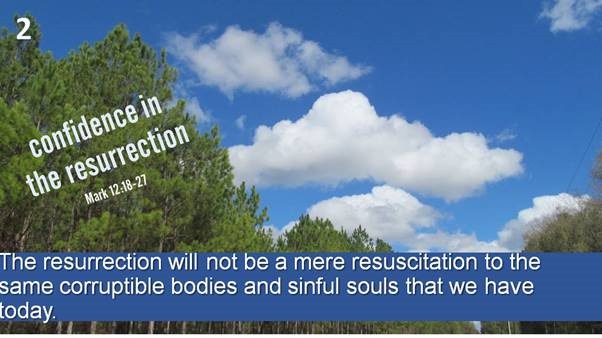
The second point in Jesus’ argument is that the resurrection will not be a mere resuscitation to the same corruptible bodies and sinful souls that we have today. God will restore us not to our present status, but to the one he intends us to have for eternity. He addresses that argument that the Sadducees made, presuming that resurrection is merely bringing a body back to life.

All resurrections that have ever happened in history have been merely resuscitations. But the resurrection that God promised is so much more than that. The apostle Paul explained that in his first letter to the Corinthians. He compared the original body with a seed that is sown. We all know that when a plant grows out of the earth that it started as a small seed, but we also know that the end product is something different – something much bigger and more glorious than the seed.

“42 So is it with the resurrection of the dead. What is sown is perishable; what is raised is imperishable. 43 It is sown in dishonor; it is raised in glory. It is sown in weakness; it is raised in power. 44 It is sown a natural body; it is raised a spiritual body. If there is a natural body, there is also a spiritual body. 45 Thus it is written, “The first man Adam became a living being”; the last Adam became a life-giving spirit. 46 But it is not the spiritual that is first but the natural, and then the spiritual. 47 The first man was from the earth, a man of dust; the second man is from heaven. 48 As was the man of dust, so also are those who are of the dust, and as is the man of heaven, so also are those who are of heaven. 49 Just as we have borne the image of the man of dust, we shall also bear the image of the man of heaven” (1 Corinthians 15:42-49 ESV).

When we Christians talk about our longing for the resurrection, it is not just that we want to be brought back to life after we die. We want much more than that. We want this sin and death that destroys our relationship with God and each other to be destroyed. We want a new life – a sinless, holy, God honouring life. That is what the resurrection promises for us. In the end, we will look more like Jesus than like Adam. We will have more in common with the eternal heaven than this present corrupted earth. You cannot really understand our desire for the resurrection as long as you see resurrection as mere resuscitation. It is more like complete regeneration.

clip_image008

Finally, Jesus argues that the resurrection must happen because God has a plan, and that plan cannot be realized among the dead. God’s promise is to all his people, not just his people of the future. His words to Moses were in effect a reminder that he is not through being faithful to those who have died. Abraham, Isaac and Jacob had long been dead. They were truly dead and they still are. Jesus was not denying the reality of death. What he was saying was that God always sees into eternity. He sees Abraham and Isaac and Jacob and Moses and David alive in their final perfected state. He sees you and me there as well. So, God is always our God. Even when we die, he is our God. He sees not just this part of his plan, but his whole plan.

To me, that fact is comforting on so many levels. The Bible says that Christ, “by a single offering … has perfected for all time those who are being sanctified” (Hebrews 10:14). God sees that. He sees the trouble I am having right now following him, and he is not worried. He looks back in time to the cross, and he sees the debt paid forever for my sins. And he looks forward into time to the resurrection, and he sees me changed into my eternal, perfected self. He sees me in that perfected state for a million years, and a million more. God sees me, and he sees you, and he is not ashamed, and he is not worried. He sees his children, and he smiles.

Something wonderful happened to me as I got a little older. I stopped worrying so much about my children. I used to be anxious about making the wrong decisions, and scarring them for life. Now, I look at those same kids, who are now raising kids of their own, and I realize that I worried too much about them. I should have trusted that God would take care of them the same way he took care of me. It’s a lot easier for me to do that now that I can see them acting with maturity and consideration for others.

The reason why people don’t have confidence in the resurrection is that it hasn’t happened yet. One day we will look back on all the pain and struggles that we are going through now, and realize that we should have just trusted God to work out his plan. If we can believe the first four words of the Bible (three words in Hebrew) we can believe in the resurrection. Those words are “In the beginning, God…” He was there in the beginning, setting his plan in place. He will be there at the end, restoring all things to himself. If we just look at the cemeteries, we will wonder about the resurrection. But if we look to the one who was here before us, he will bring us to a time when all the cemeteries are history. His plan for us is eternal, abundant life.

how faith defines us

hfdu

Titus 1:1-4 From Paul, servant of God, and missionary sent by Jesus Christ, representing the faith of God’s chosen ones, and the awareness of the truth which godliness brings; 2 In hope of eternal life, which God (who is free from deceit) promised before the ages began; 3 But he has revealed that promise in our own times through preaching, a task which has been handed over to me by order of God our Saviour; 4 To Titus, a legitimate child representing that shared faith: Grace, and peace, from God the Father and the Lord Jesus Christ our Saviour.

clip_image001

I’m starting a new series of messages today based on Paul’s little letter to Titus.

Titus is not mentioned in the book of Acts, but he is mentioned 13 times in Paul’s letters, which leads me to assume that he was a trusted and valuable member of Paul’s missionary team.

Given what Paul says about the inhabitants of Crete in the letter to Titus, he had his hands full. The Cretans had a reputation of being untrustworthy, lazy, and scoundrels who lacked self-control. In fact they actually had a Greek word kretidzo, which was formed from the name. The word meant to lie. So, the Gentile inhabitants of Crete were going to be hard for Titus to deal with.

But there’s more. The Jewish population at Crete was apparently infested with teachers of that false doctrine that had given Paul so much trouble in Galatia and Rome. Paul called them the troublers. So you had former pagans having trouble living like Christians in a non-Christian culture, and you also had people who were teaching them that they had to become more Jewish to be blessed by God, which goes against the gospel of salvation by grace.

On top of all that, there was a scarcity of leaders in a growing church community. Titus had to find appropriate leaders for churches on the island, train them, and appoint them to head those churches, and he had a limited time to do it. Titus had what you might call a high stress/ high pressure mission.

clip_image003

So, what can we learn from this little letter – one of the last to be written by the apostle Paul? I’m assuming that Crete was a kind of test case. Titus’ mission was to see if the gospel, and faith in Christ – would work there. Can a community with so many problems actually change simply by believing and living the gospel message? Can the Christian faith change us? Those are the questions I want to ask as we examine the message of Titus in this series.

My hypothesis is that faith can change us. No matter who we are, no matter what our background, no matter how many mistakes we have made in the past, no matter how many questions we have today, faith in Christ can transform us individually and as a community.

clip_image005

From these first few lines of Paul’s letter we get the impression that the Cretans’ faith in the gospel had already begun to change them. I think this community had put their faith in Christ, and that faith had begun to redefine them as a people. That’s where it can begin with our community as well.

clip_image007

FAITH DEFINES US BY MAKING US AWARE OF THE TRUTH

Paul sometimes says things that are really quite profound, and if we are not careful we will miss them. This is an example. He uses all the words that we would expect, except he puts them in the wrong order. We might expect Paul to say that recognizing the truth leads to faith and faith leads to godliness. But what Paul says in verse 1 is that both faith and the awareness of truth are the result of godliness. Many miss this fact, and never get real faith or confidence that they know the truth.

It all starts not with a confession of faith, but a commitment to godly living. Submitting to the Lordship of Christ leads to obedience to his commands. The results of that obedience are faith and awareness of the truth. So, if you are struggling with your faith in Christ, there is an answer. That answer is obey what he taught. The resulting godliness with empower your faith and solve your truth issues.

clip_image009

FAITH DEFINES US BY GIVING US HOPE BEYOND TODAY

Today is a problem for everyone, because none of us totally live up to our own expectations, and we never completely get what we want. But the secret of the Christian life is that there is hope beyond today. That hope rests on the foundation of the faithfulness of God, who promised to make us his everlasting children.

If your faith rests on what is happening in your life today, you are on shaky ground. Because even if you are having a good day, you know it won’t last. You know the other shoe is going to drop, and failure is just around the corner.

But if your faith rests not on your today, but on what God promises for your tomorrow, that faith is based on him, not you. So, even if you are having a bad day, God remains faithful, and you can still end the day encouraged.

You just have to keep telling yourself that God is faithful, and he is not a liar. What he promised is what is going to happen.

clip_image011

FAITH DEFINES US BY GIVING US PURPOSE FOR TODAY

I like the way Paul narrows the focus of his life and ministry, making it a very simple matter. Reading about Paul in the book of Acts and his epistles, we realise that he had a very important role in the establishment of the early church. He was a missionary, and planted churches all over the known world of his time. He brought around him a large group of missionaries, and put them to work on that same missions task. Titus was one of the members of his team. He trained many of those people, and he oversaw their ministries, as is made clear by epistles like Titus and 1 & 2 Timothy.

But Paul described himself as a preacher. He did not allow the complicated nature of what he did to confuse him as to his purpose. Paul found his purpose in preaching the Gospel. The details as to how he would do it were going to lead him to do what he did. But his purpose was always in the back of his mind. That kept him going when it became no longer possible for him to do this or that. His faith defined him as a preacher. When he could no longer go and preach, then he would write and preach.

Every one of us has to find our purpose, and for each of us it will be different. Ask yourself, what is it that God wants you to do, no matter what. Then, find a way to do it.

clip_image013

FAITH DEFINES US BY REWRITING OUR PAST

Notice that Paul describes Titus as a legitimate child. Why would he say that? It could be that Titus was not a physical legitimate child, so Paul described him as a spiritual legitimate child. Titus could not change what he was. But his faith in Christ did change what he had become. If I’m reading that right, it makes sense for Paul to send Titus to Crete. His ministry there would be a demonstration of how God can take a messed-up life and make it special and godly and beautiful.

That’s something that faith can do for us. Each of us has things about our life that we regret. But a life focused on Christ, obeying and preaching his word – can rewrite our past. It can turn our past ugliness into something nice and desirable. It can heal our hurts and use them to heal the hurts of others.

clip_image015

Each of us has a choice. We do not have a choice about all the challenges and difficulties that we face. They are here, and here to stay until Jesus returns. But we do have a choice as to what we allow to define us. We can be defined by our fears or our faith. In Titus, we are challenged to let our faith in Christ define who we are.

it’s like a box of chocolates

DSCF2150gift of life #23

it’s like a box of chocolates

If you are ever inclined to be philosophical, try an internet search for quotes that begin with the words “life is…”

Some of my favourites are:

  • “Life is what happens to you while you’re busy making other plans.”  (John Lennon).
  • “Life is like riding a bicycle. To keep your balance, you must keep moving.”  (Albert Einstein).
  • “Life’s hard. It’s even harder when you’re stupid.”  (John Wayne).
  • “Life’s under no obligation to give us what we expect.”  (Margaret Mitchell).
  • “Life … is a tale told by an idiot, full of sound and fury, signifying nothing.”  (William Shakespeare, Macbeth).
  • …And then there’s my favourite “life is…” quote of all, attributed to Forrest Gump’s mother: “Life is like a box of chocolates. You never know what you’re going to get.”

It seems that almost everybody has an idea or two about life, but we all do not agree. Even if we were unified, who’s to say that we would be right? What we need is advice from the One who invented life. We can find such advice, but we have to look in the right place – the Bible.

The most prevalent message in the Bible about life is that it is limited. It is a precious thing because it runs out. Life has a beginning and an end, and the end always comes too soon. The Bible says “our days on earth are a shadow.” Our days pass by quickly, disappearing as soon as the light hits them. Job said “Man who is born of a woman …flees like a shadow and continues not.” You cannot look at a shadow, and come back in an hour or two and find it in the same place. Like life, shadows are always coming and going. Shadows do not stay put. You never know what you’re going to get when you open the box of chocolates, but you know it won’t last very long.

Lots of things just seem unfair, particularly the more we realize that the limits of life do not allow for do-overs. Often we realize too late that our days are like an evening shadow, soon to be over – swallowed up in death, and nothing we can do will change that fact. Robert Harris said “The true currency of life is time, not money, and we’ve all got a limited stock of that.” As we conclude our study of the gift of life, I want to leave you with a word of application. Since the Bible teaches that we are mortal, and our lives are limited, don’t waste your life currency. Don’t waste your limited time doing things that will not matter in eternity.

And now a short summary of the 23 lessons in this series:

  • Life is a gift, not a given. Socrates was wrong: only God has immortality. We are dependent on him for life.
  • Having a soul does not make us immortal. Animals have souls.
  • In our sinful state, being immortal would be a curse, not a blessing.
  • Death is not going to a better place. It is not the answer to our problems. Christ is. Death is sleep – an unconscious wait for the resurrection. The dead go to a silent, dark state or condition in which everyone exists at death. In that state we know nothing, and can only live again by a resurrection from the LORD.
  • Hell is a reality, but it does not take place at death. It is the future lake of fire in which God will punish the lost with everlasting destruction.
  • The hope of resurrection is essential to the gospel message, and it should never be replaced by a hope of going to heaven at death.

If you have any questions about this teaching, you can ask me at jeffersonvann@yahoo.com. Thank you for joining me in this series as we have searched the scriptures to learn about the gift of life.

Listen to the audio file at Afterlife.

a resurrection perspective

146


gift of life #22


a resurrection perspective


Paul David Tripp calls it “eternity amnesia.”  It is people living with no hope for the future. They live for today because they think today is all that we have. In his recent book, Forever, he outlines the symptoms of this problem: 


  1. Living with unrealistic expectations,
  2. Focusing too much on self,
  3. Asking too much of people,
  4. Being controlling or fearful,
  5. Questioning the goodness of God,
  6. Living more disappointed than thankful,
  7. Lacking motivation and hope,
  8. Living as if life doesn’t have consequences.

We can understand it when people who do not know Christ live this way. But all too often, those of us who claim to know Jesus live the same way. We are victims when we should be living in victory. The victory was already obtained by Christ. Because of what he did for us, we need never live as if these temporary lives are all that we have. We can see everything that happens now in the light of the glory that awaits us in eternity. We can tolerate pain and failure because we understand them to be temporary setbacks. We can better grasp the significance of success when we see it from the standard of eternity as well. We can look on every soul we encounter as another being who is potentially immortal and glorified, which might help us tolerate their present imperfections. We can have a better attitude about our own present failures to hit the mark.


Another Paul, the apostle Paul – said something about eternity amnesia too.  He said “And if our hope in Christ is only for this life, we are more to be pitied than anyone in the world.” (1 Corinthians 15:19). If you take away the resurrection, Christianity is an empty religion with no real hope, and believers are of all people most to be pitied. The reason is that all human beings are born mortal. We have a death sentence hanging over us because of Adam’s rebellion. We imitate Adam by being creatures who return to the dust. But the hope of the resurrection gives us a forever perspective.

People who live without the forever perspective can only hope to accomplish a limited number of things. No matter how happy or successful or significant their lives, that happiness, success and significance will be buried in the ground when they die. But people who have a resurrection perspective – a gospel perspective, can accomplish an unlimited number of things. We can make an eternal difference in other people’s lives by pointing them to the Saviour. We can get our minds off of the things which enslave others, because our focus is on serving Christ.  He was the first to be resurrected.  We are next.  Knowing our future can free us to truly live in the present.


The gospel’s victory is not a happy life today.  The gospel’s victory is an eternal happy life at the resurrection.  Here is how the apostle Paul explains it: “In a moment, in the twinkling of an eye, at the last trump: for the trumpet shall sound, and the dead shall be raised incorruptible, and we shall be changed. For this corruptible must put on incorruption, and this mortal must put on immortality. So when this corruptible shall have put on incorruption, and this mortal shall have put on immortality, then shall be brought to pass the saying that is written, Death is swallowed up in victory”” (1 Corinthians 15:52-54.) The resurrection is God’s victory, and ours. The gospel is the good news about that victory. It is the story of the crucial battle won on the cross, and demonstrated by Christ’s resurrection. It is the story of the final victory over sin and pain through the resurrection at Christ’s return. Coming to faith in Christ is entering into that story. We know how the story ends. That is why we can have a resurrection perspective.


If you have any questions about this teaching, you can ask me at jeffersonvann@yahoo.com.  Join me for this entire series as we search the scriptures to learn about the gift of life.


Listen to the audio at Afterlife.

wrong about hell

DSCF1426gift of life #21

wrong about hell

Today I want to respond to some of the criticisms we conditionalists get when we dare to assert that hell will eventually come to an end.

The universalists say we are wrong about hell because they believe hell’s purpose is destroying sins, not sinners. They agree with us that hell is a temporary event. They teach that it will end when the last sinner has paid for his sins, and has been restored.

But we conditionalists don’t see evidence of that restoration in scripture. Scripture says that God makes the wicked perish, blotting out their name forever (Psalm 9:5). Jesus taught that God can destroy both soul and body in Gehenna hell (Matthew 10:28). But neither the universalists nor the traditionalists think that this is really possible. Both of these groups believe that souls are indestructible. Conditionalists teach that human souls are created by God, and they can be destroyed by God.

Traditionalists say we are wrong about hell because we redefine the word forever. We respond by pointing out that most of the time in the Bible when the Hebrew word ‘olam or the Greek word aionios appears, neither refers to a perpetual process. Most of the time they simply mean permanent, or everlasting, and we certainly have no problems with those translations.

Here are some examples:

  • the permanent destruction the lost will face at Christ’s return (2 Thessalonians 1:9).
  • the permanent glory that accompanies salvation in Christ (2 Timothy 2:10).
  • The permanent salvation made possible by Jesus, our great high priest (Hebrews 5:9).
  • The permanent judgment that will take place after the resurrection of the dead (Hebrews 6:2).
  • the permanent covenant made possible by the shedding of the blood of Christ (Hebrews 13:20).
  • entrance into the permanent kingdom provided for all those who make their calling and election sure (2 Peter 1:10-11).

But, yes, we object to the word eternal because that English word conveys the idea of an on-going process. By definition, destruction cannot be a perpetual process. It has to end, or it cannot take place.

Traditionalists also say we are wrong about hell because God’s justice morally demands it. We agree with all other Bible-believing Christians that God’s justice requires a judgment day. We object to those who insist that day must continue forever. If the punishment for sins requires an eternity of suffering, then all of us are lost. Our Lord himself suffered punishment in our place on the cross, but his suffering came to an end when he died. How can we say that his death atoned for our sins? That’s what the Bible says. It says God sent his Son to be the atoning sacrifice for our sins (1 John 4:10). It says the wages of sin is death, not suffering eternally (Romans 6:23). It says that final punishment will be a lake of fire, resulting in the second death. That is what God’s justice demands.

So, no, we are not wrong about hell. We are a voice of reason, asking people to take another look at what the Bible really says about this important topic.

If you have any questions about this teaching, you can ask me at jeffersonvann@yahoo.com. Join me for this entire series as we search the scriptures to learn about the gift of life.

Listen to the audio file at Afterlife.