
WHY HE DIED
Hebrews 2:14-15; 9:24-28 NET.
14 Therefore, since the children share in flesh and blood, he likewise shared in their humanity, so that through death he could destroy the one who holds the power of death (that is, the devil), 15 and set free those who were held in slavery all their lives by their fear of death.
24 For Christ has not entered the holy places made with hands, which are copies of the true, but into heaven itself, now to appear in the presence of God for us; 25 not that He should offer Himself often, as the high priest enters the Most Holy Place every year with blood of another — 26 He then would have had to suffer often since the foundation of the world. Still, now, once at the end of the ages, He has appeared to put away sin by the sacrifice of Himself. 27 And as it is appointed for men to die once, but after this the judgment, 28 so Christ was offered once to bear the sins of many. To those who eagerly wait for Him, He will appear a second time, apart from sin, for salvation.
The joy of Palm Sunday
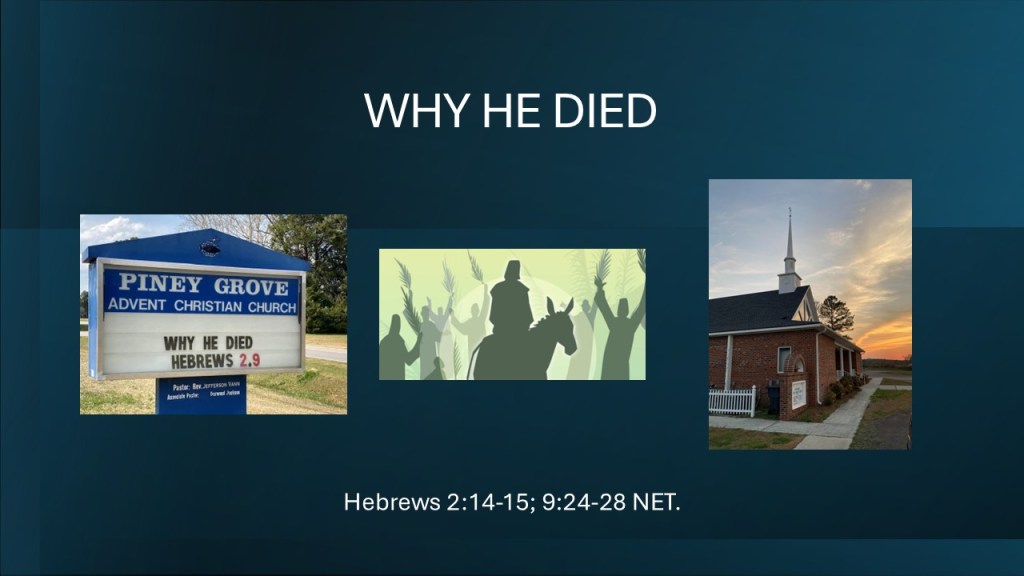
In Matthew 21:1–11, Jesus gives two of His disciples a simple but unusual job: find a donkey and her young colt and bring them to Him. They do exactly what He says. Soon, Jesus is riding into Jerusalem on the young donkey.
What happens next is amazing. People start taking off their coats—things that were very valuable back then—and laying them on the road like a carpet for a king. Others cut branches and wave them in the air to celebrate. When Jesus rides by, the whole crowd shouts with excitement: “Hosanna to the Son of David!” This isn’t quiet clapping. It’s the loud cheer of people who believe their long‑promised King has finally arrived.
Matthew stops to remind us that this moment was predicted long ago in Zechariah 9:9, where God told His people to rejoice because their King would come to them humbly, riding on a donkey. The joy of the crowd isn’t random. It’s exactly the kind of joy the prophet said would happen hundreds of years earlier.
In Mark 11:1–11, the story happens almost the same way—there’s the donkey, the coats on the road, and the branches waving in the air. But Mark focuses on what the people were hoping for. They shout, “Hosanna! Blessed is he who comes in the name of the Lord!” Then they add something that shows what they’re expecting: “Blessed is the coming kingdom of our father David!”
They aren’t just cheering for a man who can do miracles. They believe Jesus is the King who will bring back the great kingdom David once ruled. Their excitement is huge. They think Jesus isn’t only going to help others—He is going to change their own lives in a big way.
In Luke 19:28–44, the feelings in the story are even stronger. As Jesus rides the young donkey, His disciples start praising God loudly because of all the amazing miracles they have seen Him do. They shout, “Blessed is the king who comes in the name of the Lord!” They are excited and proud to follow Him.
But then Luke tells us something surprising. While the crowds are cheering, Jesus begins to cry. He knows something the people don’t. Even though everyone is happy right now, the city of Jerusalem will not accept the peace He brings. Their joy is real, but it doesn’t go very deep, and it won’t last.
This reminds us of something important. Even when we celebrate Palm Sunday and worship Jesus as our King, many people in the world still ignore Him or push Him away. Jesus feels that sadness, even in the middle of all the cheering.
In John 12:12–19, the celebration becomes the biggest and most excited of all the Gospel stories. John is the only one who mentions palm branches, which were symbols of victory and national pride. Huge crowds rush out to meet Jesus, shouting, “Hosanna! Blessed is the King of Israel!”
John also tells us why everyone is so thrilled. Just before this, Jesus had raised Lazarus from the dead. News of that miracle spread everywhere, and people couldn’t stop talking about it. So when Jesus arrived, they weren’t just welcoming a great teacher. They were welcoming the One who had shown power over death itself.
Their joy is the joy of people who feel like they are seeing the beginning of a brand‑new world—one filled with hope, life, and the promise that everything is about to change.
The irony of Palm Sunday
Right after the exciting Triumphal Entry, Jesus enters the temple and finds people cheating others and making dishonest money. He turns over the tables of the moneychangers to stop the corruption. This makes the religious leaders very angry. They challenge Him in front of everyone and ask, “Who gave you the right to do this?” Then they try to trap Him with tricky questions about paying taxes, the resurrection, and which commandment is the greatest. They aren’t looking for real answers. They want to catch Him saying something wrong. This is the first big rejection: they refuse to accept Jesus as the Messiah or even as a true teacher.
After Jesus tells several parables exposing the leaders’ hypocrisy, they become even angrier. They decide that Jesus must die. The chief priests and elders meet in secret and make a plan. They agree to arrest Him quietly so the crowds won’t find out. They look for the perfect moment when no one is watching. This is the strongest rejection of all: they choose, on purpose, to work together to kill Him.
One of Jesus’ own disciples becomes part of the leaders’ plan. Judas agrees to betray Jesus in exchange for a bag of coins. After that, he starts watching for the right time to hand Jesus over. This is a very personal kind of rejection—a painful betrayal from someone in Jesus’ closest group of friends.
When Jesus is arrested, His disciples become scared and run away. Even though they had promised to stay with Him no matter what, their fear is stronger in that moment. This is a painful kind of rejection: the people who loved Him most leave Him alone when He needs them.
Jesus is taken to the high priest’s house for a trial in the middle of the night, even though this was against Jewish law. People are brought in to lie about Him, but their stories don’t match. Some accuse Jesus of saying He would destroy the temple. When Jesus says clearly that He is the Messiah, the Son of Man, the council becomes furious. They say He is guilty of blasphemy. Then they spit on Him, hit Him, and make fun of Him. This is a terrible kind of rejection: the religious court wrongly condemns the true Judge of Israel.
While Jesus is being mocked inside, Peter is outside in the courtyard. Three different times, people ask him if he knows Jesus, and each time Peter says he doesn’t. When the rooster crows, Peter suddenly remembers Jesus’ warning. He realizes what he has done and begins to cry bitterly. This is an emotional kind of rejection: fear makes even Jesus’ bravest disciple deny knowing Him.
Jesus is taken to Pilate, the Roman governor. The religious leaders accuse Him of claiming to be a king. Pilate looks into the charges and says he can’t find anything Jesus has done wrong. But the crowd, pushed by the leaders, begins shouting for Jesus to be crucified. Pilate doesn’t want trouble, so he gives in to the pressure and hands Jesus over to be killed. This is a kind of public, government rejection: Rome chooses to punish an innocent man to keep the peace.
The same city that cheered for Jesus with palm branches now chooses someone else instead of Him. Pilate offers to let Jesus go free, but the crowd shouts for Barabbas, a man who had committed serious crimes. Then the crowd begins to yell, “Crucify Him!” This is a public rejection: the people choose a criminal over their true King.
Everyone around Him rejects Jesus. The Roman soldiers make fun of Him and pretend He is a fake king. People walking by the cross shout insults at Him. The religious leaders laugh at Him and challenge Him to save Himself. Even one of the criminals being crucified next to Him joins in the mocking. This is complete rejection: leaders, crowds, soldiers, and criminals all turn against Him.
Between Palm Sunday and Good Friday, Jesus is rejected again and again. The religious leaders turn against Him. One of His own disciples betrays Him. His friends run away. False witnesses lie about Him. Peter denies knowing Him. The Jewish council hands Him over to the Romans. Rome sentences Him even though He is innocent. And the same crowds that once cheered for Him now shout for His death.
Why did Jesus have to die?
After seeing the huge, joyful crowd on Palm Sunday, it’s hard to understand how everything went so wrong so fast. One day, the people are cheering for Jesus, and only a few days later, He is rejected and killed. It doesn’t seem to make sense. So we naturally ask, Why was Jesus rejected? And why did He have to die?
But we don’t have to stay confused. God never gives us a question without giving us an answer in His Word. When we look at today’s passage, we find many reasons that explain why Jesus was rejected and why His death was necessary.
Today’s passage in the Book of Hebrews gives us three big reasons why Jesus had to die on the cross. To make them easy to remember, we can use three words that all start with the same letter: slavery, sacrifice, and salvation.
These three words help us understand that the cross was not an accident. It wasn’t a mistake or a surprise. It was part of God’s perfect plan. God chose to send His one and only Son to die on a cruel cross so that His people could be set free, forgiven, and saved forever.
The first reason Jesus had to die is connected to the word slavery. The writer of Hebrews explains that God’s children are human—they have flesh and blood—so Jesus became human too. He did this so that through His own death, He could break the power of the devil, the one who uses death to scare people. By dying, Jesus set people free from being slaves to the fear of death their whole lives.
In other words, Jesus died to break our chains. He died so we wouldn’t have to live scared of death anymore.
One of the big problems Jesus came to fix by dying on the cross was the slavery problem. This problem began with Satan. In the Garden of Eden, Satan appeared to Adam and Eve as a serpent. He tempted them to disobey God’s command and eat the fruit God had forbidden. When they listened to him, sin entered the world, and people became trapped—like slaves—under the power of sin and death.
Jesus came to break that slavery. He came to undo what Satan started and to set people free from the fear and power of death.
Satan knew exactly why God told Adam and Eve not to eat the forbidden fruit. God wanted to protect them from the power of sin and from the pain of death. God had warned them that if they disobeyed, they would become mortal—their bodies would grow old, break down, and eventually die.
Satan understood this. He knew that if he could get them to disobey, they would fall under the power of sin and death. And that is exactly what happened. By tempting them, Satan helped bring death into the human story, and people became trapped in fear and brokenness.
We don’t have to look far to see that this is exactly what happened. The world around us shows the results of that first terrible choice in the Garden. We know we are mortal—we are flesh‑and‑blood people who live only for a short time. Our lives are fragile, and every breath reminds us that one day our bodies will stop working.
Because of this, many people live with a quiet fear of dying. That fear follows us through life like a shadow. The writer of Hebrews calls this slavery—being trapped by the fear of death and unable to escape it on our own.
Jesus came to break that slavery. He came to set us free.
The worst part of this slavery is that we can’t fix it ourselves. There is nothing we can do to stop being mortal. Doctors can help us for a while, but eventually, even they reach a point where they can’t repair our bodies anymore. Science tries to make our lives longer, but even then, it can only stretch out the time, not remove death. Sometimes people live longer in their bodies while their minds fade away.
No matter what we try, slavery continues. We cannot free ourselves from death or the fear that comes with it.
The writer of Hebrews says that the devil holds the power of death. He has this power because our first ancestors gave it to him. When Adam and Eve listened to Satan’s temptation and chose to disobey God, they handed themselves—and all of us—over to the power of sin and death.
By following Satan’s lie instead of God’s truth, they placed themselves under his control. In that moment, we became like slaves, trapped by sin.
Since we are slaves to sin and death, we cannot free ourselves. No matter how hard we try, we cannot pay the price needed to break our chains. For us to be set free, one of us would have to pay the price for all of us. But none of us qualifies, because we are all sinners and all mortal.
So God sent Jesus.
Jesus is God’s only begotten Son, but He came into the world and became one of us. He took on our humanity—our flesh and blood—so that He could die a sinless death in our place. His perfect life and His willing death became the ransom that frees us from our slavery to sin and death.
Jesus did what none of us could ever do. He paid the price to set us free.
Because we were slaves to sin and death, we also had a sacrifice problem. We knew we were sinners, and we knew that sin needed a perfect, spotless sacrifice to make things right with God. But none of us could make that sacrifice. Even the best people in the world are still touched by the failure that began in the Garden of Eden.
No human being is completely pure. No one is without sin. So none of us could offer the perfect sacrifice God required. We needed someone who was truly without sin—someone who could stand in our place.
Under the old covenant, God told the Israelites to offer sacrifices as part of their worship. These sacrifices were important, but they did not solve the problem of sin forever. They were more like a temporary fix—something to hold things together until a better, final sacrifice would come.
People could bring an animal to the altar, but that didn’t always mean their hearts were truly changed. Someone could offer a sacrifice without real repentance or without turning away from their sin. So even though the sacrifices were part of God’s plan, they could not remove sin completely or change the human heart.
They pointed forward to a greater sacrifice that was still to come.
The writer of Hebrews explains this in chapter 9, verses 24–26. He says that Jesus did something no other priest or sacrifice could ever do. Instead of bringing an animal into an earthly temple, Jesus brought His own life as the perfect sacrifice into the heavenly sanctuary—God’s true presence.
All the sacrifices in the Old Testament were pointing forward to this one moment. They were like signs showing that a greater sacrifice was coming. And when Jesus came, He offered Himself once for all. Hebrews says He appeared “at the end of the ages” to put away sin by giving His own life.
In other words, Jesus didn’t need to be sacrificed again and again. His one sacrifice was enough to deal with sin forever.
The last problem we face is our need for salvation. We needed someone to rescue us from slavery to death. We needed a perfect, sinless sacrifice to take our place. But we also needed someone who could save us forever.
The writer of Hebrews explains this in chapter 9, verses 27–28. He says that every person is appointed to die once, and after that comes judgment. That means we will all stand before God one day. But here is the good news: Jesus has already been offered once to carry the sins of many people. He died once, and that sacrifice was enough.
And Hebrews says something even better. Jesus will come again—not to deal with sin, because He already did that—but to bring salvation to everyone who is waiting for Him with hope.
In other words, Jesus’ first coming took away our sin. His second coming will restore his universe.
For our salvation to be complete, we needed two things. First, we needed our sins to be paid for, and Jesus did that when He died on the cross. His death provided the atonement we could never earn on our own.
But even after our sins are forgiven, we still face another problem: we still die. Our bodies still grow old, break down, and eventually stop working. That’s because our first death comes from Adam’s sin, not our own. The Bible says, “In Adam, all die.” Jesus’ death on the cross paid for our sins, but it did not remove the physical death that comes from being part of Adam’s family.
So even forgiven people still experience the first death. That’s why we need something more—something only Jesus can give.
For our salvation to be complete, we needed more than a perfect sacrifice. Jesus’ death on the cross paid for our sins, and that was essential. But even after our sins are forgiven, we still face physical death. That first death comes from Adam’s sin, and Jesus’ sacrifice did not remove that part of our human condition.
So we needed something else.
We needed a Savior who would come back and rescue us from our graves. We needed someone who had already defeated death to come and pull us out of it. Until that happens, our salvation is not finished. We can say we are saved because we trust Jesus to complete the work He began.
That’s why the Bible talks about salvation in three tenses:
- We have been saved — Jesus paid for our sins on the cross.
- We are being saved — Jesus is changing us and keeping us in faith.
- We will be saved — Jesus will return and raise us from the dead.
All three are true because of what Jesus did on the cross and what He will do when He comes again.
So now we come back to the cries of the crowds on that first Palm Sunday. They shouted “Hosanna!” Many people today think of that word as a kind of praise, but at first it wasn’t praise at all. It was a prayer. The word comes from the Hebrew phrase hôshîʿah-nnaʾ, which means “Save us, please!” or “Please rescue us!” Over time, the meaning of the word changed. It became a way of celebrating the salvation God had already given. That’s why we often use it as a joyful word of praise today. But it is still right—and very fitting—for us to use the word in its original meaning too. We still need God to save us. We still need Jesus to finish the salvation He began. So when we cry out “Hosanna,” we are both praising God for what He has done and praying for Him to complete His work when Christ returns. “Hosanna” is both a shout of joy and a cry for help. It is the perfect word for people who trust Jesus to save them completely.
We still live in a world that is trapped in the slavery of fearing death. So we pray, “Save us, Christ, we pray!” We still need forgiveness for our sins and rescue from the damage they cause. So again we cry, “Save us, Christ, we pray!”
And we still wait for the day when our salvation will be complete—when the One who conquered death will return and pull us out of our graves. Our hearts long for that day, so we say once more, “Save us, Christ, we pray!”
This is the true meaning of Hosanna. It is the cry of people who trust Jesus to finish what He started. It is the prayer of those who believe He will come again to save us fully and forever.





 jeffersonvann