2 Samuel 9:1 David said, “Is there anyone remaining from the family of Saul I can show kindness to for Jonathan’s sake?”
2 Samuel 9:2 There was a servant of Saul’s family named Ziba. They summoned him to David, and the king said to him, “Are you Ziba?” “I am your servant,” he replied.
2 Samuel 9:3 So the king asked, “Is there anyone left of Saul’s family that I can show the kindness of God to?” Ziba said to the king, “There is still Jonathan’s son who was crippled in both feet.”
2 Samuel 9:4 The king asked him, “Where is he?” Ziba answered the king, “You’ll find him in Lo-debar at the house of Machir, son of Ammiel.”
2 Samuel 9:5 So King David had him brought from the house of Machir, son of Ammiel in Lo-debar.
2 Samuel 9:6 Mephibosheth, son of Jonathan, son of Saul, came to David, fell facedown, and paid homage. David said, “Mephibosheth!” “I am your servant, ” he replied.
2 Samuel 9:7 “Don’t be afraid,” David said to him, “since I intend to show you kindness for the sake of your father Jonathan. I will restore to you all your grandfather Saul’s fields, and you will always eat meals at my table.”
2 Samuel 9:8 Mephibosheth paid homage and said, “What is your servant that you take an interest in a dead dog like me?”
2 Samuel 9:9 Then the king summoned Saul’s boy Ziba and said to him, “I have given to your master’s grandson all that belonged to Saul and his family.
2 Samuel 9:10 You, your sons, and your servants are to work the ground for him, and you are to bring in the crops so your master’s grandson will have food to eat. But Mephibosheth, your master’s grandson, is always to eat at my table.” Now Ziba had fifteen sons and twenty servants.
2 Samuel 9:11 Ziba said to the king, “Your servant will do all my lord the king commands.” So, Mephibosheth ate at David’s table just like one of the king’s sons.
2 Samuel 9:12 Mephibosheth had a young son named Mica. All those living in Ziba’s house were Mephibosheth’s servants.
2 Samuel 9:13 However, Mephibosheth lived in Jerusalem because he always ate at the king’s table. His feet had been crippled.
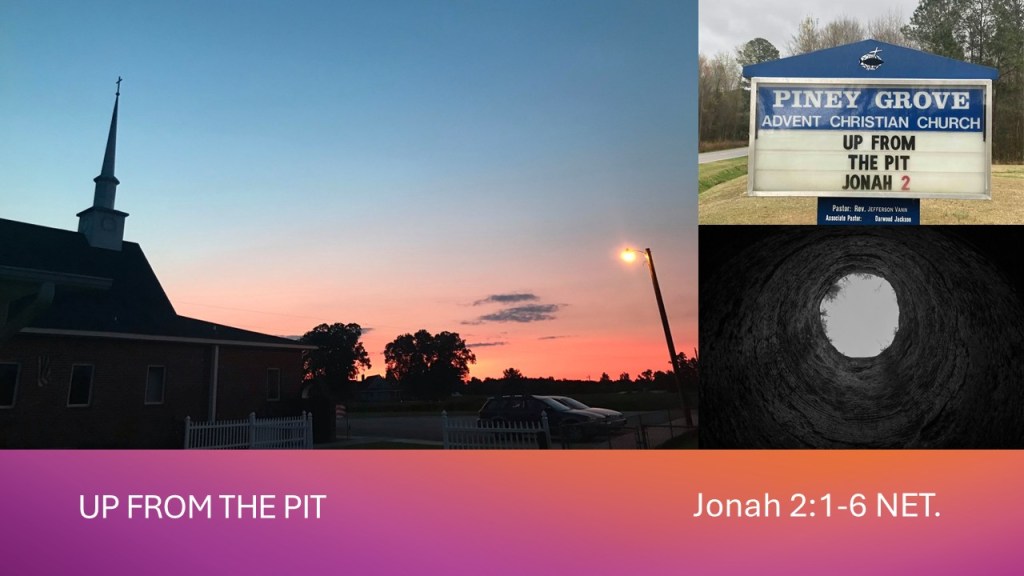
1 Jonah prayed to the LORD his God from the stomach of the fish 2 and said, “I called out to the LORD from my distress, and he answered me; from the belly of Sheol I cried out for help, and you heard my prayer. 3 You threw me into the deep waters, into the middle of the sea; the ocean current engulfed me; all the mighty waves you sent swept over me. 4 I thought I had been banished from your sight, that I would never again see your holy temple! 5 Water engulfed me up to my neck; the deep ocean surrounded me; seaweed was wrapped around my head. 6 I went down to the very bottoms of the mountains; the gates of the netherworld barred me in forever; but you brought me up from the Pit, O LORD, my God.
I usually rely on the NET translation when I preach because it is clear, careful, and often very helpful. At times, though, I switch to another version if it captures the Hebrew or Greek more accurately. But today I stayed with the NET precisely because, in this case, its weaker rendering becomes a teaching moment. I’m referring to the phrase “the gates of the netherworld” in verse 6. Jonah did not speak in vague mythological language, nor was he imagining some shadowy underworld out of ancient folklore. The Hebrew phrase points much more directly to the realm of death itself—the place no one escapes, the place whose “bars” and “gates” symbolize finality and hopelessness.
Jonah is describing what it felt like to be swallowed by death. He believed he had crossed the threshold from which no human being returns. And yet, from within that prison, he cried out—and the Lord heard him. The point is not that Jonah understood everything perfectly, but that God’s mercy reached him even where he thought no mercy could reach. The “gates” that should have held him forever could not hold him because the Lord willed otherwise.
Keeping the NET’s awkward phrase in front of us helps us slow down and ask what Jonah actually meant. It reminds us that God’s saving power is not limited by our circumstances, our despair, or even our mistaken assumptions. When we feel trapped behind our own “gates,” Jonah’s prayer teaches us that the Lord can still bring us up from the pit.
The NET’s own notes acknowledge the literal Hebrew—“As for the earth, its bars…”—yet the translation still opts for the much looser and theologically loaded phrase “the gates of the netherworld.” That choice imports an idea Jonah never expressed. There is no “netherworld” in this passage, no mythic underworld, no realm of demons or torment. Jonah is not giving us cosmology; he is giving us biography—the raw memory of a man who believed he was about to die.
The phrase הָאָרֶץ בְּרִחֶיהָ paints a concrete picture: the earth with its bars, the physical world closing over him like a prison. In Jonah’s mind, the ocean floor was not a symbolic underworld but the literal boundary between life and death. The “bars” are the finality of drowning—the sense that the world has shut behind him and there is no way back.
Jonah prays this from inside the fish, but his language reaches back to the moments before the fish swallowed him. Verse 2 already tells us he cried out from “the belly of Sheol.” In the Old Testament, Sheol is not the netherworld; it is simply the state of being dead—the grave, the silence, the end of consciousness. Jonah is saying, “I was as good as dead. I had crossed the threshold. I was already in death’s grip.”
Jonah’s point is simple and profound: he was dying, and God saved him. The “bars” of the earth were closing, the grave was claiming him, and yet God intervened. The miracle is not that Jonah visited some mystical realm—it is that God preserved a man who had already begun to descend into death.
Christians often end up confused about what happens after death because our English Bibles sometimes adjust the Hebrew and Greek in ways that unintentionally reinforce ideas the biblical writers never taught. When translators choose words like “netherworld”, they introduce the notion of a conscious realm people enter immediately after death—a concept far more at home in Greek mythology than in the Old Testament. The result is that many readers assume the Bible teaches an automatic, conscious afterlife somewhere else, when in fact the Hebrew text is describing something much simpler and far more sobering: death itself.
Several English translations use terms like “netherworld,” “underworld,” or “realm of the dead,” language that suggests ongoing awareness after death. These words carry cultural baggage and make readers imagine souls continuing life elsewhere. But Hebrew Scripture uses Sheol to describe the state of being dead—silent, unconscious, cut off from the living. It is not a destination but the condition of no longer being alive. Such mythic terms mislead readers into believing in a conscious afterlife before resurrection. In Jonah 2, the language is physical: he is drowning, the “bars of the earth” closing over him. “Sheol” means he was as good as dead.
The biblical writers are not concerned with where people “go” when they die. They are concerned with the fact that death ends life, and only God can restore it.
When Christians focus on “going somewhere” after death, they often miss the heart of the good news. The gospel is not about escaping to another realm. It is about God’s promise to undo death itself. Jesus does not offer relocation; He offers resurrection. The hope held out in Scripture is not that we will continue living elsewhere, but that God will give life back to those who have died.
This is why the New Testament proclaims resurrection so loudly and so often. It is the answer to the problem the Bible actually describes: not the fear of going to the wrong place, but the reality that we die—and need Jesus to raise us.
We all face the same reality when life ends, and Scripture names it in several ways: the grave, Sheol, the Pit, and death. These are not different realms but different expressions for the same end of earthly life. Biblical writers use them interchangeably to describe the universal fate of all people. When Jonah speaks of Sheol and the Pit, he is not picturing an underworld but describing how near he was to dying as the sea closed in around him. In his mind, he had already crossed into death, and his prayer rose from that desperate awareness.
And yet, God brought him back.
Because all these terms point to the same reality, they also point to the same hope. If death is the problem, then resurrection is the solution. The Bible does not promise that we will go somewhere else when we die; it promises that God will raise the dead. That is why the New Testament anchors Christian hope not in escape from death but in victory over it.
Death is a Pit
Jonah was not exaggerating. He was seconds from death, the world closing in like a prison as the sea swallowed him and the earth’s “bars” shut behind him. He was entering the finality Scripture calls the Pit—where life ends, and hope disappears. At that moment, God intervened and lifted him out. His rescue was a reversal of death, not a metaphor. The Pit is not an underworld but another name for Sheol, the grave, death itself. Jonah describes breath leaving his body and darkness overtaking him. His prayer is the cry of a man already slipping beneath life’s final boundary.
Job captures this hopelessness with painful clarity: “If I hope for Sheol as my house, if I make my bed in darkness, if I say to the pit, ‘You are my father,’ and to the worm, ‘My mother,’ or ‘My sister,’ where then is my hope? Who will see my hope? Will it go down to the bars of Sheol? Shall we descend together into the dust?” (Job 17:13–16)
Job’s questions assume the answer: there is no hope in Sheol—no future, no life, no expectation. Hope cannot follow a person into the dust. Jonah felt that same nearness to death as darkness closed in and the sea’s “bars” shut behind him. Yet where hope should have ended, God intervened and lifted him from the Pit. His prayer becomes a testimony of deliverance. Scripture’s images—darkness, worms, bars—describe the finality of death, not a conscious realm. This matches God’s word to Adam: made from dust, he would return to dust. Death ends life; consciousness ceases; dust returns to dust.
This is why the Bible uses “Sheol,” “the grave,” “the Pit,” and “death” interchangeably. They all describe the same reality: the end of life, the silence that follows, the condition from which only God can raise a person.
When Jonah speaks of the Pit and the bars of the earth, he is not imagining a mythological underworld. He is describing the moment when death was closing in on him. The darkness, the pressure, the descent, the sense of no escape—these are the very images Scripture uses to describe the grave. Jonah believed he was already crossing that threshold.
And yet, God brought him back.
There will be a rescue from the Pit.
Job admits no one escapes the Pit; once a person enters death, no strength or righteousness can bring him back. Yet he refuses despair. He knows he will return to dust, but he also knows his Redeemer lives and will one day stand on that dust and raise him. His own eyes will see God—resurrection hope. David echoes this in Psalm 30: death silences praise, so he pleads for life. Psalm 49 adds that no one can ransom another to “live on forever.” Wise and foolish alike perish. Death ends consciousness and activity; the Pit is simply the end of life.
Many people still resist this. They insist that people continue living somewhere else after their bodies die. But the sons of Korah say the opposite: we perish. We do not relocate; we cease.
Paul’s confirmation: we are perishable until resurrection
Paul brings Old Testament teaching to its climax: we are perishable and remain so until Jesus raises us from the dead. Only then do we become imperishable. He writes, “the dead will be raised imperishable” (1 Corinthians 15:52). He does not say the dead are already imperishable or alive elsewhere. He speaks of a future resurrection in which the dead are made imperishable. The Bible’s hope is not surviving death but God undoing death itself.
Jonah was lifted from the Pit.
Jonah fits seamlessly into the pattern established by Job, David, and the sons of Korah. He was seconds from dying, swallowed by the sea, sinking past the point of rescue. He felt himself descending into the Pit, the same Pit Job said no one can escape. The “bars of the earth” were closing behind him, sealing him in. His life was slipping away; he was returning to the dust from which all humanity comes. And yet, at the very brink—when death had already begun its work—God reached into that hopeless place and lifted him. Jonah’s deliverance is not merely dramatic; it is a small-scale demonstration of the very thing Scripture promises God will one day do for all His people.
Jonah’s rescue is a living parable of resurrection: God will bring life out of death, hope out of hopelessness, deliverance up from the Pit.
An EXPANDED VERSION of this sermon is available on the Afterlife site!
2 Samuel 8:1 After this, David struck the Philistines down, subdued them, and took Metheg-ammah from Philistine control.
2 Samuel 8:2 He also struck down the Moabites, and after making them lie down on the ground, he measured them off with a cord. He measured every two cord lengths of those to be put to death and one full length of those to be kept alive. So, the Moabites became David’s subjects and brought tribute.
2 Samuel 8:3 David also struck down Hadadezer, son of Rehob, king of Zobah, when he went to restore his control at the Euphrates River.
2 Samuel 8:4 David captured seventeen hundred horsemen and twenty thousand foot soldiers from him, and he hamstrung all the horses and kept a hundred chariots.
2 Samuel 8:5 When the Arameans of Damascus came to assist King Hadadezer of Zobah, David struck down twenty-two thousand Aramean men.
2 Samuel 8:6 Then he placed garrisons in Aram of Damascus, and the Arameans became David’s subjects and brought tribute. Yahveh made David victorious wherever he went.
2 Samuel 8:7 David took the gold shields of Hadadezer’s officers and brought them to Jerusalem.
2 Samuel 8:8 King David also took huge quantities of bronze from Betah and Berothai, Hadadezer’s cities.
2 Samuel 8:9 When King Toi of Hamath heard that David had struck down the entire army of Hadadezer,
2 Samuel 8:10 he sent his son Joram to King David to greet him and to congratulate him because David had fought against Hadadezer and struck him down, for Toi and Hadadezer had fought many wars. Joram had items of silver, gold, and bronze with him.
2 Samuel 8:11 King David also dedicated these to the Lord, along with the silver and gold he had dedicated from all the nations he had subdued–
2 Samuel 8:12 from Edom, Moab, the Ammonites, the Philistines, the Amalekites, and the spoil of Hadadezer, son of Rehob, king of Zobah.
2 Samuel 8:13 David made a reputation for himself when he returned from striking down eighteen thousand Edomites in Salt Valley.
2 Samuel 8:14 He placed garrisons throughout Edom, and all the Edomites were subject to David. Yahveh made David victorious wherever he went.
2 Samuel 8:15 So David reigned over all Israel, administering justice and righteousness for all his people.
2 Samuel 8:16 Joab son of Zeruiah was over the army; Jehoshaphat son of Ahilud was court historian;
2 Samuel 8:17 Zadok son of Ahitub and Ahimelech son of Abiathar were priests; Seraiah was court secretary;
2 Samuel 8:18 Benaiah, son of Jehoiada, was over the Cherethites and the Pelethites, and David’s sons were chief officials.
2 Samuel 7:1 When the king had settled into his palace, and Yahveh had given him relief on every side from all his enemies,
2 Samuel 7:2 the king said to the prophet Nathan, “See, I am living in a cedar house while the ark of God sits inside tent curtains.”
2 Samuel 7:3 So Nathan told the king, “Go and do all that is on your mind, for Yahveh is with you.”
2 Samuel 7:4 But that night the word of Yahveh came to Nathan:
2 Samuel 7:5 “Go to my servant David and say, ‘This is what Yahveh says: Are you to build me a house to dwell in?
2 Samuel 7:6 From the time I brought the Israelites out of Egypt until today, I have not dwelt in a house; instead, I have been moving around with a tent as my dwelling.
2 Samuel 7:7 In all my journeys with all the Israelites, have I ever spoken a word to one of the tribes of Israel, whom I commanded to shepherd my people Israel, asking: Why haven’t you built me a house of cedar?’
2 Samuel 7:8 “So now this is what you are to say to my servant David: ‘This is what Yahveh of Armies says: I took you from the pasture, from tending the flock, to be ruler over my people Israel.
2 Samuel 7:9 I have been with you wherever you have gone, and I have destroyed all your enemies before you. I will make a great name for you like that of the greatest on the land.
2 Samuel 7:10 I will designate a place for my people Israel and plant them so that they may live there and not be disturbed again. Evildoers will not continue to oppress them as they have been doing
2 Samuel 7:11 ever since the day I ordered judges to be over my people Israel. I will give you rest from all your enemies. ” ‘Yahveh declares to you: Yahveh himself will make a house for you.
2 Samuel 7:12 When your time comes, and you rest with your fathers, I will raise after you your seed, who will come from your body, and I will establish his kingdom.
2 Samuel 7:13 He is the one who will build a house for my name, and I will establish the throne of his kingdom forever.
2 Samuel 7:14 I will be his father, and he will be my son. When he does wrong, I will discipline him with a rod of men and blows from mortals.
2 Samuel 7:15 But my faithful love will never leave him as it did when I removed it from Saul, whom I removed from before you.
2 Samuel 7:16 Your house and kingdom will endure before me forever, and your throne will be established forever.'”
2 Samuel 7:17 Nathan reported all these words and this entire vision to David.
2 Samuel 7:18 Then King David went in, sat in Yahveh’s presence, and said, who am I, Lord God, and what is my house that you have brought me this far?
2 Samuel 7:19 What you have done so far was a little thing to you, Lord Yahveh, for you have also spoken about your servant’s house in the distant future. And this is instruction for humanity, Lord Yahveh.
2 Samuel 7:20 What more can David say to you? You know your servant, Lord Yahveh.
2 Samuel 7:21 Because of your word and according to your heart, you have revealed all these great things to your servant.
2 Samuel 7:22 This is why you are great, Lord Yahveh. There is no one like you, and there is no God besides you, as all we have heard confirms.
2 Samuel 7:23 And who is like your people Israel? God came to one nation on land in order to redeem a people for himself, to make a name for himself, and to perform for them great and awesome acts, driving out nations and their gods before your people you redeemed for yourself from Egypt.
2 Samuel 7:24 You established your people Israel to be your people forever, and you, Lord, have become their God.
2 Samuel 7:25 Now, Yahveh God, fulfill the promise forever that you have made to your servant and his house. Do as you have promised,
2 Samuel 7:26 so that your name will be exalted forever, when it is said, “Yahveh of Armies is God over Israel.” The house of your servant David will be established before you
2 Samuel 7:27 since you, Yahveh of Armies, God of Israel, have revealed this to your servant when you said, “I will build a house for you.” Therefore, your servant has found the heart to pray this prayer to you.
2 Samuel 7:28 Lord Yahveh, you are God; your words are true, and you have promised this good thing to your servant.
2 Samuel 7:29 Now, please bless your servant’s house so that it will continue before you forever. For you, Lord Yahveh, have spoken, and with your blessing, your servant’s house will be blessed forever.
2 Samuel 6:1 David again gathered[1] all the fit young men in Israel: thirty thousand.
2 Samuel 6:2 He and all his people set out to bring the ark of God from Baalah in Judah. The ark bears the Name, the name of Yahveh of Armies who is enthroned between the cherubim.
2 Samuel 6:3 They set the ark of God on a new cart and transported it from Abinadab’s house, which was on the hill. Uzzah and Ahio, sons of Abinadab, were guiding the cart
2 Samuel 6:4 and brought it with the ark of God from Abinadab’s house on the hill. Ahio walked in front of the ark.
2 Samuel 6:5 David and the whole house of Israel were dancing before Yahveh with all kinds of fir wood instruments, lyres, harps, tambourines, sistrums, and cymbals.
2 Samuel 6:6 When they came to Nacon’s threshing floor, Uzzah reached out to the ark of God and took hold of it because the oxen had stumbled.
2 Samuel 6:7 Then Yahveh’s anger burned against Uzzah, and God struck him down on the spot for his irreverence, and he died there next to the ark of God.
2 Samuel 6:8 David was angry because of Yahveh’s outburst against Uzzah, so he named that place Outburst Against Uzzah, as it is today.
2 Samuel 6:9 David feared Yahveh that day and said, “How can the ark of Yahveh ever come to me?”
2 Samuel 6:10 So he was not willing to bring the ark of Yahveh to the city of David; instead, he diverted it to the house of Obed-edom of Gath.
2 Samuel 6:11 The ark of Yahveh remained in his house for three months, and Yahveh blessed Obed-edom and his whole family.
2 Samuel 6:12 It was reported to King David: “Yahveh has blessed Obed-edom’s family and all that belongs to him because of the ark of God.” So, David went and had the ark of God brought up from Obed-edom’s house to the city of David with rejoicing.
2 Samuel 6:13 When those carrying the ark of Yahveh advanced six steps, he sacrificed an ox and a fattened calf.
2 Samuel 6:14 David was dancing with all his might before Yahveh wearing a linen ephod.
2 Samuel 6:15 He and the whole house of Israel were bringing up the ark of Yahveh with shouts and the sound of the ram’s horn.
2 Samuel 6:16 As the ark of Yahveh was entering the city of David, Saul’s daughter Michal looked down from the window and saw King David leaping and dancing before the Lord, and she despised him in her heart.[2]
2 Samuel 6:17 They brought the ark of Yahveh and set it in its place inside the tent David had pitched for it. Then David offered burnt offerings and fellowship offerings in Yahveh’s presence.
2 Samuel 6:18 When David had finished offering the burnt offering and the fellowship offerings, he blessed the people in the name of Yahveh of Armies.
2 Samuel 6:19 Then he distributed a loaf of bread, a date cake, and a raisin cake to each one in the entire Israelite community, both men and women. Then all the people went home.
2 Samuel 6:20 When David returned home to bless his household, Saul’s daughter Michal came out to meet him. “How the king of Israel honored himself today!” she said. “He exposed himself today in the sight of the slave girls of his subjects like a vulgar person would expose himself.”
2 Samuel 6:21 David replied to Michal, “It was before Yahveh who chose me over your father and his whole family to appoint me ruler over Yahveh’s people Israel. I will dance before the Lord,
2 Samuel 6:22 and I will dishonor myself and humble myself even more. However, by the slave girls you spoke about, I will be honored.”
2 Samuel 6:23 And Saul’s daughter Michal had no child to the day of her death.






 jeffersonvann