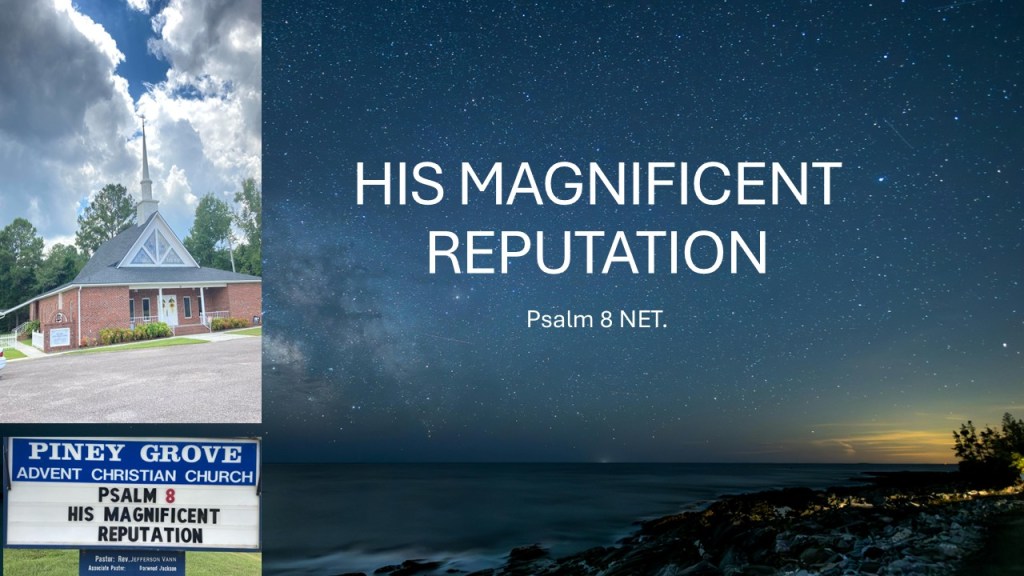
HIS MAGNIFICENT REPUTATION

HIS MHIS MAGNIFICENT REPUTATION

Psalm 8 NET.

For the music director, according to the gittith style; a psalm of David. 1 O LORD, our Lord, how magnificent is your reputation throughout the earth! You reveal your majesty in the heavens above! 2 From the mouths of children and nursing babies you have ordained praise on account of your adversaries, so that you might put an end to the vindictive enemy. 3 When I look up at the heavens, which your fingers made, and see the moon and the stars, which you set in place, 4 Of what importance is the human race, that you should notice them? Of what importance is mankind, that you should pay attention to them, 5 and make them a little less than the heavenly beings? You grant mankind honor and majesty; 6 you appoint them to rule over your creation; you have placed everything under their authority, 7 including all the sheep and cattle, as well as the wild animals, 8 the birds in the sky, the fish in the sea and everything that moves through the currents of the seas. 9 O LORD, our Lord, how magnificent is your reputation throughout the earth!

We are now in the 19th book of our English Bibles, the Psalms – the songbook of the Bible. It is poetry, but our translations rarely rhyme or have a metrical rhythm. The originals are not about that either. Hebrew poetry focuses more on pairing two or more expressions of the same idea than on rhyming sounds.

We recognize poetry in the 1784 anonymous nursery rhyme: “The rose is red, the violet’s blue, The honey’s sweet, and so are you.” Over time, the poem has changed a bit, but it still says what people wanted to say. The original used rhyme and paired similar syllables in 4-3-3-4 meter. Our modern version is a 4-4-4-4 meter.

Many Hebrew words of the same type rhyme, so rhyming is not a characteristic of Hebrew poetry. Instead, they pair statements of the same idea. For example, here is what that poem would look like if written in Hebrew poetry:

Roses are red, like a brilliant sunset

Violets are blue, the color of berries

Honey is sweet, as sweet as syrup

And you are sweet and precious to me.

The emphasis is shown by the repetition of an idea, using different words. In today’s text, verses 3-4 are good examples:

3 When I look up at the heavens, which your fingers made,

and see the moon and the stars, which you set in place,

4 Of what importance is the human race, that you should notice them?

Of what importance is mankind that you should pay attention to them?

That gives us insight into the structure of what we are reading. But what is the purpose of the Psalms? As poetry, the Psalms focus not on historical facts but on the feelings connected to them. In the Torah, God speaks to humanity. In the Psalms, humans talk back to him. They share their feelings. They use these words to encourage others to trust God and continue obeying him. Songs can sometimes inform us, but their main purpose is to go beyond instruction. They are meant to make us feel something – to evoke emotion. They are expressions of emotion.

Reading the Psalms can be difficult because they include feelings we might prefer not to acknowledge. These songs often involve a lot of complaining. They were written by people who experienced suffering and brought their laments to God. Consequently, they give us a view of a God who is large enough not to be bothered by our honest frustrations. He loves us and wants to hear from us, even if what we say falls short of praise.

The Psalms are also meant to bring us back to God when we’re distracted by our problems. When we struggle to make ends meet, it’s comforting to remember that we have a Shepherd watching over us, leading us to still waters, and guiding us with his rod and staff. When we feel confused and everything around us seems dark, we are encouraged to think of the LORD as our light and salvation.

Many of the Psalms were written by David, and this seems to be one of them. The inscription informs us that David wrote this song, dedicated it to the music director, and composed it in the Gittith style. Some parts of the psalm make sense when we consider that David was the author. The writer clearly understands musical styles. David was a skilled musician. The writer also reflects on the importance of human authority. David was a king. The writer has gone out at night, gazed at the open sky, and thought about the moon and stars. As a young boy, David was a shepherd and likely spent many nights watching over the flock.

As we explore the details of this ancient poem, it helps to visualize not just the facts David conveys, but the feelings they evoke in him. These feelings are what David wants us to experience.

The Shepherd King looks up.

David is sitting on his throne, but in his mind, he is back in the fields, watching his flock by night. Once the stray sheep are brought into the fold, there isn’t much to do. You spend most of your time just standing around. It gives you time to think. You probably get to know the night sky very well. David is not an evolutionist. He looks up into the night sky and does not see a bunch of random orbs that accidentally came together to make up that sky. He sees the heavens that the LORD God has made. He sees the moon and stars that the LORD God has set in place. The night sky is a testimony to the divine artist who created it as a testimony to his existence, greatness, and power. No human being could do that. The sky (as it says in another psalm) declares the glory of God. It displays his handiwork.

In the Psalms, the sky is where God sits, laughing at the proud claims of mere mortals. Birds are up there, along with the sun, moon, and stars, but even above all these wonders is the glory of God. His throne is there, and from it, he looks down on humanity. He spoke, and the sky came into existence. Now, he looks down from there to see if anyone understands and seeks him. The sky joins the divine chorus of all creation in praising its creator, even when human voices are silent. From the sky, the LORD speaks, and it rains water onto the ground. From the sky, God provided manna for his people to eat. All the gods of the nations are just dumb idols, but the LORD made the sky.

The sky symbolizes God’s character and work. Just as the sky is high above the earth, God’s mercy is great toward those who fear him. His mercy, truth, and glory are as boundless as the space between the ground and the stars. He also possesses infinite power. He is in the sky and does whatever he chooses. The sky represents the highest realm we can reach, and the psalmist says that even if he were to go there, he would find the same God as here. There is no escaping his presence.

King David authored this psalm. He once faced a giant and did not fear him because he knew someone greater and more powerful than Goliath. David had reached the pinnacle of the metaphorical ladder — he was king. No one was more powerful or more prominent. Still, King David looked up. Later kings would look down on their insignificant subjects and declare themselves gods. But David knew better. One of the healthiest lessons leaders can learn is that there is a God on the throne in heaven, and they are not him.

What is the Shepherd King feeling as he gazes up at the sky? He feels humbled by God’s greatness and understands his responsibility to Him. But that feeling of responsibility is more than humbling.

The Shepherd King looks around.

David was once in charge of a flock of sheep. Now he oversees an entire nation. He is amazed that small humans like himself have been given the authority to rule over anything in God’s creation. He mentions sheep first, which I find important. Then he talks about cattle, wild animals, the birds in the sky, and the fish and other creatures in the sea.

David sees himself as a model of exemplary leadership because he leads others by following God. He believes dominion is possible because that is what God designed all humans to do. He created us (as David mentions in verse 5) a little less than the heavenly beings, but he gave us charge over all the earthly beings. David is in awe that God even pays attention to us. He is amazed that God would delegate such power into our small hands.

Here we are, the human race. We have the potential for greatness, but we can also fail miserably. We can build, but we can also destroy. We can clean the air and water, but we can also pollute them. We can heal diseases, but we can also infect others and cause pandemics. We can blow up a mountain and mine its jewels. Yet, we can also use that same dynamite to blow up our neighbors. We can get it right, but we can also get it oh, so wrong.

God’s reputation is magnificent. But the strange part is that he has not chosen to protect that reputation by restricting us. Instead, he has entrusted us with the task of controlling this world. God’s power is impressive, but the fact that he has delegated some of that power to us is unbelievable. Compared to him, we are all children and nursing infants.

The Shepherd King looks beyond.

After David considers all that he and other humans are responsible for, he becomes prophetic. We only get hints from the Holy Spirit in this psalm, but the hints are there. Those children and nursing babies are praising God for something. When the crowds shouted Hosanna, welcoming Jesus into Jerusalem, the religious leaders were furious at them. But Jesus said that they were fulfilling the prediction in Psalm 8:2. David was a great king, but he also knew that one of his descendants would be an even greater king— the Messiah himself. He would come to Earth to redeem the lost and restore humanity, and God had prepared praise for himself because of this coming king (Matthew 21:16).

Another hint that David is becoming messianic in this Psalm is his use of the word translated as “mankind” in verse 4. The Hebrew phrase is בֶן־אָדָם – son of man. We know that Jesus often used that phrase as his own title. What’s happening in this psalm is that David is saying that God gives humans authority, but we all fall short of ruling with God’s perfection. However, there will come a human being in David’s future who will embody all that humanity is meant to be. He will reign with God’s glory and perfectly reflect God’s magnificent reputation.

The New Testament passages we read in today’s responsive reading[1] highlight that theme and expand on it. The author of Hebrews tells us that we don’t yet see everything under Jesus’ control, but that day is coming. Paul says that Jesus will reign until all of his enemies are defeated – with death itself being the final enemy. He also mentioned that Christ currently serves as the head of the church. As we submit to him, we are simply acknowledging him as the rightful King of Kings and Lord of Lords. Eventually, every knee will bow to him, so it is right and fitting for us to bow our knees to him now. David did not live to see his descendant begin his reign, but he will be raised to life to witness the moment when that reign becomes universal.

If we want to live out the message of Psalm 8 today, we should keep looking up at the sky and recognize God’s greatness and that everything belongs to Him. Then, we should look around to see how we can bring God’s order to the chaos caused by sinful humanity. But, most importantly, we should look beyond what we can do and long for the day when the rightful King of the universe will restore things to God’s original design. When Jesus returns, He will bring the world back to a state where we all reflect God’s magnificent reputation.


[1] Hebrews 2:5-9; 1 Corinthians 15:25-27; Ephesians 1:22.

Exodus 22

Exodus 22

Exodus 22:1 “If a person steals an ox or a sheep, and kills it or sells it, he should repay five oxen for an ox, and four sheep for a sheep.

Exodus 22:2 “If a thief is found breaking in and is attacked and dies as a result, there should be no bloodguilt for him,

Exodus 22:3 but if the sun has risen on him, there should be bloodguilt for him. He will surely pay. If he has nothing, then he should be sold for his theft.

Exodus 22:4 If the stolen animal is found alive in his possession, whether it is an ox or a donkey or a sheep, he should pay double.

Exodus 22:5 “If a person causes a field or vineyard to be grazed over or lets his animal loose and it feeds in another person’s field, he should recompense the person from the best in his own field and in his own vineyard.

Exodus 22:6 “If fire breaks out and catches in weeds so that the stacked grain or the standing grain or the field is consumed, the one who started the fire should fully recompense for the loss.

Exodus 22:7 “If a person gives to his neighbor money or goods to keep safe, and it is stolen from the person’s house, then, if the thief is found, that one should pay double.

Exodus 22:8 If the thief is not found, the owner of the house will come near to God to show whether or not he has put his hand to his neighbor’s property.

Exodus 22:9 For every breach of trust, whether it is for an ox, for a donkey, for a sheep, for a cloak, or for any kind of lost thing, of which one says, ‘This is it,’ the case of both parties should come before God. The one whom God condemns will pay double to that one’s neighbor.

Exodus 22:10 “If a person gives to their neighbor a donkey or an ox or a sheep or any animal to keep safe, and it dies or is injured or is driven away, without anyone seeing it,

Exodus 22:11 an oath by Yahveh should be between them both to see whether or not someone has put their hand to their neighbor’s property. The owner should accept the oath, and should not seek recompense.

Exodus 22:12 But if it is stolen from that person, they should seek recompense from its owner.

Exodus 22:13 If it is torn by animals, let them bring it as evidence. They should not seek recompense for what has been torn.

Exodus 22:14 “If a person borrows anything of their neighbor, and it is injured or dies, the owner not being with it, they should fully recompense the loss.

Exodus 22:15 If the owner was with it, they should not seek recompense; if it was rented, only the rental fee is due.

Exodus 22:16 “If a man seduces a virgin who is not engaged to be married and has sex with her, he should give the bride-price for her and make her his wife.

Exodus 22:17 If her father utterly refuses to give her to him, he should still pay money equal to the bride-price for virgins.

Exodus 22:18 “You will not allow a sorceress to live.

Exodus 22:19 “Whoever has sex with an animal should be put to death.

Exodus 22:20 “Whoever sacrifices to any god, other than Yahveh alone, should be set apart for destruction.

Exodus 22:21 “You should not take advantage of a foreign guest or oppress him, because you were foreign guests in the land of Egypt.

Exodus 22:22 You should not mistreat any widow or fatherless child.

Exodus 22:23 If you do mistreat them, and they cry out to me, I will surely hear their cry,

Exodus 22:24 and my wrath will burn, and I will kill you with the sword, and your wives will become widows and your children fatherless.

Exodus 22:25 “If you lend money to any of my poor people with you, you should not be like a creditor to him; you should not require interest from him.

Exodus 22:26 If you take your neighbor’s cloak in pledge, you should return it to him before the sun goes down,

Exodus 22:27 because that is his only covering; it is his cloak for his body; in what else would he sleep? Then if he cries out to me, I will respond, because I am compassionate.

Exodus 22:28 “You should not demean God, nor curse a leader of your people.

Exodus 22:29 “You should not delay offering from the fullness of your harvest and from the outpouring of your presses. The firstborn of your sons you should give to me.

Exodus 22:30 You should do the same with your oxen and with your sheep: seven days it should be with its mother; on the eighth day you should give it to me.

Exodus 22:31 “You should be sacred for me. For that reason, you should not eat any flesh that is torn by animals in the field; you should throw it to the dogs.

Exodus 22 quotes:

“The commandment tells us that we are not to steal (Exodus 20:15). This commandment assumes the privilege and right of ownership by individuals, families, business establishments, corporations, partnerships, and churches. Stiff penalties are meted out to dissuade a potential thief, or, in the case of a theft, have the thief make restitution to compensate the victim (Exodus 22:1-15).”

DeMar, Gary. God and Government. American Vision Press, 1982. p. 94.

“The person who is responsible for accidental damage or who has borrowed something is required to make good what the owner has lost. A singlefold restitution takes place in order to match the loss. In the case of theft, by contrast, the restitution is usually double (Exodus 22:7).”

Poythress, Vern S. The Shadow of Christ in the Law of Moses. P & R Pub., 1995. p. 126.

“A sorceress claims to be able to use supernatural power in order to cast an evil spell upon people, causing accidents, sickness or death. A more familiar term in those countries such as in Africa where sorcery is still practiced is “witchcraft.” The practice of sorcery is idolatry. It gives honor to the powers of Satan rather than to the true God. That is why the Lord demanded the death penalty, just as every form of open idolatry in Israel’s theocracy was punished with death. In many cultures and societies in the world today the power of witchcraft is still one of the greatest forces of evil.”

Wendland, Ernst H. Exodus. Northwestern Pub. House, 1984. p. 150.

Exodus 22 links:

covenant household property loss liability rights
Exodus- a holy people
laws about giving
set apart for destruction
taking advantage


EXODUS in Jeff’s library

Deuteronomy 27

Deuteronomy 27

Deuteronomy 27:1 Moses and the elders of Israel commanded the people, and they said, “Watch every command I am giving you today.

Deuteronomy 27:2 When you cross the Jordan into the land Yahveh your God is giving you, set up large stones and cover them with plaster.

Deuteronomy 27:3 Write all the words of this instruction on the stones after you cross to enter the land Yahveh your God is giving you, a land flowing with milk and honey, as Yahveh, the God of your fathers, has promised you.

Deuteronomy 27:4 When you have crossed the Jordan, you are to set up these stones on Mount Ebal, as I am commanding you today, and you are to cover them with plaster.

Deuteronomy 27:5 Build an altar of stones there to Yahveh your God – do not use any iron tool on them.

Deuteronomy 27:6 Use uncut stones to build the altar of Yahveh, your God, and offer ascending offerings to Yahveh, your God, on it.

Deuteronomy 27:7 There you are to sacrifice offerings for healthy relationships,[1] eat, and enjoy the face of Yahveh, your God.

Deuteronomy 27:8 Write clearly all the words of this instruction on the plastered stones.”

Deuteronomy 27:9 Moses and the Levitical priests spoke to all Israel, and this is what they said: “Be silent, Israel, and listen! This day, you have become the people of Yahveh, your God.

Deuteronomy 27:10 Obey Yahveh your God and follow his commands and prescriptions I am giving you today.”

Deuteronomy 27:11 On that day, Moses commanded the people, and this is what he said:

Deuteronomy 27:12 “When you have crossed the Jordan, these tribes will stand on Mount Gerizim to empower the people: Simeon, Levi, Judah, Issachar, Joseph, and Benjamin.

Deuteronomy 27:13 And these tribes will stand on Mount Ebal to deliver the affliction: Reuben, Gad, Asher, Zebulun, Dan, and Naphtali.

Deuteronomy 27:14 The Levites will answer in a loud voice to every Israelite:

Deuteronomy 27:15 ‘The person who makes a carved idol or cast image, which is repulsive to Yahveh, the work of a craftsman, and places it in secret is afflicted with a curse.’[2] And all the people will answer, ‘Amen!’

Deuteronomy 27:16 ‘The one who dishonors his father or mother is afflicted with a curse.’ And all the people will say, ‘Amen!’

Deuteronomy 27:17 ‘The one who moves his neighbor’s boundary marker is afflicted with a curse.’ And all the people will say, ‘Amen!’

Deuteronomy 27:18 ‘The one who leads a blind person astray on the road is afflicted with a curse.’ And all the people will say, ‘Amen!’

Deuteronomy 27:19 ‘The one who denies justice to a guest, a fatherless child, or a widow is afflicted with a curse.’ And all the people will say, ‘Amen!’

Deuteronomy 27:20 ‘The one who has sex with his father’s wife is afflicted with a curse, for he has violated his father’s marriage bed.’ And all the people will say, ‘Amen! ‘

Deuteronomy 27:21 ‘The one who has sex with any animal is afflicted with a curse.’ And all the people will say, ‘Amen!’

Deuteronomy 27:22 ‘The one who has sex with his sister, whether his father’s daughter or his mother’s daughter is afflicted with a curse.’ And all the people will say, ‘Amen!’

Deuteronomy 27:23 ‘The one who has sex with his mother-in-law is afflicted with a curse.’ And all the people will say, ‘Amen!’

Deuteronomy 27:24 ‘The one who secretly kills his neighbor is afflicted with a curse.’ And all the people will say, ‘Amen!’

Deuteronomy 27:25 ‘The one who accepts a “gift” to kill an innocent throat is afflicted with a curse.’ And all the people will say, ‘Amen!’

Deuteronomy 27:26 ‘Anyone who does not put the words of this instruction into practice is afflicted with a curse.’ And all the people will say, ‘Amen!’


[1]שֶׁלֶם = offering for healthy relationships.

[2]אָרָר = afflict with a curse. Deuteronomy 27:15, 16, 17, 18, 19, 20, 21, 22, 23, 24, 25, 26; 28:16, 17, 18, 19.

Deuteronomy 27 quotes:

“Chapter 27 makes an important literary and theological connection with 11:26–32 in terms of Mounts Gerizim and Ebal and the associated blessings and curses, as well as commitment to the covenant laws. As such, these passages provide a frame for the laws in chapters 12 – 26, establishing a final link between Horeb, Moab and Shechem on the basis of today (27:1, 10–11; cf. 5:1). However, chapter 27 locates the altar and the inscription of the laws upon the mountain of curse, Mount Ebal, which must be replicated when Israel crosses the Jordan (27:1–8; cf. Josh. 8:30–35). Both the elders (27:1) and the Levitical priests (27:9) witness this event, and will ensure the future of the law. Even though Moses announces both blessings and curses (27:11–13), only twelve curses are recited by the priestly Levites (27:14–26; cf. 29:17–28).This appears to be a deliberate literary and theological ploy, providing a fitting conclusion to the laws already given, and focusing especially on secret aspects of breaking the law. Furthermore, these laws remind Israel (symbolized by the twelve curses) that they stand under the curse as far as covenant and law are concerned.”

Woods, Edward J.. Deuteronomy: An Introduction and Commentary (Tyndale Old Testament Commentaries Book 5) . InterVarsity Press. Kindle Edition.

“The specific details concerning the continuity of leadership in the covenant community are stated in chs. 29–30, but in ch. 27 the general principle is given, namely, that in the future there would have to be a further renewal of obedience and commitment to God’s law, which had just been declared and expounded (chs. 12–26).”

Craigie, Peter C.. The Book of Deuteronomy (The New International Commentary on the Old Testament) (p. 327). Wm. B. Eerdmans Publishing Co.. Kindle Edition.

Deuteronomy 27 links:

an altar of stones
appreciating parents
caring for lives
determining deviancy
duty to the disabled
final affliction
getting away with it
illegitimate relationships
in retrospect- dos and don’ts
our end of the contract
respecting the contract
secret idols
shut up and listen up
Spring up, Oh Well
stipulations
supporting the marginalized
victimless crime


The DEUTERONOMY shelf in Jeff’s library.

Exodus 21

Exodus 21

Exodus 21:1 “These are the judgments that you should explain to them.

Exodus 21:2 When you contract with a Hebrew slave, he should serve six years, and in the seventh he should go out free, for nothing.

Exodus 21:3 If he comes in single, he should go out single; if he comes in married, then his wife should go out with him.

Exodus 21:4 If his employer gives him a wife and she bears him sons or daughters, the wife and her children will be her employer’s, and he should go out alone.

Exodus 21:5 But if the slave declares, ‘I love my master, my wife, and my children; I will not go out free,’

Exodus 21:6 then his employer should bring him to God, and he should bring him to the door or the doorpost. And his employer should bore his ear through with an awl, and he will be his slave permanently.

Exodus 21:7 “When a man contracts out his daughter as a female slave, she should not go out as the male slaves do.

Exodus 21:8 If she does not please her employer, who has designated her for himself, then he should let her be redeemed. He will have no right to sell her to foreign people, since he has broken faith with her.

Exodus 21:9 If he designates her for his son, he will deal with her justly as with a daughter.

Exodus 21:10 If he takes another wife to himself, he will not diminish her food, her clothing, or her marital rights.

Exodus 21:11 And if he does not do these three things for her, she will go out for nothing, without payment of money.

Exodus 21:12 “Whoever hits a man so hard that he dies should be put to death.

Exodus 21:13 But if he did not lie in wait for him, but God let him fall into his hand, then I will appoint for you a location to which he may escape.

Exodus 21:14 But if a man willfully attacks another to kill him deliberately, you should take him even from my altar, so that he may die.

Exodus 21:15 “Whoever hits his father or his mother should be put to death.

Exodus 21:16 “Whoever kidnaps a man and sells him into slavery, and anyone found in possession of him, should be put to death.

Exodus 21:17 “Whoever curses his father or his mother should be put to death.

Exodus 21:18 “When men quarrel and one hits the other with a stone or with his fist and the man does not die but takes to his bed,

Exodus 21:19 then if the man rises again and walks outdoors with his staff, he who struck him will be clear; only he should pay for the loss of his time and should make sure he is thoroughly healed.

Exodus 21:20 “When a man hits his slave, male or female, with a rod and the slave dies under his hand, he should be avenged.

Exodus 21:21 But if the slave recovers after a day or two, he is not to be avenged, because the slave is his silver.

Exodus 21:22 “When men fight together and hit a pregnant woman, so that her children come out, but there is no lasting harm to them, the one who hit her should surely be fined, whatever the woman’s husband will impose on him, and he should pay as the judges determine.

Exodus 21:23 But if there is lasting harm, then you will pay throat for throat,

Exodus 21:24 eye for eye, tooth for tooth, hand for hand, foot for foot,

Exodus 21:25 burn for burn, wound for wound, stripe for stripe.

Exodus 21:26 “When a man hits the eye of his slave, male or female, and destroys it, he should let the slave go free because of his eye.

Exodus 21:27 If he knocks out the tooth of his slave, male or female, he should let the slave go free because of his tooth.

Exodus 21:28 “When an ox gores a man or a woman, and death occurs, the ox should be stoned, and its meat should not be eaten, but the owner of the ox will not be liable.

Exodus 21:29 But if the ox has been given to goring in the past, and its owner has been warned but has not kept watch over it, and it kills a man or a woman, the ox should be stoned, and its owner also should be put to death.

Exodus 21:30 If a redemption price is set for him, then he should give for the redemption of his throat whatever is set for him.

Exodus 21:31 If it gores a man’s son or daughter, he should be dealt with according to this same justice.

Exodus 21:32 If the ox gores a slave, male or female, the owner will give to their master thirty shekels of silver, and the ox should be stoned.

Exodus 21:33 “When a man opens a pit, or when a man digs a pit but does not cover it, and an ox or a donkey falls into it,

Exodus 21:34 the owner of the pit should make restoration. He should give money to its owner, and the dead animal will be his.

Exodus 21:35 “When one man’s ox butts another’s, so that it dies, then they should sell the live ox and share its price, and the dead beast also they will share.

Exodus 21:36 Or if it is known that the ox has been accustomed to gore in the past, and its owner has not kept watch over it, he should repay ox for ox, and the dead animal will be his.

Exodus 21 quotes:

“For four centuries, from Joseph to Moses, God’s people had lived as slaves in Egypt. In the world of the Old Testament, “slave of the Lord” was a title of honor. In the Old Testament Abraham, David, Moses and Joshua are all referred to by the Hebrew word for slave (ebed). Though, slavery played only a minimal role in Jewish society, the Jews were the kindest of slaveholders in the ancient world. Jewish slavery was often so benign that a special provision was made for slaves who, after their time of servitude expired, chose to remain slaves. It has been called the “order of the pierced ear.”

Card, Michael. A Better Freedom : Finding Life as Slaves of Christ. InterVarsity Press, 2009, http://site.ebrary.com/id/10837631. p. 26.

“Perhaps the most crucial question for a Christian regarding abortion is whether God considers the unborn child a person. This question takes precedence over essentially pragmatic considerations such as socioeconomic distress, mental anguish, and illegitimacy. If the Scriptures clearly imply the personhood of the unborn, then Christians have an obligation to seek the protection of the unborn through educational, religious, and legislative action.”

Davis, John Jefferson. Abortion and the Christian : What Every Believer Should Know. Presbyterian and Reformed Pub. Co., 1984. p. 40.

“One of the most general principles of God’s justice is the principle of similar measure. “As you have done, it will be done to you, your deeds will return upon your own head” (Obadiah 15). Jeremiah 50:29, Habakkuk 2:8, Joel 3:4, 7, and other passages articulate the same principle in varying forms. The famous law of punishment, “eye for eye, tooth for tooth” (Exodus 21:24), embodies the same principle in a specific juridical context. It was never intended as an excuse for personal vengeance but as a directive to judges making decisions regarding penalties in cases of injury (Exodus 21:22-25).”

Poythress, Vern S. The Shadow of Christ in the Law of Moses. P & R Pub., 1995. p. 123.

Exodus 21 links:

covenant household employment rights
covenant household injury compensation rights
covenant household property loss compensation rights
Exodus- Restitution
expire


Maranatha Daily Devotional – Thursday, March 21, 2019
Maranatha Daily Devotional – Thursday, March 23, 2023
Maranatha Daily Devotional – Tuesday, March 23, 2021


EXODUS in Jeff’s library

Exodus 20

Exodus 20

Exodus 20:1 Then God spoke all these words, and this is what he said,

Exodus 20:2 “I am Yahveh your God, who rescued you from the land of Egypt, taking you out of the house of slavery.

Exodus 20:3 “No other gods before me are for you.

Exodus 20:4 “You will not make for yourself a carved image, or any reproduction of anything that is in the sky above, or that is in the land beneath, or that is in the water under the land.

Exodus 20:5 You will not bow down to them or slave for them, because I Yahveh your God am a jealous God, visiting the iniquity of the fathers on the children to the third and the fourth generation of those who hate me,

Exodus 20:6 but showing covenant faithfulness to thousands of those who love me and keep my commandments.

Exodus 20:7 “You will not use the name of Yahveh your God hypocritically, because Yahveh will not hold him guiltless who uses his name hypocritically.

Exodus 20:8 “Remember the Sabbath day, by keeping it holy.

Exodus 20:9 Six days you will work, and do all your labor

Exodus 20:10 but the seventh day is a Sabbath to Yahveh your God. On it you will not do any work, you, or your son, or your daughter, your male slave, or your female slave, or your livestock, or the foreign guest who is within your gates.

Exodus 20:11 Because in six days Yahveh made the sky and land, the sea, and everything that is in them, and ceased on the seventh day. Therefore, Yahveh blessed the Sabbath day and made it holy.

Exodus 20:12 “Value your father and your mother, so that your lives may be extended in the land that Yahveh your God is giving you.

Exodus 20:13 “Do not murder.

Exodus 20:14 “Do not commit adultery.

Exodus 20:15 “Do not steal.

Exodus 20:16 “Do not give false testimony against your neighbor.

Exodus 20:17 “Do not crave[1] your neighbor’s house; Do not lust after your neighbor’s wife, or greedily seek his male slave, or his female slave, or his ox, or his donkey, or anything that is your neighbor’s.”

Exodus 20:18 Then all the people saw the thunder and the flashes of lightning and the sound of the trumpet and the mountain smoking, the people were afraid and trembled, and they stood far off

Exodus 20:19 and said to Moses, “You speak to us, and we will listen; but do not let God speak to us, or else we will die.”

Exodus 20:20 Moses said to the people, “Do not fear, because God has come to test you, so that the fear of him may be before you, so that you may not fail.”

Exodus 20:21 The people stood far off, while Moses approached the thick darkness where God was.

Exodus 20:22 And Yahveh told Moses, “This is what you should say to the people of Israel: ‘You have seen for yourselves that I have communicated with you from the sky.

Exodus 20:23 Do not make gods of silver to represent me, nor make for yourselves gods of gold.

Exodus 20:24 You should make for me an earthen altar and sacrifice on it your whole burnt offerings and your peace offerings, your sheep and your oxen. I will come to you and bless you in each place where I cause my name to be remembered.

Exodus 20:25 If you make me an altar of stone, you should not build it out of carved stones, because if you use your tool on it you defile it.

Exodus 20:26 And do not go up by steps to my altar, so that your nakedness is not exposed on it.’


[1]חמד = crave. Exodus 20:17; 34:24.

Exodus 20 quotes:

“Exodus 20:3 records the words of the first commandment: “You shall have no other Gods before me.” Topping the list of ten, this “law to love by” reminds us that God the Creator, who revealed Himself through His Word and His world, is the one, the only one, to trust, obey, worship, and love. This God, rather than the variety of “gods” people revere, must have first place in our lives. Five Learning Center activities, focusing on the themes of “One” and “First,” are intended to help participants gain a greater understanding of this important instruction and grasp the message that the First. Commandment invites us into an intimate union with a loving God.”

Wezeman, Phyllis Vos, and Judith Harris Chase. Laws to Love by : The Ten Commandments. Educational Ministries, 1996. p. 15.

“Law is an important part of every human society because it regulates human conduct and defines moral standards. This is especially true of the society in the Bible, the people of God. In both the Old and New Testaments, law and the way life is shaped by law are significant concerns that have various expressions and understandings. The first five books of the Bible, Genesis through Deuteronomy, deal in large part with the giving of the law to ancient Israel. Here are grouped the major collections of law for the whole Bible, including two versions of the Ten Commandments (Exodus 20 and Deuteronomy 5). But the rest of the Old Testament constantly refers back to the laws. For example, the prophets rely on them to announce God’s judgment on the people; and the history books (such as Kings and Ezra) and wisdom writings (including Proverbs and Job) assume the grounding of Israel in the law.”

Dutcher-Walls, Patricia, et al. The Commandments : For a Blessed Life. Kerygma Program, 1999. p. 3.

“The ten commandments are introduced by the statement, “I am the Lord your God, who brought you out of the land of Egypt, out of the house of slavery” (Exodus 20:2; Deuteronomy 5:6) . Israel had a history. For more than four hundred years, it had been a nation of slaves. Then, without any action on their part to merit it, the people had experienced a series of miracles, culminating in their passage through the Red Sea and the subsequent destruction of the enemies who were in pursuit of them. It was on the basis of this experience that God had a right to give them a body of commandments.”

Kalas, J. Ellsworth. The Ten Commandments from the Back Side. Abingdon Press, 1998. p. 108.

Exodus 20 links:

covenant constitution (part one)
covenant constitution (part two)
Exodus- second exodus
Exodus- spirituality and servanthood
invaded
monotheistic worship
The sky God is supreme


Maranatha Daily Devotional – Friday, August 18, 2017
Maranatha Daily Devotional – Saturday, August 19, 2017
Maranatha Daily Devotional – Sunday, August 20, 2017


EXODUS in Jeff’s library