

JOSHUA THE MISSIONARY       

JOSHUA THE MISSIONARY       

Joshua 1:1-9 NET.

1 After Moses the LORD’s servant died, the LORD said to Joshua son of Nun, Moses’ assistant: 2 “Moses my servant is dead. Get ready! Cross the Jordan River! Lead these people into the land which I am ready to hand over to them. 3 I am handing over to you every place you set foot, as I promised Moses. 4 Your territory will extend from the wilderness in the south to Lebanon in the north. It will extend all the way to the great River Euphrates in the east (including all of Syria) and all the way to the Mediterranean Sea in the west. 5 No one will be able to resist you all the days of your life. As I was with Moses, so I will be with you. I will not abandon you or leave you alone. 6   Be strong and brave! You must lead these people in the conquest of this land that I solemnly promised their ancestors I would hand over to them. 7 Make sure you are very strong and brave! Carefully obey all the law my servant Moses charged you to keep! Do not swerve from it to the right or to the left, so that you may be successful in all you do. 8  This law scroll must not leave your lips! You must memorize it day and night so you can carefully obey all that is written in it. Then you will prosper and be successful. 9 I repeat, be strong and brave! Don’t be afraid and don’t panic, for I, the LORD your God, am with you in all you do.”

We are still bunny-hopping our way through the Bible, stopping every Sunday at the place where we are in our reading—two chapters a day. This week, we finished Deuteronomy and began Joshua on Friday. Because I am planning two special messages for Palm Sunday and Easter, this will be our only message based on the book of Joshua. I am focusing on these introductory words from Joshua 1 as the text for my message.

It is essential at the outset that I establish the relevance of the study of Joshua. Some Christians find it difficult to study Old Testament books like Joshua because they fail to see what these ancient narratives have to do with them in their modern setting. We might remember some of the stories in Joshua from Sunday School lessons or past sermons, or cartoons. But aside from these little dips into the pool, we tend to shy away from Joshua because we might be tempted to think of it as a relatively shallow book. The truth is that Joshua is just as deep as the other biblical books we are studying. It had a purpose in the canon of Scripture, and that purpose is still as crucial today as it was when its words were first written.

But what is the purpose of the book of Joshua? Why are its words relevant for 21st-century Christians? The Bible teaches that every Scripture is inspired by God and profitable for us. But how can we profit from these old words and ancient stories?

The key to answering that question might be to come at the question from the other end first. Before asking what the old stories have to do with us, maybe we should take a closer look at what we are doing to see if there are some points of contact. There are lots of things we do today that are different than what God’s people were doing in the time of Joshua. What are some things that are the same?

One thing that is the same is that we are serving the same God that Joshua did. Marcion was wrong when he suggested that the God of the Old Testament was an evil, wrathful God and that a loving, compassionate God had replaced him. Remember, God does not change. He is immutable. Times change, circumstances change, but the God we believe in does not change.

When they asked Jesus what the greatest commandment was, he indicated that loving God wholeheartedly is #1. The second greatest commandment is to love our neighbors as ourselves. Those two life priorities were valid and relevant in Joshua’s time, and they are still valid and applicable to us today.

So, what has changed? The simple answer is that the mission God has called us to is different than the mission God was calling Joshua to. Jesus calls us all to a mission of cross-cultural evangelism. He commanded us to disciple all the nations. God called Joshua to a different mission. We are going to examine that mission this morning. However, the thing that we need to keep in mind is that even though our mission is different from Joshua’s, there will be points of contact. Some of the things that Joshua learned about his mission are helpful for us to keep in mind as we seek to fulfill our mission.

Joshua’s Mission

Instead of outlining every task Joshua was to do, the Lord described Joshua’s mission by summarizing the first three steps of that mission. We find that summary in verse 2. The Lord said that Joshua was to “Get ready! Cross the Jordan River! Lead these people into the land which I am ready to hand over to them.” The first phase was to get ready. This involved Joshua getting himself ready. You cannot get your team prepared if you are not ready yourself.

The principle of personal preparation applies to us in our mission as well. We should not expect to step into the task of global evangelization without preparation. Jesus prepared his apostles for the task over several years of training. Then he challenged them to feed the sheep – to get the other disciples trained so that they could continue the mission by being disciplers.

Joshua was encouraged to be ready emotionally and physically for the task of leadership. He was commanded to be strong and brave. He was told to resist the temptation to be afraid and panic when things got rough. He had to build up the strength he needed because the mission he was called to would not be an easy one. He was expected to display the confidence that comes from knowing that God was with him.

The second phase of Joshua’s to-do list in today’s text is to cross over the Jordan river. He could not do that himself. The command to him (as leader) was a command to the whole people of Israel. It was going to be a miracle that only God could accomplish, but the people needed to be prepared for it. The leaders needed to prepare the people. That is part of the job for anyone called into ministry. Our task is not simply to maintain the status quo, but it also requires us to prepare the church for the next thing God is going to do among us.

The third phase for Joshua was to lead the people into the Promised Land. He was not to merely point in the direction and drive the people into it. He was to be a frontline leader. It is one thing to be an armchair general. It is another thing to strap on the sword and tell the soldiers to follow you into battle. As I said, these three commands do not encompass all of Joshua’s mission. God did not reveal everything to Joshua. We should not expect him to do that for us either. If we knew all the details, most of us would go hide in the woods. Our Lord is wise to only show us the next few steps in our path of following him.

Joshua’s Master

Notice how many times the word “I” shows up in today’s text. These words are God’s words. He is challenging Joshua to lead his people to where he wants them, but the emphasis is not entirely on Joshua. Joshua is challenged to be strong and brave, but notice what God says he will do:

  • God says he is ready to hand over the land to them. He promises to give them all the land that they set foot on.
  • God promises to be with Joshua the same way he was with his predecessor, Moses.
  • God reminds Joshua that he solemnly promised his ancestors to hand the land over to their descendants. Now was the time to fulfill that promise.
  • God promises to be with Joshua in all that he does.

There are two truths that every Christian should remember every day. These two things seem like diametrical opposites, but they are both true. The first truth is that we are slaves of God. He is our owner and our master. That may seem to be a depressing reality, but it is actually quite freeing.

The second truth is that our Master is Almighty God. He controls the universe. Nothing happens that he does not allow. We pray to him because only he can make the impossible possible. We can face any challenge—not because we are able, but because our Master is always able.

Joshua’s Manual

Note also how God stresses to Moses his absolute reliance upon the holy Scriptures. God tells him to obey all the laws his servant Moses carefully charged him to keep! He said that Joshua should not swerve from it to the right or to the left so that he may be successful in all he does. He said that the law scroll must not leave Joshua’s lips! He had to memorize it day and night so he could carefully obey all that is written in it. Then, he would prosper and be successful. God was sending Joshua on a mission, and the word of God was to be his mission manual. He did not have the whole Bible, but every word he had was the Holy Bible.

What Joshua the missionary had for his missionary work would help him accomplish that work. The same is true for you and me today. We read and study the Bible not to entertain us – not even to inform us. Our goal is not to learn the Bible as if it were an encyclopedia of religious trivia. It is our mission manual. It empowers us to do what God has called us to do.

As we read Joshua this month, let’s remember that its words do not describe a king or a military general. Joshua’s work was missionary work. May its words help us to be strong, brave, and faithful in the missionary work God has called us to do.

Holy Communion

1 John 2:14 NET.

“I have written to you, children, that you have known the Father. I have written to you, fathers, that you have known him who has been from the beginning. I have written to you, young people, that you are strong, and the word of God resides in you, and you have conquered the evil one.”

As we consider the death of our Lord this morning, let us remember that what Jesus did for us on the cross is enough, no matter where we are in life’s journey.

If you are new to the faith – a mere child of God – you might wonder if you are going to survive the challenges of life and come out on the other end with a genuine faith. God’s word to you is that you have known the Father. That is all you need because your confidence is in Him, not yourself.

The same promise applies to the old-timers in the faith—the Fathers and Mothers who have fought most of their battles—their mission is almost accomplished. But their confidence is not in their own accomplishments. It is in the fact that they have come to know the Father because of the finished work of Christ on the cross.

And what about the young men and women? Those who are going to be first into the battle, claiming territory for God and his kingdom?  The manual tells them that they are strong, that the word of God resides in them, and that they have conquered the evil one. Their battle is fresh, and they are in the front of it, but from God’s perspective, they have already won. They are challenged to let the word of Christ dwell in them richly because it is the manual that will take them from the present battle to the future glory.

Lord, we thank you for your finished work of redemption. We pray for your power to take us to the finish of our mission for you. We ask that you make us strong and brave warriors and faithful slaves of our Almighty Master. Amen.

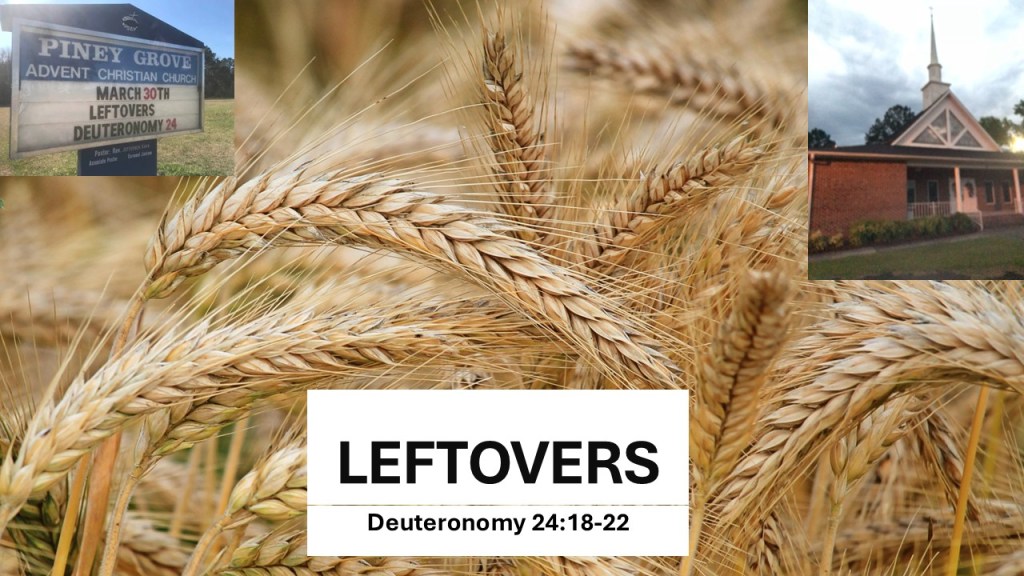
LEFTOVERS  

LEFTOVERS  

Deuteronomy 24:18-22 NET.

18 Remember that you were slaves in Egypt and that the LORD your God redeemed you from there; therefore I am commanding you to do all this.

19 Whenever you reap your harvest in your field and leave some unraked grain there, you must not return to get it; it should go to the resident foreigner, orphan, and widow so that the LORD your God may bless all the work you do. 20 When you beat your olive tree you must not repeat the procedure; the remaining olives belong to the resident foreigner, orphan, and widow. 21 When you gather the grapes of your vineyard you must not do so a second time; they should go to the resident foreigner, orphan, and widow. 22 Remember that you were slaves in the land of Egypt; therefore, I am commanding you to do all this.

It is merely coincidental that I am preaching this sermon after two weeks of dealing with a personal crisis with my family. Penny’s accident meant that I had to take on the role of full-time caregiver. It has been difficult for both of us to adjust to the new normal in our household. It would have been even more difficult if it had been necessary for me to provide all the meals as well as do all the cleaning. But many of you stepped in and provided some excellent meals for us. As a consequence, all I had to do most days is figure out which leftovers I would heat up. In fact, most of the time, I didn’t even have to go to the freezer to thaw anything out. The only drawback was that many of our meals looked and tasted just like the meals we had previously. That’s Okay. We are very grateful for your help.

So, as I said, it is merely coincidental that the title of today’s sermon is “LEFTOVERS.”  The title comes from the command that the LORD gave the Israelites for when they crossed over the Jordan into the Promised Land. He told them to leave some grain in their fields when they harvested. That leftover grain would be for the poor: particularly the resident foreigners, the orphans, and the widows who lived near them. He told them to treat their orchards the same way they treated their fields. They could harvest their olive trees, but they should not make a second pass over them. Instead, anything left over should be reserved for the poor: that is, the resident foreigners, the orphans, and the widows. They should treat their vineyards the same way. They could gather the grapes once. But anything left over should go to the resident foreigners, the orphans, and the widows.

It is important as we study these particular laws to understand that each of them is merely a single application of an over-arching principle. If we don’t do that, then most people who read these words will be disinterested and feel that nothing applies to them. After all, some of you own fields and plant them. Fewer of you own gravevines – and even those do not own entire vineyards. As far as I know, none of you have an olive orchard. To understand the relevance of today’s text, we need to look at the principles that it teaches, not just the practices it lists.

The redeemed should remember (18, 22).

The LORD tells the Israelites to remember that they were slaves in Egypt. Once they get into the Promised Land, their status will change from a nation of slaves to a nation of landowners. They will own land and property and will not have to give the proceeds to any master. They will be free to gain wealth. Whereas their masters in Egypt had exploited them, now they would be tempted to exploit others. The shoe will be on the other foot. So, the LORD commands them to remember what it felt like to be on the receiving end of exploitation and oppression.

They were to remember that the LORD redeemed them from Egypt. So, they were not to recreate the same situation that they faced in another land. They had been slaves, so they were not to become enslavers. They were to look out for those with fewer opportunities than they had. Unless they remembered how they had been exploited, history was liable to repeat itself, with the Israelites now on the potential giving end of the exploitation.

The command was for them to keep their greed in check. Instead of looking out for number one, they were to look out for all those little people who would not experience the immediate advantages of the new land.

This was not the only law that God established to take care of the poor among his people. Note Deuteronomy 14:28-29. It says that “At the end of every three years you must bring all the tithe of your produce, in that very year, and you must store it up in your villages. Then the Levites (because they have no allotment or inheritance with you), the resident foreigners, the orphans, and the widows of your villages may come and eat their fill so that the LORD your God may bless you in all the work you do.” The produce of the land was to be tithed, and every three years, it would be distributed to four groups. The three groups already mentioned: the resident foreigners, the orphans, and the widows, and also the Levites because they are not distributed territory by tribe like the other tribes are.

Not also Deuteronomy 26:12-15. It says, When you finish tithing all your income in the third year (the year of tithing), you must give it to the Levites, the resident foreigners, the orphans, and the widows so that they may eat to their satisfaction in your villages. Then you shall say before the LORD your God, “I have removed the sacred offering from my house and given it to the Levites, the resident foreigners, the orphans, and the widows just as you have commanded me. I have not violated or forgotten your commandments. I have not eaten anything when I was in mourning, or removed any of it while ceremonially unclean, or offered any of it to the dead; I have obeyed you and have done everything you have commanded me.             Look down from your holy dwelling place in heaven and bless your people, Israel, and the land you have given us, just as you promised our ancestors- a land flowing with milk and honey.” The same four groups of underprivileged among the Israelites are mentioned. But this passage points to another principle about taking care of the needy:

The redeemed should seek blessing (19).

That verse says, “Whenever you reap your harvest in your field and leave some unraked grain there, you must not return to get it; it should go to the resident foreigner, orphan, and widow so that the LORD your God may bless all the work you do.” The blessing on the crops was conditional on the sharing of the wealth with the lesser advantaged. If God looked down and saw a greedy farmer who did not share, he would withhold his blessing on that farmer and his family.

Jesus told a parable about a farmer who was greedy like that. He said, “Beware! Guard against every kind of greed. Life is not measured by how much you own”  (Luke 12:15). That statement is just as radical today as it was two millennia ago. Today, the popular belief is that those who have the most stuff have the best life.  The rich are idolized no matter what they believe and no matter who they serve.

Then he told them a story: “A rich man had a fertile farm that produced fine crops.  He said to himself, ‘What should I do? I don’t have room for all my crops.’  Then he said, ‘I know! I’ll tear down my barns and build bigger ones. Then I’ll have room enough to store all my wheat and other goods.  And I’ll sit back and say to myself, ‘My friend, you have enough stored away for years to come. Now, take it easy! Eat, drink, and be merry!”(Luke 12:16-19).

This was the man’s 401K – his retirement plan.  He said, “I got some good stuff.  I’m going to make bigger barns so that I can hold all my stuff.  Then I’m going to kick back, go to Barbados, and get some sand between my toes.”  Well, that was the plan.  But God knew something that the would-be retiree did not know:

But God said to him, ‘You fool! You will die this very night. Then who will get everything you worked for?’ (Luke 12:20).

The man was rich, resourceful, productive, and successful. He had made a plan that would provide for his needs and (presumably) those of his family.  He would have been praised by the popular culture of his day and ours.  But in just one moment – one last heartbeat – he was going to lose all that he had ever gained. 

 “Yes, a person is a fool to store up earthly wealth but not have a rich relationship with God”(Luke 12:21)

This is the moral of the story.  Jesus tells his disciples and the others who have ears to hear, “Don’t waste your life just collecting stuff.  Bigger barns are not the answer.”  So, what is the answer?  The answer is “a rich relationship with God.”  But how do we get that?  One way is to use our wealth to do what God would do: help the needy!

We can build bigger barns, or we can give our excess to help those less well off. It is no secret which option Jesus would want us to choose. He taught people that when they put on a banquet, they should invite those who cannot repay them. In his parable of the wedding banquet, the original invitees did not respond, so the king told his slaves to scour the streets and invite everyone. In the parable, God is the king, and we are his slaves. He wants us to share the blessing the king has in store, and that is how we will be blessed. But according to today’s text, the opposite is also true. The Israelites who hoarded their crops would lose the blessing. If we don’t pass on the blessings of our redemption, we displease the one who redeemed us.

The redeemed should be redeemers (19-21).

The story of Ruth shows how this principle is appropriately illustrated. Boaz was an Israelite who was greatly blessed. He shared that blessing with one who was a qualified member of one of the disadvantaged classes. She was a foreign resident. She was an outsider: an immigrant. Most people consider the Book of Ruth a love story, and that is exactly what it is. But it is more than a romance. It is the story of a man who was redeemed who chose to become a redeemer. The tradition of the kinsman redeemer came out of a desire to obey commands such as the ones highlighted in today’s text.

Ruth asked Naomi for permission to go and gather in the fields. Boaz obeyed the biblical command to leave some grain to glean. In fact, he went out of his way to show compassion to Ruth. He told his slaves to pull out some ears of grain and drop them so that she could gather them up.

The lesson for us is that our God wants us to be like Boaz. He wants us to demonstrate his compassion toward those who are underprivileged and needy. When we start helping the needy in Christ’s name, then the world around us will be more interested in what we say about him. Being a witness means drawing people to God, and one of the ways we can do that is by showing compassion. We can love people into the kingdom. But that love has to be more than emotional. It has to be tangible. Love is leaving some grain to glean.

LOVE PRIORITIES

LOVE PRIORITIES

Deuteronomy 10:12-22 NET.

12 Now, Israel, what does the LORD your God require of you except to revere him, to obey all his commandments, to love him, to serve him with all your mind and being, 13 and to keep the Lord’s commandments and statutes that I am giving you today for your own good? 14 The heavens — indeed the highest heavens — belong to the LORD your God, as does the earth and everything in it. 15 However, only to your ancestors did he show his loving favor, and he chose you, their descendants, from all peoples — as is apparent today. 16 Therefore, cleanse your heart and stop being so stubborn! 17 For the LORD your God is God of gods and Lord of lords, the great, mighty, and awesome God who is unbiased and takes no bribe, 18      who justly treats the orphan and widow, and who loves resident foreigners, giving them food and clothing. 19 So you must love the resident foreigner because you were foreigners in the land of Egypt.

20 Revere the LORD your God, serve him, be loyal to him and take oaths only in his name. 21 He is the one you should praise; he is your God, the one who has done these great and awesome things for you that you have seen. 22 When your ancestors went down to Egypt, they numbered only seventy, but now the LORD your God has made you as numerous as the stars of the sky.

The title of the book of Deuteronomy comes from the Latin for second Law. Moses is in the final phase of his life and ministry. He knows that he will not be going with the children of Israel when they cross over the Jordan and begin occupying the Promised Land. So, he writes Deuteronomy – not as a new Law for his people, but as a reflection on the basic principles of the Law God had given him at Sinai. He knows that if his people are to succeed, they will have to get over their stubborn selfishness and think and live God’s way. He searches for a way to summarize all that it means to live like the people who have been redeemed from slavery by a loving, compassionate God.

The big picture – the basic principles that Moses writes about in today’s text is the same message we get from Jesus in the New Testament. When the experts in the religious law came to Jesus to interrogate him, they asked him which commandment in the Law was the greatest. Jesus quickly answered that question by quoting from Deuteronomy. He said, “‘Love the LORD your God with all your heart, with all your soul, and with all your mind.’ – a quote from Deuteronomy 6:5. Before the lawyers had a chance to redirect, he went on to say, “This is the first and greatest commandment. The second is like it: ‘Love your neighbor as yourself.’ That is a quote from Leviticus 19:18, but the principle is taught again in today’s text from Deuteronomy. These two commands go together and constitute the gist of God’s requirements for his people. He wanted them to love him and others. Jesus condemned his generation of Israelites because they sought to love God by hating others. But what Moses taught in Deuteronomy and what Jesus taught in his parable of the Good Samaritan is that you cannot truly love God if you refuse to love all those around you – particularly those who need you.

Today, I want to break down the message of Deuteronomy 10:12-22 into its various parts and analyze each part. I want to do essentially what an appliance repair technician does. I realize I am dating myself by this illustration. Nowadays, when you have a toaster that does not work, you throw it away and get another toaster. But back in the old days, we had people that we called appliance repair technicians. What these people did was take apart the appliance and examine each part to find out which parts were working and which needed to be repaired or replaced. Once they repaired the damaged part, they put the toaster back together again, and now your old useless toaster was new and useful again.

What we want to do for today’s text is examine all the principles in the word carefully to see which ones are working and which ones need to be understood and applied correctly. The problem is not really like the problem in the toaster. There is no part of God’s word anywhere that is defective and needs to be replaced.  But it is entirely possible that – like the Israelites in Jesus’ day – we are incorrect in our application of God’s word. So, here we go. We will break down all the principles taught in today’s text to see which ones we need to refresh and apply more correctly.

Loving God must be the priority.

Moses taught the children of Israel that their first priority in life was to love their Creator and Savior, God. He also broke down that principle into its component parts, wanting his relatives to know precisely which God they were to prioritize.

So, he talks about God the way we sometimes do when we pray the simple prayer at meals: God is great, and God is good. He is great because there is no one higher than him. Everything and everyone belongs to him. The whole planet and everything above it also belong to him. He “ is God of gods and Lord of lords, the great, mighty, and awesome God.”

The theologians speak of this aspect of who God is when they define him by pointing out the three ways that he is different from all his creations.

We cannot measure up to God in terms of space because he is everywhere, and we are not. We are confined to one place and one time, while he lives in every place at all times.

Also, unlike us, God is unchangeable. His greatness and nature do not change. Nothing we do can change him into something else other than what he has always been.

The third way God is different from us is his life does not and cannot ever come to an end. He existed before anything or anyone ever lived. The Bible says that he alone possesses immortality (1 Timothy 6:16). The only way any creature can ever become immortal is by means of his grace. God has promised believers eternal life, but we should not be arrogant like those who claim that all people are born immortal. That is not what the Bible teaches.

In summary, God is great because he is unmeasurable, immutable, and immortal. We are challenged to love God with all our mind and being. We will find it difficult to obey that command because God is so different from us. But God makes it easier because of what he has done for us. He gave us life to begin with. He gave us forgiveness, restoration, and deliverance. God is great, but he is also good. We can love God by focusing on all the good things he has done for us and all of his internal goodness. This includes his holiness, righteousness, faithfulness, integrity, graciousness, loyalty to his covenant, and kindness toward those who believe and trust in him.

We have many reasons for loving God, but it still comes down to our choice. He has created us with the power to love freely, which means we also can reject him, be unfaithful to him, rebel against him, and disobey his commands.

Loving God requires a change of attitude and action.

Moses outlines all of the components of this toaster and identifies all the changes in our attitude that will be necessary if we are to love God truly.

We need to stop being indifferent about God and start revering him. Reverence is a kind of fear. It is not the fear a person might have of a rabid, snarling animal. That is fear, but it is not reverence. Reverence is like the attitude you might have toward your boss if you are starting work at a new job. If you have decided to work for this new boss, you want to please her. You want to say and do the things that will make your new boss happy. You want her to be grateful that you are working in her office. You might notice that your new boss’s desk is neat and orderly, so you will decide to tidy up your desk so she is not displeased with its appearance. You might notice that when you come to work, your boss is always there already. You will decide to be punctual so that your boss will approve. That is what reverence is. It is not fear of punishment. It is seeking to please someone to whom you are already committed. That is the first attitude change that Moses suggests in verse 12.

We need to determine to stop ignoring all of God’s commands and start obeying them. Obedience is an attitude that is expressed by actions. Human beings are created with the ability to follow commands. Unfortunately, we are also capable of resenting commands, rebelling against the ones who give commands, and demanding independence from any authority. God does not tell us to unthinkingly submit to anyone who wants us to do anything. He tells us to obey him. He requires that we follow all of his commandments. He does not say that we can make a list of his commandments and cross off all the ones that we cannot understand or that we do not want to obey. Obedience is the attitude that predisposes us to pay attention to what God wants and directs us away from the inclination only to do what we want.

God does not tell us to stop caring about ourselves. What he wants us to do is to care about him as well. He wants us to change our focus so that who we care about is not determined by our needs and desires. He wants us to love him first.

God does not want us to stop serving ourselves and others. He wants us to focus on serving him with all our mind and being. The Hebrew literally says all our hearts and throats. The heart is the symbol for the blood’s circulation, and the throat is the symbol for the breath’s circulation. He wants us to serve him as if our lives depend on serving him. That is not easy to do.

Loving God entails loving as God does.

The priest and the Levite in Jesus’ parable of the Good Samaritan thought that loving God wholeheartedly meant staying focused on their religious traditions. Their lives centered around sacrifices and ceremonies and things they did for their congregations. It is very easy for 21st-century evangelical Christians to live like that, too. If we think that loving God means getting together for a special service every week and singing and praying together, we can become very much like that priest and Levite were.

But notice what Moses said about who God is and what he is focused on in verses 17-18:

“… God who is unbiased and takes no bribe, who justly treats the orphan and widow, and who loves resident foreigners, giving them food and clothing.”

If we revere our boss, we want to do things like she does, things that identify with what she focuses on. God is great, and God is good, and he demonstrates his goodness by internal integrity. He does not take bribes to pervert justice. He is unbiased. He does not treat some people with preferential treatment, nor does he ignore the needs of others. The priest and Levite in Jesus’ parable thought that they could ignore the man lying in a heap on the road because they had more important things to do rather than stop and help him. But God’s priority is helping the needy. If loving God is our priority, then we need to care for the needy too.

Loving others is loving as God loves.

God loves the orphan and the widow. He loves the resident foreigner, giving him food and clothing. Rahab and Ruth were resident foreigners. These were people who chose to live in the Israelite community even though they were not ethnically Jews.

When Jesus answered the lawyer’s question about the greatest commandments, he said the second greatest commandment was to love your neighbor as yourself. Immediately, the lawyer asked, “Who is my neighbor?”  He was not thinking according to the Law in Deuteronomy 10, or he would not have asked that question. According to Deuteronomy 10, loving our neighbors is loving the dispossessed and the underprivileged. It is reaching out to people who are not in the same socio-economic category as we are.

The LORD told the Israelites that they must love the resident foreigner because they were resident foreigners in the land of Egypt. When they get into the Promised Land, they will be first-class citizens. The resident foreigners will be those who choose to submit to their laws and live in their communities. God wanted his people to love those people. He wanted them to draw those people to him by their actions and by their care and consideration. He wanted his people to be his witnesses. He wanted them to testify to his character by their character.

Jesus told his disciples the same thing. He said they were to be his “witnesses in Jerusalem, and in all Judea and Samaria, and to the farthest parts of the earth” (Acts 1:8). He wanted them to spread his love to every nation on the planet. Loving others had to be a priority for them, and it needs to be a priority for us.

CLEAN BREAK

CLEAN BREAK

Numbers 33:50-56

50 The LORD spoke to Moses in the plains of Moab by the Jordan, across from Jericho. He said: 51 “Speak to the Israelites and tell them, ‘When you have crossed the Jordan into the land of Canaan, 52 you must drive out all the inhabitants of the land before you. Destroy all their carved images, all their molten images, and demolish their high places. 53 You must dispossess the inhabitants of the land and live in it, for I have given you the land to possess it. 54 You must divide the land by lot for an inheritance among your families. To a larger group you must give a larger inheritance, and to a smaller group you must give a smaller inheritance. Everyone’s inheritance must be in the place where his lot falls. You must inherit according to your ancestral tribes. 55 But if you do not drive out the inhabitants of the land before you, then those whom you allow to remain will be irritants in your eyes and thorns in your side, and will cause you trouble in the land where you will be living. 56 And what I intended to do to them I will do to you.”

The children of Israel are at the plains of Moab. They have a big job ahead of them. The Lord has brought them to this place. He knows where they have been and where they are going. Moses will not be going with them when they cross the Jordan, but the Lord does have one other job for Moses before he dies. I would say that Moses is going to give his people a pep-talk, but that does not sound serious enough to explain what Moses will say in today’s text. It is more like a mission statement. In these few verses, Moses outlines the mission for the nation of Israel when they cross over into the Promised Land.

The people themselves have changed since they left their slavery in Egypt. One whole generation has passed. They are not the slaves that they were when they cried out for God to deliver them. This body of people has grown up in transit. They don’t know Egypt. They have only stories passed down to them about how life was back under Pharaoh. But they don’t have any history as warriors either. They have a task before them, but they don’t know exactly what to do or how to do it.

As we read these pages from the Old Testament, we learn something about our God. We learn that if God wants us to do something, he will make sure we know exactly what we are to do and what we need to watch out for.

Some people are sure that these Old Testament stories are here to prepare us for eternity, but I don’t think that is the case. Think about it. Will we be fighting the Canaanites when Jesus returns and sets up his eternal kingdom? No, we will not. The conquest of the Promised Land is written in the Bible for our benefit. But it is not to teach us how to do battle in the future. The time for our spiritual warfare is not when Jesus comes again; it is going on now.

The New Testament teaches us that our warfare is not with flesh and blood but with the supernatural forces of evil in the unseen realm. God has provided supernatural armor to protect us against these enemies. By faith in God’s word and prayer, we are able to withstand their attacks. The purpose for this spiritual warfare is very much like that of the conquest of Canaan. God wants us to take over territory currently held by the enemies of Christ and his coming kingdom.

God has a plan for us to take dominion of that territory – not just at the coming of Christ but now. We begin by submitting to God and his will now. We continue by encouraging others to submit to his will and the commands of our King, Jesus. The devil will try to keep us from doing that, but we must resist him. He will try to set up strongholds in our families and communities where he reigns. We are commanded to demolish those strongholds. God’s kingdom and Satan’s kingdom must not be allowed to exist in the same territory. God’s will is our complete victory over Satan – not just later but now. The devil is looking for someone to devour but it is our responsibility to keep him from having his lunch in our territory.

Today, we will examine Moses’ mission statement for the people of God as they advance into the Promised Land. We will find three specific commands and one warning. The people would never be able to complain that they were unaware of what God wanted them to do, as Moses would spell it out for them. He will also warn them against being lazy, as laziness in the mission would mean disaster for them in the land.

The command to drive out the land’s inhabitants (52a).

The first command is not necessarily to commit genocide. They are to drive out all the inhabitants of the land. The only people they must kill are those who resist their possession of the land. That reinforces some things we already know about why God sent the Israelites to this land. God is the judge of all. All the land belongs to him. If he should decide that a certain people no longer deserve to live in this land, he is under no obligation to tolerate their presence there.

Some look at stories like this and reject the Bible because they think it depicts God as cruel and unforgiving. They feel that a holy God should be able to love everyone and that a holy people should be able to exist alongside everyone. But that idea is not consistent with what we know about God from either Testament. The Old Testament commands the Israelites to drive out God’s enemies from the land, and the New Testament tells us that when Jesus returns, he is going to destroy all his enemies.

A world in which everyone lives together regardless of the state of their hearts is impractical. It is absurd. When our ancestors rebelled in Eden, God did not accommodate their rebellion. He chased them out of his paradise. When the people of the ancient world became utterly sinful, God chose to destroy them, saving only one family by his grace. Noah’s flood was necessary because God could not tolerate sin. He had to destroy the sinners. When Sodom and Gomorrah became so wicked that God could not accept their continued existence, he sent the destroying angels. That is what God does to sin.

When God decides to move his presence into a place, all those who resist his will have a choice. They must move out of that land or be destroyed. That is what was taking place in Canaan. The Canaanites would have learned about God’s people, rescued by his power from slavery in Egypt, and headed their way. Their choice was simple: leave their land or face the consequences of rebelling against God’s will.

Now, some object to what God is saying on the basis that it was unfair to the current inhabitants of Canaan. But that is not true. God had already allowed many non-Israelites to become part of the community. They had merely to agree to live by the laws and regulations of the Mosaic covenant. These foreign guests were travelling along with the Israelites on the way to the Promised Land. They had a choice. If they were going to live in God’s land, they had to follow God’s rules. But the Canaanites would not agree to this. God knew that the various nations would not be able to coexist in the same land.

If we examine what is happening in the land of Israel today, we can see another example of this principle. There is constant conflict and violence, and suffering in that land today because the citizens of modern-day Israel are finding it impossible to be a unique people and also coexist with the Palestinians. The more they try to make peace, the more they are being forced to surrender their uniqueness as a Jewish state. We should not be surprised at this.

The command to destroy the land’s idols (52b).

It was not enough for the Israelites to drive out all the Canaanites from the land. They also had to cleanse the land of all its idolatry. God had already told them not to make any idols. Now, he tells them to destroy the idols that the Canaanites had already made and set up. He is particular about what the Israelites are going to discover when they get into that land.

In my travels as a missionary, I encountered many different idols in the lands where I served. There were crude idols and elaborate idols, sacred images and sacred places. There were idols people wore and idols people set up to venerate. Families owned some of the idols; others were owned by the community as a whole. Idols permeated the lands.

The Israelites were told that they would find carved images (made of wood and stone), molten images (made of metal), and high places (set apart for worship of the false gods). When they found carved images, they were to destroy them. When they found molten images, they were to melt them down and destroy them. When they found high places, they had to demolish them. They could not destroy the places, but they could reconstruct the landscape so that those places were no longer recognized as being dedicated to false gods.

The command to divide the land for an inheritance (54).

The final command involved reimagining the surface of the land. They would enter into land already claimed by cities and ethnic groups and remake its geopolitical characteristics. They would take over the cities, but these cities would now be allocated to the twelve tribes of Israel. Each tribe would be given an inheritance, and each family and clan would be given land within the territory assigned to it once that land was conquered.

Again, here, we see why it would not have been possible for the existing nations to coexist in the land with the Israelites. They claimed to own that land. But God owns the land, and he is establishing which Israelite tribe is to take possession of the territory. The tribes have dedicated themselves to the worship of one God. There could not be pockets of idol worshippers spread throughout the land devoted to Yahveh alone.

The warning if the commands are not obeyed (55-56).

The final part of today’s text is essential. It explains what would happen if the Israelites entered the land but refused to follow Moses’s prescribed mission. Those left in the land would become irritants in their eyes and thorns in their side. They would be constant sources of trouble. It would not be possible for the Israelites to live as God intended while all these others lived around them. The non-Israelites would tempt them to ignore their mission.

However, verse 56 tells us that if the Israelites chose to tolerate the outsiders, it would not be simply an irritant for them. God would judge them with the same judgment that he intended for the pagans. The holy land will not tolerate a mixed population.

If I have read today’s text correctly, it suggests that if you and I want to be obedient to God’s call, we cannot tolerate a mixed community either. We must seek to win the lost all around us. God can only bless a land where his people walk in obedience. Those of us who are saved by grace are now commissioned to share that salvation everywhere we live. If we refuse to do that, the unbelievers all around us will cause trouble for us.

But if we leave the mission undone, it will become even worse than that. God cannot bless a mixed land. He doesn’t want our children growing up in a mixed land. He does not want our towns and villages peppered with idols and temples to false gods.

The only thing that has changed in the New Testament under the covenant of grace is that the enemy is not political, ethnic, or national. The enemy is Satan and his demons in the unseen realm. We are not called on to defeat people in battle. We are called on to drive out those devoted to other gods by winning them to Christ. Jesus does not tell us to eradicate all nations but to make disciples of all nations. But success at the mission is still essential. We need to make a clean break with the old slavery and dedicate ourselves to building the new holy land. There is no third option.

LORD of our warfare, enable us to gain territory for the coming kingdom. Please help us to stop tolerating the evil all around us and overcome that evil with good. Forgive us for being such complacent creatures. Build in us a disgust for all that is unholy and a craving for all that is sacred. In Jesus’ name, Amen.

CALLING AND CREW

CALLING AND CREW

Numbers 18:1-5 NET.

1 The LORD said to Aaron, “You and your sons and your tribe with you must bear the iniquity of the sanctuary, and you and your sons with you must bear the iniquity of your priesthood. 2 “Bring with you your brothers, the tribe of Levi, the tribe of your father, so that they may join with you and minister to you while you and your sons with you are before the tent of the testimony. 3 They must be responsible to care for you and to care for the entire tabernacle. However, they must not come near the furnishings of the sanctuary and the altar, or both they and you will die. 4        They must join with you, and they will be responsible for the care of the tent of meeting, for all the service of the tent, but no unauthorized person may approach you. 5 You will be responsible for the care of the sanctuary and the care of the altar, so that there will be no more wrath on the Israelites.

We are continuing our bunny-hop through the Bible. This week, we have landed on the Book of Numbers, chapters 18-19. Last week, we were still at Sinai preparing for launch into the wilderness and on the way to Canaan.

On Monday, we learned about the Nazarite vow. It was the consecration of a period during which a person could set himself apart for God. The others could look around and see visible examples of those who had chosen to dedicate themselves to the LORD, which would encourage the whole community to seek God’s purity and holiness.

Also, on Monday, we read the Aaronic blessing. The LORD dictated these words through Moses to Aaron, the high priest. Aaron and his sons—the priests—were instructed to say this prayer as a blessing from God upon the whole congregation.

They were to say, “Yahveh bless you and keep you; Yahveh make his face to light upon you and be gracious to you; Yahveh lift his face to you and give you peace.” They asked Yahveh to protect the people from outside enemies and evil within. They asked Yahveh to manifest his presence among the people, shining a joyful face of grace and lifting a face of favor. They asked Yahveh to bring wholeness, health, and peace to the people. We all need these blessings from God every day. We need his protection, his presence, and his peace.

On Tuesday, we learned some special instructions about lighting the lamps in the lampstand, the dedication of the priests, and the annual Passover.

On Wednesday, woo-hoo! The camp dismantled the Tabernacle and began marching toward their destination! But it did not take long for the people to start complaining. They complained that they didn’t have any meat to eat – just this Manna stuff. So, God gave them the quail. But while they were still chewing these birds, God struck them with a plague.

You would think that they would straighten up and fly right after this punishment, but on Thursday, it got worse. Miriam and Aaron, with words of criticism and if that had not been dealt with immediately, it would have resulted in rebellion. The LORD stepped in and defended Moses. Miriam was struck with leprosy, and Aaron confessed their sin and pleaded for Moses’ intercession. Moses prayed for them, and God took away their punishment. But she did have to be shut outside the camp for seven days.

Then the LORD instructed Moses to send 12 men to explore the land that they were heading to. One man from each tribe was chosen for this duty. When they returned, ten of the men said that conquering the land would be impossible.

On Friday, we learned that this majority report of the scouts led to the attempt at rebellion that Aaron and Miriam came close to. They even planned to stone Moses and return to Egypt. The two faithful scouts – Joshua and Caleb – pleaded for the larger community not to rebel. The LORD was ready to destroy them all and start over with just Moses. But Moses interceded and prayed for God’s mercy. The LORD agreed to spare the nation, but they did suffer for their disobedience.

Yesterday’s chapters tell of another rebellion—this one aimed at the priests. Another plague killed thousands, but God showed his approval for Aaron and his priests in an obvious way. He had each tribe contribute a wooden staff, and Levi’s staff had Aaron’s name written on it. Moses placed the staffs in the Tent of Meeting. The next day, Levi’s staff sprouted. Then all Israel knew that God himself had appointed Aaron and his family to serve as priests for the whole community.

Now we know why the action stops again at this point—in Chapter 18 —and the LORD gives instruction concerning the priests and Levites. There had been an attempted rebellion in the camp centered around who was qualified to speak to God on behalf of the people and administer the sacrifices at the Tabernacle.

Both the priests and the Levites were from the tribe of Levi. Why was that tribe set apart and chosen for this peculiar ministry? When the 12 tribes sent out scouts (you might have noticed from your reading) that one tribe was not included. The tribe of Joseph had been split into two, and both his sons became tribal leaders. So, there was a tribe of Ephraim and a tribe of Manasseh. Each of those tribes sent out a scout, so Levi’s tribe did not participate in the scouting party. So, Levi’s tribe was the only one that would not be punished for the attempted rebellion.

The priests: called and accountable.

The Lord told Aaron and his sons that they would bear the guilt of offenses connected with the sanctuary. They were called to a unique position, and that calling made them accountable before God for a unique ministry. They were allowed to minister within the Tabernacle, but when they did so, they would be coming on behalf of a stubborn, rebellious, and sinful people. It was their task to approach a holy God and plead for forgiveness for their nation. The sacrifices offered before God in the Tabernacle were symbols of the confession of those sins and the prayers for restoration and atonement. Without the ministry of the priest, the nation would have to perpetually suffer the wrath of God for their transgressions and violations of his law.

If this unique group of servants had not been there, no nation would have made it to the Promised Land. They were a gift from God. What they did on a regular basis was essential for the survival and success of the Israelite nation.

The Levites: called to assist.

A special group of holy soldiers from the tribe of Levi assisted them in meeting their practical needs. The Levites were God’s chosen partners in the ministry of the priests, and the whole tribe of Levi had a special calling to assist the priests with their unique calling. But there were limits to where the Levites could go and what ministry they could perform. Korah had been a Levite who overstepped the boundary of his function and tried to do the work of a priest. He and others dared to come near the articles in the sanctuary and the altar, and they all died as a result of their rebellion.

The Levites were there to help and make it possible for the priests to do what only they could do. They were to be a gift to the priests, who were a gift to the nation.

Jesus saw hypocrisy in priests and Levites.

Jesus told the story of a man who robbers attacked on his way to Jericho. He said a priest was going down that road. When he saw the poor victim, he passed by on the other side. He was too busy to stop and help this injured man. Then he said a Levite was walking down the same road and saw the same victim. He also passed by on the other side. Why did Jesus use the priest and the Levite as examples in his story? Both the priests and the Levites in Jesus’s day were expected to be super-spiritual. They were called to unique positions in their community and were expected to be accountable to God for their actions. But in Jesus’s story, both of these individuals acted hypocritically. Instead of representing God’s love and compassion, they used their positions as religious professionals to ignore the hurt and the needy. By so doing, they testified that God did not care for the poor and needy. By contrast, the Samaritan had no unique position. No one expected this foreigner to care, but he did. He was the only example of someone who loved his neighbor as himself. He was the only one who obeyed the great commandment.

The New Testament priesthood.

Jesus did not command a special priestly class for his New Testament church or a Levitical class of assistants of the priests. He abolished the Aaronic priesthood and started a new priesthood. He, himself, serves as the high priest of that new order. The Old Testament had predicted that God would establish an eternal priest after the pattern of Melchizedek (Psalm 110:4). The Book of Hebrews, chapters 5, 6, and 7, describe this new priesthood.

With Jesus as our High Priest, every believer is now a priest in this new pattern. Offering sacrifices at the Tabernacle of the temple is no longer necessary because Jesus’ death on the cross has once and for all time made atonement for sin. But the priestly role of intercession is still ours to accomplish. We still have a rebellious world that needs our prayers in order to give them access to God’s presence.

1 Peter 2:5 states that believers are living stones built up as a spiritual house to be a holy priesthood and to offer spiritual sacrifices that are acceptable to God through Jesus Christ. There is no longer an exclusive priesthood of a single tribe or group. There is equality in the church. All Christians are equal in their ability to approach God directly, without needing a priest to intercede on their behalf. When you go to God in prayer, you don’t need a pastor or church leader to pave the way for you. Jesus spoke against the modern church’s tendency to create hierarchies. The priesthood belongs to all believers. We have different ministries depending on our gifting, but we are all gifted with the same Holy Spirit, so each of us can access God’s throne.

Under the new covenant, there are no Levites because they were excluded from service within the Tabernacle. Now, the veil has been torn by the blood of Christ. Access to God’s presence is available to all. New Testament priests also have a new ministry: building the body of Christ through evangelism and discipling. Not only can we bring people to God by intercession, but we can also bring God to people by sharing the gospel with them.

LORD, we accept your call to the privileged ministry of the New Testament priesthood. Use us to reconcile people to you and share the good news of salvation by grace.