GLORY TO ISRAEL 

GLORY TO ISRAEL 

Luke 2:32 NET.

“a light, for revelation to the Gentiles, and for glory to your people Israel.”

When Mary and Joseph took the baby Jesus to the temple in Jerusalem to dedicate him, they encountered two prophets: a man named Simeon and a woman named Anna. Today we are going to focus on the prophetic statement that Simeon made that day. Simeon is described in this chapter as “righteous and devout.” Those two words say a lot. They speak of Simeon’s outward character and his inward loyalty to God. He was a man who did the right thing toward others and also stayed faithful to God and cultivated a close relationship with God. We would all do well to focus on those two things.

This chapter also says that Simeon had an expectation – a hope. It says that he was “looking for the restoration of Israel.” It did not elaborate on that statement, so we don’t know in what sense Simeon expected Israel to be restored. We know from history (including the history in the Gospels themselves) that Israel was a nation in captivity. Rome ruled an empire that expanded to include the known world at that time. All of Israel was engulfed in that empire. Caesar ruled over the whole empire and all the rulers of the various regions had their rulers who were subservient to Rome. When Joseph and Mary traveled from Nazareth to Bethlehem, they moved from one region to the next. Nazareth was part of the Roman Provence of Galilee. Bethlehem and Jerusalem were parts of the Roman Provence of Judea. Israel wanted to be free from Rome’s power. They had gained their freedom from Greece for a time under the Maccabees. But that freedom was short-lived. Perhaps Simeon was praying for and hoping for his nation to be restored to independence.

But since Simeon was a devout prophet of God, he hoped for more than that. His aspirations for his homeland were more than political. He wanted a spiritual restoration for Israel. Like the Old Testament prophets, Simeon longed for a day when his nation would truly be the people of God and foremost in proclaiming and living the word of God. Simeon was not just a player in the drama of the temple. He was tuned in to the power that the temple represented: the presence of God among human beings. This chapter says that the Holy Spirit was upon him. That was the best that any believer could expect before Pentecost. The Holy Spirit of God used him to declare the word of God to the people of God.

The Holy Spirit had also given a particular message to Simeon about his own life and ministry. He had told Simeon that he would not die until he saw with his own eyes the Anointed Messiah of Israel: the Christ. Simeon had a calling to a particular ministry. That calling would continue until he fulfilled it. He would know when his ministry was complete by the sign that one day when he entered the temple, the Messiah would be there. Perhaps Simeon imagined a triumphant Messiah coming into the temple to take over and lead his people to glory. We don’t know.

We only know that Simeon was watching for the moment when he would see his savior face to face. That moment arrived, and Simeon did not miss it. Joseph and Mary came into the temple with a little bundle of joy. Jesus was 40 days old. Because Jesus was the firstborn male of Joseph and Mary’s family, he was to be formally presented to the Lord and redeemed according to this law. The ritual celebrated God’s deliverance of all the firstborn males from the destroying angel in Egypt. When the destroying angel saw the blood of the lamb on the doorposts of the Hebrew slaves, he did not enter those houses and take the lives of the firstborn males within them. The ritual celebrated that deliverance.

What Mary and Joseph did that day was to redeem the Redeemer ritually. They paid the price for their son, who would one day pay the price for everyone’s sons and daughters. The angels in heaven were watching.

Simeon was watching too. The moment he saw that child, Simeon knew that his life’s work had been completed. This chapter says that “Simeon, directed by the Spirit, came into the temple courts, and when the parents brought in the child Jesus to do for him what was customary according to the law, Simeon took him in his arms and blessed God, saying, “Now, according to your word, Sovereign Lord, permit your servant to depart in peace. For my eyes have seen your salvation that you have prepared in the presence of all peoples.” It is in that context that we read the verse that is today’s text.

Simeon said that Jesus is a light shining from heaven to earth.

When all creation was in darkness, seen only by the creator, he said four words (actually two words in Hebrew): “Let there be light.” From that time on, God has been the one to bring light to the darkness.

One of the plagues in Egypt was a plague of darkness. Exodus 10 says, “The LORD said to Moses, “Extend your hand toward heaven so that there may be darkness over the land of Egypt, a darkness so thick it can be felt.” So Moses extended his hand toward heaven, and there was absolute darkness throughout the land of Egypt for three days. No one could see another person, and no one could rise from his place for three days. But the Israelites had light in the places where they lived.”

The theme of God bringing light to his people amid the darkness of unbelief runs throughout the Old Testament. When the Israelites traveled by night in the wilderness, God provided a fiery light to direct them all night long. Psalm 78:14 says, “He led them with a cloud by day, and with the light of a fire all night long.” Psalm 97:11 says. “The godly bask in the light.” Psalm 112:4 says, “In the darkness, a light shines for the godly, for each one who is merciful, compassionate, and just.”

Isaiah prophesied that the Messiah would come and appear first in a particular region. He said, “The gloom will be dispelled for those who were anxious. In earlier times, he humiliated the land of Zebulun and the land of Naphtali, but now he brings honor to the way of the sea, the region beyond the Jordan, and Galilee of the nations. The people walking in darkness see a bright light; the light shines on those who live in a land of deep darkness” (Isaiah 9:1-2).

Did you catch that? Isaiah predicted the exact region where the Messiah would begin his earthly ministry. It would be in the land where the tribes of Zebulun and Naphtali were apportioned property. It would be the land that the Gentiles called Galilee. 700 years later, who shows up in the tiny village of Nazareth in Galilee? A carpenter’s son named Jesus. Simeon said that Jesus would be a light shining from heaven to earth. It would first start shining in Galilee.

Simeon also said that Jesus revealed God’s will to the Gentiles.

The prophet Simeon predicted that Jesus would have a ministry among the Gentiles. That, itself, was not unheard of. Many of Israel’s great heroes had a profound influence on the Gentiles and Gentile rulers. But Simeon predicted that God would reveal himself to the Gentiles through Jesus. You and I are in this place right now, declaring our love for God because Jesus did just that. He was the door for the sheep allowing sheep from other pastures into the fold. As Gentiles, we did not have a way to the Father. But Jesus came and proclaimed that he is the Way, the Truth, and the Life and that everyone and anyone can come to the Father through him.

Jesus revealed God’s love to the Gentiles. He said, “For this is the way God loved the world: He gave his one and only Son so that everyone who believes in him will not perish but have eternal life. For God did not send his Son into the world to condemn the world, but that the world should be saved through him” (John 3:16-17). The Old Testament revealed that God loved Israel and rescued it from Egypt. Jesus revealed to the Gentiles that God loved us too. He loved us and provided for our rescue by sending his Son – not just to Israel, but to the planet, and anyone – Jew or Gentile – who believes in Jesus will not have to perish in hell but can be rescued and have eternal life.

Jesus revealed God’s truth to the Gentiles. He spoke that truth to anyone who had ears to hear – whether those ears were Jewish or Gentile – it didn’t matter. He commissioned his apostles to launch their mission work starting from Jerusalem, but to expand into all of Judea, then into Samaria, and to keep going until they reach the farthest parts of the earth (Acts 1:8). The gospel message was to go to all the nations. The word “nations” in Matthew 28 is the same word in today’s text that is translated as “Gentiles.” You and I are in Christ because Jesus’ message and ministry were designed to reach us. It was not a cosmic accident. Jesus was never meant to be the exclusive property of one ethnic group. He is King of all kings and Lord of all lords. We are to send the proclamation over vale and hill that whosoever will may come to Jesus.

But Simeon also said that Jesus brought eternal glory to Israel.

In light of what we know about the universal nature of Christ’s gospel message and the universal scope of his deliverance, what did Simeon mean when he said that Jesus was for glory to Israel?

Paul addresses this question in his epistle to the Romans. He makes it quite clear that everyone is a sinner and needs salvation, and everyone can get saved only by repenting of their sins and putting their faith in Christ. So, salvation is not a particular gift to Jews. It is for everyone. So, Paul asks what advantage does the Jew have. Being a Jew himself, Paul could answer his question. He said that the Jews were entrusted with the oracles of God (Romans 3:2). Before it was our Old Testament, it was their Hebrew Bible. It’s possible to become a Christian without the Old Testament, but those 39 books explain much of what appears in the latter 27 books.

Jesus himself said that “salvation is from the Jews” (John 4:22). The gospel message was first proclaimed in that cultural context, which makes the Jew more likely to understand its basic principles, provided those ideas are believed. Of course, many Jews rejected the gospel, and they are not going to be saved. God does not have two kingdoms. He is not going to save anyone just because of their ethnic heritage. He responds to one thing: faith in his Son.

So, why did Simeon say that Jesus would bring glory to Israel? Remember, when we defined the word glory, we noted that its opposite is shame. Jesus brought glory to Israel because theirs was the nation and culture into which God sent his Son. If he was to be born a man, he had to be born into a nation and live with a particular culture. Israel has the distinction of being the nation to which God sent his prophets. God sent salvation to the Jewish patriarchs. He sent his precious promises through the Old Testament authors by his Holy Spirit. “When the appropriate time had come, God sent out his Son, born of a woman, born under the (Jewish) law, to redeem those who were under the law, so that we may be adopted as sons with full rights” (Galatians 4:4-5).

God took this shameful culture, steeped in sin, and sent us his only begotten Son through them. His human ancestry was Jewish. God’s eternal kingdom is laid upon the foundations of the New Testament apostles (who were all Jewish) and the Old Testament prophets (who were all Jewish). Even though many things were shameful and wrong about Israel, God, in his grace, chose to glorify that nation by sending us our Redeemer from that nation. They had been longing for a Messiah who would come and ransom captive Israel. He came, and because God is not a respecter of persons, he offered redemption not just for Israel but for all nations.

So, Simeon was right on both counts. The baby boy that he blessed that day would grow up to be a revelation from God to the Gentiles and bring glory to Israel. All across this planet today, people from all nations and ethnic backgrounds are worshipping him and praying in his name. But there is a land which we call the holy land. It is a unique land because God sent us a savior and he walked and lived and preached and died and rose again in that land.

LORD GOD, thank you for your Son, Jesus Christ. Thank you for that nation through whom you have given us this great gift. Thank you that anyone can receive this gift, regardless of our ancestry. He is our gift from your grace. Amen.

Jeff’s Books available through Amazon!

GLORY TO GOD 

GLORY TO GOD 

Luke 2:14 NET.

“Glory to God in the highest, and on earth peace among people with whom he is pleased!”

We are back in the fields with the shepherds today. We are focusing on the words that the army of angels said after the angel had given his message to the shepherds. Are you aware that you know a little Latin? Yes, you do. In fact you just sang in Latin when we were singing “Angels We Have Heard on High.” “Gloria in Excelsis Deo” is one way of translating “Glory to God in the highest” in Latin.

The English word glory sometimes means the impressive appearance of someone or something. When we see something amazing, we might call it glorious. Luke used this word when he said that the glory of the Lord shone around the shepherds.

But there is another meaning of the word. It sometimes refers to the fame, renown, praise, and honor that someone is due. The opposite of glory is shame. What the angles appear to be saying is that the greatest glory belongs to the greatest God—the God who created all things and rules all things.

You will notice that I used the word “saying” there instead of “singing.” The Christmas cards and carols are wrong. The Bible does not tell us that these angels were singing. It says that they were praising God and saying something.

It probably felt like they were singing. They were, after all, angels. Their voices probably resonated throughout the countryside. When these shepherds went into the towns and villages to share the good news that these angels told them, the villagers probably asked them what all that racket was about. I imagine those angel voices shook the mountains. When the shepherds went to tell the good news on the mountains, over the hills and everywhere, they were explaining the miraculous supernatural event that they experienced firsthand. When they told the villagers about the baby boy in the manger, they could explain that he was the one that all this noise was about.

Well, once again, I have to say that it was not exactly a silent night. It was a typically quiet night up until the army of angels showed up and started praising God and talking about his glory. Then, it became a noisy night. The angels were noisy, and they passed the noise on to the shepherds. The shepherds went to see Jesus, and then they gossipped the gospel throughout the countryside. I imagine the silence was broken that night and people would be talking about that noisy night for years afterward.

On that night God’s glory shone around the shepherds. On that night, God’s glory was celebrated by the angels, then by the shepherds, and then by all the believers who heard the message that the king had been born. I want to talk about that glory today.

God’s glory is a message.

The message is about God, who lives in the highest place. We call that place heaven. It is the realm in which God resides and the realm over which he presides. No human being had ever seen that glory. Some of the people of God had come close to seeing it. But God does not share his visible glory with the likes of us. We can only imagine what it is like to be in the visible presence of Almighty God. Some have even dared to describe what it might be like, but all the descriptions we have ever heard or read about do not approach any proximity of accuracy.

Those angels celebrated this marvelous glory of Almighty God that night. The angel Gabriel – when he was sent to share the good news with Zechariah – told him, “I am Gabriel, who stands in the presence of God, and I was sent to speak to you and to bring you this good news” (Luke 1:19). Imagine standing in the presence of God. I don’t feel worthy even to lie prostrate in the presence of God. But this mighty angel stands in the presence of his creator without shame. He is one of God’s sacred angels. He is in another category – he is not a fallen creature, like all of us human beings are.

We miserable mortal creatures have decided that we are going to launch ourselves into space to see what is up there – to reach what is out there. We can go farther than we had ever imagined, but we have never reached the highest place. We never will reach the highest place. The Bible says that no one has ascended into heaven except the one who descended from heaven — that is Jesus himself (John 3:13). I hear a lot of people talking about dying and going to heaven. It is just not so. Religion has fostered that fallacy for generations, but the Bible denies it. Our goal in life is not to get to heaven but to be ready when heaven’s king comes back to earth.

One of the reasons that the angels were celebrating that night is that God was putting into action his plan to rescue humanity, and he had chosen this angelic army to begin the process of spreading that message. God’s glory is a message. It is a message that says that the God who lives in the highest place has decided to reach down to the lowest place. It is appropriate then, that these angelic messengers pass the baton on to these lowly shepherds. It is as if God is telling us that when he decides to act to redeem his fallen creatures, he is going to make that salvation available to everyone, great and small.

When we look at humanity as a whole, we see all kinds of differences. We see racial differences. I believe that black lives matter just as much as white lives. But we can talk about black lives because people who are African Americans grow up in a different world than those who are not. I am fortunate to have some black friends, but I can never be just like them because there is a difference that cannot be explained just by referencing the color of our skin. I was born into and live in a different world.

There are also socio-economic differences among human beings. We have a lower economic class, a middle class, and an upper class. Back in the biblical days, they also had a slave class. I thank God that we no longer have a slave class in America, but we do have many who are destined to live their whole lives as subservient to others. We have a long way to go before we can imagine a world in which there are no socio-economic differences.

There are also gender differences. God created us, male and female. Those differences are obvious. Some in our society today want to blur those distinctions. Some want to recreate the world and make it have several genders. Some want to medically alter themselves so that they can pretend to be a different gender than the one they were born as. Some want to turn gender distinctions into an opportunity to tyrannize others. It gets very complicated. But the fact that we were born with a gender difference is obvious.

There are also religious differences. There are different religions, denominations, and forms of atheism and agnosticism. There are fanatical cults and lukewarm pretenders. We cannot unify everyone under one religion because religions involve belief, and none of us believe the same things as anyone else.

When we look at all these differences, we discover that very few things are true of every human being. We are a divided species. But there is one thing that unites us because it is true of all of us: We are all part of a fallen species, a sinful species, a reprobate species. The message of glory is that our God is going to change that.

God’s glory is a mission.

The good news that the angels declared that night is the announcement that God in the highest place was beginning his mission to reach down and save all of us who live in the lowest place. So, the angels compared heaven (the highest) with earth. The earth is the mission field. It is characterized by sin, corruption, violence, and warfare. But God has made it his mission to bring peace on earth. He plans to bring peace back to the earth. He is not going to eradicate all our differences. But he does plan to deal with the sin problem because it is sin in us that turns all our differences into means of exploiting and hurting one another.

So, the Christmas cards get this one right. Christmas is a message of God’s mission to bring peace on earth. God is putting his plan into operation on this night, which will eventually result in a world restored to the original peace of the pre-fall paradise.

But some even manage to get this aspect of the mission wrong. They think that God has already brought peace to earth and we celebrate that on Christmas. They think that just by being born on this planet, Jesus has already undone the effects of sin and shame brought about by the fall. So, they misread what the angels declared that night.

The angels promised peace on earth “among people with whom he is pleased.” The peace that God brings only comes to some of the people on this planet. He is coming with a mission to eradicate sin. Only those who repent of their sins and put their faith in the Savior will experience redemption. They will know peace with God at first and will eventually experience universal peace from God when Christ restores all things.

That explains why Jesus said something that appears to contradict what the angels promised. He said, “Do not think that I have come to bring peace to the earth. I have not come to bring peace, but a sword” (Matthew 10:34). Jesus’ mission was not to bring peace to all of us but to bring peace to some of us. Those of us who put our faith in him will experience division, persecution, violence, and martyrdom at the hands of those who do believe. The mission to bring peace to Earth will happen in stages. The peace is always conditional. Those who accept peace with God will be at war with those who reject his peace.

This explains why our Christmas traditions are filled with stories of violence and rejection as well as stories of blessing and joy. Herod rejected God’s mission of peace and went to war, trying to eliminate the newborn king. The wise men were warned not to disclose the whereabouts of the holy family to Herod but to return to their country. The other newborns in Bethlehem and the surrounding towns are violently put to death. The sacred family are forced to become political refugees and flee to Egypt and live there as immigrants.

There is one more aspect implied in the angels’ doxology that I want to point out today.

God’s glory is a man.

Before the angelic army chanted their “Gloria in Excelsis Deo,” a single angel told the shepherds not to be afraid because he was here to proclaim the good news that brings great joy. The good news was that a baby boy had just been born. What made that good news glorious was that it announced the birth of the world’s only savior. He was born in Bethlehem, the city of David, and he is Christ the Lord. God’s glory is a man.  

What does the Bible say about that man? Our Declaration of Principles sums up the Bible’s description of Jesus. It says that Jesus Christ is “our Lord, the only begotten Son of God, conceived of the Holy Spirit, born of the Virgin Mary; who came into our world to seek and to save that which was lost; who died for our sins; who was raised bodily from the dead for our justification; who ascended in heaven as our High Priest and Mediator, and who will come again in the end of this age, to judge the living and the dead, and to reign forever and ever.”

The Bible also expresses who Jesus is by different titles that he holds.  Moses called him the Rock. Job called him his Redeemer.  Isaiah called him the Prince of Peace and Immanuel (God with Us). Jeremiah called him the Branch. God called him his Beloved Son. The angel called him the Christ – the Messiah – Anointed One. Jesus called himself the Vine, the Bread of Life, the Way, the Truth and the Life, and the “I Am,” Matthew called him the Son of Man.  John called him the Word, the Alpha and Omega, the Good Shepherd, the Lion of Judah, the Bridegroom, the King of Kings, the Bright and Morning Star, and the Lamb of God. Paul called him the Chief Cornerstone. The Author of Hebrews called him the Mediator.

Each of Jesus’ titles reflects a relationship that he has with us as his followers and something about his mission. God has a glorious message and a glorious mission and they all center around this glorious man. He stands at the center of time and calls everyone to himself. Christmas comes every year, but Jesus only came as our savior once. The next time he comes, it will be to fulfill the rest of the Bible’s promises about him. He is coming in his glory because God’s full mission to bring his glory and peace to earth has not been accomplished. As we celebrate the first advent of our Lord this year, let’s keep in mind that however spectacular that event was, his second advent will be even more glorious. Let’s get ready for that.

Jeff’s books available at Amazon.com

THE GLORY SHONE

THE GLORY SHONE

Luke 2:9 NET.

“An angel of the Lord appeared to them, and the glory of the Lord shone around them, and they were absolutely terrified.”

Two years ago, we examined the shepherd’s story, but this year, we are going to begin our Christmas series by zooming in on one incident in that story. The very first thing the shepherds saw that night was an angel. At first, it was just one angel. The text says that the glory of the Lord shone around them. It wasn’t just an angel with the glory of the Lord around him. When the angel appeared, the glory of the Lord shone around all of the shepherds.

the story begins in terror

If it was really a silent night when the angel showed up, it was because the shepherds were scared and speechless. We Christians sometimes talk about angels as if they are warm and fuzzy creatures who make everybody smile, but the picture we get in the Bible is that angels are supernatural warriors who are a force to be reckoned with. In fact, all it takes is one angel to slaughter an entire army.

The Apostle Paul wrote to the Corinthians that they should not be immoral as some of the Israelites were in the wilderness. He spoke about the time when 23,000 immoral Israelites died in a single day. Paul told the Corinthians not to “put Christ to the test, as some of them did, and were destroyed by snakes.” He told them not to “complain, as some of them did and were killed by the destroying angel” (1 Corinthians 10:8-10). All it took was one angel to destroy thousands. All it took was one angel to kill all the firstborns in Egypt not protected by the blood of the lamb.

So, when the shepherds saw the angel on that first Christmas night, they didn’t feel like singing. They did not feel warm and fuzzy. They could only feel what anyone would feel when faced with an uncontrollable danger. Lions and tigers and bears, Oh my! An angel. Oh my, Oh my!

So, first contact had all the makings of a terrorist attack. Nobody would ever imagine that two thousand years later, we would be celebrating the event with Christmas cards, gifts, and chocolates! When the prophets saw angelic beings in visions, they had so little experience with their form that they often described them by saying that they looked like fierce beasts with a head of a “this” and legs like a “that.” Part of their terror was the fact that they looked so unusual.

But, then, sometimes, they looked just like a man. The angels sent to destroy Sodom looked like ordinary men – so much so that the corrupt inhabitants of Sodom wanted to abuse them. Lot realized that they were not the simple men they looked like. Joshua encountered the Angel of the Lord and dared to ask him whose side he was on – was he for the Israelites or their enemies? The angel told him that he was the commander of the Lord’s army. At that, Joshua “bowed down with his face to the ground and asked, “What does my master want to say to his servant?”

In the Book of Daniel, an angel appeared as just the palm and fingers of a human hand writing something on a wall. King Belshazzar saw it, and the color drained from his face. The joints of his hips gave way, and his knees began knocking together. He was terrified and visibly shaken (Daniel 5). All it took was this meager demonstration of God’s power to take down the pride of the most powerful man in the empire.

Now, these men out in the fields that night were not powerful kings. They were just ordinary men. In fact, they were the lowest of the low. They were humble shepherds. As shepherds, they were probably pretty tough. They kept watch over their flocks. They were perhaps prepared if a wolf or lion came after their sheep. But they saw that angel, and they were absolutely terrified. It was not just their sheep who seemed in danger. They saw an angel. They were probably convinced that it would be the last thing they saw.

Add to that, the glory of the Lord shone all around them. It was night-time. None of these me had ever seen a flashlight, much less the glory of the Lord. It was a brilliant light, brighter than anything in their experience, and it shone all around them. Their first feeling was not the blessed assurance of their salvation. It was a desperate feeling of doom and impending destruction.

But the story ends in joy.

The angel immediately tells them not to be afraid because he is not coming to destroy them. Angels are agents sent from heaven. An angel is a messenger. The message can be bad news or good news. On this occasion, the message is good news. He said, “Do not be afraid! Listen carefully, for I proclaim to you good news that brings great joy to all the people: Today, your Savior is born in the city of David. He is Christ the Lord. This will be a sign for you: You will find a baby wrapped in strips of cloth and lying in a manger” (Luke 2:10-12).

A woman travails in labor – sometimes for hours while her anxious friends and family await the news in anticipation and trepidation. Then the news comes in just three words: “It’s a girl” or “It’s a boy.” The last message these shepherds expected to hear that night was, “It’s a boy.” But that was the angel’s message.

The wise men from another country got the message when they observed his star. That sent them on a mission to find this newborn king and honor him with gifts. Despite the Christmas mythology, they didn’t show up that night. They came later after Mary, Joseph, and Jesus had moved into a house in Bethlehem.

But that night, when the angel told the shepherds that it was a boy, they hurried to find this newborn. When the wise men saw the star, they were overjoyed. When the shepherds saw the baby, they rejoiced and spread the news. They “related what they had been told about this child and all who heard it were astonished at what the shepherds said” (Luke 2:17-18). Then, the shepherds returned, glorifying and praising God for all they had heard and seen; everything was just as they had been told (Luke 2:20).

The whole universe had been waiting for this good news. Paul told the Galatians that “when the appropriate time had come, God sent out his Son, born of a woman, born under the law, to redeem those who were under the law, so that we may be adopted as sons with full rights” (Galatians 4:4-5). Because he was born, we can be reborn. Because he lives, we have the option of living again and forever.

Today’s text suggests the question, how will you meet Jesus?

The glory of God that shone around the shepherds that night terrified them until they heard the good news. It was the Shekinah glory—the glory of God’s presence among his people. That was a one-time event, not to be repeated. But the Bible does speak of a time in the future when Jesus himself will appear in glory.

“When the Son of Man comes in his glory and all the angels with him, then he will sit on his glorious throne” (Matthew 25:31). When Jesus was born, he did not look glorious. He looked like an ordinary child. The shepherds had to be told that Jesus was the savior, or they would not have gone to look for him. His birth was normal, aside from the fact that his mother was a virgin.

The angel announced his birth with glory. A whole sky full of angels joined him to celebrate that good news. Then, the shepherds went to see Jesus. Many others went to see Jesus while he walked this earth. The apostles said, “We saw his glory — the glory of the one and only, full of grace and truth, who came from the Father” (John 1:14). But they saw his glory in a vision—on the Mount of Transfiguration. Jesus came in the flesh but not in his glory.

We are still waiting for when the Son comes in his glory. My question for you – brother or sister – is how will you meet Jesus.”  Will you meet him as your savior, master, and king? Will his coming terrify you or be a cause of great joy? The answer to that question will depend on your relationship with him now. When he comes, he will separate the faithful followers from the faithless pretenders. The sheep will be put on his right side, the goats on his left. The sheep will know the joy of a permanent life in his kingdom. The goats will depart from him, destined for a fire which is called the second death. It is a death from which there will be no resurrection. It is what Paul called the penalty of permanent destruction (2 Thessalonians 2:9). All of us will meet the same Jesus. For some, it will be a time of weeping and gnashing of teeth. For some, it will be a blessed reunion with our loved ones to be with the Lord forever. I cannot answer for you. I can only ask the question for you. I can answer the question for me because I have put my faith and hope in Jesus Christ, so my destiny is sure.

Is your destiny sure? If so, good. But I have one more question.

how will your neighbor meet Jesus?

Yes, that neighbor who you see on a regular basis as he comes and goes. When the shepherds got the good news, the first thing they wanted to do was go and see Jesus for themselves. Then, they did not rush back to their regular jobs and regular lives. They had to share the good news. It was too good to keep to themselves. They had the joy of meeting Jesus; then, they had the pleasure of sharing Jesus. But it was not just for their benefit. The villages around Bethlehem were filled with people who needed to know that God had not forgotten them. They needed to understand that a savior had been born.

Your neighbor needs to know that Jesus is not just a religious myth or an excuse to get together with family and pass out presents. Your neighbor needs to know the gospel. The Bible says, “Look! He is returning with the clouds, and every eye will see him, even those who pierced him, and all the tribes on the earth will mourn because of him” (Revelation 1:7). Why will the tribes of the earth mourn? They will mourn because they will meet Jesus as their judge, not as their savior. He must be one or the other. He will either be their savior and welcome them to permanent life, or he will be their judge and punish them with permanent destruction.

On that first Christmas night, the shepherds were given a great privilege. They saw the baby in a manger that all heaven had rejoiced over, and that experience caused them to rejoice as well. But with that great privilege came a great responsibility. The shepherds had to get the good news out. So, as you celebrate the birth of your savior this year, use this holiday period to reach out to your friends and neighbors and make sure they are ready to meet Jesus. Because, when he comes again, it will not be as a baby in a manger. He’s coming in his glory as king of kings and Lord of Lords.

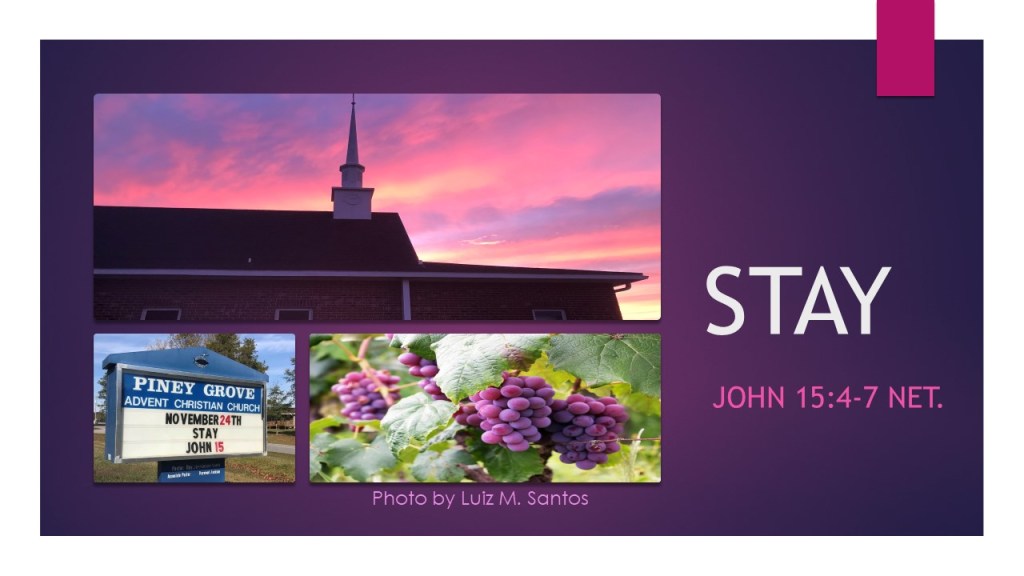
STAY 

STAY 

John 15:4-7 NET.

4 Remain in me, and I will remain in you. Just as the branch cannot bear fruit by itself, unless it remains in the vine, so neither can you unless you remain in me. 5 “I am the vine; you are the branches. The one who remains in me — and I in him — bears much fruit, because apart from me you can accomplish nothing. 6 If anyone does not remain in me, he is thrown out like a branch, and dries up; and such branches are gathered up and thrown into the fire, and are burned up. 7 If you remain in me and my words remain in you, ask whatever you want, and it will be done for you.

Back in February, I was preaching from Matthew 20, where Jesus described the work of the kingdom by comparing it to work in a vineyard. He told a parable about a vineyard owner who hired a bunch of people to work in his vineyard. The vineyard owner paid all the workers the same regardless of how many hours they worked in the harvest. That parable was actually a description of God’s grace. It taught that all of us who sign up for God’s coming kingdom will be blessed with that kingdom when it comes, and the eternal life we get will all be the same, no matter how much kingdom work we do. That’s because salvation is by grace. It is not brought about by our work – even our kingdom work. It is all bought at the same price, and Jesus paid that price on Calvary’s cross.

Today’s message is by the same Jesus, and it also mentions a vineyard. But in John 15, he is not talking about kingdom work. In this parable, Jesus is not the vineyard owner – he’s the vine. And we are not the workers in the vineyard. We are the branches of the vine.

Jesus’ parable of the workers in the vineyard was intended to remind all believers that God initiates our salvation, and he blesses us with the promise of eternal life not because of the quantity of our work for him but because of the quality of his grace toward us. It is helpful for us to know this because even on our best days, we are not going to accomplish anything by ourselves that would warrant any unique standing with God. Salvation by grace tells us that whatever God accomplishes through us or however much we are blessed, it is all because of his grace and his sola gratia – his grace alone.

Today’s parable puts the accent on the other side of the coin. It reminds us that even though we are all saved by grace, and we supply nothing to add to it, God still requires that we persevere in our faith. It is not totally passive – as if a person could be saved without ever knowing it.

Jesus says that his Father is the gardener and He is the vine. He says that the gardener will attend to every branch in him that does not bear fruit and take away all the branches that do not bear fruit. Even the branches that are bearing fruit will undergo pruning so that they can become even more fruitful.

Again, salvation is not described as passive. God himself is involved in the lives of every believer and works out the details of their lives so that they are fruitful. So, even though Jesus is telling us that he expects us to stay committed to him, he is not suggesting that our commitment is the only thing that matters for our salvation.

Before he tells us to stay in him, he tells us that his Father is already working in the background of our lives to produce that commitment. This gives Christians a whole new approach to the problem of suffering. We see every instance of suffering in our lives, not just as the work of the devil. We see the Father’s hand—the gardener’s hand—at work, building commitment and fruitfulness by means of suffering.

That is the background to today’s text. Now, let’s look at what the text tells us.

The text tells us where we should stay (4-5).

Jesus commands us to remain in him and promises that if we do, he will remain in us. He said that he is the vine, and we are the branches. The only thing he requires of his branches is that we do not jump off his vine and jump onto some other vine. It is a ridiculous thing to ask, in a sense. Have you ever noticed any grapes jumping off their vine and jumping on another vine?

Jesus was well aware of how unnatural that sounded. I imagine one or two of the disciples who heard Jesus say these words might have giggled at the notion. But they might also have remembered that low point in Jesus’ ministry when the crowds stopped coming, and even some of those who had been following him earlier decided to stop.

Jesus had been teaching using another illustration. He was teaching in a synagogue at Capernaum and said that unless people eat his flesh and drink his blood, they will not have eternal life and be raised on the last day. After that, “many of his disciples quit following him and did not accompany him any longer” (John 6:66). So, Jesus asked his disciples if they wanted to desert him too. That is when Peter said, “Lord, to whom would we go? You have the words of eternal life. We have come to believe and to know that you are the Holy One of God!” (John 6:68-69).

What was happening? It was a separation of the sheep from the goats. It was a church split that revealed the authentic believers and the inauthentic wannabe Christians. To use the wording of today’s text, some of the branches stopped staying in the vine.

I know that there is a considerable theological debate about whether a person can lose their salvation. This text does not actually speak to that issue. The parable that Jesus uses does not suggest that true believers can jump off the vine. Instead, it indicates that many who claim to be true believers or who want to be true believers will not stay with Jesus. They will depart. They will apostatize. They will not remain in the vine. They will jump off. As ridiculous as that picture is, it does describe what happens when people discover the cost of following Jesus and decide that they are not willing to pay the price.

True believers will never make that choice. But it is not always possible to see who is the true believer and who is the imposter. Judas did everything that the other apostles did. The eleven were shocked to find that he was the betrayer. If the parables in Matthew 25 inform us regarding this issue, they teach us to be diligent to be found faithful and not to assume that we are the elect and, therefore, not in danger of defection. Today’s passage teaches the same thing. Jesus had just told the eleven that they were clean already because of the word that he had spoken to them. But he didn’t follow that up with: “Relax, you are safe.” No, the very following words he said were, “Remain in me, and I will remain in you.” He did not want his disciples to hide behind the doctrine of election; He wanted them to stay committed to him and to remain diligent in doing his work.

I should also point out that this word translated “remain” or “stay” is the Greek verb μένω. It is directly related to the noun Jesus had just used in John 14:2. He said that in his Father’s house there are many dwelling places. That word is μονή. So, when Jesus commands us to stay, he is pointing back to that promise. He’s saying that we not only have a future in God’s presence when he returns, but we can stay in that presence now. We do that by staying faithful to Christ and staying in Christ.

The text answers the question, ‘What if we don’t stay?’ (5, 6).

There are two outcomes that Jesus highlights in today’s text. There is the present-day outcome and the ultimate outcome. The present-day outcome for those who decide to jump off the vine is that they will “accomplish nothing.” Someone who claims to be a Christian but does not stay in Christ will not bear any fruit for Christ. They might stay in church, but they are outside of Christ. As a result, their lives will be unfruitful for Christ’s kingdom.

They might look like they are working toward a harvest, but at the end of the day, they will have no produce to show for their work. In Jesus’ day, the nation of Israel had whole groups of committed workers who were not really in the vine. The Scribes, Pharisees, and Sadducees were such. They had the appearance of being committed to God but Jesus called them out for their hypocrisy. He said they were like whitewashed tombs. Outwardly, they looked clean and tidy, but inside them were dead people’s bones.

Jesus pictured the ultimate outcome of such lives by describing them as branches that fall off the vine, are gathered up and thrown into the fire, and are burned up. What Jesus is describing is Gehenna hell. Jesus had said that we should not fear human beings, but we should fear God because he “is able to destroy both soul and body in hell” (Matthew 10:28). Here, Jesus is saying that those branches that do not stay in him will be gathered all together in one place at one time. The place is hell, and the time is judgment day. When Jesus throws those branches into hell, they will NOT burn forever and ever. They will be destroyed. According to today’s text, they will be burned up.

The prophet Malachi predicted the same thing. He said, “The day is coming, burning like a furnace, and all the arrogant evildoers will be chaff. The coming day will burn them up,” says the LORD who rules over all. “It will not leave even a root or branch” (Malachi 4:1). Imagine that. Malachi even used the same word that Jesus did in today’s text. Rebellious branches will not be given the privilege of eternal life – even in hell. They will be burned up, obliterated, annihilated. That is the ultimate result of not staying in the vine.

The text also answers the question, ‘What if we do stay?’ (4, 5, 7).

Jesus was not aiming at scaring the disciples with the parable. He used the parable of the vine and the branches to encourage them. He told them that choosing to stay in the vine – that is, remain in Christ – will result in the ability to bear fruit. After all, that is what the vine is for, and that is what the branches are for. A branch that does not bear fruit is pruned because it is not accomplishing the task it was created for. If we do stay in Christ, we can expect a fruitful life and fruitful ministry.

In fact, Jesus promises in verse 5 that if we stay in him we will not only bear some fruit, but we will bear much fruit. Apart from him, we can do nothing, but in him, we can do anything. We should all be looking at our lives and expecting Jesus to use us to bear much fruit for his kingdom. We should be praying for more than “Lord, get me safe into the coming kingdom.” We should be praying, Lord, make good on your promise to make my life bear much fruit for you today.

If we get into that mindset where we expect to bear much fruit for the Lord now, we will have no problem fulfilling the other promise that is in today’s text. In verse 7, Jesus says, “If you remain in me and my words remain in you, ask whatever you want, and it will be done for you.” This is an actual promise from Jesus. Some people think that the promise no longer applies because they don’t see any evidence that Jesus is answering their prayers. So, they come up with a doctrine that the gifts and miracles have ceased.

I want to challenge you on this issue because I am not such a person, and I do not believe the Bible teaches that the gifts and miracles have ceased. Instead, if we look at the context of Jesus’ promise here, we will find out why there seem to be so few examples of answered prayer. The context is that of remaining in Christ and having a fruitful life and ministry for him. The two conditions of the promise are these: “if you remain in me” and “if my words remain in you.”

The condition “if you remain in me” speaks of maintaining an authentic relationship with Christ. The condition “if my words remain in you” speaks of learning and living by the commands of Christ and trusting in the promises of Christ. We all have a long way to go before we can claim that we have met those conditions. But, again, Jesus is not asking us to despair. He wants us to aim at fulfilling those conditions because he wants to create an army of faithful Christians who are well-known for answered prayers.

John Wesley commented on this verse, “Prayers themselves are a fruit of faith, and they produce more fruit.” The devil knows that there is one sure way to prevent us from bearing fruit as Christians. He can keep us from being productive if he can convince us to stop praying. Praying is not an additional condition that Jesus adds to the ones Jesus already pointed out. Those are having a relationship with Christ, learning and living by the commands of Christ, and trusting in the promises of Christ. So, when Jesus says, “Ask whatever you want, and it will be done for you,” he is telling us to pray because we are in him, and his word is in us. Prayer is not a third condition. It is a natural outflow of meeting the two conditions.

That means that anytime we get into our prayer closets and are determined to spend some quality time praying, we can pray with confidence. There are only two conditions that Jesus lists for fruitful prayer. Perfection is not one of those conditions. His grace covers our inadequacies and faults. His love overlooks our obvious failures and imperfections. We need only concern ourselves with two questions: do we have a relationship with Christ by faith, and do we know and trust his word? If we can answer “yes” to those two conditions, then we can pray with confidence.

Now, I know what happens when I pray and I don’t see an immediate answer. I begin to doubt my ability to pray productively. That doubt is the devil’s work. Jesus did not add any further conditions to his promise. So, what will happen if I give in to that doubt and stop praying? Remember what the command is. Jesus said, “Remain in me.” We honor him when we keep praying and keep staying. We show our trust in his promises by persevering through the dry times and waiting for him to produce the water from the rock. Our Lord wants people who dare to persevere.

HEAVENLY FATHER, thank you for the gift of Jesus Christ. Thank you for his sacrifice on Calvary’s cross that made it possible for us to be saved by grace. Thank you for the privilege of being in Christ by faith. Oh, Lord, we want to stay in him. Protect us from the temptation to defect from him, to stop trusting in his finished work, or to doubt his sure promises. We thank you that he is the way to your eternal presence. We ask you for the strength we need to stay in him as we wait for the fulfillment of all his promises. In Jesus’ name, Amen.

LOVE BY OBEYING  

LOVE BY OBEYING  

John 14:15-17 NET.

15 “If you love me, you will obey my commandments. 16 Then I will ask the Father, and he will give you another Advocate to be with you forever — 17 the Spirit of truth, whom the world cannot accept, because it does not see him or know him. But you know him, because he resides with you and will be in you.

I imagine that if you stopped everyone in this county and asked them if they love Jesus, the vast majority would say yes. We live in a world that apparently loves Jesus – billions of us. But how do you know if a person’s love of Jesus is genuine or not? That is where today’s text can help. It says that people who genuinely love Jesus are going to demonstrate that love. What’s more, it says that the way they will demonstrate their love for Jesus is concrete and easy to recognize. It says that genuine lovers of Jesus obey his commandments.

We have been studying the commands of Jesus here at Piney Grove for three years now. We isolated each command and examined it in its context to discover its full meaning and how it can be applied to our lives today. But that is the easy part. Jesus didn’t say “If you love me, you will learn my commandments. No, the way we truly demonstrate love for our Lord is to obey them. The Greek word is τηρέω, which means to keep. You keep a commandment by doing what it says to do or not doing what it prohibits. A commandment is a special message from God. But we can only keep commandments when we take that message and let it alter our lives. That is what it means to keep it. Once you encounter the commandment, if you had been breaking it, you repent of that rebellion, and you own it. From that time on, you are changed by that act of repentance.

We learned that Jesus gave many commands, and we have had to meet him at the altar regularly and deal with each one. The more we allowed the command to challenge us and change our behavior, the more like Jesus we became. The more like Jesus we became, the more love for Jesus grew inside us. We have discovered a more profound commitment to Jesus and a stronger appreciation for him with each trip to the altar. What Jesus wants is for us to learn the habit of letting him change us each time we encounter a command from him. We learn to love Jesus by obeying him and our love for him grows as we allow him to keep reviving us with his commands in God’s word.

In today’s text, Jesus identifies three ways that we can know if this process is really going on in our lives. We all want to be the real thing, not just people who appear to be obedient Christians. We want to be actually obedient Christians.

First, only obedient Christians truly love Jesus (15).

Jesus said that if we love him, we will obey his commandments. He did not say that if we put our names on a church membership list, he would accept that as a substitute. He didn’t say that if we had family members who were obedient Christians, we could be accepted on the basis of their obedience.

Love is loyalty. Lots of people admire Jesus and approve of his words. But that does not mean they love him. Jesus himself gave the evidence that would indicate if a person truly loves him. True love is a commitment. Since Jesus is a king, the kind of love he requires is the love of a loyal subject. Our generation has problems with that kind of love. They want a Jesus they can like, but not a Jesus whom they have to obey. They want the other Jesus. They want a Jesus who will accept them on their terms. They want to do what they want and get Jesus thrown in as a minor side-project.

The world wants Jesus without all those costly commandments. They want a baby in a manger, but not a prophet pronouncing tragedy coming upon the rebellious. They want a good shepherd as long as the shepherd does not mind them straying off on their own and getting into trouble when they want to. The only problem is that a good shepherd will not allow his flock to stray. He disciplines the unruly. The world doesn’t want a Jesus like that.

But those who genuinely love Jesus invite him to take control of their lives. They realize their need for him and are willing to do anything he asks them to do because they know obeying him is the only way they will ever know true freedom.

The world does not mind the idea of a Jesus who accepts them just as they are. They do mind a Jesus who insists on bringing them back into a relationship with his Father. That would involve change. They don’t want a Jesus who wants to change them.

Only obedient Christians can truly love Jesus because they are the only ones who want to be saved. Salvation is not possible without repentance, and repentance does not happen without change.

Second, only obedient Christians can accept the Advocate (16,17a).

Jesus used the word Advocate for the gift of the Holy Spirit here. The actual Greek word in verse 16 is παράκλητος. This word is variously translated in different versions as Helper, Advocate, Comforter, and Counselor. It speaks of a person who is called alongside another person to assist them.

The best way to understand how Jesus uses that title for the Holy Spirit is to keep in mind that Jesus intended the Holy Spirit to do what Jesus did while he was here on earth. He had a ministry of discipling and he gave us his Holy Spirit to continue that process after he ascended to heaven.

Jesus said that he was going to ask the Father to give us the Holy Spirit. We know from the Book of Acts that he followed up on that promise. The Holy Spirit descended visibly upon the obedient Christians in Jerusalem at Pentecost. Ever since then, the Holy Spirit has been available for all true Christians to help us grow in our faith and to empower us to disciple others. That is an amazing gift, and the fact that people still keep coming to Christ after all these centuries is evidence that He has not lost his power.

Now, Jesus said in verse 17 that the world cannot accept this gift. He is earmarked for only truly obedient Christians. It does not matter how much an unbeliever might want the Holy Spirit; they cannot have Him. The seven sons of Sceva in the book of Acts wished to use the Holy Spirit’s power, so they tried to invoke the names of Jesus and Paul to access that power. The demons replied, “I know about Jesus, and I am acquainted with Paul, but who are you?” (Acts 19:15). A man named Simon approached Peter and tried to purchase the Holy Spirit with money. But Peter said “May your silver perish with you, because you thought you could acquire God’s gift with money! (Acts 8:20). There is only one way to accept the Gifty of the Holy Spirit. It is given to repentant, obedient Christians.

Finally, only obedient Christians can possess the Advocate (17b).

Jesus went on in today’s text to explain just how his apostles were going to receive this Advocate. He said that He already resides with them and will be in them. The Holy Spirit was not absent from the world before Pentecost. But He came to work his power alongside[1] those whom he decided to bless. After Pentecost, the Holy Spirit was still capable of showing God’s power alongside others. But he could also work through obedient Christians because at Pentecost he came inside.[2] them.

Thus, the Holy Spirit has two ongoing missions. He is the Advocate for every believer, assisting them in learning and putting into practice Christ’s commands. He is also the empowerment that enables every believer to proclaim the gospel to the nations.

He is available to you and me. If we need more wisdom to walk according to the commands of our King, the Advocate is there for us. If we need the power to fulfill the great commission, the Holy Spirit is in us. Jesus told the watching faithful that they would receive power when the Holy Spirit came upon them, and they would be his witnesses in Jerusalem, and in all Judea and Samaria, and to the farthest parts of the earth (Acts 1:8). That same Holy Spirit is provided for us, to accomplish the same mission. He is also available to help us obey our King.

LORD, we acknowledge what the Scripture teaches. The Holy Spirit is within us. Empower us through your Holy Spirit to be obedient to our Master and, by so doing, to show that we love him.


[1] Greek παρά.

[2] Greek ἐν.