1 Samuel 6:1 When the ark of Yahveh had been in Philistine territory for seven months,
1 Samuel 6:2 the Philistines summoned the priests and the diviners and pleaded, “What should we do with the ark of Yahveh? Tell us how we can send it back to its place.”
1 Samuel 6:3 They replied, “If you send the ark of Israel’s God away, do not send it without an offering. Send back a guilt offering to him, and you will be healed. Then the reason his hand hasn’t been removed from you will be revealed.”
1 Samuel 6:4 They asked, “What guilt offering should we send back to him?” And they answered, “Five gold tumors and five gold mice corresponding to the number of Philistine rulers, since there was one plague for both you and your rulers.
1 Samuel 6:5 Make images of your tumors and of your mice that are destroying the land. Give glory to Israel’s God, and perhaps he will stop oppressing you, your gods, and your land.
1 Samuel 6:6 Why harden your hearts as the Egyptians and Pharaoh hardened theirs? When he afflicted them, didn’t they send Israel away, and Israel left?
1 Samuel 6:7 “Now then, prepare one new cart and two milk cows that have never been yoked. Hitch the cows to the cart, but take their calves away and pen them up.
1 Samuel 6:8 Take the ark of Yahveh, place it on the cart, and put the gold objects that you’re sending him as a guilt offering in a box beside the ark. Send it off and let it go its way.
1 Samuel 6:9 Then watch: If it goes up the road to its homeland toward Beth-shemesh, it is Yahveh who has made this terrible trouble for us. However, if it doesn’t, we will know that it was not his hand that punished us– it was just something that happened to us by chance.”
1 Samuel 6:10 The men did this: They took two milk cows, hitched them to the cart, and confined their calves in the pen.
1 Samuel 6:11 Then they put the ark of Yahveh on the cart, along with the box containing the gold mice and the images of their tumors.
1 Samuel 6:12 The cows went straight up the road to Beth-shemesh. They stayed on that one highway, mooing as they went; they never strayed to the right or to the left. The Philistine rulers were walking behind them to the territory of Beth-shemesh.
1 Samuel 6:13 The people of Beth-shemesh were harvesting wheat in the valley, and when they looked up and saw the ark, they were overjoyed to see it.
1 Samuel 6:14 The cart came to the field of Joshua of Beth-shemesh and stopped there near a large rock. The people of the city chopped up the cart and offered the cows as an ascending[1] offering to Yahveh.
1 Samuel 6:15 The Levites removed the ark of Yahveh, along with the box containing the gold objects, and placed them on the large rock. That day the people of Beth-shemesh offered burnt offerings and made sacrifices to Yahveh.
1 Samuel 6:16 When the five Philistine rulers observed this, they returned to Ekron that same day.
1 Samuel 6:17 As a guilt offering to Yahveh, the Philistines had sent back one gold tumor for each city: Ashdod, Gaza, Ashkelon, Gath, and Ekron.
1 Samuel 6:18 The number of gold mice also corresponded to the number of Philistine cities of the five rulers, the fortified cities and the outlying villages. The large rock on which the ark of Yahveh was placed is still in the field of Joshua of Beth-shemesh today.
1 Samuel 6:19 God struck down the people of Beth-shemesh because they looked inside the ark of Yahveh. He struck down seventy persons. The people mourned because Yahveh struck them with a great slaughter.
1 Samuel 6:20 The people of Beth-shemesh asked, “Who is able to stand in the presence of Yahveh this holy God? To whom should the ark go from here?”
1 Samuel 6:21 They sent messengers to the residents of Kiriath-jearim, saying, “The Philistines have returned the ark of Yahveh. Come down and get it.”
1 Samuel 5:1 After the Philistines had captured the ark of God, they took it from Ebenezer to Ashdod,
1 Samuel 5:2 brought it into the temple of Dagon and placed it next to his statue.
1 Samuel 5:3 When the people of Ashdod got up early the next morning, notice – there was Dagon, fallen with his face to the ground before the ark of Yahveh. So they took Dagon and returned him to his place.
1 Samuel 5:4 But when they got up early the next morning, notice Dagon, fallen with his face to the ground before the ark of Yahveh. This time, Dagon’s head and both of his hands were broken off and lying on the threshold. Only Dagon’s torso remained.
1 Samuel 5:5 That is why, still today, the priests of Dagon and everyone who enters the temple of Dagon in Ashdod do not step on Dagon’s threshold.
1 Samuel 5:6 Yahveh’s hand was heavy on the people of Ashdod. He terrified the people of Ashdod and its territory and afflicted them with tumors.
1 Samuel 5:7 When the people of Ashdod saw what was happening, they said, “The ark of Israel’s God must not stay here with us, because his hand is strongly against us and our god Dagon.”
1 Samuel 5:8 So they called all the Philistine rulers together and asked, “What should we do with the ark of Israel’s God?” “The ark of Israel’s God should be moved to Gath,” they replied. So they moved the ark of Israel’s God.
1 Samuel 5:9 After they had moved it, Yahveh’s hand was against the city of Gath, causing a great panic. He afflicted the people of the city, from the youngest to the oldest, with an outbreak of tumors.
1 Samuel 5:10 The people of Gath then sent the ark of God to Ekron, but when it got there, the Ekronites cried out, “They’ve moved the ark of Israel’s God to us to kill us and our people!”
1 Samuel 5:11 The Ekronites called all the Philistine rulers together. They said, “Send the ark of Israel’s God away. Let it return to its place so it won’t kill us and our people!” For the fear of death pervaded the city; God’s hand was oppressing them.
1 Samuel 5:12 Those who did not die were afflicted with tumors, and the outcry of the city went up to the sky.[1]
[1] שָׁמַיִם = sky. 1 Samuel 2:10; 5:12; 17:44, 46.
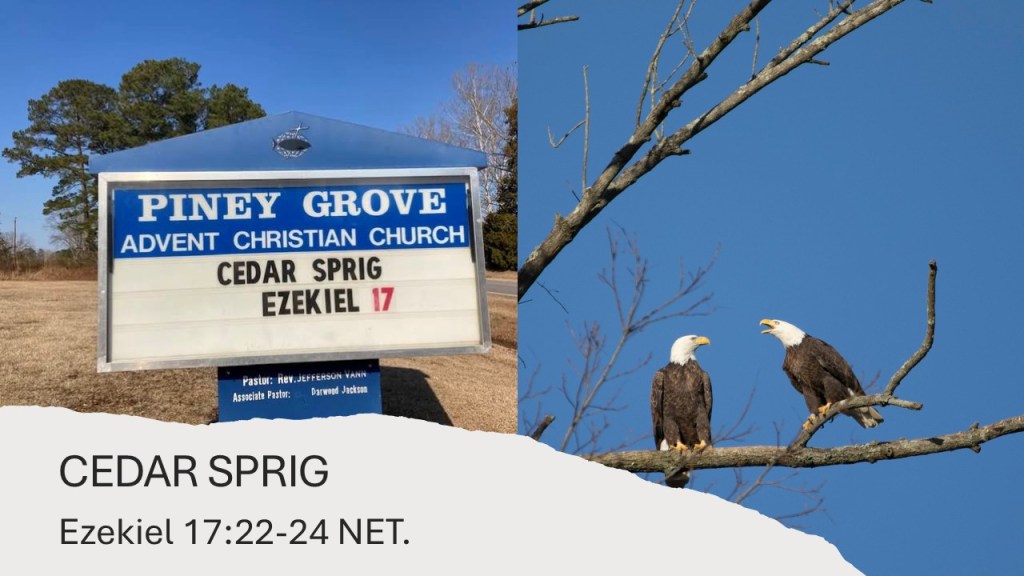
22 “‘This is what the sovereign LORD says: “‘I will take a sprig from the lofty top of the cedar and plant it. I will pluck from the top one of its tender twigs; I myself will plant it on a high and lofty mountain. 23 I will plant it on a high mountain of Israel, and it will raise branches and produce fruit and become a beautiful cedar. Every bird will live under it; Every winged creature will live in the shade of its branches. 24 All the trees of the field will know that I am the LORD. I make the high tree low; I raise the low tree. I make the green tree wither, and I make the dry tree sprout. I, the LORD, have spoken, and I will do it!'”
Today’s message is all about a parable. Jesus is not the only one who taught in parables. The Old Testament prophets sometimes used parables, too. The parable we are going to look at today is that of the eagles and the vine. It is found in Ezekiel 17.
The large eagle, Ezekiel 17:1-6
God told Ezekiel, “Son of Adam, tell a riddle and parable to Israel. Say, ‘This is what the Lord Yahveh says: A large eagle came to Lebanon, took the cedar’s top, and brought it to a trading city. It planted some of the land’s seed in a fertile, water-rich area, like a willow. It sprouted into a vine, spreading low with branches toward him but roots beneath. It grew into a vine, producing branches and shoots.'”
This is not the entire parable, so only some elements have been revealed at this point. This large eagle is the king of Babylon. His empire is the superpower of the time. The vine is Zedekiah’s offspring: the royal line of Judah. Although humbled and in exile, the vine spread, producing branches and sending out shoots.
It is human nature to want to get out of your humbling circumstances and make something better for yourself and your children. We all want a better life for ourselves and to overcome the obstacles we encounter. But like Zedekiah, we can be tempted to do this in ways that are outside God’s purposes for us. Not all of us are destined to be mighty eagles in this life. Sometimes, the best that we can hope for is to be a spreading vine under the mighty eagle’s power. Zedekiah had made a covenant with Babylon, and things went well for his children as long as he kept it.
But there was another eagle, and the vine defaulted on its promises to the first eagle. That was an unwise choice. The vine was blooming where it had been planted, but it wanted more than God allowed.
We need wisdom to find balance in our lives. That means seeking the best we can make of our lives while staying true to our responsibilities and current boundaries.
Leaving God out of the picture, Ezekiel 17:7-8
In the parable, another large eagle with strong wings and dense plumage appears. The vine leans its roots toward it! It reaches out its branches from the plot where it was planted, as if asking for water. It was cultivated in a fertile field with plenty of water to grow branches, produce fruit, and become a magnificent vine.
As this parable continues, we are introduced to another large eagle. In real life, vines do not change their direction to accommodate the animals they encounter. But in this parable, that is exactly what the vine does.
The king and his sons chose to abandon their covenant with one evil empire and side with another. But their sin was leaving God out of the picture. Perhaps you and I should consider the choices we are making and whether our failures stem from making them without seeking the Lord’s will.
We need to consult God before making decisions outside his will. Zedekiah did not do that. He saw his chance, and he took it. He exercised his own sovereignty rather than trusting in God’s.
Will it flourish? Ezekiel 17:9-10
God asks: Will the vine flourish? Won’t he tear out its roots and strip off its fruit so that it shrivels? All its fresh leaves will wither! Notice, though it is planted, will it flourish? Won’t it wither completely when the east wind slaps it? It will wither on the plot where it sprouted.’”
The king and his sons had chosen to abandon their covenant with Babylon and seek another eagle’s protection. The parable asks about this new plan. The question is: “Will it flourish?”
Perhaps there is a change you are considering for your life and family recently. Will it make things better, or get you in more hot water?
The New Testament encourages us to pray for wisdom if we need it. James says, “If anyone is deficient in wisdom, he should ask God, who gives to all generously and without reprimand, and it will be given to him.”[1] We all know how dangerous it is to make decisions based on faulty or incomplete information. Wisdom requires knowing things that we sometimes do not know. We need the courage to ask.
We need wisdom to avoid rash and hurting choices.
price of escape Ezekiel 17:11-15
God said: ‘Tell that rebellious house, ‘Don’t you understand these events?” Notice that the king of Babylon came to Jerusalem, took its king and officials, and brought them to Babylon. He made a covenant with a royal family member, putting him under oath, and took away the land’s leaders so the kingdom would be humble and keep its covenant. Yet this king rebelled by sending ambassadors to Egypt to procure horses and a large army. Will he prosper? Can he escape after such betrayal? Can he break a covenant and still succeed?'”
The royal family of Judah had sought to escape its covenant with Babylon by seeking help from Egypt.
What struck me as I pondered these words today is how quickly families are destroyed by those who encounter trouble and seek to escape it by breaking the covenant with their spouse. In a fallen world like ours, some marriages may be destined to fail, but every divorced person also knows that escape comes at a heavy price.
We need strong commitments that honor God and respect each other. This includes our marriages and other commitments. The world is looking for representatives of God’s righteousness. One way we can shine the light of God’s truth is by keeping our promises.
No cheating, Ezekiel 17:16-21
God says Zedekiah will die in Babylon, the land of the king who put him on the throne, because he broke his oath and covenant. Pharaoh’s army won’t help him as ramps and siege walls are built. He thinks lightly of the oath despite giving his pledge. He will not escape! God says he will hold Zedekiah accountable for breaking his covenant, catching him in my net, and bringing him to Babylon for judgment. His top troops will fall; survivors scattered. And when it happens, they will know that God has spoken.
The king of Judah had made a terrible decision. He had made a covenant with Babylon, but then decided to switch allegiance to Egypt. This infuriated God because the Babylonian exile was his idea. He intended to punish his own people for their idolatry and hypocrisy. He wanted to humble them, and so bring them back to himself. But they wanted to cheat.
Our God does not like it when we break the rules. We can justify our cheating all we want, but God knows when we step over the line. We need to keep between the lines so that we demonstrate our commitment to God.
The cedar sprig, Ezekiel 17:22-24
God says that he will take a sprig from the top of the cedar and plant it on Israel’s high mountain so it may bear branches, produce fruit, and become a majestic cedar. Birds will nest under it, sheltering in its shade. All trees will know he is Yahveh. He will bring down tall trees and make low trees tall. He causes green trees to wither and makes withered trees thrive. He, Yahveh, will do it.
The bad news for Judah was that God would not establish Zedekiah and his dynasty. The good news for Judah was that God was not through with them. He himself would take a sprig and plant it on a high, towering mountain. Another king would come who would keep his covenant of peace with God and humanity.
There is even some good news for those of us who are not descendants of Judah. This coming king would not remain a humble sprig but would grow into a great cedar. Birds of every kind will nest under it, taking shelter in the shade of its branches.
God has established his new king, and everyone — Jew and Gentile alike- can find rest and support from him. We are the birds of every kind.
LORD, thank you for your Messiah — Jesus Christ. He is the cedar sprig whom God chose to rule over the universe. He is the king of kings and Lord of Lords. He is the Vine and we are his branches. We pledge our loyalty and trust him. We choose to abide in him. We will allow him to be sovereign in our lives. We will not break the promises we have made to him. We will not seek to escape from the commitments we have made in his presence.
1 Samuel 4:1 And Samuel’s words came to all Israel. Israel went out to meet the Philistines in battle and camped at Ebenezer while the Philistines camped at Aphek.
1 Samuel 4:2 The Philistines lined up in battle formation against Israel, and as the battle intensified, Israel was defeated by the Philistines, who struck down about four thousand men on the battlefield.
1 Samuel 4:3 When the troops returned to the camp, the elders of Israel asked, “Why did Yahveh defeat us today before the Philistines? Let’s bring the ark of Yahveh’s covenant from Shiloh. Then it will go with us and save us from our enemies.”
1 Samuel 4:4 So the people sent men to Shiloh to bring back the ark of the covenant of Yahveh of Armies, who is enthroned between the cherubim. Eli’s two sons, Hophni and Phinehas, were there with the ark of the covenant of God.
1 Samuel 4:5 When the ark of the covenant of Yahveh entered the camp, all the Israelites raised such a loud shout that the ground shook.
1 Samuel 4:6 The Philistines heard the sound of the war cry and asked, “What’s this loud shout in the Hebrews’ camp?” When the Philistines discovered that the ark of Yahveh had entered the camp,
1 Samuel 4:7 they panicked. “A god has entered their camp!” they said. “Tragedy[1] has come to us, nothing like this has happened before.
1 Samuel 4:8 Tragedy has come to us, who will rescue us from these magnificent gods? These are the gods that slaughtered the Egyptians with all kinds of plagues in the wilderness.
1 Samuel 4:9 Show some courage and be men, Philistines! Otherwise, you’ll serve the Hebrews just as they served you. Now be men and fight!”
1 Samuel 4:10 So the Philistines fought, and Israel was defeated, and each man fled to his tent. The slaughter was severe– thirty thousand of the Israelite foot soldiers fell.
1 Samuel 4:11 The ark of God was captured, and Eli’s two sons, Hophni and Phinehas, died.
1 Samuel 4:12 That same day, a Benjaminite man ran from the battle and came to Shiloh. His clothes were torn, and there was dirt on his head.
1 Samuel 4:13 When he arrived, notice – there was Eli sitting on his chair beside the road watching, because he was anxious about the ark of God. When the man entered the city to give a report, the entire city cried out.
1 Samuel 4:14 Eli heard the outcry and asked, “Why this commotion?” The man quickly came and reported to Eli.
1 Samuel 4:15 At that time Eli was ninety-eight years old, and his eyes didn’t move because he couldn’t see.
1 Samuel 4:16 The man said to Eli, “I’m the one who came from the battle. I fled from there today.” “What happened, my son?” Eli asked.
1 Samuel 4:17 The messenger answered, “Israel has fled from the Philistines, and also there was a great slaughter among the people. Your two sons, Hophni and Phinehas, are both dead, and the ark of God has been captured.”
1 Samuel 4:18 When he mentioned the ark of God, Eli fell backward off the chair by the city gate, and since he was old and heavy, his neck broke and he died. Eli had judged Israel forty years.
1 Samuel 4:19 Eli’s daughter-in-law, the wife of Phinehas, was pregnant and about to give birth. When she heard the news about the capture of God’s ark and the deaths of her father-in-law and her husband, she collapsed and gave birth because her labor pains came on her.
1 Samuel 4:20 As she was dying, the women taking care of her said, “Don’t be afraid. You’ve given birth to a son!” But she did not respond or pay attention.
1 Samuel 4:21 She named the boy Ichabod, saying, “The glory has been removed from Israel,” referring to the capture of the ark of God and to the deaths of her father-in-law and her husband.
1 Samuel 4:22 “The glory has been removed from Israel,” she said, “because the ark of God has been captured.”
1 Samuel 3:1 The boy Samuel served Yahveh in Eli’s presence. In those days the word of Yahveh was rare and prophetic visions were not widespread.
1 Samuel 3:2 One day Eli, whose eyesight was failing, was lying in his usual place.
1 Samuel 3:3 Before the lamp of God had gone out, Samuel was lying down in the temple of Yahveh, where the ark of God was located.
1 Samuel 3:4 Then Yahveh called Samuel, and he answered, “Notice me.”
1 Samuel 3:5 He ran to Eli and said, “Notice me; you called me.” “I didn’t call,” Eli replied. “Go back and lie down.” So he went and lay down.
1 Samuel 3:6 Once again Yahveh called, “Samuel!” Samuel got up, went to Eli, and said, “Notice me; you called me.” “I didn’t call, my son,” he replied. “Go back and lie down.”
1 Samuel 3:7 Now Samuel did not yet know Yahveh, because the word of Yahveh had not yet been revealed to him.
1 Samuel 3:8 Once again, for the third time, Yahveh called Samuel. He got up, went to Eli, and said, “Notice me; you called me.” Then Eli understood that Yahveh was calling the boy.
1 Samuel 3:9 He told Samuel, “Go and lie down. If he calls you, say, ‘Speak, Lord, for your servant is listening.'” So Samuel went and lay down in his place.
1 Samuel 3:10 Yahveh came, stood there, and called as before, “Samuel, Samuel!” Samuel responded, “Speak, for your servant is listening.”
1 Samuel 3:11 Yahveh said to Samuel, “Notice, I am about to do something in Israel that everyone who hears about it will shudder.
1 Samuel 3:12 On that day I will carry out against Eli everything I said about his family, from beginning to end.
1 Samuel 3:13 I told him that I am going to judge his family forever because of the iniquity he knows about: his sons are cursing God, and he has not stopped them.
1 Samuel 3:14 Therefore, I have sworn to Eli’s family: The iniquity of Eli’s family will never be wiped out by either sacrifice or offering.”
1 Samuel 3:15 Samuel lay down until the morning; then he opened the doors of Yahveh’s house. He was afraid to tell Eli the vision,
1 Samuel 3:16 but Eli called him and said, “Samuel, my son.” “Notice me,” answered Samuel.
1 Samuel 3:17 “What was the message he gave you?” Eli asked. “Don’t hide it from me. May God punish you and do so severely if you hide anything from me that he told you.”
1 Samuel 3:18 So Samuel told him everything and did not hide anything from him. Eli responded, “He is Yahveh. Let him do what he thinks is good.”
1 Samuel 3:19 Samuel grew, and Yahveh was with him, and he fulfilled everything Samuel prophesied.
1 Samuel 3:20 All Israel from Dan to Beer-sheba knew that Samuel was a confirmed prophet of Yahveh.
1 Samuel 3:21 Yahveh continued to appear in Shiloh, because there he revealed himself to Samuel by his word.





 jeffersonvann