REPENT AND BELIEVE

REPENT AND BELIEVE


Mark 1:14-15 NET
14 Now after John was imprisoned, Jesus went into Galilee and proclaimed the gospel of God. 15 He said, “The time is fulfilled and the kingdom of God is near. Repent and believe the gospel!”


We have been studying two foundational imperatives this month: repentance from sin and believing in God’s gospel. It is in today’s passage that we learn from Jesus himself how foundational these two actions are. When our Lord began his preaching, it could be summarized by these words: “repent and believe the gospel.” We have seen in our study that neither of these is a new command.


Today I want to share seven reasons to repent and believe the gospel. Three of the seven reasons are implied from today’s text.


First, we are commanded to repent by our king (15).

When Jesus started proclaiming that the kingdom of God was near, he was declaring that he had been appointed King of that kingdom. When he next said “Repent and believe the gospel!” he was commanding all of his subjects to do something. The form of the word (μετανοεῖτε) is a grammatical imperative. He did not give anyone an option. He did not say that the gospel was one of the paths to God that a person could take.


He did not add a condition to his command. If he had said “if the world will let you, repent” then perhaps that would have excluded some people. Many who have repented and turned to faith in the gospel have paid for that choice with their lives. Their political and religious leaders demanded that they reject Christ. But their king did not put an exclusion clause in his command. Jesus commanded them to repent, and so they did.


Many have had to renounce their own families to obey the command from their king. They knew that Jesus did not say “if your family will let you, repent.” His command came with no conditions.


Second, the gospel demands a response (14)

What Mark referred to as the gospel is the whole story of how God has intervened in the history of humanity by sending his Son to be our king. As our king, Jesus will renew all creation, destroying all evil and removing sin from the earth. But we cannot be passive about this news.


The gospel is not good news because it promises that everything is going to come out alright. Jesus’ words to us were not “let it be.” No, the gospel is good news because the ship we are on is going to be torpedoed – but we have the chance to get off it and get into a lifeboat before it happens. If we choose to do nothing, we will go down with the ship!


A third reason to repent and believe is found in our Lord’s statement that it causes joy in heaven.

Jesus said, “there will be more joy in heaven over one sinner who repents than over ninety-nine righteous people who have no need to repent” (Luke 15:7).

Maybe you think you can take your chances on being one of the ninety-nine who does not need to repent. I would not. If you have never repented, I can guarantee you that you are not one of the ninety-nine. Besides, the real question for all of us is this: do we want to bring joy to our heavenly Father? If we do, Jesus told us that we can do that by repenting.


A fourth reason to repent and believe is that the alternative is perishing.

Luke records a time when Jesus was talking to some people about two horrible events: a massacre by Pilate of some Galileans and a disaster in Jerusalem when a tower fell on some bystanders.


“Now there were some present on that occasion who told him about the Galileans whose blood Pilate had mixed with their sacrifices. He answered them, “Do you think these Galileans were worse sinners than all the other Galileans, because they suffered these things? No, I tell you! But unless you repent, you will all perish as well! Or those eighteen who were killed when the tower in Siloam fell on them, do you think they were worse offenders than all the others who live in Jerusalem? No, I tell you! But unless you repent you will all perish as well!” (Luke 13:1-5).


If you are ever in a disaster situation like that, it makes you think. You naturally begin to question why it happened. You might even wonder about the victims. You might wonder what they had done to deserve such a tragedy happening to them. But Jesus urged his listeners to think about something else. He urged them to realize that we all deserve that fate. Repentance and faith in the gospel is our only way out of a similar fate.


Our history might lead us to bring up some other disaster, like 9-1-1, a plane crash, or COVID-19. But Jesus was teaching us that no one escapes the big one. The big one is the second death – destruction in Gehenna. That is the big disaster still looming in the future for everyone… everyone who does not repent. The torpedo is slicing through the sea surface as I speak. No one on board will be safe when it hits. That is why the news about the lifeboat is good news.


The Bible says that “this is the way God loved the world: He gave his one and only Son, so that everyone who believes in him will not perish but have eternal life.” (John 3:16). Those are the two options. Either repent and believe in Christ or perish in the big one when it comes.


I want to share a quote here from a very old book. The edition from which I will be quoting is dated 1845. The author is John Oswald Jackson.


“This is for you, if unsaved, THE great question; all others fall beside it into the shade. Compared with this, all domestic, commercial, political questions are as the small dust of the balance; they are but as drops to the ocean; in a word, they are for time, this for ETERNITY!! And let me in fidelity say, that if you are conscious that you have not yet experienced this repentance, you are in the most perilous condition imaginable. However amiable and learned; however rich and refined; or however poor and despised; what ever may be your inward disposition or outward character; your internal feelings or external circumstances; still, unless you have repented, the God of truth and tenderness declares solemnly you must perish!”1

A fifth reason to repent and believe is that the same king who commanded it will be the judge appointed to decide our permanent fate.

The apostle Paul taught that “although God has overlooked such times of ignorance, he now commands all people everywhere to repent, because he has set a day on which he is going to judge the world in righteousness, by a man whom he designated, having provided proof to everyone by raising him from the dead” (Acts 17:30-31).


It will not be only Christians who are held accountable for obeying this command of Christ. That command extends to all people everywhere. The one who preached the good news to his people will hold the entire planet responsible for believing it. The God who created this planet has set a day in which it will be judged. He has appointed a man to do the judging. That man is not me. I could not handle that responsibility and neither could you. But God has appointed one who is capable of answering this question. He is the one who commanded us all to repent and believe his gospel. He knows whether or not we have done it.

A sixth reason to repent and believe is that just being sad about one’s sin is not enough.

Note what the apostle says here:
“For sadness as intended by God produces a repentance that leads to salvation, leaving no regret, but worldly sadness brings about death” (2 Corinthians 7:10).


Paul points out that there are two kinds of sadness – one intended by God and the other, worldly. Only one kind of sadness leads to life. The other leads to death. Both are true sadness. But only one kind of sadness saves. That is the sadness given to us by God to produce repentance. So, my question for you today is not whether you are sad about your sin. Cain was sad about his sin. Judas was sad about his sin. Worldly sadness just leads to death.


A seventh and final reason to repent and believe the gospel is that it is available for every living person right now.

Jesus commanded all the Galileans to repent and believe the gospel (15). No doubt there were many Galileans to whom Jesus spoke who had wrecked their lives with failure after failure. But Jesus did not stop at each one and give each one a specific regimen of works of restitution and penance. No, the command to repent and believe is a one size fits all command. Repentance is designed as the beginning of a life of sanctification. Repentance serves as the foundation of a life of good works. But no amount of sanctification or good works ever precedes the initial act of repentance.

Repentance (μετάνοια) is by definition a change of mind. You do not have to work for a change of mind. You don’t have to ease into it by slow progression. There are not twelve steps to take. Repentance is not graduation – it is enrollment.


Repentance is something you can do all at once, in response to a single command. The same is true of belief. Faith is like a lamp. It can be off and then turned on in a second.

Now, once the light is turned on, there will be a thousand adjustments every day that you and I will have to make. But these adjustments are not repentance. They are the natural result of turning on the lamp. Now that we see the light, we know what steps to take and which steps to avoid. The light helps us to examine ourselves and to root out evils that we had no idea were here inside us. But none of that is repentance. Repentance is a once-in-a-lifetime decision to obey Christ – to enter his kingdom, to believe in his gospel.


Consider, brothers and sisters, whether you have repented in that sense. Have you turned from a self-centered life of sin and allowed God to turn his light on in your heart?


For most of you, I can imagine that you do not have to struggle with that question. You can remember the time – for some of you the exact day – when you gave your heart to Jesus. I’m not asking you to do it again. The light needs only to be switched on once.


If you are confident in your repentance and faith in the gospel, I merely want to encourage you to express that confidence. There are people all around us who have not yet obeyed Christ’s command. We are called to bear witness to them. Many still ride the fence. We need to make it clear to them which side we have taken. Many have not yet brought joy to their creator in heaven. If we have, it should have resulted in a bit of joy for us. The world needs to see that. If we have repented, we are guaranteed not to perish in the fires of Gehenna. That knowledge should give us confidence that gets people’s attention. If we have truly repented, we should feel more joy than sadness.


Jesus commanded us to repent and believe his gospel. If you have done that, you are on the right side of history. If you haven’t done that yet. All it takes is flipping the switch.

video

WHO WOULD HAVE BELIEVED?

WHO WOULD HAVE BELIEVED?

Jefferson Vann preaches about biblical faith from Isaiah 53:1-12 NET

This month we are talking about repentance and faith. We are looking at the Old Testament to fill in some or the gaps about what repentance and faith entails. Last week, we looked at Hosea 14 for a description of biblical repentance. This week we are looking at Isaiah 53 for a description of biblical faith.

Isaiah predicted a Messiah who was hard to believe (1-3).

1 Who would have believed what we just heard? When was the LORD’s power revealed through him?
2 He sprouted up like a twig before God, like a root out of parched soil; he had no stately form or majesty that might catch our attention, no special appearance that we should want to follow him.
3 He was despised and rejected by people, one who experienced pain and was acquainted with illness; people hid their faces from him; he was despised, and we considered him insignificant.

Isaiah’s people were a despised lot. No one would have expected the Son of God to make his appearance among men as one of the Israelites. But that is exactly what Isaiah predicts. And just to show that God rejects all our deceptive assumptions, Isaiah predicts that when the Messiah does show himself, he will be despised and rejected by those same people. He will appear weak, struck down and afflicted. But this beating he would take would be as a substitute for the transgressions of the world.

Before we run off with this idea as it relates to Christ, and his suffering on the cross, we need to see the message from Isaiah’s standpoint. He was speaking to a group of people who had deceptive assumptions about themselves. He was trying to encourage them to stop believing those lies. The truth is, God did want to work though them. Example: the Messiah himself would be seen as a beaten, condemned criminal. But God would work in that reality to save us all.

Isaiah asks the question “who would have believed what we just heard? God has a plan, but it is going to show up way out in left field. God is not going to use a mighty warrior to accomplish his purpose. He’s going to use a root out of parched soil. Roots don’t grow well in parched soil. Mostly dry soil just stays dry soil. When the rain comes — if the rain comes — then we can expect something to happen.

My series of sermons this month is on repentance and faith. This passage tells us something about the faith that reaches God. It is a faith that dares to see him doing what no one would expect. The focal point of that faith is Jesus Christ.

The world doesn’t really mind it if we have faith. But the world has a fit when we dare to tell everyone that we have put our faith in Jesus Christ. There is no saving faith outside of Jesus Christ.

Acts 4:12 “And there is salvation in no one else, for there is no other name under heaven given among people by which we must be saved.”

Isaiah predicted that when Jesus appeared there would be no significant evidence that he was the one the universe needed. It would have to be taken on faith.

Yes, the crowds folllowed hm, but before long the crowds were shouting “crucify him.” They wanted someone to overthrow Rome, not someone who would be executed as a criminal by Rome.

Isaiah predicted a ministry that was hard to believe (4-6)

4 But he lifted up our illnesses, he carried our pain; even though we thought he was being punished, attacked by God, and afflicted for something he had done.
5 He was wounded because of our rebellious deeds, crushed because of our sins; he endured punishment that made us well; because of his wounds we have been healed.
6 All of us had wandered off like sheep; each of us had strayed off on his own path, but the LORD caused the sin of all of us to attack him.

We know all about that ministry today because we have had two thousand years to ponder the significance of the cross. We call it the docrtrine of substitutionary atonement. It involves four particular things that Jesus did for us by dying on the cross.

By dying on the cross, Jesus purchased forgiveness for sinners so that we can be justified — decalred righteous in God’s sight.

By dying on the cross, Jesus reconciled us to God, so that we could become his friends instead of his enemies.

By dying on the cross, Jesus served as our substitute, taking upon himself the penalty of death that we deserve.

2 Corinthians 5:21 God made the one who did not know sin to be sin for us, so that in him we would become the righteousness of God.

1 John 4:10 In this is love: not that we have loved God, but that he loved us and sent his Son to be the atoning sacrifice for our sins.

By dying on the cross, Jesus absorbed the full wrath of God for all those who put their faith in his finished work. That does not keep any of us from dying the first death, but it will prevent us from experiencing the second death.

Isaiah also mentions in this amazing section that the Messiah would do this while people looked on, thinking that he was suffering for his own sins. Verse 4 say “we thought he was being punished, attacked by God, and afflicted for something he had done.” The cross was for criminals — but here is the sinless Son of God walking the via dolorosa and getting nailed to the cross — not for a real crime but as a sacrifice to purchase deliverance for us.

Isaiah predicted a faithfulness that was hard to believe (7-9)

7 He was treated harshly and afflicted, but he did not even open his mouth. Like a lamb led to the slaughtering block, like a sheep silent before her shearers, he did not even open his mouth.
8 He was led away after an unjust trial — but who even cared? Indeed, he was cut off from the land of the living; because of the rebellion of his own people he was wounded.
9 They intended to bury him with criminals, but he ended up in a rich man’s tomb, because he had committed no violent deeds, nor had he spoken deceitfully.

Note the silence of Jesus before his accusers and judges during his trials. Note his refusal to lash out at them or those taunting him.

Matthew 26:62-63 So the high priest stood up and said to him, “Have you no answer? What is this that they are testifying against you?” But Jesus was silent. The high priest said to him, “I charge you under oath by the living God, tell us if you are the Christ, the Son of God.”

Matthew 27:13-14 Then Pilate said to him, “Don’t you hear how many charges they are bringing against you?” But he did not answer even one accusation, so that the governor was quite amazed.

Isaiah predicted a victory that is hard to believe (10-12)

10 Though the LORD desired to crush him and make him ill, once restitution is made, he will see descendants and enjoy long life, and the LORD’s purpose will be accomplished through him.
11 Having suffered, he will reflect on his work, he will be satisfied when he understands what he has done. “My servant will acquit many, for he carried their sins.
12 So I will assign him a portion with the multitudes, he will divide the spoils of victory with the powerful, because he willingly submitted to death and was numbered with the rebels, when he lifted up the sin of many and intervened on behalf of the rebels.”

Now Isaiah predicts a victory that assumes two things. First, he predicts that the suffering servant will accomplish restitution.

But verse 10 says something that is not quite made clear in the NET translation. The phrase “once restitution is made” is actually im tasim asam nafsho (‎אִם־תָּשִׂ֤ים אָשָׁם֙ נַפְשׁ֔וֹ) in Hebrew. The WEB (World English Bible) translates that phrase more literally, “When you make his soul an offering for sin.” Christ’s whole being died, not just his body. He did not appear to die. He died — completely. When Jesus said “it is finished” that is what was finished. He accomplished the purpose for which he came into the world. That is the first part of the victory. His resurrection was the proof of this accomplishment.

The second thing that Isaiah predicts is a profound exaltation. Isaiah says the Messaiah “will see descendants and enjoy long life” which is a bit of understatement. All of the saved of all time will enjoy eternal life with him — as a result of his victory for them. With victory will also come the spoils of victory. Ultimately, the prophet is talking about eternity in the new universe. The king of kings and lord of lords is going to take his throne. Under him will be every other king and every other lord. He will have gone from the lowest of the low to the highest of the high.

The Servant shall be high and lifted up and exalted.

Isaiah 52:13 “Look, my servant will succeed! He will be elevated, lifted high, and greatly exalted.”

But first he will be despised and rejected by men.

Kings will be shocked by his exaltation (52:15).

But first he must go to the cross with his own mouth shut, like a lamb led to the slaughter (53:7).

He will know eternal life and prosperity , but first he must allow God’s will to happen, which means he will be crushed (53:10). He will make many to be accounted righteous (53:11), but first he must pour out his soul to death, and be numbered with the transgressors (53:12).

Who would have believed such a thing? This was God’s plan. Yet there is something still more unbelievable. God has done all this for us through Christ, yet there are still people who say they don’t believe. There are still some who refuse to put their faith in Christ.

Repentance is half of the foundation. Faith is the other half. We must turn to God, ready to tell him all the things we have done against him. But then we must also turn to God in faith.

LORD, thank you for the ultimate sacrifice: infinite purity made into a sin offering to rescue us from our own defilement. We choose to believe in Jesus Christ the one you sent.

RETURN AND REPENT

RETURN AND REPENT

Hosea 14: 1-9 NET

I’m beginning the new year with a series of sermons based on repentance and believing. These two ideas go together: repentance from sin and believing in what God has revealed to us in his word.

I am beginning our study of these two ideas in the Old Testament. Repentance and faith did not just magically show up in the New Testament. If we ignore what the Old Testament says about these subjects, we will be missing some vital pieces of the puzzle.

So, this morning we are going to look at Hosea 14, where the prophet Hosea talks about repentance.

Hosea urges his people to repent (1-3)

1 Return, O Israel, to the LORD your God, for your sin has been your downfall!

2 Return to the LORD and repent! Say to him: “Completely forgive our iniquity; accept our penitential prayer, that we may offer the praise of our lips as sacrificial bulls.

3 Assyria cannot save us; we will not ride war horses. We will never again say, ‘Our gods’ to what our own hands have made. For only you will show compassion to Orphan Israel!”

Hosea uses two Hebrew words to explain the process of repenting. First, he uses the word shuv (שׁוב) – which means to turn or return. That is the word translated return in verse 1 and repent in verse 2. In the military, if you have a soldier looking in one direction, and you want that soldier to look in the opposite direction, you give the command: about-face. That’s what shuv means. Repenting requires a person to change direction.

But how do you change direction in your life? Hosea explains how to get started doing that in verse 2 as well. He says literally “take words with you.” The Hebrew word for take is lakach (לָקַח). If you really want to repent, before you do your about-face, you have to come before God’s face. You have to do that with words. Don’t try to repent without saying anything. God knows the thoughts of your heart. But being truly repentant requires that we tell him something.

The principle is called confession. The New Testament elaborates on this principle, but it is right here in the Old Testament first.

Hosea urged his people to confess four things.

He urged them to confess their inability to save themselves. They had fashioned idols made of wood, stone, and metal. Then they bowed down to those idols and called them their gods. So, in verse 3, Hosea instructs his people to say “We will never again say, ‘Our gods’ to what our own hands have made. For only you will show compassion to Orphan Israel!”

He urged them to confess that they had trusted the wrong things. In Hosea’s time, the political superpower was Assyria. Hosea tells his people to come to God and confess “Assyria cannot save us; will not ride war horses.” God wanted his people to admit that if they were going to be delivered, it was not going to happen by aligning themselves with a more powerful nation. They had to align themselves with the most powerful God.

Hosea urged them to confess faith in God’s ability to forgive them completely. He told them to ask God to forgive them. They were to ask for a return to the position they held before they rebelled.

Hosea urged them to confess the desire to return to proper worship. They promised to offer God the praise he deserved.

True repentance begins with these four confessions. When you are ready to repent, you are ready to acknowledge that you cannot save yourself. You have tried other ways, and they just got you more lost. But you believe that God can save you completely. One cross fits all. Not only do you dare to ask God for help, but you are also committed to acknowledging his salvation for the rest of your life by regular worship.

God promises repenters that he will turn away his anger and bless them instead (4-8)

4 “I will heal their waywardness and love them freely, for my anger will turn away from them.

5 I will be like the dew to Israel; he will blossom like a lily, he will send down his roots like a cedar of Lebanon.

6 His young shoots will grow; his splendor will be like an olive tree, his fragrance like a cedar of Lebanon.

7 People will reside again in his shade; they will plant and harvest grain in abundance. They will blossom like a vine, and his fame will be like the wine from Lebanon.

8 O Ephraim, I do not want to have anything to do with idols anymore! I will answer him and care for him. I am like a luxuriant cypress tree; your fruitfulness comes from me!

Forgiveness is just the beginning of what God offers the truly repentant. It is the door to the house. Once you enter through the door, you can start enjoying everything in the house. Look at what God has in his house in store for those who repent.

God promises to heal us.

God promises to turn his anger away from us.

God promises to make us blossom and be fruitful like a lily or a vine, or a cypress tree.

God promises to give us strong deep roots like a cedar.

God promises to protect us like shade protects those exposed to the sun.

God promises to make his fame and glory shine through us.

It all begins with a prayer of repentance.

Hosea reminds his people that wisdom begins with repentance (9).

9 Who is wise? Let him discern these things! Who is discerning? Let him understand them! For the ways of the LORD are right; the godly walk in them, but in them the rebellious stumble.

Do you feel that sometimes you are just not wise enough to deal with all the problems you face, or discerning enough to help others? If you have come to God through Jesus Christ, you have already begun the process of getting God’s wisdom.

The next step is going to God’s word and letting him teach you wisdom. A prayer of repentance is a prayer of dependence. It consists of telling God you want him to teach you. Once you have repented, you can begin a hard reboot of your life.

Now, God has given us a body of literature in his word that is expressly for the purpose of reconfiguring our minds to his wisdom. It’s called wisdom literature.

It starts with Job – God’s wisdom when life does not make sense.

Then, Psalms – God’s wisdom in poetic form.

Proverbs – God’s wisdom collected.

Ecclesiastes – God’s wisdom applied to aging.

Finally, Song of Solomon – God’s wisdom applied to human love.

Now, the key to actually learning from the wisdom literature is this: you have to start with repentance.

LORD, we want to start the new year right and live right all the rest of our years. For that reason, if we have never done so before, we come to you in repentance. Accept our heart’s yearning for a new relationship with you, where we denounce our own self-sufficiency and trust you to bless us. Make us wise by teaching us wisdom. Restore the years that the locust has eaten. Heal us. Turn your anger away from us. Make us blossom and be fruitful like a lily or a vine, or a cypress tree. Give us strong deep roots like a cedar. Protect us like shade protects those exposed to the sun. Make your fame and glory shine through us. In Jesus’ name, Amen.

video
click for my e-books

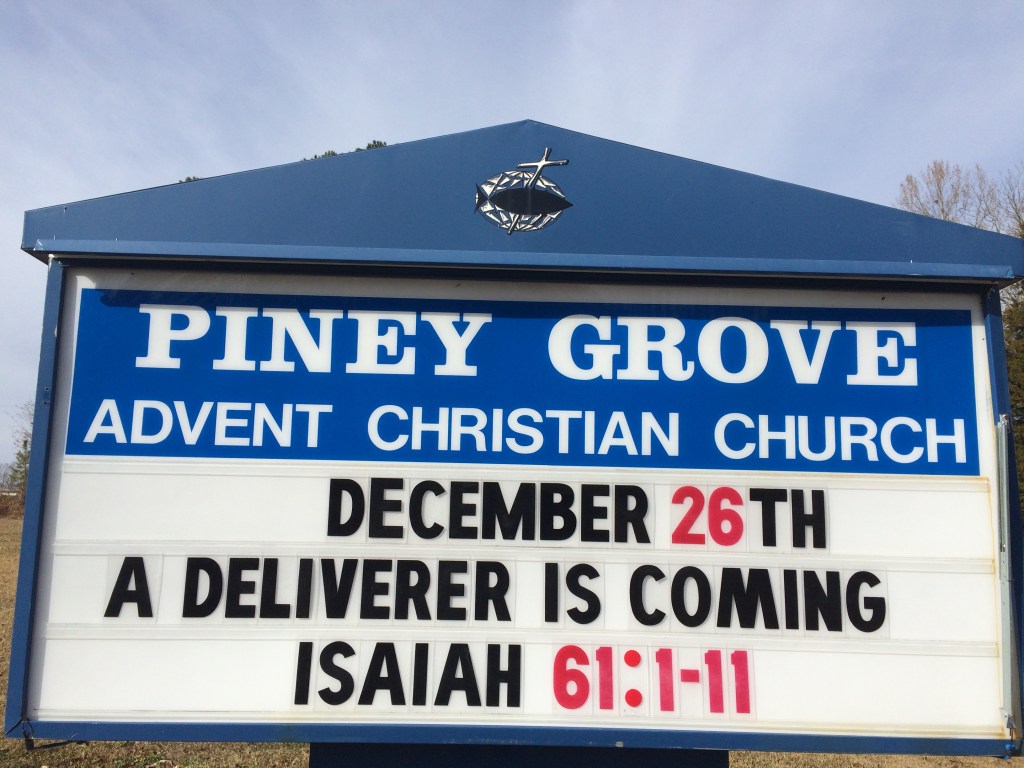
A DELIVERER IS COMING

A DELIVERER IS COMING

Isaiah 61:1-11 NET

Christmas is a time for us all to reflect on what it meant for Christ to come to earth, as a gift to humanity. The whole life of Jesus Christ was a gift to us. This year, I have been reflecting on some aspects of Christ as a gift that are not usually associated with Christmas. I think it is important for all of us to see that Jesus’ fulfillment of prophecy did not end after his nativity. He was the Messiah his whole life, and he still is. So, now that Christmas day is past, I still want to talk about Jesus. That child whose miraculous birth we celebrated yesterday grew up to be the Messiah.

I want to talk about the prophecy in Isaiah 61 today. This was the passage that Jesus himself used to announce himself as the fulfillment of the Old Testament prophecies of the coming Messiah. Isaiah was speaking to a people who had been humiliated by defeat and bondage. His prophecies referred specifically to what the Jewish Messiah would do for the Jewish people. But the words also speak to us – believers in Christ, no matter what our ethnic background is.

Isaiah predicted an encouraging Messiah (1-3)

1 The spirit of the sovereign LORD is upon me, because the LORD has chosen me. He has commissioned me to encourage the poor, to help the brokenhearted, to decree the release of captives, and the freeing of prisoners, 2 to announce the year when the LORD will show his favor, the day when our God will seek vengeance, to console all who mourn, 3 to strengthen those who mourn in Zion, by giving them a turban, instead of ashes, oil symbolizing joy, instead of mourning, a garment symbolizing praise, instead of discouragement. They will be called oaks of righteousness, trees planted by the LORD to reveal his splendor.

Luke tells us that “Jesus came to Nazareth, where he had been brought up, and went into the synagogue on the Sabbath day, as was his custom. He stood up to read, and the scroll of the prophet Isaiah was given to him. He unrolled the scroll and found the place where it was written, “The Spirit of the Lord is upon me, because he has anointed me to proclaim good news to the poor. He has sent me to proclaim release to the captives and the regaining of sight to the blind, to set free those who are oppressed, to proclaim the year of the Lord’s favor.” Then he rolled up the scroll, gave it back to the attendant, and sat down. The eyes of everyone in the synagogue were fixed on him. Then he began to tell them, “Today this scripture has been fulfilled even as you heard it being read” (Luke 4:16-21).

Anyone can see that Jesus was reading from Isaiah 61 here. By saying that the scripture has been fulfilled is to say that he was the Messiah that the scripture predicted. Apparently, the copy of Isaiah that Jesus read from also contained the phrase “and the regaining of sight to the blind” – which was no problem for Jesus. But Jesus stopped before the place in Isaiah 61 where it says “the day when our God will seek vengeance.”

The reason he did not say that part is very important. The Messiah’s primary ministry when he first came was to encourage his own people. He was commissioned to encourage, console and strengthen his people. He was to proclaim the year when the LORD would show his favor. He did speak of the day of the LORD’s vengeance. It was the judgment day we talked about last week. But Jesus didn’t want to concentrate on that. He wanted to tell his own people that God had not given up on them.

Jesus’ message to you and me is also one of encouragement. He finds us in poverty, bondage, blindness, and oppression. We have lived our lives under the control of the devil and in mourning and deep depression. He comes to us with the good news of the gospel.

Isaiah predicted a rejuvenating Messiah (4-7)

4 They will rebuild the perpetual ruins and restore the places that were desolate; they will reestablish the ruined cities, the places that have been desolate since ancient times. 5 “Foreigners will take care of your sheep; foreigners will work in your fields and vineyards. 6 You will be called, ‘the LORD’s priests, servants of our God.’ You will enjoy the wealth of nations and boast about the riches you receive from them. 7 Instead of shame, you will get a double portion; instead of humiliation, they will rejoice over the land they receive. Yes, they will possess a double portion in their land and experience lasting joy.

Isaiah painted a picture of a nationwide rebuilding program under the Messiah. Cities would be rebuilt and reestablished. People from other nations would work in their fields and vineyards. That was the opposite of what was happening in Isaiah’s day. The Israelites had become slaves to foreigners. Isaiah predicted that God’s people would be rejuvenated. But for that to happen, the people would have to accept him as their Messiah. Some did, but most did not. “He came to what was his own, but his own people did not receive him” (John 1:11). “But to all who have received him – those who believe in his name – he has given the right to become God’s children – children not born by human parents or by human desire or a husband’s decision, but by God” (John 1:12-13).

So, instead of rebuilding the nation of Israel – at least right now – Jesus offers to rebuild our lives. The lasting joy he promises is to everyone who comes to him and says ‘Here, Jesus – here is my life. It has been in perpetual ruins. Please rebuild it. It is a desolate place. Please restore it. I have been a slave long enough. Here’s my life Lord. Make me your priest, your servant. Here’s my humiliation Lord. I will exchange it for your gift of lasting joy. Here’s my thirst Lord. Let me drink. Here’s my sore neck Lord. I’m ready for your easy yoke and your light burden.

Isaiah predicted a blessing Messiah (8-11)

8 For I, the LORD, love justice and hate robbery and sin. I will repay them because of my faithfulness; I will make a permanent covenant with them. 9 Their descendants will be known among the nations, their offspring among the peoples. All who see them will recognize that the LORD has blessed them.” 10 I will greatly rejoice in the LORD; I will be overjoyed because of my God. For he clothes me in garments of deliverance; he puts on me a robe symbolizing vindication. I look like a bridegroom when he wears a turban as a priest would; I look like a bride when she puts on her jewelry. 11 For just as the ground produces its crops and a garden yields its produce, so the sovereign LORD will cause deliverance to grow, and give his people reason to praise him in the sight of all the nations.

Isaiah predicted a new covenant – a permanent covenant to replace the temporary one. The temporary covenant was the one established on Sinai. The Israelites broke it and continued to break it. As a result, that old covenant became a curse. But the Messiah would come with a new covenant. All who see those who are under the new covenant will recognize that the LORD has blessed them.” The first blessing is the covenant itself. It was not a conditional covenant requiring faithfulness to the law. It was a declaration by God that he would bless believers because of his own faithfulness.

Jesus declared to his disciples that his blood was “the blood of the covenant, that is poured out for many for the forgiveness of sins” (Matthew 26:28). His righteous blood was shed so that God could forgive us for our unrighteous lives. Debt paid. We are now free.

But Isaiah predicted another blessing in today’s text beside the enormous blessing of forgiveness. He said that “just as the ground produces its crops and a garden yields its produce, so the sovereign LORD will cause deliverance to grow, and give his people reason to praise him in the sight of all the nations.” For the last two thousand years, God’s deliverance has been growing among the nations. Every hour, every day, more people stream into the household of our God because of this great deliverance. Missions was built into the DNA of the new covenant. Jesus commanded his church to make disciples of all nations, to proclaim the gospel to all nations, to offer repentance and forgiveness of sins to all nations. If the old covenant could be described as “come to us,” the new covenant is best described as “go to them.” In the Great Commission text, the participle “go” does not have the same weight as the imperative “make disciples.” However, the fact that Jesus was sending his disciples somewhere (in actuality, Jerusalem) was significant. It set the stage for a church that would always be going with the gospel.

That role of expanding ourselves through reaching new lands and cultures with the gospel is also described by Jesus in his “vine and branches” message. He told his disciples “You did not choose me, but I chose you and appointed you that you should go and bear fruit” (John 15:16) Jesus did not simply command us to stay where we are and bear fruit. He appointed us to “go” and “bear fruit.” The word translated “go” in that text is used for sending someone off in a particular direction for a particular purpose. The mission of reaching new lands, peoples, and cultures with the gospel is built into our new identity as branches of Christ’s vine, and as recipients of his new covenant.

The Messiah’s ministry was a ministry of encouragement, rejuvenation, and blessing. As representatives of Christ, our ministry should be that too. There are still some poor discouraged people who need the good news. There are still some broken-down lives that need rebuilding. There are still many whose lives are cursed, who need the blessing of the permanent covenant of forgiveness.

LORD, just as the Father sent you, now send us. Send us to encourage, rebuild, and bless others with your forgiveness.

video

A JUDGE IS COMING

A JUDGE IS COMING

church sign

Isaiah 11:1-5 NET

1 A shoot will grow out of Jesse’s root stock, a bud will sprout from his roots.
2 The LORD’s spirit will rest on him — a spirit that gives extraordinary wisdom, a spirit that provides the ability to execute plans, a spirit that produces absolute loyalty to the LORD.
3 He will take delight in obeying the LORD. He will not judge by mere appearances, or make decisions on the basis of hearsay.
4 He will treat the poor fairly, and make right decisions for the downtrodden of the earth. He will strike the earth with the rod of his mouth, and order the wicked to be executed.
5 Justice will be like a belt around his waist, integrity will be like a belt around his hips.

During this advent season, we have been looking at some of the things predicted about the coming Messiah. Last year we focused on some of the things we usually associate with Christmas. But this year we are looking at some predictions about Jesus that we normally don’t talk about at Christmas. In today’s text, Isaiah described the coming Messiah as a shoot that will grow out of Jesse’s root stock, a bud that will sprout from his roots.

The prophet Ezekiel used similar imagery to describe the coming Messiah. He predicted that God would put an end to the kingdom of Judah, but that he would pull a sprig from Judah, and replant it on a very high mountain. That shoot would grow into a huge cedar and birds of every kind would be protected under it (Ezekiel 17:23). This coming king from the line of Judah would rule over not just Judah, but birds of every kind.

We now know who that king is, and what Ezekiel meant by the birds of every kind. When we celebrate the newborn king, the wise men from the east join in the celebration. They realize that the Messiah is not just a Jewish king. He is everyone’s king.

Now, Isaiah’s message about this coming Messiah emphasizes not the ability to rule over all people, but his ability to judge all people fairly.

What comes to your mind when you hear the word justice? Maybe you picture the image of a woman with a blindfold on, carrying a scale. That is actually a good image because it portrays some of the aspects of justice that we have come to expect. It is a woman, so we would expect justice to have compassion for the weak and helpless. She has a blindfold on because she is not influenced by prejudice or greed or the color of a defendant’s skin. She carries a scale because she is interested in doing the right thing exactly.

Jesus has the wisdom to judge everyone fairly (2)

During his earthly life, Jesus demonstrated all those abilities we would expect in the perfect judge. He came from humble circumstances, so he has compassion for the needy. He treated people with decency no matter who they were. He was able to deal with others without prejudice or chauvinism. When others wanted to stone the adulterous woman, he saw beyond the sin and treated it with the proper balance. When his own disciples wanted him to call down fire, he rebuked them.

Jesus demonstrated what the Bible calls wisdom. Isaiah predicted that “The LORD’s spirit will rest on him — a spirit that gives extraordinary wisdom.” That is what we need in a judge. We need someone who can look past the things that we get hung up on, and find the root of the problem. We need someone who cares about everyone the same — who does not play favorites.

God has appointed a day in which he will judge the world and its inhabitants and has given us a wise judge who will do the judging.

Jesus has the compassion to bring justice to those who have been mistreated (4a)

I love that time in Jesus’ ministry when he looked over the crowds coming to him and the Bible says that he had compassion on them because they were harassed and helpless. He knows things like that. He not only knows our strengths, he knows our weaknesses. If I am being mistreated, I want a judge who understands that.

Isaiah predicted that the Messiah “will treat the poor fairly, and make right decisions for the downtrodden of the earth.” Jesus came preaching the gospel — and he made it a point to reach the poor and downtrodden with that gospel message. The kingdom is open to everyone, but Jesus knew that the ones whom life had treated unfairly would be looking for a chance at making things right. His gospel proclaimed that.

Jesus defined his mission when he quoted “The Spirit of the Lord is upon me because he has anointed me to proclaim good news to the poor. He has sent me to proclaim release to the captives and the regaining of sight to the blind, to set free those who are oppressed, to proclaim the year of the Lord’s favor” (Isaiah 61:1-2 quoted in Luke 4:18-19).

Jesus has the authority of a judge to execute the wicked (4b)

Isaiah says that the Messiah “will strike the earth with the rod of his mouth, and order the wicked to be executed.” That’s his call. Religion says that God made us so that we cannot be unmade. But God says differently. He will not only condemn the wicked, he will execute them. There is a reason that the book of Revelation talks about a lake of fire, and calls it the second death.

So the Old Testament tells us that our Messiah will judge the world. But when Jesus came to this earth for his first advent, he did not come as judge. John said that “God did not send his Son into the world to condemn the world, but that the world should be saved through him” (John 3:17). Paul told the Athenians that God “has set a day on which he is going to judge the world in righteousness, by a man whom he designated, having provided proof to everyone by raising him from the dead” (Acts 17:31). That is one of four normative texts in the New Testament that explain about the coming day of judgment.

The other three texts are 2 Corinthians 5:10; Romans 2:16 and 2 Timothy 4:1.

2 Corinthians 5:10 NET For we must all appear before the judgment seat of Christ, so that each one may be paid back according to what he has done while in the body, whether good or evil.

Romans 2:16 NET on the day when God will judge the secrets of human hearts, according to my gospel through Christ Jesus.

2 Timothy 4:1 NET I solemnly charge you before God and Christ Jesus, who is going to judge the living and the dead, and by his appearing and his kingdom:

Let me summarize for you what those four normative New Testament passages teach about the coming day of judgment.

They teach that Christ is the means of judgment.

St. Peter is not going to be standing at the pearly gates letting people in or telling them to go you know where. Jesus is the judge. The one who has set a day has also designated a man to judge, and that man is the one he authorized by means of raising him from the dead. “We must all appear before the judgment seat of Christ.”

They teach that Christ will judge us all.

He’s going to judge the world. We “must all appear before the judgment seat of Christ.” He “will judge the secrets of human hearts.” And all means “the living and the dead” so there will have to be a resurrection.

Revelation describes that courtroom. It mentions a large white throne. It says “Then I saw a large white throne and the one who was seated on it; the earth and the heaven fled from his presence, and no place was found for them. And I saw the dead, the great and the small {That’s everybody, folks}, standing before the throne. Then books were opened, and another book was opened — the book of life. So the dead were judged by what was written in the books, according to their deeds. The sea gave up the dead that were in it, and Death and Hades gave up the dead that were in them, and each one was judged according to his deeds. Then Death and Hades were thrown into the lake of fire. This is the second death — the lake of fire. If anyone’s name was not found written in the book of life, that person was thrown into the lake of fire” (Revelation 20:11-15 NET).

They teach that Christ will judge on the Judgment Day.

The timing is important. There is a popular teaching among the religious that people are judged when they die. That is not the case. God has set a day, and that day corresponds to Christ’s appearing and his kingdom. So, until Christ returns, the judgment will not take place. If you have unsaved loved ones, they are not suffering in hell. They are doing the same thing your saved loved ones are doing. They are waiting for the judge. Just like in a modern courtroom, the judgment doesn’t start until the judge arrives.

Revelation talks about that judgment day. It says “the time has come for the dead to be judged, and the time has come to give to your servants, the prophets, their reward, as well as to the saints and to those who revere your name, both small and great, and the time has come to destroy those who destroy the earth” (Revelation 11:18 NET). God has set a day for both judging the lost and rewarding the saved, and that day corresponds to the day of Christ’s appearing. No one suffers the lake of fire until that day. No one goes to their reward until that day.

Isaiah predicted that the coming Messiah would be a judge. He would not be wearing a blindfold, because he will know all things, and be able to judge with wisdom. Instead, he will be wearing justice as a belt around his waist, and integrity as a belt around his hips. He will judge fairly. But really, the only thing we need to know about judgment day is whether our name is listed in his book of life. He has a list, and he does not need to check it twice. It is not a list of nice boys and girls. It is a list of those redeemed by the blood of the Lamb. Only the righteous will be rewarded and righteousness comes only through faith in Jesus Christ. Our judge will be the one who went to the cross for us. We will be in good hands.

video