1 Samuel 12:1 Then Samuel said to all Israel, “Notice, I have carefully listened to everything you said to me and placed a king over you.
1 Samuel 12:2 Now notice that the king is leading you. As for me, notice I’m old and gray, and my sons are here with you. I have led you from my youth until now.
1 Samuel 12:3 Notice me. Bring charges against me before Yahveh and his anointed: Whose ox or donkey have I taken? Whom have I wronged or mistreated? From whom have I accepted a bribe to overlook something? I will return it to you.”
1 Samuel 12:4 “You haven’t wronged us, you haven’t mistreated us, and you haven’t taken anything from anyone,” they responded.
1 Samuel 12:5 He said to them, “Yahveh is a witness against you, and his anointed is a witness today that you haven’t found anything in my hand.” “He is a witness,” they said.
1 Samuel 12:6 Then Samuel said to the people, “Yahveh, who appointed Moses and Aaron and who brought your ancestors up from the land of Egypt, is a witness.
1 Samuel 12:7 Now present yourselves, so I may confront you before Yahveh about all the righteous acts he has done for you and your ancestors.
1 Samuel 12:8 “When Jacob went to Egypt, your ancestors cried out to Yahveh, and he sent them Moses and Aaron, who led your ancestors out of Egypt and settled them in this place.
1 Samuel 12:9 But they forgot Yahveh their God, so he handed them over to Sisera commander of the army of Hazor, to the Philistines, and to the king of Moab. These enemies fought against them.
1 Samuel 12:10 Then they cried out to Yahveh and said, ‘We have sinned, for we abandoned Yahveh and worshiped the Baals and the Ashtoreths. Now rescue us from the power of our enemies, and we will serve you.’
1 Samuel 12:11 So Yahveh sent Jerubbaal, Barak, Jephthah, and Samuel. He rescued you from the power of the enemies around you, and you lived securely.
1 Samuel 12:12 But when you saw that Nahash king of the Ammonites was coming against you, you said to me, ‘No, we must have a king reign over us’– even though Yahveh your God is your king.
1 Samuel 12:13 “Now notice the king you’ve chosen, the one you requested. Notice, this is the king Yahveh has placed over you.
1 Samuel 12:14 If you fear Yahveh, worship and obey him, and if you don’t rebel against Yahveh’s command, then both you and the king who reigns over you will follow Yahveh your God.
1 Samuel 12:15 However, if you disobey Yahveh and rebel against his command, Yahveh’s hand will be against you as it was against your ancestors.
1 Samuel 12:16 “Now, therefore, present yourselves and see this great thing that Yahveh will do before your eyes.
1 Samuel 12:17 Isn’t the wheat harvest today? I will call on Yahveh, and he will send thunder and rain so that you will recognize what an immense evil you committed in Yahveh’s sight by requesting a king for yourselves.”
1 Samuel 12:18 Samuel called on Yahveh, and on that day Yahveh sent thunder and rain. As a result, all the people greatly feared Yahveh and Samuel.
1 Samuel 12:19 They pleaded with Samuel, “Pray to Yahveh your God for your slaves so we won’t die! For we have added to all our sins the evil of requesting a king for ourselves.”
1 Samuel 12:20 Samuel replied, “Don’t be afraid. Even though you have committed all this evil, don’t turn away from following Yahveh. Instead, worship Yahveh with all your heart.
1 Samuel 12:21 Don’t turn away to follow worthless things that can’t profit or rescue you; they are worthless.
1 Samuel 12:22 Yahveh will not abandon his people, because of his great name and because he has determined to make you his own people.
1 Samuel 12:23 “As for me, I vow that I will not sin against Yahveh by ceasing to pray for you. I will teach you the good and right way.
1 Samuel 12:24 Above all, fear Yahveh and worship him faithfully with all your heart; consider the great things he has done for you.
1 Samuel 12:25 However, if you continue to do what is evil, both you and your king will be swept away.”
19 All the people said to Samuel, “Pray to the LORD your God on behalf of us — your servants — so we won’t die, for we have added to all our sins by asking for a king.” 20 Then Samuel said to the people, “Don’t be afraid. You have indeed sinned. However, don’t turn aside from the LORD. Serve the LORD with all your heart. 21 You should not turn aside after empty things that can’t profit and can’t deliver, since they are empty. 22 The LORD will not abandon his people because he wants to uphold his great reputation. The LORD was pleased to make you his own people. 23 As far as I am concerned, far be it from me to sin against the LORD by ceasing to pray for you! I will instruct you in the way that is good and upright. 24 However, fear the LORD and serve him faithfully with all your heart. Just look at the great things he has done for you! 25 But if you continue to do evil, both you and your king will be swept away.”
We started reading 1 Samuel on Tuesday. We read about Hannah, who prayed so desperately for a child that the priest thought she was drunk. But the LORD answered her desperate prayers, and she gave birth to Samuel. When the boy was old enough, she gave him to be raised in God’s presence permanently.
In a sense, all of us who are believers experience what Hannah did. We knew the fruitlessness of a barren life until we met Christ and were born again. But our vow to God is to give the life he gave us back to him. We can do so with joy because life came from him in the first place.
Samuel lived with the elder priest, Eli. Samuel grew up respecting God and the priesthood, but Eli’s sons did not. They sinned and brought shame upon the land. But the LORD spoke to Samuel, and Samuel listened to his voice. So many of us put our spiritual cellphones on “do not disturb” because we cannot be bothered with a vision from God. Like it was in Eli’s day, the word of Yahveh is rare. We have God’s written word, but we often ignore that.
On Wednesday, we read about the Philistines capturing the ark. This battle resulted in the deaths of Hophni and Phineas, Eli’s sons. Eli died as well. This was a reminder that even those who profess faith in God will not always live in victory, especially if there are areas of our lives that we do not surrender to him.
This week, we read through most of Samuel’s narrative, and by this time, we notice that he is already an older man. Under his leadership, the people had gotten tired of God working out his will among them. They wanted a king and demanded that Samuel appoint one. The LORD told Samuel to relent and give them a king, and also to warn them of the price they would have to pay.
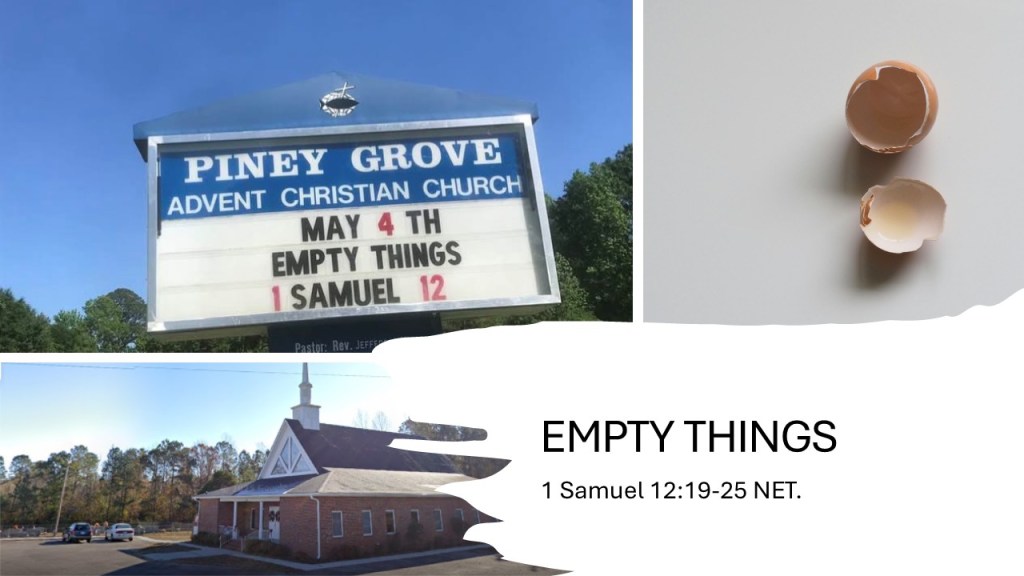
The people turned aside after empty things (21).
Samuel told the people that they should not turn aside after empty things. The Hebrew word he used was תֹּהוּ, a word that we had encountered in the first chapter of Genesis. We are told that when God first created the planet, it was formless and void. The word for formless is תֹּהוּ. It means something that doesn’t matter: a something that is a nothing.
The Israelites’ pursuit of a king and executive leadership did not seem like nothing to them. It looks like our modern society here in the USA is obsessed with the same thing. People talk, fight, plan, and scheme to get their person elected or to get who they think is the wrong person out. All the network news services join in the fight. It seems like every segment has to mention the President’s name somehow. The United States has over 300 million people, but somehow, no one matters but POTUS.
The Israelites decided that they needed a king. Samuel initially rejected their request, but the LORD told him to go along with it. The LORD sometimes refuses to give us what we want if we ask for the wrong thing. But sometimes, he gives us what we ask for to reveal the selfishness behind our asking.
We have just finished the book of Judges. The Judges were a special group of temporary and local leaders that God gave the Israelites before the monarchy. Samuel was the last of the Judges. He presided over the transition, and it must have hurt him deeply to be the last. He felt the sting of rejection behind the people’s request for a king. But he was also upset because he saw what the kings of all the nations around Israel were doing to their people. The kings led their people to acts of sacrilege and violence. The kings led their people away from God and his word. This is why Samuel called the desire for a king turning aside after empty things that cannot profit or deliver. The real power of any nation is not in its executive branch but in its relationship with God.
Samuel warned of the consequences of seeking empty things (25).
Samuel saw that a king could only make a selfish people more selfish. He warned his people that if they continued to do evil, both they and their precious king would be swept away. The people did not want to hear that. They suffered under the delusion of permanence. They assumed that they would always be around and keep doing what they were doing. But God, through Samuel, was warning them that they were not as steady as they thought they were.
Jesus teaches us the same thing. He warns his readers that they are building their houses on the sand. But he warns us that when the rain falls and the flood comes, the winds will beat on those houses and they will collapse and be utterly destroyed. We love our houses. We spend our time cleaning them, repairing them, remodeling them, and beautifying them. But if those houses are not built on the rock, then none of our efforts will matter. The house itself is just another empty thing that we have turned aside from God and run after. There are consequences of seeking empty things. Even when the empty things seem like important things, we need to keep them in perspective. We need to seek God’s kingdom and his righteousness first. All other things are empty things.
Samuel offered God’s good things (22-24).
He challenged his people to review their history and consider the great things God had done for them. We have been reading about those great things this year. I hope that we have done so, realizing that God expected his people to respond to his miraculous acts of love by returning the love. Samuel challenged his people to fear the LORD and serve him faithfully with all their heart.
When I meet a stranger and that person shows disrespect for me, I may be confused, but I don’t let it bother me. I tell myself that if that person actually knew me, they would not treat me that way. But if I get the same disrespect from one of my children, it makes me angry. Why do I get angry at the same behavior from one of my children? The reason is apparent. My children know how much I love them. They have decades of evidence of my care and concern for them. For that reason, if they disrespect me, it hurts more.
History would reveal the people’s response to Samuel’s offer.
Samuel makes a bargain with his people. He commanded them to stay faithful to God despite their past failures and to fear and follow him faithfully without getting caught up in trivial pursuits. For his part of the
bargain, Samuel promised to pray for them consistently, which is what they asked for. But he also promised to teach them the good and proper way to follow God. As we continue reading the Old Testament, we are going to see evidence that a few leaders got it right and brought reform and revival to the land and its people. But many failed to stay focused on God and his word. When that happened, God stayed faithful to his covenant. He brought punishment to his people because he had to remain faithful to his covenant with them.
Holy Communion service:
Colossians 2:14 NET
He has destroyed what was against us, a certificate of indebtedness expressed in decrees opposed to us. He has taken it away by nailing it to the cross.
I want to confess. I like to pay bills. I get a satisfactory feeling every time I sit at my computer and transfer funds from my account to pay my credit card bills. Before you volunteer to give me some of your bills to pay, I have to explain that I like paying my bills.
This month, I encountered some bills that were charged against me that I had not incurred. I didn’t want to pay those bills because they were not mine. I didn’t deserve them. So my bank reimbursed me for the false charges, and got the company that defrauded me to reimburse them.
Today, I want to remind you that you once had a charge against you in heaven’s court: a court that is even higher than any human supreme court. You deserve to answer all of those charges, but our Lord chose to take the punishment for them on himself. He took away your certificate of indebtedness and nailed it on the cross with his body. His blood cleansed you from every stain of every sin you committed. That is why we celebrate Jesus with these emblems of holy communion. It is all about him and what he did. It had to be him because only he was qualified. Only he was sinless. He became a sin offering for us. Every time we come to this table, we celebrate the forgiveness of a debt. We celebrate the freedom we now have to live without the condemnation we deserve because of the love and grace of God in Christ.
Thank you, heavenly Father, for the loving gift of your Son. His death on the cross has taken away our indebtedness and nailed it to the cross. Because of him, we can live free of the guilt and shame of sin. Thank you that our Lord Jesus Christ is not an empty thing. He is worth our faith and loyalty, and devotion because he has delivered us. Amen.




 jeffersonvann