
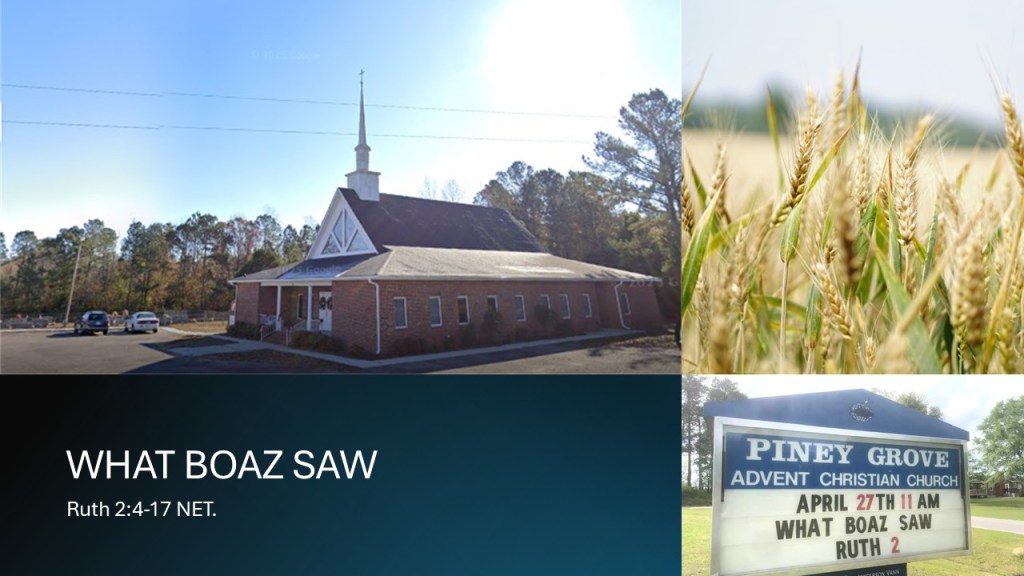
WHAT BOAZ SAW
Ruth 2:4-17 NET.
4 Now at that very moment, Boaz arrived from Bethlehem and greeted the harvesters, “May the LORD be with you!” They replied, “May the LORD bless you!” 5 Boaz asked his servant in charge of the harvesters, “To whom does this young woman belong?” 6 The servant in charge of the harvesters replied, “She’s the young Moabite woman who came back with Naomi from the region of Moab. 7 She asked, ‘May I follow the harvesters and gather grain among the bundles?’ Since she arrived, she has been working hard from this morning until now — except for sitting in the resting hut a short time.” 8 So Boaz said to Ruth, “Listen carefully, my dear! Do not leave to gather grain in another field. You need not go beyond the limits of this field. You may go along beside my female workers. 9 Take note of the field where the men are harvesting and follow behind with the female workers. I will tell the men to leave you alone. When you are thirsty, you may go to the water jars and drink some of the water the servants draw.” 10 Ruth knelt before him with her forehead to the ground and said to him, “Why are you so kind and so attentive to me, even though I am a foreigner?” 11 Boaz replied to her, “I have been given a full report of all that you have done for your mother-in-law following the death of your husband — how you left your father and your mother, as well as your homeland, and came to live among people you did not know previously. 12 May the LORD reward your efforts! May your acts of kindness be repaid fully by the LORD God of Israel, from whom you have sought protection!” 13 She said, “You really are being kind to me, sir, for you have reassured and encouraged me, your servant, even though I am not one of your servants!” 14 Later, during the mealtime Boaz said to her, “Come here and have some food! Dip your bread in the vinegar!” So she sat down beside the harvesters. Then he handed her some roasted grain. She ate until she was full and saved the rest. 15 When she got up to gather grain, Boaz told his male servants, “Let her gather grain even among the bundles! Don’t chase her off! 16 Make sure you pull out ears of grain for her and drop them so she can gather them up. Don’t tell her not to!” 17 So she gathered grain in the field until evening. When she threshed what she had gathered, it came to about thirty pounds of barley!
We are continuing to read through the Bible, two chapters per day. Our reading has brought us to the period of the judges, and today’s text describes events that happened during that period. This was a time when the Israelites were not known for their loyalty to the LORD. There was no king, so people pretty much did whatever they wanted, with very little to prevent wickedness. It was a time and a culture much like that of our own. If you asked anyone whether what they were doing was right, they would say yes. But they were doing what was right in their own eyes. They had been given God’s law through Moses, but they paid very little attention to that law. If they wanted to do something, they did it. They did not stop to ask if what they were doing honored God. Most of the people during this time lived like that.
But there were exceptions. The life stories of some of those exceptional people are recorded in Scripture. The book of Ruth represents the islands of light in the sea of darkness. People like Ruth, Naomi, and Boaz were reminders that even during times of rampant wickedness, one can still choose to follow the Lord and be the light of the world. Many sermons have been preached that highlight the way Ruth and Naomi pierced the darkness by their faith and the actions brought about by that faith. For today’s message, I have chosen to look more closely at Boaz. The reason I want to focus on Boaz is that he had a character quality that very few in his time possessed. He had insight into the things that really mattered. He discerned how to make the right choices based on an awareness of what was significant and what was not.
I want to focus on how today’s text identifies Boaz’s insight. Each part of the passage introduces a new way of thinking that Boaz understood, but few around him did. He was set apart as an example of someone who could see opportunities where others only saw problems. He could see God at work where others only saw the mundane—the ordinary.
Boaz saw an opportunity to honor God in everything he did (4, 12).
The easiest facet of Boaz’s insight to recognize is what we see in these two verses. In verse 4, Boaz is greeting his harvesters. He does not begin by barking out orders, or even by requesting a report on the progress of the harvest. No, he starts with a formal greeting. It looks like this is a tradition with Boaz. We don’t see too many examples of this kind of greeting in Scripture, particularly not in this period. But Boaz is an exception. The first thing out of Boaz’s mouth is a blessing. He invokes God’s presence among his workers. He says, “May the LORD be with you.” They respond in turn, “May the LORD bless you.” They put the LORD first in their conversation. This is a clue that they have put the LORD first in their lives. They are harvesters, but they prioritize the LORD over their harvest. Boaz is the master of the harvest. He puts the LORD first over himself.
Jesus teaches that we should prioritize the LORD first. He taught us to pray, “Our Father… hallowed be thy name.” He taught us to seek first his kingdom and his righteousness. If we seek God’s kingdom first, then everything we do can be in his name. Boaz was not about making himself look great. He was not even about making Israel great. His priority was making the name of God great.
Later in the text, Boaz reflects the same insight when he asks the LORD to reward Ruth’s efforts (vs. 12). Boaz saw Ruth as someone who had taken refuge in the LORD. He asks God to repay her for seeking the LORD’s protection. She was not depending on Naomi or Boaz. She was showing dependence upon God himself, and Boaz praised her for it.
Boaz saw beyond national and ethnic prejudices (5-6).
He had asked his servants who Ruth was. Their answer seems to indicate that they had written Ruth off because she was not a natural-born citizen of Israel. They said, “She’s the young Moabite woman who came back with Naomi from the region of Moab. Their answer focuses on only one aspect of Ruth’s personality: her ethnic lineage. To them, the most important thing about Ruth was that she was one of them. Her ancestors were children of Lot, not children of Abraham.
The Moabites were very different from the Israelites. They claimed a different territory. They worshipped and served other gods. They sometimes clashed with and fought against the Israelites. But even beyond that, the Israelites often viewed the Moabites with suspicion because Lot’s daughters had gotten their father drunk and become impregnated by him to preserve his family line. So, when Naomi came back to Israel, tongues wagged because of that Moabite girl she brought with her.
Boaz had the spiritual insight to see beyond Ruth’s physical background and see Ruth for who she was on the inside. Of course, it helped Boaz that he himself came from a mixed family. His father was Salmon of the clan of Elimelech. But Salmon had married Rahab. Yes, the Rahab who had been a citizen of Jericho until she took a leap of faith and protected the Israelite scouts. After that, she became one of them. Before, she was one of them – the outsiders. Since Boaz probably grew up with tongues wagging all around him about his foreign mother, he was sensitive to what prejudice can do to a person.
Boaz saw potential where others saw a problem (8-9).
He invited Ruth to stay close to his workers and not to stray to other fields. He told his men to help her out and not to harass her. He did this because he recognized that she could be an asset, not a liability. Some property owners might have told their workers to shoo away the foreigners, but not Boaz. He looked beyond her background and responded only to her actions as a hard worker.
Boaz saw faith where others saw mere kindness (10-12).
When Ruth asked Boaz why he was being so kind to her, even though she was one of them, Boaz answered her. He said that he had been given a full report of all she had done for Naomi. Naomi had given both of her daughters-in-law permission to leave her and go back to their people. Orpah chose to do that. But Ruth chose to stay with Naomi. She decided to remain loyal to Naomi, even when that meant leaving her people and going to live among Naomi’s people.
Ruth’s loyalty to Naomi is so well-stated that it is often used to express marital fidelity even today. She was the one who first said, “Intreat me not to leave thee, or to return from following after thee: for whither thou goest, I will go; and where thou lodgest, I will lodge: thy people shall be my people, and thy God my God” (Ruth 1:16 KJV). Ruth was not just being kind to Naomi. She had decided to be all in. Boaz recognized that choice as an act of faith.
Boaz saw Ruth’s heart and sought to encourage her (13-17).
It was one thing for Boaz to appreciate Ruth for her loyalty to her mother-in-law. It was another to go beyond that and actively show deference to Ruth. Boaz was hooked. She had won his heart, and so he went out of his way to encourage hers. From that point on, it was Boaz who was going out of his way to pay attention to Ruth and bless her beyond what was expected.
When Ruth arrived home that night, she had about thirty pounds of barley with her. That was way more than your average yield for a day’s gleaning. Naomi knew right then that Ruth had caught Boaz’s attention.
We can learn from Boaz a thing or two about making a difference in the lives of those around us. He had been blessed, and he returned the blessing. This is more than just a love story. This is a story about a man who decided to live by the covenant that he had inherited from his family. Everything Boaz did was in obedience to the commands of God through Moses. We learned in our study of Deuteronomy that God expected his people to show deference to the poor, the foreign resident, and the widow. Ruth was all three of these. Boaz looked at this woman, and he saw more than a potential wife. Their courtship began because he chose to obey God’s word.
Jesus said that the second greatest commandment is to love our neighbors as we love ourselves. There is a reason God wants us to do that. He wants us to show that he loves the world and demonstrate that love. We demonstrate love by loving. We demonstrate that God cares by caring for people ourselves. There is a planet full of Ruths just waiting for someone to care. They are amazing people, but most of the world does not see their potential because they are different from us. Boaz challenges us to look at others with love in our hearts. The Good Samaritan challenges us to take the time to help the needy. Maybe the next Ruth is gleaning in our fields today. Will we dare to care for them?

 jeffersonvann