
Deuteronomy 24

Deuteronomy 24

Deuteronomy 24:1 “If a man marries a woman, but she becomes displeasing to him because he finds something indecent about her, he may write her a divorce certificate, hand it to her, and send her away from his house.

Deuteronomy 24:2 If, after leaving his house, she goes and becomes another man’s wife,

Deuteronomy 24:3 and the second man hates her, writes her a divorce certificate, hands it to her, and sends her away from his house, or if he dies,

Deuteronomy 24:4 the first husband who sent her away may not marry her again after she has been defiled, because that would be repulsive to Yahveh. You must not cause failures on the land Yahveh, your God, is giving you as an inheritance.

Deuteronomy 24:5 “When a man takes a bride, he must not go out with the army or be liable for any duty. He is free to stay at home for one year so that he can bring joy to the wife he has married.

Deuteronomy 24:6 “Do not take a pair of grindstones or even the upper millstone as security for a debt, because that is like taking a throat as security.

Deuteronomy 24:7 “If a man is discovered stealing a throat of one of his Israelite brothers, whether he treats him as a slave or sells him, the kidnapper must die. You must purge the evil from you.

Deuteronomy 24:8 “Be careful with a person who has a case of severe skin disease, watching carefully everything the Levitical priests instruct you to do. Be careful to do as I have commanded them.

Deuteronomy 24:9 Remember what Yahveh your God did to Miriam on the journey after you left Egypt.

Deuteronomy 24:10 “When you make a loan of any kind to your neighbor, do not enter his house to collect what he offers as security.

Deuteronomy 24:11 Stand outside while the man you are making the loan to brings the security out to you.

Deuteronomy 24:12 If he is a poor man, do not lie down with the garment he has given as security.

Deuteronomy 24:13 Be sure to return it to him at sunset. Then he will lie down in it and celebrate you, and this will be counted as righteousness to you before Yahveh, your God.

Deuteronomy 24:14 “Do not exploit[1] a hired worker who is poor and needy, whether one of your Israelite brothers or one of the guests in a town in your land.

Deuteronomy 24:15 You are to pay him his wages each day before the sun sets because he is poor and his throat depends on them. Otherwise, he will cry out to Yahveh against you, and you will be held guilty of the failure.

Deuteronomy 24:16 “Fathers are not to be put to death for their children, and children are not to be put to death for their fathers; each person will be put to death for his failure.

Deuteronomy 24:17 Do not deny justice to a guest or fatherless child, and do not take a widow’s garment as security.

Deuteronomy 24:18 Remember that you were a slave in Egypt, and Yahveh, your God, redeemed you from there. Therefore, I am commanding you to do this.

Deuteronomy 24:19 “When you reap the harvest in your field, and you forget a sheaf in the field, do not go back to get it. It is to be left for the guest, the fatherless, and the widow, so that Yahveh your God may empower you in all the work of your hands.

Deuteronomy 24:20 When you knock down the fruit from your olive tree, do not go over the branches again. What remains will be for the guest, the fatherless, and the widow.

Deuteronomy 24:21 When you gather the grapes of your vineyard, do not glean what is left. What remains will be for the guest, the fatherless, and the widow.

Deuteronomy 24:22 Remember that you were a slave in the land of Egypt. Therefore I am commanding you to do this.


[1]עָשַׁק = exploit. Deuteronomy 24:14; 28:29, 33.

Deuteronomy 24 quotes:

“If the man decided to divorce the woman, he was to write out a bill of divorce and formally serve it on the woman. She was then sent away from the man’s house, but possession of the bill of divorce gave her a certain protection under law from any further action by the man, In the situation envisaged by this particular piece of legislation, the divorced woman then remarries another man. The second marriage is terminated, either by a second divorce or by the death of the second husband. Now comes the specific legislation: under all these circumstances, the first man may not remarry his former wife. After she has been defiled—the language (defiled) suggests adultery (see Lev. 18:20). The sense is that the woman’s remarriage after the first divorce is similar to adultery in that the woman cohabits with another man. However, if the woman were then to remarry her first husband, after divorcing the second, the analogy with adultery would become even more complete; the woman lives first with one man, then another, and finally returns to the first. Thus the intent of the legislation seems to be to apply certain restrictions on the already existing practice of divorce.”

Craigie, Peter C.. The Book of Deuteronomy (The New International Commentary on the Old Testament) (p. 305). Wm. B. Eerdmans Publishing Co.. Kindle Edition.

“This is not a general law permitting divorce or setting forth grounds for it, but simply takes the practice of divorce for granted (cf. 22:19, 29). The case is therefore a special one, framed in a casuistic fashion (as an ‘if ’ or hypothetical situation). The first three verses are the protasis (‘if ’ section), describing a situation of successive marriages that have terminated. Then verse 4 contains the apodosis (‘then’ section) which supplies the consequence to verses 1–3, and brings the law to a conclusion.”

Woods, Edward J.. Deuteronomy: An Introduction and Commentary (Tyndale Old Testament Commentaries Book 5) . InterVarsity Press. Kindle Edition.

Deuteronomy 24 links:

daily wages rule
fair to everyone
in retrospect- remembering the past
jobs and the will of God
leftovers
never less than the best
poverty and dignity
remember Miriam
work and marriage

The DEUTERONOMY shelf in Jeff’s library.

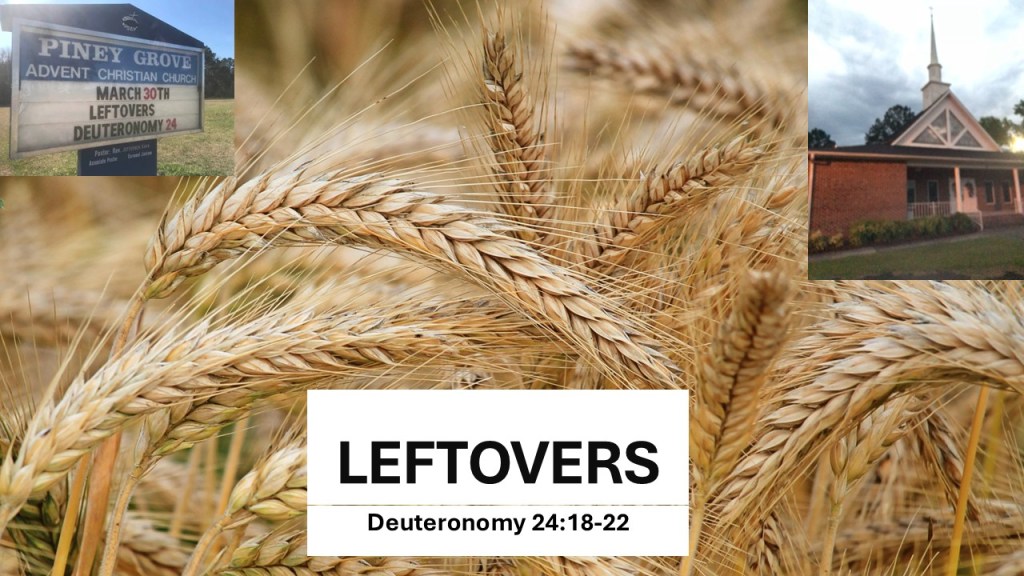
LEFTOVERS  

LEFTOVERS  

Deuteronomy 24:18-22 NET.

18 Remember that you were slaves in Egypt and that the LORD your God redeemed you from there; therefore I am commanding you to do all this.

19 Whenever you reap your harvest in your field and leave some unraked grain there, you must not return to get it; it should go to the resident foreigner, orphan, and widow so that the LORD your God may bless all the work you do. 20 When you beat your olive tree you must not repeat the procedure; the remaining olives belong to the resident foreigner, orphan, and widow. 21 When you gather the grapes of your vineyard you must not do so a second time; they should go to the resident foreigner, orphan, and widow. 22 Remember that you were slaves in the land of Egypt; therefore, I am commanding you to do all this.

It is merely coincidental that I am preaching this sermon after two weeks of dealing with a personal crisis with my family. Penny’s accident meant that I had to take on the role of full-time caregiver. It has been difficult for both of us to adjust to the new normal in our household. It would have been even more difficult if it had been necessary for me to provide all the meals as well as do all the cleaning. But many of you stepped in and provided some excellent meals for us. As a consequence, all I had to do most days is figure out which leftovers I would heat up. In fact, most of the time, I didn’t even have to go to the freezer to thaw anything out. The only drawback was that many of our meals looked and tasted just like the meals we had previously. That’s Okay. We are very grateful for your help.

So, as I said, it is merely coincidental that the title of today’s sermon is “LEFTOVERS.”  The title comes from the command that the LORD gave the Israelites for when they crossed over the Jordan into the Promised Land. He told them to leave some grain in their fields when they harvested. That leftover grain would be for the poor: particularly the resident foreigners, the orphans, and the widows who lived near them. He told them to treat their orchards the same way they treated their fields. They could harvest their olive trees, but they should not make a second pass over them. Instead, anything left over should be reserved for the poor: that is, the resident foreigners, the orphans, and the widows. They should treat their vineyards the same way. They could gather the grapes once. But anything left over should go to the resident foreigners, the orphans, and the widows.

It is important as we study these particular laws to understand that each of them is merely a single application of an over-arching principle. If we don’t do that, then most people who read these words will be disinterested and feel that nothing applies to them. After all, some of you own fields and plant them. Fewer of you own gravevines – and even those do not own entire vineyards. As far as I know, none of you have an olive orchard. To understand the relevance of today’s text, we need to look at the principles that it teaches, not just the practices it lists.

The redeemed should remember (18, 22).

The LORD tells the Israelites to remember that they were slaves in Egypt. Once they get into the Promised Land, their status will change from a nation of slaves to a nation of landowners. They will own land and property and will not have to give the proceeds to any master. They will be free to gain wealth. Whereas their masters in Egypt had exploited them, now they would be tempted to exploit others. The shoe will be on the other foot. So, the LORD commands them to remember what it felt like to be on the receiving end of exploitation and oppression.

They were to remember that the LORD redeemed them from Egypt. So, they were not to recreate the same situation that they faced in another land. They had been slaves, so they were not to become enslavers. They were to look out for those with fewer opportunities than they had. Unless they remembered how they had been exploited, history was liable to repeat itself, with the Israelites now on the potential giving end of the exploitation.

The command was for them to keep their greed in check. Instead of looking out for number one, they were to look out for all those little people who would not experience the immediate advantages of the new land.

This was not the only law that God established to take care of the poor among his people. Note Deuteronomy 14:28-29. It says that “At the end of every three years you must bring all the tithe of your produce, in that very year, and you must store it up in your villages. Then the Levites (because they have no allotment or inheritance with you), the resident foreigners, the orphans, and the widows of your villages may come and eat their fill so that the LORD your God may bless you in all the work you do.” The produce of the land was to be tithed, and every three years, it would be distributed to four groups. The three groups already mentioned: the resident foreigners, the orphans, and the widows, and also the Levites because they are not distributed territory by tribe like the other tribes are.

Not also Deuteronomy 26:12-15. It says, When you finish tithing all your income in the third year (the year of tithing), you must give it to the Levites, the resident foreigners, the orphans, and the widows so that they may eat to their satisfaction in your villages. Then you shall say before the LORD your God, “I have removed the sacred offering from my house and given it to the Levites, the resident foreigners, the orphans, and the widows just as you have commanded me. I have not violated or forgotten your commandments. I have not eaten anything when I was in mourning, or removed any of it while ceremonially unclean, or offered any of it to the dead; I have obeyed you and have done everything you have commanded me.             Look down from your holy dwelling place in heaven and bless your people, Israel, and the land you have given us, just as you promised our ancestors- a land flowing with milk and honey.” The same four groups of underprivileged among the Israelites are mentioned. But this passage points to another principle about taking care of the needy:

The redeemed should seek blessing (19).

That verse says, “Whenever you reap your harvest in your field and leave some unraked grain there, you must not return to get it; it should go to the resident foreigner, orphan, and widow so that the LORD your God may bless all the work you do.” The blessing on the crops was conditional on the sharing of the wealth with the lesser advantaged. If God looked down and saw a greedy farmer who did not share, he would withhold his blessing on that farmer and his family.

Jesus told a parable about a farmer who was greedy like that. He said, “Beware! Guard against every kind of greed. Life is not measured by how much you own”  (Luke 12:15). That statement is just as radical today as it was two millennia ago. Today, the popular belief is that those who have the most stuff have the best life.  The rich are idolized no matter what they believe and no matter who they serve.

Then he told them a story: “A rich man had a fertile farm that produced fine crops.  He said to himself, ‘What should I do? I don’t have room for all my crops.’  Then he said, ‘I know! I’ll tear down my barns and build bigger ones. Then I’ll have room enough to store all my wheat and other goods.  And I’ll sit back and say to myself, ‘My friend, you have enough stored away for years to come. Now, take it easy! Eat, drink, and be merry!”(Luke 12:16-19).

This was the man’s 401K – his retirement plan.  He said, “I got some good stuff.  I’m going to make bigger barns so that I can hold all my stuff.  Then I’m going to kick back, go to Barbados, and get some sand between my toes.”  Well, that was the plan.  But God knew something that the would-be retiree did not know:

But God said to him, ‘You fool! You will die this very night. Then who will get everything you worked for?’ (Luke 12:20).

The man was rich, resourceful, productive, and successful. He had made a plan that would provide for his needs and (presumably) those of his family.  He would have been praised by the popular culture of his day and ours.  But in just one moment – one last heartbeat – he was going to lose all that he had ever gained. 

 “Yes, a person is a fool to store up earthly wealth but not have a rich relationship with God”(Luke 12:21)

This is the moral of the story.  Jesus tells his disciples and the others who have ears to hear, “Don’t waste your life just collecting stuff.  Bigger barns are not the answer.”  So, what is the answer?  The answer is “a rich relationship with God.”  But how do we get that?  One way is to use our wealth to do what God would do: help the needy!

We can build bigger barns, or we can give our excess to help those less well off. It is no secret which option Jesus would want us to choose. He taught people that when they put on a banquet, they should invite those who cannot repay them. In his parable of the wedding banquet, the original invitees did not respond, so the king told his slaves to scour the streets and invite everyone. In the parable, God is the king, and we are his slaves. He wants us to share the blessing the king has in store, and that is how we will be blessed. But according to today’s text, the opposite is also true. The Israelites who hoarded their crops would lose the blessing. If we don’t pass on the blessings of our redemption, we displease the one who redeemed us.

The redeemed should be redeemers (19-21).

The story of Ruth shows how this principle is appropriately illustrated. Boaz was an Israelite who was greatly blessed. He shared that blessing with one who was a qualified member of one of the disadvantaged classes. She was a foreign resident. She was an outsider: an immigrant. Most people consider the Book of Ruth a love story, and that is exactly what it is. But it is more than a romance. It is the story of a man who was redeemed who chose to become a redeemer. The tradition of the kinsman redeemer came out of a desire to obey commands such as the ones highlighted in today’s text.

Ruth asked Naomi for permission to go and gather in the fields. Boaz obeyed the biblical command to leave some grain to glean. In fact, he went out of his way to show compassion to Ruth. He told his slaves to pull out some ears of grain and drop them so that she could gather them up.

The lesson for us is that our God wants us to be like Boaz. He wants us to demonstrate his compassion toward those who are underprivileged and needy. When we start helping the needy in Christ’s name, then the world around us will be more interested in what we say about him. Being a witness means drawing people to God, and one of the ways we can do that is by showing compassion. We can love people into the kingdom. But that love has to be more than emotional. It has to be tangible. Love is leaving some grain to glean.