
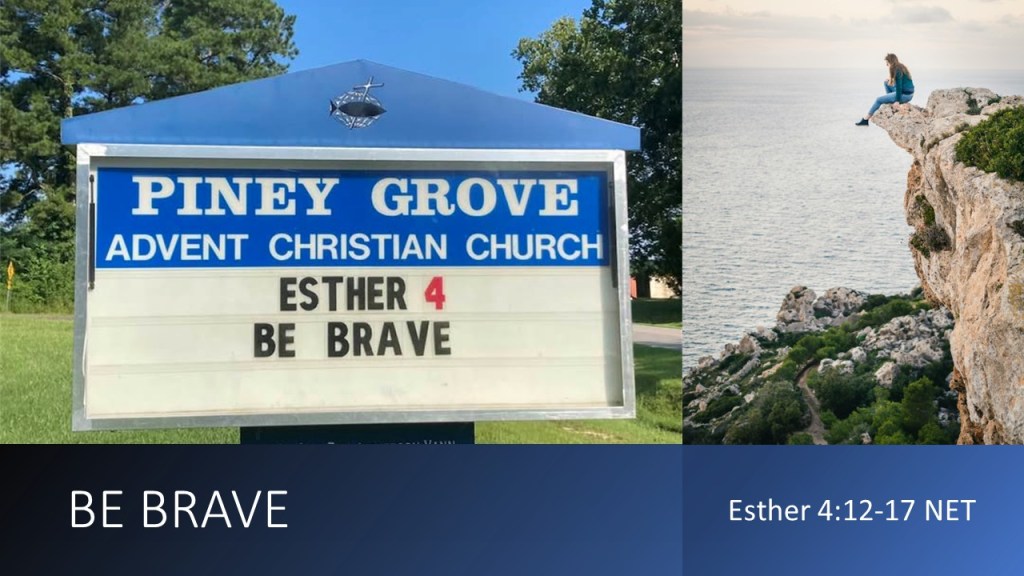
BE BRAVE
Esther 4:12-17 NET.
The stories in the Old Testament serve as lessons for us. They show the actions and behaviors that are expected of God’s people or reveal the opposite—the things believers should avoid. We need to pay close attention when reading because some Old Testament characters change their roles halfway through. They might start rebellious and then repent, or begin righteous and make a wrong turn or a terrible mistake. Therefore, reading these Old Testament narratives is not always easy.
We need to read the stories in the order we received them because that provides us with context. Context helps us understand what the characters are doing and why they are doing it. For example, today’s text is set during exile. This is the period when the Israelites are no longer in the land of Israel. They have been condemned by God for their lack of faithfulness and punished by exile. Exile is when people are taken from their land and brought to a new land by their conqueror.
Esther recounts the story of the Jews in Persia. The king had dismissed his queen, and he chose a new queen who happened to be Jewish. The villain of the story is an Agagite named Haman, who was violently anti-Semitic long before Hitler. Haman schemes to use the king’s power to eliminate the Jews.
Another key character in Esther is Mordecai, the cousin and guardian of Esther. Mordecai discovers a plot to destroy the Jews and appeals to Esther to intervene. When she learns of the plot, she wants to help save her people, but there is a problem. The protocol for appealing to the king is that he must first summon you. But Esther had not been called into the King’s presence in a month. Anyone who dares to enter the King’s presence without an invitation risks being executed. Esther understood the situation and chose to bravely enter the King’s presence to plead for her people’s lives.
If we look a little further back, we can see that another layer is at play in the story of Esther. There is a broader background as well as a more immediate one. In Esther, the sovereign God is protecting the people of Israel, from whom the Messiah will eventually come. That is another aspect we should recognize in these Old Testament stories. All of them reveal something about our Lord Jesus Christ. The Old Testament prepares the way for Christ’s first coming.
The book of Esther highlights one aspect of faith. It is a quality of biblical faith that isn’t often emphasized when we discuss what it means to have faith. In the New Testament book of Revelation, we find a list of all the people who will be excluded from eternal life and will be destroyed in the lake of fire. It states this: “But the cowards, faithless, detestable, murderers, sexually immoral, sorcerers, idolaters, and all liars, their share will be in the lake that burns with fire and sulfur, which is the second death” (Revelation 21:8).
I find it interesting that the first item on the list of those who will be destroyed in hell is cowards. Of all the things that the Bible describes as bad or evil, why put cowardice first?
I think there is a very good reason for this. Remember that the New Testament also tells us that our adversary, the devil, is prowling around looking for someone to devour. It does not ask us to hide from him. It does not tell us to run from him. It does not ask us to aim our rifles at him while he is far away and shoot him. It says that we are to resist him. Resistance requires contact. We must put ourselves in harm’s way and trust that God will accomplish his will. There’s no guarantee that we will always win.
There is no bravery without an obstacle.
We learned from Queen Esther not to let obstacles prevent us from standing up against enemies’ attacks. The obstacle Esther faced was that she had to enter the King’s presence to appeal to him on behalf of her people, but doing so could have cost her life.
Other biblical characters face the same challenge. Doing what is right could very likely cost them their lives. Daniel faced the lions in the den, his three companions faced the fire in the furnace, David faced Goliath, and Paul went to his death in Rome because he knew God wanted him to share the gospel with the emperor. One of the signs of faith in the Bible is that the people of God bravely set their sights on doing God’s will even when doing so is dangerous.
Another lesson we learned from Esther is that God is at work in every conflict, but we still must be brave.
I used to enjoy playing certain computer games where you faced dangerous challenges. I especially liked playing those games in what we called God Mode. If you set your settings to God Mode, then the bullets wouldn’t hurt you. The game remained challenging, but you had all the time you needed, and you could make all the mistakes possible without dying. Some people think that Christian life is like playing a game in God Mode. They believe they can face any challenge and don’t need to worry because their faith will protect them from losing. But that’s not what the Christian life is about. Esther is an example to follow, not because she was immune to danger, but because she wasn’t. She truly risked her life to do what was right. The world is full of cowards who aren’t willing to do the same.
God says that if we acknowledge Him before people, He will acknowledge us in the presence of His angels. But cowards hide behind their ignorance. They proclaim themselves as agnostics because they don’t want to offend anyone by claiming that Jesus Christ is Lord of Lords. They think they are saving themselves through their cowardice. But the fact is that refusing to bow the knee to Christ is like what Haman did. He built gallows, intending to hang Mordecai on them. However, he ended up being hanged from the very gallows he built.
The book we are reading today is called Esther because Esther showed faith to stand up and be counted to save her people. Esther had faith, and that faith was brave. But this is not just a story of one person’s faith. Before Esther went into the King’s presence, she told Mordecai to gather all the Israelites praying and fasting for her.
Not every Christian will face the kind of challenges she did, but we should all be ready to support those who do.
The New Testament encourages us all to pray and fast, but not solely for our preservation. Note these specific times when the apostle Paul asked others to pray for him.
- He asked the Roman Christians to pray that he might be rescued from the unbelievers in Judea (Romans 15:31).
- He asked the Ephesian Christians to stay alert and persevere in prayer for all the saints (Ephesians 6:18).
- He also asked them to pray that he would stay bold in proclaiming the gospel even though he was in chains (Ephesians 6:20).
- He asked the Colossian Christians to pray that God would give him and his team an opportunity to speak the mystery of Christ (Colossians 4:3).
- He asked the Thessalonians to pray that as he and his team traveled to other places, the word of the Lord would spread quickly and be honored just as it was with them (2 Thessalonians 3:1).
Biblical faith is courageous faith. One reason we can be brave is that we know an army of prayer warriors is backing us up.
Communion Meditation
John 10:18
“No one takes it from me, but I lay it down, and I have the right to take it up again. I received this command from my father.”
We have discussed bravery as an aspect of faith. Esther demonstrated this bravery when she risked her life to save her people. She feared death, so she called for prayer and fasting on her behalf. Her bravery wasn’t the absence of fear; it was the courage to do what was right despite her fears.
Jesus is our example of that kind of courageous faith. He didn’t want to die, but he was brave enough to submit to God’s will and die in our place.
Today’s communion text tells us that God commanded both Christ’s crucifixion and resurrection. The father told the son to do it, and Jesus bravely did it. His one active obedience demonstrated both his compassion for us and his obedience to his father.
 jeffersonvann