Exodus 15:1 At that time, Moses and the sons of Israel sang this song to Yahveh, and this is what he sang, “I will sing to Yahveh, for victoriously he has achieved victory; the horse and his rider he has shot into the sea.
Exodus 15:2 Yahveh is my strength and my song, and he has become my salvation; this is my God, and I will praise him, my father’s God, and I will exalt him.
Exodus 15:3 Yahveh is a man of war; Yahveh is his name.
Exodus 15:4 “Pharaoh’s chariots and his army he shot into the sea, and his elite officers were sunk in the Red Sea.
Exodus 15:5 The depths covered them; they went down into the deep sea like a stone.
Exodus 15:6 Your right hand, LORD, made glorious by power, your right hand, LORD, smashes the enemy.
Exodus 15:7 In the greatness of your majesty you overthrow your adversaries; you send out your burning anger; it consumes them like stubble.
Exodus 15:8 At the breath of your nostrils the waters piled up; the floods stood up in a heap; the depths solidified in the heart of the sea.
Exodus 15:9 The enemy said, ‘I will pursue, I will overtake, I will divide the spoil, my throat will be satisfied over them. I will draw my sword; my hand will destroy them.’
Exodus 15:10 You puffed your breath; the sea covered them; they sank like lead in the grand waters.
Exodus 15:11 “Who is like you, LORD, among the gods? Who is like you, great in holiness, awesome in praiseworthy deeds, doing miracles?
Exodus 15:12 You stretched out your right hand; the land swallowed them.
Exodus 15:13 “You have led by your covenant faithfulness[1] these people whom you have redeemed; you have guided them by your strength to your sacred dwelling.
Exodus 15:14 The peoples have heard; they shudder; anguish has taken hold of the those who dwell in Philistia.
Exodus 15:15 At that time the chiefs of Edom became disturbed; trembling has taken hold of the leaders of Moab; all who live in Canaan have melted.
Exodus 15:16 Terror and dread fall upon them; because of the greatness of your arm, they keep still as a stone, till your people, Yahveh, pass by, till the people pass by whom you have bought.
Exodus 15:17 You will bring them in and place them on your own mountain, the place, LORD, which you have made for your dwelling, the sanctuary, Lord, which your hands have set up.
Exodus 15:18 Yahveh will reign permanently and continually.”
Exodus 15:19 Because when the horses of Pharaoh with his chariots and his horsemen went into the sea, Yahveh brought back the waters of the sea upon them, but the people of Israel walked on dry ground in the midst of the sea.
Exodus 15:20 Then Miriam the prophetess, the sister of Aaron, took a tambourine in her hand, and all the women went out behind her with tambourines and dancing.
Exodus 15:21 And Miriam sang to them: “Sing to Yahveh, because he has achieved victory; the horse and his rider he has shot into the sea.”
Exodus 15:22 Then Moses pulled up Israel from the Red Sea, and they went into the Shur open country. They went three days in the open country and could not find water.
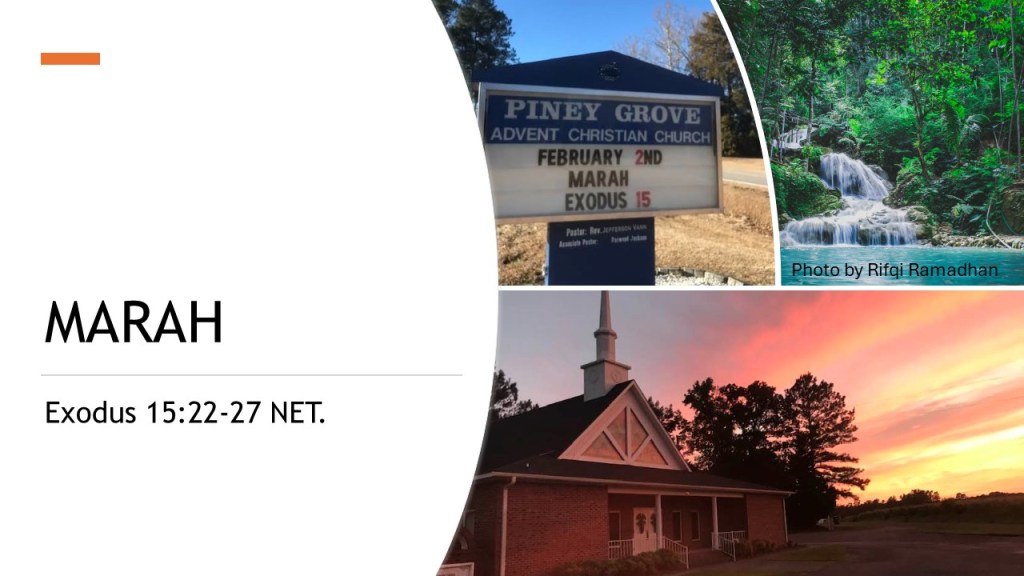
Exodus 15:23 When they came to Marah, they could not drink the water of Marah because it was bitter; therefore, it was named Marah.
Exodus 15:24 And the people complained about Moses, and this is what they said, “What will we drink?”
Exodus 15:25 And he cried out to Yahveh, and Yahveh showed him a tree, and he threw it into the water, and the water became sweet. There Yahveh made for them a prescribed task and a judgment,[2] and there he tested them,
Exodus 15:26 saying, “If you will carefully listen to the voice of Yahveh your God, and do that which is right in his eyes, and give ear to his commandments and keep all his prescribed tasks, I will put none of the maladies on you that I put on the Egyptians, for I am Yahveh, your healer.”
Exodus 15:27 Then they came to Elim, where there were twelve springs of water and seventy palm trees, and they set up camp there by the water.
“This poem is a lyrical outpouring of emotional praise of the God who had delivered them. It enters that praise assuming that we know the story, and tells it from an alternative point of view. Rather than focusing on the human side of the story, it focuses on the spiritual and heavenly side and it does so with evocative language that has God at its centre. So, where Exodus 14:21 told us that the sea parted when a strong east wind blew through the night, Exodus 15:8 tells us that it was by the blast of God’s nostrils that the waters piled up.”
Reid, Andrew. Out of Darkness : Exodus 1- 18. Matthias Media, 2005. p. 56.
“Miriam’s Song appears at the end of a Hebrew poem about God’s deliverance at the Red Sea (Exodus 15:1-21). The entire poem is known in Judaism as Shirat ha-Yam, “The Song of the Sea.”? John I. Durham proposes that this song was “stimulated by an exceptional moment in Israel’s history.” * Israel had just witnessed God’s power through the 10 plagues and the parting of the Red Sea, walked across the seabed on dry land, and watched the complete destruction of Egypt’s pursuing army (14:21-29). Their response is summarized in verse 31: “Thus Israel saw the great work which the Lord had done in Egypt; so the people feared the Lord, and believed the Lord and His servant Moses.””
Guy, Cynthia Dianne. Struggle Seek Grow: How 12 Women in Scripture Sought Spiritual Maturity. Gospel Advocate Company, 2011. p. 136.
“So here is a hymn that looks back to a miraculous event fresh in the minds of all the Israelites, and yet looks forward to a promise of a land the people have not yet seen (Exodus 15: 17). It is a song both of experience and of faith, of proof and yet of trust. Most of all it is a people’s song, expressing praise to their God, Yahweh, the Lord, who was leading them — by displays of great power where necessary— every step of their journey.”
Stuart, Douglas K. Favorite Old Testament Passages : A Popular Commentary for Today. 1st ed, Westminster Press, 1985. p. 27.
22 Then Moses led Israel to journey away from the Red Sea. They went out to the Desert of Shur, walked for three days into the desert, and found no water. 23 Then they came to Marah, but they were not able to drink the waters of Marah, because they were bitter. (That is why its name was Marah.) 24 So the people murmured against Moses, saying, “What can we drink?” 25 He cried out to the LORD, and the LORD showed him a tree. When Moses threw it into the water, the water became safe to drink. There the Lord made for them a binding ordinance, and there he tested them. 26 He said, “If you will diligently obey the LORD your God, and do what is right in his sight, and pay attention to his commandments, and keep all his statutes, then all the diseases that I brought on the Egyptians I will not bring on you, for I, the LORD, am your healer.” 27 Then they came to Elim, where there were twelve wells of water and seventy palm trees, and they camped there by the water.
We have been reading about the miraculous way God rescued the Israelites from Egypt, removing all obstacles to their freedom and defeating their enemies by drowning them in the Red Sea. The first thing the children of Israel did was worship – joining Moses in a song of triumph and praise. All the women joined in the worship with hand drums and dances. Miriam sang in response to them “Sing to the LORD, for he has triumphed gloriously; the horse and its rider he has thrown into the sea.”
After this tremendous offering of praise and worship, the Israelites set out for the open country – what today’s text calls the Desert of Shur. There, the LORD tested them with the bitter water of Marah. We will examine this passage closely this morning because it reveals several key principles that can help us all as we live our lives. In order to give some structure to today’s message, I will ask and answer three questions. First, why did the Israelites go to Marah? Second, what did they learn there? Third, what happened afterward?
Why did the Israelites go to Marah? (22-25).
You might recall from your reading that when Moses first confronted Pharaoh, he did not immediately demand that all the slaves be set free so they could go to the promised land. No, his first request was that his people be allowed merely to go out into the wilderness three days’ journey so that they could worship the LORD with their sacrifices and offerings. Pharaoh did not want to allow them to leave. After all, they were his slaves, and they should stay with him to serve him. At first, he offered another option. He said that the Hebrews could perform their sacrifices to Yahveh in Egypt instead of traveling three days into the wilderness. But Moses rejected that offer. “Moses said, “That would not be the right thing to do, for the sacrifices we make to the LORD our God would be an abomination to the Egyptians. If we make sacrifices that are an abomination to the Egyptians right before their eyes, will they not stone us? We must go on a three-day journey into the desert and sacrifice to the LORD our God, just as he is telling us.” (8:26-27).
Moses indicates something here that not everyone notices. The Hebrews couldn’t worship God the way he wanted them to. Even the sacrifices that the Hebrews made to God were repulsive to the Egyptians. That is what the word abomination means. For over 400 years, the Israelites were limited in what they could do to worship the LORD. Their loyalty to Pharaoh had checked their devotion to God. But God was setting them free. That freedom was not so that they could do whatever they wanted to do. That freedom was so that they could now do what God wanted them to do.
I am not suggesting that all the Israelites knew this. In fact, today’s text indicates that the main body of the Hebrews would be constantly in need of correction in this regard. They probably thought that now they were free from Pharaoh and the threat of his armies, they could do whatever they wanted.
Our text says that Moses led Israel from the Red Sea into the Desert of Shur. But the word for “led” is not the usual one for leading. The verb נָסַע means to pull something up—like to uproot a plant. The people wanted to stay by the Red Sea and keep celebrating their victory, but Moses had to force them to pull up and set out into the unknown. Moses had a mission, and most of the people he led had no idea what that mission was. In fact, even Moses did not clearly understand the reasons he was leading his people into the wilderness.
We can imagine the reason partly if we take a good look at what the Hebrews were doing at the beach of the Red Sea. They were celebrating their deliverance from a great enemy, rejoicing at what God had done for them. For some people, that is all that worship entails. But worship only begins there. True worship moves from celebration of what God has done to adoration of who God is.
Why is this so? Well, imagine it snowed again, and you were out in your car when a massive snowstorm hit. It forced you to stop, and before long, your vehicle was trapped in ice. What if some people come along and rescue you from that? You would be grateful. You would tell everyone about your rescue from the danger. But when they asked you about your rescuer, what could you say? You might not even know their names, much less anything substantial about them.
The wilderness journey of the Hebrews from Egypt to Canaan was their chance to get to know the God who rescued them. It was their opportunity to learn about and identify with the God of their ancestors. Marah would be the first lesson for them.
When I was in college, I took many classes in biblical languages. My professor always began each class with a vocabulary test. That is what God is doing for the Hebrews. Every lesson starts with a test. The three-day journey into the Desert of Shur was not a mistake. God was intentionally bringing his people into a desperate situation. “Then they came to Marah, but they were not able to drink the waters of Marah, because they were bitter. (That is why its name was Marah.)” Why did Moses deliberately put them in such a situation? Why head to Marah first? Marah means bitter. Miriam’s name comes from the same word. She was born in bitter captivity. The bitter herbs the Hebrews ate during Passover were a reminder of that time of bitterness. Most of the Israelites were scratching their heads when they arrived in Marah. Some might have wondered why they left Egypt if they were going to encounter bitterness and hardship here.
The “people murmured against Moses, saying, “What can we drink?” After three days of travel, whatever water they had brought with them was exhausted. Their canteens were empty. So, they come to a place with water, but it seems a cruel joke. The water is undrinkable.
The notes to the NET text say, “The verb וַיִּלֹנוּ (vayyillonu) from לוּן (lun) is a much stronger word than “to grumble” or “to complain.” It is used almost exclusively in the wilderness wandering stories to describe the Israelites’ rebellion against God …. They were not merely complaining—they were questioning God’s abilities and motives. The action is something like a parliamentary vote of no confidence.
The Psalms are filled with great poets like David and Asaph pouring out their hearts to God. God encourages us to do that. It might seem like complaining, but it is anything but that. It is crying out to the only one who sees the problem and has the power to intervene. Instead of that, the people focused their complaints on God himself and the leader he had appointed. Instead of paying attention when God was testing them, they chose to test him and try his patience, even though they had seen his work (See Psalm 95:8-9; Hebrews 3:8-9).
So, in three days, the Hebrews went from celebrating God’s salvation to rebelling against him. All it took was one incident where it seemed that their needs were not being met, and they turned against God, their Savior. This event revealed a profound immaturity and lack of trust in the Hebrew people. If they had been thinking with maturity, they would have remembered the number of times in Egypt when they discovered they were not able, and then God showed that he was able. The people could have responded in faith to this crisis. They could have come to Moses and said, “We cannot drink the water, but we trust God for a solution to this problem.”
They did not do that. Instead, they rebelled against God and criticized Moses. At the first sign of difficulty, they attacked the leader that they had chosen to follow. It seems ridiculous, but it is actually human nature. The flesh always causes us to turn against our leaders rather than turn toward God.
But Moses did not follow their example. He chose to cry out to God. A prayer is always a better alternative to a critical word or complaint. As soon as Moses prayed, God showed him the solution. He had not only brought them to the place of testing but also given them the answer to the test. Some teachers make their questions so hard that students are unable to find the answer. God is not like that. If we have a need, he has an answer – already on his tongue.
The “LORD showed him a tree. When Moses threw it into the water, the water became safe to drink.” The bitter water became sweet. It had been unsafe to drink at first. That is a real problem if you are walking a long distance. I remember when Penny and I were on our thru-hike. There was one night we were camping out on the trail and needed water badly. I could not find a spring or stream. I found some deer and followed them to a puddle, so I filled up our water bottles from the puddle. But the water was yellow, and as badly as I wanted a drink, I could not bring myself to drink it. We finally decided to pour our deer urine and hope to find a better water source the next day. Obviously, we did.
For the Hebrews, the answer was a tree. God had already caused a particular tree to grow in that place. We don’t know whether the water changed because of the tree or just because Moses was obedient and used the tree. The point was that God already had a solution to the crisis, and he was waiting for his people to ask.
There, God tested them. He wanted them to come to a problem that they could not solve. The text says that there, the LORD “made for them a binding ordinance.” The binding ordinance is actually two words in Hebrew: the word for prescription and the word for judgment. God was prescribing for them the correct action to take when being tested. He was offering his judgment in place of their own. In fact, the word “showed” in verse 25 is the verbal root of the noun תּוֹרָה. This incident is the beginning of the Law of God for the people of God.
God focused on the law in the books of Exodus to Deuteronomy because the Law served as the link between the salvation God brought and the people he wanted to testify to that salvation to the next generation. Walking according to God’s Law would be their way of testifying that God had saved them. In later generations, people exchanged the Law for salvation itself. They thought obeying the Law was their means of saving themselves. That is never the case. The Law is God’s way of walking. The deliverance always comes from him.
What did the Israelites learn at Marah? (26).
The big lesson of Marah is not to “stop complaining, or God is going to get mad at you.” Moses lays out the lesson plan in verse 26. He said: “If you will diligently listen to the voice of the LORD your God, and do that which is right in his eyes, and give ear to his commandments and keep all his statutes, I will put none of the diseases on you that I put on the Egyptians, for I am the LORD, your healer.”
Moses describes a standard “IF-THEN” relationship: God is the teacher, and the Israelites are his learners. As learners, they are responsible for diligently listening to his voice and not for following their instincts. God is their teacher, so he promises to reveal to them specific commandments and statutes to help them walk appropriately. It is no surprise that the main action in the last four books of Moses is walking. While walking to Canaan, they were learning how to walk. To the extent that they learned the lessons and walked appropriately, God guaranteed that he would prove to be more than a teacher. He would also be their healer, preventing all judgment diseases that he had put on the Egyptians.
To summarize the principle: WALK GOD’S WALK, AND HE WILL BE OUR TEACHER AND HEALER.
What happened to the Israelites afterward? (27).
“Then they came to Elim, where there were twelve wells of water and seventy palm trees, and they camped there by the water.” When they arrived at the next oasis, they found that it did not need to be cleaned. The water was already pure. God was showing them that every day would not be a test. But they should be prepared to seek his instruction when the times of testing come. Likewise, you and I will not be undergoing constant trials. But we should count it all joy when the times of testing do come. They are not proof that God has abandoned us. They are chances for us to grow and opportunities for us to display our confidence in God our Savior.
Holy Communion
“You cannot serve God and money. Therefore, I tell you, do not worry about your life, what you will eat or drink, or about your body, what you will wear. Isn’t there more to life than food and more to the body than clothing?” (Matthew 6:24-25).
The Hebrews had been rescued from slavery in Egypt and escorted out of that place of oppression. They were on their way to the Promised Land—a land flowing with milk and honey. But before they got there, they had to learn a few lessons about how to walk God’s way. Some of the very first lessons dealt with worrying about what they would eat and drink.
Today, as we remember what our Lord did for us on Calvary’s cross, he invites us to re-examine our life’s priorities. He has promised to be our teacher and healer. But there is something that might prevent that. We can let worry steal our relationship with Christ. He surrendered himself for us. We can show our faith in him by releasing our hold on our self-preservation. He wants to be our master. We cannot have two.
LORD, we celebrate what you did for us for our deliverance and promise to walk your walk and let you be our Teacher and Healer.
Here is a quote from Devotions from Exodus:
“Nuisance
The frog was also a deity in the Egyptian pantheon. Heqet was a goddess who represented fertility. To have the territory overrun by these creatures was more than an annoyance. It was another reminder to Pharaoh that his worldview was erroneous. It was an embarrassment. And even though his magicians were able to duplicate the same thing on a smaller scale (because they were illusionists) he was perturbed, so he appealed to Moses to have Yahveh stop the plague. He was starting to take Yahveh seriously. Moses even gives Pharaoh the honor of choosing the day for the pestilence to stop. But when the break came, Pharaoh still stubbornly refused to comply with Yahveh’s demand.
I wonder if we are any better than Pharaoh was. We regularly experience nuisances in our lives, and they sometimes are so bad that we appeal to Yahveh to rescue us. But do we ever stop to ask if Yahveh wants to change us? Maybe an annoying event might be his way of getting our attention. Perhaps we should not be so quick to return to business as usual when the nuisance is over.
LORD, forgive us for ignoring you when you remind us of our need to change. Help us to see the possible significance of the annoying interruptions in our lives. Keep us sensitive to your guidance” (p. 40);
The book is 296 pages long and was released on May 17, 2024.





 jeffersonvann