
LISTENING TO THE HOLY SPIRIT

LISTENING TO THE HOLY SPIRIT

1 Samuel 25:32-38 NET.

32 Then David said to Abigail, “Praised be the LORD, the God of Israel, who has sent you this day to meet me! 33 Praised be your good judgment! May you yourself be rewarded for having prevented me this day from shedding blood and taking matters into my own hands! 34 Otherwise, as surely as the LORD, the God of Israel, lives — he who has prevented me from harming you — if you had not come so quickly to meet me, by morning’s light not even one male belonging to Nabal would have remained alive!” 35 Then David took from her hand what she had brought to him. He said to her, “Go back to your home in peace. Be assured that I have listened to you and responded favorably.” 36 When Abigail went back to Nabal, he was holding a banquet in his house like that of the king. Nabal was having a good time and was very intoxicated. She told him absolutely nothing until morning’s light. 37 In the morning, when Nabal was sober, his wife told him about these matters. He had a stroke and was paralyzed. 38 After about ten days the LORD struck Nabal down and he died.

We have committed to reading through the Bible, two chapters a day. Our calendars have brought us to today’s text, in which David responds to Abigail’s appeal to him not to attack and destroy her husband and his men, even though he had acted foolishly and provoked David. Abigail listened to the Holy Spirit and saved her husband and David from making a rash decision. I’m going to approach today’s text by first looking at the background that helps explain what is going on. Then, I’m going to explore Abigail’s character by asking what made her such a wise person. Finally, I’m going to walk us all through the process of applying today’s lesson to our own lives by outlining how we should follow Abigail’s example of listening to the Holy Spirit when we face trouble.

The background to the story

In last week’s sermon, we learned that Samuel was an older man who promised to instruct the people in living God’s way. However, they wanted a king, and Samuel was allowed by God to give them one. The king’s name was Saul. Despite starting well, Saul proved to be a disappointment, both to Samuel and to God. So, God promised that he would tear the kingdom away from Saul, just like Saul accidentally tore Samuel’s robe.

In today’s chapter, Saul is still king, but Samuel had already anointed David and was biding his time before God’s promise would be fulfilled. At the beginning of this chapter, we learned that Samuel had died, and all Israel assembled and mourned for him. Having just experienced the death and funeral for Pope Francis, we have some idea what that would have been like. After this period of mourning, David went with his men to the open country. It was there that he started planning for the coming holiday. He had remembered that his men had protected the property of a wealthy man named Nabal while they were in Carmel.

David sent ten of his men to request that Nabal provide what they needed to celebrate the coming feast. This was not an unreasonable request since David’s men had protected his property in the past. Also, Nabal had thousands of animals, so meeting the request would not have harmed him. But Nabal was in a mood. He absolutely refused the request and spoke harshly about David. When David’s men returned and told him what Nabal had said, David was incensed. David decided to visit Nabal himself – fully armed – with four hundred of his men (to-thirds of his army)!

In the meantime, one of Abigail’s slaves had witnessed Nabal’s bad behavior and rushed to tell Abigail. The slave knew that Nabal had done something both foolish and dangerous. The slave did not appeal to Nabal’s sense of propriety. Apparently, Nabal did not have any common sense, and the slave knew it. Instead, the slave went to the one person in the household who could make a difference: her mistress, Abigail.

When Abigail heard about her husband’s insult, she assumed David would respond in anger. She quickly gathered 200 loaves of bread, two skins of wine, five sheep, five seahs of grain, 100 clusters of raisins, and 200 fig cakes and loaded them onto donkeys. She determined to intervene to keep Nabal’s foolishness from destroying him. She took the gift and met David’s army on the road. She bowed to David and apologized, accepting all the responsibility and seeking to make reparation for the insult. What we read in today’s text is the result of that act of wisdom.

That day, Abigail saved two men who were acting on their emotions. Her actions demonstrated wisdom, and David rightly commended her for rescuing both her husband and David himself.

What made Abigail a wise person

Abigail showed that humility is wise. She was beautiful and intelligent, but she approached David with humility and wisdom, acknowledging his authority and the fact that he could rightly bring harm on her husband and his men. She used her intelligence not for pride but to discern the situation and act appropriately. Abigail’s story demonstrates that wisdom and humility are not weaknesses but powerful virtues that can be used to overcome adversity, bring peace, and ultimately glorify God.

Abigail gave the soft answer that the Bible says turns away wrath. All too often, we have been led to believe that the only way to fight fire is with fire. But ask a firefighter. A firefighter will tell you that the proper way to fight a fire is with water. It puts out the fire. Abigail teaches us that in a volatile situation, you don’t need to strap on your swords. Sometimes, what you need is to bring a present.

Abigail showed that peacemaking is wise. The first act of peacemaking was not to run to Nabal and explain to him how foolish he had been. Instead, she snuck out without going to Nabal because he had made a mess that had to be cleaned up. Later, there would be time to approach Nabal, not while he was still in a drunken rage.

Her gift to David and his men effectively diffused a potentially deadly situation by offering a peace offering and acknowledging her husband’s wrongdoings. Her words and actions prevented a bloody confrontation and spared her family and servants.

Later, Abigail showed constraint when she returned and found Nabal drunk. She waited until he was sober to reveal what she had done to save him and his men. Sometimes peacemaking means knowing when to wait for the right time to act.

Abigail showed that Intercession is wise. Some think that Abigail’s story prefigures Jesus’s sacrifice, as she placed herself between David and Nabal, just as Jesus placed himself between God and humanity.  Abigail showed wisdom by taking the blame for her husband’s actions and making reparation even though she knew he was wrong.

Even if Abigail’s story were not intended to teach about the coming Messiah, we can see him in her actions. He was a man of peace in a time of violence and anger. He taught his followers to be peacemakers. He came to die in our place to keep us all from receiving the punishment that we deserve.  

Abigail showed that following God’s will is wise. She could have told her slave to go away and mind her own business. She could have said that her husband was a fool and he deserved whatever would happen to him. But Abigail was wise enough to realize that what was happening was her prompt to get involved. God’s will would not work itself out without her involvement.

We need to realize that as well. God has a plan to make a difference in our community, our homes, and our church. But his plan requires that we get off our easy chairs and make things happen. The message came to Abigail, not somebody else. If Abigail had decided to pass the buck, the story would have ended badly for everyone.

Abigail’s actions are a powerful reminder of the importance of choosing righteousness and aligning oneself with God’s will, even when it’s difficult. She decided to align herself with David, the future king, and did not let her husband’s actions dictate her behavior.

How we can act as wise people.

We can take our debts seriously. Abigail realized that her family owed David for his protection. When she found out that her husband had offended David by not helping out his men, she took it on herself to pay that debt. Paying our debts is a spiritual matter. The Apostle Paul told the believers to owe nobody anything except the continuing debt of love. Wise people determine to live with integrity. That means never skipping one’s obligations.

We should never hide behind anyone else. Abigail could have left everything to her husband, but that was not the wise approach in this situation. Wise men know they sometimes make mistakes, and are grateful for wives who will not let those mistakes go uncorrected. We should be correctors of problems. Passing the buck and leaving the problems for others to fix is not wise.

We should think and act beyond ourselves. When she did what she did, Abigail undoubtedly acted outside the expectations of others. That does not make her a rebel; it makes her a hero. As a wise person, she looked outside the box when staying inside the box would have ended in disaster. She demonstrated insight when she was moved to action. She could not remain passive. She did not say, “It’s not my place.”

Abigail was the precursor to Queen Esther. Both women recognized that they were placed into their circumstances by God because God had a mission for them. If either of these women had not taken the initiative, innocent people would have died. Neither of them was a person of violence. But if they had not acted, violence would have been the result.

We don’t know whether Abigail was a mother, but she probably was. It would have made sense for her to intercede to try to prevent the deaths of some of her sons. Today happens to be Mother’s Day here in this country. Some of the most outstanding leaders the world has ever known owe their greatness to the wisdom they acquired by following their mothers. Those mothers might have had a reputation for being passive and unassuming. But watch out when their children are in trouble. As a hiker, I learned the most dangerous thing you can encounter on the trail is a mother bear with her cubs.

It will not be every day that you and I are called on to do such extraordinary things. When the time is right, we will know it. Then, it will be up to us to listen to the Holy Spirit and make the wise decision, like Abigail did. It will be a decision that we must make because God wants to use us to accomplish his will. When the people most capable of making peace choose to do nothing, that will be our prompt to do what must be done to make peace.

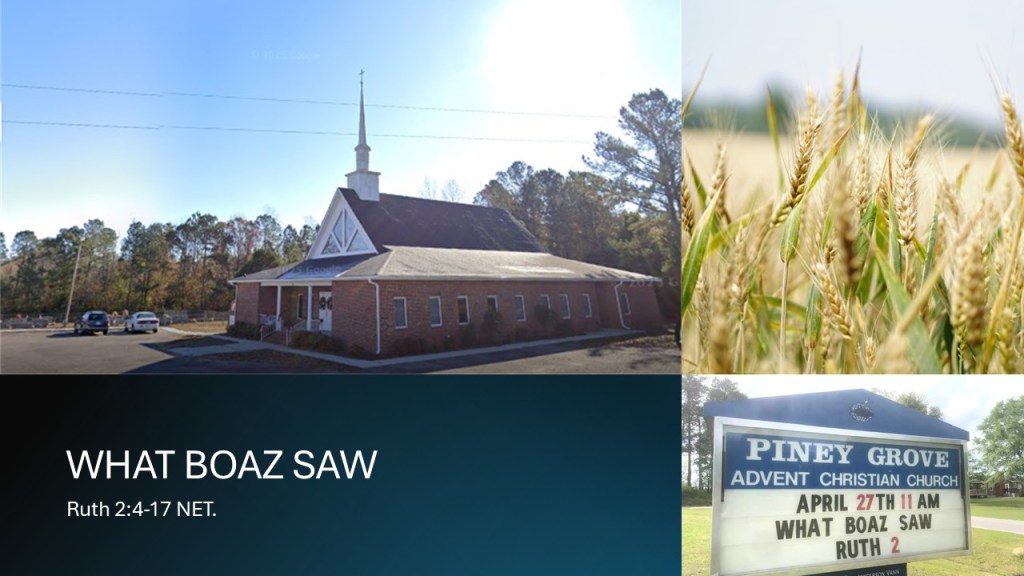
WHAT BOAZ SAW

WHAT BOAZ SAW

Ruth 2:4-17 NET.

4 Now at that very moment, Boaz arrived from Bethlehem and greeted the harvesters, “May the LORD be with you!” They replied, “May the LORD bless you!” 5 Boaz asked his servant in charge of the harvesters, “To whom does this young woman belong?” 6  The servant in charge of the harvesters replied, “She’s the young Moabite woman who came back with Naomi from the region of Moab. 7 She asked, ‘May I follow the harvesters and gather grain among the bundles?’ Since she arrived, she has been working hard from this morning until now — except for sitting in the resting hut a short time.” 8 So Boaz said to Ruth, “Listen carefully, my dear! Do not leave to gather grain in another field. You need not go beyond the limits of this field. You may go along beside my female workers. 9 Take note of the field where the men are harvesting and follow behind with the female workers. I will tell the men to leave you alone. When you are thirsty, you may go to the water jars and drink some of the water the servants draw.” 10 Ruth knelt before him with her forehead to the ground and said to him, “Why are you so kind and so attentive to me, even though I am a foreigner?” 11 Boaz replied to her, “I have been given a full report of all that you have done for your mother-in-law following the death of your husband — how you left your father and your mother, as well as your homeland, and came to live among people you did not know previously. 12 May the LORD reward your efforts! May your acts of kindness be repaid fully by the LORD God of Israel, from whom you have sought protection!” 13 She said, “You really are being kind to me, sir, for you have reassured and encouraged me, your servant, even though I am not one of your servants!” 14 Later, during the mealtime Boaz said to her, “Come here and have some food! Dip your bread in the vinegar!” So she sat down beside the harvesters. Then he handed her some roasted grain. She ate until she was full and saved the rest. 15 When she got up to gather grain, Boaz told his male servants, “Let her gather grain even among the bundles! Don’t chase her off! 16 Make sure you pull out ears of grain for her and drop them so she can gather them up. Don’t tell her not to!” 17 So she gathered grain in the field until evening. When she threshed what she had gathered, it came to about thirty pounds of barley!

We are continuing to read through the Bible, two chapters per day. Our reading has brought us to the period of the judges, and today’s text describes events that happened during that period. This was a time when the Israelites were not known for their loyalty to the LORD. There was no king, so people pretty much did whatever they wanted, with very little to prevent wickedness. It was a time and a culture much like that of our own. If you asked anyone whether what they were doing was right, they would say yes. But they were doing what was right in their own eyes. They had been given God’s law through Moses, but they paid very little attention to that law. If they wanted to do something, they did it. They did not stop to ask if what they were doing honored God. Most of the people during this time lived like that.

But there were exceptions. The life stories of some of those exceptional people are recorded in Scripture. The book of Ruth represents the islands of light in the sea of darkness. People like Ruth, Naomi, and Boaz were reminders that even during times of rampant wickedness, one can still choose to follow the Lord and be the light of the world. Many sermons have been preached that highlight the way Ruth and Naomi pierced the darkness by their faith and the actions brought about by that faith. For today’s message, I have chosen to look more closely at Boaz. The reason I want to focus on Boaz is that he had a character quality that very few in his time possessed. He had insight into the things that really mattered. He discerned how to make the right choices based on an awareness of what was significant and what was not.

I want to focus on how today’s text identifies Boaz’s insight. Each part of the passage introduces a new way of thinking that Boaz understood, but few around him did. He was set apart as an example of someone who could see opportunities where others only saw problems. He could see God at work where others only saw the mundane—the ordinary.

Boaz saw an opportunity to honor God in everything he did (4, 12).

The easiest facet of Boaz’s insight to recognize is what we see in these two verses. In verse 4, Boaz is greeting his harvesters. He does not begin by barking out orders, or even by requesting a report on the progress of the harvest. No, he starts with a formal greeting. It looks like this is a tradition with Boaz. We don’t see too many examples of this kind of greeting in Scripture, particularly not in this period. But Boaz is an exception. The first thing out of Boaz’s mouth is a blessing. He invokes God’s presence among his workers. He says, “May the LORD be with you.” They respond in turn, “May the LORD bless you.” They put the LORD first in their conversation. This is a clue that they have put the LORD first in their lives. They are harvesters, but they prioritize the LORD over their harvest. Boaz is the master of the harvest. He puts the LORD first over himself.

Jesus teaches that we should prioritize the LORD first. He taught us to pray, “Our Father… hallowed be thy name.” He taught us to seek first his kingdom and his righteousness. If we seek God’s kingdom first, then everything we do can be in his name. Boaz was not about making himself look great. He was not even about making Israel great. His priority was making the name of God great.

Later in the text, Boaz reflects the same insight when he asks the LORD to reward Ruth’s efforts (vs. 12). Boaz saw Ruth as someone who had taken refuge in the LORD. He asks God to repay her for seeking the LORD’s protection. She was not depending on Naomi or Boaz. She was showing dependence upon God himself, and Boaz praised her for it.

Boaz saw beyond national and ethnic prejudices (5-6).

He had asked his servants who Ruth was. Their answer seems to indicate that they had written Ruth off because she was not a natural-born citizen of Israel. They said, “She’s the young Moabite woman who came back with Naomi from the region of Moab. Their answer focuses on only one aspect of Ruth’s personality: her ethnic lineage. To them, the most important thing about Ruth was that she was one of them. Her ancestors were children of Lot, not children of Abraham.

The Moabites were very different from the Israelites. They claimed a different territory. They worshipped and served other gods. They sometimes clashed with and fought against the Israelites. But even beyond that, the Israelites often viewed the Moabites with suspicion because Lot’s daughters had gotten their father drunk and become impregnated by him to preserve his family line. So, when Naomi came back to Israel, tongues wagged because of that Moabite girl she brought with her.

Boaz had the spiritual insight to see beyond Ruth’s physical background and see Ruth for who she was on the inside. Of course, it helped Boaz that he himself came from a mixed family. His father was Salmon of the clan of Elimelech. But Salmon had married Rahab. Yes, the Rahab who had been a citizen of Jericho until she took a leap of faith and protected the Israelite scouts. After that, she became one of them. Before, she was one of them – the outsiders. Since Boaz probably grew up with tongues wagging all around him about his foreign mother, he was sensitive to what prejudice can do to a person.

Boaz saw potential where others saw a problem (8-9).

He invited Ruth to stay close to his workers and not to stray to other fields. He told his men to help her out and not to harass her. He did this because he recognized that she could be an asset, not a liability. Some property owners might have told their workers to shoo away the foreigners, but not Boaz. He looked beyond her background and responded only to her actions as a hard worker.

Boaz saw faith where others saw mere kindness (10-12).

When Ruth asked Boaz why he was being so kind to her, even though she was one of them, Boaz answered her. He said that he had been given a full report of all she had done for Naomi. Naomi had given both of her daughters-in-law permission to leave her and go back to their people. Orpah chose to do that. But Ruth chose to stay with Naomi. She decided to remain loyal to Naomi, even when that meant leaving her people and going to live among Naomi’s people.

Ruth’s loyalty to Naomi is so well-stated that it is often used to express marital fidelity even today. She was the one who first said, “Intreat me not to leave thee, or to return from following after thee: for whither thou goest, I will go; and where thou lodgest, I will lodge: thy people shall be my people, and thy God my God” (Ruth 1:16 KJV). Ruth was not just being kind to Naomi. She had decided to be all in. Boaz recognized that choice as an act of faith.

Boaz saw Ruth’s heart and sought to encourage her (13-17).

It was one thing for Boaz to appreciate Ruth for her loyalty to her mother-in-law. It was another to go beyond that and actively show deference to Ruth. Boaz was hooked. She had won his heart, and so he went out of his way to encourage hers. From that point on, it was Boaz who was going out of his way to pay attention to Ruth and bless her beyond what was expected.

When Ruth arrived home that night, she had about thirty pounds of barley with her. That was way more than your average yield for a day’s gleaning. Naomi knew right then that Ruth had caught Boaz’s attention.

We can learn from Boaz a thing or two about making a difference in the lives of those around us. He had been blessed, and he returned the blessing. This is more than just a love story. This is a story about a man who decided to live by the covenant that he had inherited from his family. Everything Boaz did was in obedience to the commands of God through Moses. We learned in our study of Deuteronomy that God expected his people to show deference to the poor, the foreign resident, and the widow. Ruth was all three of these. Boaz looked at this woman, and he saw more than a potential wife. Their courtship began because he chose to obey God’s word.

Jesus said that the second greatest commandment is to love our neighbors as we love ourselves. There is a reason God wants us to do that. He wants us to show that he loves the world and demonstrate that love. We demonstrate love by loving. We demonstrate that God cares by caring for people ourselves. There is a planet full of Ruths just waiting for someone to care. They are amazing people, but most of the world does not see their potential because they are different from us. Boaz challenges us to look at others with love in our hearts. The Good Samaritan challenges us to take the time to help the needy. Maybe the next Ruth is gleaning in our fields today. Will we dare to care for them?


JOSHUA THE MISSIONARY       

JOSHUA THE MISSIONARY       

Joshua 1:1-9 NET.

1 After Moses the LORD’s servant died, the LORD said to Joshua son of Nun, Moses’ assistant: 2 “Moses my servant is dead. Get ready! Cross the Jordan River! Lead these people into the land which I am ready to hand over to them. 3 I am handing over to you every place you set foot, as I promised Moses. 4 Your territory will extend from the wilderness in the south to Lebanon in the north. It will extend all the way to the great River Euphrates in the east (including all of Syria) and all the way to the Mediterranean Sea in the west. 5 No one will be able to resist you all the days of your life. As I was with Moses, so I will be with you. I will not abandon you or leave you alone. 6   Be strong and brave! You must lead these people in the conquest of this land that I solemnly promised their ancestors I would hand over to them. 7 Make sure you are very strong and brave! Carefully obey all the law my servant Moses charged you to keep! Do not swerve from it to the right or to the left, so that you may be successful in all you do. 8  This law scroll must not leave your lips! You must memorize it day and night so you can carefully obey all that is written in it. Then you will prosper and be successful. 9 I repeat, be strong and brave! Don’t be afraid and don’t panic, for I, the LORD your God, am with you in all you do.”

We are still bunny-hopping our way through the Bible, stopping every Sunday at the place where we are in our reading—two chapters a day. This week, we finished Deuteronomy and began Joshua on Friday. Because I am planning two special messages for Palm Sunday and Easter, this will be our only message based on the book of Joshua. I am focusing on these introductory words from Joshua 1 as the text for my message.

It is essential at the outset that I establish the relevance of the study of Joshua. Some Christians find it difficult to study Old Testament books like Joshua because they fail to see what these ancient narratives have to do with them in their modern setting. We might remember some of the stories in Joshua from Sunday School lessons or past sermons, or cartoons. But aside from these little dips into the pool, we tend to shy away from Joshua because we might be tempted to think of it as a relatively shallow book. The truth is that Joshua is just as deep as the other biblical books we are studying. It had a purpose in the canon of Scripture, and that purpose is still as crucial today as it was when its words were first written.

But what is the purpose of the book of Joshua? Why are its words relevant for 21st-century Christians? The Bible teaches that every Scripture is inspired by God and profitable for us. But how can we profit from these old words and ancient stories?

The key to answering that question might be to come at the question from the other end first. Before asking what the old stories have to do with us, maybe we should take a closer look at what we are doing to see if there are some points of contact. There are lots of things we do today that are different than what God’s people were doing in the time of Joshua. What are some things that are the same?

One thing that is the same is that we are serving the same God that Joshua did. Marcion was wrong when he suggested that the God of the Old Testament was an evil, wrathful God and that a loving, compassionate God had replaced him. Remember, God does not change. He is immutable. Times change, circumstances change, but the God we believe in does not change.

When they asked Jesus what the greatest commandment was, he indicated that loving God wholeheartedly is #1. The second greatest commandment is to love our neighbors as ourselves. Those two life priorities were valid and relevant in Joshua’s time, and they are still valid and applicable to us today.

So, what has changed? The simple answer is that the mission God has called us to is different than the mission God was calling Joshua to. Jesus calls us all to a mission of cross-cultural evangelism. He commanded us to disciple all the nations. God called Joshua to a different mission. We are going to examine that mission this morning. However, the thing that we need to keep in mind is that even though our mission is different from Joshua’s, there will be points of contact. Some of the things that Joshua learned about his mission are helpful for us to keep in mind as we seek to fulfill our mission.

Joshua’s Mission

Instead of outlining every task Joshua was to do, the Lord described Joshua’s mission by summarizing the first three steps of that mission. We find that summary in verse 2. The Lord said that Joshua was to “Get ready! Cross the Jordan River! Lead these people into the land which I am ready to hand over to them.” The first phase was to get ready. This involved Joshua getting himself ready. You cannot get your team prepared if you are not ready yourself.

The principle of personal preparation applies to us in our mission as well. We should not expect to step into the task of global evangelization without preparation. Jesus prepared his apostles for the task over several years of training. Then he challenged them to feed the sheep – to get the other disciples trained so that they could continue the mission by being disciplers.

Joshua was encouraged to be ready emotionally and physically for the task of leadership. He was commanded to be strong and brave. He was told to resist the temptation to be afraid and panic when things got rough. He had to build up the strength he needed because the mission he was called to would not be an easy one. He was expected to display the confidence that comes from knowing that God was with him.

The second phase of Joshua’s to-do list in today’s text is to cross over the Jordan river. He could not do that himself. The command to him (as leader) was a command to the whole people of Israel. It was going to be a miracle that only God could accomplish, but the people needed to be prepared for it. The leaders needed to prepare the people. That is part of the job for anyone called into ministry. Our task is not simply to maintain the status quo, but it also requires us to prepare the church for the next thing God is going to do among us.

The third phase for Joshua was to lead the people into the Promised Land. He was not to merely point in the direction and drive the people into it. He was to be a frontline leader. It is one thing to be an armchair general. It is another thing to strap on the sword and tell the soldiers to follow you into battle. As I said, these three commands do not encompass all of Joshua’s mission. God did not reveal everything to Joshua. We should not expect him to do that for us either. If we knew all the details, most of us would go hide in the woods. Our Lord is wise to only show us the next few steps in our path of following him.

Joshua’s Master

Notice how many times the word “I” shows up in today’s text. These words are God’s words. He is challenging Joshua to lead his people to where he wants them, but the emphasis is not entirely on Joshua. Joshua is challenged to be strong and brave, but notice what God says he will do:

  • God says he is ready to hand over the land to them. He promises to give them all the land that they set foot on.
  • God promises to be with Joshua the same way he was with his predecessor, Moses.
  • God reminds Joshua that he solemnly promised his ancestors to hand the land over to their descendants. Now was the time to fulfill that promise.
  • God promises to be with Joshua in all that he does.

There are two truths that every Christian should remember every day. These two things seem like diametrical opposites, but they are both true. The first truth is that we are slaves of God. He is our owner and our master. That may seem to be a depressing reality, but it is actually quite freeing.

The second truth is that our Master is Almighty God. He controls the universe. Nothing happens that he does not allow. We pray to him because only he can make the impossible possible. We can face any challenge—not because we are able, but because our Master is always able.

Joshua’s Manual

Note also how God stresses to Moses his absolute reliance upon the holy Scriptures. God tells him to obey all the laws his servant Moses carefully charged him to keep! He said that Joshua should not swerve from it to the right or to the left so that he may be successful in all he does. He said that the law scroll must not leave Joshua’s lips! He had to memorize it day and night so he could carefully obey all that is written in it. Then, he would prosper and be successful. God was sending Joshua on a mission, and the word of God was to be his mission manual. He did not have the whole Bible, but every word he had was the Holy Bible.

What Joshua the missionary had for his missionary work would help him accomplish that work. The same is true for you and me today. We read and study the Bible not to entertain us – not even to inform us. Our goal is not to learn the Bible as if it were an encyclopedia of religious trivia. It is our mission manual. It empowers us to do what God has called us to do.

As we read Joshua this month, let’s remember that its words do not describe a king or a military general. Joshua’s work was missionary work. May its words help us to be strong, brave, and faithful in the missionary work God has called us to do.

Holy Communion

1 John 2:14 NET.

“I have written to you, children, that you have known the Father. I have written to you, fathers, that you have known him who has been from the beginning. I have written to you, young people, that you are strong, and the word of God resides in you, and you have conquered the evil one.”

As we consider the death of our Lord this morning, let us remember that what Jesus did for us on the cross is enough, no matter where we are in life’s journey.

If you are new to the faith – a mere child of God – you might wonder if you are going to survive the challenges of life and come out on the other end with a genuine faith. God’s word to you is that you have known the Father. That is all you need because your confidence is in Him, not yourself.

The same promise applies to the old-timers in the faith—the Fathers and Mothers who have fought most of their battles—their mission is almost accomplished. But their confidence is not in their own accomplishments. It is in the fact that they have come to know the Father because of the finished work of Christ on the cross.

And what about the young men and women? Those who are going to be first into the battle, claiming territory for God and his kingdom?  The manual tells them that they are strong, that the word of God resides in them, and that they have conquered the evil one. Their battle is fresh, and they are in the front of it, but from God’s perspective, they have already won. They are challenged to let the word of Christ dwell in them richly because it is the manual that will take them from the present battle to the future glory.

Lord, we thank you for your finished work of redemption. We pray for your power to take us to the finish of our mission for you. We ask that you make us strong and brave warriors and faithful slaves of our Almighty Master. Amen.

LOVE PRIORITIES

LOVE PRIORITIES

Deuteronomy 10:12-22 NET.

12 Now, Israel, what does the LORD your God require of you except to revere him, to obey all his commandments, to love him, to serve him with all your mind and being, 13 and to keep the Lord’s commandments and statutes that I am giving you today for your own good? 14 The heavens — indeed the highest heavens — belong to the LORD your God, as does the earth and everything in it. 15 However, only to your ancestors did he show his loving favor, and he chose you, their descendants, from all peoples — as is apparent today. 16 Therefore, cleanse your heart and stop being so stubborn! 17 For the LORD your God is God of gods and Lord of lords, the great, mighty, and awesome God who is unbiased and takes no bribe, 18      who justly treats the orphan and widow, and who loves resident foreigners, giving them food and clothing. 19 So you must love the resident foreigner because you were foreigners in the land of Egypt.

20 Revere the LORD your God, serve him, be loyal to him and take oaths only in his name. 21 He is the one you should praise; he is your God, the one who has done these great and awesome things for you that you have seen. 22 When your ancestors went down to Egypt, they numbered only seventy, but now the LORD your God has made you as numerous as the stars of the sky.

The title of the book of Deuteronomy comes from the Latin for second Law. Moses is in the final phase of his life and ministry. He knows that he will not be going with the children of Israel when they cross over the Jordan and begin occupying the Promised Land. So, he writes Deuteronomy – not as a new Law for his people, but as a reflection on the basic principles of the Law God had given him at Sinai. He knows that if his people are to succeed, they will have to get over their stubborn selfishness and think and live God’s way. He searches for a way to summarize all that it means to live like the people who have been redeemed from slavery by a loving, compassionate God.

The big picture – the basic principles that Moses writes about in today’s text is the same message we get from Jesus in the New Testament. When the experts in the religious law came to Jesus to interrogate him, they asked him which commandment in the Law was the greatest. Jesus quickly answered that question by quoting from Deuteronomy. He said, “‘Love the LORD your God with all your heart, with all your soul, and with all your mind.’ – a quote from Deuteronomy 6:5. Before the lawyers had a chance to redirect, he went on to say, “This is the first and greatest commandment. The second is like it: ‘Love your neighbor as yourself.’ That is a quote from Leviticus 19:18, but the principle is taught again in today’s text from Deuteronomy. These two commands go together and constitute the gist of God’s requirements for his people. He wanted them to love him and others. Jesus condemned his generation of Israelites because they sought to love God by hating others. But what Moses taught in Deuteronomy and what Jesus taught in his parable of the Good Samaritan is that you cannot truly love God if you refuse to love all those around you – particularly those who need you.

Today, I want to break down the message of Deuteronomy 10:12-22 into its various parts and analyze each part. I want to do essentially what an appliance repair technician does. I realize I am dating myself by this illustration. Nowadays, when you have a toaster that does not work, you throw it away and get another toaster. But back in the old days, we had people that we called appliance repair technicians. What these people did was take apart the appliance and examine each part to find out which parts were working and which needed to be repaired or replaced. Once they repaired the damaged part, they put the toaster back together again, and now your old useless toaster was new and useful again.

What we want to do for today’s text is examine all the principles in the word carefully to see which ones are working and which ones need to be understood and applied correctly. The problem is not really like the problem in the toaster. There is no part of God’s word anywhere that is defective and needs to be replaced.  But it is entirely possible that – like the Israelites in Jesus’ day – we are incorrect in our application of God’s word. So, here we go. We will break down all the principles taught in today’s text to see which ones we need to refresh and apply more correctly.

Loving God must be the priority.

Moses taught the children of Israel that their first priority in life was to love their Creator and Savior, God. He also broke down that principle into its component parts, wanting his relatives to know precisely which God they were to prioritize.

So, he talks about God the way we sometimes do when we pray the simple prayer at meals: God is great, and God is good. He is great because there is no one higher than him. Everything and everyone belongs to him. The whole planet and everything above it also belong to him. He “ is God of gods and Lord of lords, the great, mighty, and awesome God.”

The theologians speak of this aspect of who God is when they define him by pointing out the three ways that he is different from all his creations.

We cannot measure up to God in terms of space because he is everywhere, and we are not. We are confined to one place and one time, while he lives in every place at all times.

Also, unlike us, God is unchangeable. His greatness and nature do not change. Nothing we do can change him into something else other than what he has always been.

The third way God is different from us is his life does not and cannot ever come to an end. He existed before anything or anyone ever lived. The Bible says that he alone possesses immortality (1 Timothy 6:16). The only way any creature can ever become immortal is by means of his grace. God has promised believers eternal life, but we should not be arrogant like those who claim that all people are born immortal. That is not what the Bible teaches.

In summary, God is great because he is unmeasurable, immutable, and immortal. We are challenged to love God with all our mind and being. We will find it difficult to obey that command because God is so different from us. But God makes it easier because of what he has done for us. He gave us life to begin with. He gave us forgiveness, restoration, and deliverance. God is great, but he is also good. We can love God by focusing on all the good things he has done for us and all of his internal goodness. This includes his holiness, righteousness, faithfulness, integrity, graciousness, loyalty to his covenant, and kindness toward those who believe and trust in him.

We have many reasons for loving God, but it still comes down to our choice. He has created us with the power to love freely, which means we also can reject him, be unfaithful to him, rebel against him, and disobey his commands.

Loving God requires a change of attitude and action.

Moses outlines all of the components of this toaster and identifies all the changes in our attitude that will be necessary if we are to love God truly.

We need to stop being indifferent about God and start revering him. Reverence is a kind of fear. It is not the fear a person might have of a rabid, snarling animal. That is fear, but it is not reverence. Reverence is like the attitude you might have toward your boss if you are starting work at a new job. If you have decided to work for this new boss, you want to please her. You want to say and do the things that will make your new boss happy. You want her to be grateful that you are working in her office. You might notice that your new boss’s desk is neat and orderly, so you will decide to tidy up your desk so she is not displeased with its appearance. You might notice that when you come to work, your boss is always there already. You will decide to be punctual so that your boss will approve. That is what reverence is. It is not fear of punishment. It is seeking to please someone to whom you are already committed. That is the first attitude change that Moses suggests in verse 12.

We need to determine to stop ignoring all of God’s commands and start obeying them. Obedience is an attitude that is expressed by actions. Human beings are created with the ability to follow commands. Unfortunately, we are also capable of resenting commands, rebelling against the ones who give commands, and demanding independence from any authority. God does not tell us to unthinkingly submit to anyone who wants us to do anything. He tells us to obey him. He requires that we follow all of his commandments. He does not say that we can make a list of his commandments and cross off all the ones that we cannot understand or that we do not want to obey. Obedience is the attitude that predisposes us to pay attention to what God wants and directs us away from the inclination only to do what we want.

God does not tell us to stop caring about ourselves. What he wants us to do is to care about him as well. He wants us to change our focus so that who we care about is not determined by our needs and desires. He wants us to love him first.

God does not want us to stop serving ourselves and others. He wants us to focus on serving him with all our mind and being. The Hebrew literally says all our hearts and throats. The heart is the symbol for the blood’s circulation, and the throat is the symbol for the breath’s circulation. He wants us to serve him as if our lives depend on serving him. That is not easy to do.

Loving God entails loving as God does.

The priest and the Levite in Jesus’ parable of the Good Samaritan thought that loving God wholeheartedly meant staying focused on their religious traditions. Their lives centered around sacrifices and ceremonies and things they did for their congregations. It is very easy for 21st-century evangelical Christians to live like that, too. If we think that loving God means getting together for a special service every week and singing and praying together, we can become very much like that priest and Levite were.

But notice what Moses said about who God is and what he is focused on in verses 17-18:

“… God who is unbiased and takes no bribe, who justly treats the orphan and widow, and who loves resident foreigners, giving them food and clothing.”

If we revere our boss, we want to do things like she does, things that identify with what she focuses on. God is great, and God is good, and he demonstrates his goodness by internal integrity. He does not take bribes to pervert justice. He is unbiased. He does not treat some people with preferential treatment, nor does he ignore the needs of others. The priest and Levite in Jesus’ parable thought that they could ignore the man lying in a heap on the road because they had more important things to do rather than stop and help him. But God’s priority is helping the needy. If loving God is our priority, then we need to care for the needy too.

Loving others is loving as God loves.

God loves the orphan and the widow. He loves the resident foreigner, giving him food and clothing. Rahab and Ruth were resident foreigners. These were people who chose to live in the Israelite community even though they were not ethnically Jews.

When Jesus answered the lawyer’s question about the greatest commandments, he said the second greatest commandment was to love your neighbor as yourself. Immediately, the lawyer asked, “Who is my neighbor?”  He was not thinking according to the Law in Deuteronomy 10, or he would not have asked that question. According to Deuteronomy 10, loving our neighbors is loving the dispossessed and the underprivileged. It is reaching out to people who are not in the same socio-economic category as we are.

The LORD told the Israelites that they must love the resident foreigner because they were resident foreigners in the land of Egypt. When they get into the Promised Land, they will be first-class citizens. The resident foreigners will be those who choose to submit to their laws and live in their communities. God wanted his people to love those people. He wanted them to draw those people to him by their actions and by their care and consideration. He wanted his people to be his witnesses. He wanted them to testify to his character by their character.

Jesus told his disciples the same thing. He said they were to be his “witnesses in Jerusalem, and in all Judea and Samaria, and to the farthest parts of the earth” (Acts 1:8). He wanted them to spread his love to every nation on the planet. Loving others had to be a priority for them, and it needs to be a priority for us.