Rescuing Christmas

slide1

Philippians 2:5-16 ESV

Have this mind among yourselves, which is yours in Christ Jesus, 6 who, though he was in the form of God, did not count equality with God a thing to be grasped, 7 but made himself nothing, taking the form of a servant, being born in the likeness of men. 8 And being found in human form, he humbled himself by becoming obedient to the point of death, even death on a cross. 9 Therefore God has highly exalted him and bestowed on him the name that is above every name, 10 so that at the name of Jesus every knee should bow, in heaven and on earth and under the earth, 11 and every tongue confess that Jesus Christ is Lord, to the glory of God the Father. 12 Therefore, my beloved, as you have always obeyed, so now, not only as in my presence but much more in my absence, work out your own salvation with fear and trembling, 13 for it is God who works in you, both to will and to work for his good pleasure. 14 Do all things without grumbling or questioning, 15 that you may be blameless and innocent, children of God without blemish in the midst of a crooked and twisted generation, among whom you shine as lights in the world, 16 holding fast to the word of life, so that in the day of Christ I may be proud that I did not run in vain or labor in vain.

slide2

I want to begin with a story that is found in the prophet Zechariah:

Zechariah 7:1-3 NLT “On December 7 of the fourth year of King Darius’s reign, another message came to Zechariah from the LORD. The people of Bethel had sent Sharezer and Regemmelech, along with their attendants, to seek the LORD’s favor. They were to ask this question of the prophets and the priests at the Temple of the LORD of Heaven’s Armies: “Should we continue to mourn and fast each summer on the anniversary of the Temple’s destruction, as we have done for so many years?””

This was an important question. We should ask ourselves this questions about all the traditions that we are following.

slide3

This was God’s reply: Zechariah 7:4-7 NLT “The LORD of Heaven’s Armies sent me this message in reply: “Say to all your people and your priests, ‘During these seventy years of exile, when you fasted and mourned in the summer and in early autumn, was it really for me that you were fasting? And even now in your holy festivals, aren’t you eating and drinking just to please yourselves? Isn’t this the same message the LORD proclaimed through the prophets in years past when Jerusalem and the towns of Judah were bustling with people, and the Negev and the foothills of Judah were well populated?’ “”

God reminded his people that those traditions were part of the problem, not the solution, because they were being followed for selfish reasons.

slide4

God’s prescription for the problem was this:

Zechariah 7:8-10 NLT “Then this message came to Zechariah from the LORD: “This is what the LORD of Heaven’s Armies says: Judge fairly, and show mercy and kindness to one another. Do not oppress widows, orphans, foreigners, and the poor. And do not scheme against each other.”

God said if they really want to follow a tradition, they should make a tradition of being good to others. They could rescue the fasts by showing mercy and kindness to one another.

slide5

Christmas is a tradition that needs to be rescued as well.

Until Christ returns, there will always be two Christmases. There will be the Christmas of this “crooked and twisted generation.” That is a Christmas that people celebrate for celebration’s sake. The world will continue to pile tradition upon tradition on top of that Christmas, because they do not know about the true Christmas. They will enjoy the show, then pack it up until next year.

But for us believers, there is another Christmas. It is a story that we cannot pack away, and we cannot afford to forget. It is a story of a loving God who gave his only son so that we might have everlasting life.

Paul’s words to the Philippian Christians are about authentic Christian living. It is by authentic Christian living that we can rescue Christmas.

slide6

Paul said that Jesus was in the form of God, so he deserved a crown in heaven. Instead, he took upon himself the form of a man, and chose to serve. He served us as no other being could ever do. He served us by being obedient to God’s will and going to the cross. His service meant dying as our substitute in order to pay the price that we owed. The wages of sin is death, so Jesus had to die for us or we would all die in Gehenna hell.

God probably will not ask you to die for someone. But he does ask us as believers to humble ourselves like Christ did and serve others. Having the mind of Christ means wanting to serve others in Christ’s name. Wouldn’t Christmas be different if every believer went out of his way to serve others during this season?

slide7

Paul said that God is working in the Philippians to make them desire and do that which pleases him. He encouraged the Philippians to cooperate with God by working out their salvation with fear and trembling.

These verses have been adopted by those on either side of the sovereignty/ free will debate. But Paul was urging believers to live up to what God had begun in them. Here we see both sovereignty of God in giving us new life and our responsibility to cooperate with him and work out the details of that new life.

How does this relate to Christmas? Christmas is one time of year where everyone tends to socialize. This is a time when the real us is probably more visible because there is more stress. That makes it especially important that we live up to the Christian principles we profess.

slide8

Paul said that believers are to shine as lights in the world. What better time to shine than when the world is claiming to celebrate the birth of our Lord?

In many places this time of year neighbourhoods will have competitions to see if they can outshine each other. What would happen if we Christians would make a concerted effort to outshine each other in the sense that Paul uses the word?

What does Paul mean by encouraging the Philippians to shine?

slide9

Listen again to verses 14-16.

• 14 Do all things without grumbling or questioning. Wouldn’t it be a brighter Christmas for everybody if we decided to go about our business cheerfully instead of turning into Ebenezer Scrooge?

•15 that you may be blameless and innocent, children of God without blemish in the midst of a crooked and twisted generation. Wouldn’t it be a brighter Christmas if we decided to act with integrity. It is not the Grinch who stole Christmas. It is the Devil. This Christmas, let’s shine by doing the right thing.

•16 holding fast to the word of life. Wouldn’t it be a brighter Christmas if we used this holiday as an opportunity to share the Gospel?

slide10

One of my favourite Christmas traditions is “A Charlie Brown Christmas” in which Linus told Charlie Brown about the true meaning of Christmas.

Linus Van Pelt (Lucy’s brother) just quoted the story of Christ’s birth from Luke 2, King James Version. But something magical happened. Suddenly Christmas was not about putting on a show. It was about Christ.

slide11

The Vann family wishes you and your family the happiest of times this Christmas. God bless you.

_______________________

LORD, help us this year to tell the world around us about the Christmas that we know. Help us to confess the name of Christ, who is no longer a babe in a manger, but is now the Lord of the universe. Every tongue will soon confess his name. Help us to confess his name now.

confidence in the gospel

Slide1

“For I am not ashamed of the gospel, for it is the power of God for salvation to everyone who believes, to the Jew first and also to the Greek. For in it the righteousness of God is revealed from faith for faith, as it is written, “The righteous shall live by faith.”” Romans 1:16.

Penny and I worked as professors at Oro Bible College in the Philippines. Every year just before the students were due to graduate, we brought the candidates together for one final oral exam. One of the questions we regularly asked each student was “define the gospel.” We were consistently amazed that after four years of biblical and theological training, our students had problems with that simple question. Perhaps we should not have been so amazed, because most evangelicals do not really know what the gospel is.

Oh, they know that if they believe in Jesus they can receive eternal life (and that is certainly true). But most would be surprised to discover that this conditional statement misses a great deal of the heart of the biblical good news. The Good news that the Bible teaches is that, but it is also something else. Consider, for example, the following texts which contain the word euangelion:

“Jesus traveled throughout the region of Galilee, teaching in the synagogues and announcing the Good News about the Kingdom. And he healed every kind of disease and illness.” Matthew 4:23 NLT

This first occurrence of the term in the New Testament is remarkable for what it does not say. It does not say that the gospel is a theological concept that someone must believe. No, the good news is not about a theological decision one makes (or prayer that one prays) as much as it is about a kingdom that one can join. Jesus himself is the king of that kingdom. He teaches about himself, and then proceeds to back up that teaching about himself with miracles that prove he is who he says he is. The gospel here is not as much about what you and I believe as it is about who Jesus is.

“Truly, I say to you, wherever this gospel is proclaimed in the whole world, what she has one will also be told in memory of her.” Matthew 26:13 ESV

When Jesus commanded us to proclaim the gospel to the world, he was not referring to another gospel: a gospel other than the one he was preaching. Yet he had not been proclaiming his death and substitutionary atonement. As important as that truth is, it is not the heart of the gospel. The heart of the gospel is something else.

“But none of these things move me, neither count I my life dear unto myself, so that I might

finish my course with joy, and the ministry, which I have received of the Lord Jesus, to testify the gospel of the grace of God.” Acts 20:24 KJV

Paul called his message “the gospel of the grace of God.” He was set apart to teach and proclaim this gospel. It was the good news – not that we can do something for God (like believe in his Son) – but that God has graciously done something for us. The good news is Jesus himself – a gift of God’s grace.

“For I am not ashamed of the gospel, for it is the power of God for salvation to everyone who believes, to the Jew first and also to the Greek. For in it the righteousness of God is revealed from faith for faith, as it is written, “The righteous shall live by faith.”” Romans 1:16 ESV.

Knowing this gives the reader a fresh perspective on how Paul describes the gospel in Romans. If the gospel that is the power of God for salvation is the person of Christ himself, then the faith that leads to the righteousness of God is not just acceptance of his forgiveness. It is acceptance of all that he is, all that he has done for us, and all that he will do. The gospel does not simply draw our attention back to the cross. It also draws our attention to the eternal ramifications of the cross. It is good news, because God has intervened definitively in the person of Jesus Christ. Christ is the revelation of God’s deliverance – his righteousness.

The righteousness of God revealed in the gospel is not simply the fact that God regards us as righteous because of what Jesus did for us. It is a righteousness that is accomplished by his grace, and imparted by sanctification, and realized by faith in future glorification. So, we can have confidence in the good news for at least three reasons.

Slide7We can have confidence in the gospel because of God’s grace

Jesus died for me. I have been saved from my sin by the sacrifice of Christ on the cross. My sins are atoned for by his death. They are forgiven. I am no longer on the list of those whose destiny is eternal death. When Paul talked about God’s righteousness being revealed, he was using a very old Hebrew use of the word “righteousness.” In that context, it means the same thing as salvation, or deliverance.

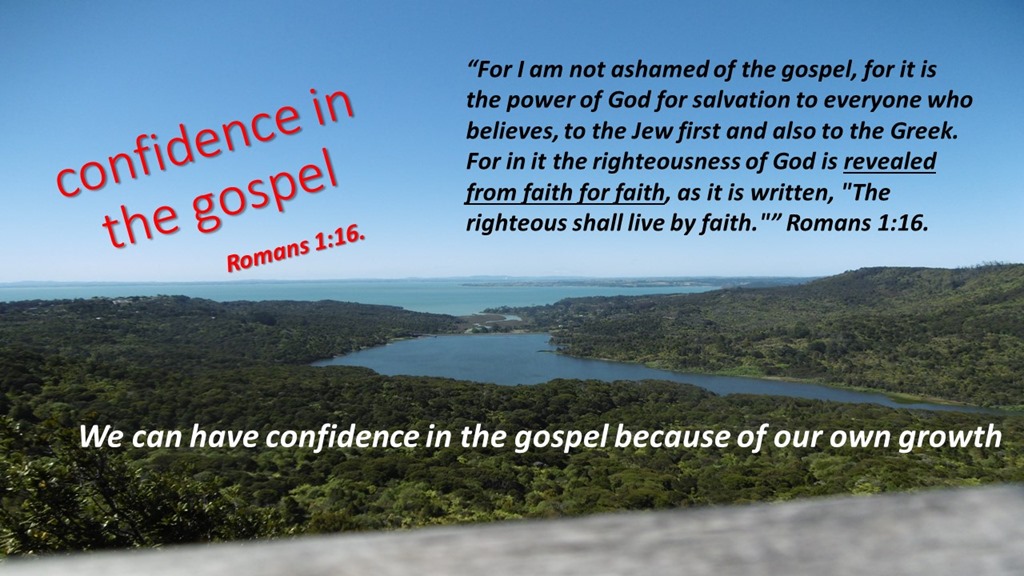
Slide8We can have confidence in the gospel because of our own growth

Jesus teaches me. I stand forgiven, and have access to the Holy Spirit to affect true change in my behavior. I can now live in victory over sin, and grow in the likeness of Christ. The key to living this life is the gospel message that Jesus proclaimed when he was on this earth. He gave commands which can drastically alter my life. But I have to learn and obey those commands. I am a disciple of Christ. I must choose to live like one. The gospel is the gospel of the kingdom. If I choose to live outside of the principles taught in the gospel, I have not responded to the gospel, regardless of what I believe about the atonement.

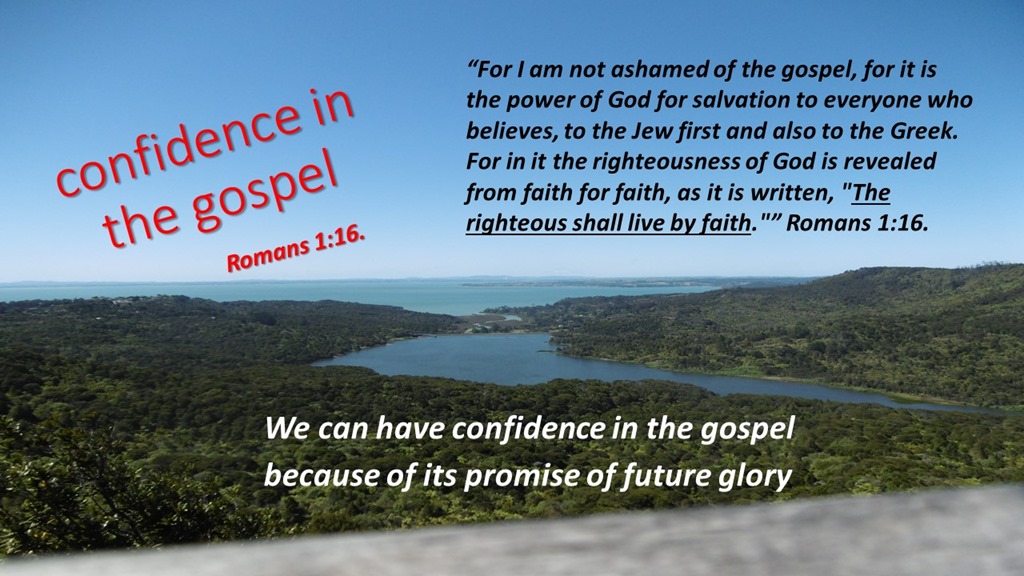
Slide9We can have confidence in the gospel because of its promise of future glory

Jesus will make me immortal. I have an eternal destiny that will begin the day Jesus breaks the clouds and returns from heaven. On that day, if I am still alive, I will be transformed, and never taste death. If I die before that happens, I will be raised to life at Christ’s command when he returns, never to die again. The gospel is good news because it shows us the destiny that is ours beyond the grave. It does not deny that death is real. It shows hope beyond death.

“Now I would remind you, brothers, of the gospel I preached to you, which you received, in which you stand, and by which you are being saved, if you hold fast to the word I preached to you – unless you believed in vain. For I delivered to you as of first importance what I also received: that Christ died for our sins in accordance with the Scriptures, that he was buried, that he was raised on the third day in accordance with the Scriptures” 1 Corinthians 15:1-4 ESV.

This explains why Paul’s most extensive presentation of the gospel is found in a chapter entirely dedicated to the resurrection. There is no gospel without the resurrection. Because Christ was raised, we now can have victory over the penalty of sin in the past, and the power of sin in the present. Because Christ will raise us from the dead, we now have an eternal destiny – a future besides destruction in hell.

You cannot really understand the gospel without this perspective on the future, and that is exactly what the problem was in Corinth. The believers in Corinth had lost the good news of the resurrection. They had lost the gospel.

“how can some of you say that there is no resurrection of the dead? 1 Corinthians 15:12b ESV.

Not knowing the future God has for us can severely cripple us. Knowing our future can free us to truly live in the present.

“In a moment, in the twinkling of an eye, at the last trump: for the trumpet shall sound, and the dead shall be raised incorruptible, and we shall be changed. For this corruptible must put on incorruption, and this mortal must put on immortality. So when this corruptible shall have put on incorruption, and this mortal shall have put on immortality, then shall be brought to pass the saying that is written, Death is swallowed up in victory.”” 1 Corinthians 15:52-54 KJV.

Slide12

The resurrection is God’s victory, and ours. The gospel is the good news about that victory. It is the story of God entering this world of sin and pain through his Son, and taking on that sin and pain through the atonement on the cross. It is the story of the crucial battle won on the cross, and demonstrated by Christ’s resurrection. It is the story of the final victory over sin and pain through the resurrection at Christ’s return. Coming to faith in Christ is entering into that story. We know how the story ends. That is why we can have an eternal perspective. This coming year, we should not live recklessly – like there is no tomorrow. But may we live fearlessly, because there will be a tomorrow. The gospel assures it.

confidence in ultimate victory

clip_image002

“Who is this coming from Edom, with bright red garments from Bozrah … this one so fabulously robed, tilting forward in his great might?” “It is I, announcing righteousness, strong enough to deliver.” “Why are your robes red, and your garments like theirs who tread the wine press?” “I have trampled the wine press alone, and no one from the peoples was with me; I trampled them in my anger and crushed them in my wrath; their juice spurted on my garments, and stained all my robes. Because the day of vengeance was in my heart, and the year for my redeeming work had come. I looked, but there was no assistant; I was shocked, but there was no one to support me; so my own arm brought me victory, and my wrath supported me. I stomped down peoples in my anger, I made them drunk on my wrath, and I poured their juice out on the ground.” — Isaiah 63:1-6

We are too prone to idolatry for us to fool around with carved, painted or engraved images of God, and those who do soon discover that the image takes a life of its own, and leads to dependence on the image, rather that dependence on God. That is why the Bible specifically forbids us to make graven images of God.

But even though the Bible forbids our making images of God, the word of God itself uses numerous word-images from nature to describe him, so that we can understand better who our God is.

  • · a rainbow teaches us that God is faithful to his promises,
  • · a consuming fire teaches us that God is jealous, and destroys his enemies,
  • · a mountain fortress teaches us that God is our refuge in time of trouble,
  • · a rock teaches us that God is a solid foundation for our lives,
  • · streams and rivers speak of God’s abundant provision,
  • · the stars in the night sky speak of God’s glory and his plan,
  • · rushing wind speaks of God’s omnipresent Holy Spirit.

These, and numerous other word-pictures just give us a tiny glimpse of who our God is. In today’s text, the prophet Isaiah pictures God as a warrior coming up from the battle, his garments stained with so much blood that it looks like he has been stomping grapes all day. If I had asked any of you to draw a picture of God, I doubt any of you would have chosen that image. But Isaiah’s message was very important for the people of his day to understand, and it is just as important for us today.

clip_image004

The people of Israel in Isaiah’s day were captives to two separate kingdoms, and Isaiah’s message is that Yahveh is strong enough to deliver them from both. First, they were captives of the nations around them. During Isaiah’s time, the Assyrian empire was ruling over many nations, including Israel.

Isaiah describes Yahveh as the deliverer, coming up from Edom as an army in bright red uniforms. Bozrah was Edom’s capital city, and its name may have been associated with grape gathering. The Lord used the Assyrian empire to crush and subdue Edom, that ancient nation which had long been an enemy of Israel. The symbolism of a God as a warrior clothed in red as if he had been crushing grapes speaks of the comprehensiveness of God’s victory over his enemies.

Isaiah’s point is that Edom is only the first of many nations which will be judged and crushed under the power of Yahveh’s might. The end result will be freedom from all oppressors, and the one making this happen is God himself. This promise was especially helpful for the Israelites in Isaiah’s time because it seemed that all the power was in someone else’s hands. The people felt oppressed, with no deliverer. In fact, deliverance from one enemy was coming from another enemy.

God’s people needed deliverance, but they had no power and no resources to achieve their own deliverance. In that context, Isaiah pictures the God of Israel coming up from the winepress, where he has crushed the enemy into wine. He was telling his people that God is strong enough to deliver them by himself. God does not need an army. He does not even need one strong warrior. When he gets ready to overcome his enemies, he can do it all by himself.

clip_image006

So, Isaiah tells his people to rest on his power and trust his grace, and the empire of Assyria will be overcome by God himself. He sees their bondage, and he will bring it to an end. History tells us that the Assyrian empire was defeated in stages, but by the time Babylon took power, their power was broken. The Israelites did not do this. God did it using the surrounding nations.

But Israel was experiencing another kind of bondage as well. The LORD comes “announcing righteousness” because the people are first and foremost in bondage to sin. In fact, it was this bondage to sin that had led to the bondage to the Assyrians. God’s vengeance against these other nations is also vengeance against that kingdom, and the end result of his judgment will be the obliteration of sin and evil.

Do you know that? Do you know that sin and evil are not a permanent fixture in God’s universe? Some teach that God can never get rid of sin and sinners – that there will always be a hell burning with God’s creatures who rebelled against him. But Jesus said that God is able to destroy sinners’ souls and bodies in hell. He will do this on judgment day. Listen to the word of God about what is going to happen that day:

  • Psalm 37:38 “transgressors shall be altogether destroyed”
  • Isaiah 13:6 “the day of the LORD is near; as destruction from the Almighty it will come!”
  • Joel 1:15 “the day of the LORD is near, and as destruction from the Almighty it comes.”
  • Matthew 7:13 “Enter by the narrow gate. For the gate is wide and the way is easy that leads to destruction, and those who enter by it are many.”
  • Matthew 10:28 “fear him who can destroy both soul and body in hell.”
  • Mark 12:9; Luke 20:16 “He will come and destroy the tenants and give the vineyard to others.”
  • Romans 9:22 “vessels of wrath prepared for destruction”
  • Philippians 3:19 “Their end is destruction”
  • 1 Corinthians 3:17 “If anyone destroys God’s temple, God will destroy him.”
  • 1 Corinthians 6:13 “”Food is meant for the stomach and the stomach for food”- and God will destroy both one and the other.”
  • 1 Corinthians 15:26 “The last enemy to be destroyed is death.”
  • 2 Thessalonians 1:9 “They will suffer the punishment of eternal destruction”
  • Hebrews 10:39 “we are not of those who shrink back and are destroyed, but of those who have faith and preserve their souls.”
  • James 4:12 “There is only one lawgiver and judge, he who is able to save and to destroy.”
  • 2 Peter 3:7 “the heavens and earth that now exist are stored up for fire, being kept until the day of judgment and destruction of the ungodly.”
  • 1 John 3:8 “The reason the Son of God appeared was to destroy the works of the devil.”
  • Revelation 11:18 “your wrath came, and the time for the dead to be judged, and for rewarding your servants, the prophets and saints, and those who fear your name, both small and great, and for destroying the destroyers of the earth.”

God’s ultimate victory will be when he destroys sin and evil, sinners and evildoers. We will be on one side or the other side in that ultimate war. Either we are on the side of God’s righteousness through faith in Christ, or we are on the side of the defeated and destroyed enemy.

clip_image008

The New Testament picks up on the imagery of Isaiah 63 and pictures Jesus as this conquering deliverer: “He is clothed in a robe dipped in blood, and the name by which he is called is The Word of God. …From his mouth comes a sharp sword with which to strike down the nations, and he will rule them with a rod of iron. He will tread the winepress of the fury of the wrath of God the Almighty” (Revelation 19:13,15).

Isaiah’s message to his people is the same as John’s message through Revelation: The Lord is the only one strong enough to deliver us from all our bondage. True freedom comes only from him. The message is that sin and evil will be with us all during this age. We will not defeat it. We will not be able to right all the wrongs, and fix all the problems in this world. We can try, but eventually we will all discover that our ability to change things is severely limited.

The good news of the gospel is that God does not require that we correct all the defects in our fallen world. He has a Saviour for that. The picture of Christ coming down from heaven with his robe dipped in blood is the ultimate picture of victory. But it is not our victory for Christ but his victory for us. He is going to overcome our bondage just as definitively as he overcame Israel’s bondage to Assyria. One day we will look around at this world and we will find that Jesus has utterly and completely purified it.

clip_image009

LORD, we long for the true freedom which can only come from you. Come and set us free. But, before you return to conquer sin utterly, we invite you to come into our personal lives and destroy sin’s power over us.

confidence in the resurrection

clip_image002

Mark 12:18-27

18 Sadducees, who say that resurrection is not possible, came to him and questioned him, saying, 19 “Teacher, Moses wrote for us that if a man’s brother dies, leaving behind a wife but no child, the man should marry the widow and raise up children for his brother. 20 There were seven brothers; the first married and, when he died, left no children; 21 and the second married her and died, leaving no children; and the third likewise; 22 none of the seven left children. Last of all the woman herself died. 23 In the resurrection whose wife will she be? Because the seven had married her.” 24 Jesus said to them, “Is not this the reason you have gone astray,[1] that you recognize neither the scriptures nor the power of God? 25 Because when they rise from the dead, they will neither marry nor be given in marriage, but are like angels in heaven. 26 And as for the dead being raised, have you not read in the book of Moses, in the story about the bush, how God said to him, ‘I am the God of Abraham, the God of Isaac, and the God of Jacob’?[2] 27 He is God not of the dead, but of the living; you have gone extremely astray.”

I like to watch a good debate. I don’t mean when two or three political candidates get together and call each other names, and reveal the fact that neither knows what they are talking about. Let’s call that a category one debate. I mean an honest-to-goodness real debate, where we actually learn the facts behind the issue, and are left with the ability to make an educated decision about which side is best. That’s the kind of debate I like to watch. We will call that a category two debate. The trouble is, most debates don’t have participants who approach the task with integrity, so they wind up being category one debates, and leave the audience with the wrong impressions.

Today’s text records what started out as a category one debate, but it ended up as a category two debate. Mark records Jesus and the Sadducees having a fundamental disagreement here over the concept of bodily resurrection. Their disagreement comes from the fact that each has a presupposition about the promise of resurrection, and their presuppositions are diametrical opposites.

The Sadducees say that resurrection is impossible, and that such a concept implies ludicrous things – a view they demonstrated with their little hypothetical story to Jesus. What they are actually doing is trying to have the wrong kind of debate with Jesus. They want to throw out a bunch of wrongheaded arguments and leave their audience thinking they know something about the subject, but they don’t. I have actually read scholarly books where the same kind of argument is made. Here’s some examples of that:

· The resurrection cannot happen because if people really die, they have to be recreated in order to live again, so they are not the same person.

· The resurrection does not need to happen because all that is really important is the soul, and that never dies.

· A universal resurrection cannot happen because some people are completely are completely disintegrated, so there is nothing left to resurrect.

· A universal resurrection cannot happen because some people are eaten by animals or cannibals so their bodies become part of the bodies of those who eat them.

I’m not going to stop and answer each of these arguments yet. I just want to demonstrate that the debate over the resurrection still goes on. I do want to say that any argument against the concept of a coming, universal resurrection of all the dead tends to try what the Sadducees were trying. They tried to show that the promise of the resurrection is not possible. The Sadducees used as their debate tactic a hypothetical story about a woman with seven husbands. If the argument had been stated as a syllogism, it might sound something like this.

· resurrection restores a dead person back to life.

· if a woman marries seven men in succession, when she is raised, she will either be a polygamist, or she will be forced to divorce six of her legitimate husbands.

· therefore the resurrection is immoral, so it cannot happen.

The argument does not sound half as convincing today as it probably did back then. But the problem with category one debates is that they do not have to be convincing. As long as the debaters are saying something, they think their job is done. They don’t have to prove their point, all they have to do is make their point.

Jesus reveals his presuppositions about bodily resurrection here. In so doing, he proves not only that he is right about the coming resurrection, but he also proves that all three presuppositions that the Sadducees had about resurrection are false.

· He proves that resurrection involves more than merely restoring a dead person back to life.

· He proves that a person married in this life will not be married in the next (even if you are Mormon).

· He proves that there are no moral obstacles to the resurrection.

Here is how Jesus frames his argument:

clip_image004

First, he explains that the resurrection is not a debate to be fought, but an event to be experienced. It is promised in scripture, and God’s unstoppable power is behind that promise. So, Jesus does not address the resurrection as a hypothesis. He does not say “if they rise,” he says “when they rise” (25). He had the advantage of not having to sort out all the questions and figure out solutions for them. He knew that there would be a resurrection, and that he, himself would be the one who brings it about.

Do you remember when Jesus was talking to Martha when he arrived in Bethany, four days after the death of Lazarus. Martha told Jesus that she knew her brother would be raised on resurrection day. Jesus told Martha “I am the resurrection and the life.” He explained to her that on that day, anyone who had died, he would bring them back to life. He went on to explain that anyone who believes in him who was not dead on that day – would never die.

Some people read Jesus’ words to Martha with blinders on, because they are convinced that it must somehow be about what happens when you die. It is not. It is about resurrection day. That day will start out with two kinds of Christian: dead Christians, and living Christians. Then Jesus will do his thing, and suddenly, and eternally – there will be only one kind of Christian. He will literally raise the dead, and make all living believers immortal.

clip_image006

The second point in Jesus’ argument is that the resurrection will not be a mere resuscitation to the same corruptible bodies and sinful souls that we have today. God will restore us not to our present status, but to the one he intends us to have for eternity. He addresses that argument that the Sadducees made, presuming that resurrection is merely bringing a body back to life.

All resurrections that have ever happened in history have been merely resuscitations. But the resurrection that God promised is so much more than that. The apostle Paul explained that in his first letter to the Corinthians. He compared the original body with a seed that is sown. We all know that when a plant grows out of the earth that it started as a small seed, but we also know that the end product is something different – something much bigger and more glorious than the seed.

“42 So is it with the resurrection of the dead. What is sown is perishable; what is raised is imperishable. 43 It is sown in dishonor; it is raised in glory. It is sown in weakness; it is raised in power. 44 It is sown a natural body; it is raised a spiritual body. If there is a natural body, there is also a spiritual body. 45 Thus it is written, “The first man Adam became a living being”; the last Adam became a life-giving spirit. 46 But it is not the spiritual that is first but the natural, and then the spiritual. 47 The first man was from the earth, a man of dust; the second man is from heaven. 48 As was the man of dust, so also are those who are of the dust, and as is the man of heaven, so also are those who are of heaven. 49 Just as we have borne the image of the man of dust, we shall also bear the image of the man of heaven” (1 Corinthians 15:42-49 ESV).

When we Christians talk about our longing for the resurrection, it is not just that we want to be brought back to life after we die. We want much more than that. We want this sin and death that destroys our relationship with God and each other to be destroyed. We want a new life – a sinless, holy, God honouring life. That is what the resurrection promises for us. In the end, we will look more like Jesus than like Adam. We will have more in common with the eternal heaven than this present corrupted earth. You cannot really understand our desire for the resurrection as long as you see resurrection as mere resuscitation. It is more like complete regeneration.

clip_image008

Finally, Jesus argues that the resurrection must happen because God has a plan, and that plan cannot be realized among the dead. God’s promise is to all his people, not just his people of the future. His words to Moses were in effect a reminder that he is not through being faithful to those who have died. Abraham, Isaac and Jacob had long been dead. They were truly dead and they still are. Jesus was not denying the reality of death. What he was saying was that God always sees into eternity. He sees Abraham and Isaac and Jacob and Moses and David alive in their final perfected state. He sees you and me there as well. So, God is always our God. Even when we die, he is our God. He sees not just this part of his plan, but his whole plan.

To me, that fact is comforting on so many levels. The Bible says that Christ, “by a single offering … has perfected for all time those who are being sanctified” (Hebrews 10:14). God sees that. He sees the trouble I am having right now following him, and he is not worried. He looks back in time to the cross, and he sees the debt paid forever for my sins. And he looks forward into time to the resurrection, and he sees me changed into my eternal, perfected self. He sees me in that perfected state for a million years, and a million more. God sees me, and he sees you, and he is not ashamed, and he is not worried. He sees his children, and he smiles.

Something wonderful happened to me as I got a little older. I stopped worrying so much about my children. I used to be anxious about making the wrong decisions, and scarring them for life. Now, I look at those same kids, who are now raising kids of their own, and I realize that I worried too much about them. I should have trusted that God would take care of them the same way he took care of me. It’s a lot easier for me to do that now that I can see them acting with maturity and consideration for others.

The reason why people don’t have confidence in the resurrection is that it hasn’t happened yet. One day we will look back on all the pain and struggles that we are going through now, and realize that we should have just trusted God to work out his plan. If we can believe the first four words of the Bible (three words in Hebrew) we can believe in the resurrection. Those words are “In the beginning, God…” He was there in the beginning, setting his plan in place. He will be there at the end, restoring all things to himself. If we just look at the cemeteries, we will wonder about the resurrection. But if we look to the one who was here before us, he will bring us to a time when all the cemeteries are history. His plan for us is eternal, abundant life.