
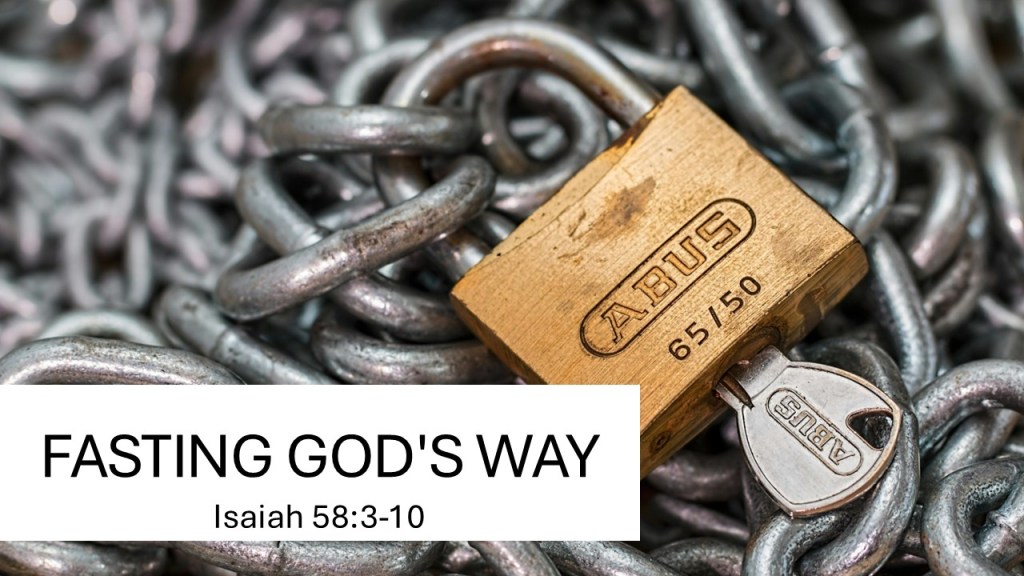
FASTING GOD’S WAY
Isaiah 58:3-10 NET.
3 They lament, ‘Why don’t you notice when we fast? Why don’t you pay attention when we humble ourselves?’ Look, at the same time you fast, you satisfy your selfish desires, you oppress your workers. 4 Look, your fasting is accompanied by arguments, brawls, and fistfights. Do not fast as you do today, trying to make your voice heard in heaven. 5 Is this really the kind of fasting I want? Do I want a day when people merely humble themselves, bowing their heads like a reed and stretching out on sackcloth and ashes? Is this really what you call a fast, a day that is pleasing to the LORD? 6 No, this is the kind of fast I want. I want you to remove the sinful chains, to tear away the ropes of the burdensome yoke, to set free the oppressed, and to break every burdensome yoke. 7 I want you to share your food with the hungry and to provide shelter for homeless, oppressed people. When you see someone naked, clothe him! Don’t turn your back on your own flesh and blood! 8 Then your light will shine like the sunrise; your restoration will quickly arrive; your godly behavior will go before you, and the LORD’s splendor will be your rear guard. 9 Then you will call out, and the LORD will respond; you will cry out, and he will reply, ‘Here I am.’ You must remove the burdensome yoke from among you and stop pointing fingers and speaking sinfully.
10 You must actively help the hungry and feed the oppressed. Then your light will dispel the darkness, and your darkness will be transformed into noonday.
Some health gurus suggest that intermittent fasting can help us lose weight or manage specific health problems. That is not the fasting Isaiah addresses in today’s text. He is dealing with ritual fasting, when a group of people fast to get back on God’s good side. Recently, our Sunday School class watched a video featuring a former Muslim. He described salvation in Islam as doing enough good works to outweigh all your sins. He said that one of the good works a Muslim can do to impress God is to fast.
The LORD told Isaiah to confront his people with their rebellious deeds. They were seeking God, but they were not changing their ways. They were doing many of the things they thought were right, but it was to cover up for all the things they were doing wrong. Let’s take a look at today’s text to see what the problem was.
What was wrong?
The ritual was fasting, and the people fasted regularly. They complained to Isaiah that God was not holding up his part of the bargain. But God told Isaiah to tell them that their fast was not acceptable. They were doing it, but they were doing it wrong. A fast is supposed to bring a person closer to God by allowing them to focus on God rather than their daily work schedule. It was not just about food. It was also about the tremendous amount of time each day needed for the processing, preparation, and consumption of food. By setting aside time that would otherwise be spent on food, people could focus on their relationship with God.
Food is a natural desire. But if we allow that desire to take first place in our lives, it can overrule our spiritual desires and make us selfish. During their fast, the Israelites showed an inclination toward selfish desires. Instead of satisfying their need for closeness to God, they focused on themselves. Their hunger became an excuse to mistreat others, especially employers. If a couple had servants working for them, they would hate fast days because those would be the days when their bosses would be unbearable. They would use their hunger as an excuse to exploit their workers.
Another thing that happened during fast days was that personal relationships took a hit. Because people were hungry, they allowed it to affect how they felt about each other. Little annoyances became huge problems. Everyone was wound tight, so the slightest thing could make them angry. Anger, without self-control, can lead to arguments and fights. That is what fasting was doing to the people Isaiah was preaching to.
It was also turning them into a nation of hypocrites. They would focus so much on appearing humble, yet inside, they would denounce each other in pride. It was all about the show.
Why was it wrong?
God never intended the ritual of fasting to become a means of destroying his people. He wanted their fasting time to be a time of spiritual healing and growth. He wanted it to be a time when the people could come together and reflect his love for one another. He wanted them to look forward to this time when they could rest from their labor and focus on the word of God rather than on their own stomachs.
God had never intended the ritual of fasting to become a show of false humility. It was designed to reinforce their actual dependence on God and on each other. But it had become a competition. They were trying to outdo each other by appearing more humble than anyone else. The winners looked more humble than the losers. The fact was that they were all losers. You cannot get a blue ribbon in a humility contest. As soon as you accept the prize, you reveal that the show is all you were doing.
Brian Beyer says this about today’s passage:
- “The people complained because God was not honoring their fasting (58:3). They abstained from food and humbled themselves (at least they thought so), yet God seemed unimpressed. Isaiah explained the reason for God’s failure to honor the people’s fasting (58:3-4). No heart change occurred. The people continued exploiting their workers and quarreling, their edginess no doubt intensified by their hunger and their frustration at God’s lack of response. Such a situation would never receive God’s blessing. Isaiah contrasted the people’s current situation with the scenario God desired (58:5-7). Sincerity and humility are needed to accompany their fasting. But sincerity and humility were best evidenced by action, not by words. The Lord wanted to see them cease injustice and oppression, share food with the hungry, and take care of others’ needs. Fasting that produced a change of heart in God’s people would bring God’s approval (58:8-12). The Lord’s presence would surround them, and he would quickly answer their prayers. Their spiritual darkness would give way to the light of God’s ways, and the Lord would refresh their souls. They would rebuild ancient cities that had long lain in ruins. God’s presence would bring them the ability and resolve to accomplish everything he set before them.”[1]
How could it be made right?
God tells the people through the prophet that if they want to rescue the fasting ritual, they will need to break some chains. Where were the sinful chains? The lower class was wearing them. The servants, the poor, and the homeless in the community were being mistreated. The foreigners who owned no land were at the mercy of the landowners. During fasting times, the mistreatment worsened. The lower class expected to be abused by their “betters” during fasting days.
God tells the people to change how they observe fasting days. He tells them to take some of the food they have stored because they cannot eat it and give it to the hungry. Build shelters for the homeless and exploited poor. Give clothing to those who need it. Help fellow Israelites who are down on their luck.
He says that if they rescued the ritual of fasting in that way, the darkness will turn to light. Then the Lord will be free to respond to their prayers and make himself known among them.
Communion meditation:
“…we must help the weak, and remember the words of the Lord Jesus that he himself said, ‘It is more blessed to give than to receive.’” (Acts 20:35).
The communion service is a time we set apart to remember what Jesus Christ did for us. He gave his life for us. His death paid the ransom for our sins, so that we do not have to experience the second death.
The Apostle Paul told the Ephesian elders to remember something else. He told them to remember that Jesus said it is more blessed to give than to receive. He wanted the church community to model the Lord’s generosity.
We don’t have public fasts in our community today, but we do have a ritual we observe every week. It’s called going to church. If we are not careful, going to church can become a time when our selfishness dominates us, and our anger and lack of self-control can ruin our testimony. God wants us to turn that around, too.
Imagine what would happen if our fellowship became a time to help those in need. Imagine if we broke a few chains and rescued the needy during our meetings. Imagine a time focused on spiritual growth rather than the deeds of the flesh. That is what our Lord wants. This week, whenever we remember the blessing of communion, let’s also remember to be a blessing to the others we see every day.
[1] Beyer, Bryan. Encountering the Book of Isaiah: A Historical and Theological Survey. Baker Academic, 2007. pp. 224-225.

 jeffersonvann