
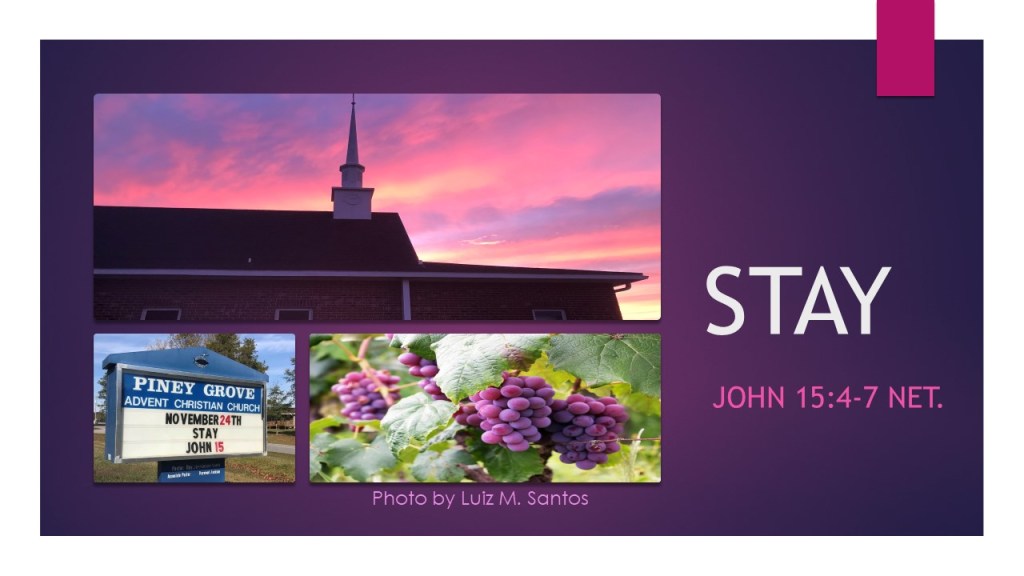
STAY
John 15:4-7 NET.
4 Remain in me, and I will remain in you. Just as the branch cannot bear fruit by itself, unless it remains in the vine, so neither can you unless you remain in me. 5 “I am the vine; you are the branches. The one who remains in me — and I in him — bears much fruit, because apart from me you can accomplish nothing. 6 If anyone does not remain in me, he is thrown out like a branch, and dries up; and such branches are gathered up and thrown into the fire, and are burned up. 7 If you remain in me and my words remain in you, ask whatever you want, and it will be done for you.
Back in February, I was preaching from Matthew 20, where Jesus described the work of the kingdom by comparing it to work in a vineyard. He told a parable about a vineyard owner who hired a bunch of people to work in his vineyard. The vineyard owner paid all the workers the same regardless of how many hours they worked in the harvest. That parable was actually a description of God’s grace. It taught that all of us who sign up for God’s coming kingdom will be blessed with that kingdom when it comes, and the eternal life we get will all be the same, no matter how much kingdom work we do. That’s because salvation is by grace. It is not brought about by our work – even our kingdom work. It is all bought at the same price, and Jesus paid that price on Calvary’s cross.
Today’s message is by the same Jesus, and it also mentions a vineyard. But in John 15, he is not talking about kingdom work. In this parable, Jesus is not the vineyard owner – he’s the vine. And we are not the workers in the vineyard. We are the branches of the vine.
Jesus’ parable of the workers in the vineyard was intended to remind all believers that God initiates our salvation, and he blesses us with the promise of eternal life not because of the quantity of our work for him but because of the quality of his grace toward us. It is helpful for us to know this because even on our best days, we are not going to accomplish anything by ourselves that would warrant any unique standing with God. Salvation by grace tells us that whatever God accomplishes through us or however much we are blessed, it is all because of his grace and his sola gratia – his grace alone.
Today’s parable puts the accent on the other side of the coin. It reminds us that even though we are all saved by grace, and we supply nothing to add to it, God still requires that we persevere in our faith. It is not totally passive – as if a person could be saved without ever knowing it.
Jesus says that his Father is the gardener and He is the vine. He says that the gardener will attend to every branch in him that does not bear fruit and take away all the branches that do not bear fruit. Even the branches that are bearing fruit will undergo pruning so that they can become even more fruitful.
Again, salvation is not described as passive. God himself is involved in the lives of every believer and works out the details of their lives so that they are fruitful. So, even though Jesus is telling us that he expects us to stay committed to him, he is not suggesting that our commitment is the only thing that matters for our salvation.
Before he tells us to stay in him, he tells us that his Father is already working in the background of our lives to produce that commitment. This gives Christians a whole new approach to the problem of suffering. We see every instance of suffering in our lives, not just as the work of the devil. We see the Father’s hand—the gardener’s hand—at work, building commitment and fruitfulness by means of suffering.
That is the background to today’s text. Now, let’s look at what the text tells us.
The text tells us where we should stay (4-5).
Jesus commands us to remain in him and promises that if we do, he will remain in us. He said that he is the vine, and we are the branches. The only thing he requires of his branches is that we do not jump off his vine and jump onto some other vine. It is a ridiculous thing to ask, in a sense. Have you ever noticed any grapes jumping off their vine and jumping on another vine?
Jesus was well aware of how unnatural that sounded. I imagine one or two of the disciples who heard Jesus say these words might have giggled at the notion. But they might also have remembered that low point in Jesus’ ministry when the crowds stopped coming, and even some of those who had been following him earlier decided to stop.
Jesus had been teaching using another illustration. He was teaching in a synagogue at Capernaum and said that unless people eat his flesh and drink his blood, they will not have eternal life and be raised on the last day. After that, “many of his disciples quit following him and did not accompany him any longer” (John 6:66). So, Jesus asked his disciples if they wanted to desert him too. That is when Peter said, “Lord, to whom would we go? You have the words of eternal life. We have come to believe and to know that you are the Holy One of God!” (John 6:68-69).
What was happening? It was a separation of the sheep from the goats. It was a church split that revealed the authentic believers and the inauthentic wannabe Christians. To use the wording of today’s text, some of the branches stopped staying in the vine.
I know that there is a considerable theological debate about whether a person can lose their salvation. This text does not actually speak to that issue. The parable that Jesus uses does not suggest that true believers can jump off the vine. Instead, it indicates that many who claim to be true believers or who want to be true believers will not stay with Jesus. They will depart. They will apostatize. They will not remain in the vine. They will jump off. As ridiculous as that picture is, it does describe what happens when people discover the cost of following Jesus and decide that they are not willing to pay the price.
True believers will never make that choice. But it is not always possible to see who is the true believer and who is the imposter. Judas did everything that the other apostles did. The eleven were shocked to find that he was the betrayer. If the parables in Matthew 25 inform us regarding this issue, they teach us to be diligent to be found faithful and not to assume that we are the elect and, therefore, not in danger of defection. Today’s passage teaches the same thing. Jesus had just told the eleven that they were clean already because of the word that he had spoken to them. But he didn’t follow that up with: “Relax, you are safe.” No, the very following words he said were, “Remain in me, and I will remain in you.” He did not want his disciples to hide behind the doctrine of election; He wanted them to stay committed to him and to remain diligent in doing his work.
I should also point out that this word translated “remain” or “stay” is the Greek verb μένω. It is directly related to the noun Jesus had just used in John 14:2. He said that in his Father’s house there are many dwelling places. That word is μονή. So, when Jesus commands us to stay, he is pointing back to that promise. He’s saying that we not only have a future in God’s presence when he returns, but we can stay in that presence now. We do that by staying faithful to Christ and staying in Christ.
The text answers the question, ‘What if we don’t stay?’ (5, 6).
There are two outcomes that Jesus highlights in today’s text. There is the present-day outcome and the ultimate outcome. The present-day outcome for those who decide to jump off the vine is that they will “accomplish nothing.” Someone who claims to be a Christian but does not stay in Christ will not bear any fruit for Christ. They might stay in church, but they are outside of Christ. As a result, their lives will be unfruitful for Christ’s kingdom.
They might look like they are working toward a harvest, but at the end of the day, they will have no produce to show for their work. In Jesus’ day, the nation of Israel had whole groups of committed workers who were not really in the vine. The Scribes, Pharisees, and Sadducees were such. They had the appearance of being committed to God but Jesus called them out for their hypocrisy. He said they were like whitewashed tombs. Outwardly, they looked clean and tidy, but inside them were dead people’s bones.
Jesus pictured the ultimate outcome of such lives by describing them as branches that fall off the vine, are gathered up and thrown into the fire, and are burned up. What Jesus is describing is Gehenna hell. Jesus had said that we should not fear human beings, but we should fear God because he “is able to destroy both soul and body in hell” (Matthew 10:28). Here, Jesus is saying that those branches that do not stay in him will be gathered all together in one place at one time. The place is hell, and the time is judgment day. When Jesus throws those branches into hell, they will NOT burn forever and ever. They will be destroyed. According to today’s text, they will be burned up.
The prophet Malachi predicted the same thing. He said, “The day is coming, burning like a furnace, and all the arrogant evildoers will be chaff. The coming day will burn them up,” says the LORD who rules over all. “It will not leave even a root or branch” (Malachi 4:1). Imagine that. Malachi even used the same word that Jesus did in today’s text. Rebellious branches will not be given the privilege of eternal life – even in hell. They will be burned up, obliterated, annihilated. That is the ultimate result of not staying in the vine.
The text also answers the question, ‘What if we do stay?’ (4, 5, 7).
Jesus was not aiming at scaring the disciples with the parable. He used the parable of the vine and the branches to encourage them. He told them that choosing to stay in the vine – that is, remain in Christ – will result in the ability to bear fruit. After all, that is what the vine is for, and that is what the branches are for. A branch that does not bear fruit is pruned because it is not accomplishing the task it was created for. If we do stay in Christ, we can expect a fruitful life and fruitful ministry.
In fact, Jesus promises in verse 5 that if we stay in him we will not only bear some fruit, but we will bear much fruit. Apart from him, we can do nothing, but in him, we can do anything. We should all be looking at our lives and expecting Jesus to use us to bear much fruit for his kingdom. We should be praying for more than “Lord, get me safe into the coming kingdom.” We should be praying, Lord, make good on your promise to make my life bear much fruit for you today.
If we get into that mindset where we expect to bear much fruit for the Lord now, we will have no problem fulfilling the other promise that is in today’s text. In verse 7, Jesus says, “If you remain in me and my words remain in you, ask whatever you want, and it will be done for you.” This is an actual promise from Jesus. Some people think that the promise no longer applies because they don’t see any evidence that Jesus is answering their prayers. So, they come up with a doctrine that the gifts and miracles have ceased.
I want to challenge you on this issue because I am not such a person, and I do not believe the Bible teaches that the gifts and miracles have ceased. Instead, if we look at the context of Jesus’ promise here, we will find out why there seem to be so few examples of answered prayer. The context is that of remaining in Christ and having a fruitful life and ministry for him. The two conditions of the promise are these: “if you remain in me” and “if my words remain in you.”
The condition “if you remain in me” speaks of maintaining an authentic relationship with Christ. The condition “if my words remain in you” speaks of learning and living by the commands of Christ and trusting in the promises of Christ. We all have a long way to go before we can claim that we have met those conditions. But, again, Jesus is not asking us to despair. He wants us to aim at fulfilling those conditions because he wants to create an army of faithful Christians who are well-known for answered prayers.
John Wesley commented on this verse, “Prayers themselves are a fruit of faith, and they produce more fruit.” The devil knows that there is one sure way to prevent us from bearing fruit as Christians. He can keep us from being productive if he can convince us to stop praying. Praying is not an additional condition that Jesus adds to the ones Jesus already pointed out. Those are having a relationship with Christ, learning and living by the commands of Christ, and trusting in the promises of Christ. So, when Jesus says, “Ask whatever you want, and it will be done for you,” he is telling us to pray because we are in him, and his word is in us. Prayer is not a third condition. It is a natural outflow of meeting the two conditions.
That means that anytime we get into our prayer closets and are determined to spend some quality time praying, we can pray with confidence. There are only two conditions that Jesus lists for fruitful prayer. Perfection is not one of those conditions. His grace covers our inadequacies and faults. His love overlooks our obvious failures and imperfections. We need only concern ourselves with two questions: do we have a relationship with Christ by faith, and do we know and trust his word? If we can answer “yes” to those two conditions, then we can pray with confidence.
Now, I know what happens when I pray and I don’t see an immediate answer. I begin to doubt my ability to pray productively. That doubt is the devil’s work. Jesus did not add any further conditions to his promise. So, what will happen if I give in to that doubt and stop praying? Remember what the command is. Jesus said, “Remain in me.” We honor him when we keep praying and keep staying. We show our trust in his promises by persevering through the dry times and waiting for him to produce the water from the rock. Our Lord wants people who dare to persevere.
HEAVENLY FATHER, thank you for the gift of Jesus Christ. Thank you for his sacrifice on Calvary’s cross that made it possible for us to be saved by grace. Thank you for the privilege of being in Christ by faith. Oh, Lord, we want to stay in him. Protect us from the temptation to defect from him, to stop trusting in his finished work, or to doubt his sure promises. We thank you that he is the way to your eternal presence. We ask you for the strength we need to stay in him as we wait for the fulfillment of all his promises. In Jesus’ name, Amen.


 jeffersonvann