
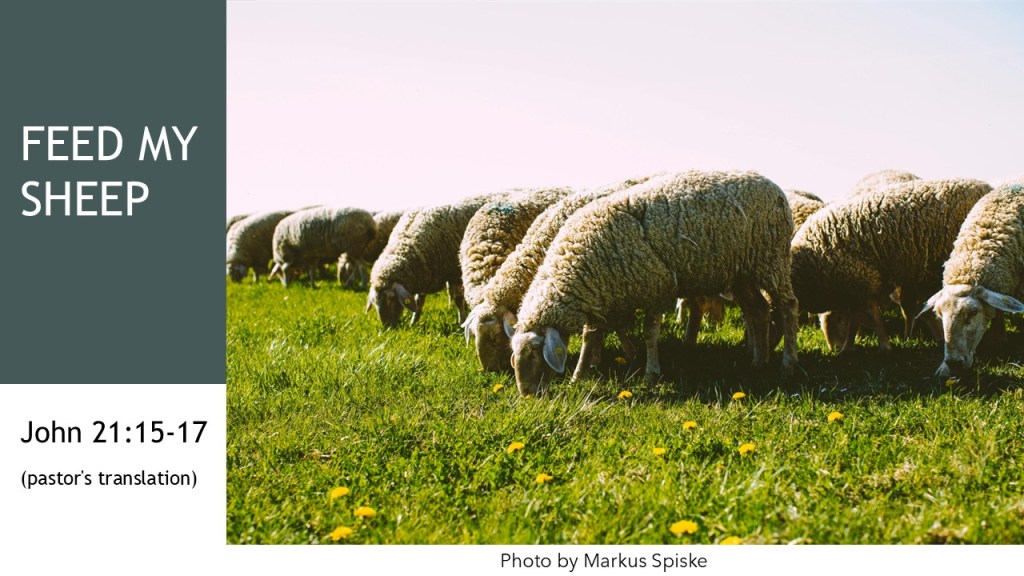
FEED MY SHEEP
John 21:15-17 (pastor’s translation)
15 When they had eaten breakfast, Jesus asked Simon Peter, “Simon, son of John, do you care about me more than these?” “Yes, Lord,” he said to him, “you are aware that I have regard for you.” “Feed my lambs,” he told him. 16 He asked him a second time, “Simon, son of John, do you care about me?” “Yes, Lord,” he said, “you are aware that I have regard for you.” “Shepherd my sheep,” he told him. 17 He asked him the third time, “Simon, son of John, do you have regard for me?” Peter was so grieved that he asked him the third time, “Do you have regard for me?” He said, “Lord, you are aware of everything; you are aware that I have regard for you.” “Feed my sheep,” Jesus said.
The incident that John described in today’s passage fell between our Lord’s resurrection and his ascension to heaven. Peter had decided to go fishing and had a disappointing night because they had caught nothing. But Jesus intervened and told them to throw the net on the right side of the boat. They caught so many fish that they could not haul in the net. Some of the other disciples came and assisted them in recovering the net. When they went onto the shore, Jesus instructed them to bring some of the fish they had caught. He had already started a charcoal fire. The conversation Jesus had with Jesus took place at this fireside.
This passage is about Peter’s grief.
The fact that they were at a campfire and Jesus asked essentially the same question three times got Peter’s memory going. He remembered another fireside – on the night of Jesus’ crucifixion. On that night the people had built a fire to keep warm, and Peter had approached the fire, hoping that nobody would recognize him. Sure enough, three different people had asked him if he knew this criminal – Jesus. Three times, Peter had denied knowing Jesus and being his disciple.
Our text says that Peter was so grieved that Jesus had asked him the same question three times. He was grieved that when challenged, he had chosen to deny Christ rather than admit that he had been his disciple. Peter had boasted that he would follow Jesus even if he had to die doing it. But when the time for testing came, Peter chickened out. The rooster crowed, and Peter had broken down in shame and grief. He was grieving not only because his master was being condemned. He was also grieving because he (Peter) had not lived up to his promise. He proved to be not as committed as he said he was.
Each of us who tries to live the Christian life will find ourselves in such situations. We will see that our actions do not match our testimony. As much as we love Jesus and declare our allegiance to him, we will discover times when we fail to live the life we want to live. We will be seriously disappointed with ourselves.
I’m glad that this passage is in the Bible. It tells us something about our loving Savior. It tells us that when we have failed him in the most public and shameful ways, Jesus will still be waiting at the seashore, ready to talk about it over breakfast. If we did not have this passage, we might be tempted to think that Jesus would reject us as soon as we fail to admit our loyalty to him. But this passage tells us that the one who taught us to forgive seventy times seven is going to be there for us with love and forgiveness.
This passage is about Peter’s love.
Y’all know that I do not normally use my translation when preaching. I usually use a modern translation that is available to anyone. However, I chose to use my translation because the modern translations and the ancient ones all have problems translating the passage. The difficulty is found in the fact that the passage was originally written in Greek with two different words, both of which are usually translated with the same word in English. The Greek words are ἀγαπάω and φιλέω. John is using these two words because even though both can be translated with our English word love, each has a different connotation. Each denotes a different aspect of love.
In order to show the differences between the two words being used, in my translation, I translate both words differently. I chose not to use the word love in my translation because it would not be clear which word was being used in Greek. When ἀγαπάω is used, I translate the word “care about.” When you care about someone, the focus is on what you can do for them. When φιλέω is used, I translate it as “have regard for.” When you have regard for someone, the focus is on appreciation for who they are and what they have done for you.
So, here again is my translation of the conversation:
“Jesus asked Simon Peter, “Simon, son of John, do you care about (ἀγαπάω) me more than these?” “Yes, Lord,” he said to him, “you are aware that I have regard for (φιλέω) you.” “Feed my lambs,” he told him. 16 He asked him a second time, “Simon, son of John, do you care about (ἀγαπάω) me?” “Yes, Lord,” he said, “you are aware that I have regard for (φιλέω) you.” “Shepherd my sheep,” he told him. 17 He asked him the third time, “Simon, son of John, do you have regard for (φιλέω) me?” Peter was so grieved that he asked him the third time, “Do you have regard for (φιλέω) me?” He said, “Lord, you are aware of everything; you are aware that I have regard for (φιλέω) you.”
Peter had grieved because he knew that he had dissapointed Jesus when he denied him at his crucifixion. His grief was natural because he cared about Jesus. He did not want to disappoint him again. But Jesus was teaching Peter that he didn’t want Peter to focus on his concern for Jesus. He wanted Peter to concentrate on his admiration and appreciation of Jesus because that is what he needed to be successful in his future ministry. In other words, his future ministry had to be based on the greatness of his master, not the strength of his concern for his master.
This passage is about Peter’s mission.
That is why Jesus kept telling Peter to feed and shepherd his sheep. Peter had to get his mind focused on his mission because that was to be the means by which he proved his regard for his master. The story began with Jesus asking Peter, “Do you care about me more than these?” Who were the “these”? They were the fish. Peter had decided to go fishing. Jesus first met Peter when he was out fishing. Jesus called Peter and three other fishermen to follow him, and he would make them fishers of people.
The new mission required a new metaphor. The old metaphor was good enough when the disciples’ primary ministry was evangelism. Jesus made them fishers of people because their primary responsibility was to catch people in the net—to win them to Christ. They would still be doing that, but Jesus was adding a new ministry when he told them to feed and shepherd his flock.
The new mission was to assist and lead the congregations to maturity in Christ. This would be proof of their high regard for their master. Jesus had given them a new commandment: to love one another. Now, he was giving them a new mission to nurture and protect all the sheep in the fold.
The Lord has been dealing with me on the issue of feeding the flock as well. For this coming year, he wants me to focus on getting this congregation into the word of God on a regular basis. I am introducing a new calendar for the coming year. Each day of the calendar has a reference to two chapters from the Bible. We will be beginning in Genesis and reading through the Bible, finishing with Revelation in the middle of 2026. Each month, you will get a new calendar with the month’s readings. Each Sunday, I will take my Scripture passage from that Sunday’s texts. I want us to commit to reading or listening to those two chapters every day if possible. The Sunday School lessons will also be taken from that week’s readings.
There is more to spiritual growth and maturity than just reading the Bible regularly. But one of the reasons Christians stay spiritually immature is that they do not get into the word and let it nourish them. As a congregation, we are responsible to feed the sheep in this community. I want us to get more biblically literate because it is one of the means of becoming more spiritually mature. As we are preparing to begin a new year, let us take the opportunity to establish some new patterns. One of the most critical new patterns that anyone can set is to have a regular plan for reading and studying the Bible. As you read, if you encounter a word or phrase you do not understand, write it down to discuss on Sunday. You can also email or text me with a question.
The owner of the flock wants us all to be well-fed and strong. Let’s commit to becoming a congregation that knows the Word and lives by it. God bless y’all.


A quote from Piney Grove Pulpit #3:
““Make yourself an ark of gopher wood” (Genesis 6:14).
Noah’s response was that he “built an ark to deliver his family.” He built it by faith. Nobody had built such a thing before. There was no precedent. There hadn’t been any need before. God himself had to give Noah the blueprint for the thing. Building the ark was something that was going to be very hard to do, and it was going to take a lot of effort and resources to do it.
But … and this is very important… it could be done. God sometimes calls you and me to do the impossible, but most of the time he just calls us to do the impractical, to test our resolve and commitment to him. God didn’t call Noah to build a spaceship. A boat was what was needed, and Noah could do that. Noah’s faith helped him to respond appropriately to his fear and build that boat.”




 jeffersonvann