EVERYTHING ALIVE
Genesis 9:12-17 NET.
12 And God said, “This is the guarantee of the covenant I am making with you and every living creature with you, a covenant for all subsequent generations: 13 I will place my rainbow in the clouds, and it will become a guarantee of the covenant between me and the earth. 14 Whenever I bring clouds over the earth and the rainbow appears in the clouds, 15 then I will remember my covenant with you and with all living creatures of all kinds. Never again will the waters become a flood and destroy all living things. 16 When the rainbow is in the clouds, I will notice it and remember the perpetual covenant between God and all living creatures of all kinds that are on the earth.” 17 So God said to Noah, “This is the guarantee of the covenant that I am confirming between me and all living things that are on the earth.”
We are now on our 5th day of the new year, which means that we are five days into our commitment to read two chapters a day in God’s holy word. I’m hoping that we all can keep to that commitment because I know that God wants to bless us with his wisdom and a closer relationship with him. The early chapters of Genesis teach us that God is holy and he wants to have a close relationship with his people. But he will not tolerate rebellion. Adam and Eve rebelled in the garden and so God banished them from it. That meant that our ancestors no longer had access to the Tree of Life. They were mortal, and our race began to die, starting with Abel, who his brother killed.
The rebellion continued among our ancestors and finally grew to such a degree that God could not tolerate it. Thus, God sent the flood to cover the planet in water and destroy all its inhabitants. But God is also merciful, and he chose one family of humans to rescue by his grace, along with the animals he chose to preserve for life after the flood. Genesis 9 describes the new covenant that God made with Noah, all humanity, and everything alive on this planet when the flood was over.
The version we are reading today uses the phrase “every living creature” to describe everything alive on the planet—humans and animals. That term is found in verses 12, 15, and 16. Verse 17 uses a synonym, “all living things.” Both terms refer to everything alive. The covenant God made was more comprehensive than we usually think. It was not made merely with Noah. It was a covenant with all the humans and animals on earth.
We should also note that the term for living creatures in verses 12, 15, and 16 reveals something that many religions (including many Christian denominations) refuse to accept. The average Hindu, Muslim, Catholic, and many others believe that the one thing that separates human beings from animals is that humans have souls, but animals do not.
One reason many Christians accept this doctrine is that many versions of Genesis 2:7 read something like the King James, which says, “And the LORD God formed man of the dust of the ground, and breathed into his nostrils the breath of life, and man became a living soul.” This reading led many to accept the concept that humans are endowed with an immortal soul and animals do not have souls.
Some modern translations correct the KJV. The NET reads, “The LORD God formed the man from the soil of the ground and breathed into his nostrils the breath of life, and the man became a living being.” The reason they had to correct this is that the exact phrase that the KJV translated, “living soul,” is found elsewhere in the Bible to refer to animals. The phrase is found in today’s text three times. Every time, it refers explicitly to everything alive. The point is not that every animal has a soul. The point is that the word translated soul (Hebrew נֶפֶשׁ) means something that breathes. The verb נָפַשׁ means to breathe. A נֶפֶשׁ is a throat which breathes.
This is a very unpopular belief, but it is proven true by the Bible. The Bible nowhere says that human beings are immortal – not even a part of them. Having a soul does not make us immortal. In fact, it proves the opposite. We breathe every breath until we breathe our last breath. We are temporary creatures, just like every other living creature. Our hope in Christ is not that we will survive death but that he will return and make us alive again. We don’t have immortality naturally by being human. We hope for immortality supernaturally by means of resurrection.
Now, I’m saying all this not just because of a doctrine I espouse but because it is essential context to understand the passage we are looking at this morning. The covenant that God made, as expressed in Genesis 9, is often called the Noahic covenant. But in fact, God made the covenant not just with Noah and not even with all humanity. He made this covenant with everything alive on the planet.
This passage gives the reason for the covenant
Notice the phrase “never again” in today’s text. In verse 11, God says, “Never again will all living things be wiped out by the waters of a flood; never again will a flood destroy the earth.” In verse 15, he says, “Never again will the waters become a flood and destroy all living things.” The reason for the covenant between God and everything alive is that the act of Judgment had a profound effect on the divine judge. He regretted that he had to destroy all those lives. Even though God, by his grace, rescued one family and enough animals to repopulate the planet, he still regretted having to kill everyone else.
God is the creator of all life, and he does not approve of reckless disregard for that life. There is a doctrine called the sanctity of human life, and I agree with it. I believe abortion is wrong because it is the taking of the life of an innocent human being who has done nothing wrong to deserve the death penalty. You can choose to rename abortion and call it reproductive rights or reproductive healthcare if you want to. But it does not change what is really happening. A human life is being destroyed. It’s not a suicide; it’s a homicide. The sanctity of human life is being disregarded.
But this passage is saying something even more comprehensive. It is saying that all life is sacred, not just all human life. God regretted the fact that he had to destroy every living creature in the flood. He determined not to do that ever again. It is wrong to kill a human being and show reckless disregard for that life. It is equally wrong to kill another creature for no reason and show reckless disregard for that life. The Noahic covenant was put into effect so that human beings would show the proper respect for all God’s creatures.
This passage gives the details of that covenant.
One of the details of the Noahic covenant was a repetition of a mandate that was part of the Adamic covenant. Verse 1 says, “Then God blessed Noah and his sons and said to them, “Be fruitful and multiply and fill the earth.” God still wants human beings to have children and expand their dominion over the planet.
A new mandate that is part of the Noahic covenant involves a change in the relationship between humans and animals. Human beings are allowed to take the lives of animals for the purpose of sustaining their own lives. Humans are allowed to eat animals but must not do so when the animals are still alive. Verses 3-4 say, “You may eat any moving thing that lives. As I gave you the green plants, I now give you everything. But you must not eat meat with its life (that is, its blood) in it.” The word “life” in that verse is the same translated creature in 12, 15, and 16. It’s that word “soul” again. It means something breathing. Humans are not allowed to eat an animal still breathing, with its blood still coursing through its veins.
There is also a new mandate stipulated in the Noahic covenant suggested in verse 6: “Whoever sheds human blood, by other humans must his blood be shed; for in God’s image God has made humankind.” This mandate establishes human law against homicide and human government to enforce that law.
From the Noahic covenant, we know that our God holds us accountable for preserving all life—especially human life. He wants us to be agents of renewal, undoing the devastation of the flood and making this planet thrive.
This passage also gives the guarantee of the covenant.
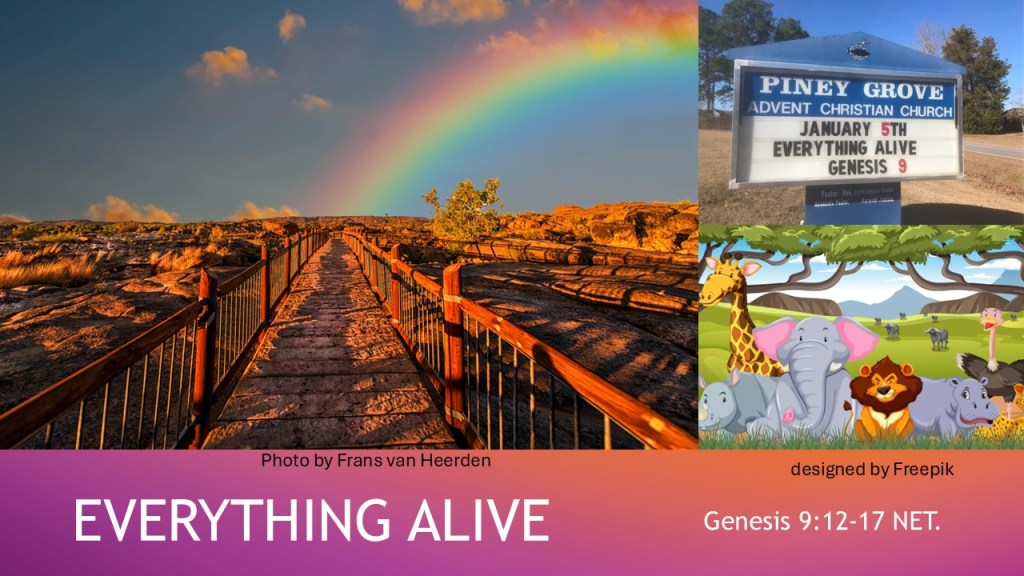
It is a sign. The sign still exists today. Unfortunately, many are abusing this sign and using it as a symbol of pride in something they should be ashamed of. For many, the rainbow now means that human beings are free to have conjugal relations with anything they want – be it someone of the same gender or even a different species. That’s not what the sign means. The rainbow in the sky is God’s guarantee that he will never again destroy everything alive on earth by means of a universal flood. He has done that, and he will not do it again. If people commit crimes, there will be governments with authority to punish them. If people sin against God, there will be the final judgment and the lake of fire to punish that. But the rainbow is God’s promise to us that “Never again will all living things be wiped out by the waters of a flood; never again will a flood destroy the earth.” He is going to allow us to live how we want to live, and he will not intervene by retaliating against all humanity as he did in the days of Noah.
The rainbow is God’s commitment to life. It is his statement and sign of his love for us, even if we do not deserve it. We should certainly be aware that God is capable of immediate reprisal against any rebellion. We should not take the rainbow to mean that God is not capable of punishing sin. Instead, we should realize that God is giving us space and time to turn back to him—to seek him during this age of grace.
Holy Communion
In Matthew 26:28 Jesus said, “for this is my blood, the blood of the covenant, that is poured out for many for the forgiveness of sins.”
The signs of the new covenant that Jesus established with his followers were the bread and cup of the communion ritual. The sign of the rainbow meant that God chose not to punish the sins of humanity with immediate retribution. The signs of the new covenant show God’s grace even more drastically. The bread and cup symbolized what Jesus did for us on the cross. He did more than delay God’s retaliation against sin. He brought about God’s forgiveness of sins. When the blood of Jesus flowed from his body while he was nailed to that cross, the flowing blood took our sins with it. We now stand as recipients of a new covenant with God. When we stand before Christ as judge, all of the world’s sins will be laid before him. But our sins will be marked “paid in full” because of the substitutionary death of Christ.
The rainbow is God’s commitment to life. So are the symbols we use today to celebrate Holy Communion. They are signs of sinners forgiven and given eternal life in the age to come. Hallelujah!

A quote from The Piney Grove Pulpit #5:
“God also said “(he) will put a new spirit within (them)” (Ezekiel 36:26b). The spirit is the breath that is inside a breathing body. The Hebrews used this breath as a metaphor for the internal life. As such, good breath inside a person suggested health, vitality and a good attitude. An evil breath (not to be confused with bad breath) meant that the body was unhealthy, dying and full of hate and bitterness.
So, when God said that he was going to put a new spirit in his people, he was talking about restoring their relationship with him through forgiveness, and that would result in health and wholeness.”
{The book has 72 pages and was published on September 15th, 2024}.
 jeffersonvann