
 GENTLENESS TO ALL PEOPLE
Titus 3 (CSB)
Remind them to submit to rulers and authorities, to obey, to be ready for every good work, 2 to slander no one, to avoid fighting, and to be kind, always showing gentleness to all people. 3 For we too were once foolish, disobedient, deceived, enslaved by various passions and pleasures, living in malice and envy, hateful, detesting one another. 4 But when the kindness of God our Savior and his love for mankind appeared, 5 he saved us—not by works of righteousness that we had done, but according to his mercy—through the washing of regeneration and renewal by the Holy Spirit. 6 He poured out his Spirit on us abundantly through Jesus Christ our Savior 7 so that, having been justified by his grace, we may become heirs with the hope of eternal life. 8 This saying is trustworthy. I want you to insist on these things, so that those who have believed God might be careful to devote themselves to good works. These are good and profitable for everyone. 9 But avoid foolish debates, genealogies, quarrels, and disputes about the law, because they are unprofitable and worthless. 10 Reject a divisive person after a first and second warning. 11 For you know that such a person has gone astray and is sinning; he is self-condemned. 12 When I send Artemas or Tychicus to you, make every effort to come to me in Nicopolis, because I have decided to spend the winter there. 13 Diligently help Zenas the lawyer and Apollos on their journey, so that they will lack nothing. 14 Let our people learn to devote themselves to good works for pressing needs, so that they will not be unfruitful. 15 All those who are with me send you greetings. Greet those who love us in the faith. Grace be with all of you.
We have been looking at the message of Paul’s letter to Titus for the past two weeks, and will conclude with a look at chapter three today. I have particularly felt the need to emphasize the fact that Titus was sent to help develop the churches on Crete because they were being influenced by false teachers. This is important for us today because our society is being bombarded with false teachings and we are being pressured to conform. This is happening in our congregations, but it is also happening in our schools, in politics, in the media, social media – it is everywhere.
It is important to see what the apostle Paul commanded Titus. We saw that one of the solutions to the problem on Crete was the establishment of leaders in the church who could address the false teachings. Chapter one emphasized this solution.
In chapter two, Paul emphasized the role of everyone in the Christian community in sharing the gospel by living in a sensible, righteous and godly way. Everyone in the Christian community had a part to play in proving the validity of the gospel. Everyone was a link in the chain.
In this chapter, Paul concludes his instruction by emphasizing the attitude we should all have as we interact with people. We all know of people who have been hurt by religious bullies. Some have sworn to never enter a church again because of conflict they have had with professing Christians.
Paul’s instruction for the Christians in Crete is that they should be “always showing gentleness to all people” (2). The Greek word for “gentleness” here is πραΰτης – which is a “non-imperious attitude” of humility, courtesy and consideration for others.
Everybody knows that you can do the right thing in the wrong way. Paul here instructs the Christians in Crete to share the gospel the right way. He implies that if we do not share the gospel gently, our efforts will be unfruitful (14).
We can be gentle to all people because we all began on the wrong side (3).
Paul encouraged the Cretan Christians to remember who they were before they came to Christ. He says “For we too were once foolish, disobedient, deceived, enslaved by various passions and pleasures, living in malice and envy, hateful, detesting one another.”
You and I can still choose to live that way. But there is now a correcting influence on our attitude: the Holy Spirit. He now produces within us the fruit of gentleness. That is number eight out of the nine characteristics that Paul called the fruit of the Spirit:
• “But the fruit of the Spirit is love, joy, peace, patience, kindness, goodness, faithfulness, gentleness, and self-control. The law is not against such things” (Galatians 5:22-23).
We should not be surprised if the non-christian world fails to manifest these character traits. But we have every reason to do so as Christians.
• We have been saved from hate so that we can now experience love.
• We have been saved from despair so that we can now experience joy.
• We have been saved from anxiety so that we can now experience peace.
• We have been saved from impatience so that we can now experience patience.
• We have been saved from meanness so that we can show kindness.
• We have been saved from evil so that we can now show goodness.
• We have been saved from unfaithfulness so that we can now show faithfulness.
• We have been saved from brutality so that we can now show gentleness.
• We have been saved from self-indulgence so that we can now exhibit self-control.
Paul’s point for the Cretan Christians is that they have been born again, but they still remember the lives they lived before they were born again. So they can approach the unsaved with a spirit of gentleness. Because they were once on the wrong side, they can approach those still on the wrong side with consideration and humility. Such is the case with us today.
We can be gentle to all people because God has been gentle to us (4-7).
When we deserved God’s judgment, he saved us according to his mercy (5). We had no works of righteousness that could be counted in our favor. In fact, all our acts of righteousness could be seen by God as what they truly were – filthy rags. If you try to clean something with a filthy rag you are going to make it more filthy. That was what we were doing with our religion and our attempts at charity. Everything that we tried to do to appease our own guilt was still sin, and so we kept spiraling down the hole.
But God showed mercy to us. Mercy is not giving someone what they deserve. God saw our filthiness and he washed us by “regeneration and renewal by the Holy Spirit” (5). We deserved to be condemned, but God saved us according to his mercy.
When we deserved to die for our sins, God chose to justify us by his grace (7). Grace is giving someone what they don’t deserve. We did not deserve for the Son of God to die on a cross to purchase forgiveness for us. That was grace – unmerited favor. Because of his grace we now have the hope of eternal life. We didn’t merit that either. Our names were placed in the Lamb’s book of life at the cost of the cross.
You see, friends, God is not Santa Claus. He does not have a naughty list and a nice list. He does not choose to save people on the basis of their good behavior. It’s a good thing, too, because all of us would be permanent entries on the naughty list.
But the good news of the gospel is that our God took pity on some of us, and showed us a Savior. Our heavenly Father treated us with gentleness and consideration.
And now it is our turn. We can focus on doing good works, not so that we can be saved, but so that others can be saved. We can be gentle with unbelievers because our God was gentle with us when he showed us the way out.
But being gentle to all people means being careful how we handle controversy (8-11).
Paul instructed the believers in Crete to “be careful to devote themselves to good works” (8). This was the primary strategy for winning unbelievers to Christ.
But false teachers had introduced controversy at Crete. They had undermined the faith of believers. They had corrupted whole households. So, Paul had to give special instructions here on how believers should handle controversy.
• First, Paul tells believers to “avoid foolish debates, genealogies, quarrels, and disputes about the law, because they are unprofitable and worthless” (9).
I have seen in my ministry overseas where a pastor swallowed some false teaching about how the church should be more Jewish and then led the whole church into rejection of the gospel. I can still remember the day one of my students – a member of that church – came into my office in tears. Thankfully, he and his family chose to not follow that errant pastor. We had to start from scratch again in that village and plant a new church.
False teaching killed that congregation. That was the kind of thing that Satan was trying to accomplish all over Crete. Paul’s instruction for the believers was that they should not allow themselves to get sidetracked. Their mission was to win their towns for Christ. Controversies that take our eyes off Christ are unprofitable and worthless. We have to intentionally avoid them.
• Secondly, Paul challenges Titus to patiently warn those who are caught up in controversy (9).
A divisive person is to receive a first and second warning. Instead of branding such people and immediately rejecting them, Paul advises Titus to take a more gentle approach. Three strikes and they are out. That is taking the problem seriously, but still keeping a door open for repentance and recovery of those caught up in controversy.
Our society today thrives on controversy. We have turned drawing a line in the sand into an art form. We attack first, and ask questions later. But that kind of attitude fails to give room for the Holy Spirit to work. He wants to make some of our enemies into our friends. We should not allow ourselves to be provoked. Taking a deep breath and counting to four may cause our enemies to question their position.
• But thirdly, if people remain consistently divisive, Paul told Titus to reject them (10-11).
He told Titus to “Reject a divisive person after a first and second warning. For you know that such a person has gone astray and is sinning; he is self-condemned.”
The church in Crete was experiencing a storm of false teaching, and it threatened to destroy every congregation in every town. But Paul recommended three courses of action to Titus. First, he encouraged the development of competent leadership. Second, he encouraged every believer in Crete to promote gospel truth by demonstrating it through sensible, righteous and godly living. Finally, Paul encouraged a “non-imperious attitude” of humility, courtesy and consideration for others. Our church fellowship is a wonderful place to learn how to do this. We can learn how to show gentleness to each other, and that will help us to show gentleness to unbelievers.


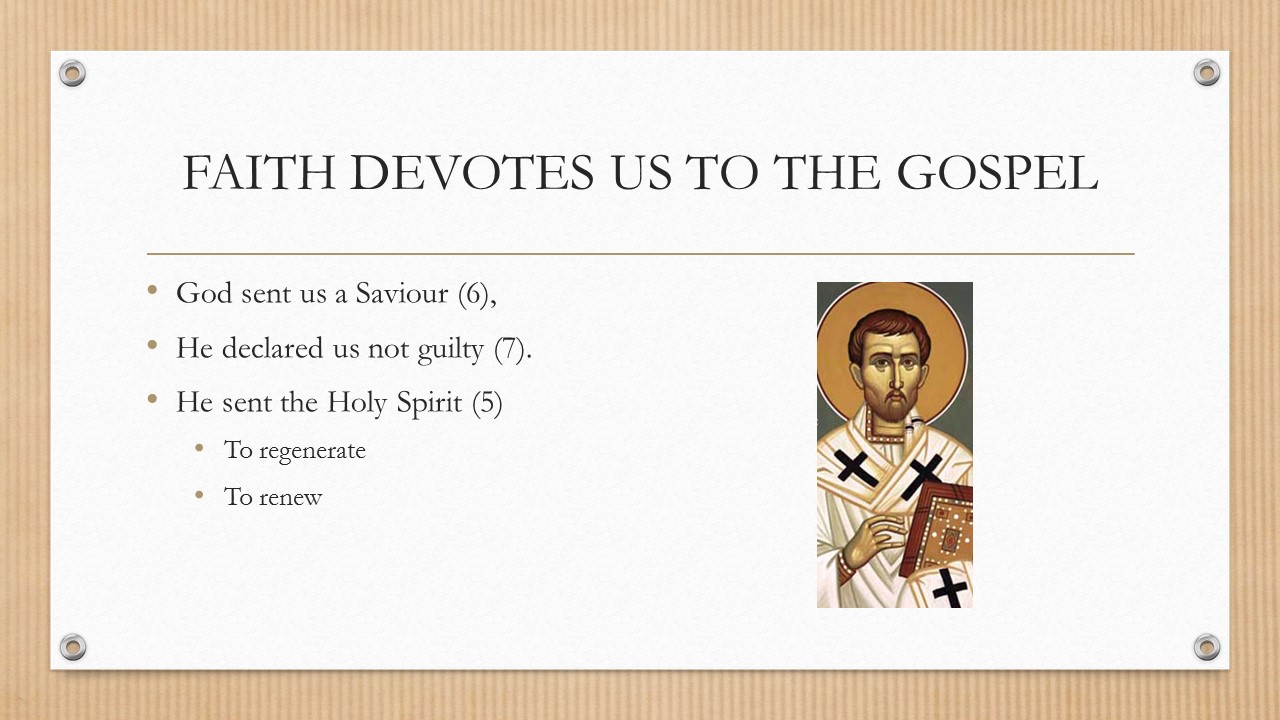 Just as he did in chapter two, Paul sets the foundation for Titus’ ministry assignment in the gospel message itself. Nothing that Paul instructs Titus to do is arbitrary. Everything is based on what God had already done for us in Christ. Notice the elements of the gospel message here. In theological terms, incarnation, justification, regeneration and sanctification are all works of grace and they are the foundation of the church’s ministry.

 jeffersonvann