The Gospel: A Reason to Boast (Gal. 6:11-18).

Galatians 6:11-18 ESV
See with what large letters I am writing to you with my own hand. 12 It is those who want to make a good showing in the flesh who would force you to be circumcised, and only in order that they may not be persecuted for the cross of Christ. 13 For even those who are circumcised do not themselves keep the law, but they desire to have you circumcised that they may boast in your flesh. 14 But far be it from me to boast except in the cross of our Lord Jesus Christ, by which the world has been crucified to me, and I to the world. 15 For neither circumcision counts for anything, nor uncircumcision, but a new creation. 16 And as for all who walk by this rule, peace and mercy be upon them, and upon the Israel of God. 17 From now on let no one cause me trouble, for I bear on my body the marks of Jesus. 18 The grace of our Lord Jesus Christ be with your spirit, brothers. Amen.

Our journey through the book of Galatians is coming to an end, and before we examine today’s text I want to do a little reflecting. Why is this letter in scripture? After all, it is letter from a person we have never met – the apostle Paul – to a group of people we have never known – the Galatian believers – in a place we probably will never visit.

God saw fit to make the letter to the Galatians part of canonical scripture. I think one of the reasons is that the Galatians had encountered a belief system that challenged the Gospel of Salvation by Grace that Paul had preached. By responding to that challenge, Paul articulated the Gospel of salvation by Grace. He also showed how easy it is for believers to get sidetracked if we are not careful.
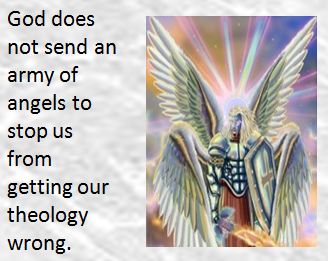
The LORD allows us to learn the principles from his word at our own pace, which is a good thing. But we can also be lulled into a false sense of security. God does not send an army of angels to stop us from reading false teaching in a book, magazine or on the internet. We have the personal responsibility to evaluate what we read, hear and see on a screen. We have to compare it to the truth we have already learned in our walk with Christ.

The Galatians had not done that. The Judaizers from Jerusalem came into the Galatian churches and before long their version of the Gospel was the only one being preached. Because they lacked discernment, they had abandoned the gospel of grace for another gospel, and didn’t even realize it.

When you see someone doing something, do you ever stop to ask what motivates him to do that. Often a person’s motives for doing something are just as important as what he or she does. Paul concludes his letter to the Galatians by comparing his motivations with the motivations that the Judaizers had in spreading their version of the gospel.

Paul talks about boasting here. He is not talking about prideful boasting. He is comparing motivations. A reason to boast in that context is a reason to see yourself as completing the task you set out to accomplish. Paul is comparing two completely different sets of motivations in these final verses of his letter.
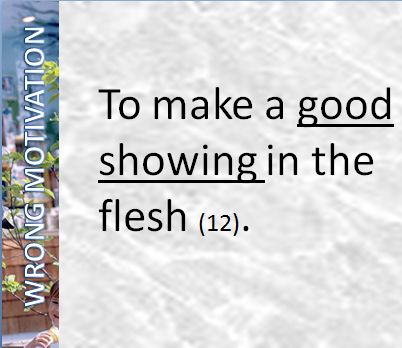
The Judaizers wanted the Galatians to be circumcised. It wasn’t that they wanted to obey God’s command or follow the Abrahamic covenant. Paul points out the wrong motivation behind their religious activity. They wanted to make a good showing. They would argue that appearances matter, and that is true. But if the only reason you want to do something is that it looks good, there’s something wrong.

The Judaizers wanted the Galatians to be circumcised because the Jews were actively persecuting converts to Christianity. Paul knew about that because he had been one of the persecutors. Before he came to Christ, he had used fear as a tool to keep people in line. Paul said that the Judaizers were doing what they were doing “in order that they may not be persecuted for the cross of Christ ” (Galatians 6:12).

Fear is a strong motivator but love is a better one. When believers are motivated by fear, the world sees only the fear. When believers are motivated by love, the world sees Christ.

The Judaizers wanted the Galatians to be circumcised because they wanted to boast in their flesh (13). They wanted to change these pagan Galatians into God-fearing Jews – but their motivation had nothing to do with God. It was human pride. They wanted to make their mark on these Gentiles. What better way than to force them to give up those things that identified them culturally as Gentiles.

The Judaizers did not want to redeem the Galatians, they wanted to alter them They insisted on the Galatians changing their identity. That’s why they only chose those aspects of Judaism that have to do with outward identity: diet, celebrations, circumcision, etc. They wanted to make a difference but it had nothing to do with inner change.
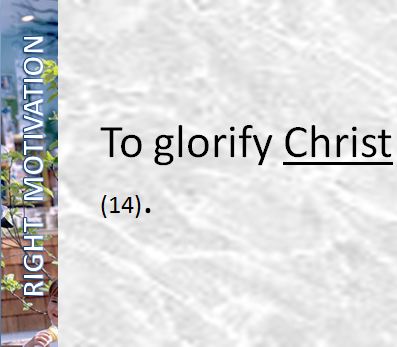
But Paul was motivated by what Christ did for the Galatians on the cross. He said “far be it from me to boast except in the cross of our Lord Jesus Christ, by which the world has been crucified to me, and I to the world” (Galatians 6:14). Paul had not preached to the Galatians because he wanted to change them, he preached to the Galatians because of what Jesus Christ did on the cross. The Gospel is not about how good we can become. It is about how good God is. God’s goodness sent his only begotten Son to the cross to die in our place. God’s goodness and grace as seen on the cross of Calvary leads not to our glorifying ourselves, but to glorifying Christ.

For Paul, “neither circumcision counts for anything, nor uncircumcision, but a new creation” (Galatians 6:15). He was talking about what Jesus said to Nicodemus. He said “unless one is born again he cannot see the kingdom of God” (John 3:3). Unless the change happens on the inside, then all the reforming and following orders you do is useless.

The Galatians had encountered a belief system that challenged the Gospel of Salvation by Grace that Paul had preached. By responding to that challenge, Paul articulated the Gospel of salvation by Grace. He also showed how easy it is for believers to get sidetracked if we are not careful.

I think that each of us is in danger of replacing our grace theology with some works theology. But Galatians is about more than that. It encourages us to hold on to Christ and what he did as the foundation for who we are. It also encourages us to live the freedom we have in Christ instead of giving into bondage. In Galatia, the bondage was primarily legalism. The bondage you and I may be tempted with could be something else. If we can shake free from the bondage that threatens us, we will have a reason to boast.

Excursus: "Away from the Body" (2 Cor. 5:8).

2 Corinthians 5:1-10 ESV
1 For we know that if the tent, which is our earthly home, is destroyed, we have a building from God, a house not made with hands, eternal in the heavens. 2 For in this tent we groan, longing to put on our heavenly dwelling, 3 if indeed by putting it on we may not be found naked. 4 For while we are still in this tent, we groan, being burdened–not that we would be unclothed, but that we would be further clothed, so that what is mortal may be swallowed up by life. 5 He who has prepared us for this very thing is God, who has given us the Spirit as a guarantee. 6 So we are always of good courage. We know that while we are at home in the body we are away from the Lord, 7 for we walk by faith, not by sight. 8 Yes, we are of good courage, and we would rather be away from the body and at home with the Lord. 9 So whether we are at home or away, we make it our aim to please him. 10 For we must all appear before the judgment seat of Christ, so that each one may receive what is due for what he has done in the body, whether good or evil.

This is one of those passages that have been so hijacked by traditionalist thought that the wording appears to reject much of what the same author (Paul) says elsewhere. Before addressing 5:8 itself, it is helpful to review the theology of 5:1-10, to see that it is consistent.

What Paul believed about the Resurrection

This passage looks forward to the resurrection body. If the earthly body is a tent, that resurrection body is a building fashioned by God himself (1). This earthly body can be destroyed. The resurrection body is permanent (aionios). It is a house not made with hands. But the glorious eternal body is not a present possession. It is an inheritance. This future immortal life is guaranteed (5), and the Holy Spirit is the guarantee.

Paul is not saying that he has mortality (the tent) and immortality (the eternal house) at the same time. The reason he groans (2) is that he only has this present mortal body, which suffers persecution and hardship, shipwrecks, floggings, etc. He is longing to put on that heavenly dwelling. Here Paul mixes the building metaphor with that of putting on clothing. Paul had used that metaphor in his previous letter to Corinthians, where he was addressing the same subject: the resurrection.

For this perishable body must put on the imperishable, and this mortal body must put on immortality. When the perishable puts on the imperishable, and the mortal puts on immortality, then shall come to pass the saying that is written: “Death is swallowed up in victory” (1 Corinthians 15:53-54 ESV).

The translators have added the word “body” to the text, but it would be just as appropriate to supply the word “me” instead. It would then read “For this perishable me must put on the imperishable, and this mortal me must put on immortality. When the perishable me puts on the imperishable, and the mortal me puts on immortality, then shall come to pass the saying that is written: “Death is swallowed up in victory.” Paul is talking about the future when Christ comes to give him the immortality he promised. He is longing for that time, not the intermediate state. He is looking forward to life, not death. In this present life he expects to continue to groan, being burdened (4).

With this promise of the resurrection in mind, he considers his present state in the (mortal) body. He does not feel at home. He feels away from the Lord. He would rather be away from his mortal body, and at home with the Lord (8), but that is not his choice. As long as Christ tarries, he makes it his aim to please the Lord (9). He knows what is done in this life matters because Christ is going to judge and reward when he comes (10).

In summary, in 1 Cor. 5:1-10 Paul argues that the resurrection is essential because believers do not yet have the eternal, immortal existence that God promised them.

What Paul believed about the Second Coming.

The second coming of Christ is the event Paul has in view. The building from God is in the heavens. The only way Paul is going to experience it is for Christ to come down to earth and bring it with him. When Jesus ascended, angelic messengers told the disciples that Jesus would come back in the same way that they saw him ascend: literally, physically (Acts 1:10-11). They did not promise that the disciples would see Jesus before that event. Paul, likewise, expected the second coming to be the next time he would see Jesus. Paul said “For the Lord himself will descend from heaven with a cry of command, with the voice of an archangel, and with the sound of the trumpet of God. And the dead in Christ will rise first. Then we who are alive, who are left, will be caught up together with them in the clouds to meet the Lord in the air, and so we will always be with the Lord” (1 Thess. 4:16-17). That was his hope.

It was at the second coming that Paul expected to get his new house, his heavenly dwelling (2). He talked about “what is mortal” being “swallowed up by life” (4). He had previously told the Corinthians that this transformation would happen “in a moment, in the twinkling of an eye, at the last trumpet. For the trumpet will sound, and the dead will be raised imperishable, and we shall be changed” (1 Cor. 15:52). The heavenly dwelling that Paul expected was not a disembodied existence, but a resurrected life. This could not happen at death. It required the second coming of Christ.

Paul is walking by faith, not by sight (7). He is not relying on what some Greek philosopher has told him about human nature. He is trusting in Jesus, that he will keep his promise. By faith, he lets the Holy Spirit inside him operate. That Holy Spirit is the guarantee of what is to come (5), not what Paul already possesses. If Paul got what he wanted, he would be “at home with the Lord” (8). But if Christ does not come in his lifetime, he is willing to remain “at home in the body” until he does.

What Paul believed about the intermediate state.

Paul repeats one idea in this passage in order to stress it. He is adamant about this one thing, so he does not want the Corinthians to misunderstand him. For that reason he says he does not want to be “found naked” in vs. 3, and repeats that he does not want to be “unclothed” in vs. 4. Both statements mean the same thing. Being clothed means getting his resurrection body. Thus, there is only one thing that being unclothed could mean: the intermediate state. Paul is not looking forward to the state between death and the resurrection. That is not his hope. That is not the event that he refers to when he wants to encourage other believers (1 Thess. 4:18). That is not what he is longing for (2). That is not the time when what is mortal is going to be swallowed up by life (4). That is not what the Holy Spirit guarantees (5). A disembodied existence is not what Paul means by “being home with the Lord” (7). For Paul, home is the building from God (1). Being “with the Lord” is not going to happen until the second coming (1 Thess. 4:17).

Paul does affirm a judgment after death, but it is the “judgment seat of Christ” (10). Christ does not judge anyone during the intermediate state. He will raise the dead and then judge them. He will judge the living and the dead at the same time (Acts 10:42). This will happen only after Christ returns (Rev. 20:12-13). Humanity is right to expect a judgment of raging fire that will consume the enemies of God (Heb. 10:27). But that judgment will not occur during the intermediate state. Paul taught that the judgment is an event yet to come (Acts 24:25). It is not going on now.

Paul treats the intermediate state as both existentially and theologically insignificant. He skips over it, concentrating instead on the more important issue of the resurrection. The Bible teaches that the intermediate state is one of darkness (Job. 7:9; 10:20; 17:13; 18:18; Psalm 13:3; 49:19; 88:12; 143:3; Prov. 20:20; Eccl. 6:3-5; Lam. 3:6), and silence (Eccl. 9:5,6,10; Job 21:13; Psalm 6:5; 30:9; 31:17; 94:17; Isaiah 38:18-19). It is no surprise, then, that Paul would not look forward to it.

What Paul does look forward to is the second coming, when Paul will be both away from his (present suffering, mortal) body and at home with the (returned, triumphant, sovereign) Lord. That is the hope he describes in 1 Cor. 5:8. That is our hope.

ACST 23. The Ethnic Being

In revealing the essence of humanity, the Bible has presented humans as beings which share a common unity (ancestry in Adam and responsibility before God), but also diversity (male and female). These truths are revealed in the book of Genesis, which has provided a good foundation for an understanding of humanity. It may hold the key to understanding another kind of diversity as well: ethnic and racial distinctions.

For the purposes of this study, racial distinctions are those physical characteristics which can be used to identify someone: such as bone structure, facial characteristics, and skin color. Racial distinctions are hereditary, and appear to change slowly. Ethnic distinctions are those social characteristics that identify someone as having been reared in (or adjusted to) a particular culture. Ethnic distinctions are environmental, and are constantly changing. Some ethnic communities are closely identified with certain races, while others are not. Taken together, both racial and ethnic differences are reminders of a fundamental fact of human nature: humans are ethnic beings.

The reason for this fact that all human beings have an ethnic identity may be revealed in Genesis.

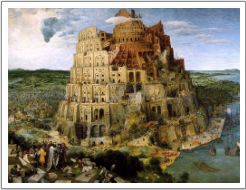
Now the whole earth had one language and the same words. And as people migrated from the east, they found a plain in the land of Shinar and settled there. And they said to one another, “Come, let us make bricks, and burn them thoroughly.” And they had brick for stone, and bitumen for mortar. Then they said, “Come, let us build ourselves a city and a tower with its top in the heavens, and let us make a name for ourselves, lest we be dispersed over the face of the whole earth.” And the LORD came down to see the city and the tower, which the children of man had built. And the LORD said, “Behold, they are one people, and they have all one language, and this is only the beginning of what they will do. And nothing that they propose to do will now be impossible for them. Come, let us go down and there confuse their language, so that they may not understand one another’s speech.” So the LORD dispersed them from there over the face of all the earth, and they left off building the city. Therefore its name was called Babel, because there the LORD confused the language of all the earth. And from there the LORD dispersed them over the face of all the earth.1

The creature God created appears to have had a remarkable unity until this time in history. That unity probably was a racial one as well. This can be seen from the fact that God chose to place an identifying mark upon Cain to protect him from future vengeance.2 So, if racial distinctions were passed on through Adam, one would expect Cain’s appearance to be already distinct enough that such a mark would be unnecessary.

Perhaps the transformation that God caused at Babel was more than a simple change of languages. It might have been the beginning point for racial distinctions as well. If that were so, the communities that eventually emerged from the scattering at Babel would be based on linguistic and racial distinctions. Cultural differences would evolve from these separated communities.

Jenkins suggests that that the Babel story is given to answer at least two questions: “1) Where did the variety of languages come from? and 2) How did man disperse and populate the world.”3 Perhaps the answer to a third question, “What is the origin of ethnic identity” may be found here also. What is certain is that at some point in human history the human species has diverged into a number of distinct ethnic groups.

From One Ethnic Identity to Many

The king James version follows the textual tradition which added the word haimatos (blood)4 to Acts 17:26. Thus the KJV reads “And hath made of one blood all nations of men for to dwell on all the face of the earth.” This rendering accents the fact that the human race has an origin in one bloodline. Most modern translations reject the word haimatos as an editorial addition, and translate something like “And he made from one man every nation.”5 But the word “man” is not in the text. It might just as easily be translated “And he made from one nation every nation.”

The word for nation in that text is ethnos, which is the generic word for ethnic groups as well as political groups. The apostle Paul was of one ethnic group (Jews) and he was speaking to the Athenians, who were of another ethnic group (Greeks). His statement recognized the ethnic distinctions between the two groups, while at the same time appealing to a common origin.

The Purpose of Ethnic Identities

God’s intention for the existence of these ethnic identities is to preserve them throughout eternity under the lordship of Christ. That can be inferred from Rev. 7:9, where John says “After this I looked, and behold, a great multitude that no one could number, from every nation, from all tribes and peoples and languages, standing before the throne and before the Lamb, clothed in white robes, with palm branches in their hands.” John uses four terms, and each implies ethnic distinctions. It is clear that eternity is not intended to eradicate ethnic distinctions, but will celebrate them. These distinctions, which cause a great deal of turmoil, hatred and violence in this fallen world, will be enjoyed passionately in the restored world.

In Revelation, the Lamb is the king of the ethnic groups.6 All ethnic groups will come and worship him.7 Satan will be banished to the bottomless pit so that he will be unable to deceive the ethnic groups any longer.8 The ethnic groups will walk in the light of the Lamb himself.9 The ethnic groups will bring their glory and honor into the new Jerusalem.10 Each ethnic group will receive healing and life from the tree of life.

No Favorites

Jesus was born into a human context, so he has an ethnic identity as well. He had a conversation once with a woman who was a Samaritan. She was from another ethnic group. As soon as she perceived that Jesus was “a prophet” she immediately called to attention a distinction between Jews and Samaritans: “Our fathers worshiped on this mountain, but you say that in Jerusalem is the place where people ought to worship.”12

Jesus’ reply to her tells us how seriously we should take ethnic distinctions when it comes to our relationship to God:

“Woman, believe me, the hour is coming when neither on this mountain nor in Jerusalem will you worship the Father. You worship what you do not know; we worship what we know, for salvation is from the Jews. But the hour is coming, and is now here, when the true worshipers will worship the Father in spirit and truth, for the Father is seeking such people to worship him. God is spirit, and those who worship him must worship in spirit and truth” (John 4:21-24).

For the Samaritans, worship of God was defined by ethic considerations: it had to take place on Mt. Gerazim. For the Jews, worship had to take place at the temple, which was in Jerusalem. Jesus spoke of a time when worship did not have to do with ethnic externals. God was going to reach out to all ethnic groups and call them to himself equally through the Gospel.

Salvation is “from the Jews” in the sense that the message of salvation by grace originated in the Old testament. Also, it was through the Jewish ethnic group that Christ came. But that does not imply that God favors any particular ethnic group – not even the Jews. He wishes to redeem the entire human race, and that includes people from every race and culture. Christ’s death put an end to the hostility that had separated the ethnic groups:

For he himself is our peace, who has made us both one and has broken down in his flesh the dividing wall of hostility by abolishing the law of commandments and ordinances, that he might create in himself one new man in place of the two, so making peace, and might reconcile us both to God in one body through the cross, thereby killing the hostility. (Ephesians 2:14-16).

So, when Jesus gave his marching orders for his disciples to convert the world to the Christian faith, he told them to make disciples of panta ta ethné: every ethnic group.13 The good news is for everybody. This is also why the apostle Paul got very angry when false teaches came to the churches he established and taught them that they had to be more Jewish to please God.14 Paul said that those teachers — who taught a kind of ethnocentricity — were ruled by the flesh, not the Holy Spirit.15 Many today are deceived into believing that they have to become more Jewish in order to be more spiritual. Nothing could be further from the truth.

God Hates Racism

Racism is a special kind of hatred that exists because of ignorance and fear. God does not endorse any kind of hatred. God loves the entire human species and wants to show that love to everyone for eternity. Our differences may have begun as a result of God’s judgment upon humanity at Babel. But the end result of those differences is the greater glory of God. His majesty will be enhanced by the great diversity of those who stand before the throne and the Lamb, clothed in white robes, with palm branches in their hands. Christians of diverse ethnic groups should unite under Christ their king and worship and serve together. We do not need to preserve our ethnic unity when we assemble in Christ’s name. Christ’s authority supersedes all other authorities. He is the King of kings and Lord of lords.16

In our modern society, ethnic diversity is celebrated. Churches who intentionally seek to win all the people in their communities to Christ – regardless of race or ethnic origin – are noticed. These are the kinds of churches that the general population will take seriously. Churches have an opportunity to model the kind of unity in Christ that we claim will be ours for eternity. We do not have to wait until Christ returns to begin doing that.

______________________________________

1 Genesis 11:1-9

2 Genesis 4:15. This mark was not a racial distinction. It was given only to Cain, not his descendents. Also, the human race as we know it today is completely descended from Noah, who was a descendant of Seth, not Cain.

3 Everett Jenkins, The Creation: Secular, Jewish, Catholic, Protestant, And Muslim Perspectives (Jefferson, NC: McFarland & Co., 2003), 170.

4 Gk. Haimatos is the genitive of haima.

5 ESV.

6 Rev. 15:3.

7 Rev. 15:4.

8 Rev. 20:3.

9 Rev. 21:23-24.

10 Rev. 21:25.

11 Rev. 22:2.

12 Matt. 28:19.

13 Gal. 1:6; 2:16; 3:8, 13-14, 28; 4:9, 20, 25-26; 6:15.

14 Gal. 3:3; 4:23, 29; 5:13-21, 24; 6:8, 12.

15 John 4:20.

16 1 Tim. 6:15; Rev. 17:14; 19:16.

The Gospel Sowed and Reaped (Gal. 6:1-10).

Galatians 6:1-10 ESV
Brothers, if anyone is caught in any transgression, you who are spiritual should restore him in a spirit of gentleness. Keep watch on yourself, lest you too be tempted. 2 Bear one another’s burdens, and so fulfill the law of Christ. 3 For if anyone thinks he is something, when he is nothing, he deceives himself. 4 But let each one test his own work, and then his reason to boast will be in himself alone and not in his neighbor. 5 For each will have to bear his own load. 6 One who is taught the word must share all good things with the one who teaches. 7 Do not be deceived: God is not mocked, for whatever one sows, that will he also reap. 8 For the one who sows to his own flesh will from the flesh reap corruption, but the one who sows to the Spirit will from the Spirit reap eternal life. 9 And let us not grow weary of doing good, for in due season we will reap, if we do not give up. 10 So then, as we have opportunity, let us do good to everyone, and especially to those who are of the household of faith.

We now come to the final chapter in the book of Galatians. Every time I have sat down and studied one of these sections of the book, it has helped me to remember the context in which the words were written. Paul had planted and established the work in Galatia, then left it in the hands of its own leaders. He had every reason to believe that the Galatian churches would thrive as long as they stayed faithful to the LORD, and followed the principles he taught them.

But that is not what happened. Those “troublers” came from Jerusalem and brought an alternate gospel with them.

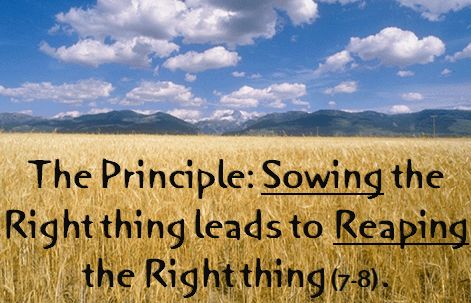
In this section, Paul appeals to a principle that explains what went wrong in Galatia. That principle is found in Galatians 6:7-8 “Do not be deceived: God is not mocked, for whatever one sows, that will he also reap. For the one who sows to his own flesh will from the flesh reap corruption, but the one who sows to the Spirit will from the Spirit reap eternal life.”
The Principle is: Sowing the Right thing leads to Reaping the Right thing. This is true for a person, and it is also true and a church.

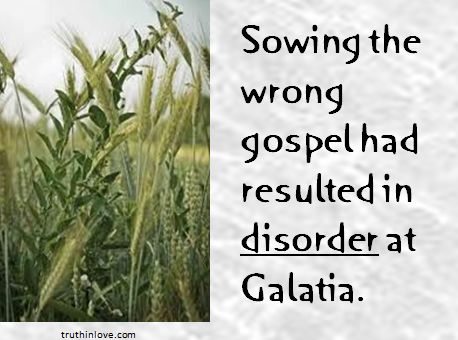
Jesus had told a parable about a farmer who planted wheat, but discovered that his enemy had secretly mixed in some weed seed (Matt. 13:25-30). The result was that the field grew both. That is what had happened in Galatia, and it didn’t look good. It was a disorderly mess. Paul’s letter was God’s way of helping the church to recover from that mess.

We 21st century churches can get a bit disordered at times too. We should follow Paul’s advice if we want to have a bountiful harvest for Christ. He teaches here how we can sow the true gospel in a church context.

Just like the farmer in Jesus’ parable, Paul advises against going into the Galatian churches and pulling up all the weeds. Instead, he tells us to turn the weeds into wheat. He says in verse 1: “if anyone is caught in any transgression, you who are spiritual should restore him in a spirit of gentleness.” That is wonderful pastor imagery.

Paul tells them in verse 2 to “Bear one another’s burdens, and so fulfill the law of Christ. ” That law was expressed in John 13:34, where Jesus says “A new commandment I give to you, that you love one another: just as I have loved you, you also are to love one another.”

Manifesting that love means restoring those who stray away from the gospel. In Romans 15:1, Paul says “We who are strong have an obligation to bear with the failings of the weak, and not to please ourselves.”

Paul goes on to say “For if anyone thinks he is something, when he is nothing, he deceives himself. But let each one test his own work, and then his reason to boast will be in himself alone and not in his neighbor. ” Galatians 6:3-4. To keep with the field analogy, Paul is saying, “make sure you have sowed the gospel in your own life first.” He had told the Corinthians to “Examine yourselves, to see whether you are in the faith. Test yourselves.” (2 Corinthians 13:5).

When the true gospel has been sowed in our lives, it will produce the right kind of works all by itself. So one way to test whether your theology is correct, is to examine your life to see if it is producing kingdom living and the fruit of the Spirit.

Paul says in verse 6, “One who is taught the word must share all good things with the one who teaches.” This takes some explanation. You see, before Paul had left the Galatian region, he had set up leaders who faithfully taught the gospel. When the troublers came in with their alternate gospel, they encouraged their followers to ignore these teachers.

Paul says in 1 Corinthians 9:14 “those who proclaim the gospel should get their living by the gospel.” God has established a way for the church to continue preaching the gospel, and that is through the professional ministry. What happened in Galatia is that those teaching the false gospel had supplanted those duly set up to teach in the church. So Paul is urging the Galatians to restore support to the rightful teachers.

In Galatians 6:9 Paul says “let us not grow weary of doing good, for in due season we will reap, if we do not give up.” He told the Corinthians something similar: “be steadfast, immovable, always abounding in the work of the Lord, knowing that in the Lord your labor is not in vain.” (1 Corinthians 15:58).

One of the reasons churches do not reap the harvest is that the people give up before the harvest comes. Galatians teaches us that we cannot be saved by works, but we are reading it wrongly if we think it is saying just trust the LORD and do nothing. The works that we will do will be the Holy Spirit’s works, not ours. They will be done because we are saved, not in order to get saved. But make no mistake: God’s people are expected to persevere in ministry until Christ comes.

So this section concludes with Paul saying “as we have opportunity, let us do good to everyone, and especially to those who are of the household of faith. ” (Galatians 6:10). The end result of the false gospel was that it led to the church biting and devouring one another. The end result of Paul’s gospel of salvation by grace is that the people in the church will invest themselves in each other’s lives.

The reason this kind of good works follows from the true gospel is that we have been set free from having to establish our own salvation, so now we have the opportunity to steer our good works toward others. That is how a church of saved people is supposed to operate.

LORD, we confess that all too often we have acted like the Galatians in our approach to ministry. We have sought to impress you by our obedience. We have worked hard to get on your good side. We repent of those kinds of works.

Help us LORD to trust in what Christ has done for us, so that we can be free to invest ourselves in others. Help us to sow the gospel of grace in this church, so that your Holy Spirit will be free to produce the fruit of the Spirit in our lives. In Jesus’ name. Amen.