ACST 26. Sin: The Causes


SDC11300

Sin is a very complex thing, and so are its causes. In fact, Paul complained that the law of God itself caused him to sin. By pointing out the possibility of sinning in a certain area, the law became an unwilling partner with the sin nature that existed inside Paul, so he “was alive once, apart from the law, but when the commandment came, sin sprang to life.”[1] Based on this experience, Paul argued in Romans that the law is not the solution to the sin problem, faith in Christ is.

Christians need to be aware of the causes of sin in their lives. This knowledge can be like knowing where the snares and traps and wild beasts are in the jungle. It can keep us out of the danger zones. After all, snares and traps are not things that just happen. Someone has set the traps with the specific intention of catching something. Wild beasts are there to eat their prey. To ignore the causes of sin in one’s life is like going into the jungle blindly, hoping not to be caught or devoured.

One of the obvious causes of sin is that inherited sinful inclination mentioned in chapter 25. The important truth to grasp is that often the traps are within us. Most of our sins cannot be blamed on our society, or our parents. Sin is (as it was for Paul) within us. But the sin within us takes advantage of things which happen to us, and things which are around us, and then “springs to life.” Knowing when and why that happens can help believers overcome when tempted.

Internal Factors

In a sense, all causes of personal sins are both internal and external. The choice to sin is a personal choice. Yet every sin involves some external factors. Therefore, the categories of internal and external factors causing sin are approximations.

Rebellion

Rebellion begins as a lack of appreciation for the boundaries God has placed on the sinner’s life. The choice that our ancestors made to rebel against God’s prohibition in Eden is a useful example. It did not seem like a major act of rebellion. Logic concluded that a fruit which was desirable and had the potential to make one wise was a fruit worth eating. Sinners make choices like that every day. We weigh the options, and calculate the risks, concluding that the potential benefits outweigh the possible disadvantages.

In rebellion, the mind is functioning as God intended it to. There is usually no psycho-somatic aberration that causes people to transgress God’s limits. The human mind is intended to make value judgments, and does so – without sinning – constantly. The problem with instances of rebellion is that the sinner makes value judgments where God has already established which is the right choice, and which is the wrong one. Usually, the sinner knows that God has promised to bring negative consequences upon her if she chooses to transgress.

Regardless of the specific nature of the boundaries, then, rebellion is at heart caused by an internal thing: defiance of God. There usually are numerous consequences to rebellion, affecting the lives of the sinner and all those around her. But the primary consequence is the damage done to her relationship with God.

Tradition- Idolatry or Change – Idolatry

The prospect of some kind of change that could happen in the sinner’s life is often a catalyst for choices that could involve sin – particularly the sin of idolatry. One example of this is conflict that can ensue when an organization is considering a change. The reason is that “if people are so attached to the old way (or the new way) that they are willing to fight for their position, they have idolized their desire.”[2] Usually both sides of the conflict have good arguments for their positions. The problem is that both sides are committed to an either-or solution, and are willing to sacrifice their relationships with each other for their position.

This happens because human “hearts are idol factories and sometimes our desires escalate into sinful demands, or idols.”[3] When the heart of the sinner is against the threatened change, he sets up a tradition-idol. When the heart of the sinner is for the proposed change, he sets up a change-idol. There may not be a clear winner in the battle that results from these choices. The organization usually is the clear loser. It sometimes dissolves, and often loses members whose demands were not met by the organization as a whole.

Greed

The Bible exposes greed as a particularly dangerous cause for personal sin. Jesus denounced the scribes and Pharisees because they made efforts to look pure and clean on the outside, but inside were filthy with greed and self-indulgence.[4] Paul warned the Corinthian believers not to associate – or even have a meal with a person known for his greed.[5] Both he and Peter had encountered those whose “ministries” are merely a pretext for fulfilling their greed.[6] It had become a means of evaluating whether or not a first-century preacher was or was not a false prophet.

Lust

Both apostles had also warned believers to stay away from lustful passions. Paul instructs the Thessalonians “that each one of you know how to control his own body in holiness and honor, not in the passion of lust like the Gentiles who do not know God.”[7] Peter speaks of “those who indulge in the lust of defiling passion” as being kept by God “under punishment until the day of judgment.”[8] Neither of these men of God sought to prohibit legitimate sexual relationships, but both were profoundly troubled by the damage that is done when people transgress those legitimate boundaries.

Lust has always been a problem for human beings, but free and easy private access to sexually explicit materials has turned that problem into an epidemic. Such materials (now made even more accessible through the internet) trap men into bondage through images and stories that promise the pleasure of sex without the intimacy of relationship. Similarly, women are lured away from their spouses through chat rooms and social networks where they are convinced that their current partner does not understand or deserve them. Pornographers usually hide behind the “freedom of speech” excuse. The irony is that the motivation for such websites and other media has nothing to do with free speech or sex or pleasure. The sex industry is built on greed. Porn is a multi-billion dollar “industry” that creates only addiction and destruction.[9]

Etc.

Numerous other forms of selfishness could be added to the list of things that cause human beings to sin. Some of these can be so subtle that it might take some time in counseling to convince the sinner that his motivation was wrong. The human heart is creative, and unfortunately that means that a sinner can be very creative in how he defends his own sinfulness. God calls sinners to repent even when they do not understand all the factors that have brought them under condemnation.

External Factors

Each sinner is individually responsible for every sin she commits. However, it is still possible to objectively identify a number of factors that contribute to her making that choice. Eden, for example, contained more than two people and a commandment. It also contained a tree, and a snake.

The choices sinners make cannot be defended on the basis on the basis of external factors. Adam and Eve tried the blame game, and it did not get them very far. But knowing about the external factors can help people avoid putting themselves in an environment where they will be likely to sin. Also, knowing where an enemy is hiding is a good defense against his attacks.

Temptation

The devil is real and he can really tempt people to sin. It may seem simplistic to say that, but it is important, because an increasing number of people appear to be confused on the issue of Satan’s existence. Not only is there an actual person called Satan, but he also has an enormous army of other persons – called demons –whose purpose in life is to tempt people to sin. Most temptations do not involve a physical manifestation of the tempter. That is as planned – because demons work best when they have convinced the one being tempted that they do not exist.

Temptation can involve taking a natural desire and convincing the victim that having the thing desired is more important than avoiding the consequences of getting it by means of sin. The more confused the victim is on the theology of sin, or on the existence of tempters, or on God’s holiness – the more likely the temptation will work. Conversely, the more aware a person is in these areas the more likely he will be able to resist.

Societal Pressure

The world around the victim also seems to conspire to lead her to sin. She knows people who have sinned in this way and have not suffered any immediate punishment. Thus, she is more likely to follow suit. Societal mores can be helpful in curtailing certain kinds of immoral behavior. Unfortunately, societies are made up of sinners, and every society has holes in its moral structure. A society can be quite determined to overcome environmental evils, for example, and yet turn a blind eye to human trafficking or abortion.

Societal mores also constantly change, and the difference between right and wrong does not. Right and wrong are based on God’s definition, not that of the latest opinion poll. Both Peter and Paul warned believers not to be conformed to societal pressure, but encouraged them to strive for God’s holiness.[10] Sometimes sinners are convinced to participate in sin because it appears to be the loyal and faithful thing to do. In this way, governments and societies can contribute to the sinfulness of their members.

Deception

High on the list of things which cause sin is deception. In a sense, all sin is committed because of deception. Since every sin must be punished by a holy God, the victim must be convinced that either that is not true, or that what he is being tempted to do is not sin: both are forms of deception. Eve argued that Satan (through the serpent) had deceived her. She was right, but that did not excuse her sin. Likewise, there will be billions of sins committed today, and the victims will have been convinced to commit those sins by means of lies whispered in their ear of taught in the streets.

The source of those lies may be subtle (like an invisible demon or like a science textbook that boldly claims that humans are nothing but evolved animals). The result may not be that the victim is convinced, but perhaps a seed of doubt is planted. The source may be covert, like a theologian who convinces his readers that God is love and could never send people to hell, or the teacher who convinces his followers that God wants them to commit some act of violence.

Ultimately, all these deceptions are orchestrated by demonic beings. In many cases, violence occurs when one human society attacks another based on its perception of truth – taught by demons. The other side responds with the same kind of violence, based on its view of truth – taught by demons. Both sides are being played by invisible hands.


[1] Rom. 7:9 (LEB).

[2] Peacemaker Ministries, The Leadership Opportunity: Living Out the Gospel Where Conflict and Leadership Intersect. (Billings, MT: Peacemaker Ministries, 2009), 56.

[3] Peacemaker Ministries, 69.

[4] Matthew 23:25; Luke 11:39.

[5] 1 Cor. 5:11.

[6] 1 Thess. 2:5; 2 Pet. 2:3, 14.

[7] 1 Thessalonians 4:4-5 .

[8] 2 Pet. 2:9-10.

[9] For more information, see Gary R. Brooks, The Centerfold Syndrome. (Jossey-Bass, 1995), Richard D. Land, “Porn profits reflect its potency versus even Hollywood, rock music,” Baptist Press (Nashville, May 4, 2001); http://erlc.com/article/pornography/; http://www.internetevangelismday.com/ dangers.php; http://www.helium.com/items/1242976-dangers-of-internet-pornography.

[10] Rom. 12:2; 1 Pet. 1:14.

The Heart of Jonah (2:1-10)


slide1

Jonah 2:1-10 ESV

Then Jonah prayed to the LORD his God from the belly of the fish, 2 saying, “I called out to the LORD, out of my distress, and he answered me; out of the belly of Sheol I cried, and you heard my voice. 3 For you cast me into the deep, into the heart of the seas, and the flood surrounded me; all your waves and your billows passed over me. 4 Then I said, ‘I am driven away from your sight; Yet I shall again look upon your holy temple.’ 5 The waters closed in over me to take my life; the deep surrounded me; weeds were wrapped about my head 6 at the roots of the mountains. I went down to the land whose bars closed upon me forever; yet you brought up my life from the pit, O LORD my God. 7 When my life was fainting away, I remembered the LORD, and my prayer came to you, into your holy temple. 8 Those who pay regard to vain idols forsake their hope of steadfast love. 9 But I with the voice of thanksgiving will sacrifice to you; what I have vowed I will pay. Salvation belongs to the LORD!” 10 And the LORD spoke to the fish, and it vomited Jonah out upon the dry land.

slide2

This is the second in a series of 16 sermons based on messages from the writing prophets. The prophets are like a gold mine. They are filled with precious treasure, but getting to that treasure takes some digging and a lot of hard work. To understand the message of a prophet, you have to know the background of the prophet and the people he spoke to. You also have to a reasonable grasp of world history to know when a prophecy has begun to be fulfilled. You also need to know the LORD because the messages from the prophets are meant to be understood and applied by believers whether they have been fulfilled or not.


slide3

I place Jonah’s prophecies early, which is why I place it during the first time period. I think he prophesied after the time of Elisha, but before the fall of Nineveh. This was a time when Nineveh posed less of a threat to Israel than it would later. From Nineveh’s standpoint, it was a time when they would be more inclined to listen to a message of deliverance from a prophet from Israel. The date was about 760 BC.

slide 4

Jonah was a reluctant prophet. God had called him to go to Nineveh. He knew the LORD and he knew the message, and he knew his audience. His problem was he didn’t want to do what God wanted him to do. So, chapter 1 of Jonah tells us:

Jonah 1:3-17 NLT

But Jonah got up and went in the opposite direction to get away from the LORD. He went down to the port of Joppa, where he found a ship leaving for Tarshish. He bought a ticket and went on board, hoping to escape from the LORD by sailing to Tarshish. 4 But the LORD hurled a powerful wind over the sea, causing a violent storm that threatened to break the ship apart. 5 Fearing for their lives, the desperate sailors shouted to their gods for help and threw the cargo overboard to lighten the ship. But all this time Jonah was sound asleep down in the hold. 6 So the captain went down after him. “How can you sleep at a time like this?” he shouted. “Get up and pray to your god! Maybe he will pay attention to us and spare our lives.” 7 Then the crew cast lots to see which of them had offended the gods and caused the terrible storm. When they did this, the lots identified Jonah as the culprit. 8 “Why has this awful storm come down on us?” they demanded. “Who are you? What is your line of work? What country are you from? What is your nationality?” 9 Jonah answered, “I am a Hebrew, and I worship the LORD, the God of heaven, who made the sea and the land.” 10 The sailors were terrified when they heard this, for he had already told them he was running away from the LORD. “Oh, why did you do it?” they groaned. 11 And since the storm was getting worse all the time, they asked him, “What should we do to you to stop this storm?” 12 “Throw me into the sea,” Jonah said, “and it will become calm again. I know that this terrible storm is all my fault.” 13 Instead, the sailors rowed even harder to get the ship to the land. But the stormy sea was too violent for them, and they couldn’t make it. 14 Then they cried out to the LORD, Jonah’s God. “O LORD,” they pleaded, “don’t make us die for this man’s sin. And don’t hold us responsible for his death. O LORD, you have sent this storm upon him for your own good reasons.” 15 Then the sailors picked Jonah up and threw him into the raging sea, and the storm stopped at once! 16 The sailors were awestruck by the LORD’s great power, and they offered him a sacrifice and vowed to serve him. 17 Now the LORD had arranged for a great fish to swallow Jonah. And Jonah was inside the fish for three days and three nights.

slide 5

Jonah prophesied to the city of Nineveh which was a great distance North and East of Israel and Judah. He was from Gath Hepher near Nazareth in the Northern kingdom of Israel. He did have a message for Nineveh, but most of the messages of Jonah were to Jonah.


slide 6


Jonah had to get to the point of death before he would surrender to the LORD’s will. Verse 7 says “As my life was slipping away, I remembered the LORD. And my earnest prayer went out to you in your holy Temple.” He remembered who God is. He remembered the call of God on his life. He knew that he had failed God. Jonah recognized in one brief lucid moment that his will was not supreme, that he was not sovereign. God is.


slide 7


Jonah repented. Verse 2 records his prayer “I called out to the LORD, out of my distress, and he answered me; out of the belly of Sheol I cried, and you heard my voice.” Sheol is the place where dead people go to await the resurrection. Jonah was in the belly of Sheol before he was in the belly of the whale. What Jonah was saying was that he was in the ocean, about to drown. That is when he found time to pray.


slide 8

The whale was actually God’s answer to Jonah’s prayer. Jonah said that God answered him (2). He rejoiced that God chose to rescue him. He rejoiced that God was giving him the chance to return to the center of God’s will. People do not always get that chance. Sometimes disaster strikes and God does not provide a miracle to rescue us. But when he does, suddenly all those reasons you once had to escape from his will do not seem sound anymore. The correct response to the challenges God has place before you is to rejoice that God has given you life to face those challenges.

slide 9

Three days in a fish gave Jonah the chance to recommit his life to doing the LORD’s will. He thought about the unbelievers in Nineveh who were trapped in slavery to idol worship. He realized that they did not have hope in God’s steadfast love like he did (8). He decided to go back to God’s temple and rededicate himself to serving the LORD as a prophet (4, 9).


slide 10 Jonah’s story is real. What happened to him really happened. God allowed it to happen because he loved the people of Nineveh and wanted Jonah to preach to them. God also allowed it to happened because he loved Jonah, and wanted to call him back to himself. The message also speaks to you and me, when we decide to turn our back on God’s call for our lives.

In times of great distress, God is there with an answer.

________________

LORD. Help us to serve you with unwavering commitment. In times when we are reluctant to follow you, save us from ourselves, and turn us around. Help us to surrender to your will.

ACST 25. Sin: The Definitions


          As he tried to explain why believers should avoid making a practice of personal sin, the apostle John defined sin by relating it to another word which rhymes with it – in Greek.  He said that “everyone who makes a practice of sinning (hamartian) also practices lawlessness (anomian); sin (hamartia) is lawlessness (anomia) (1 John 3:4). John’s definition was probably very appropriate for his readers, who were likely appreciative of their new relationship with God through Christ, and did not want to jeopardize that relationship by transgressing God’s law.


          Some people in the world today do not take the concept of divine law seriously.  Defining sin as breaking the law may not have the same effect in them. For example, Corfe responds to the definition of sin as a transgression against God’s law:


Divine law is a fine sounding phrase – or at least it is

threatening – but what does it mean? Sociologically it

is nothing more than the imposition of a code of conduct which is so ancient that its origins are lost in the mists of time. And because there is no evidence of its man-made  nature, it is asserted and conveniently reinforced as having been ordained by God. But today, with all our anthropological knowledge, we know that this is but one out of a multitude of moral codes imposed by man on

himself.[1]


One does not need to agree with Corfe’s view to see that simply defining sin as a transgression of God’s law will not have the desired effect with him. Fortunately, the Bible defines sin in various ways. While some of the definitions may not seem relevant, others might hit the target dead center.

          Sin is a complicated issue, because it manifests itself in so many ways. The terms which describe sin do not always refer to the same reality. There are actually three realities the Bible calls sin: 1) the inherited sinful inclination caused by the fall, 2) the judgment that we live with as a result of the fall, which has led to a corrupted world, mortality and eventual death, and 3) our personal acts of transgression, mistakes, failures, and rebellion.  Believers cannot afford to overlook either of these realities.


Inherited Sinful Inclination


          The term most used in the scriptures for this reality is flesh.[2] Usually the term simply refers to the material aspect of a human, or any creature, without any moral implications. Sometimes, however, the term refers to a sinful tendency within humans, an inclination toward selfishness, rebellion, and evil.


          In Genesis 6:3, Moses records God saying “My Spirit shall not abide in man forever, for he is flesh.”  That this is not merely a reference to humanity’s material aspect is made clear two verses later. Moses records, “The LORD saw that the wickedness of man was great in the earth, and that every intention of the thoughts of his heart was only evil continually, and the LORD was sorry that he had made man on the earth, and it grieved him to his heart.”[3]  God’s heart was grieved by the results of humanity’s heart.


          God was not the cause of this inclination toward disobedience.  Humanity has inherited a sin nature, but we have inherited it from our original parents, whose rebellion in Eden has isolated us from God’s holiness. As a result, all creation was affected. The most profound affect, however, is upon humans themselves.


Genesis dramatically reveals the domino effect that inherited sin had on the original humans. A family begins, only to be torn apart by jealousy and murder.  A society begins, only to be unraveled by such selfishness and violence that God is forced to destroy the earth with a flood. The one family rescued by God’s grace from the flood soon shows itself in bondage to drunkenness and disfunctionality. A city begins to come together only to be punished for its pride, and sent off in division and segregation. A nation “under God” begins, only to find itself in the bondage of slavery in pagan Egypt within four generations.


These examples from Genesis reveal a major result of the sinful nature. It tends to cause digression and degradation rather than progression in the human race. It is like a spiritual version of the second law of thermodynamics, in which all processes tend toward entropy. In this case, the entropy is physical, spiritual and moral.


This ever-increasing weakness is often contrasted with God’s eternal strength. David proclaims “in God I trust; I shall not be afraid. What can flesh do to me?”[4] Asaph declares that God “remembered that (his people) were but flesh, a wind that passes and comes not again.”[5]  Job asks God “Have you eyes of flesh? Do you see as man sees?”[6] He was so distressed that God had not healed him, that he asks God if he was limited like humans are. But the consensus of scripture declares that there is always a difference between God’s strength and the “arm of flesh.”[7]


The New Testament reveals that the flesh is man’s mind pitted against and opposed to God’s Holy Spirit.  Paul says “to set the mind on the flesh is death, but to set the mind on the Spirit is life and peace.  For the mind that is set on the flesh is hostile to God, for it does not submit to God’s law; indeed, it cannot.  Those who are in the flesh cannot please God.”[8] The Holy Spirit wants  to produce His fruit in the lives of believers, but living according to the flesh can prevent it.[9]


So, believers have a choice that unbelievers do not have. We can choose either to sow to our own flesh or sow to the Holy Spirit.[10] Although we “walk in the flesh” (in the sense of having physical bodies) we do not have to “walk according to the flesh” (that is, live by the strength of our flesh, or do warfare by its rules).[11] The sinful inclination will never leave the believer this side of the resurrection, but God’s Spirit gives us power to override its influence. That power is not an automatic thing. Christians are not automatically immune to the flesh’s influence simply by virtue of accepting Christ or being baptized. That explains why Christians can have the same moral failures and social problems as non-Christians do.


But Christians do have access to the means by which the Holy Spirit can override the flesh’s influence. So Paul tells believers “For if you live according to the flesh you will die, but if by the Spirit you put to death the deeds of the body, you will live.  For all who are led by the Spirit of God are sons of God.”[12] We are all born with a sinful inclination, but it does not have to determine our destiny.


When Christ returns, he will glorify those who believe in him. One of the results of this glorification is that he “will transform our lowly body to be like his glorious body.”[13]  Such transformation appears to include an eradication of the sinful inclination. The believer will be free from a bent toward sin and selfishness. This is God’s solution to the problem of the flesh.


God’s Judgment As A Result Of The Fall: A Sinful World


          Humans and the world around us have also suffered from the results of God’s just judgment since the rebellion in Eden.  That judgment adds to the downward spiral of degradation this world has experienced.  It has resulted not only in mortality and eventual death for all living things, but also in a general state of decay and less-than-usefulness in inorganic matter. Things just do not work out the way we plan.  Rather than feeling depressed about that fact, believers can actually see it as a positive thing.  It is as we should expect in a world where God is sovereign and his will has been rejected by his creatures. Since sin is a reality, we should not expect things to run smoothly.


          In a sermon recorded in the book of Acts, Peter spoke of two times. A time of refreshing that is available now for all those who repent and come to Christ, and a time of restoring which will happen when Christ returns to set up his kingdom, which the prophets predicted.[14]  It appears that God plans to deal with the problem of sin’s consequences on the world in phases. Believers can expect the power of God to assist them in overcoming sin’s effects on their lives now, during the times of refreshing. This help is available by God’s grace, and is limited. Believers will still struggle with the consequences of sin, including the ultimate consequence of death. But by God’s grace believers can overcome some of these consequences as we live according to the Holy Spirit.


          The second time Peter mentions is the time of restoring. It appears that Peter refers to Christ’s kingdom, in which we humans will have the opportunity to reverse the damage that Satan’s kingdom has produced in the last few thousand years. The picture that the Bible gives of this kingdom certainly does suggest that the consequences of sin on this planet will be significantly curtailed.


The wolf shall dwell with the lamb, and the leopard shall lie down with the young goat, and the calf and the lion and the fattened calf together; and a little child shall lead them.  The cow and the bear shall graze; their young shall lie down together; and the lion shall eat straw like the ox.  The nursing child shall play over the hole of the cobra, and the weaned child shall put his hand on the adder’s den.  They shall not hurt or destroy in all my holy mountain; for the earth shall be full of the knowledge of the LORD as the waters cover the sea.  In that day the root of Jesse, who shall stand as a signal for the peoples- of him shall the nations inquire, and his resting place shall be glorious.[15]


No more shall there be in it an infant who lives but a few days, or an old man who does not fill out his days, for the young man shall die a hundred years old, and the sinner a hundred years old shall be accursed.   They shall build houses and inhabit them; they shall plant vineyards and eat their fruit.  They shall not build and another inhabit; they shall not plant and another eat; for like the days of a tree shall the days of my people be, and my chosen shall long enjoy the work of their hands.  They shall not labor in vain or bear children for calamity, for they shall be the offspring of the blessed of the LORD, and their descendants with them.  Before they call I will answer; while they are yet speaking I will hear.  The wolf and the lamb shall graze together; the lion shall eat straw like the ox, and dust shall be the serpent’s food. They shall not hurt or destroy in all my holy mountain,” says the LORD.[16]


Isaiah’s words suggest a time when many of the consequences of sin in this world will no longer be as extreme. Yet sin will still be here, and death still a reality.  The third and final time period (also mentioned by Peter) will be the new heavens and new earth, in which righteousness dwells,[17] but sin and death do not.


Personal Sins


          Lastly, the rebellion in Eden combined with the judgment upon the world caused by the Fall results in personal acts of transgression, mistakes, failures, and rebellion. These personal sins are what we must confess.[18] These personal sins are what sent Christ to Calvary to die for.[19] These personal sins are what Christ will call humans to account for on the Judgment Day.[20]  A Major Greek lexicon lists 214 different terms in the New Testament which describe personal sins and immoral attitudes and behaviors.  God takes sins seriously, and so should we.


          The Roman Catholic Church placed sins in two categories: A sin could be either venial (and thus forgivable without confession) or mortal (and thus will lead to punishment in hell if not dealt with by confession and penance). Based on Proverbs 6:16-19, they said that the mortal sins are lust, greed, gluttony, sloth, wrath, envy and pride. But the Bible insists that any sin incurs the death penalty.[21] Therefore “any attempt to categorize sin into varying degrees of gravity is an exercise in futility.”[22]  James says that “whoever keeps the whole law but fails in one point has become accountable for all of it.”[23] That one point may be seen as the weakest point, but it does not matter. To God, any sin is as serious as all sin.


          There appear to be three biblical categories of personal sin. A personal sin can be a transgression – that is, anything that anyone does that is wrong.[24]  A personal sin can be a sin against conscience — that is an act the sinner thinks may be wrong and he does it anyway.[25]  A personal sin can also be a sin of omission – that is an act that the sinner knows he should do and does not do it.[26] Those three biblical categories are broad enough to describe all of the previously mentioned 214 terms in the New Testament. 


          The good news is that there is not one sin in either category that is not covered by the atoning blood of Jesus at Calvary.  God does not overlook personal sins. He takes them very seriously. Even sins that we might feel are minor are an affront to God’s holiness, and would effectively bar the sinner from eternal life. God’s forgiveness for every sin is available at the cost that Christ paid on the cross.


          Personal sins bring bondage to human beings. The more one knows about personal sins, the more she will be capable to overcome that bondage, and live free of the sins. The proceeding chapters will focus on revealing the causes of sin and the nature of that bondage.


[1] Robert Corfe, Deism and Social Ethics   (Bury St. Edmunds: Arena books, 2007), 133.

[2] Hebrew basar, Aramaic besar, Greek sarx.

[3] Genesis 6:5-6.

[4] Psalm 56:4.

[5] Psalm 78:39.

[6] Job 10:4.

[7] 2 Chron. 32:8; Jer. 17:5.

[8] Romans 8:6-8.

[9] Gal. 5:16-26.

[10] Gal. 6:6-8. The metaphor suggests that the more we concentrate on the things of God’s Holy Spirit (like producing his fruit) the less problems we will have with the flesh. The more we let the flesh rule (by giving in the works of the flesh), the less spiritual we will be.

[11] 2 Cor. 10:2-6.

[12] Romans 8:13-14.

[13] Philippians 3:21.

[14] Acts 3:20-21.

[15] Isaiah 11:6-10.

[16] Isaiah 65:20-25 .

[17] Isaiah 65:17, 22; 2 Pet. 3:13..

[18] James 5:16; 1 John 1:9.

[19] Col. 1:14; 1 Pet. 2:24; 3:18; 2 Pet. 1:9; 1 John 2:2, 12; 3:5; 4:10; Rev. 1:5.

[20] Rom. 2:12; Rev. 20:13.

[21] Rom. 5:12; 6:16, 23; 7:13; 1 Cor. 15:56; James 1:15.

[22] Ergun Caner, in The Popular Encyclopedia of Apologetics  (Eugene, Oregon: Harvest House Publishers, 2008), 453.

[23] James 2:10.

[24] 1 John 5:17.

[25] Rom. 14:23.

[26] James 4:17.

Walks in the Gardens

Auckland Botanic Gardens in Manukau is a place where Penny and I visit frequently. There are all kinds of beautiful trees and flowers, and lots of space to walk. It is just up the road from the church in Takanini where we work, so we sometimes just drop in for lunch and a quick walk on work days.

SDC11564

The lanes meander through exhibits of trees and flowers from various locations. Not all of the plants are blooming at the same time, so every time we walk the experience is a little different. I usually think to bring the camera so that I can capture the color. The pics make great backgrounds for my computer desktop.

SDC11583

Some of the hiking (tramping) trails go by green fields. I love the fields in New Zealand. They seem to go on forever. The clouds are also glorious here. Clouds remind me that Jesus is coming. The whole experience also helps Penny and me get over the fact that we are so far away from our family in the States. Cities remind us of the differences between the two countries. Landscapes remind us of the similarities.

SDC11568

Occasionally we will run across a plant like this one – one which we have never seen before. I am amazed at the variety of plant life on this planet. It seems like God wants to tell us that we will never get bored throughout eternity because he knows how to keep us guessing what he’s going to do next!

The Heart of Joel (2:25-32)

Joel 2:25-32 ESV
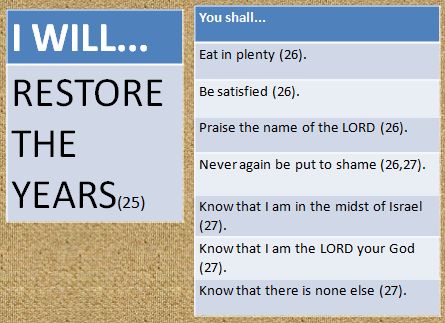
I will restore to you the years that the swarming locust has eaten, the hopper, the destroyer, and the cutter, my great army, which I sent among you. 26 “You shall eat in plenty and be satisfied, and praise the name of the LORD your God, who has dealt wondrously with you. And my people shall never again be put to shame. 27 You shall know that I am in the midst of Israel, and that I am the LORD your God and there is none else. And my people shall never again be put to shame. 28 “And it shall come to pass afterward, that I will pour out my Spirit on all flesh; your sons and your daughters shall prophesy, your old men shall dream dreams, and your young men shall see visions. 29 Even on the male and female servants in those days I will pour out my Spirit. 30 “And I will show wonders in the heavens and on the earth, blood and fire and columns of smoke. 31 The sun shall be turned to darkness, and the moon to blood, before the great and awesome day of the LORD comes. 32 And it shall come to pass that everyone who calls on the name of the LORD shall be saved. For in Mount Zion and in Jerusalem there shall be those who escape, as the LORD has said, and among the survivors shall be those whom the LORD calls.

This is the second in a series of 16 sermons based on messages from the writing prophets. The prophets are like a gold mine. They are filled with precious treasure, but getting to that treasure takes some digging and a lot of hard work. To understand the message of a prophet, you have to know the background of the prophet and the people he spoke to. You also have to have a reasonable grasp of world history to know when a prophecy has begun to be fulfilled. You also need to know the LORD because the messages from the prophets are meant to be understood and applied by believers whether they have been fulfilled or not.

I place Joel’s prophecies early, which is why I place it during the first time period. I think he prophesied during the reign of king Joash of Judah, but his book was probably written during the time Joash still young and in seclusion, and the kingdom of Judah was being run by the high priest. The date was about 835 BC.

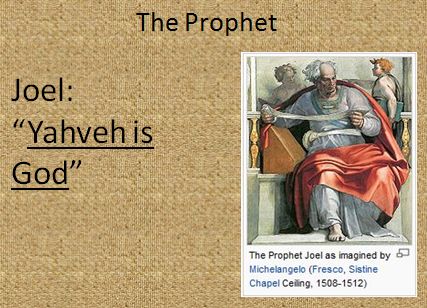
The name Joel means Jahveh is God. When Michelangelo painted his picture of Joel on the Sistine chapel, he had him looking at a small scroll. Someone has said that that represents his being inspired by God to say something new. Many of these new things that Joel said were repeated by the prophets who came after him. Joel’s message was very relevant to his local situation, but it looked way beyond that local situation to events that would take centuries to occur.

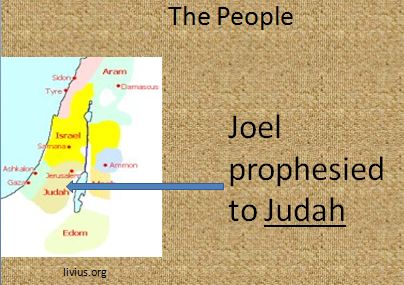
Joel prophesied to the nation of Judah after the kingdom had been divided. Yet, you may have noticed that Joel used the name “Israel” in his prophecy.

“You shall know that I am in the midst of Israel” (27).

That was no mistake. He looked so far into the future that by the time his prophecies would be fulfilled, Judah and Israel would be one nation again.

Judah had been hit by a major natural disaster: a series of locust plagues that wiped out the nation’s economy and led to system-wide depression and famine. It was hard to imagine things getting any worse. But Joel does not ride into town with his white horse and tell everybody “there, there, everything is going to get better now.” No, Joel’s message is more like “You ain’t seen nothing yet.” The plague of locusts which came from the north is going to be followed by swarms of armies coming from the same direction. We know from history that those armies came from Assyria, then Babylon, the Persia, then Greece, then Rome.

But Joel’s message is not all bad news. In verse 32 he says “there shall be those who escape.” He also says “among the survivors shall be those whom the LORD calls.” It was a message for Judah to hang on to their faith and God will bring them through all those bad times. Then, God is going to move.

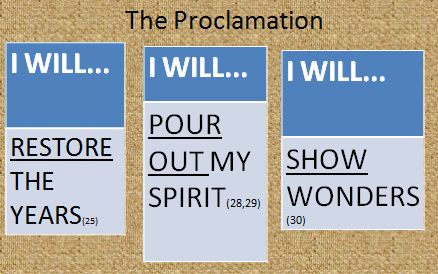
He’s going to do three things: He’s going to restore the years that that the locusts AND THE ARMIES have taken. He’s going to undo the damage. He’s also going to cause a spiritual revolution that will affect the whole nation, not just a few prophets here and there. And just before he does these things he will announce it with some miracles.

So the key to understanding Joel’s words here is that he is giving the predictions in reverse order. Look at verse 30. God is going to show wonders. That means he’s going to do a lot of miracles to let people know something significant is happening. Those wonders are going to be in the heavens and on the earth.

I think that Joel is pointing to Jesus’ life and ministry. The ultimate wonders that Joel mentions took place on the day of his crucifixion. He was being put to death at the same time the temple sacrifices were being prepared, and an eclipse took place that turned the sun to darkness.

Now look at verse 31. Notice the phrase “BEFORE the great and awesome day of the LORD comes.”

When you see “the day of the LORD” in the prophets, it is the same as saying “when God strikes.” So Joel is saying that he is going to cause a strong and significant spiritual revolution immediately after the death of Christ.

In Joel’s day, God poured out his Spirit on a few select prophets. If you wanted to know what God thinks, you would have to search out one of the prophets. But Joel predicts that when God strikes, EVERY believer will have his message. The Holy Spirit will gift and empower all believers regardless of gender, age, or social status.

In Acts 2:16-21 (At Pentecost Peter said) … “this is what was uttered through the prophet Joel” and then he quotes Joel 2:28-32. He recognized that this was the beginning of the spiritual revolution that God had predicted through Joel. That revolution is still going on. The Christian church which began in 30AD is part of God’s fulfillment of a prophecy Joel gave 800 years before that.

The Holy Spirit’s ministry through us is also the key to how God will choose to work beginning on that crucial day. In Joel 2:32, the prophet had predicted that this revolution would begin among the survivors in Jerusalem, but that it would be available to “EVERYONE WHO CALLS ON THE NAME OF THE LORD.”

Years later Paul would say in Romans 10:12-13 “For there is no distinction between Jew and Greek; the same Lord is Lord of all, bestowing his riches on all who call on him. For (and then he quotes Joel) “everyone who calls on the name of the Lord will be saved.” ”

Now, as I understand it, the first thing that Joel predicted will actually be the last thing fulfilled. ALREADY we have seen a time of great miracles BY CHRIST ending with the crucifixion OF CHRIST. ALREADY we have seen a time of great spiritual revolution beginning at Jerusalem but reaching out to all the cities and nations of the planet.

But Joel predicts that Jerusalem will experience a tremendous spiritual and material renewal. It will experience a time when the present famine and the future wars will all be in the past. Israel will know God, and worship him exclusively. In fact, God will be in the midst of Israel (27) and they will know it.

Joel’s message for you and me today is not to let the present spoil your vision of the future. It may take a long time before you actually see God at work in your life and family. But keep trusting in him. He has a plan, and he is going to fulfil his promises to you. When he begins to act, you will know it. Trust him during the locust swarms of your life. Trust him even during the cataclysmic invasions you will experience. He will never take anything away from you that he does not plan on restoring.
_________
LORD, help us to trust you during the trying times, and cooperate with your Holy Spirit ministering salvation to all we can reach. In Jesus’ name. Amen.