
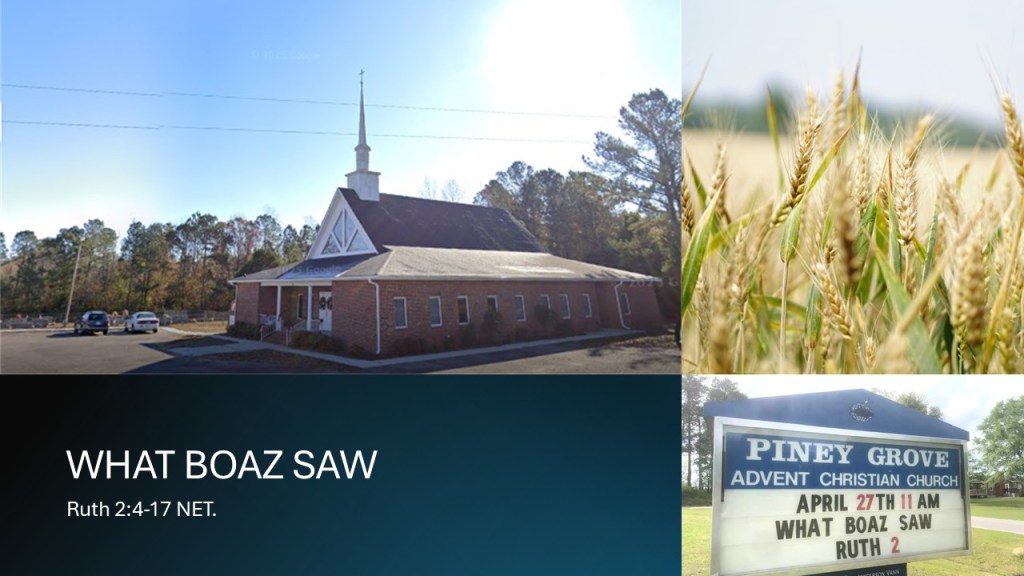
WHAT BOAZ SAW

WHAT BOAZ SAW

Ruth 2:4-17 NET.

4 Now at that very moment, Boaz arrived from Bethlehem and greeted the harvesters, “May the LORD be with you!” They replied, “May the LORD bless you!” 5 Boaz asked his servant in charge of the harvesters, “To whom does this young woman belong?” 6  The servant in charge of the harvesters replied, “She’s the young Moabite woman who came back with Naomi from the region of Moab. 7 She asked, ‘May I follow the harvesters and gather grain among the bundles?’ Since she arrived, she has been working hard from this morning until now — except for sitting in the resting hut a short time.” 8 So Boaz said to Ruth, “Listen carefully, my dear! Do not leave to gather grain in another field. You need not go beyond the limits of this field. You may go along beside my female workers. 9 Take note of the field where the men are harvesting and follow behind with the female workers. I will tell the men to leave you alone. When you are thirsty, you may go to the water jars and drink some of the water the servants draw.” 10 Ruth knelt before him with her forehead to the ground and said to him, “Why are you so kind and so attentive to me, even though I am a foreigner?” 11 Boaz replied to her, “I have been given a full report of all that you have done for your mother-in-law following the death of your husband — how you left your father and your mother, as well as your homeland, and came to live among people you did not know previously. 12 May the LORD reward your efforts! May your acts of kindness be repaid fully by the LORD God of Israel, from whom you have sought protection!” 13 She said, “You really are being kind to me, sir, for you have reassured and encouraged me, your servant, even though I am not one of your servants!” 14 Later, during the mealtime Boaz said to her, “Come here and have some food! Dip your bread in the vinegar!” So she sat down beside the harvesters. Then he handed her some roasted grain. She ate until she was full and saved the rest. 15 When she got up to gather grain, Boaz told his male servants, “Let her gather grain even among the bundles! Don’t chase her off! 16 Make sure you pull out ears of grain for her and drop them so she can gather them up. Don’t tell her not to!” 17 So she gathered grain in the field until evening. When she threshed what she had gathered, it came to about thirty pounds of barley!

We are continuing to read through the Bible, two chapters per day. Our reading has brought us to the period of the judges, and today’s text describes events that happened during that period. This was a time when the Israelites were not known for their loyalty to the LORD. There was no king, so people pretty much did whatever they wanted, with very little to prevent wickedness. It was a time and a culture much like that of our own. If you asked anyone whether what they were doing was right, they would say yes. But they were doing what was right in their own eyes. They had been given God’s law through Moses, but they paid very little attention to that law. If they wanted to do something, they did it. They did not stop to ask if what they were doing honored God. Most of the people during this time lived like that.

But there were exceptions. The life stories of some of those exceptional people are recorded in Scripture. The book of Ruth represents the islands of light in the sea of darkness. People like Ruth, Naomi, and Boaz were reminders that even during times of rampant wickedness, one can still choose to follow the Lord and be the light of the world. Many sermons have been preached that highlight the way Ruth and Naomi pierced the darkness by their faith and the actions brought about by that faith. For today’s message, I have chosen to look more closely at Boaz. The reason I want to focus on Boaz is that he had a character quality that very few in his time possessed. He had insight into the things that really mattered. He discerned how to make the right choices based on an awareness of what was significant and what was not.

I want to focus on how today’s text identifies Boaz’s insight. Each part of the passage introduces a new way of thinking that Boaz understood, but few around him did. He was set apart as an example of someone who could see opportunities where others only saw problems. He could see God at work where others only saw the mundane—the ordinary.

Boaz saw an opportunity to honor God in everything he did (4, 12).

The easiest facet of Boaz’s insight to recognize is what we see in these two verses. In verse 4, Boaz is greeting his harvesters. He does not begin by barking out orders, or even by requesting a report on the progress of the harvest. No, he starts with a formal greeting. It looks like this is a tradition with Boaz. We don’t see too many examples of this kind of greeting in Scripture, particularly not in this period. But Boaz is an exception. The first thing out of Boaz’s mouth is a blessing. He invokes God’s presence among his workers. He says, “May the LORD be with you.” They respond in turn, “May the LORD bless you.” They put the LORD first in their conversation. This is a clue that they have put the LORD first in their lives. They are harvesters, but they prioritize the LORD over their harvest. Boaz is the master of the harvest. He puts the LORD first over himself.

Jesus teaches that we should prioritize the LORD first. He taught us to pray, “Our Father… hallowed be thy name.” He taught us to seek first his kingdom and his righteousness. If we seek God’s kingdom first, then everything we do can be in his name. Boaz was not about making himself look great. He was not even about making Israel great. His priority was making the name of God great.

Later in the text, Boaz reflects the same insight when he asks the LORD to reward Ruth’s efforts (vs. 12). Boaz saw Ruth as someone who had taken refuge in the LORD. He asks God to repay her for seeking the LORD’s protection. She was not depending on Naomi or Boaz. She was showing dependence upon God himself, and Boaz praised her for it.

Boaz saw beyond national and ethnic prejudices (5-6).

He had asked his servants who Ruth was. Their answer seems to indicate that they had written Ruth off because she was not a natural-born citizen of Israel. They said, “She’s the young Moabite woman who came back with Naomi from the region of Moab. Their answer focuses on only one aspect of Ruth’s personality: her ethnic lineage. To them, the most important thing about Ruth was that she was one of them. Her ancestors were children of Lot, not children of Abraham.

The Moabites were very different from the Israelites. They claimed a different territory. They worshipped and served other gods. They sometimes clashed with and fought against the Israelites. But even beyond that, the Israelites often viewed the Moabites with suspicion because Lot’s daughters had gotten their father drunk and become impregnated by him to preserve his family line. So, when Naomi came back to Israel, tongues wagged because of that Moabite girl she brought with her.

Boaz had the spiritual insight to see beyond Ruth’s physical background and see Ruth for who she was on the inside. Of course, it helped Boaz that he himself came from a mixed family. His father was Salmon of the clan of Elimelech. But Salmon had married Rahab. Yes, the Rahab who had been a citizen of Jericho until she took a leap of faith and protected the Israelite scouts. After that, she became one of them. Before, she was one of them – the outsiders. Since Boaz probably grew up with tongues wagging all around him about his foreign mother, he was sensitive to what prejudice can do to a person.

Boaz saw potential where others saw a problem (8-9).

He invited Ruth to stay close to his workers and not to stray to other fields. He told his men to help her out and not to harass her. He did this because he recognized that she could be an asset, not a liability. Some property owners might have told their workers to shoo away the foreigners, but not Boaz. He looked beyond her background and responded only to her actions as a hard worker.

Boaz saw faith where others saw mere kindness (10-12).

When Ruth asked Boaz why he was being so kind to her, even though she was one of them, Boaz answered her. He said that he had been given a full report of all she had done for Naomi. Naomi had given both of her daughters-in-law permission to leave her and go back to their people. Orpah chose to do that. But Ruth chose to stay with Naomi. She decided to remain loyal to Naomi, even when that meant leaving her people and going to live among Naomi’s people.

Ruth’s loyalty to Naomi is so well-stated that it is often used to express marital fidelity even today. She was the one who first said, “Intreat me not to leave thee, or to return from following after thee: for whither thou goest, I will go; and where thou lodgest, I will lodge: thy people shall be my people, and thy God my God” (Ruth 1:16 KJV). Ruth was not just being kind to Naomi. She had decided to be all in. Boaz recognized that choice as an act of faith.

Boaz saw Ruth’s heart and sought to encourage her (13-17).

It was one thing for Boaz to appreciate Ruth for her loyalty to her mother-in-law. It was another to go beyond that and actively show deference to Ruth. Boaz was hooked. She had won his heart, and so he went out of his way to encourage hers. From that point on, it was Boaz who was going out of his way to pay attention to Ruth and bless her beyond what was expected.

When Ruth arrived home that night, she had about thirty pounds of barley with her. That was way more than your average yield for a day’s gleaning. Naomi knew right then that Ruth had caught Boaz’s attention.

We can learn from Boaz a thing or two about making a difference in the lives of those around us. He had been blessed, and he returned the blessing. This is more than just a love story. This is a story about a man who decided to live by the covenant that he had inherited from his family. Everything Boaz did was in obedience to the commands of God through Moses. We learned in our study of Deuteronomy that God expected his people to show deference to the poor, the foreign resident, and the widow. Ruth was all three of these. Boaz looked at this woman, and he saw more than a potential wife. Their courtship began because he chose to obey God’s word.

Jesus said that the second greatest commandment is to love our neighbors as we love ourselves. There is a reason God wants us to do that. He wants us to show that he loves the world and demonstrate that love. We demonstrate love by loving. We demonstrate that God cares by caring for people ourselves. There is a planet full of Ruths just waiting for someone to care. They are amazing people, but most of the world does not see their potential because they are different from us. Boaz challenges us to look at others with love in our hearts. The Good Samaritan challenges us to take the time to help the needy. Maybe the next Ruth is gleaning in our fields today. Will we dare to care for them?

MADE ALIVE

MADE ALIVE

1 Corinthians 15:20-26 NET.

20 But now Christ has been raised from the dead, the firstfruits of those who have fallen asleep.21 For since death came through a man, the resurrection of the dead also came through a man.22 For just as in Adam all die, so also in Christ all will be made alive.23 But each in his own order: Christ, the firstfruits; then when Christ comes, those who belong to him.24 Then comes the end, when he hands over the kingdom to God the Father, when he has brought to an end all rule and all authority and power.25 For he must reign until he has put all his enemies under his feet.26 The last enemy to be eliminated is death.

We are reading through the Bible – two chapters a day – and our Sunday morning messages have usually been based on one of the passages we have encountered in our reading. But we have been taking a short break from that practice these past two Sundays. Because last Sunday was Palm Sunday and today is Easter, we are taking a detailed look at what Paul says in 1 Corinthians 15, which is Paul’s presentation of the gospel message. For Paul, the gospel message is focused on the reality of Christ’s resurrection. That is what Easter is all about. When we take away all the cultural traditions and external wrapping, Easter is the holiday of the resurrection. But our holiday does not simply celebrate the hope of resurrection in general. As Paul makes it clear in this chapter, our hope of a future resurrection is forever linked to who Jesus is and the fact of his resurrection.

If we take Christ away from Easter, we will still have all the external celebrations and rituals, but they will have been robbed of their true meaning. That is why we need to focus first on what happened to Jesus on Easter Sunday morning. Before we jump to some other focus, we should be sure what the Bible says about that empty tomb as it relates to the man who was inside that tomb.

Christ is the first to be made alive (20).

The Scripture says that Christ has been raised from the dead. That tells us that he was not merely pretending to be dead, nor was he only partially dead. There is a category of human beings that we refer to as “the dead,” and for a brief period of days, Jesus Christ was in that category. All of us are familiar with the concept. We have enjoyed the company of friends and family members, but we have also lost some of them to the enemy dead. To use Paul’s analogy, death is reigning over us. Even if we are perfectly healthy and completely alive, the spectre of death hangs over us all like a dark cloud, predicting dark days and final defeat by that enemy.

But it is not all bad news. In today’s passage, the Apostle Paul describes the significance of Jesus’s resurrection by painting three different pictures. This first picture is that of a planting and a harvest. Death is compared to the planting of a seed. There is a natural similarity. When we plant seeds, we bury them in the ground. Later, the seeds germinate and sprout, eventually becoming a whole crop of new plants, alive and fruitful. Planting involves a period of dormancy. The seed is there in the ground, hidden from our eyes and sleeping. It is inactive.

Paul describes Christ as having experienced that period of dormancy. Before Easter Sunday morning, he was among the dead, asleep in Hades, but Scripture says that he was not abandoned there. He was among those who had fallen asleep in death. But then he was wakened to life again. He had been planted, but all was not lost. He was planted with a view of experiencing new life again. He did not immediately experience that new life. His death was not an illusion. It was a real death. But it did not end his life permanently. He has been raised from the dead.

The planting analogy continues as we examine the title Paul gives Jesus in these early verses: He is the firstfruits, the first harvest of all those planted. All the other dead continue sleeping in their graves, but not Jesus. It is not simply the fact that he has been resuscitated. Many die and are revived, either by a miracle (like Lazarus was) or but jump-starting their bodies again. But Jesus’s resurrection was different. He was revived, never to experience being planted again. The life he lives now is a different kind of life that the lives you and I live. We live with that dark cloud over us. Even on our best days, our mortality slips through and spoils our joy of living. But Jesus was raised never to die again. He is the only person who has ever experienced what the Bible calls the resurrection unto life.

The word “firstfruits ” offers hope. It speaks of a larger harvest yet to come. It says that Jesus is the first of a larger group of seeds, planted, dormant, and then sprouting to life. The life he is living now is the life we will inherit from him. Every Easter, we have the opportunity to look on our Savior as the first of a new category of human beings. Eternal, immortal, perfected human beings. Human beings free of our present imperfections and made anew into the image of Christ himself. He is the firsfruits, and there will be a later harvest. We can live in expectation not only of living again but of living his kind of life. As John the Baptist went before and prepared the world for Jesus, so Jesus went before us, tasting death for us, but also tasting the new life for us. That is something to celebrate! Jesus is our firstfruits!

Christ is the second Adam (22).

The Bible tells us all about the first Adam. He failed God, and because of his failure, all of us die. We die because when our first ancestors rebelled against God in the garden of Eden, that failure was passed on to everyone that their union would produce. All of their descendants die like they did. We are all born mortal and will all eventually die. That is what it means to be in Adam. We share the characteristics of our first parents. Many of us share characteristics of our immediate parents. We can see and hear the parents of our friends and family members in their children. We sometimes suffer ailments because we inherit deficiencies in our DNA. We are linked to those who have gone on before us through our bloodline. But what is true on that level is also true on the global, planetary level. We inherit things from Adam. He is the first, and we are next down the line. Mortality is one of those things we have inherited from Adam.

But Jesus is the second Adam. All of us belong to Adam, but verse 23 says that some of us also belong to Christ. Because we who have put our faith in Christ now belong to him, we will experience the same kind of resurrection that Christ did when he comes again. There is a resurrection unto life, and there is a resurrection unto condemnation that will end in the second death. Jesus was the second Adam because his resurrection was the first in the chain of resurrections unto life. Today’s text even gives us the order of the resurrections. Christ’s resurrection came first, and our resurrections unto life will happen when Christ comes. The second Adam is alive today in heaven. He wants all of us to experience the fantastic immortal life he is now living. He knows that will happen. But he also knows that it has to happen in the proper order. So, the Lord said that he is coming, and his reward is with him. He does not pass on that reward to people when they die. Death is not graduation day. His return is when all those in Christ will be made alive.

The phrase “second Adam” offers hope. We all know how fantastic it is to be part of the human race. We are amazed at the potential power, beauty, and wisdom that human beings are capable of. Even the lowest of us can think amazing thoughts and overwhelm others with our actions. An unassuming person comes to the auditorium, and the judges of the contest are introduced to the contestant. But for a brief moment, nobody knows what is coming next. Then, the contestant starts to sing or dance or do some acrobatic stunt. All of a sudden, people realize that this is no mere average human being. This is a star. This is a winner. This is exceptional among all us normals.

But the phrase “second Adam” tells us that God plans to create a new category of human beings. We are currently in the normal first-Adam generation. But we will inherit a world of stars, a world of winners, a world of people who are patterned after Christ himself. He is the next big thing, and we have the opportunity to be like him. That is why Paul said that he made it his aim to know Christ and to experience his resurrection. He was not satisfied with simply living out his first-Adam life. He wanted more. Easter reminds us that God wants more of us as well.

So, if you have ever asked yourself, “Is this all there is?” or “Is there nothing more?” you were getting at the question that Easter answers. God has much more in store for you and me than we can imagine. The second Adam has begun a revolution that will spread throughout the universe. We are invited to be part of that new thing.

 Christ will end the reign of death (25-26).

Another way of seeing the reality that Easter reveals is that God plans to undo all that is wrong with this reality. Paul teaches in today’s text that God will not be satisfied with simply collecting all the believers and transporting them to a good place. He plans to cleanse the impure things and make new the old things. He plans to make an end to all the things corrupted by sin. Those things are currently reigning over us. They dominate us. And the worst of all is the enemy death. Paul teaches here that Christ intends to put an end to all rule, authority, and power. Those are all the things in this life that dominate us and keep us from walking in freedom. Not only will Christ free us from the bondage of Hades, but he will also put all these other enemies under his feet. He will eliminate them from the universe. They are his enemies, and they are also our enemies.

The last and most potent of these enemies is death itself. Today, we have no choice but to welcome this enemy into our lives, our homes, and our families. But it will not be welcome in Christ’s new universe. Its reign has peppered our landscapes with monuments and memorial stones. But there will be no such thing on the Earth made new. The last battle will be fought, the last coffin emptied, the last flag rolled. The second death will be the last death. The lake of fire will be the last place of destruction.

Verse 22 says that everyone in Adam dies. We know that from experience. But the verse also says that everyone in Christ will be made alive. This is an easy text to misinterpret – especially as it reads in the NET. The clause “all will be made alive” only applies to the prepositional phrase “in Christ.” The promise of the resurrection unto eternal life only applies to those who are in Christ. Believers will live again never to die again. That is a promise worth living for. That is a hope worth celebrating.

ASLEEP IN CHRIST

ASLEEP IN CHRIST

1 Corinthians 15: 12-19 NET.

12 Now if Christ is being preached as raised from the dead, how can some of you say there is no resurrection of the dead 13 But if there is no resurrection of the dead, then not even Christ has been raised.14 And if Christ has not been raised, then our preaching is futile and your faith is empty.15 Also, we are found to be false witnesses about God, because we have testified against God that he raised Christ from the dead, when in reality he did not raise him, if indeed the dead are not raised.16 For if the dead are not raised, then not even Christ has been raised.17 And if Christ has not been raised, your faith is useless; you are still in your sins.18 Furthermore, those who have fallen asleep in Christ have also perished.19 For if only in this life we have hope in Christ, we should be pitied more than anyone.

It’s the time of year when we celebrate Easter again. It is fitting that we set aside a time every year to meditate on its meaning because, more than any other holiday, Easter forces us to think about the Bible’s most essential message and the most significant event in history.

The message of Easter is that Christ has been raised.

Like all holidays, Easter has attracted many traditions and rituals that compete with the event that we actually celebrate. Christmas is like that, too. Hopefully, we all know that Christmas is not about the man in the red suit who carries a bag. It’s not about reindeer—even ones with mutated noses. It’s not about trees or packages or family get-togethers. All those traditions are tacked on to the essential message of Christmas, which celebrates an event—the birth of our Savior.

Easter has its own set of tacked-on traditions as well. It’s not about a bunny. It’s not about hiding Easter eggs. Nowadays, we are hiding our eggs in a vault because they are so expensive. Easter is also not about Springtime. I gave an Easter sermon when I was pastoring in New Zealand. March and April are not in the Springtime in New Zealand because it is in the Southern Hemisphere. Easter comes in the Fall there. But that culture has its traditions about Easter.

It is essential for us as Christians not to get so caught up in cultural traditions that we lose sight of Easter’s real meaning. We need to peel back the traditions, reveal the actual event we are celebrating, and then focus on its significance.

Easter is really about Christ’s resurrection. The Apostle Paul spent this entire chapter of his first letter to the Corinthians focusing on the event and its significance. That is the true meaning of Easter, and its message is essential to the presentation of the gospel and our understanding of the gospel.

If I were to ask the average Christian what the gospel is all about, they would probably say that Christ died for our sins and if we believe in him we can have eternal life. That’s not wrong, but interestingly, that is not how the apostle Paul chose to explain the gospel here. In verse one of this chapter, we find that the Apostle wanted his readers to be clear about the gospel message. For that reason, he goes on for the following 57 verses to write about the event of Christ’s resurrection and its significance for believers. He does say that Christ died for our sins in verse 3. But he goes on to say that Christ was raised on the third day. His focus was not on trying to convince the Corinthians that Christ died for them. Instead, he focused on the fact of Christ’s resurrection. He did not want the faith of the Corinthian Christians to be focused on a dead Savior.

The message of Easter and the gospel is not centered on the death of Christ – as important as that fact is. The gospel Easter message says that the Christ who died as our substitute was raised and became the firstfruits. Later in this chapter (verse 23), Paul mentions that the idea of Christ as the firstfruits is essential to Paul’s gospel message. Sadly, even those who are all the time talking about the gospel often fail even to bring up the idea of the firstfruits. But that truth is gospel truth. If we don’t correctly understand how Christ is God’s firstfruits, we don’t yet fully comprehend the gospel.

Believers who die have fallen asleep in Christ.

In this chapter, Paul identifies three types of people. There is Christ, who is in a category all by himself because he alone has been raised from the dead, never to die again. He is the firstfruits—the first part of the harvest.

I really enjoy it when the garden crops start coming in. I like sharing the first part of the harvest with others because it is proof that God has given a harvest. But it is just the firstfruits. Part of the joy of the firstfruits is the anticipation of the whole harvest, which comes later.

So, Christ is the firstfruits because he is proof that God raises the dead. But the rest of the harvest will come later.

The second category of people that Paul mentions in 1 Corinthians 15 is the enemies of Christ. We read in verse 25 that when Christ returns to the Earth, he is going to reign until he puts all his enemies under his feet. Some people reading that verse think that Paul is saying that Christ is going to put his enemies in jail where they will live for eternity, always suffering for their rejection of him. But that is not what Paul means. In the ancient Near East, to put an enemy under your feet means to kill the enemy. We know that is what Paul means here because he goes on to say in the next verse that the last enemy to be eliminated is death itself. That’s a critical gospel verse because it tells us that the enemy death is real, and it is not yet eliminated.

So, now we get to the third category of people. Remember, Christ is the firstfruits. He is the only one, so he is the only person who is now living in eternal victory over death. The second category is God’s enemies. They are all mortal, so they will die for Adam’s sin. But when Jesus comes back, he will raise them from the dead, judge them, and then finally put them under his feet – that is, eliminate them.

So, the third category is believers in Christ. When Christ returns, he will raise us immortal, and we will begin our eternal lives at that point. We are the next phase of the harvest. But what about now? What is the status of those who have put their faith in Christ and die before his return? The Apostle Paul explains what happens to these believers. He says in verse 17 that they have fallen asleep in Christ.

Before I explain what being asleep in Christ means, I want to make clear what it does not mean. Being asleep in Christ does not mean that you have gone to be with the Lord.

There is only one place in Scripture that discusses believers being with the Lord. That is 1 Thessalonians 4:13-18. In this passage, Paul says that the believing dead are in the same state that he said they are in in 1 Corinthians 15. In 1 Corinthians, Paul said that they have fallen asleep in Christ. In 1 Thessalonians, Paul says that they are asleep (verse 13) and that they have fallen asleep as Christians (verse 14), and that they have fallen asleep (verse 15). When Christ returns, they will rise from their sleep. Only at that time are believers said to be with the Lord (verse 17).

Being asleep in Christ does not mean that you have gone to heaven. In John 3:13, we learn that no one has ascended to heaven except Jesus himself. The only human being in heaven today is Christ, the firstfruits.

Being asleep in Christ does not mean that you have gone to a better place. The better place is the new Earth, which Jesus is going to create when he returns. Dead believers are sleeping in the same place that dead unbelievers are sleeping. That place is called Hades in the New Testament. When Jesus returns, he is going to open the gates of Hades; He is going to raise all the dead. So, being asleep in Christ does not mean that you are in a better place than the unbelievers are. It just means that when you rise, you will experience the better resurrection. The Bible says there is a resurrection unto life and there is a resurrection unto condemnation that will conclude with the lake of fire – the second death. So, the only comfort we have if our loved ones have died is that they will inherit eternal life when Jesus comes again.

Being asleep in Christ does not mean that you have gone on to your reward. In Revelation 22:12, Jesus says that he is coming soon and his reward is with him. So, believers who are asleep in Christ are waiting for Christ to come again so that they can receive their reward.

The hope of Easter is in the Christ who has been raised.

Bunnies hop away. Easter eggs don’t last. Springtime comes and goes. But the hope of a resurrection unto eternal life is the confidence we have in Christ.

Paul says that if our hope in Christ is merely for this life, we should be pitied more than anyone. The reason we put our hope in Christ is that his tomb is empty. One day, he is coming back, and he is going to wake the dead in every cemetery. The word cemetery actually means “sleeping place.” He is going to bring back to life all who have ever lived.

The gospel is not anthropocentric, not man-centered. It is Christocentric, centered on the person and work of Jesus Christ. That is why we celebrate Easter. Our hope is in the one who has conquered death and brought life and immortality to light through the gospel.

Paul says, “We know that since Christ has been raised from the dead, he is never going to die again; death no longer has mastery over him” (Romans 6:9).

Paul says, “We know that the whole creation groans and suffers together until now” (Romans 8:22). Our day has not yet come, and our resurrection and eternal life have not returned.

Paul says, “We know that the one who raised up Jesus will also raise us up with Jesus and will bring us with you into his presence” (2 Corinthians 4:14).

But Paul also says he aims to know Christ and to experience the power of his resurrection (Philippians 3:10). He hasn’t experienced it yet because he is currently asleep in Christ. We haven’t experienced it yet either, but we will!

Paul knows the one in whom his faith is set, and he is convinced that Christ is able to protect him until the day of Christ’s return (2 Timothy 1:12).

Easter is a time for all Christians to declare what we know. We declare Christ crucified for our sins, raised to life as the firstfruits, and coming again to set us all free from the slavery to death and give us glorious eternal life.

JOSHUA THE MISSIONARY       

JOSHUA THE MISSIONARY       

Joshua 1:1-9 NET.

1 After Moses the LORD’s servant died, the LORD said to Joshua son of Nun, Moses’ assistant: 2 “Moses my servant is dead. Get ready! Cross the Jordan River! Lead these people into the land which I am ready to hand over to them. 3 I am handing over to you every place you set foot, as I promised Moses. 4 Your territory will extend from the wilderness in the south to Lebanon in the north. It will extend all the way to the great River Euphrates in the east (including all of Syria) and all the way to the Mediterranean Sea in the west. 5 No one will be able to resist you all the days of your life. As I was with Moses, so I will be with you. I will not abandon you or leave you alone. 6   Be strong and brave! You must lead these people in the conquest of this land that I solemnly promised their ancestors I would hand over to them. 7 Make sure you are very strong and brave! Carefully obey all the law my servant Moses charged you to keep! Do not swerve from it to the right or to the left, so that you may be successful in all you do. 8  This law scroll must not leave your lips! You must memorize it day and night so you can carefully obey all that is written in it. Then you will prosper and be successful. 9 I repeat, be strong and brave! Don’t be afraid and don’t panic, for I, the LORD your God, am with you in all you do.”

We are still bunny-hopping our way through the Bible, stopping every Sunday at the place where we are in our reading—two chapters a day. This week, we finished Deuteronomy and began Joshua on Friday. Because I am planning two special messages for Palm Sunday and Easter, this will be our only message based on the book of Joshua. I am focusing on these introductory words from Joshua 1 as the text for my message.

It is essential at the outset that I establish the relevance of the study of Joshua. Some Christians find it difficult to study Old Testament books like Joshua because they fail to see what these ancient narratives have to do with them in their modern setting. We might remember some of the stories in Joshua from Sunday School lessons or past sermons, or cartoons. But aside from these little dips into the pool, we tend to shy away from Joshua because we might be tempted to think of it as a relatively shallow book. The truth is that Joshua is just as deep as the other biblical books we are studying. It had a purpose in the canon of Scripture, and that purpose is still as crucial today as it was when its words were first written.

But what is the purpose of the book of Joshua? Why are its words relevant for 21st-century Christians? The Bible teaches that every Scripture is inspired by God and profitable for us. But how can we profit from these old words and ancient stories?

The key to answering that question might be to come at the question from the other end first. Before asking what the old stories have to do with us, maybe we should take a closer look at what we are doing to see if there are some points of contact. There are lots of things we do today that are different than what God’s people were doing in the time of Joshua. What are some things that are the same?

One thing that is the same is that we are serving the same God that Joshua did. Marcion was wrong when he suggested that the God of the Old Testament was an evil, wrathful God and that a loving, compassionate God had replaced him. Remember, God does not change. He is immutable. Times change, circumstances change, but the God we believe in does not change.

When they asked Jesus what the greatest commandment was, he indicated that loving God wholeheartedly is #1. The second greatest commandment is to love our neighbors as ourselves. Those two life priorities were valid and relevant in Joshua’s time, and they are still valid and applicable to us today.

So, what has changed? The simple answer is that the mission God has called us to is different than the mission God was calling Joshua to. Jesus calls us all to a mission of cross-cultural evangelism. He commanded us to disciple all the nations. God called Joshua to a different mission. We are going to examine that mission this morning. However, the thing that we need to keep in mind is that even though our mission is different from Joshua’s, there will be points of contact. Some of the things that Joshua learned about his mission are helpful for us to keep in mind as we seek to fulfill our mission.

Joshua’s Mission

Instead of outlining every task Joshua was to do, the Lord described Joshua’s mission by summarizing the first three steps of that mission. We find that summary in verse 2. The Lord said that Joshua was to “Get ready! Cross the Jordan River! Lead these people into the land which I am ready to hand over to them.” The first phase was to get ready. This involved Joshua getting himself ready. You cannot get your team prepared if you are not ready yourself.

The principle of personal preparation applies to us in our mission as well. We should not expect to step into the task of global evangelization without preparation. Jesus prepared his apostles for the task over several years of training. Then he challenged them to feed the sheep – to get the other disciples trained so that they could continue the mission by being disciplers.

Joshua was encouraged to be ready emotionally and physically for the task of leadership. He was commanded to be strong and brave. He was told to resist the temptation to be afraid and panic when things got rough. He had to build up the strength he needed because the mission he was called to would not be an easy one. He was expected to display the confidence that comes from knowing that God was with him.

The second phase of Joshua’s to-do list in today’s text is to cross over the Jordan river. He could not do that himself. The command to him (as leader) was a command to the whole people of Israel. It was going to be a miracle that only God could accomplish, but the people needed to be prepared for it. The leaders needed to prepare the people. That is part of the job for anyone called into ministry. Our task is not simply to maintain the status quo, but it also requires us to prepare the church for the next thing God is going to do among us.

The third phase for Joshua was to lead the people into the Promised Land. He was not to merely point in the direction and drive the people into it. He was to be a frontline leader. It is one thing to be an armchair general. It is another thing to strap on the sword and tell the soldiers to follow you into battle. As I said, these three commands do not encompass all of Joshua’s mission. God did not reveal everything to Joshua. We should not expect him to do that for us either. If we knew all the details, most of us would go hide in the woods. Our Lord is wise to only show us the next few steps in our path of following him.

Joshua’s Master

Notice how many times the word “I” shows up in today’s text. These words are God’s words. He is challenging Joshua to lead his people to where he wants them, but the emphasis is not entirely on Joshua. Joshua is challenged to be strong and brave, but notice what God says he will do:

  • God says he is ready to hand over the land to them. He promises to give them all the land that they set foot on.
  • God promises to be with Joshua the same way he was with his predecessor, Moses.
  • God reminds Joshua that he solemnly promised his ancestors to hand the land over to their descendants. Now was the time to fulfill that promise.
  • God promises to be with Joshua in all that he does.

There are two truths that every Christian should remember every day. These two things seem like diametrical opposites, but they are both true. The first truth is that we are slaves of God. He is our owner and our master. That may seem to be a depressing reality, but it is actually quite freeing.

The second truth is that our Master is Almighty God. He controls the universe. Nothing happens that he does not allow. We pray to him because only he can make the impossible possible. We can face any challenge—not because we are able, but because our Master is always able.

Joshua’s Manual

Note also how God stresses to Moses his absolute reliance upon the holy Scriptures. God tells him to obey all the laws his servant Moses carefully charged him to keep! He said that Joshua should not swerve from it to the right or to the left so that he may be successful in all he does. He said that the law scroll must not leave Joshua’s lips! He had to memorize it day and night so he could carefully obey all that is written in it. Then, he would prosper and be successful. God was sending Joshua on a mission, and the word of God was to be his mission manual. He did not have the whole Bible, but every word he had was the Holy Bible.

What Joshua the missionary had for his missionary work would help him accomplish that work. The same is true for you and me today. We read and study the Bible not to entertain us – not even to inform us. Our goal is not to learn the Bible as if it were an encyclopedia of religious trivia. It is our mission manual. It empowers us to do what God has called us to do.

As we read Joshua this month, let’s remember that its words do not describe a king or a military general. Joshua’s work was missionary work. May its words help us to be strong, brave, and faithful in the missionary work God has called us to do.

Holy Communion

1 John 2:14 NET.

“I have written to you, children, that you have known the Father. I have written to you, fathers, that you have known him who has been from the beginning. I have written to you, young people, that you are strong, and the word of God resides in you, and you have conquered the evil one.”

As we consider the death of our Lord this morning, let us remember that what Jesus did for us on the cross is enough, no matter where we are in life’s journey.

If you are new to the faith – a mere child of God – you might wonder if you are going to survive the challenges of life and come out on the other end with a genuine faith. God’s word to you is that you have known the Father. That is all you need because your confidence is in Him, not yourself.

The same promise applies to the old-timers in the faith—the Fathers and Mothers who have fought most of their battles—their mission is almost accomplished. But their confidence is not in their own accomplishments. It is in the fact that they have come to know the Father because of the finished work of Christ on the cross.

And what about the young men and women? Those who are going to be first into the battle, claiming territory for God and his kingdom?  The manual tells them that they are strong, that the word of God resides in them, and that they have conquered the evil one. Their battle is fresh, and they are in the front of it, but from God’s perspective, they have already won. They are challenged to let the word of Christ dwell in them richly because it is the manual that will take them from the present battle to the future glory.

Lord, we thank you for your finished work of redemption. We pray for your power to take us to the finish of our mission for you. We ask that you make us strong and brave warriors and faithful slaves of our Almighty Master. Amen.