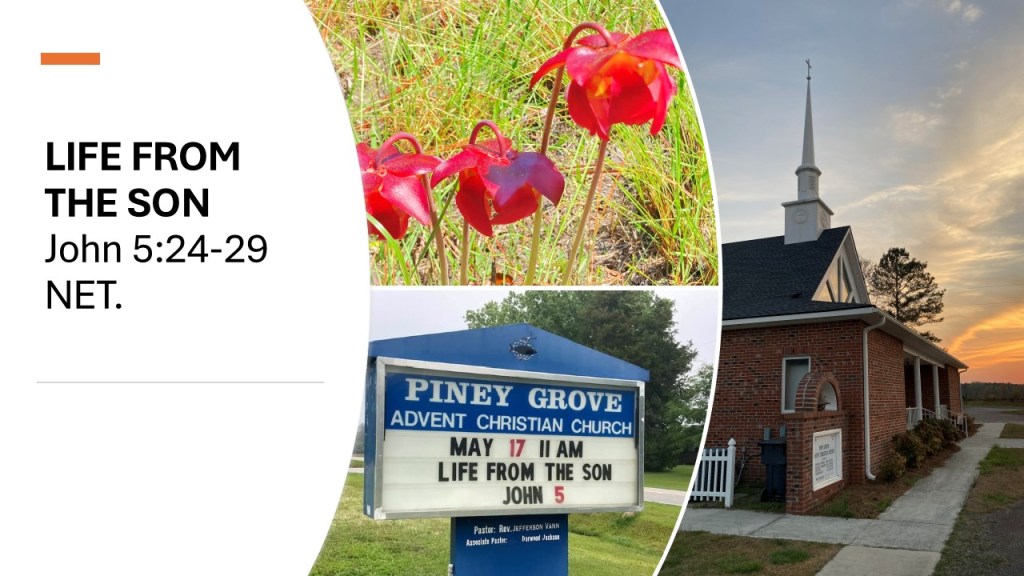

LIFE FROM THE SON

LIFE FROM THE SON

John 5:24-29 NET.

24“I tell you the solemn truth, the one who hears my message and believes the one who sent me has eternal life and will not be condemned but has crossed over from death to life. 25  I tell you the solemn truth, a time is coming — and is now here — when the dead will hear the voice of the Son of God, and those who hear will live. 26 For just as the Father has life in himself, thus he has granted the Son to have life in himself, 27 and he has granted the Son authority to execute judgment, because he is the Son of Man. 28 “Do not be amazed at this, because a time is coming when all who are in the tombs will hear his voice 29 and will come out — the ones who have done what is good to the resurrection resulting in life, and the ones who have done what is evil to the resurrection resulting in condemnation.

One of the important responsibilities of preaching is to slow us down long enough to really hear Scripture. We live in a world where familiar verses come preloaded with assumptions, ideas that almost everyone repeats, but few have traced back to the text itself. When those assumptions go unchallenged, they can blur what God is saying. Preaching becomes an act of love when it clears away that fog and lets the Word speak with its own weight and clarity.

There is something deeply real about this work. It invites us to come before God with open hands, willing to let Him correct us, surprise us, and reshape our understanding. It reminds us that Scripture is not a collection of slogans to confirm what we already think, but a living voice that calls us into truth. When a preacher helps us see what the text truly says—no more, no less—we experience that gentle moment when God realigns our hearts. And in those moments, we remember why we listen at all: because His Word still brings light, and His truth still sets us free.

Today’s passage is one of those places where we need to slow down and listen carefully. Most of us have heard John 5:24 explained the same way: it’s about a spiritual resurrection, a person getting saved, moving from spiritual death to spiritual life. And on the surface, that sounds right. I mean, what else could “crossed over from death to life” mean, if not conversion and new birth?

But you know what? Sometimes a verse we think we already understand is exactly the one that invites us to look again. That’s what I want to do with you this morning. My aim is not to be clever or to dismiss the many faithful teachers and theologians who see spiritual resurrection here. Many of them love Jesus deeply and handle Scripture with great care. I believe, after sitting with this text, that Jesus is talking about something different than what we usually assume.

So together, we’re going to walk slowly through John 5:24-29 and let the passage itself guide us. I hope that, by the end, you’ll see that what Jesus is saying is even richer and more grounded than the familiar explanation—and that your trust in His word will grow deeper, not thinner.

There are Two Life-Givers

Verse 26 says the Father has life in himself, and he has granted the Son to have life in himself. Those are the two sources where life can come from. Now, what kind of life do we get from the Father? Is it spiritual life or is it what we call physical life?

The Bible says that the LORD God formed Adam from dust from the ground and breathed into his nostrils the breath of life, and the man became a living creature.[1] He formed a non-living creature from the clay and breathed life into it, and Adam became alive. This is the kind of life we received from our Father. It was a dependent life. We owed our existence and continued functioning to the one who gave us this life. He is the first life-giver, and that life is (for want of a better description) physical animal life.

We have life, but the life we have is not self-contained. The theologians talk about humans having immortal souls, but the Bible never mentions anything about our souls being immortal. The Old Testament says that the soul who sins shall die.[2] Jesus said that sinful souls will be destroyed in Gehenna hell.[3] So, both Testaments testify that the idea of our having immortal souls by nature is unbiblical.

The life we receive from the Father is mortal, conditional life, temporary life. It can be a wonderful life, or it can be a miserable life, but there is one thing that life from the Father cannot be. It cannot be eternal life. The Father made that decision in Eden. He said that if our ancestors ate of the forbidden tree, we would become mortal and we would all eventually die.

Now, is this life from the Father spiritual life? Paul said that before salvation, all of us are “dead in our trespasses.”[4] We cannot even seek God because our sins have made us dead, not functioning in our relationship to him. So, if we are going to have a relationship with God, we are going to need a new life, another life, other than the natural life we were born into.

Never fear, because the Father, who has life in himself, has also granted the Son to have life in himself. There is another source of life. Now this is where the theologians are quick to explain that the kind of life Jesus offers is spiritual life, and that we need that because we are all spiritually dead. But hold your horses, because the text says something different.

The Son gave life by Physical Resurrection.

In verse 25, Jesus says a time is coming — and is now here — when the dead will hear the voice of the Son of God, and those who hear will live. One of the keys to understanding that statement is the fact that Jesus used the word “now.” He was referring to his earthly ministry. We know that Jesus brought the dead back to life while he walked among us. He took the corpse of Jairus’ daughter by the hand and said Little girl, I say to you, wake up!”[5] She woke up. To the widow’s son at Nain, he said, “Young man, I say to you, wake up!”[6] He woke up. In Bethany, he called Lazarus by name and told him to get out of that tomb.[7] He shuffled out of that tomb. On the night of his crucifixion, many of the saints who were buried and sleeping in their graves came out.[8] They came to life again.

Now, I want to ask you which of those four resurrections could be categorized as a spiritual resurrection? I think it is obvious that none of them were. They were all examples of Jesus literally raising people from the dead.

Jesus Establishes A Second Pattern Of Life-Giving.

In verse 25, Jesus said, “A time is coming — and is now here — when the dead will hear the voice of the Son of God, and those who hear will live.”  If the time that is here meant that Jesus could literally raise the dead during his earthly ministry, what does he mean when he talks about that time that is coming?

We don’t have to guess about that time because Jesus goes on to explain it more fully. He says, “A time is coming when all who are in the tombs will hear his voice and will come out — the ones who have done what is good to the resurrection resulting in life, and the ones who have done what is evil to the resurrection resulting in condemnation.

So, in this time that is coming, Jesus is going to perform the same kind of resurrection as he did during his earthly ministry. He is going to wake the dead and make them alive again. This is not a spiritual resurrection. It, too, is what we might call a literal, physical resurrection. In fact, it appears that there are only three things about this coming resurrection that will be different from the resurrections mentioned in the New Testament.

First, the extent to which the dead are raised. Jairus’ daughter died again. The Widow’s son died again. The saints who were sleeping fell asleep again. Those New Testament resurrections were temporary. They were miracles designed to show who Jesus is. But none of those who were raised were raised immortal.

Second, the purpose of the coming resurrection is Judgment Day. That is why Jesus says that some will be raised to a resurrection that results in condemnation. They, too, will be brought back to life, but not to immortality. Their resurrection is not a doorway into eternal joy but the moment they must stand before the Judge at the Great White Throne and answer for their lives. Every sin, every injustice, every rejection of God’s grace must be dealt with. Scripture is painfully clear: there are only two ways sin can be addressed—either through the atoning death of Christ or through the second death in Gehenna, the lake of fire.

The penalty for sin has always been death. That is the cost. And if we refuse the death of Christ as our substitute, then the only payment left is our own. Hell is not a place for people God dislikes; it is the place where unpaid sin debts are settled. It is a sober reminder that grace is offered freely, but it is not forced. The coming resurrection will reveal who trusted in Christ’s sacrifice and who chose to bear the weight of their own.

But the good news of the gospel is that there is a third and far greater difference between the resurrections Jesus performed during His earthly ministry and the resurrection He will bring about at the end of the age. The people He raised in the Gospels were restored to the same kind of life they had before—beautiful, compassionate miracles, but still temporary. They lived again, but they eventually died again. Their stories point forward, but they are not the destination.

What Jesus promises in the future is something entirely different. He says that some will be raised to a resurrection that results in life—real, lasting, indestructible life. Just as the Father gives life, so the Son gives life. But the life He gives is not mortal life stretched a little longer. It is immortal life, the kind that cannot fade or weaken or slip away. It is not natural life patched up and restarted. It is supernatural life, breathed into us by the One who conquered death. It is not a temporary life borrowed for a season. It is eternal, everlasting, permanent life—life that shares in the very permanence of God Himself.

That is the hope set before us, and it is worth holding with both hands.

This Resurrection Promise Gives us Hope.

Here are five reasons why we can draw confidence and hope from this resurrection promise:

1. The resurrection means death is not the end.

Every funeral, every diagnosis, every reminder of our mortality is not the final word. The resurrection promises that God will reverse what Adam’s fall unleashed. We do not cling to wishful thinking; we cling to a future event God has already previewed in Jesus.

2. The resurrection guarantees that our bodies matter to God.

We are not escaping creation; we are awaiting its renewal. The resurrection tells us that God will raise these very bodies—healed, restored, glorified. Nothing about our embodied life is disposable or forgotten.

3. The resurrection assures us that justice will be done.

So much in this world goes unresolved. But resurrection means God will raise every person and set all things right. No evil will remain unaddressed, and no faithfulness will go unnoticed.

4. The resurrection anchors our hope in Christ’s victory, not our performance.

Our future does not depend on our strength, consistency, or spiritual success. It rests on the risen Christ who conquered death for us. Because He lives, we will live also.

5. The resurrection promises reunion and restoration.

Every tear, every separation, every grave we’ve stood beside will be answered. God will gather His people, restore what was lost, and make all things new. Hope is not abstract. It is personal, relational, and guaranteed.

In conclusion, I am convinced Jesus is not introducing a new or hidden idea of spiritual resurrection in this passage. He is pointing us to the same promise He makes so clearly in John 6, where He says that everyone who looks to the Son and believes in Him has eternal life, and that He Himself will raise that person on the last day. That is the heartbeat of His message. He is not describing an invisible inner event; He is promising a future moment when He will act with resurrection power.

If you belong to Christ today, I cannot promise you a spiritual resurrection that happens quietly inside you. Scripture never speaks that way. But I can promise you something far better and far more concrete. Our Savior knows your name. He has not lost track of you. And one day, He will speak that name with the same authority that called Lazarus out of the tomb. If you are asleep in the dust, you will wake at His voice. If you are in your grave, you will rise and step out into a life that can never be taken from you again. That is the promise He gives, and it is worth holding onto with all your heart.


[1] Genesis 2:7.

[2] Ezekiel 18:4, 20.

[3] Matthew 10:28.

[4] Ephesians 2:1, 5; Colossians 2:13.

[5] Mark 5:21–43, Matthew 9:18–26, and Luke 8:40–56.

[6] Luke 7:11–17.

[7] John 11:1–44

[8] Matthew 27:52–53.

Resources for preaching Conditionalism


Jefferson Vann is a former missionary with the Advent Christian General Conference who now serves as Pastor of Piney Grove Advent Christian Church in Delco, North Carolina. He is the author of 46 books, including the two series mentioned below.


Conditional Immortality is the belief that eternal life is a blessing reserved only for the saved. Conditionalists hold that unbelievers will be raised at the return of Christ, judged and appropriately punished for their sins, and will die the second death in a place called Gehenna. We do not believe that God created all human beings with an immortal part that even he cannot destroy. When people die, they do not continue to live in a disembodied state. They actually die, ceasing to function until raised to life again consciously. This intermediate state is called “sleep” in the Bible. The Resurrection will wake all the dead, but only the saved will experience permanent life. The lost will literally perish.

Does your pastor preach conditionalism? Here are some resources that would help your pastor understand, preach, and teach the doctrines of conditionalism more clearly.

An Advent Christian Systematic Theology is a four-volume work that answers many typical questions about God, human nature, Christ, sin, salvation, and ultimate destiny.

Each volume is available in paperback (print-on-demand) and is currently being sold by Amazon for $15.

The 4-volume set is $60.


The Afterlife Archives is a series of five books that focus on conditionalism’s doctrines. These doctrines include God’s exclusive immortality, humanity’s potential for immortality, the unconscious sleep of the dead during the intermediate state, the resurrection to eternal life for the saved, and the resurrection to condemnation and the second death for the lost.

The set of all five paperback books in the Afterlife Archives series is currently available for $17.95. These prices may change on October 31st, 2025, but they will stay in effect for those who wish to bless their pastors with these resources during Pastor Appreciation Month (October).

Click on the pictures above to purchase the books.

MADE ALIVE

MADE ALIVE

1 Corinthians 15:20-26 NET.

20 But now Christ has been raised from the dead, the firstfruits of those who have fallen asleep.21 For since death came through a man, the resurrection of the dead also came through a man.22 For just as in Adam all die, so also in Christ all will be made alive.23 But each in his own order: Christ, the firstfruits; then when Christ comes, those who belong to him.24 Then comes the end, when he hands over the kingdom to God the Father, when he has brought to an end all rule and all authority and power.25 For he must reign until he has put all his enemies under his feet.26 The last enemy to be eliminated is death.

We are reading through the Bible – two chapters a day – and our Sunday morning messages have usually been based on one of the passages we have encountered in our reading. But we have been taking a short break from that practice these past two Sundays. Because last Sunday was Palm Sunday and today is Easter, we are taking a detailed look at what Paul says in 1 Corinthians 15, which is Paul’s presentation of the gospel message. For Paul, the gospel message is focused on the reality of Christ’s resurrection. That is what Easter is all about. When we take away all the cultural traditions and external wrapping, Easter is the holiday of the resurrection. But our holiday does not simply celebrate the hope of resurrection in general. As Paul makes it clear in this chapter, our hope of a future resurrection is forever linked to who Jesus is and the fact of his resurrection.

If we take Christ away from Easter, we will still have all the external celebrations and rituals, but they will have been robbed of their true meaning. That is why we need to focus first on what happened to Jesus on Easter Sunday morning. Before we jump to some other focus, we should be sure what the Bible says about that empty tomb as it relates to the man who was inside that tomb.

Christ is the first to be made alive (20).

The Scripture says that Christ has been raised from the dead. That tells us that he was not merely pretending to be dead, nor was he only partially dead. There is a category of human beings that we refer to as “the dead,” and for a brief period of days, Jesus Christ was in that category. All of us are familiar with the concept. We have enjoyed the company of friends and family members, but we have also lost some of them to the enemy dead. To use Paul’s analogy, death is reigning over us. Even if we are perfectly healthy and completely alive, the spectre of death hangs over us all like a dark cloud, predicting dark days and final defeat by that enemy.

But it is not all bad news. In today’s passage, the Apostle Paul describes the significance of Jesus’s resurrection by painting three different pictures. This first picture is that of a planting and a harvest. Death is compared to the planting of a seed. There is a natural similarity. When we plant seeds, we bury them in the ground. Later, the seeds germinate and sprout, eventually becoming a whole crop of new plants, alive and fruitful. Planting involves a period of dormancy. The seed is there in the ground, hidden from our eyes and sleeping. It is inactive.

Paul describes Christ as having experienced that period of dormancy. Before Easter Sunday morning, he was among the dead, asleep in Hades, but Scripture says that he was not abandoned there. He was among those who had fallen asleep in death. But then he was wakened to life again. He had been planted, but all was not lost. He was planted with a view of experiencing new life again. He did not immediately experience that new life. His death was not an illusion. It was a real death. But it did not end his life permanently. He has been raised from the dead.

The planting analogy continues as we examine the title Paul gives Jesus in these early verses: He is the firstfruits, the first harvest of all those planted. All the other dead continue sleeping in their graves, but not Jesus. It is not simply the fact that he has been resuscitated. Many die and are revived, either by a miracle (like Lazarus was) or but jump-starting their bodies again. But Jesus’s resurrection was different. He was revived, never to experience being planted again. The life he lives now is a different kind of life that the lives you and I live. We live with that dark cloud over us. Even on our best days, our mortality slips through and spoils our joy of living. But Jesus was raised never to die again. He is the only person who has ever experienced what the Bible calls the resurrection unto life.

The word “firstfruits ” offers hope. It speaks of a larger harvest yet to come. It says that Jesus is the first of a larger group of seeds, planted, dormant, and then sprouting to life. The life he is living now is the life we will inherit from him. Every Easter, we have the opportunity to look on our Savior as the first of a new category of human beings. Eternal, immortal, perfected human beings. Human beings free of our present imperfections and made anew into the image of Christ himself. He is the firsfruits, and there will be a later harvest. We can live in expectation not only of living again but of living his kind of life. As John the Baptist went before and prepared the world for Jesus, so Jesus went before us, tasting death for us, but also tasting the new life for us. That is something to celebrate! Jesus is our firstfruits!

Christ is the second Adam (22).

The Bible tells us all about the first Adam. He failed God, and because of his failure, all of us die. We die because when our first ancestors rebelled against God in the garden of Eden, that failure was passed on to everyone that their union would produce. All of their descendants die like they did. We are all born mortal and will all eventually die. That is what it means to be in Adam. We share the characteristics of our first parents. Many of us share characteristics of our immediate parents. We can see and hear the parents of our friends and family members in their children. We sometimes suffer ailments because we inherit deficiencies in our DNA. We are linked to those who have gone on before us through our bloodline. But what is true on that level is also true on the global, planetary level. We inherit things from Adam. He is the first, and we are next down the line. Mortality is one of those things we have inherited from Adam.

But Jesus is the second Adam. All of us belong to Adam, but verse 23 says that some of us also belong to Christ. Because we who have put our faith in Christ now belong to him, we will experience the same kind of resurrection that Christ did when he comes again. There is a resurrection unto life, and there is a resurrection unto condemnation that will end in the second death. Jesus was the second Adam because his resurrection was the first in the chain of resurrections unto life. Today’s text even gives us the order of the resurrections. Christ’s resurrection came first, and our resurrections unto life will happen when Christ comes. The second Adam is alive today in heaven. He wants all of us to experience the fantastic immortal life he is now living. He knows that will happen. But he also knows that it has to happen in the proper order. So, the Lord said that he is coming, and his reward is with him. He does not pass on that reward to people when they die. Death is not graduation day. His return is when all those in Christ will be made alive.

The phrase “second Adam” offers hope. We all know how fantastic it is to be part of the human race. We are amazed at the potential power, beauty, and wisdom that human beings are capable of. Even the lowest of us can think amazing thoughts and overwhelm others with our actions. An unassuming person comes to the auditorium, and the judges of the contest are introduced to the contestant. But for a brief moment, nobody knows what is coming next. Then, the contestant starts to sing or dance or do some acrobatic stunt. All of a sudden, people realize that this is no mere average human being. This is a star. This is a winner. This is exceptional among all us normals.

But the phrase “second Adam” tells us that God plans to create a new category of human beings. We are currently in the normal first-Adam generation. But we will inherit a world of stars, a world of winners, a world of people who are patterned after Christ himself. He is the next big thing, and we have the opportunity to be like him. That is why Paul said that he made it his aim to know Christ and to experience his resurrection. He was not satisfied with simply living out his first-Adam life. He wanted more. Easter reminds us that God wants more of us as well.

So, if you have ever asked yourself, “Is this all there is?” or “Is there nothing more?” you were getting at the question that Easter answers. God has much more in store for you and me than we can imagine. The second Adam has begun a revolution that will spread throughout the universe. We are invited to be part of that new thing.

 Christ will end the reign of death (25-26).

Another way of seeing the reality that Easter reveals is that God plans to undo all that is wrong with this reality. Paul teaches in today’s text that God will not be satisfied with simply collecting all the believers and transporting them to a good place. He plans to cleanse the impure things and make new the old things. He plans to make an end to all the things corrupted by sin. Those things are currently reigning over us. They dominate us. And the worst of all is the enemy death. Paul teaches here that Christ intends to put an end to all rule, authority, and power. Those are all the things in this life that dominate us and keep us from walking in freedom. Not only will Christ free us from the bondage of Hades, but he will also put all these other enemies under his feet. He will eliminate them from the universe. They are his enemies, and they are also our enemies.

The last and most potent of these enemies is death itself. Today, we have no choice but to welcome this enemy into our lives, our homes, and our families. But it will not be welcome in Christ’s new universe. Its reign has peppered our landscapes with monuments and memorial stones. But there will be no such thing on the Earth made new. The last battle will be fought, the last coffin emptied, the last flag rolled. The second death will be the last death. The lake of fire will be the last place of destruction.

Verse 22 says that everyone in Adam dies. We know that from experience. But the verse also says that everyone in Christ will be made alive. This is an easy text to misinterpret – especially as it reads in the NET. The clause “all will be made alive” only applies to the prepositional phrase “in Christ.” The promise of the resurrection unto eternal life only applies to those who are in Christ. Believers will live again never to die again. That is a promise worth living for. That is a hope worth celebrating.

ASLEEP IN CHRIST

ASLEEP IN CHRIST

1 Corinthians 15: 12-19 NET.

12 Now if Christ is being preached as raised from the dead, how can some of you say there is no resurrection of the dead 13 But if there is no resurrection of the dead, then not even Christ has been raised.14 And if Christ has not been raised, then our preaching is futile and your faith is empty.15 Also, we are found to be false witnesses about God, because we have testified against God that he raised Christ from the dead, when in reality he did not raise him, if indeed the dead are not raised.16 For if the dead are not raised, then not even Christ has been raised.17 And if Christ has not been raised, your faith is useless; you are still in your sins.18 Furthermore, those who have fallen asleep in Christ have also perished.19 For if only in this life we have hope in Christ, we should be pitied more than anyone.

It’s the time of year when we celebrate Easter again. It is fitting that we set aside a time every year to meditate on its meaning because, more than any other holiday, Easter forces us to think about the Bible’s most essential message and the most significant event in history.

The message of Easter is that Christ has been raised.

Like all holidays, Easter has attracted many traditions and rituals that compete with the event that we actually celebrate. Christmas is like that, too. Hopefully, we all know that Christmas is not about the man in the red suit who carries a bag. It’s not about reindeer—even ones with mutated noses. It’s not about trees or packages or family get-togethers. All those traditions are tacked on to the essential message of Christmas, which celebrates an event—the birth of our Savior.

Easter has its own set of tacked-on traditions as well. It’s not about a bunny. It’s not about hiding Easter eggs. Nowadays, we are hiding our eggs in a vault because they are so expensive. Easter is also not about Springtime. I gave an Easter sermon when I was pastoring in New Zealand. March and April are not in the Springtime in New Zealand because it is in the Southern Hemisphere. Easter comes in the Fall there. But that culture has its traditions about Easter.

It is essential for us as Christians not to get so caught up in cultural traditions that we lose sight of Easter’s real meaning. We need to peel back the traditions, reveal the actual event we are celebrating, and then focus on its significance.

Easter is really about Christ’s resurrection. The Apostle Paul spent this entire chapter of his first letter to the Corinthians focusing on the event and its significance. That is the true meaning of Easter, and its message is essential to the presentation of the gospel and our understanding of the gospel.

If I were to ask the average Christian what the gospel is all about, they would probably say that Christ died for our sins and if we believe in him we can have eternal life. That’s not wrong, but interestingly, that is not how the apostle Paul chose to explain the gospel here. In verse one of this chapter, we find that the Apostle wanted his readers to be clear about the gospel message. For that reason, he goes on for the following 57 verses to write about the event of Christ’s resurrection and its significance for believers. He does say that Christ died for our sins in verse 3. But he goes on to say that Christ was raised on the third day. His focus was not on trying to convince the Corinthians that Christ died for them. Instead, he focused on the fact of Christ’s resurrection. He did not want the faith of the Corinthian Christians to be focused on a dead Savior.

The message of Easter and the gospel is not centered on the death of Christ – as important as that fact is. The gospel Easter message says that the Christ who died as our substitute was raised and became the firstfruits. Later in this chapter (verse 23), Paul mentions that the idea of Christ as the firstfruits is essential to Paul’s gospel message. Sadly, even those who are all the time talking about the gospel often fail even to bring up the idea of the firstfruits. But that truth is gospel truth. If we don’t correctly understand how Christ is God’s firstfruits, we don’t yet fully comprehend the gospel.

Believers who die have fallen asleep in Christ.

In this chapter, Paul identifies three types of people. There is Christ, who is in a category all by himself because he alone has been raised from the dead, never to die again. He is the firstfruits—the first part of the harvest.

I really enjoy it when the garden crops start coming in. I like sharing the first part of the harvest with others because it is proof that God has given a harvest. But it is just the firstfruits. Part of the joy of the firstfruits is the anticipation of the whole harvest, which comes later.

So, Christ is the firstfruits because he is proof that God raises the dead. But the rest of the harvest will come later.

The second category of people that Paul mentions in 1 Corinthians 15 is the enemies of Christ. We read in verse 25 that when Christ returns to the Earth, he is going to reign until he puts all his enemies under his feet. Some people reading that verse think that Paul is saying that Christ is going to put his enemies in jail where they will live for eternity, always suffering for their rejection of him. But that is not what Paul means. In the ancient Near East, to put an enemy under your feet means to kill the enemy. We know that is what Paul means here because he goes on to say in the next verse that the last enemy to be eliminated is death itself. That’s a critical gospel verse because it tells us that the enemy death is real, and it is not yet eliminated.

So, now we get to the third category of people. Remember, Christ is the firstfruits. He is the only one, so he is the only person who is now living in eternal victory over death. The second category is God’s enemies. They are all mortal, so they will die for Adam’s sin. But when Jesus comes back, he will raise them from the dead, judge them, and then finally put them under his feet – that is, eliminate them.

So, the third category is believers in Christ. When Christ returns, he will raise us immortal, and we will begin our eternal lives at that point. We are the next phase of the harvest. But what about now? What is the status of those who have put their faith in Christ and die before his return? The Apostle Paul explains what happens to these believers. He says in verse 17 that they have fallen asleep in Christ.

Before I explain what being asleep in Christ means, I want to make clear what it does not mean. Being asleep in Christ does not mean that you have gone to be with the Lord.

There is only one place in Scripture that discusses believers being with the Lord. That is 1 Thessalonians 4:13-18. In this passage, Paul says that the believing dead are in the same state that he said they are in in 1 Corinthians 15. In 1 Corinthians, Paul said that they have fallen asleep in Christ. In 1 Thessalonians, Paul says that they are asleep (verse 13) and that they have fallen asleep as Christians (verse 14), and that they have fallen asleep (verse 15). When Christ returns, they will rise from their sleep. Only at that time are believers said to be with the Lord (verse 17).

Being asleep in Christ does not mean that you have gone to heaven. In John 3:13, we learn that no one has ascended to heaven except Jesus himself. The only human being in heaven today is Christ, the firstfruits.

Being asleep in Christ does not mean that you have gone to a better place. The better place is the new Earth, which Jesus is going to create when he returns. Dead believers are sleeping in the same place that dead unbelievers are sleeping. That place is called Hades in the New Testament. When Jesus returns, he is going to open the gates of Hades; He is going to raise all the dead. So, being asleep in Christ does not mean that you are in a better place than the unbelievers are. It just means that when you rise, you will experience the better resurrection. The Bible says there is a resurrection unto life and there is a resurrection unto condemnation that will conclude with the lake of fire – the second death. So, the only comfort we have if our loved ones have died is that they will inherit eternal life when Jesus comes again.

Being asleep in Christ does not mean that you have gone on to your reward. In Revelation 22:12, Jesus says that he is coming soon and his reward is with him. So, believers who are asleep in Christ are waiting for Christ to come again so that they can receive their reward.

The hope of Easter is in the Christ who has been raised.

Bunnies hop away. Easter eggs don’t last. Springtime comes and goes. But the hope of a resurrection unto eternal life is the confidence we have in Christ.

Paul says that if our hope in Christ is merely for this life, we should be pitied more than anyone. The reason we put our hope in Christ is that his tomb is empty. One day, he is coming back, and he is going to wake the dead in every cemetery. The word cemetery actually means “sleeping place.” He is going to bring back to life all who have ever lived.

The gospel is not anthropocentric, not man-centered. It is Christocentric, centered on the person and work of Jesus Christ. That is why we celebrate Easter. Our hope is in the one who has conquered death and brought life and immortality to light through the gospel.

Paul says, “We know that since Christ has been raised from the dead, he is never going to die again; death no longer has mastery over him” (Romans 6:9).

Paul says, “We know that the whole creation groans and suffers together until now” (Romans 8:22). Our day has not yet come, and our resurrection and eternal life have not returned.

Paul says, “We know that the one who raised up Jesus will also raise us up with Jesus and will bring us with you into his presence” (2 Corinthians 4:14).

But Paul also says he aims to know Christ and to experience the power of his resurrection (Philippians 3:10). He hasn’t experienced it yet because he is currently asleep in Christ. We haven’t experienced it yet either, but we will!

Paul knows the one in whom his faith is set, and he is convinced that Christ is able to protect him until the day of Christ’s return (2 Timothy 1:12).

Easter is a time for all Christians to declare what we know. We declare Christ crucified for our sins, raised to life as the firstfruits, and coming again to set us all free from the slavery to death and give us glorious eternal life.