
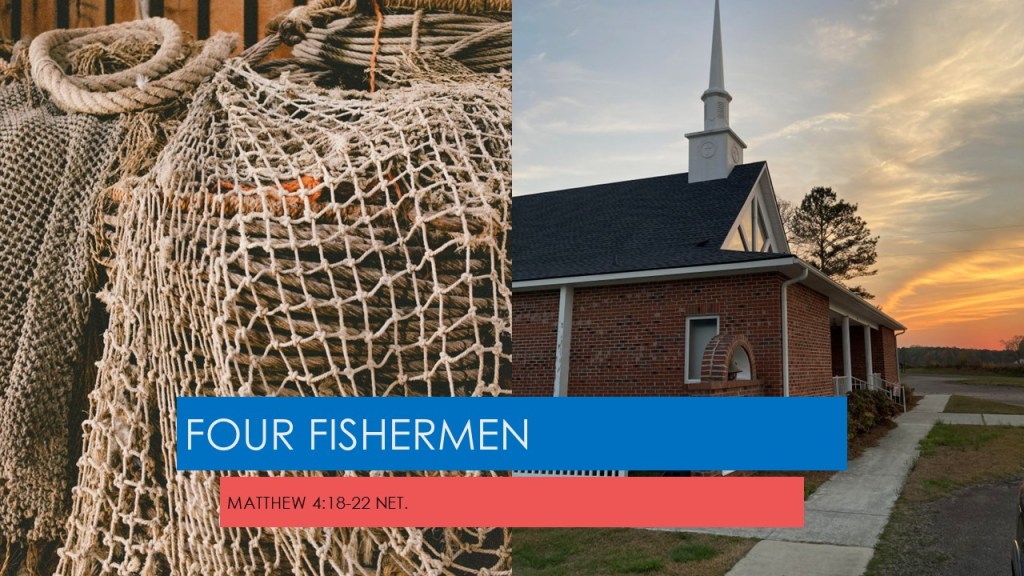
FOUR FISHERMEN
Matthew 4:18-22 NET.
18 As he was walking by the Sea of Galilee he saw two brothers, Simon (called Peter) and Andrew his brother, casting a net into the sea (for they were fishermen). 19 He said to them, “Follow me, and I will turn you into fishers of people.” 20 They left their nets immediately and followed him. 21 Going on from there he saw two other brothers, James the son of Zebedee and John his brother, in a boat with Zebedee their father, mending their nets. Then he called them. 22 They immediately left the boat and their father and followed him.
Today’s passage introduces us to four ordinary fishermen going about their daily work along the Sea of Galilee. The scene is simple and familiar: two brothers in one boat, and two more in another boat with their father, Zebedee. You can almost smell the fish on their hands and see the sun on their faces. They are doing what they had done countless times — casting their nets, mending their nets, preparing for another day of labor.
But on this particular day, everything changed.
Into this ordinary moment stepped Jesus Christ, and His call transformed their lives forever. These men would no longer spend their days pulling fish from the water. Instead, they would begin learning how to draw people into the life and kingdom of God. What began as a routine morning on the lake became the doorway to a mission that would reshape the world.
There is something deeply comforting and deeply challenging about this scene. Jesus did not call these men while they were in the synagogue or engaged in religious duties. He called them in the middle of their workday, right where life felt most ordinary. And He still does the same today. Christ meets us in the routines we know so well and invites us into something greater — a life of purpose, discipleship, and kingdom influence.
As we look more closely at each of these four fishermen, may we listen for the same voice that called them. May we be ready to leave whatever holds us back and follow the One who still transforms ordinary people into His faithful servants.
The First Fisherman Is Simon, Aka Peter.
Peter, originally named Simon, was a fisherman from Bethsaida and later Capernaum, working alongside his brother Andrew on the Sea of Galilee. His life changed forever when Jesus called him to leave his nets and follow Him. Jesus renamed him Peter (Greek Petros, “rock”), signaling the foundational role he would play in the emerging community of believers.
Peter quickly became one of Jesus’ closest disciples. Bold, impulsive, and deeply loyal, he often acted as the spokesman for the Twelve. He was present at key moments: the Transfiguration, the raising of Jairus’s daughter, and Jesus’ agony in Gethsemane. His confession — “You are the Christ, the Son of the living God” — marked a turning point in Jesus’ ministry. Yet Peter’s humanity was equally visible. Despite his confidence, he tried to convince Jesus not to go to the cross. He denied knowing Jesus three times during the trial, a failure that left him devastated. After the resurrection, Jesus restored him gently on the shores of Galilee, commissioning him to “feed my sheep,” a charge that shaped the rest of his life.
After Jesus’ ascension, Peter emerged as a central leader in the early church. On the Day of Pentecost, he preached the sermon that launched the Christian movement, leading thousands to faith. He performed miracles, confronted opposition from the Sanhedrin, and shepherded the growing community in Jerusalem. His encounter with Cornelius, a Roman centurion, marked a decisive moment in the church’s expansion, demonstrating that the gospel was for Gentiles as well as Jews.
Peter’s ministry eventually extended beyond Judea. Early Christian tradition places him in Antioch and later in Rome, where he continued preaching Christ in the heart of the empire. His two New Testament letters reflect a seasoned shepherd encouraging believers to endure suffering with hope, holiness, and steadfast faith.
According to ancient testimony, Peter was martyred in Rome during Nero’s persecution, likely in the mid‑60s AD. Tradition holds that he was crucified upside down, deeming himself unworthy to die in the same manner as his Lord.
Peter’s life is a portrait of transformation — from fisherman to apostle, from fearful denier to courageous witness. His story reminds believers that Christ forms ordinary people into instruments of extraordinary grace, grounding their hope not in their strength but in the life God alone can give.
The Second Fisherman Is Andrew, Peter’s Brother.
Andrew, one of the earliest followers of Jesus, was born in Bethsaida on the northern shore of the Sea of Galilee. A fisherman by trade, he worked alongside his brother Simon Peter, with whom he shared both a livelihood and a spiritual hunger. Before meeting Jesus, Andrew had been a disciple of John the Baptist, drawn to John’s call for repentance and readiness for the coming Messiah. It was John who first pointed Andrew to Jesus, declaring Him “the Lamb of God.” Andrew immediately followed Jesus and, after spending time with Him, became the first recorded disciple to bring another person to Christ — his own brother Peter.
This pattern of introducing others to Jesus became Andrew’s defining mark. While he never occupied the same public prominence as Peter, James, or John, Andrew consistently appears in Scripture as a quiet connector, someone who noticed people and brought them to the Lord. He brought the boy with the loaves and fish to Jesus before the feeding of the five thousand, and he helped facilitate the approach of Greek seekers who wished to meet Christ. Andrew’s instinct was always relational, always invitational.
Andrew was among the Twelve whom Jesus appointed as apostles, entrusted with preaching, healing, and casting out demons. He witnessed many of Jesus’ miracles and teachings, including the Discourse on the Mount of Olives, where Jesus spoke of the end of the age. After the resurrection and ascension, Andrew remained with the early believers in Jerusalem, praying and waiting for the promised Holy Spirit. Though the book of Acts focuses more on Peter and Paul, early Christian tradition preserves Andrew’s missionary legacy.
According to ancient accounts, Andrew traveled north and west, preaching the gospel in regions such as Scythia, Thrace, and Achaia. His ministry was marked by perseverance, humility, and a willingness to serve in places far from the centers of power. Tradition holds that Andrew was eventually martyred in the city of Patras, crucified on an X‑shaped cross — a form of execution he reportedly accepted with joy, considering himself unworthy to die in the same manner as his Lord.
Andrew’s life is a portrait of faithful, relational evangelism. He reminds believers that the kingdom of God often advances through quiet introductions, personal invitations, and the steady witness of those who simply bring people to Jesus.
The Third Fisherman Is A Man Named James, Son Of Zebedee.
James, the son of Zebedee and older brother of John, was one of the earliest disciples called by Jesus. A fisherman by trade, James worked with his family on the Sea of Galilee, likely in a prosperous business that partnered with Simon Peter. When Jesus walked by their boat and called them, James and John immediately left the nets they were mending and followed Him — a decisive act that reveals both their spiritual readiness and the compelling authority of Christ’s call.
James quickly became part of Jesus’ inner circle, along with Peter and John. These three witnessed moments of profound revelation that the other disciples did not. James was present when Jesus raised Jairus’s daughter, when He was transfigured on the mountain, and when He agonized in prayer in Gethsemane. These experiences shaped James into a man who understood both the glory and the suffering of the Messiah.
Jesus gave James and John the nickname “Boanerges,” meaning “Sons of Thunder.” The name likely reflected their passionate, fiery personalities. At one point, they asked Jesus if they should call down fire on a Samaritan village that rejected Him. On another occasion, they boldly requested seats at Jesus’ right and left hand in His kingdom. Though their zeal was sometimes misdirected, Jesus shaped it into courageous devotion.
After Jesus’ resurrection and ascension, James continued as a leader in the early Jerusalem church. His boldness and prominence made him a target of opposition. In Acts 12, King Herod Agrippa I arrested James and had him executed by the sword, making him the first apostle to be martyred. His death, occurring around AD 44, demonstrated the cost of discipleship and the seriousness with which the early church’s enemies viewed its leaders.
James left no written works. The Letter of James we have in the New Testament is written by another James, the brother of Jesus. But this James’ legacy is profound. He was a man of action, loyalty, and intensity — a disciple who followed Jesus immediately, served Him passionately, and sealed his testimony with his blood. His life reminds believers that following Christ is both glorious and costly, and that God uses even fiery, imperfect people to advance His kingdom.
James, son of Zebedee, stands as a model of courageous faith: a man who saw Christ’s glory, shared in His sufferings, and remained faithful to the end.
The Fourth Fisherman Is A Man Named John, Son Of Zebedee.
John, the son of Zebedee and younger brother of James, was a fisherman on the Sea of Galilee before Jesus called him to discipleship. Working in a family business that appears to have been relatively prosperous, John likely grew up with both responsibility and religious devotion. When Jesus called John and James from their nets, they immediately left everything to follow Him — a decisive act that marked the beginning of a lifelong relationship with the Messiah.
John quickly became part of Jesus’ inner circle, along with Peter and James. These three witnessed some of the most intimate and defining moments of Jesus’ ministry: the raising of Jairus’s daughter, the Transfiguration, and the agony of Gethsemane. John’s closeness to Jesus is further emphasized by his position at the Last Supper, where he reclined next to the Lord, earning him the title “the disciple whom Jesus loved.” This phrase reflects not favoritism but the depth of John’s personal experience of Christ’s love.
John’s temperament was passionate — Jesus nicknamed him and his brother “Boanerges,” or “Sons of Thunder.” Yet over time, John’s fiery zeal was transformed into a mature, steadfast love that permeates his writings. At the crucifixion, John was the only apostle recorded as remaining near the cross, where Jesus entrusted him with the care of His mother, Mary. After the resurrection, John was among the first to believe upon seeing the empty tomb.
In the early church, John emerged as a pillar of leadership in Jerusalem alongside Peter. Later tradition places him in Ephesus, where he shepherded the churches of Asia Minor. His writings — the Gospel of John, three Epistles, and the Book of Revelation — reveal a profound theological mind shaped by intimate knowledge of Christ. John emphasizes themes of life, love, truth, and the identity of Jesus as the eternal Word made flesh.
According to early Christian testimony, John was exiled to the island of Patmos during a period of persecution, where he received the visions recorded in Revelation. Unlike most of the apostles, John is believed to have died a natural death in old age, leaving behind a legacy of pastoral care, theological depth, and unwavering devotion to Christ.
John’s life stands as a witness to the transforming power of Jesus’ love — turning a Son of Thunder into an apostle of truth and love whose voice still shapes the church today.
Principles we learn from the Four Fishermen
As we look at the lives of these four fishermen whom Jesus called, several powerful principles rise to the surface — principles that still speak to us today.
First, each of these men was willing to follow Jesus Christ. They did not understand everything at first, but they recognized His voice and responded. Their obedience began with a simple step: leaving behind what was familiar in order to walk with the Lord.
Second, all four were willing to let the Lord use them. They offered Jesus their ordinary lives — their hands, their skills, their personalities — and He shaped them into instruments of His kingdom. None of them brought impressive résumés; they simply brought willing hearts.
Third, their time with Jesus changed them deeply. His teaching, His compassion, His holiness, and His patience transformed them from the inside out. They were not the same men at the end of the journey as they were at the beginning.
Fourth, none of them started as people of great influence, yet by following Christ they became leaders who shaped the world. Their greatness did not come from natural ability but from walking closely with the One who is truly great.
Fifth, none of them felt worthy of Christ, yet they still served Him. Their humility became the soil in which God grew boldness, faith, and perseverance.
Sixth, each man had a family, yet their commitment to Christ came first. They loved their families well, but they loved their Lord supremely.
Finally, these men were dramatically different from one another, yet Jesus welcomed them all and wove their differences into His mission.
Lord, make us just as willing, just as humble, and just as ready to be changed by You.


 jeffersonvann