
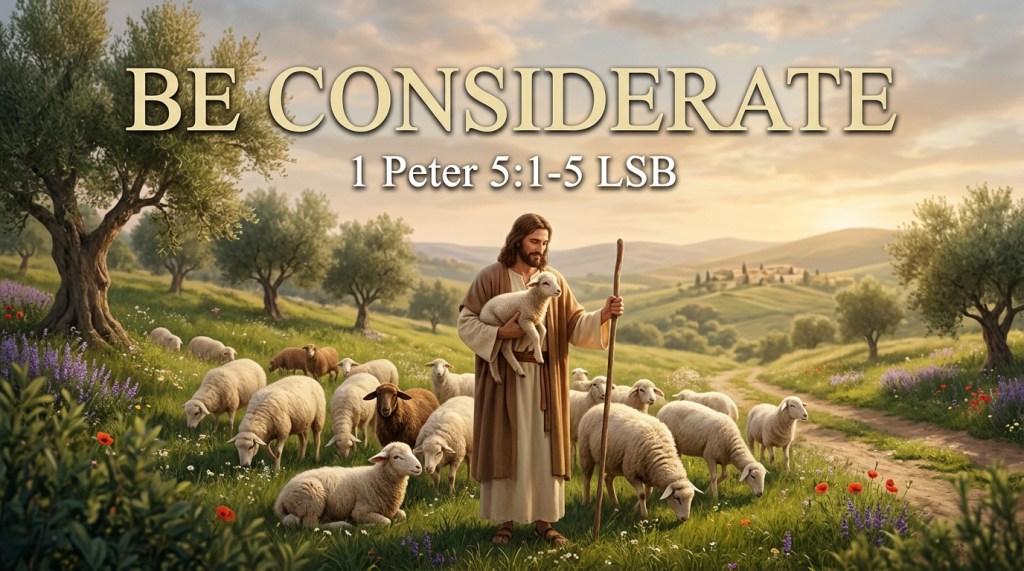

BE CONSIDERATE
1 Peter 5:1-5 (LSB)
1Therefore, I exhort the elders among you, as your fellow elder and witness of the sufferings of Christ, and a partaker also of the glory that is to be revealed, 2 shepherd the flock of God among you, overseeing not under compulsion, but willingly, according to God; and not for dishonest gain, but with eagerness; 3 nor yet as lording it over those allotted to you, but being examples to the flock. 4 And when the Chief Shepherd appears, you will receive the unfading crown of glory. 5 You younger men, likewise, be subject to your elders. And all of you, clothe yourselves with humility toward one another, for God is opposed to the proud, but gives grace to the humble.
We are entering the home stretch of Peter’s little letter to the scattered faithful. By this point, we’ve noticed something striking: Peter is not writing a theological treatise. He is writing like a missionary with a pastor’s heart—someone who has walked dusty roads, slept in borrowed homes, and carried the gospel into places where it was not welcome. His words are shaped by experience, not theory. He is speaking to believers who are simply trying to survive in a hostile environment.
There is something else worth noticing about the man writing these words. Peter was not handing out leadership theory from a safe distance. He was the disciple who once announced, “Even though all may fall away because of You, I will never fall away” (Matthew 26:33). He had measured himself against the other eleven and come out ahead in his own mind. That is the exact posture that makes a leader dangerous.
He was also the man who failed. He denied the Lord three times beside a charcoal fire. Then, after the resurrection, beside another charcoal fire, Jesus did not crush him. He commissioned him: “Tend My lambs.” “Shepherd My sheep.” “Tend My sheep” (John 21:15-17). Peter was handed a shepherd’s work by the Shepherd he had abandoned, and he never got over it.
And while our environment is different, the challenges are not as far removed as we might think. We may not fear arrest every time we mention the name of Jesus in public. But we do face pressures, misunderstandings, and relational tensions that test our faith. One of the most persistent challenges—then and now—is how believers relate to one another, especially in the realm of leadership.
Remember who these people were. Peter addresses them as “those who reside as exiles, scattered throughout Pontus, Galatia, Cappadocia, Asia, and Bithynia” (1 Peter 1:1). They had no buildings, no public standing, and no legal protection. They met in homes, and they came at real cost. The word we translate as “elder” means an older man. It was a family word long before it was an office. These elders were not administrators. They were the oldest believers in the room, the ones who had walked with God the longest.
Today’s message is about how to get along with those who lead us, and how leaders are to treat those entrusted to their care. That is a very relevant topic. Every one of us lives somewhere on the continuum of leader and follower. None of us escapes that dynamic. And all of us bring a philosophy to the table.
Some people are inclined to follow anyone with a title or office—sometimes too easily. Others are suspicious of every leader—no matter their character or calling. Peter’s concern is not where we fall on that spectrum. His concern is this: What is God’s way of dealing with leadership in the church?
Peter’s answer is surprisingly simple: we should all practice consideration toward one another—whether we lead or follow. And in this passage, he shows us what that looks like.
Consideration, then, is the practical shape of humility. It is thinking about the other person’s burden before you think about your own advantage, and it is the thread running through every verse of this passage.
1. Leaders Should Practice Consideration by Recognizing Those They Follow (v. 1)
Peter begins with a gentle reminder:
“Therefore, I exhort the elders among you, as your fellow elder…”
“Elder” is presbyteros in Greek, and it carries the ring of grey hair. Paul and Barnabas “appointed elders for them in every church” (Acts 14:23), and Paul told Titus to “appoint elders in every city” (Titus 1:5). Set those beside verse 2 and Acts 20:28, and something emerges. The same men are called elders, overseers, and shepherds in a single breath. One group, three words, no rivalry between them. And “witness” is martys, from which we eventually got the word martyr. Peter’s authority rests on what he saw and on what he is willing to endure, not on a title.
Peter could have pulled rank. He could have said, “I am an apostle. Listen to me.” Instead, he stands shoulder to shoulder with the elders. He calls himself a fellow elder, a witness of Christ’s sufferings, and a partaker of the glory to be revealed. In other words, he models the very humility he is about to command.
Leaders must never forget that they themselves are followers. They follow Christ. They follow the apostolic teaching. They follow the example of those who have gone before them. A leader who forgets he is a follower becomes dangerous. A leader who remembers he is a follower stays safe.
Peter had learned this the hard way. Jesus told him, “Simon, Simon, behold, Satan has demanded to sift all of you like wheat. But I have prayed earnestly for you, that your faith may not fail; and you, once you have returned, strengthen your brothers” (Luke 22:31-32). Look at the order. Satan sifts. Christ prays. Peter falls. Peter returns. Then Peter strengthens. Every faithful leader is downstream of somebody else’s intercession.
So leaders who remember who they follow tend to be gentler. They know the pull toward boasting, and they know the night in the courtyard. A pastor who lies awake over his flock is still a sheep. A teacher who can never be questioned is a danger to the church.
Peter’s first word to leaders is not “lead well,” but “remember who you follow.” That posture of humility is the foundation of all healthy leadership.
Paul framed the same posture: “Be imitators of me, just as I also am of Christ” (1 Corinthians 11:1). The first half sounds almost arrogant until you read the second half. He is not asking anyone to imitate him absolutely. He is asking them to imitate the part of him that is imitating Christ.
2. Leaders Should Practice Consideration by Eagerly Shepherding (v. 2)
Peter continues:
“Shepherd the flock of God among you, overseeing…”
Here Peter uses the three most common New Testament terms for church leaders: elder, overseer, and shepherd (or pastor). These are not three offices—they are three angles on the same calling.
- Elder speaks to maturity.
- Overseer speaks to responsibility.
- Shepherd speaks to care.
In fact, all three terms imply the act of caring for those they lead. Penny and I were discussing what the term overseer means in Greek. She pointed to a Greek lexicon which stated that the word meant someone who cares for others.
And notice the flock does not belong to the elders. It is “the flock of God.” Leaders are not owners—they are stewards. Their task is not to manage an organization but to shepherd the flock.
“The flock of God” is not a soft phrase. This flock was bought. Paul told the Ephesian elders that the Holy Spirit had made them overseers “to shepherd the church of God which He purchased with His own blood” (Acts 20:28). You do not own what cost God His own blood. And a steward has one requirement: “it is required of stewards that one be found faithful” (1 Corinthians 4:2). Not creative. Not popular. Faithful.
The word for “overseeing” is episkopeō, and its root idea is attention. To oversee is to look upon, to watch over, to take note. An overseer is someone who notices. He notices the family that has quietly stopped coming, the teenager who has gone silent, the marriage that is tearing without making any noise. Oversight in the New Testament is not bureaucracy. It is a pair of watchful eyes.
“Not under compulsion” rests on a word for necessity. A leader under necessity serves because there is no way out. He does the work, but he resents it, and the flock can taste the resentment. “Not for dishonest gain” is blunter still, built from a word for shameful and a word for profit. Money has always been a pressure point, which is why Paul listed the same fault for overseers in 1 Timothy 3:8 and Titus 1:7. Ours are subtler: pastoring for the size of the offering, needing the flock to finance your significance. “But with eagerness” is the alternative, a readiness of spirit that wants to be with the sheep and not merely in charge of them.
Isaiah had already painted the picture: “Like a shepherd He will shepherd His flock; In His arm He will gather the lambs” (Isaiah 40:11). Peter’s readers did not need that explained. Judah was a shepherd. David was a shepherd. Their own Psalms called the LORD a shepherd, and they had sung it in the dark.
Peter’s command is also built on a memory every believing Jew carried. God spoke against the shepherds of Israel in Ezekiel 34, and the accusation was specific. “Woe, shepherds of Israel who have been shepherding themselves! Should not the shepherds shepherd the flock?” (Ezekiel 34:2). Then the indictment: “Those who are sickly you have not strengthened, and the diseased you have not healed… but with strength and with severity you have dominated them” (Ezekiel 34:4).
Now set Peter’s three negatives beside that chapter. Not under compulsion. Not for dishonest gain. Not lording it over. He is writing an anti-Ezekiel-34 job description. The flock of God has been placed in your hands, so do not do what the failed shepherds did.
And consider how much of a shepherd’s work is invisible. He counts. He walks a boundary at dawn. He carries a lamb that cannot finish the road. He wraps a leg at midnight and is the only living witness to the injury. Almost none of that will appear in a report. It appears in the flock.
Peter tells them to do this “not under compulsion, but willingly… not for dishonest gain, but with eagerness.” In other words, leadership is not a burden to endure or a platform to exploit. It is a privilege to embrace with joy.
A shepherd who is eager to serve will always be a blessing to the flock.
3. Leaders Should Practice Consideration by Being Examples, Not Tyrants (v. 3)
Peter adds:
“Nor yet as lording it over those allotted to you, but being examples to the flock.”
This is the heart of Christian leadership. The world leads by power, pressure, and position. Jesus leads by example, sacrifice, and service. Peter remembers the day Jesus said, “The rulers of the Gentiles lord it over them… but it shall not be so among you.”
The verb behind “lording it over” is katakyrieuō, and it means to dominate the way a master dominates a slave. It appears only a handful of times in the New Testament, and one of those appearances is startling. In Acts 19:16, the same verb describes the man with the evil spirit who “leaped on them, subdued all of them, and utterly prevailed against them.” That is what lording over looks like when you get close enough to see it. It is violent at heart, even when it is wearing a smile and a title.
Jesus drew the contrast in a room full of ambition. James and John had their mother ask for the two best seats in the kingdom, and the other ten were indignant, not because they disagreed but because she asked first. So Jesus said, “You know that the rulers of the Gentiles lord it over them, and their great men exercise authority over them. It is not this way among you” (Matthew 20:25-26). Mark adds the word that stings: “those who are recognized as rulers of the Gentiles lord it over them” (Mark 10:42). Titles are not the problem. Needing to be recognized is.
Luke keeps the vocabulary of the surrounding culture: “The kings of the Gentiles lord it over them, and those who have authority over them are called ‘Benefactors’” (Luke 22:25). The Roman world knew how to dress power up as generosity. Patrons gave, clients owed, and honor always flowed upward. Jesus said, “But not so with you.”
Leaders who dominate crush the very people they are called to protect. Leaders who model Christ give the flock a living picture of what faithfulness looks like.
Scripture also names the thing Peter forbids. John wrote, “I wrote something to the church, but Diotrephes, who loves to be first among them, does not welcome what we say” (3 John 9). Then came the fallout: wicked words, closed doors, and brothers pushed out, because he “forbids those who want to do so and puts them out of the church” (3 John 10): one man, one appetite, one wounded congregation.
But Peter is not naive about the flock either. If Ezekiel 34 warns against bad shepherds, Numbers 16 warns against the other failure. Korah gathered two hundred and fifty leaders and said to Moses, “You have gone far enough, for all the congregation is holy, every one of them… so why do you exalt yourselves above the assembly of Yahweh?” (Numbers 16:3). It sounds like humility. It was a grab for the same throne. Peter’s sentence guards both ends of the church at once.
“Proving to be examples” translates typos, a word for a pattern or a stamped impression. It is used of Adam as a type of Christ (Romans 5:14), of the pattern Moses was shown for the tabernacle (Acts 7:44), and of the model Paul left behind (2 Thessalonians 3:9). Peter had already used a related picture for the whole church when he said Christ suffered for us, “leaving you an example that you should follow in His steps” (1 Peter 2:21). That word is hypogrammos, the sample letters a teacher writes across the top of a page so a child can trace them. Leaders are making copies of themselves whether they intend to or not.
Peter was in the room when Jesus said it plainly. “If I then, the Lord and the Teacher, washed your feet, you also ought to wash one another’s feet. For I gave you an example that you also should do as I did to you” (John 13:14-15). The feet in that room were filthy, every last pair of them. The one who owned those feet knelt anyway.
A tyrant demands obedience.
An example inspires it.
A tyrant uses people.
An example serves them.
A tyrant points to himself.
An example points to Christ.
A tyrant needs to be needed.
An example is glad to be replaced.
Peter says, “Be the kind of leader whose life makes obedience a joy.”
4. Leaders Should Practice Consideration by Recognizing the Reward (v. 4)
Peter lifts their eyes to the future:
“And when the Chief Shepherd appears, you will receive the unfading crown of glory.”
The title Peter uses is beautiful and unique. He calls Jesus the archipoimēn, the Chief Shepherd, and that compound appears nowhere else in the New Testament. Elders doing small work in houses nobody would photograph are standing under one Shepherd who outranks every one of them. Jesus called Himself the good shepherd who “lays down His life for the sheep” (John 10:11). Hebrews calls Him “the great Shepherd of the sheep” (Hebrews 13:20). Good, great, chief. The hierarchy has exactly one member. It is not me, and it is not you.
Every shepherd in the church serves under the Chief Shepherd—Jesus Christ. He is the true pastor of every congregation. And one day He will appear. On that day, every faithful leader will receive a crown—not of leaves that wither, but of glory that never fades.
“Unfading” is amarantinos, another word found only here, from the family of amaranth, the flower that does not wither. Peter had already used a cousin of it in his first chapter, describing believers as those who are “to obtain an inheritance incorruptible and undefiled and unfading” (1 Peter 1:4). Do you see what that means? The leader’s crown is made of the same material as the inheritance of the youngest believer in the room. The reward for faithfulness is not a promotion. It is a share.
“Crown” is stephanos, the victor’s wreath from the games, not the diadēma of a king. Paul used that image: “They then do it to receive a corruptible crown, but we an incorruptible” (1 Corinthians 9:25). Near the end of his life, he wrote of “the crown of righteousness, which the Lord, the righteous Judge, will award to me on that day, and not only to me, but also to all who have loved His appearing” (2 Timothy 4:8).
This is not a crown of status. It is a crown of gratitude from the One who sees every unseen act of service, every tear shed in prayer, every burden carried quietly for the sake of the flock.
Scripture is precise about what that crown is made of. God “alone has immortality and dwells in unapproachable light” (1 Timothy 6:16), and our Savior “abolished death and brought life and immortality to light through the gospel” (2 Timothy 1:10). Immortality is not something we bring to the table for God to decorate. It is what He gives. The crown that does not fade is His own life, shared with people who kept showing up.
Which raises a practical question. Whose approval are you actually working for? That question is not abstract, because it shows up in what discourages you. If one critical comment can ruin a Sunday of faithful service, your reward is one comment. If a decade of unnoticed labor can wait for a Shepherd who is coming, your reward is larger than any comment could ever be.
Leaders who remember the reward can endure the hardships of ministry with hope.
5. Followers Should Practice Consideration by Practicing Humility (v. 5)
Peter now turns to the rest of the church:
“You younger men, likewise, be subject to your elders; and all of you, clothe yourselves with humility toward one another…”
That statement does not only apply to males. In Koinē Greek, if you were speaking to a mixed crowd, you would use the masculine gender. It should be translated as “younger people.” It includes everyone who is not a leader.
The word “likewise” is doing quiet work. It ties the rest of the church to everything Peter has just said to the elders. The same humility that makes a leader safe is the humility that makes a congregation healthy. He is not dividing the church into one class that gives orders and another that takes them.
“Be subject” is hypotassō, to arrange oneself under. Peter uses it all through this letter, of citizens and servants and wives and husbands, and here of the younger toward the elders. It describes order, not worth. A soldier under a captain is not a lesser human being. He is a person in the right position, which is exactly what makes an army function.
And Peter does not say the younger should be subject because elders are always right. He says it because God has arranged a flock, and a flock without order scatters. Peter has just told the elders not to lord it over anyone, and now he tells the young not to despise anyone. Between those two commands, a congregation can actually live.
The call to humility is not just for leaders. It is for everyone. Peter uses a vivid word—clothe yourselves. It refers to tying on a servant’s apron. It is the same posture Jesus took when He washed His disciples’ feet.
The word is enkomboomai, and it occurs only here in the New Testament. It is built from a word for a knot, which means the picture is not a mood but a garment tied on before work begins. Peter is not telling us to feel humble. He is telling us to get dressed.
One scene fills the picture. “Jesus, knowing that the Father had given all things into His hands, and that He had come forth from God and was going back to God, got up from supper, and laid aside His garments; and taking a towel, He tied it around Himself” (John 13:3-5). He knew where He had come from; He knew where He was going, and then He picked up a towel. Security produces service. Insecurity produces strutting.
Paul pointed to the same pattern: “Do nothing from selfish ambition or vain glory, but with humility of mind regarding one another as more important than yourselves” (Philippians 2:3). Then, “Have this way of thinking in yourselves which was also in Christ Jesus, who… emptied Himself, by taking the form of a slave” (Philippians 2:5-7). Humility is not thinking less of yourself. It is thinking about yourself less, and thinking about Christ most.
Humility is the garment that makes Christian community beautiful. Without it, leadership becomes oppressive, and followership becomes rebellious. With it, leadership becomes joyful, and followership becomes peaceful and grateful.
Peter ends with a warning and a promise:
“God is opposed to the proud, but gives grace to the humble.”
Notice where Peter got that sentence. He is quoting Proverbs 3:34, which reads, “Though He scoffs at the scoffers, yet He gives grace to the humble.” James quotes the identical verse, and then adds, “Be subject therefore to God. Resist the devil, and he will flee from you” (James 4:7).
The Proverbs keep saying the same thing in different words. “When arrogance comes, then comes disgrace, but with the meek is wisdom” (Proverbs 11:2). “Before destruction the heart of man is haughty, but humility goes before glory” (Proverbs 18:12). “A man’s lofty pride will bring him low, but a lowly spirit will take hold of glory” (Proverbs 29:23). Three times, one pattern. Down first, then up. God has never once reversed it.
The word behind “opposed” is worth knowing. It is a military term, and it means to set an army in battle array against someone. Not disappointment with pride, but arrayed, organized, deliberate opposition. And the same root returns a few verses later, when Peter tells us to resist the devil. James uses exactly those same two words, side by side in the same paragraph. So the proud man arrays himself against God and then wonders why he has no strength to resist the enemy. He is standing on the wrong side of the battle line.
Pride invites God’s resistance.
Humility invites God’s help.
In a hostile world, we cannot afford to lose God’s help.
Conclusion
Peter’s message is simple but profound: In the church, leadership is not about power—it is about consideration. Leaders consider those they lead. Followers consider those who lead them. And all of us consider one another with humility.
The chain is easy to trace once you see it. The Chief Shepherd appears, the under-shepherds receive an unfading crown, the flock is fed and protected, the young submit, the older serve, and everyone is wearing the same garment. Remove humility, and you get tyrants or rebels. Remove the appearing, and you get leaders who burn out serving an audience that can never satisfy them.
Peter says one more thing just past our text, and it belongs here: “Therefore humble yourselves under the mighty hand of God, that He may exalt you at the proper time” (1 Peter 5:6). The proper time is the time he has already named. The Chief Shepherd appears, and the exalting begins.
This is God’s way of preserving unity, protecting the flock, and displaying Christ to a watching world.
May God make us a people who lead with humility, follow with grace, and live together in the beauty of Christlike consideration.